Julien Dubois
Developing modular Java   France Regional Director
      applications        SpringSource
Julien Dubois
• France Regional Director, SpringSource

• Book author :« Spring par la pratique » (Eyrolles, 2006) – new
  edition coming soon!

• 10 years of experience in Java development

• Member of OSSGTP
Why do we want modular
applications in the first place?
• Dividing a complex problem into simpler, more manageable
  problems is a well-known technique since 400 years
  (Descartes)

  • Improved quality

  • Lower complexity

• Modules are easy to reuse across an application or even
  several applications

  • Improved time-to-market

  • Lower costs

• Only true for “enterprise-grade” applications
Agenda


• Modules, layers and errors


• Doing a layered Spring application the easy way


• Modular Java with Spring and OSGi


• Modularity in the cloud
Agenda


• Modules, layers and errors


• Doing a layered Spring application the easy way


• Modular Java with Spring and OSGi


• Modularity in the cloud
Modularity & layers
• Typical Java applications are separated in layers

Presentation               Service                Repository
   Layer                    Layer                   Layer

     Object                  Object                   Object


     Object                  Object                   Object


     Object                  Object                   Object
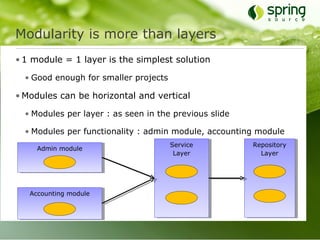
Modularity is more than layers
• 1 module = 1 layer is the simplest solution

  • Good enough for smaller projects

• Modules can be horizontal and vertical

  • Modules per layer : as seen in the previous slide

  • Modules per functionality : admin module, accounting module
                                       Service          Repository
     Admin module
                                        Layer             Layer


   Accounting module
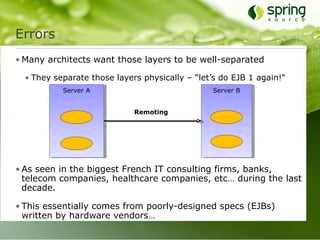
Errors
• Many architects want those layers to be well-separated

  • They separate those layers physically – “let’s do EJB 1 again!”
           Server A                             Server B


                             Remoting


• As seen in the biggest French IT consulting firms, banks,
  telecom companies, healthcare companies, etc… during the last
  decade.

• This essentially comes from poorly-designed specs (EJBs)
  written by hardware vendors…
What is the problem?
• Adding more servers will never make your application more
  scalable

• Remoting is slow and inefficient

  • A remoting call is several orders of magnitude slower than a
    local one

  • Remoting also affects your GC time : all those remote objects are
    being garbage collected…

  • Adding more servers will just add more network issues
• You do not need to physically separate your modules to have a
  modular application
Agenda


• Modules, layers and errors


• Doing a layered Spring application the easy way


• Modular Java with Spring and OSGi


• Modularity in the cloud
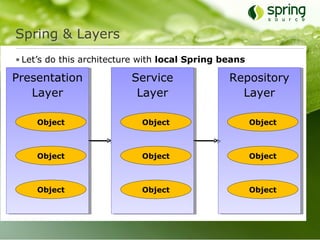
Spring & Layers
• Let’s do this architecture with local Spring beans

Presentation              Service               Repository
   Layer                   Layer                  Layer

    Object                  Object                     Object


    Object                  Object                     Object


    Object                  Object                     Object
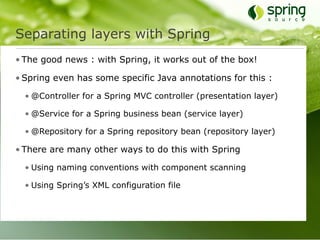
Separating layers with Spring
• The good news : with Spring, it works out of the box!

• Spring even has some specific Java annotations for this :

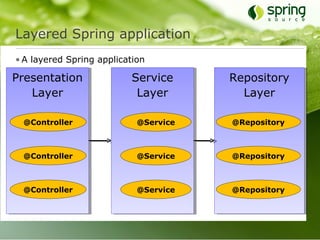
  • @Controller for a Spring MVC controller (presentation layer)

  • @Service for a Spring business bean (service layer)

  • @Repository for a Spring repository bean (repository layer)

• There are many other ways to do this with Spring

  • Using naming conventions with component scanning

  • Using Spring’s XML configuration file
Layered Spring application
• A layered Spring application

Presentation              Service      Repository
   Layer                   Layer         Layer

 @Controller                @Service   @Repository


 @Controller                @Service   @Repository


 @Controller                @Service   @Repository
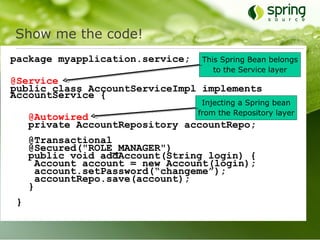
Show me the code!
package myapplication.service;     This Spring Bean belongs
                                      to the Service layer
@Service
public class AccountServiceImpl implements
AccountService {
                                   Injecting a Spring bean
                                  from the Repository layer
     @Autowired
     private AccountRepository accountRepo;
     @Transactional
     @Secured("ROLE_MANAGER")
     public void addAccount(String login) {
       Account account = new Account(login);
       account.setPassword(“changeme”);
       accountRepo.save(account);
     }
 }
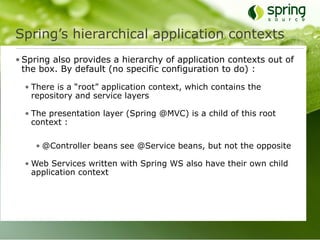
Spring’s hierarchical application contexts
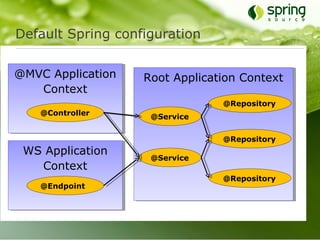
• Spring also provides a hierarchy of application contexts out of
  the box. By default (no specific configuration to do) :

  • There is a “root” application context, which contains the
    repository and service layers

  • The presentation layer (Spring @MVC) is a child of this root
    context :

    • @Controller beans see @Service beans, but not the opposite

  • Web Services written with Spring WS also have their own child
    application context
Default Spring configuration

@MVC Application   Root Application Context
   Context
                                @Repository
    @Controller     @Service


                                @Repository
 WS Application
                    @Service
   Context
                                @Repository
    @Endpoint
Separating layers with Spring
• The code we have seen is :

  • Easy to code and test

  • Very performant in production

  • Still well-separated in layers

• This is Spring default’s configuration

  • Works out of the box

  • This can be customized in many, many different ways

• You do not need to physically separate your layers to
  have a layered application
Agenda


• Modules, layers and errors


• Doing a layered Spring application the easy way


• Modular Java with Spring and OSGi


• Modularity in the cloud
The problem with the previous slides
• However, what we have just done is a monolithic application

  • Everything is put into a single deployment unit (a WAR file)

  • Memory is shared between all modules : not secured

• What you want as a developer is :

  • Updating your application at runtime, and not redeploy your WAR
    file all the time

• What your users want is :

  • New functionalities hot deployed at runtime

  • High availability

• But how can we change modules at runtime??
Introducing OSGi
• OSGi is a specification

  • Used since many years in the telecom industry

  • With several implementations in Java : for instance Equinox,
    which is the basis of the Eclipse IDE
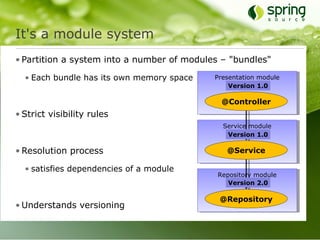
It's a module system
• Partition a system into a number of modules – "bundles"

  • Each bundle has its own memory space    Presentation module
                                                Version 1.0

                                              @Controller
• Strict visibility rules
                                              Service module
                                               Version 1.0

• Resolution process                           @Service

  • satisfies dependencies of a module
                                             Repository module
                                                Version 2.0

                                             @Repository
• Understands versioning
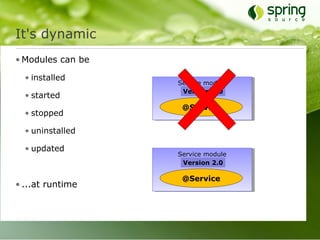
It's dynamic
• Modules can be

  • installed
                   Service module
                    Version 1.0
  • started
                    @Service
  • stopped

  • uninstalled

  • updated
                   Service module
                    Version 2.0

                    @Service
• ...at runtime
It's even service-oriented
• Bundles can publish services

  • dynamically


• Service Registry allows other bundles to find services

  • and to bind to them


• Services come and go at runtime, all taken care of for you
Introducing Spring Dynamic Modules
• Doing OSGi directly is complex

  • It also makes your code dependant on the OSGi APIs

• Spring Dynamic Modules is a Spring project, backed by
  SpringSource

  • No OSGi in your code

  • Your Spring beans are just configured to be OSGi services

  • It’s easy to move a project to/from OSGi

    • Moving from Spring to Spring+OSGi is easy

    • Going back from Spring+OSGi to Spring is also easy
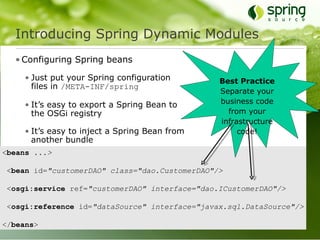
Introducing Spring Dynamic Modules
  • Configuring Spring beans

     • Just put your Spring configuration       Best Practice
       files in /META-INF/spring
                                                Separate your
     • It’s easy to export a Spring Bean to     business code
       the OSGi registry                          from your
                                                infrastructure
     • It’s easy to inject a Spring Bean from        code!
       another bundle
<beans ...>

 <bean id="customerDAO" class="dao.CustomerDAO"/>

 <osgi:service ref="customerDAO" interface="dao.ICustomerDAO"/>

 <osgi:reference id="dataSource" interface="javax.sql.DataSource"/>

</beans>
Who supports OSGi?
• Most application server vendors base their systems on OSGi


• Validates the usage of OSGi as a solution for modular
  applications

• But none offers OSGi as a programming model for the customer

• Why shouldn't the customer be as empowered as the
  application server vendor?
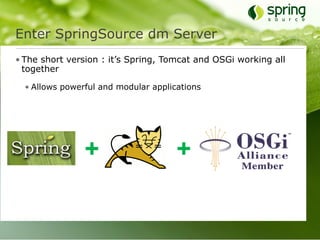
Enter SpringSource dm Server
• The short version : it’s Spring, Tomcat and OSGi working all
  together

  • Allows powerful and modular applications


                +                     +
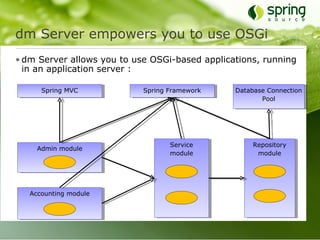
dm Server empowers you to use OSGi
• dm Server allows you to use OSGi-based applications, running
  in an application server :

      Spring MVC            Spring Framework    Database Connection
                                                       Pool


                                   Service           Repository
     Admin module
                                   module             module


   Accounting module
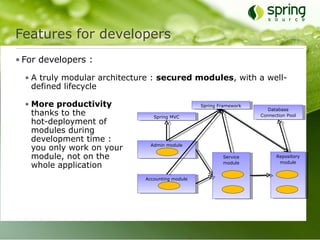
Features for developers
• For developers :

  • A truly modular architecture : secured modules, with a well-
    defined lifecycle

  • More productivity                             Spring Framework
                                                                        Database
    thanks to the                Spring MVC                          Connection Pool
    hot-deployment of
    modules during
    development time :
    you only work on your       Admin module

    module, not on the                                    Service          Repository
                                                                            module
    whole application                                     module


                              Accounting module
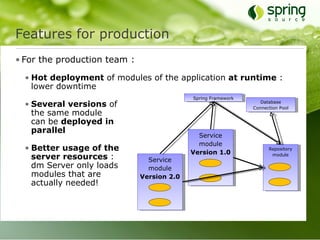
Features for production
• For the production team :

  • Hot deployment of modules of the application at runtime :
    lower downtime
                                            Spring Framework
  • Several versions of                                           Database
                                                               Connection Pool
    the same module
    can be deployed in
    parallel
                                              Service
                                              module
  • Better usage of the                     Version 1.0
                                                                     Repository

    server resources :          Service
                                                                      module

    dm Server only loads        module
    modules that are          Version 2.0
    actually needed!
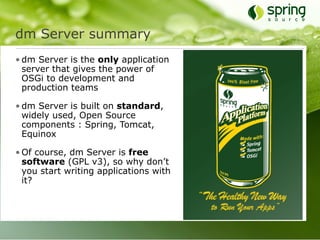
dm Server summary
• dm Server is the only application
  server that gives the power of
  OSGi to development and
  production teams

• dm Server is built on standard,
  widely used, Open Source
  components : Spring, Tomcat,
  Equinox

• Of course, dm Server is free
  software (GPL v3), so why don’t
  you start writing applications with
  it?
Agenda


• Modules, layers and errors


• Doing a layered Spring application the easy way


• Modular Java with Spring and OSGi


• Modularity in the cloud
Clustering
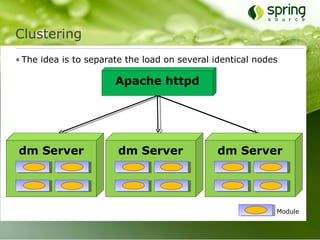
• The idea is to separate the load on several identical nodes

                       Apache httpd


dm Server              dm Server               dm Server


                                                            Module
Cloud computing & virtualization


• Experience shows that
  clusters are often widely
  under-utilized… Because
  you don’t need all the nodes
  all the time.


• Cloud computing allows renting computing power on demand

  • You can rent servers per hour with : Amazon EC2, Google
    AppEngine, Gandi Flex (in France)…

• Companies datacenters are moving to virtualization for this
  same reason
dm Server in the cloud
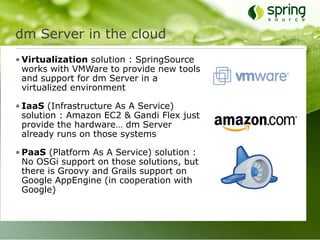
• Virtualization solution : SpringSource
  works with VMWare to provide new tools
  and support for dm Server in a
  virtualized environment

• IaaS (Infrastructure As A Service)
  solution : Amazon EC2 & Gandi Flex just
  provide the hardware… dm Server
  already runs on those systems

• PaaS (Platform As A Service) solution :
  No OSGi support on those solutions, but
  there is Groovy and Grails support on
  Google AppEngine (in cooperation with
  Google)
Cost reduction is king
• This can be far less expensive
  than a traditional cluster as long
  as :

  • You can monitor your load
    properly

  • You can estimate your needs in
    advance (launching a new EC2
    instance can take a few minutes)


• But with the current global economic climate, there is a very
  strong move towards those solutions
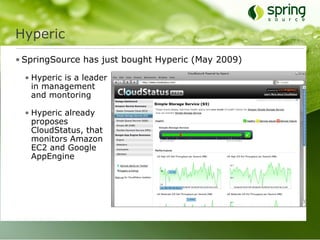
Hyperic
• SpringSource has just bought Hyperic (May 2009)

  • Hyperic is a leader
    in management
    and montoring

  • Hyperic already
    proposes
    CloudStatus, that
    monitors Amazon
    EC2 and Google
    AppEngine
Dynamic provisionning
• Currently our monitoring & management tools are able to :

  • Manage a group of servers : for example, deploying an
    application on 100 dm Server nodes with one click

  • Monitor a large group of nodes, including on the cloud or in a
    virtualized environment


• In the future, those tools will evolve to be able
  to do “provisionning”: dynamically adjust the
  number of running nodes depending on the load
Summary
• Complex applications should be split into modules : reduced
  cost, improved time-to-market

• If you want to split your application into modules at build
  time, Spring provides an excellent solution out of the box:
  there’s no need to go for more complex (and inferior) solutions
  Use tc Server (= enterprise version of Tomcat) and Spring

• If you want secured, well-defined modules that can be
  dynamically updated at runtime, Spring and OSGi offer a
  perfect solution

  Use dm Server (Tomcat + OSGi) and Spring

• Be ready for the future : cloud computing offers un-beatable
  scalability and costs. Both tc Server and dm Server are ready!
Questions?


Julien Dubois
julien.dubois@springsource.com

http://www.springsource.com/fr

Developing modular Java applications

  • 1.
    Julien Dubois Developing modularJava France Regional Director applications SpringSource
  • 2.
    Julien Dubois • FranceRegional Director, SpringSource • Book author :« Spring par la pratique » (Eyrolles, 2006) – new edition coming soon! • 10 years of experience in Java development • Member of OSSGTP
  • 3.
    Why do wewant modular applications in the first place? • Dividing a complex problem into simpler, more manageable problems is a well-known technique since 400 years (Descartes) • Improved quality • Lower complexity • Modules are easy to reuse across an application or even several applications • Improved time-to-market • Lower costs • Only true for “enterprise-grade” applications
  • 4.
    Agenda • Modules, layersand errors • Doing a layered Spring application the easy way • Modular Java with Spring and OSGi • Modularity in the cloud
  • 5.
    Agenda • Modules, layersand errors • Doing a layered Spring application the easy way • Modular Java with Spring and OSGi • Modularity in the cloud
  • 6.
    Modularity & layers •Typical Java applications are separated in layers Presentation Service Repository Layer Layer Layer Object Object Object Object Object Object Object Object Object
  • 7.
    Modularity is morethan layers • 1 module = 1 layer is the simplest solution • Good enough for smaller projects • Modules can be horizontal and vertical • Modules per layer : as seen in the previous slide • Modules per functionality : admin module, accounting module Service Repository Admin module Layer Layer Accounting module
  • 8.
    Errors • Many architectswant those layers to be well-separated • They separate those layers physically – “let’s do EJB 1 again!” Server A Server B Remoting • As seen in the biggest French IT consulting firms, banks, telecom companies, healthcare companies, etc… during the last decade. • This essentially comes from poorly-designed specs (EJBs) written by hardware vendors…
  • 9.
    What is theproblem? • Adding more servers will never make your application more scalable • Remoting is slow and inefficient • A remoting call is several orders of magnitude slower than a local one • Remoting also affects your GC time : all those remote objects are being garbage collected… • Adding more servers will just add more network issues • You do not need to physically separate your modules to have a modular application
  • 10.
    Agenda • Modules, layersand errors • Doing a layered Spring application the easy way • Modular Java with Spring and OSGi • Modularity in the cloud
  • 11.
    Spring & Layers •Let’s do this architecture with local Spring beans Presentation Service Repository Layer Layer Layer Object Object Object Object Object Object Object Object Object
  • 12.
    Separating layers withSpring • The good news : with Spring, it works out of the box! • Spring even has some specific Java annotations for this : • @Controller for a Spring MVC controller (presentation layer) • @Service for a Spring business bean (service layer) • @Repository for a Spring repository bean (repository layer) • There are many other ways to do this with Spring • Using naming conventions with component scanning • Using Spring’s XML configuration file
  • 13.
    Layered Spring application •A layered Spring application Presentation Service Repository Layer Layer Layer @Controller @Service @Repository @Controller @Service @Repository @Controller @Service @Repository
  • 14.
    Show me thecode! package myapplication.service; This Spring Bean belongs to the Service layer @Service public class AccountServiceImpl implements AccountService { Injecting a Spring bean from the Repository layer @Autowired private AccountRepository accountRepo; @Transactional @Secured("ROLE_MANAGER") public void addAccount(String login) { Account account = new Account(login); account.setPassword(“changeme”); accountRepo.save(account); } }
  • 15.
    Spring’s hierarchical applicationcontexts • Spring also provides a hierarchy of application contexts out of the box. By default (no specific configuration to do) : • There is a “root” application context, which contains the repository and service layers • The presentation layer (Spring @MVC) is a child of this root context : • @Controller beans see @Service beans, but not the opposite • Web Services written with Spring WS also have their own child application context
  • 16.
    Default Spring configuration @MVCApplication Root Application Context Context @Repository @Controller @Service @Repository WS Application @Service Context @Repository @Endpoint
  • 17.
    Separating layers withSpring • The code we have seen is : • Easy to code and test • Very performant in production • Still well-separated in layers • This is Spring default’s configuration • Works out of the box • This can be customized in many, many different ways • You do not need to physically separate your layers to have a layered application
  • 18.
    Agenda • Modules, layersand errors • Doing a layered Spring application the easy way • Modular Java with Spring and OSGi • Modularity in the cloud
  • 19.
    The problem withthe previous slides • However, what we have just done is a monolithic application • Everything is put into a single deployment unit (a WAR file) • Memory is shared between all modules : not secured • What you want as a developer is : • Updating your application at runtime, and not redeploy your WAR file all the time • What your users want is : • New functionalities hot deployed at runtime • High availability • But how can we change modules at runtime??
  • 20.
    Introducing OSGi • OSGiis a specification • Used since many years in the telecom industry • With several implementations in Java : for instance Equinox, which is the basis of the Eclipse IDE
  • 21.
    It's a modulesystem • Partition a system into a number of modules – "bundles" • Each bundle has its own memory space Presentation module Version 1.0 @Controller • Strict visibility rules Service module Version 1.0 • Resolution process @Service • satisfies dependencies of a module Repository module Version 2.0 @Repository • Understands versioning
  • 22.
    It's dynamic • Modulescan be • installed Service module Version 1.0 • started @Service • stopped • uninstalled • updated Service module Version 2.0 @Service • ...at runtime
  • 23.
    It's even service-oriented •Bundles can publish services • dynamically • Service Registry allows other bundles to find services • and to bind to them • Services come and go at runtime, all taken care of for you
  • 24.
    Introducing Spring DynamicModules • Doing OSGi directly is complex • It also makes your code dependant on the OSGi APIs • Spring Dynamic Modules is a Spring project, backed by SpringSource • No OSGi in your code • Your Spring beans are just configured to be OSGi services • It’s easy to move a project to/from OSGi • Moving from Spring to Spring+OSGi is easy • Going back from Spring+OSGi to Spring is also easy
  • 25.
    Introducing Spring DynamicModules • Configuring Spring beans • Just put your Spring configuration Best Practice files in /META-INF/spring Separate your • It’s easy to export a Spring Bean to business code the OSGi registry from your infrastructure • It’s easy to inject a Spring Bean from code! another bundle <beans ...> <bean id="customerDAO" class="dao.CustomerDAO"/> <osgi:service ref="customerDAO" interface="dao.ICustomerDAO"/> <osgi:reference id="dataSource" interface="javax.sql.DataSource"/> </beans>
  • 26.
    Who supports OSGi? •Most application server vendors base their systems on OSGi • Validates the usage of OSGi as a solution for modular applications • But none offers OSGi as a programming model for the customer • Why shouldn't the customer be as empowered as the application server vendor?
  • 27.
    Enter SpringSource dmServer • The short version : it’s Spring, Tomcat and OSGi working all together • Allows powerful and modular applications + +
  • 28.
    dm Server empowersyou to use OSGi • dm Server allows you to use OSGi-based applications, running in an application server : Spring MVC Spring Framework Database Connection Pool Service Repository Admin module module module Accounting module
  • 29.
    Features for developers •For developers : • A truly modular architecture : secured modules, with a well- defined lifecycle • More productivity Spring Framework Database thanks to the Spring MVC Connection Pool hot-deployment of modules during development time : you only work on your Admin module module, not on the Service Repository module whole application module Accounting module
  • 30.
    Features for production •For the production team : • Hot deployment of modules of the application at runtime : lower downtime Spring Framework • Several versions of Database Connection Pool the same module can be deployed in parallel Service module • Better usage of the Version 1.0 Repository server resources : Service module dm Server only loads module modules that are Version 2.0 actually needed!
  • 31.
    dm Server summary •dm Server is the only application server that gives the power of OSGi to development and production teams • dm Server is built on standard, widely used, Open Source components : Spring, Tomcat, Equinox • Of course, dm Server is free software (GPL v3), so why don’t you start writing applications with it?
  • 32.
    Agenda • Modules, layersand errors • Doing a layered Spring application the easy way • Modular Java with Spring and OSGi • Modularity in the cloud
  • 33.
    Clustering • The ideais to separate the load on several identical nodes Apache httpd dm Server dm Server dm Server Module
  • 34.
    Cloud computing &virtualization • Experience shows that clusters are often widely under-utilized… Because you don’t need all the nodes all the time. • Cloud computing allows renting computing power on demand • You can rent servers per hour with : Amazon EC2, Google AppEngine, Gandi Flex (in France)… • Companies datacenters are moving to virtualization for this same reason
  • 35.
    dm Server inthe cloud • Virtualization solution : SpringSource works with VMWare to provide new tools and support for dm Server in a virtualized environment • IaaS (Infrastructure As A Service) solution : Amazon EC2 & Gandi Flex just provide the hardware… dm Server already runs on those systems • PaaS (Platform As A Service) solution : No OSGi support on those solutions, but there is Groovy and Grails support on Google AppEngine (in cooperation with Google)
  • 36.
    Cost reduction isking • This can be far less expensive than a traditional cluster as long as : • You can monitor your load properly • You can estimate your needs in advance (launching a new EC2 instance can take a few minutes) • But with the current global economic climate, there is a very strong move towards those solutions
  • 37.
    Hyperic • SpringSource hasjust bought Hyperic (May 2009) • Hyperic is a leader in management and montoring • Hyperic already proposes CloudStatus, that monitors Amazon EC2 and Google AppEngine
  • 38.
    Dynamic provisionning • Currentlyour monitoring & management tools are able to : • Manage a group of servers : for example, deploying an application on 100 dm Server nodes with one click • Monitor a large group of nodes, including on the cloud or in a virtualized environment • In the future, those tools will evolve to be able to do “provisionning”: dynamically adjust the number of running nodes depending on the load
  • 39.
    Summary • Complex applicationsshould be split into modules : reduced cost, improved time-to-market • If you want to split your application into modules at build time, Spring provides an excellent solution out of the box: there’s no need to go for more complex (and inferior) solutions Use tc Server (= enterprise version of Tomcat) and Spring • If you want secured, well-defined modules that can be dynamically updated at runtime, Spring and OSGi offer a perfect solution Use dm Server (Tomcat + OSGi) and Spring • Be ready for the future : cloud computing offers un-beatable scalability and costs. Both tc Server and dm Server are ready!
  • 40.