 It is a methodology adopted by the Ministry of Human
Resource Development(MHRD), Government of India,
to rank institutions of higher education in India
 The Framework was approved by the MHRD and
launched by Minister of Human Resource Development
on 29 September 2015.
 There are separate rankings for different types of
institutions depending on their areas of operation like
universities and colleges, engineering institutions,
management institutions, pharmacy institutions and
architecture institutions.
 The Framework uses several parameters for ranking
purposes like resources, research, and stakeholder
perception.
 MHRD organized a one-day
workshop on 21 August 2014
on evolving methodologies
for the ranking of institutions
of higher education in India.
 Core Committee consisting
of 16 members was
constituted
 Secretary (HE, MHRD, as
Chairperson and Additional
Secretary (TE), MHRD, as
Member-Secretary.
PARAMETERS FOR RANKING
 LEARNING RESOURCES
 RESEARCH AND PRACTICES
 GRADUATION OUTOMES
 PERCEPTION
AIM OF NIRF
Ranking Universities and colleges
to have wider appeal across
Universities and colleges
India ranking released on 14th April
2016
The Central Government (CG) plans to
dissolve the All India Council for
Technical Education (AICTE) and the
University Grants Commission (UGC)
and replace them with a single body,
tentatively titled Higher Education
Empowerment Regulation Agency
(HEERA).
HEERA is
expected to
have sharper
teeth than the
extant AICTE
and UGC.
ROLE AND FUNCTION
 To eliminate the overlaps in the
jurisdiction and remove irrelevant
regulatory provisions.
 It will bring the regulation of both
technical and non-technical higher
education institutions.
ADVANTAGES
 Eliminate all overlaps in jurisdiction and also do away
with regulatory provisions that may no longer be
relevant.
 HEERA is also expected to have sharper teeth than the
extant AICTE and UGC
 Having a single statutory body for higher education
will simplify and consolidate the mass of regulations
and compliances that currently operate in the sector.
HIGHER
EDUCATION
COUNCIL OF
INDIA
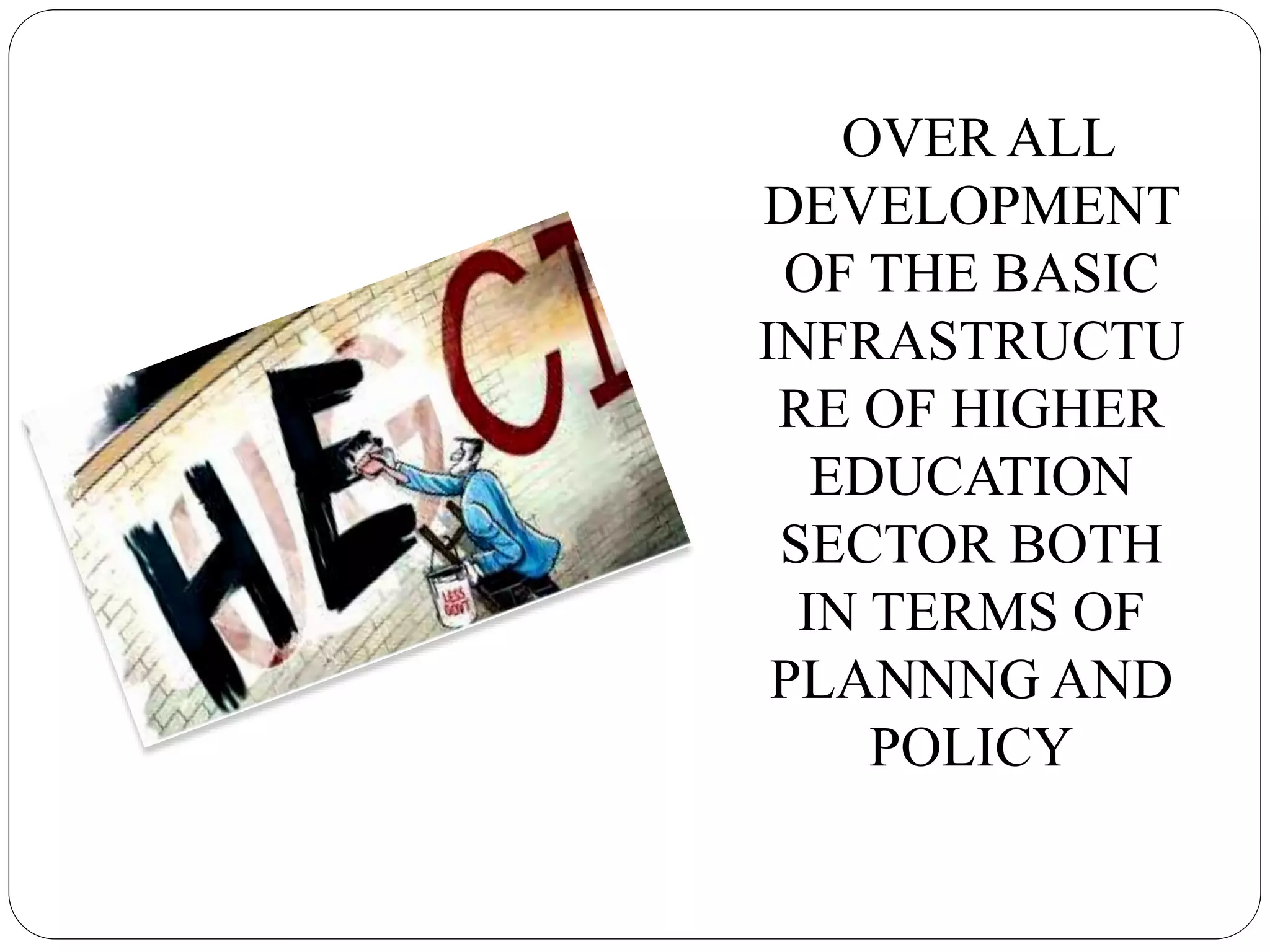
OVER ALL
DEVELOPMENT
OF THE BASIC
INFRASTRUCTU
RE OF HIGHER
EDUCATION
SECTOR BOTH
IN TERMS OF
PLANNNG AND
POLICY
VISION
To realize India's human resource
potential to its fullest in the Higher
Education sector, with equity and
inclusion.
MISION
 Provide greater opportunities of access to Higher Education
with equity to all the eligible persons and in particular to
the vulnerable sections.
 Initiate policies and programs for strengthening research
and innovations and encourage institutions
 Promote the quality of Higher Education by investing in
infrastructure and faculty, promoting academic reforms,
improving governance and institutional restructuring
toward the inclusion of the hitherto deprived communities.
OBJECTIVES
 To expand the Higher Education sector
 To provide opportunities of Higher Education to
socially-deprived communities and remove disparities
by promoting the inclusion of women, minorities and
differently-abled persons
 To remove regional imbalances in access to Higher
Education by setting up of institutions in unnerved and
underserved areas.
 To create conditions for knowledge generation through
improved research facilities in universities and
colleges.
 To promote development of Indian languages
 To undertake institutional restructuring for improving
efficiency, relevance and creativity in Higher
Education.
National Institutional Ranking Frame Work

National Institutional Ranking Frame Work

  • 3.
     It isa methodology adopted by the Ministry of Human Resource Development(MHRD), Government of India, to rank institutions of higher education in India  The Framework was approved by the MHRD and launched by Minister of Human Resource Development on 29 September 2015.
  • 4.
     There areseparate rankings for different types of institutions depending on their areas of operation like universities and colleges, engineering institutions, management institutions, pharmacy institutions and architecture institutions.  The Framework uses several parameters for ranking purposes like resources, research, and stakeholder perception.
  • 5.
     MHRD organizeda one-day workshop on 21 August 2014 on evolving methodologies for the ranking of institutions of higher education in India.  Core Committee consisting of 16 members was constituted  Secretary (HE, MHRD, as Chairperson and Additional Secretary (TE), MHRD, as Member-Secretary.
  • 6.
    PARAMETERS FOR RANKING LEARNING RESOURCES  RESEARCH AND PRACTICES  GRADUATION OUTOMES  PERCEPTION
  • 7.
    AIM OF NIRF RankingUniversities and colleges to have wider appeal across Universities and colleges India ranking released on 14th April 2016
  • 9.
    The Central Government(CG) plans to dissolve the All India Council for Technical Education (AICTE) and the University Grants Commission (UGC) and replace them with a single body, tentatively titled Higher Education Empowerment Regulation Agency (HEERA).
  • 10.
    HEERA is expected to havesharper teeth than the extant AICTE and UGC.
  • 11.
    ROLE AND FUNCTION To eliminate the overlaps in the jurisdiction and remove irrelevant regulatory provisions.  It will bring the regulation of both technical and non-technical higher education institutions.
  • 12.
    ADVANTAGES  Eliminate alloverlaps in jurisdiction and also do away with regulatory provisions that may no longer be relevant.  HEERA is also expected to have sharper teeth than the extant AICTE and UGC  Having a single statutory body for higher education will simplify and consolidate the mass of regulations and compliances that currently operate in the sector.
  • 13.
  • 14.
    OVER ALL DEVELOPMENT OF THEBASIC INFRASTRUCTU RE OF HIGHER EDUCATION SECTOR BOTH IN TERMS OF PLANNNG AND POLICY
  • 15.
    VISION To realize India'shuman resource potential to its fullest in the Higher Education sector, with equity and inclusion.
  • 16.
    MISION  Provide greateropportunities of access to Higher Education with equity to all the eligible persons and in particular to the vulnerable sections.  Initiate policies and programs for strengthening research and innovations and encourage institutions  Promote the quality of Higher Education by investing in infrastructure and faculty, promoting academic reforms, improving governance and institutional restructuring toward the inclusion of the hitherto deprived communities.
  • 17.
    OBJECTIVES  To expandthe Higher Education sector  To provide opportunities of Higher Education to socially-deprived communities and remove disparities by promoting the inclusion of women, minorities and differently-abled persons  To remove regional imbalances in access to Higher Education by setting up of institutions in unnerved and underserved areas.
  • 18.
     To createconditions for knowledge generation through improved research facilities in universities and colleges.  To promote development of Indian languages  To undertake institutional restructuring for improving efficiency, relevance and creativity in Higher Education.