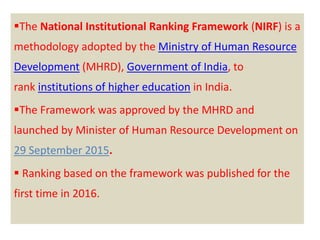
The National Institutional Ranking Framework (NIRF) is a
methodology adopted by the Ministry of Human Resource
Development (MHRD), Government of India, to
rank institutions of higher education in India.
The Framework was approved by the MHRD and
launched by Minister of Human Resource Development on
29 September 2015.
 Ranking based on the framework was published for the
first time in 2016.
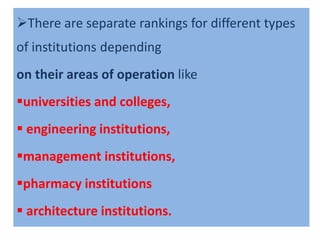
There are separate rankings for different types
of institutions depending
on their areas of operation like
universities and colleges,
 engineering institutions,
management institutions,
pharmacy institutions
 architecture institutions.
The Framework uses several parameters for ranking
purposes like
Learning resources,
research, and practices
 graduation outcomes
 perception
 outreach and inclusivity
These parameters have been grouped into five clusters
and these clusters were assigned certain weightages.
The weightages depend on the type of
institution.
The ranking score given to the universities is a
relative score, not absolute.
 It reflects the yearly performance of the
institutions.
MHRD organized a one-day workshop on 21 August 2014 on
evolving methodologies for the ranking of institutions of higher
education in India.
The meeting resolved to constitute a Committee for evolving a
National Ranking Framework.
 . Based on these decisions, a core committee consisting of 16
members was constituted on 29 October 2014 with secretary (HE,
MHRD, as chairperson and additional secretary (TE), MHRD, as
member-secretary.
. The other members were the directors of the IIT's
at Kharagpur and Madras, the vice-chancellors of Delhi
University,EFL University, Central University of
Gujarat and JNU, directors of the IIM's
at Ahmedabad and Bangalore, directors of school of
planning and architecture (Delhi), NIT (Warangal), ABV-
Indian Institute of Information Technology &
Management (Gwalior), IISER (Bhopal), NAAC
(Bangalore) and chairperson of NBA (New Delhi).
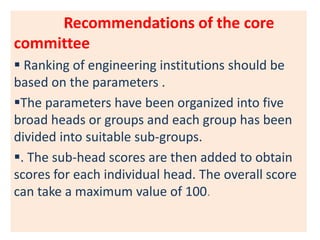
Recommendations of the core
committee
 Ranking of engineering institutions should be
based on the parameters .
The parameters have been organized into five
broad heads or groups and each group has been
divided into suitable sub-groups.
. The sub-head scores are then added to obtain
scores for each individual head. The overall score
can take a maximum value of 100.
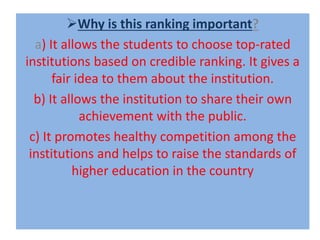
Why is this ranking important?
a) It allows the students to choose top-rated
institutions based on credible ranking. It gives a
fair idea to them about the institution.
b) It allows the institution to share their own
achievement with the public.
c) It promotes healthy competition among the
institutions and helps to raise the standards of
higher education in the country
HIGHER EDUCATION EMPOWERMENT
REGULATION AGENCY (HEERA)
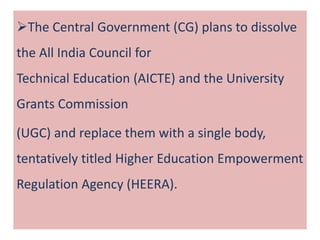
The Central Government (CG) plans to dissolve
the All India Council for
Technical Education (AICTE) and the University
Grants Commission
(UGC) and replace them with a single body,
tentatively titled Higher Education Empowerment
Regulation Agency (HEERA).
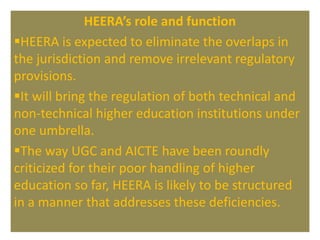
HEERA’s role and function
HEERA is expected to eliminate the overlaps in
the jurisdiction and remove irrelevant regulatory
provisions.
It will bring the regulation of both technical and
non-technical higher education institutions under
one umbrella.
The way UGC and AICTE have been roundly
criticized for their poor handling of higher
education so far, HEERA is likely to be structured
in a manner that addresses these deficiencies.
 Eliminate all overlaps in jurisdiction and also do away with
regulatory provisions that may no longer be relevant.
 HEERA is also expected to have sharper teeth than the extant
AICTE and UGC.
 Having a single statutory body for higher education will
simplify and consolidate the mass of regulations and
compliances that currently operate in the sector.
.
To expand the Higher Education sector
To expand institutional base of Higher Education
(including technical, professional and vocational
education) by creating additional capacity in
existing institutions, establishing new institutions
and incentivizing State Governments and Non-
Governmental Organizations/civil society.
To provide opportunities of Higher Education to
socially-deprived communities and remove
disparities by promoting the inclusion of women,
minorities and differently-abled persons.
To promote development of Indian languages.
To promote autonomy, innovations, academic
reforms in institutions of higher learning
To undertake institutional restructuring for
improving efficiency,relevance and creativity in
Higher Education.
 Enhancement of Gross Enrolment Ratio by expanding
access through all modes.
Promoting the participation of these sections of the
society whose GER is lower than the national average.
To improve quality and to promote academic reforms
Setting up of new educational institutions and also
capacity expansion and improvement of the existing
institutions. Use of Technology in Higher Education.
Development of Vocational Education and Skill
Development.
Development of Indian Languages.
International Collaboration in the field of education.
Nirf fathima
Nirf fathima
Nirf fathima

Nirf fathima

  • 4.
    The National InstitutionalRanking Framework (NIRF) is a methodology adopted by the Ministry of Human Resource Development (MHRD), Government of India, to rank institutions of higher education in India. The Framework was approved by the MHRD and launched by Minister of Human Resource Development on 29 September 2015.  Ranking based on the framework was published for the first time in 2016.
  • 5.
    There are separaterankings for different types of institutions depending on their areas of operation like universities and colleges,  engineering institutions, management institutions, pharmacy institutions  architecture institutions.
  • 6.
    The Framework usesseveral parameters for ranking purposes like Learning resources, research, and practices  graduation outcomes  perception  outreach and inclusivity These parameters have been grouped into five clusters and these clusters were assigned certain weightages.
  • 7.
    The weightages dependon the type of institution. The ranking score given to the universities is a relative score, not absolute.  It reflects the yearly performance of the institutions.
  • 9.
    MHRD organized aone-day workshop on 21 August 2014 on evolving methodologies for the ranking of institutions of higher education in India. The meeting resolved to constitute a Committee for evolving a National Ranking Framework.  . Based on these decisions, a core committee consisting of 16 members was constituted on 29 October 2014 with secretary (HE, MHRD, as chairperson and additional secretary (TE), MHRD, as member-secretary.
  • 10.
    . The othermembers were the directors of the IIT's at Kharagpur and Madras, the vice-chancellors of Delhi University,EFL University, Central University of Gujarat and JNU, directors of the IIM's at Ahmedabad and Bangalore, directors of school of planning and architecture (Delhi), NIT (Warangal), ABV- Indian Institute of Information Technology & Management (Gwalior), IISER (Bhopal), NAAC (Bangalore) and chairperson of NBA (New Delhi).
  • 11.
    Recommendations of thecore committee  Ranking of engineering institutions should be based on the parameters . The parameters have been organized into five broad heads or groups and each group has been divided into suitable sub-groups. . The sub-head scores are then added to obtain scores for each individual head. The overall score can take a maximum value of 100.
  • 12.
    Why is thisranking important? a) It allows the students to choose top-rated institutions based on credible ranking. It gives a fair idea to them about the institution. b) It allows the institution to share their own achievement with the public. c) It promotes healthy competition among the institutions and helps to raise the standards of higher education in the country
  • 13.
  • 14.
    The Central Government(CG) plans to dissolve the All India Council for Technical Education (AICTE) and the University Grants Commission (UGC) and replace them with a single body, tentatively titled Higher Education Empowerment Regulation Agency (HEERA).
  • 15.
    HEERA’s role andfunction HEERA is expected to eliminate the overlaps in the jurisdiction and remove irrelevant regulatory provisions. It will bring the regulation of both technical and non-technical higher education institutions under one umbrella. The way UGC and AICTE have been roundly criticized for their poor handling of higher education so far, HEERA is likely to be structured in a manner that addresses these deficiencies.
  • 17.
     Eliminate alloverlaps in jurisdiction and also do away with regulatory provisions that may no longer be relevant.  HEERA is also expected to have sharper teeth than the extant AICTE and UGC.  Having a single statutory body for higher education will simplify and consolidate the mass of regulations and compliances that currently operate in the sector.
  • 20.
  • 24.
    To expand theHigher Education sector To expand institutional base of Higher Education (including technical, professional and vocational education) by creating additional capacity in existing institutions, establishing new institutions and incentivizing State Governments and Non- Governmental Organizations/civil society. To provide opportunities of Higher Education to socially-deprived communities and remove disparities by promoting the inclusion of women, minorities and differently-abled persons.
  • 25.
    To promote developmentof Indian languages. To promote autonomy, innovations, academic reforms in institutions of higher learning To undertake institutional restructuring for improving efficiency,relevance and creativity in Higher Education.
  • 27.
     Enhancement ofGross Enrolment Ratio by expanding access through all modes. Promoting the participation of these sections of the society whose GER is lower than the national average. To improve quality and to promote academic reforms Setting up of new educational institutions and also capacity expansion and improvement of the existing institutions. Use of Technology in Higher Education. Development of Vocational Education and Skill Development. Development of Indian Languages. International Collaboration in the field of education.