The e-portfolio as a
Trojan horse
How does the implementation of the
SWITCHportfolio influence the digitalization of
teaching and learning at the Institute for Primary
Education at the University of Teacher Education in
Berne (PH Bern)?
New challenges
life long
learning
• careers don’t last a lifetime anymore
• flexibility and mobility
fast moving
technologies
• media competence as a new and important core competence
• new capabilities for learning and teaching: no “one-size-fits-all”
information
• “Know how” and “know where” instead of “know what”
• available information increase, half-life of knowledge decrease
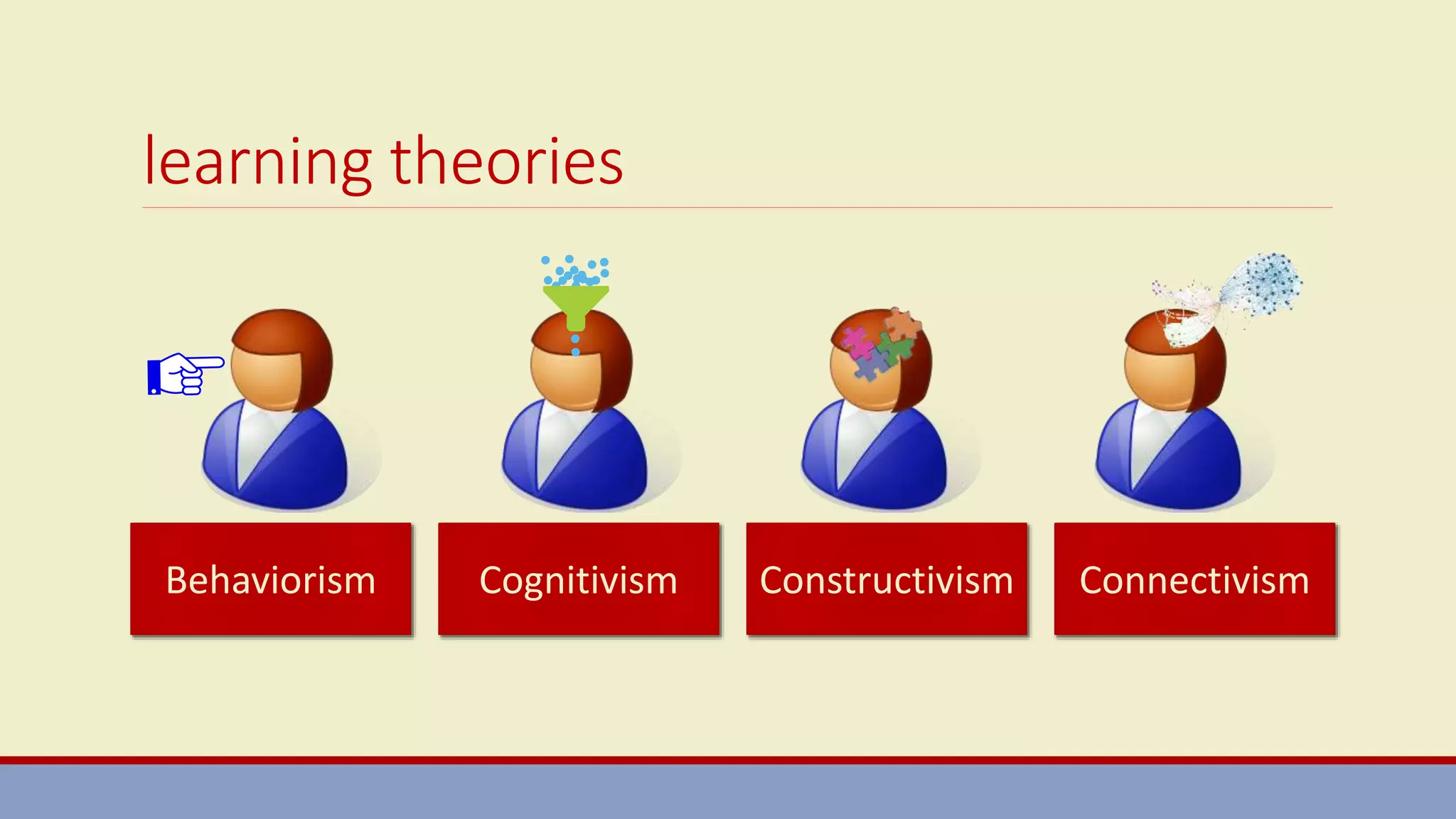
learning theories
ConnectivismBehaviorism Cognitivism Constructivism
traditional learning approach
learning in
digital age
understand and
remember
response/react on
external stimulus
create and
evaluate
encode, acquire,
store and retrieve
information
analyze and
apply
construct a
subjective reality
recognize and
connect
connect, link
information,
people (nodes)
traditional teaching approach
teaching in
digital age
lecturing and
testing
lecturing,
providing content,
assessing
facilitate / scaffold
discovery learning,
feedback
initiate self
directed learning
Connectivism
teacher <=>
learner
• creation of new knowledge = new nodes, new links
• ability to filter, condense and structure knowledge and information
personal
networks
• connecting nodes and links between persons, data, resources
• decision-making itself is a learning process
technology
• internet access plays a crucial role in everyday life
• enables free and flexible access to information and knowledge
Digitalization in Higher Ed –
lines of development
LMS
• simplify the planning and organization of teaching and learning
• distribute content, support assessment and evaluation
Web 2.0
• enhance communication and collaboration: Wikis, Social Networks, Blogs …
• reaching and sharing material and media becomes much easier: OER
MOOCs
• (further) education for free
• ubiquitous knowledge in a didactically refined and well-structured approach
Interim conclusion: Digitalizations impact
on teaching and learning
culture
• new challenges lead us to more student centered, self directed educational
approaches while keeping formal conditions of higher education in mind
learning
• learning how to learn, how to assess information; learning as a social process
• diversity  assessment is unitary, standardized ...
teaching
• changing roles: from teacher / instructor to facilitator / coach
• personal support and scaffolding instead of knowledge transfer
E-Portfolio as a Trojan Horse
CC-BY-NC-ND Hiking Artist
Institutional Background
MIT
• supports the e-portfolio initiatives (didactical and technical)
• courses in the field of “digital media in school”, new: teaching
methology in media and computer sciences”
PHBern
• Pedagogical university with around 2500 students
• 7 Institutes, which operate relatively independent from each other
IVP
• 703 students, 96 lecturers (part and full time)
• Current issue: Implementation Lehrplan 21
The SWITCHportfolio for
organization
• learning groups, courses
• network structure for learning material and resources
reflection
• personal learning experiences and progress
• practical experience in school
presentation
• personal learning achievements, assessment
• Projects, long-term learning development
reflection
• “We do not learn from experience…we learn from reflecting on experience.”
(John Dewey)
Experiences in
school
Personal
learning
development
Prior
knowledge and
competences
presentation • Projects, learning achievements
Learning process and
learning products
projects
organization • learning groups and courses
Information
and
resources
rss /
links
Forum
Organizational
advices
Working /
learning
groups
SWITCHdrive
shareable
file storage
for learning
ressources
SWITCHtube
Video Server
SWITCHportfolio
website
Learning groups
Personal lifelong
portfolio for
every student
student
Department
/ faculty
lecturer
Externals and graduates
organization • network structure for learning material and resources
Insights: lecturers’ view
Challenges of
openness: balancing
freedom and
transparency
Gathering pre-
conceptions easier
and more authentic
(some) colleagues are
rather skeptical about
digital media for
education
If students get credit for
the additional workload
for getting familiar with
the technology, they
become open-minded
A student centered
approach (mostly,
LMS are content
centered)
Guide students
individual learning
experience
Combine several
types of media for a
comprehensive
didactical approach
Conclusion
needs
• learner centered didactics, competence orientation
• Support learning to create their personal networks
changes
• the e-portfolio guides teachers to a new didactical approach
• view of learning and teaching will change if they take the potentials
of the e-portfolio in mind  connectivist learning
• e-portfolio supports individual learning, because it focuses the
learners view and provides a platform for nodes and links
• requires and promotes media competences
Literatur und Quellen
Hofhues, S. (2015b). ‚Digitalisierung‘: Herausforderung für Bildung und Hochschulen? Impulsvortrag auf dem
Digitalisierungskongress „Wie programmieren wir Zukunft?“ von Bündnis 90/Die Grünen. 19.9.2015 (Bielefeld).
Hofhues, S. (2015a). Alles digital. Auch die Bildung? Ringvorlesung „Digitale (R)Evolution“ Vortrag an der
Universität zu Köln. 2.12.2015 (Köln).
Hochschulforum Digitalisierung (https://hochschulforumdigitalisierung.de/de/themen/innovationen-
lern%E2%80%90-pr%C3%BCfungsszenarien)
Strasser, T., & Himpsl-Gutermann, K. (2016). Langsam bewegt sich das Trojanische Pferd. Oder: In kleinen
Schritten den Einsatz digitaler Medien in der universitären Lehrerausbildung fördern. Computer &
Unterricht, Lehrerarbeit digital organisieren (Heft 101, 1/2016), 44–46.
Duke, B, Harper, G. & Johnston, M. (2013) Connectivism as a Digital Age Learning Theory.
https://www.hetl.org/wp-content/uploads/2013/09/HETLReview2013SpecialIssueArticle1.pdf [25.10.2016].
Siemens, G. (2005). Connectivism: A Learning Theory for the Digital Age.
http://er.dut.ac.za/bitstream/handle/123456789/69/Siemens_2005_Connectivism_A_learning_theory_for_the_d
igital_age.pdf?sequence=1 [25.10.2016].
Weller, M. (). The digital Scholar. How Technology is Transforming Scholarly Practice
About me
PHBern Profile LinkedIn @tudfolio
slides on
slideshare

National event SIG e-Portfolio 2016 - Keynote

  • 1.
    The e-portfolio asa Trojan horse How does the implementation of the SWITCHportfolio influence the digitalization of teaching and learning at the Institute for Primary Education at the University of Teacher Education in Berne (PH Bern)?
  • 2.
    New challenges life long learning •careers don’t last a lifetime anymore • flexibility and mobility fast moving technologies • media competence as a new and important core competence • new capabilities for learning and teaching: no “one-size-fits-all” information • “Know how” and “know where” instead of “know what” • available information increase, half-life of knowledge decrease
  • 3.
  • 4.
    traditional learning approach learningin digital age understand and remember response/react on external stimulus create and evaluate encode, acquire, store and retrieve information analyze and apply construct a subjective reality recognize and connect connect, link information, people (nodes)
  • 5.
    traditional teaching approach teachingin digital age lecturing and testing lecturing, providing content, assessing facilitate / scaffold discovery learning, feedback initiate self directed learning
  • 6.
    Connectivism teacher <=> learner • creationof new knowledge = new nodes, new links • ability to filter, condense and structure knowledge and information personal networks • connecting nodes and links between persons, data, resources • decision-making itself is a learning process technology • internet access plays a crucial role in everyday life • enables free and flexible access to information and knowledge
  • 7.
    Digitalization in HigherEd – lines of development LMS • simplify the planning and organization of teaching and learning • distribute content, support assessment and evaluation Web 2.0 • enhance communication and collaboration: Wikis, Social Networks, Blogs … • reaching and sharing material and media becomes much easier: OER MOOCs • (further) education for free • ubiquitous knowledge in a didactically refined and well-structured approach
  • 8.
    Interim conclusion: Digitalizationsimpact on teaching and learning culture • new challenges lead us to more student centered, self directed educational approaches while keeping formal conditions of higher education in mind learning • learning how to learn, how to assess information; learning as a social process • diversity  assessment is unitary, standardized ... teaching • changing roles: from teacher / instructor to facilitator / coach • personal support and scaffolding instead of knowledge transfer
  • 9.
    E-Portfolio as aTrojan Horse CC-BY-NC-ND Hiking Artist
  • 10.
    Institutional Background MIT • supportsthe e-portfolio initiatives (didactical and technical) • courses in the field of “digital media in school”, new: teaching methology in media and computer sciences” PHBern • Pedagogical university with around 2500 students • 7 Institutes, which operate relatively independent from each other IVP • 703 students, 96 lecturers (part and full time) • Current issue: Implementation Lehrplan 21
  • 11.
    The SWITCHportfolio for organization •learning groups, courses • network structure for learning material and resources reflection • personal learning experiences and progress • practical experience in school presentation • personal learning achievements, assessment • Projects, long-term learning development
  • 12.
    reflection • “We donot learn from experience…we learn from reflecting on experience.” (John Dewey) Experiences in school Personal learning development Prior knowledge and competences
  • 13.
    presentation • Projects,learning achievements Learning process and learning products projects
  • 14.
    organization • learninggroups and courses Information and resources rss / links Forum Organizational advices Working / learning groups
  • 15.
    SWITCHdrive shareable file storage for learning ressources SWITCHtube VideoServer SWITCHportfolio website Learning groups Personal lifelong portfolio for every student student Department / faculty lecturer Externals and graduates organization • network structure for learning material and resources
  • 16.
    Insights: lecturers’ view Challengesof openness: balancing freedom and transparency Gathering pre- conceptions easier and more authentic (some) colleagues are rather skeptical about digital media for education If students get credit for the additional workload for getting familiar with the technology, they become open-minded A student centered approach (mostly, LMS are content centered) Guide students individual learning experience Combine several types of media for a comprehensive didactical approach
  • 17.
    Conclusion needs • learner centereddidactics, competence orientation • Support learning to create their personal networks changes • the e-portfolio guides teachers to a new didactical approach • view of learning and teaching will change if they take the potentials of the e-portfolio in mind  connectivist learning • e-portfolio supports individual learning, because it focuses the learners view and provides a platform for nodes and links • requires and promotes media competences
  • 18.
    Literatur und Quellen Hofhues,S. (2015b). ‚Digitalisierung‘: Herausforderung für Bildung und Hochschulen? Impulsvortrag auf dem Digitalisierungskongress „Wie programmieren wir Zukunft?“ von Bündnis 90/Die Grünen. 19.9.2015 (Bielefeld). Hofhues, S. (2015a). Alles digital. Auch die Bildung? Ringvorlesung „Digitale (R)Evolution“ Vortrag an der Universität zu Köln. 2.12.2015 (Köln). Hochschulforum Digitalisierung (https://hochschulforumdigitalisierung.de/de/themen/innovationen- lern%E2%80%90-pr%C3%BCfungsszenarien) Strasser, T., & Himpsl-Gutermann, K. (2016). Langsam bewegt sich das Trojanische Pferd. Oder: In kleinen Schritten den Einsatz digitaler Medien in der universitären Lehrerausbildung fördern. Computer & Unterricht, Lehrerarbeit digital organisieren (Heft 101, 1/2016), 44–46. Duke, B, Harper, G. & Johnston, M. (2013) Connectivism as a Digital Age Learning Theory. https://www.hetl.org/wp-content/uploads/2013/09/HETLReview2013SpecialIssueArticle1.pdf [25.10.2016]. Siemens, G. (2005). Connectivism: A Learning Theory for the Digital Age. http://er.dut.ac.za/bitstream/handle/123456789/69/Siemens_2005_Connectivism_A_learning_theory_for_the_d igital_age.pdf?sequence=1 [25.10.2016]. Weller, M. (). The digital Scholar. How Technology is Transforming Scholarly Practice
  • 19.
    About me PHBern ProfileLinkedIn @tudfolio slides on slideshare

Editor's Notes

  • #2 Today I am here to talk to you about e-portfolios as a Trojan horse for change processes in higher education I would like to visulalize how the implementation of the SWITCHportfolio at the Institute for Primary Education at the University of Teacher Education in Berne supports a digitalized education. My talk I devided into two parts: First I will talk about situative challenges of digitalization processes in education and higher education and then I will show how the launch of several Eportfolio programmes enhance the change. Phrasen: Identify the real issues we face when implementing … How do we create a eportfolio culture in a learning community Accountability-driven system Teaching in a digitalized learning environment is hard work It could be successful as long as the implementation focuses on student learning, rather than institutional accountability
  • #3 First, I would like to outline the initial situation and the challanges for students and teachers in a mediatized world. Mediatized world, that means: Increasing information and knowledge the half-life of knowledge: the time span from when knowledge is gained to when it becomes obsolete According to the American Society of Training and documentation: The amount of knowledge in the world has doubled in the past 10 years and is doubling every 18 months Methods and content is changing continuously  new possibilites for learning and teaching. For example, let us consider the possibilities that we have if we use wikis, Blogs, Social Media et cetera in our courses.
  • #4 In my presentation, i want to focus on teaching and learning in digital age and so I will have a look on learning theories to visualize the new perception of learning. Learning theories describe learning principles and set teaching approaches and processes - B: In B. learning is defined as a process of reacting on external stimuli. - Cog.: learning is a process of acquiring and storing information - Constructivism: meaning is continuously “constructed” through experience and reflection Connect.:learning is the process of connecting nodes or information ressources, ability to construct and maintain personal networks It is not uncontroversial whether connectivism should be named as a learning theory. Maybe it is only a paradigm. http://scholar.google.ch/scholar_url?url=http://er.dut.ac.za/bitstream/handle/123456789/69/Siemens_2005_Connectivism_A_learning_theory_for_the_digital_age.pdf%3Fsequence%3D1&hl=de&sa=X&scisig=AAGBfm15CkwkJOb7ZoOWcDYbqoas6DR3CA&nossl=1&oi=scholarr&ved=0ahUKEwjrx7WzpOnPAhXCIMAKHfHzDw4QgAMIHCgBMAA Angelehnt an http://convergenceacademies.postach.io/post/connectivism-bearing-a-heavy-node
  • #5  Angelehnt an http://convergenceacademies.postach.io/post/connectivism-bearing-a-heavy-node
  • #6  Angelehnt an http://convergenceacademies.postach.io/post/connectivism-bearing-a-heavy-node
  • #7 We live in a digital networked world, where information can be accessed and updated in real time around the clock. That leads us to new leanring approaches. New approaches for dealing with Information and knowledge. George siemens and Steven Downs are the initiators of Connectivism, a learning theory for the digital age. In our every day life, we interact virtual with people, ressources, places, fields. We obtain information from the internet. How often did you visit Wikipedia last week? Klick  erste box Decision making: do I need this information? Is the information right? Is the information still right or have some circumstances changed? How can I use / store this information? Connectivism emphazise the exchange processes between the individuum and the (virtual) environment ability to see connections between fields, ideas and concepts and to keep these connections remain stable over time, is thus one of the core competencies of the digital age. Teacher: close the gap between formal and informal learning
  • #8 Now I would like to leave the theoretical view and pass over to the educational practices:
  • #9 Connectivist learning To conclude diversity  assessment is unitary, standardized ... New methods are necessary
  • #10 Now I would like to switch from theory to practise: the central part of my presentation: how can the eportfolio help to cope with the challanges of a digitized education? How could the implementation of the SWITCHportfolio at the institute… enhance connectivist learning I use the metaphor «Trojan horse» because the eportfolio can support changing processes. The ideas, approaches and new paradigms of teaching and learning for and in a digital environment are hidden in the eportfolio, hidden in the SWITCHportfolio. Outwardly it appears like a new tool, to be only a new software for one decade, but truely it is a didactical innovation. It could – depending on the change processes – have a lasting effect on educational processes.
  • #11 Some facts about the … In 2015 a big initiative
  • #17 Mash up different kinds of resources and learning products The learning product is not the product itself, it is the ability to create and mix these different kinds of media, of resources together
  • #18 Mix up different types of ressources
  • #19 Enhance connectivist learning through interconnected learning material and ressources Nach der Folie erstmal Daniela
  • #21  - The portfolios structure is student centered not content or teaching centered