Thanks to Isabel Bastida
• Past Simple
• Past Continuous
• Past Perfect
• Past Perfect Continuous
• Time conjunctions.
Short and quickly finished actions, longer situations

and repeated events in the past.
Peter threw a stone and broke a car
window last night.

I spent all my childhood in
Scotland

Every summer Rachel fell in love.
(Used to/ Would)
It’s (high) time + past simple

We are destroying the planet. It’s
(high) time we did something about it.
My shoes are falling apart. It’s (high)
time I bought a new pair.
I would rather (I prefer)

Compare:
I’d rather be a vegetarian.
I’d rather you didn’t eat so much meat.
I’d rather stay a little longer.
I’d rather you could stay longer.
Different subjects  past simple in 2nd
clause.
Distancing

I wanted to speak to the manager.
I wondered if I could return this item
without the receipt.
Did you want some cream with your coffee,
sir?
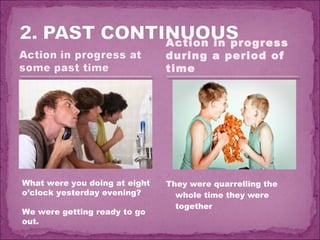
Action in progress
during a period of
time

What were you doing at eight
o’clock yesterday evening?
We were getting ready to go
out.

They were quarrelling the
whole time they were
together
1. Background actions
(AS, WHILE, WHEN, etc.)

As I was walking down the road, I saw Bill.
The phone rang while I was having a bubble
bath.
The crowd was cheering them up.
Photographers were jostling each other for
the best positions. Suddenly a woman
screamed.

2. Repeated and
unexpected events
(frequency adverb)

Aunt Mary was always turning up without
warning and bringing us loads of presents.

* Some verbs do not exist in the continuous form.
After I told/
wondered/ thought

When I arrived at the party,
they had just set fire to the
sparklers.

I wondered who had left the
door open with the keys in
the lock.
AS/WHILE/ WHEN

As/ While/ When I was watching a horror movie, I heard a
noise outside.
As/ While/When I was slaving away, my brother was
chilling out.

BEFORE/ AFTER

Before we left, I (had) filled up with petrol.
I (had) filled up with petrol before we left.
After I (had) filled up with petrol, we left.
We left after I (had) filled up with petrol.

AS SOON AS
(immediately after)

BY THE TIME

As soon as he went/had gone outside, it started raining.
It started raining as soon as he went/had gone outside.
By the time the police arrived, the robbers had run away.
The robbers had run away by the time the police arrived.

Narrative tenses

  • 1.
  • 2.
    • Past Simple •Past Continuous • Past Perfect • Past Perfect Continuous • Time conjunctions.
  • 3.
    Short and quicklyfinished actions, longer situations and repeated events in the past. Peter threw a stone and broke a car window last night. I spent all my childhood in Scotland Every summer Rachel fell in love. (Used to/ Would)
  • 4.
    It’s (high) time+ past simple We are destroying the planet. It’s (high) time we did something about it. My shoes are falling apart. It’s (high) time I bought a new pair.
  • 5.
    I would rather(I prefer) Compare: I’d rather be a vegetarian. I’d rather you didn’t eat so much meat. I’d rather stay a little longer. I’d rather you could stay longer. Different subjects  past simple in 2nd clause.
  • 6.
    Distancing I wanted tospeak to the manager. I wondered if I could return this item without the receipt. Did you want some cream with your coffee, sir?
  • 7.
    Action in progress duringa period of time What were you doing at eight o’clock yesterday evening? We were getting ready to go out. They were quarrelling the whole time they were together
  • 8.
    1. Background actions (AS,WHILE, WHEN, etc.) As I was walking down the road, I saw Bill. The phone rang while I was having a bubble bath. The crowd was cheering them up. Photographers were jostling each other for the best positions. Suddenly a woman screamed. 2. Repeated and unexpected events (frequency adverb) Aunt Mary was always turning up without warning and bringing us loads of presents. * Some verbs do not exist in the continuous form.
  • 9.
    After I told/ wondered/thought When I arrived at the party, they had just set fire to the sparklers. I wondered who had left the door open with the keys in the lock.
  • 10.
    AS/WHILE/ WHEN As/ While/When I was watching a horror movie, I heard a noise outside. As/ While/When I was slaving away, my brother was chilling out. BEFORE/ AFTER Before we left, I (had) filled up with petrol. I (had) filled up with petrol before we left. After I (had) filled up with petrol, we left. We left after I (had) filled up with petrol. AS SOON AS (immediately after) BY THE TIME As soon as he went/had gone outside, it started raining. It started raining as soon as he went/had gone outside. By the time the police arrived, the robbers had run away. The robbers had run away by the time the police arrived.