MODULE 3 CONTENTS
UNITS 7 - 9: HEROES Vocabulary : ---Character and Personality Adjectives  --- Campaigns // Causes and Issues Grammar : --- Past Simple VS. Past Continuous --- Use of Articles: a/an – the –zero article
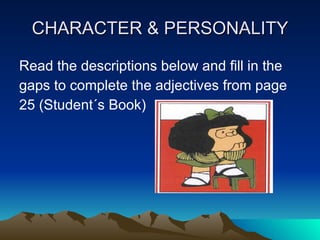
CHARACTER & PERSONALITY Read the descriptions below and fill in the gaps to complete the adjectives from page 25 (Student´s Book)
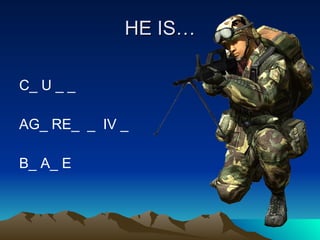
He is a soldier from the USA. He loves  fighting in times of war. He is courageous when he has to protect his country, but he doesn´t care about killing enemies or destroying towns and villages where innocent people live.
HE IS… C_ U _ _ AG_ RE_  _  IV _  B_ A_ E
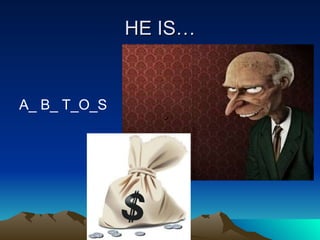
He is rich and powerful, but he is never  happy with his life.  He always wants to have more and more things, money and power.
HE IS… A_ B_ T_O_S
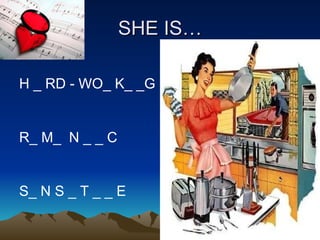
She is a model housewife who spends the whole day doing all types of housework for her family. She also likes reading love stories and starts crying as soon as she watches a good soap opera.
SHE IS… H _ RD - WO_ K_ _G R_ M_  N _ _ C S_ N S _ T _ _ E
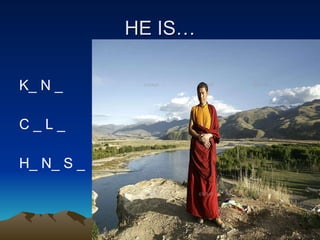
The Tibbetan monk Xiao Chang loves being in contact with nature and being relaxed most of the time. He also treats visitors very politely and never tells lies to people
HE IS… K_ N _ C _ L _  H_ N_ S _
Mother Teresa spent her life helping poor people, especially orphan children found in the streets of Calcuta. She was also very clever and, from her heart, she gained a type of spiritual intelligence that isn´t found at any  university.
SHE WAS… G _ N _ R _ U S W _ S _
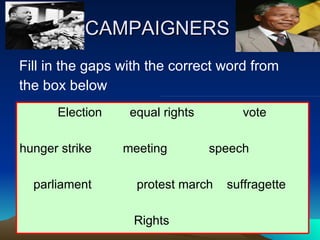
CAMPAIGNERS  Fill in the gaps with the correct word from the box below Election  equal rights  vote hunger strike  meeting  speech parliament  protest march  suffragette Rights
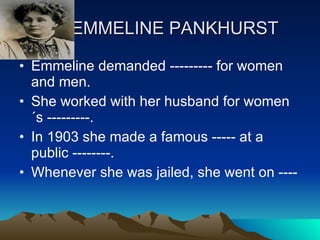
EMMELINE PANKHURST  Emmeline demanded --------- for women and men. She worked with her husband for women´s ---------. In 1903 she made a famous ----- at a public --------. Whenever she was jailed, she went on ----
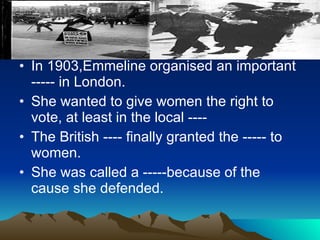
In 1903,Emmeline organised an important ----- in London. She wanted to give women the right to vote, at least in the local ---- The British ---- finally granted the ----- to women. She was called a -----because of the cause she defended.
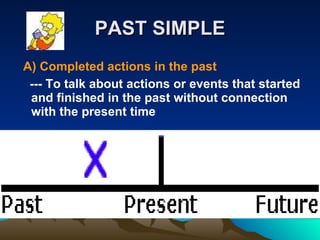
PAST SIMPLE A) Completed actions in the past --- To talk about actions or events that started and finished in the past without connection with the present time
EXAMPLES I  saw  a movie yesterday.  I  didn't see  a play yesterday.  Last year, I  travelled  to Japan.  Last year, I  didn't travel  to Korea.  Did  you  have  dinner last night?  She  washed  her car.  He  didn't wash  his car.
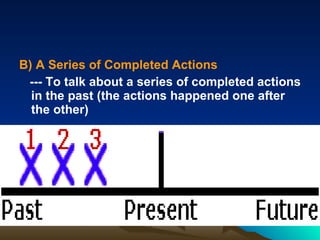
B)  A Series of Completed Actions  --- To talk about a series of completed actions in the past (the actions happened one after the other)
EXAMPLES I  finished  work,  walked  to the beach, and  found  a nice place to swim.  He  arrived  from the airport at 8:00,  checked  into the hotel at 9:00, and  met  the others at 10:00.  Did  you  add  flour,  pour  in the milk, and then  add  the eggs?
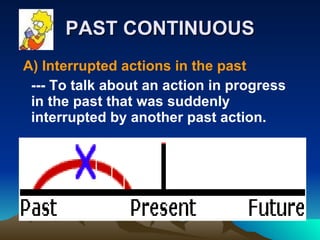
PAST CONTINUOUS A) Interrupted actions in the past --- To talk about an action in progress in the past that was suddenly interrupted by another past action.
EXAMPLES I  was watching  TV when she called.  When the phone rang, she  was writing  a letter.  While we  were having  the picnic, it started to rain.  What  were  you  doing  when the earthquake started?  You  were not listening  to me when I told you to turn the oven off.  While John  was sleeping  last night, someone stole his car.  Sammy  was waiting  for us when we got off the plane.
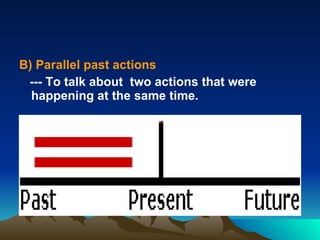
B) Parallel past actions --- To talk about  two actions that were  happening at the same time.
EXAMPLES I  was studying  while he  was making  dinner.  While Ellen  was reading , Tim  was watching  television.  Were  you  listening  while he  was talking ?  I  wasn't paying  attention while I  was writing  the letter, so I made several mistakes.  What  were  you  doing  while you  were waiting ?  Thomas  wasn't working , and I  wasn't working  either.
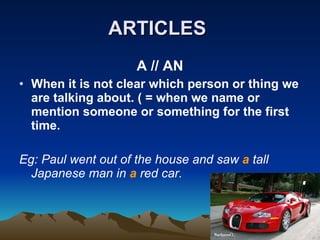
ARTICLES   A // AN When it is not clear which person or thing we are talking about. ( = when we name or mention someone or something for the first time. Eg: Paul went out of the house and saw  a  tall  Japanese man in  a  red car.
When it doesn´t matter which person// thing we are talking about ( = any) Eg: I have to write your phone numer now. I need  a  pen.
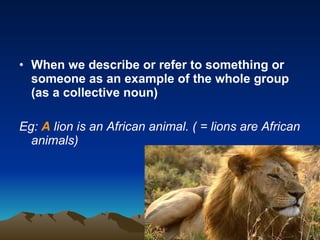
When we describe or refer to something or someone as an example of the whole group (as a collective noun) Eg:  A  lion is an African animal. ( = lions are African animals)
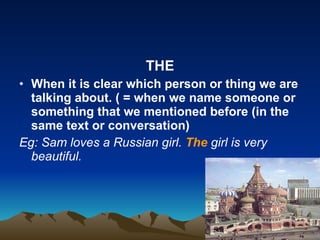
THE When it is clear which person or thing we are talking about. ( = when we name someone or something that we mentioned before (in the same text or conversation) Eg: Sam loves a Russian girl.  The  girl is very beautiful.
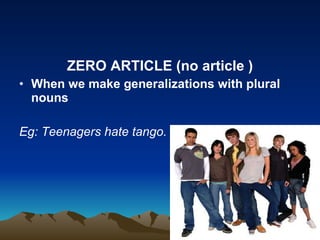
ZERO ARTICLE (no article ) When we make generalizations with plural nouns Eg: Teenagers hate tango.
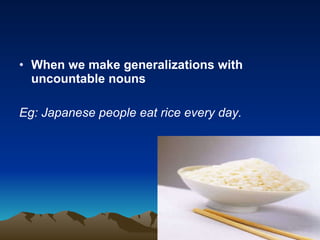
When we make generalizations with uncountable nouns Eg: Japanese people eat rice every day.
When we refer to languages Eg: Can you speak Italian fluently?
MULTI – PART VERBS SET UP :  establish TAKE PART :  participate PUT OFF :  postpone COME BACK :  return

Module 3

  • 1.
  • 2.
    UNITS 7 -9: HEROES Vocabulary : ---Character and Personality Adjectives --- Campaigns // Causes and Issues Grammar : --- Past Simple VS. Past Continuous --- Use of Articles: a/an – the –zero article
  • 3.
    CHARACTER & PERSONALITYRead the descriptions below and fill in the gaps to complete the adjectives from page 25 (Student´s Book)
  • 4.
    He is asoldier from the USA. He loves fighting in times of war. He is courageous when he has to protect his country, but he doesn´t care about killing enemies or destroying towns and villages where innocent people live.
  • 5.
    HE IS… C_U _ _ AG_ RE_ _ IV _ B_ A_ E
  • 6.
    He is richand powerful, but he is never happy with his life. He always wants to have more and more things, money and power.
  • 7.
    HE IS… A_B_ T_O_S
  • 8.
    She is amodel housewife who spends the whole day doing all types of housework for her family. She also likes reading love stories and starts crying as soon as she watches a good soap opera.
  • 9.
    SHE IS… H_ RD - WO_ K_ _G R_ M_ N _ _ C S_ N S _ T _ _ E
  • 10.
    The Tibbetan monkXiao Chang loves being in contact with nature and being relaxed most of the time. He also treats visitors very politely and never tells lies to people
  • 11.
    HE IS… K_N _ C _ L _ H_ N_ S _
  • 12.
    Mother Teresa spenther life helping poor people, especially orphan children found in the streets of Calcuta. She was also very clever and, from her heart, she gained a type of spiritual intelligence that isn´t found at any university.
  • 13.
    SHE WAS… G_ N _ R _ U S W _ S _
  • 14.
    CAMPAIGNERS Fillin the gaps with the correct word from the box below Election equal rights vote hunger strike meeting speech parliament protest march suffragette Rights
  • 15.
    EMMELINE PANKHURST Emmeline demanded --------- for women and men. She worked with her husband for women´s ---------. In 1903 she made a famous ----- at a public --------. Whenever she was jailed, she went on ----
  • 16.
    In 1903,Emmeline organisedan important ----- in London. She wanted to give women the right to vote, at least in the local ---- The British ---- finally granted the ----- to women. She was called a -----because of the cause she defended.
  • 17.
    PAST SIMPLE A)Completed actions in the past --- To talk about actions or events that started and finished in the past without connection with the present time
  • 18.
    EXAMPLES I saw a movie yesterday. I didn't see a play yesterday. Last year, I travelled to Japan. Last year, I didn't travel to Korea. Did you have dinner last night? She washed her car. He didn't wash his car.
  • 19.
    B) ASeries of Completed Actions --- To talk about a series of completed actions in the past (the actions happened one after the other)
  • 20.
    EXAMPLES I finished work, walked to the beach, and found a nice place to swim. He arrived from the airport at 8:00, checked into the hotel at 9:00, and met the others at 10:00. Did you add flour, pour in the milk, and then add the eggs?
  • 21.
    PAST CONTINUOUS A)Interrupted actions in the past --- To talk about an action in progress in the past that was suddenly interrupted by another past action.
  • 22.
    EXAMPLES I was watching TV when she called. When the phone rang, she was writing a letter. While we were having the picnic, it started to rain. What were you doing when the earthquake started? You were not listening to me when I told you to turn the oven off. While John was sleeping last night, someone stole his car. Sammy was waiting for us when we got off the plane.
  • 23.
    B) Parallel pastactions --- To talk about two actions that were happening at the same time.
  • 24.
    EXAMPLES I was studying while he was making dinner. While Ellen was reading , Tim was watching television. Were you listening while he was talking ? I wasn't paying attention while I was writing the letter, so I made several mistakes. What were you doing while you were waiting ? Thomas wasn't working , and I wasn't working either.
  • 25.
    ARTICLES A // AN When it is not clear which person or thing we are talking about. ( = when we name or mention someone or something for the first time. Eg: Paul went out of the house and saw a tall Japanese man in a red car.
  • 26.
    When it doesn´tmatter which person// thing we are talking about ( = any) Eg: I have to write your phone numer now. I need a pen.
  • 27.
    When we describeor refer to something or someone as an example of the whole group (as a collective noun) Eg: A lion is an African animal. ( = lions are African animals)
  • 28.
    THE When itis clear which person or thing we are talking about. ( = when we name someone or something that we mentioned before (in the same text or conversation) Eg: Sam loves a Russian girl. The girl is very beautiful.
  • 29.
    ZERO ARTICLE (noarticle ) When we make generalizations with plural nouns Eg: Teenagers hate tango.
  • 30.
    When we makegeneralizations with uncountable nouns Eg: Japanese people eat rice every day.
  • 31.
    When we referto languages Eg: Can you speak Italian fluently?
  • 32.
    MULTI – PARTVERBS SET UP : establish TAKE PART : participate PUT OFF : postpone COME BACK : return