MEHREEN MAZHAR
What is narration
Main points in narration
The narrator
Direct and indirect narration or
speech
Elements of narration
Point of view in narration
Narrative voice
Narrative time
 Narration means telling story
 A narrative paragraph tells a story about
something that happened to you or to
someone else or something that you saw
or read.
 Relies on specific details
 Cover events in a time sequence
 A good narrative helps the reader involved
in story by providing vivid details
 It is always about happenings, events,
actions, incidents
A narrator is a personal character or a
non-personal voice that the creator
(author) of the story develops to deliver
information to the audience, particularly
about the plot. In the case of most written
narratives (novels, short stories, poems,
etc.), the narrator typically functions to
convey the story in its entirety.
DIRECT SPEECH
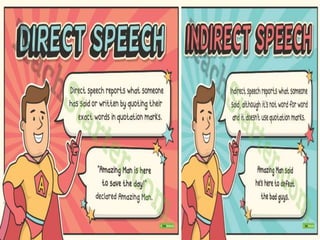
Direct speech repeats, or quotes, the exact
words spoken. When we use direct speech
in writing, we place the words spoken
between quotation marks (" ") and there is
no change in these words.
Example:
1. John said, "There's an elephant outside
the window."
Reported or indirect speech :is usually
used to talk about the past, so we normally
change the tense of the words spoken. We
use reporting verbs like 'say', 'tell', 'ask', and
we may use the word 'that' to introduce the
reported words. Inverted commas are not
used.
Example:
She said, "I saw him." (direct speech) = She
said that she had seen him. (indirect
speech)
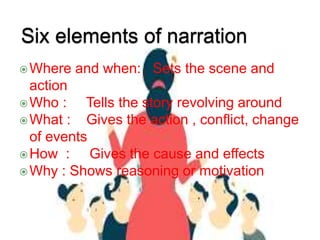
Where and when: Sets the scene and
action
Who : Tells the story revolving around
What : Gives the action , conflict, change
of events
How : Gives the cause and effects
Why : Shows reasoning or motivation
Include your point in the topic sentence
The point of narrative is the incident or
the incidents that you’re writing about.
EXAMPLES:
1-What did I learn?
2-Did it changed me?
3-What is the meaning of the story?
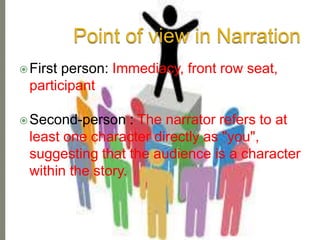
First person: Immediacy, front row seat,
participant
Second-person : The narrator refers to at
least one character directly as "you",
suggesting that the audience is a character
within the story.
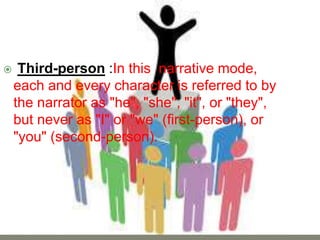
 Third-person :In this narrative mode,
each and every character is referred to by
the narrator as "he", "she", "it", or "they",
but never as "I" or "we" (first-person), or
"you" (second-person).
The narrative voice describes how the
story is conveyed: for example, by
"viewing" a character's thought processes,
reading a letter written for someone,
retelling a character's experiences, etc.
Narrative time: the grammatical
placement of the story's time-frame in the
past, the present, or the future.
For example, an author can narrate
events in reverse order: he can tell us first
how he gasped in horror at the pool of
blood, and then recall the whistle of the
bullet and how, before that, the cold-
blooded killer had pulled the trigger….
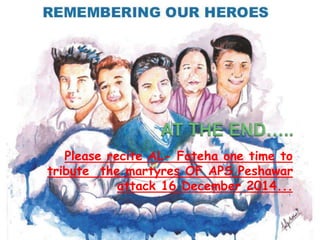
Please recite AL- Fateha one time to
tribute the martyres OF APS Peshawar
attack 16 December 2014...
Narration

Narration

  • 2.
  • 3.
    What is narration Mainpoints in narration The narrator Direct and indirect narration or speech Elements of narration Point of view in narration Narrative voice Narrative time
  • 4.
     Narration meanstelling story  A narrative paragraph tells a story about something that happened to you or to someone else or something that you saw or read.
  • 5.
     Relies onspecific details  Cover events in a time sequence  A good narrative helps the reader involved in story by providing vivid details  It is always about happenings, events, actions, incidents
  • 6.
    A narrator isa personal character or a non-personal voice that the creator (author) of the story develops to deliver information to the audience, particularly about the plot. In the case of most written narratives (novels, short stories, poems, etc.), the narrator typically functions to convey the story in its entirety.
  • 7.
    DIRECT SPEECH Direct speechrepeats, or quotes, the exact words spoken. When we use direct speech in writing, we place the words spoken between quotation marks (" ") and there is no change in these words. Example: 1. John said, "There's an elephant outside the window."
  • 8.
    Reported or indirectspeech :is usually used to talk about the past, so we normally change the tense of the words spoken. We use reporting verbs like 'say', 'tell', 'ask', and we may use the word 'that' to introduce the reported words. Inverted commas are not used. Example: She said, "I saw him." (direct speech) = She said that she had seen him. (indirect speech)
  • 10.
    Where and when:Sets the scene and action Who : Tells the story revolving around What : Gives the action , conflict, change of events How : Gives the cause and effects Why : Shows reasoning or motivation
  • 11.
    Include your pointin the topic sentence The point of narrative is the incident or the incidents that you’re writing about. EXAMPLES: 1-What did I learn? 2-Did it changed me? 3-What is the meaning of the story?
  • 12.
    First person: Immediacy,front row seat, participant Second-person : The narrator refers to at least one character directly as "you", suggesting that the audience is a character within the story.
  • 13.
     Third-person :Inthis narrative mode, each and every character is referred to by the narrator as "he", "she", "it", or "they", but never as "I" or "we" (first-person), or "you" (second-person).
  • 14.
    The narrative voicedescribes how the story is conveyed: for example, by "viewing" a character's thought processes, reading a letter written for someone, retelling a character's experiences, etc.
  • 15.
    Narrative time: thegrammatical placement of the story's time-frame in the past, the present, or the future. For example, an author can narrate events in reverse order: he can tell us first how he gasped in horror at the pool of blood, and then recall the whistle of the bullet and how, before that, the cold- blooded killer had pulled the trigger….
  • 18.
    Please recite AL-Fateha one time to tribute the martyres OF APS Peshawar attack 16 December 2014...