Myths
and
Legends
Johanna Riobamba
Jenny Quiroz
Andreas Puenayan
Juan Carlos Guevara
What are myths, legends and
folktales?
Myths and legends are
stories that have been told
over a long period of time
that have no proof of
existence.
Cater: (v.) to
provide what is
required or
desired (for)
Hand Down: (v.) to
pass (an outgrown
garment) on from one
member of a family to
a younger one
What are legends?
A legend is a semi-
true story, which has
been passed on from
person to person.
Encompass: (v.) to
include entirely or
comprehensively
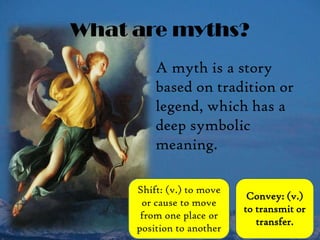
What are myths?
A myth is a story
based on tradition or
legend, which has a
deep symbolic
meaning.
Shift: (v.) to move
or cause to move
from one place or
position to another
Convey: (v.)
to transmit or
transfer.
What are folktales?
A folktale is a
popular story that
was passed on in a
spoken form, from
one generation to
the next.
Comprise: (v.) to
include; contain.
What is the difference
between legends, myths
and folktales?
Myths, legends and folktales are
hard to classify and often
overlap.
Overlap: (v.)
(of two things) to
extend or lie partly
over (each other)
Account: (n.): a
verbal or written
report, description, or
narration of some
occurrence, event, etc.
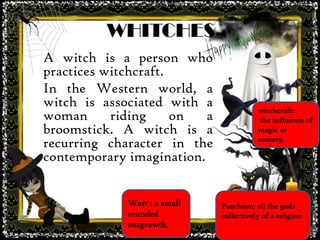
WHITCHES
A witch is a person who
practices witchcraft.
In the Western world, a
witch is associated with a
woman riding on a
broomstick. A witch is a
recurring character in the
contemporary imagination.
Wart : a small
rounded
outgrowth.
Pantheon: all the gods
collectively of a religion
witchcraft:
the influence of
magic or
sorcery.
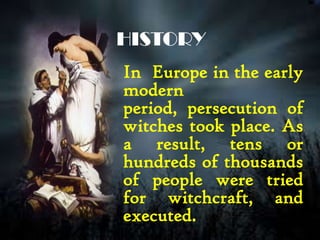
HISTORY
In Europe in the early
modern
period, persecution of
witches took place. As
a result, tens or
hundreds of thousands
of people were tried
for witchcraft, and
executed.
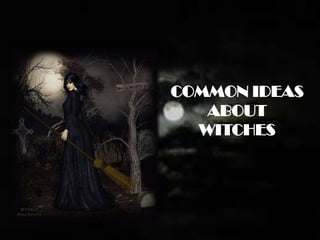
COMMON IDEAS
ABOUT
WITCHES
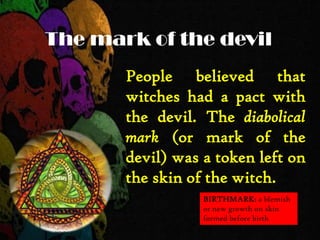
The mark of the devil
People believed that
witches had a pact with
the devil. The diabolical
mark (or mark of the
devil) was a token left on
the skin of the witch.
BIRTHMARK: a blemish
or new growth on skin
formed before birth
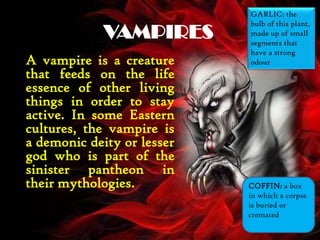
VAMPIRES
A vampire is a creature
that feeds on the life
essence of other living
things in order to stay
active. In some Eastern
cultures, the vampire is
a demonic deity or lesser
god who is part of the
sinister pantheon in
their mythologies. COFFIN: a box
in which a corpse
is buried or
cremated
GARLIC: the
bulb of this plant,
made up of small
segments that
have a strong
odour
IDENTIFYING VAMPIRE
Corpses thought to be vampires
were generally described as
having a healthier appearance
than expected, plump and
showing little or no signs of
decomposition. Evidence that a
vampire was active in a given
locality included death of cattle,
sheep, relatives or neighbors.
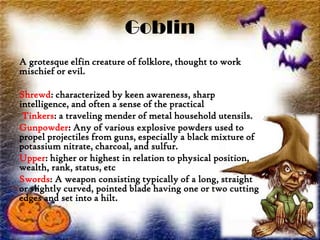
Goblin
A grotesque elfin creature of folklore, thought to work
mischief or evil.
Shrewd: characterized by keen awareness, sharp
intelligence, and often a sense of the practical
Tinkers: a traveling mender of metal household utensils.
Gunpowder: Any of various explosive powders used to
propel projectiles from guns, especially a black mixture of
potassium nitrate, charcoal, and sulfur.
Upper: higher or highest in relation to physical position,
wealth, rank, status, etc
Swords: A weapon consisting typically of a long, straight
or slightly curved, pointed blade having one or two cutting
edges and set into a hilt.
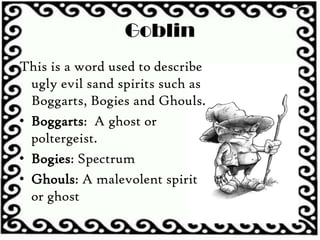
Goblin
This is a word used to describe
ugly evil sand spirits such as
Boggarts, Bogies and Ghouls.
• Boggarts: A ghost or
poltergeist.
• Bogies: Spectrum
• Ghouls: A malevolent spirit
or ghost
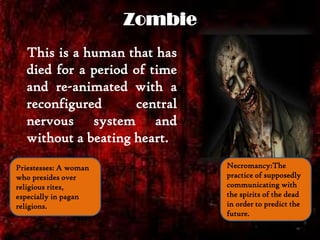
Zombie
This is a human that has
died for a period of time
and re-animated with a
reconfigured central
nervous system and
without a beating heart.
Necromancy:The
practice of supposedly
communicating with
the spirits of the dead
in order to predict the
future.
Priestesses: A woman
who presides over
religious rites,
especially in pagan
religions.
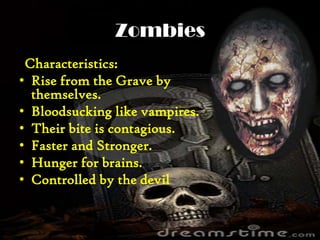
Zombies
Characteristics:
• Rise from the Grave by
themselves.
• Bloodsucking like vampires.
• Their bite is contagious.
• Faster and Stronger.
• Hunger for brains.
• Controlled by the devil
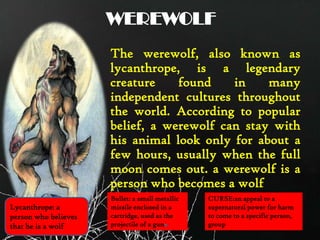
WEREWOLF
The werewolf, also known as
lycanthrope, is a legendary
creature found in many
independent cultures throughout
the world. According to popular
belief, a werewolf can stay with
his animal look only for about a
few hours, usually when the full
moon comes out. a werewolf is a
person who becomes a wolf
Lycanthrope: a
person who believes
that he is a wolf
Bullet: a small metallic
missile enclosed in a
cartridge, used as the
projectile of a gun
CURSE:an appeal to a
supernatural power for harm
to come to a specific person,
group
HOW TO
BECOME A
WEREWOLF?
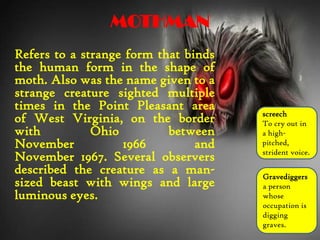
MOTHMAN
Refers to a strange form that binds
the human form in the shape of
moth. Also was the name given to a
strange creature sighted multiple
times in the Point Pleasant area
of West Virginia, on the border
with Ohio between
November 1966 and
November 1967. Several observers
described the creature as a man-
sized beast with wings and large
luminous eyes.
Gravediggers
a person
whose
occupation is
digging
graves.
screech
To cry out in
a high-
pitched,
strident voice.
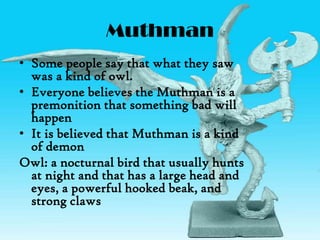
Muthman
• Some people say that what they saw
was a kind of owl.
• Everyone believes the Muthman is a
premonition that something bad will
happen
• It is believed that Muthman is a kind
of demon
Owl: a nocturnal bird that usually hunts
at night and that has a large head and
eyes, a powerful hooked beak, and
strong claws
Colombian Myths and
Legends
The Colombian
folklore has strong
influences from
Spanish culture, with
elements of African
and native American
cultures.
Folklore: (n.) the body of
stories and legends
attached to a particular
place, group, activity, etc.
• The Hombre Caiman, or Alligatorman.
• The Mohana (La Mojana) Mother of water or Mami
Wata
• The evil chicken ("pollo maligno")
• The Candileja
• The dark mule or Mula Retinta
• The Tunda (La Tunda)
• The Patasola or "one foot"
• The Moan
• The Llorona or the Weeping Woman
• The Madre Monte (Mother of the forest) or
Marimonda
• The Sombreron
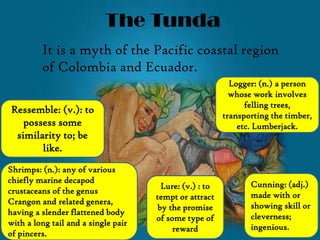
The Tunda
It is a myth of the Pacific coastal region
of Colombia and Ecuador.
Ressemble: (v.): to
possess some
similarity to; be
like.
Lure: (v.) : to
tempt or attract
by the promise
of some type of
reward
Shrimps: (n.): any of various
chiefly marine decapod
crustaceans of the genus
Crangon and related genera,
having a slender flattened body
with a long tail and a single pair
of pincers.
Cunning: (adj.)
made with or
showing skill or
cleverness;
ingenious.
Logger: (n.) a person
whose work involves
felling trees,
transporting the timber,
etc. Lumberjack.
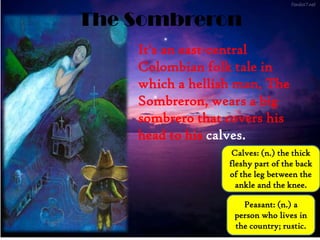
The Sombreron
It's an east-central
Colombian folk tale in
which a hellish man, The
Sombreron, wears a big
sombrero that covers his
head to his calves.
Calves: (n.) the thick
fleshy part of the back
of the leg between the
ankle and the knee.
Peasant: (n.) a
person who lives in
the country; rustic.
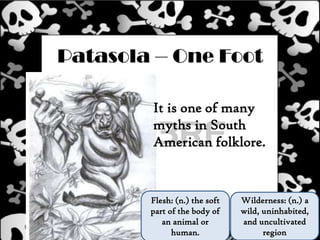
Patasola – One Foot
It is one of many
myths in South
American folklore.
Wilderness: (n.) a
wild, uninhabited,
and uncultivated
region
Flesh: (n.) the soft
part of the body of
an animal or
human.
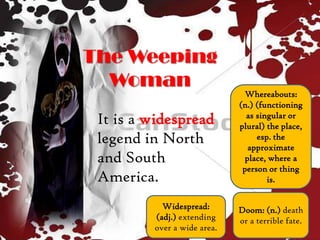
The Weeping
Woman
It is a widespread
legend in North
and South
America.
Widespread:
(adj.) extending
over a wide area.
Doom: (n.) death
or a terrible fate.
Whereabouts:
(n.) (functioning
as singular or
plural) the place,
esp. the
approximate
place, where a
person or thing
is.
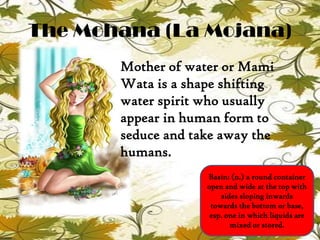
The Mohana (La Mojana)
Mother of water or Mami
Wata is a shape shifting
water spirit who usually
appear in human form to
seduce and take away the
humans.
Basin: (n.) a round container
open and wide at the top with
sides sloping inwards
towards the bottom or base,
esp. one in which liquids are
mixed or stored.
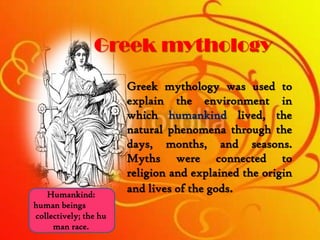
Greek mythology
Greek mythology was used to
explain the environment in
which humankind lived, the
natural phenomena through the
days, months, and seasons.
Myths were connected to
religion and explained the origin
and lives of the gods.Humankind:
human beings
collectively; the hu
man race.
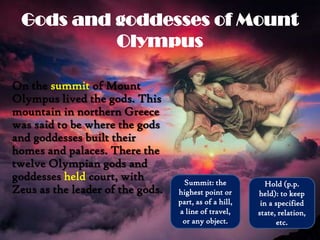
Gods and goddesses of Mount
Olympus
On the summit of Mount
Olympus lived the gods. This
mountain in northern Greece
was said to be where the gods
and goddesses built their
homes and palaces. There the
twelve Olympian gods and
goddesses held court, with
Zeus as the leader of the gods.
Summit: the
highest point or
part, as of a hill,
a line of travel,
or any object.
Hold (p.p.
held): to keep
in a specified
state, relation,
etc.
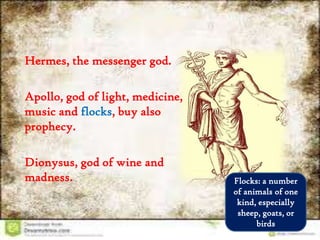
Hermes, the messenger god.
Apollo, god of light, medicine,
music and flocks, buy also
prophecy.
Dionysus, god of wine and
madness. Flocks: a number
of animals of one
kind, especially
sheep, goats, or
birds
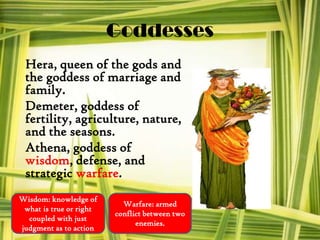
Goddesses
Hera, queen of the gods and
the goddess of marriage and
family.
Demeter, goddess of
fertility, agriculture, nature,
and the seasons.
Athena, goddess of
wisdom, defense, and
strategic warfare.
Wisdom: knowledge of
what is true or right
coupled with just
judgment as to action
Warfare: armed
conflict between two
enemies.
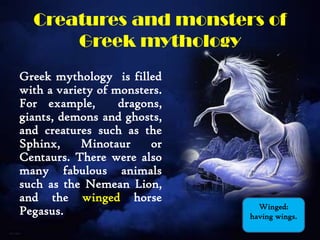
Creatures and monsters of
Greek mythology
Greek mythology is filled
with a variety of monsters.
For example, dragons,
giants, demons and ghosts,
and creatures such as the
Sphinx, Minotaur or
Centaurs. There were also
many fabulous animals
such as the Nemean Lion,
and the winged horse
Pegasus. Winged:
having wings.
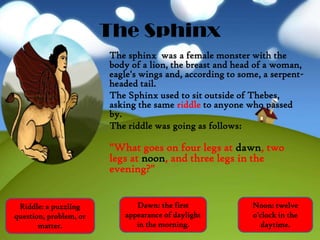
The Sphinx
The sphinx was a female monster with the
body of a lion, the breast and head of a woman,
eagle's wings and, according to some, a serpent-
headed tail.
The Sphinx used to sit outside of Thebes,
asking the same riddle to anyone who passed
by.
The riddle was going as follows:
"What goes on four legs at dawn, two
legs at noon, and three legs in the
evening?"
Riddle: a puzzling
question, problem, or
matter.
Noon: twelve
o'clock in the
daytime.
Dawn: the first
appearance of daylight
in the morning.
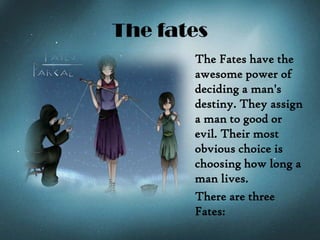
The fates
The Fates have the
awesome power of
deciding a man's
destiny. They assign
a man to good or
evil. Their most
obvious choice is
choosing how long a
man lives.
There are three
Fates:
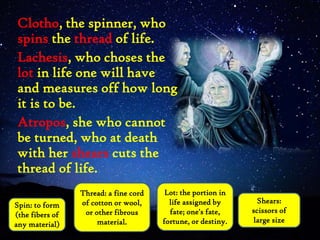
Clotho, the spinner, who
spins the thread of life.
Lachesis, who choses the
lot in life one will have
and measures off how long
it is to be.
Atropos, she who cannot
be turned, who at death
with her shears cuts the
thread of life.
Spin: to form
(the fibers of
any material)
Thread: a fine cord
of cotton or wool,
or other fibrous
material.
Lot: the portion in
life assigned by
fate; one's fate,
fortune, or destiny.
Shears:
scissors of
large size
The Hecatonchires
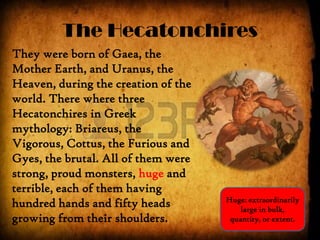
They were born of Gaea, the
Mother Earth, and Uranus, the
Heaven, during the creation of the
world. There where three
Hecatonchires in Greek
mythology: Briareus, the
Vigorous, Cottus, the Furious and
Gyes, the brutal. All of them were
strong, proud monsters, huge and
terrible, each of them having
hundred hands and fifty heads
growing from their shoulders.
Huge: extraordinarily
large in bulk,
quantity, or extent.
Thanks
=)

Myths & legends

  • 1.
  • 2.
    What are myths,legends and folktales? Myths and legends are stories that have been told over a long period of time that have no proof of existence. Cater: (v.) to provide what is required or desired (for) Hand Down: (v.) to pass (an outgrown garment) on from one member of a family to a younger one
  • 3.
    What are legends? Alegend is a semi- true story, which has been passed on from person to person. Encompass: (v.) to include entirely or comprehensively
  • 4.
    What are myths? Amyth is a story based on tradition or legend, which has a deep symbolic meaning. Shift: (v.) to move or cause to move from one place or position to another Convey: (v.) to transmit or transfer.
  • 5.
    What are folktales? Afolktale is a popular story that was passed on in a spoken form, from one generation to the next. Comprise: (v.) to include; contain.
  • 6.
    What is thedifference between legends, myths and folktales? Myths, legends and folktales are hard to classify and often overlap. Overlap: (v.) (of two things) to extend or lie partly over (each other) Account: (n.): a verbal or written report, description, or narration of some occurrence, event, etc.
  • 7.
    WHITCHES A witch isa person who practices witchcraft. In the Western world, a witch is associated with a woman riding on a broomstick. A witch is a recurring character in the contemporary imagination. Wart : a small rounded outgrowth. Pantheon: all the gods collectively of a religion witchcraft: the influence of magic or sorcery.
  • 8.
    HISTORY In Europe inthe early modern period, persecution of witches took place. As a result, tens or hundreds of thousands of people were tried for witchcraft, and executed.
  • 9.
  • 10.
    The mark ofthe devil People believed that witches had a pact with the devil. The diabolical mark (or mark of the devil) was a token left on the skin of the witch. BIRTHMARK: a blemish or new growth on skin formed before birth
  • 11.
    VAMPIRES A vampire isa creature that feeds on the life essence of other living things in order to stay active. In some Eastern cultures, the vampire is a demonic deity or lesser god who is part of the sinister pantheon in their mythologies. COFFIN: a box in which a corpse is buried or cremated GARLIC: the bulb of this plant, made up of small segments that have a strong odour
  • 12.
    IDENTIFYING VAMPIRE Corpses thoughtto be vampires were generally described as having a healthier appearance than expected, plump and showing little or no signs of decomposition. Evidence that a vampire was active in a given locality included death of cattle, sheep, relatives or neighbors.
  • 13.
    Goblin A grotesque elfincreature of folklore, thought to work mischief or evil. Shrewd: characterized by keen awareness, sharp intelligence, and often a sense of the practical Tinkers: a traveling mender of metal household utensils. Gunpowder: Any of various explosive powders used to propel projectiles from guns, especially a black mixture of potassium nitrate, charcoal, and sulfur. Upper: higher or highest in relation to physical position, wealth, rank, status, etc Swords: A weapon consisting typically of a long, straight or slightly curved, pointed blade having one or two cutting edges and set into a hilt.
  • 14.
    Goblin This is aword used to describe ugly evil sand spirits such as Boggarts, Bogies and Ghouls. • Boggarts: A ghost or poltergeist. • Bogies: Spectrum • Ghouls: A malevolent spirit or ghost
  • 15.
    Zombie This is ahuman that has died for a period of time and re-animated with a reconfigured central nervous system and without a beating heart. Necromancy:The practice of supposedly communicating with the spirits of the dead in order to predict the future. Priestesses: A woman who presides over religious rites, especially in pagan religions.
  • 16.
    Zombies Characteristics: • Rise fromthe Grave by themselves. • Bloodsucking like vampires. • Their bite is contagious. • Faster and Stronger. • Hunger for brains. • Controlled by the devil
  • 17.
    WEREWOLF The werewolf, alsoknown as lycanthrope, is a legendary creature found in many independent cultures throughout the world. According to popular belief, a werewolf can stay with his animal look only for about a few hours, usually when the full moon comes out. a werewolf is a person who becomes a wolf Lycanthrope: a person who believes that he is a wolf Bullet: a small metallic missile enclosed in a cartridge, used as the projectile of a gun CURSE:an appeal to a supernatural power for harm to come to a specific person, group
  • 18.
  • 19.
    MOTHMAN Refers to astrange form that binds the human form in the shape of moth. Also was the name given to a strange creature sighted multiple times in the Point Pleasant area of West Virginia, on the border with Ohio between November 1966 and November 1967. Several observers described the creature as a man- sized beast with wings and large luminous eyes. Gravediggers a person whose occupation is digging graves. screech To cry out in a high- pitched, strident voice.
  • 20.
    Muthman • Some peoplesay that what they saw was a kind of owl. • Everyone believes the Muthman is a premonition that something bad will happen • It is believed that Muthman is a kind of demon Owl: a nocturnal bird that usually hunts at night and that has a large head and eyes, a powerful hooked beak, and strong claws
  • 21.
    Colombian Myths and Legends TheColombian folklore has strong influences from Spanish culture, with elements of African and native American cultures. Folklore: (n.) the body of stories and legends attached to a particular place, group, activity, etc.
  • 22.
    • The HombreCaiman, or Alligatorman. • The Mohana (La Mojana) Mother of water or Mami Wata • The evil chicken ("pollo maligno") • The Candileja • The dark mule or Mula Retinta • The Tunda (La Tunda) • The Patasola or "one foot" • The Moan • The Llorona or the Weeping Woman • The Madre Monte (Mother of the forest) or Marimonda • The Sombreron
  • 23.
    The Tunda It isa myth of the Pacific coastal region of Colombia and Ecuador. Ressemble: (v.): to possess some similarity to; be like. Lure: (v.) : to tempt or attract by the promise of some type of reward Shrimps: (n.): any of various chiefly marine decapod crustaceans of the genus Crangon and related genera, having a slender flattened body with a long tail and a single pair of pincers. Cunning: (adj.) made with or showing skill or cleverness; ingenious. Logger: (n.) a person whose work involves felling trees, transporting the timber, etc. Lumberjack.
  • 24.
    The Sombreron It's aneast-central Colombian folk tale in which a hellish man, The Sombreron, wears a big sombrero that covers his head to his calves. Calves: (n.) the thick fleshy part of the back of the leg between the ankle and the knee. Peasant: (n.) a person who lives in the country; rustic.
  • 25.
    Patasola – OneFoot It is one of many myths in South American folklore. Wilderness: (n.) a wild, uninhabited, and uncultivated region Flesh: (n.) the soft part of the body of an animal or human.
  • 26.
    The Weeping Woman It isa widespread legend in North and South America. Widespread: (adj.) extending over a wide area. Doom: (n.) death or a terrible fate. Whereabouts: (n.) (functioning as singular or plural) the place, esp. the approximate place, where a person or thing is.
  • 27.
    The Mohana (LaMojana) Mother of water or Mami Wata is a shape shifting water spirit who usually appear in human form to seduce and take away the humans. Basin: (n.) a round container open and wide at the top with sides sloping inwards towards the bottom or base, esp. one in which liquids are mixed or stored.
  • 28.
    Greek mythology Greek mythologywas used to explain the environment in which humankind lived, the natural phenomena through the days, months, and seasons. Myths were connected to religion and explained the origin and lives of the gods.Humankind: human beings collectively; the hu man race.
  • 29.
    Gods and goddessesof Mount Olympus On the summit of Mount Olympus lived the gods. This mountain in northern Greece was said to be where the gods and goddesses built their homes and palaces. There the twelve Olympian gods and goddesses held court, with Zeus as the leader of the gods. Summit: the highest point or part, as of a hill, a line of travel, or any object. Hold (p.p. held): to keep in a specified state, relation, etc.
  • 30.
    Hermes, the messengergod. Apollo, god of light, medicine, music and flocks, buy also prophecy. Dionysus, god of wine and madness. Flocks: a number of animals of one kind, especially sheep, goats, or birds
  • 31.
    Goddesses Hera, queen ofthe gods and the goddess of marriage and family. Demeter, goddess of fertility, agriculture, nature, and the seasons. Athena, goddess of wisdom, defense, and strategic warfare. Wisdom: knowledge of what is true or right coupled with just judgment as to action Warfare: armed conflict between two enemies.
  • 32.
    Creatures and monstersof Greek mythology Greek mythology is filled with a variety of monsters. For example, dragons, giants, demons and ghosts, and creatures such as the Sphinx, Minotaur or Centaurs. There were also many fabulous animals such as the Nemean Lion, and the winged horse Pegasus. Winged: having wings.
  • 33.
    The Sphinx The sphinxwas a female monster with the body of a lion, the breast and head of a woman, eagle's wings and, according to some, a serpent- headed tail. The Sphinx used to sit outside of Thebes, asking the same riddle to anyone who passed by. The riddle was going as follows: "What goes on four legs at dawn, two legs at noon, and three legs in the evening?" Riddle: a puzzling question, problem, or matter. Noon: twelve o'clock in the daytime. Dawn: the first appearance of daylight in the morning.
  • 34.
    The fates The Fateshave the awesome power of deciding a man's destiny. They assign a man to good or evil. Their most obvious choice is choosing how long a man lives. There are three Fates:
  • 35.
    Clotho, the spinner,who spins the thread of life. Lachesis, who choses the lot in life one will have and measures off how long it is to be. Atropos, she who cannot be turned, who at death with her shears cuts the thread of life. Spin: to form (the fibers of any material) Thread: a fine cord of cotton or wool, or other fibrous material. Lot: the portion in life assigned by fate; one's fate, fortune, or destiny. Shears: scissors of large size
  • 36.
    The Hecatonchires They wereborn of Gaea, the Mother Earth, and Uranus, the Heaven, during the creation of the world. There where three Hecatonchires in Greek mythology: Briareus, the Vigorous, Cottus, the Furious and Gyes, the brutal. All of them were strong, proud monsters, huge and terrible, each of them having hundred hands and fifty heads growing from their shoulders. Huge: extraordinarily large in bulk, quantity, or extent.
  • 37.