RWD, EHRs, PROs.
Using data to inform the
patient trajectory and
experience
Warren A. Kibbe, Ph.D.
Professor, Biostatistics & Bioinformatics
Chief Data Officer, Duke Cancer Institute
warren.kibbe@duke.edu
@wakibbe
#PredictiveModeling
#ConnectedHealth
#PopulationScience
Special thanks to Mike Hogarth, UCSD and NCI for some of the slides
Take homes
• Data generation is no longer the
bottleneck – data management,
analysis, reasoning are
• Technology is changing, ubiquitous,
connected. Platform for new insights
• Data science is everywhere
• Move from observation to prediction to
intervention & prevention
• Understanding the patient context, the
patient trajectory, is key
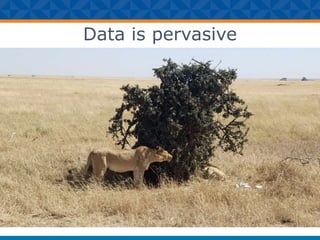
Data is pervasive
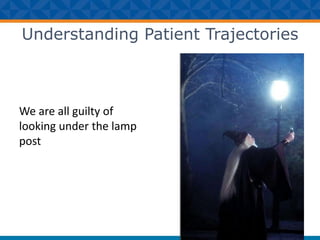
Understanding Patient Trajectories
We are all guilty of
looking under the lamp
post
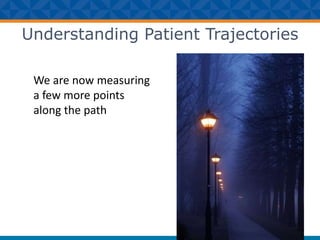
Understanding Patient Trajectories
We are now measuring
a few more points
along the path
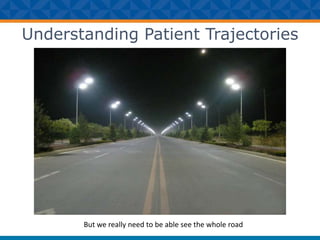
Understanding Patient Trajectories
But we really need to be able see the whole road
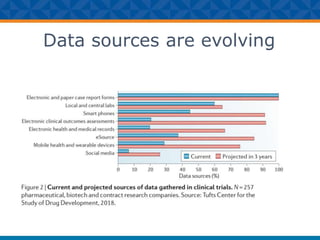
Data sources are evolving
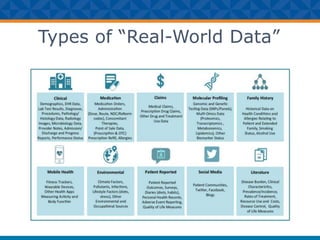
Types of “Real-World Data”
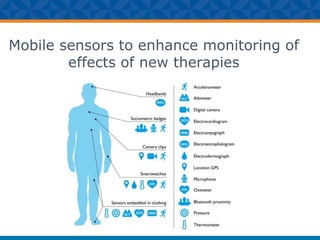
Mobile sensors to enhance monitoring of
effects of new therapies
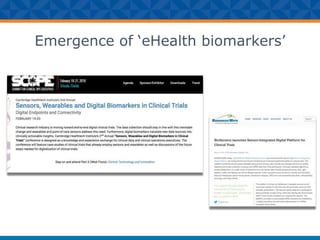
Emergence of ‘eHealth biomarkers’
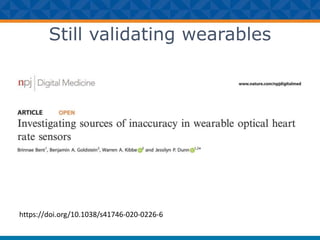
Still validating wearables
https://doi.org/10.1038/s41746-020-0226-6
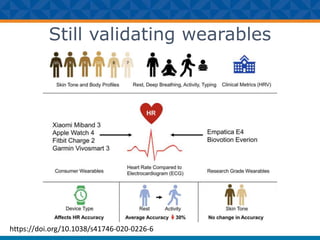
Still validating wearables
https://doi.org/10.1038/s41746-020-0226-6
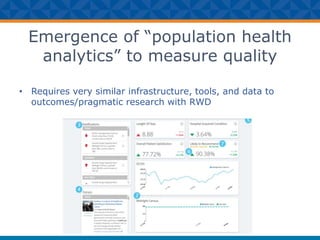
Emergence of “population health
analytics” to measure quality
• Requires very similar infrastructure, tools, and data to
outcomes/pragmatic research with RWD
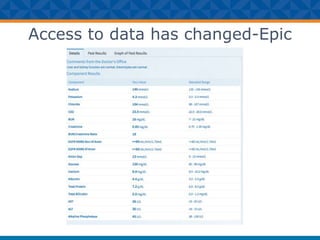
Access to data has changed-Epic
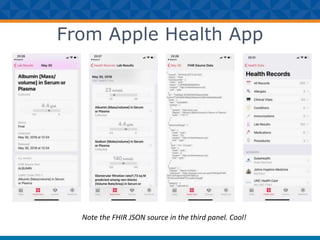
From Apple Health App
Note the FHIR JSON source in the third panel. Cool!
Issues in Healthcare
• Evidence is not consistently
accessible and structured
• Outcomes are not connected to care
• Patient trajectories are not calculated
or easily accessible
Population Health
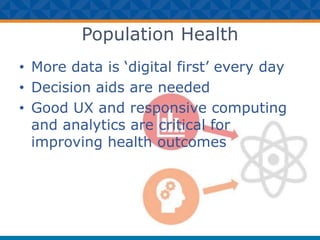
• More data is ‘digital first’ every day
• Decision aids are needed
• Good UX and responsive computing
and analytics are critical for
improving health outcomes
Data Science Hype
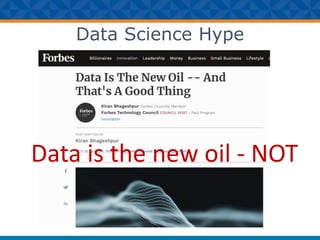
Data is the new oil - NOT
Data Science Hype
Using data
increases its value
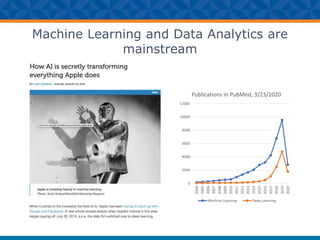
Machine Learning and Data Analytics are
mainstream
0
2000
4000
6000
8000
10000
12000
2004
2005
2006
2007
2008
2009
2010
2011
2012
2013
2014
2015
2016
2017
2018
2019
2020
Publications in PubMed, 3/23/2020
Machine Learning Deep Learning
Applying Machine Learning
• Image analysis at scale, with well
characterized error, uncertainty and confidence
• Support for Molecular Tumor Boards, linking
mutations with evidence for intervention
• Decision Support such as ‘This patient has
melanoma with BRAF V600E mutations.
Consider a targeted therapy like Trametinib
or Vemurafenib’
• Identification of high risk patients, like
‘Your patient is at high risk for re-admittance.
Patients with APACHE scores, MI, and pain
medications have a x in y probability of
remittance based on 2014-2018 data.
Applying Machine Learning
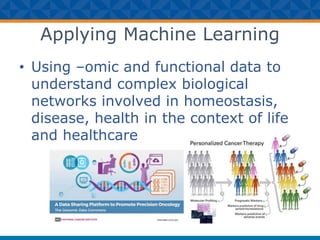
• Using –omic and functional data to
understand complex biological
networks involved in homeostasis,
disease, health in the context of life
and healthcare
Applying Machine Learning
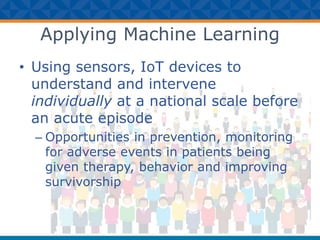
• Using sensors, IoT devices to
understand and intervene
individually at a national scale before
an acute episode
– Opportunities in prevention, monitoring
for adverse events in patients being
given therapy, behavior and improving
survivorship
Questions?
Warren Kibbe, Ph.D.
warren.kibbe@duke.edu
@wakibbe
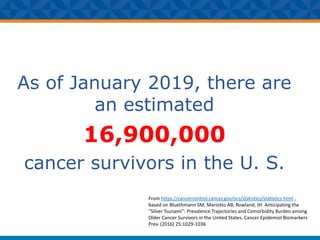
As of January 2019, there are
an estimated
16,900,000
cancer survivors in the U. S.
From https://cancercontrol.cancer.gov/ocs/statistics/statistics.html ,
based on Bluethmann SM, Mariotto AB, Rowland, JH. Anticipating the
''Silver Tsunami'': Prevalence Trajectories and Comorbidity Burden among
Older Cancer Survivors in the United States. Cancer Epidemiol Biomarkers
Prev. (2016) 25:1029-1036
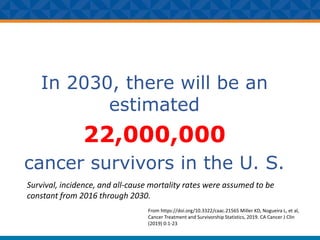
In 2030, there will be an
estimated
22,000,000
cancer survivors in the U. S.
From https://doi.org/10.3322/caac.21565 Miller KD, Nogueira L, et al,
Cancer Treatment and Survivorship Statistics, 2019. CA Cancer J Clin
(2019) 0:1-23
Survival, incidence, and all-cause mortality rates were assumed to be
constant from 2016 through 2030.

ENAR 2020

  • 1.
    RWD, EHRs, PROs. Usingdata to inform the patient trajectory and experience Warren A. Kibbe, Ph.D. Professor, Biostatistics & Bioinformatics Chief Data Officer, Duke Cancer Institute warren.kibbe@duke.edu @wakibbe #PredictiveModeling #ConnectedHealth #PopulationScience Special thanks to Mike Hogarth, UCSD and NCI for some of the slides
  • 2.
    Take homes • Datageneration is no longer the bottleneck – data management, analysis, reasoning are • Technology is changing, ubiquitous, connected. Platform for new insights • Data science is everywhere • Move from observation to prediction to intervention & prevention • Understanding the patient context, the patient trajectory, is key
  • 3.
  • 4.
    Understanding Patient Trajectories Weare all guilty of looking under the lamp post
  • 5.
    Understanding Patient Trajectories Weare now measuring a few more points along the path
  • 6.
    Understanding Patient Trajectories Butwe really need to be able see the whole road
  • 7.
  • 8.
  • 9.
    Mobile sensors toenhance monitoring of effects of new therapies
  • 10.
  • 11.
  • 12.
  • 13.
    Emergence of “populationhealth analytics” to measure quality • Requires very similar infrastructure, tools, and data to outcomes/pragmatic research with RWD
  • 14.
    Access to datahas changed-Epic
  • 15.
    From Apple HealthApp Note the FHIR JSON source in the third panel. Cool!
  • 16.
    Issues in Healthcare •Evidence is not consistently accessible and structured • Outcomes are not connected to care • Patient trajectories are not calculated or easily accessible
  • 17.
    Population Health • Moredata is ‘digital first’ every day • Decision aids are needed • Good UX and responsive computing and analytics are critical for improving health outcomes
  • 18.
    Data Science Hype Datais the new oil - NOT
  • 19.
    Data Science Hype Usingdata increases its value
  • 20.
    Machine Learning andData Analytics are mainstream 0 2000 4000 6000 8000 10000 12000 2004 2005 2006 2007 2008 2009 2010 2011 2012 2013 2014 2015 2016 2017 2018 2019 2020 Publications in PubMed, 3/23/2020 Machine Learning Deep Learning
  • 21.
    Applying Machine Learning •Image analysis at scale, with well characterized error, uncertainty and confidence • Support for Molecular Tumor Boards, linking mutations with evidence for intervention • Decision Support such as ‘This patient has melanoma with BRAF V600E mutations. Consider a targeted therapy like Trametinib or Vemurafenib’ • Identification of high risk patients, like ‘Your patient is at high risk for re-admittance. Patients with APACHE scores, MI, and pain medications have a x in y probability of remittance based on 2014-2018 data.
  • 22.
    Applying Machine Learning •Using –omic and functional data to understand complex biological networks involved in homeostasis, disease, health in the context of life and healthcare
  • 23.
    Applying Machine Learning •Using sensors, IoT devices to understand and intervene individually at a national scale before an acute episode – Opportunities in prevention, monitoring for adverse events in patients being given therapy, behavior and improving survivorship
  • 24.
  • 25.
    As of January2019, there are an estimated 16,900,000 cancer survivors in the U. S. From https://cancercontrol.cancer.gov/ocs/statistics/statistics.html , based on Bluethmann SM, Mariotto AB, Rowland, JH. Anticipating the ''Silver Tsunami'': Prevalence Trajectories and Comorbidity Burden among Older Cancer Survivors in the United States. Cancer Epidemiol Biomarkers Prev. (2016) 25:1029-1036
  • 26.
    In 2030, therewill be an estimated 22,000,000 cancer survivors in the U. S. From https://doi.org/10.3322/caac.21565 Miller KD, Nogueira L, et al, Cancer Treatment and Survivorship Statistics, 2019. CA Cancer J Clin (2019) 0:1-23 Survival, incidence, and all-cause mortality rates were assumed to be constant from 2016 through 2030.

Editor's Notes

  • #19 Be careful of the hype. The promise is solid, but the snakeoil is real
  • #20 Be careful of the hype. The promise is solid, but the snakeoil is real