Data Science for Healthcare:
What Today's Leaders Must Know
© 2016 Health Catalyst
Proprietary. Feel free to share but we would appreciate a Health Catalyst citation.
Data Science for Healthcare
Success in today’s data-driven healthcare
industry will be increasingly defined by
leaders who understand data science.
This knowledge will be critical as
executives build and guide teams toward
a harmonious, well-planned vision for
healthcare improvement that fully
harnesses data’s capabilities.
Up to 30 percent of the world’s warehoused data comes from the healthcare
industry. There’s significant opportunity for healthcare improvement in this
information cache, including an estimated $300 billion in annual cost savings.
© 2016 Health Catalyst
Proprietary. Feel free to share but we would appreciate a Health Catalyst citation.
Data Science for Healthcare
But the industry can only welcome these
prospects if health systems fully leverage data
to identify areas for improvement and promote
evidence-based care. Even with this massive
data potential, healthcare too often relies on
outdated technology.
For example, up to 75 percent of medical
communication still occurs via fax machine (in
an era where automotive companies use data
science to add navigation capabilities to cars).
Technology has laid out the opportunities, but,
to realize gains in the digital era, healthcare
leaders must understand data science and the
urgency of investing in data science resources.
© 2016 Health Catalyst
Proprietary. Feel free to share but we would appreciate a Health Catalyst citation.
The Bird’s Eye View of What Data Scientists Do
As a broad term, data science means
pulling information out of data, or
converting raw data into actionable
insights.
Data scientists are knowledgeable in their
subject matter (e.g., healthcare clinical
data) and statistics, and use computer
programming skills to tell the computer
how to leverage data to derive insights.
© 2016 Health Catalyst
Proprietary. Feel free to share but we would appreciate a Health Catalyst citation.
The Bird’s Eye View of What Data Scientists Do
Data scientists augment traditional data
analysis by automating the process of
insight delivery through code.
This automation can bring efficiency gains
and new depths of insight to analytics,
and enables real-time predictive analytics
by reducing the time it takes to go from
data to prediction.
© 2016 Health Catalyst
Proprietary. Feel free to share but we would appreciate a Health Catalyst citation.
The Heart of Healthcare Data Science:
Machine Learning Models that Yield Deeper Insights
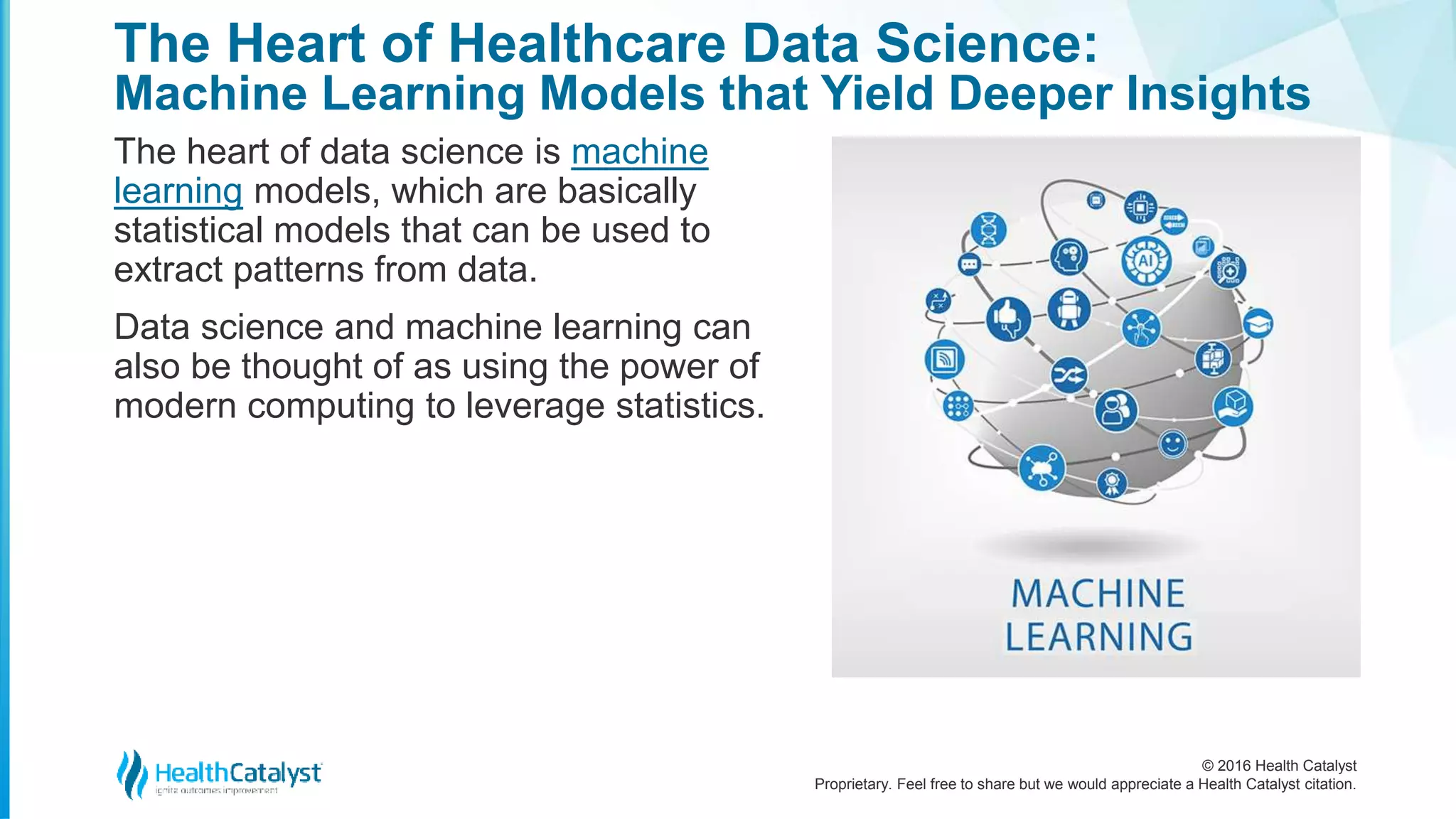
The heart of data science is machine
learning models, which are basically
statistical models that can be used to
extract patterns from data.
Data science and machine learning can
also be thought of as using the power of
modern computing to leverage statistics.
© 2016 Health Catalyst
Proprietary. Feel free to share but we would appreciate a Health Catalyst citation.
The Heart of Healthcare Data Science:
Machine Learning Models that Yield Deeper Insights
Some machine learning models, such as
regularized regression and decision trees,
lend themselves well to deriving insights
and explaining patterns in data.
Other machine learning models, such
random forests and neural networks (deep
learning), are primarily used for prediction
(e.g., each patient in a population’s
likelihood of readmission after discharge).
© 2016 Health Catalyst
Proprietary. Feel free to share but we would appreciate a Health Catalyst citation.
Healthcare Data Science Is the Key to Faster
Diagnosis, Better Treatment
Healthcare has long relied on data and data
analysis to understand health-related issues and
find effective treatments.
For example, researchers have used double blind
placebo-controlled studies as the foundation of
evidence-based medicine.
Such studies generate data about the treatment
under evaluation and analyze that data to
determine whether the treatment is effective, as
well as understand its side effects.
As a method of generating data and insight, this
study process works in a spirit similar to data
science, but is costlier and more time consuming.
© 2016 Health Catalyst
Proprietary. Feel free to share but we would appreciate a Health Catalyst citation.
Healthcare Data Science Is the Key to Faster
Diagnosis, Better Treatment
Today, healthcare needs data to optimize patient
outcomes with evidence-based practices more
than ever; those insights are waiting to be
discovered in data that has already been collected.
With data science, the industry can find efficient,
cost-effective ways to harness vast amounts of
existing healthcare data—to maximize its potential
to transform healthcare with faster, more accurate
diagnosis and more effective, lower-risk treatment.
© 2016 Health Catalyst
Proprietary. Feel free to share but we would appreciate a Health Catalyst citation.
Data Science for Healthcare in Action
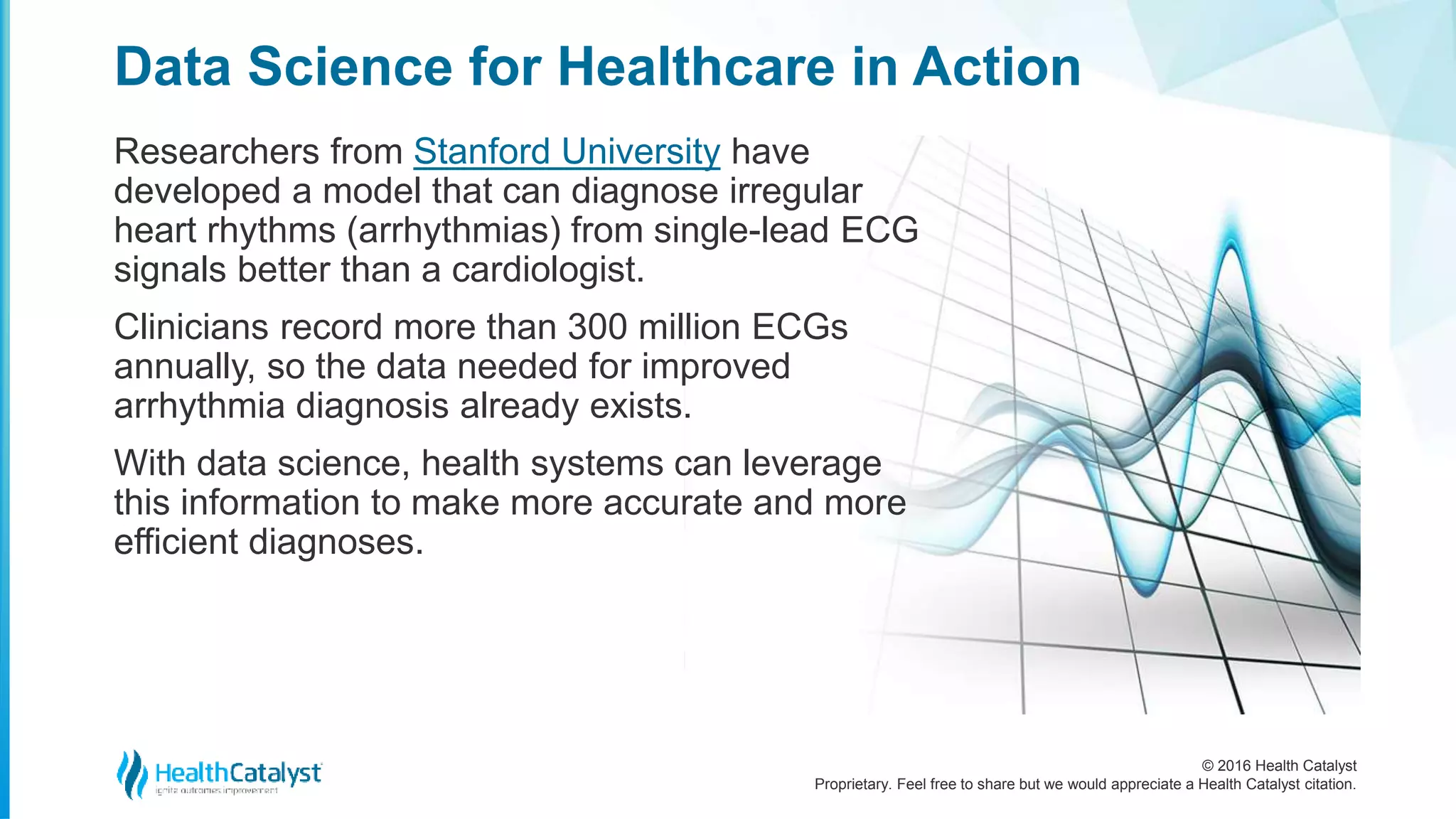
Researchers from Stanford University have
developed a model that can diagnose irregular
heart rhythms (arrhythmias) from single-lead ECG
signals better than a cardiologist.
Clinicians record more than 300 million ECGs
annually, so the data needed for improved
arrhythmia diagnosis already exists.
With data science, health systems can leverage
this information to make more accurate and more
efficient diagnoses.
© 2016 Health Catalyst
Proprietary. Feel free to share but we would appreciate a Health Catalyst citation.
Data Science for Healthcare in Action
Another group of Stanford researchers has
developed a diagnostic model for skin cancers that
uses AI to classify images of skin lesions as benign
marks or malignant skin cancers.
This model, which can classify lesions as
accurately as board-certified dermatologists, can
potentially save health systems and patients time
and cost by transforming the multistep process of
diagnosing skin cancer into a single-step data
analysis.
While models are not designed to replace
clinicians, they can provide valuable diagnostic
guidance, making the care process both more
efficient and more effective.
© 2016 Health Catalyst
Proprietary. Feel free to share but we would appreciate a Health Catalyst citation.
Data Science for Healthcare in Action
Mission Health wanted to improve the accuracy of
its readmission risk assessment, so it leveraged
machine learning to develop a predictive model
based on its own patient population.
Mission was using the LACE index to predict risk
for readmission, which, while somewhat helpful,
was developed using a patient population from
Canada that was notably different from Mission’s
demographic.
With a machine learning model that used its own
population, Mission improved its readmission risk
prediction to outperform LACE and achieve a
readmission rate 1.2 percentage points lower
than its top hospital peers.
© 2016 Health Catalyst
Proprietary. Feel free to share but we would appreciate a Health Catalyst citation.
The Time to Understand and Leverage Data
Science Is Now
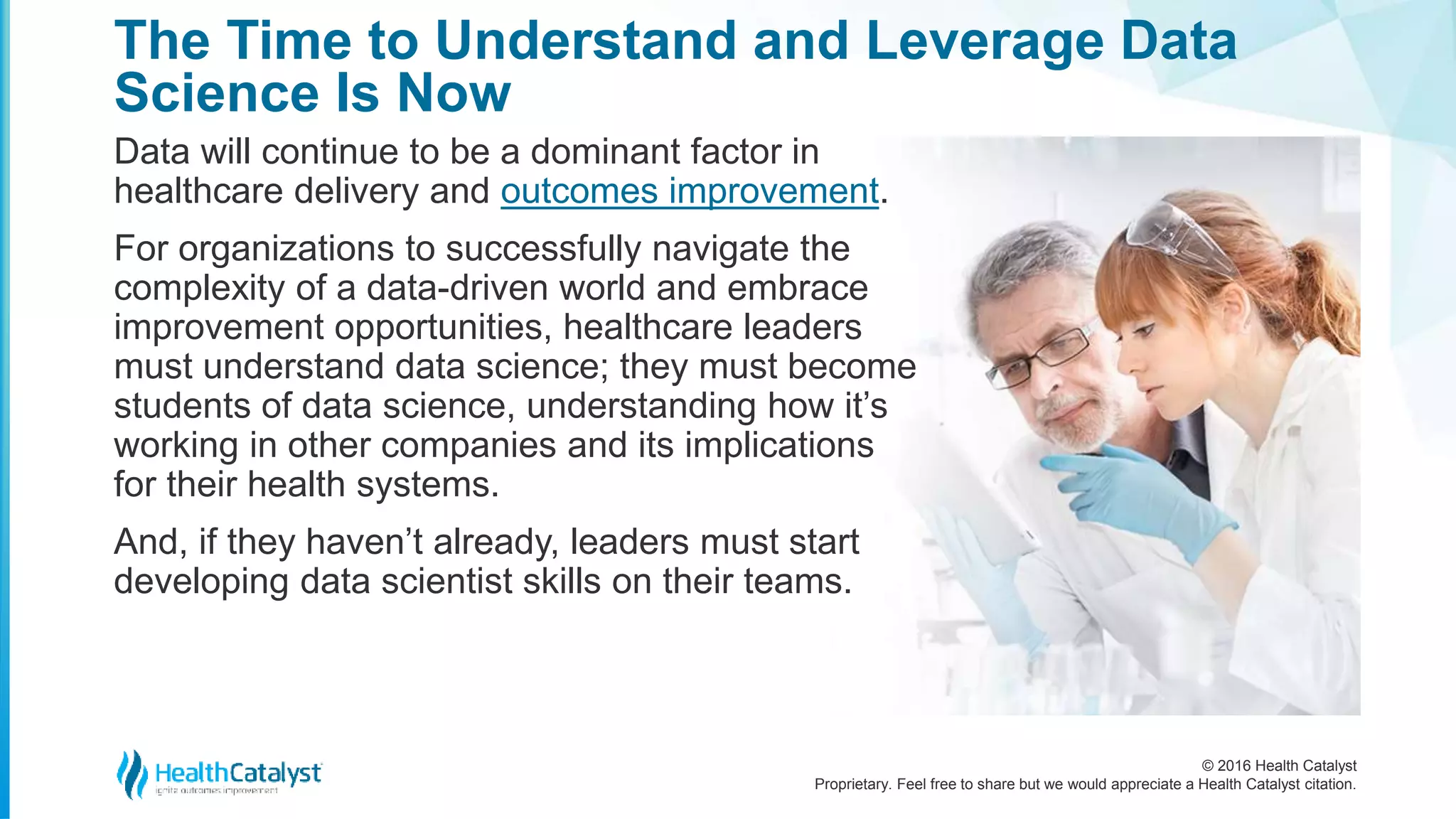
Data will continue to be a dominant factor in
healthcare delivery and outcomes improvement.
For organizations to successfully navigate the
complexity of a data-driven world and embrace
improvement opportunities, healthcare leaders
must understand data science; they must become
students of data science, understanding how it’s
working in other companies and its implications
for their health systems.
And, if they haven’t already, leaders must start
developing data scientist skills on their teams.
© 2016 Health Catalyst
Proprietary. Feel free to share but we would appreciate a Health Catalyst citation.
For more information:
“This book is a fantastic piece of work”
– Robert Lindeman MD, FAAP, Chief Physician Quality Officer
© 2016 Health Catalyst
Proprietary. Feel free to share but we would appreciate a Health Catalyst citation.
More about this topic
Link to original article for a more in-depth discussion.
Data Science for Healthcare: What Today's Leaders Must Know
The Healthcare Analytics Ecosystem: A Must-Have in Today’s Transformation
John Wadsworth, Technical Operations, VP
Healthcare Analytics Adoption Model: A Framework and Roadmap (white paper)
Dale Sanders, President of Technology
In Healthcare Predictive Analytics, Big Data Is Sometimes a Big Mess Kenneth Kleinberg,
David Crockett, PhD., Research & Predictive Analytics, Sr. Director
Patient Flight Path Analytics: From Airline Operations to Healthcare Outcomes
Dale Sanders, David Crockett, Justin Gressel
Machine Learning, Predictive Analytics, and Process Redesign Reduces Readmission
Rates by 50 Percent Health Catalyst - EDW/Machine Learning Solution
© 2016 Health Catalyst
Proprietary. Feel free to share but we would appreciate a Health Catalyst citation.
Other Clinical Quality Improvement Resources
Click to read additional information at www.healthcatalyst.com
Michael joined Health Catalyst in June 2017 as a data scientist. Prior to coming to Health
Catalyst, he received his PhD from the University of California, Davis in Ecology using network
analysis to study how people learn and think about sustainable agriculture. Michael also has an
MS in Biology from West Virginia University and a BS in Chemistry from Fort Lewis College.
Michael Levy

Data Science for Healthcare: What Today’s Leaders Must Know

  • 1.
    Data Science forHealthcare: What Today's Leaders Must Know
  • 2.
    © 2016 HealthCatalyst Proprietary. Feel free to share but we would appreciate a Health Catalyst citation. Data Science for Healthcare Success in today’s data-driven healthcare industry will be increasingly defined by leaders who understand data science. This knowledge will be critical as executives build and guide teams toward a harmonious, well-planned vision for healthcare improvement that fully harnesses data’s capabilities. Up to 30 percent of the world’s warehoused data comes from the healthcare industry. There’s significant opportunity for healthcare improvement in this information cache, including an estimated $300 billion in annual cost savings.
  • 3.
    © 2016 HealthCatalyst Proprietary. Feel free to share but we would appreciate a Health Catalyst citation. Data Science for Healthcare But the industry can only welcome these prospects if health systems fully leverage data to identify areas for improvement and promote evidence-based care. Even with this massive data potential, healthcare too often relies on outdated technology. For example, up to 75 percent of medical communication still occurs via fax machine (in an era where automotive companies use data science to add navigation capabilities to cars). Technology has laid out the opportunities, but, to realize gains in the digital era, healthcare leaders must understand data science and the urgency of investing in data science resources.
  • 4.
    © 2016 HealthCatalyst Proprietary. Feel free to share but we would appreciate a Health Catalyst citation. The Bird’s Eye View of What Data Scientists Do As a broad term, data science means pulling information out of data, or converting raw data into actionable insights. Data scientists are knowledgeable in their subject matter (e.g., healthcare clinical data) and statistics, and use computer programming skills to tell the computer how to leverage data to derive insights.
  • 5.
    © 2016 HealthCatalyst Proprietary. Feel free to share but we would appreciate a Health Catalyst citation. The Bird’s Eye View of What Data Scientists Do Data scientists augment traditional data analysis by automating the process of insight delivery through code. This automation can bring efficiency gains and new depths of insight to analytics, and enables real-time predictive analytics by reducing the time it takes to go from data to prediction.
  • 6.
    © 2016 HealthCatalyst Proprietary. Feel free to share but we would appreciate a Health Catalyst citation. The Heart of Healthcare Data Science: Machine Learning Models that Yield Deeper Insights The heart of data science is machine learning models, which are basically statistical models that can be used to extract patterns from data. Data science and machine learning can also be thought of as using the power of modern computing to leverage statistics.
  • 7.
    © 2016 HealthCatalyst Proprietary. Feel free to share but we would appreciate a Health Catalyst citation. The Heart of Healthcare Data Science: Machine Learning Models that Yield Deeper Insights Some machine learning models, such as regularized regression and decision trees, lend themselves well to deriving insights and explaining patterns in data. Other machine learning models, such random forests and neural networks (deep learning), are primarily used for prediction (e.g., each patient in a population’s likelihood of readmission after discharge).
  • 8.
    © 2016 HealthCatalyst Proprietary. Feel free to share but we would appreciate a Health Catalyst citation. Healthcare Data Science Is the Key to Faster Diagnosis, Better Treatment Healthcare has long relied on data and data analysis to understand health-related issues and find effective treatments. For example, researchers have used double blind placebo-controlled studies as the foundation of evidence-based medicine. Such studies generate data about the treatment under evaluation and analyze that data to determine whether the treatment is effective, as well as understand its side effects. As a method of generating data and insight, this study process works in a spirit similar to data science, but is costlier and more time consuming.
  • 9.
    © 2016 HealthCatalyst Proprietary. Feel free to share but we would appreciate a Health Catalyst citation. Healthcare Data Science Is the Key to Faster Diagnosis, Better Treatment Today, healthcare needs data to optimize patient outcomes with evidence-based practices more than ever; those insights are waiting to be discovered in data that has already been collected. With data science, the industry can find efficient, cost-effective ways to harness vast amounts of existing healthcare data—to maximize its potential to transform healthcare with faster, more accurate diagnosis and more effective, lower-risk treatment.
  • 10.
    © 2016 HealthCatalyst Proprietary. Feel free to share but we would appreciate a Health Catalyst citation. Data Science for Healthcare in Action Researchers from Stanford University have developed a model that can diagnose irregular heart rhythms (arrhythmias) from single-lead ECG signals better than a cardiologist. Clinicians record more than 300 million ECGs annually, so the data needed for improved arrhythmia diagnosis already exists. With data science, health systems can leverage this information to make more accurate and more efficient diagnoses.
  • 11.
    © 2016 HealthCatalyst Proprietary. Feel free to share but we would appreciate a Health Catalyst citation. Data Science for Healthcare in Action Another group of Stanford researchers has developed a diagnostic model for skin cancers that uses AI to classify images of skin lesions as benign marks or malignant skin cancers. This model, which can classify lesions as accurately as board-certified dermatologists, can potentially save health systems and patients time and cost by transforming the multistep process of diagnosing skin cancer into a single-step data analysis. While models are not designed to replace clinicians, they can provide valuable diagnostic guidance, making the care process both more efficient and more effective.
  • 12.
    © 2016 HealthCatalyst Proprietary. Feel free to share but we would appreciate a Health Catalyst citation. Data Science for Healthcare in Action Mission Health wanted to improve the accuracy of its readmission risk assessment, so it leveraged machine learning to develop a predictive model based on its own patient population. Mission was using the LACE index to predict risk for readmission, which, while somewhat helpful, was developed using a patient population from Canada that was notably different from Mission’s demographic. With a machine learning model that used its own population, Mission improved its readmission risk prediction to outperform LACE and achieve a readmission rate 1.2 percentage points lower than its top hospital peers.
  • 13.
    © 2016 HealthCatalyst Proprietary. Feel free to share but we would appreciate a Health Catalyst citation. The Time to Understand and Leverage Data Science Is Now Data will continue to be a dominant factor in healthcare delivery and outcomes improvement. For organizations to successfully navigate the complexity of a data-driven world and embrace improvement opportunities, healthcare leaders must understand data science; they must become students of data science, understanding how it’s working in other companies and its implications for their health systems. And, if they haven’t already, leaders must start developing data scientist skills on their teams.
  • 14.
    © 2016 HealthCatalyst Proprietary. Feel free to share but we would appreciate a Health Catalyst citation. For more information: “This book is a fantastic piece of work” – Robert Lindeman MD, FAAP, Chief Physician Quality Officer
  • 15.
    © 2016 HealthCatalyst Proprietary. Feel free to share but we would appreciate a Health Catalyst citation. More about this topic Link to original article for a more in-depth discussion. Data Science for Healthcare: What Today's Leaders Must Know The Healthcare Analytics Ecosystem: A Must-Have in Today’s Transformation John Wadsworth, Technical Operations, VP Healthcare Analytics Adoption Model: A Framework and Roadmap (white paper) Dale Sanders, President of Technology In Healthcare Predictive Analytics, Big Data Is Sometimes a Big Mess Kenneth Kleinberg, David Crockett, PhD., Research & Predictive Analytics, Sr. Director Patient Flight Path Analytics: From Airline Operations to Healthcare Outcomes Dale Sanders, David Crockett, Justin Gressel Machine Learning, Predictive Analytics, and Process Redesign Reduces Readmission Rates by 50 Percent Health Catalyst - EDW/Machine Learning Solution
  • 16.
    © 2016 HealthCatalyst Proprietary. Feel free to share but we would appreciate a Health Catalyst citation. Other Clinical Quality Improvement Resources Click to read additional information at www.healthcatalyst.com Michael joined Health Catalyst in June 2017 as a data scientist. Prior to coming to Health Catalyst, he received his PhD from the University of California, Davis in Ecology using network analysis to study how people learn and think about sustainable agriculture. Michael also has an MS in Biology from West Virginia University and a BS in Chemistry from Fort Lewis College. Michael Levy