Presentation by the Adaptation Committee
2015 NAP Expo
Work of the Adaptation Committee with regards to the
National Adaptation Plans process
Bonn, Germany, 14-15 April 2015
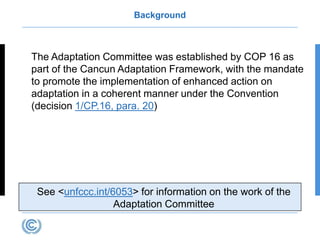
Background
The Adaptation Committee was established by COP 16 as
part of the Cancun Adaptation Framework, with the mandate
to promote the implementation of enhanced action on
adaptation in a coherent manner under the Convention
(decision 1/CP.16, para. 20)
See <unfccc.int/6053> for information on the work of the
Adaptation Committee
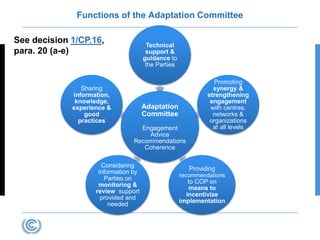
Functions of the Adaptation Committee
Adaptation
Committee
Engagement
Advice
Recommendations
Coherence
Technical
support &
guidance to
the Parties
Promoting
synergy &
strengthening
engagement
with centres,
networks &
organizations
at all levels
Providing
recommendations
to COP on
means to
incentivize
implementation
Considering
information by
Parties on
monitoring &
review support
provided and
needed
Sharing
information,
knowledge,
experience &
good
practices
See decision 1/CP.16,
para. 20 (a-e)
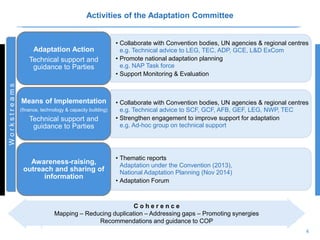
Activities of the Adaptation Committee
• Collaborate with Convention bodies, UN agencies & regional centres
e.g. Technical advice to LEG, TEC, ADP, GCE, L&D ExCom
• Promote national adaptation planning
e.g. NAP Task force
• Support Monitoring & Evaluation
Adaptation Action
Technical support and
guidance to Parties
• Collaborate with Convention bodies, UN agencies & regional centres
e.g. Technical advice to SCF, GCF, AFB, GEF, LEG, NWP, TEC
• Strengthen engagement to improve support for adaptation
e.g. Ad-hoc group on technical support
Means of Implementation
(finance, technology & capacity building)
Technical support and
guidance to Parties
• Thematic reports
Adaptation under the Convention (2013),
National Adaptation Planning (Nov 2014)
• Adaptation Forum
Awareness-raising,
outreach and sharing of
information
Workstreams
4
C o h e r e n c e
Mapping – Reducing duplication – Addressing gaps – Promoting synergies
Recommendations and guidance to COP
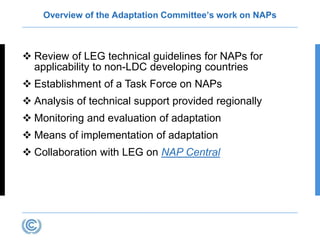
Overview of the Adaptation Committee’s work on NAPs
 Review of LEG technical guidelines for NAPs for
applicability to non-LDC developing countries
 Establishment of a Task Force on NAPs
 Analysis of technical support provided regionally
 Monitoring and evaluation of adaptation
 Means of implementation of adaptation
 Collaboration with LEG on NAP Central
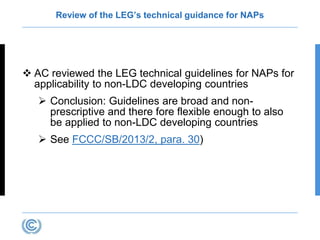
Review of the LEG’s technical guidance for NAPs
 AC reviewed the LEG technical guidelines for NAPs for
applicability to non-LDC developing countries
 Conclusion: Guidelines are broad and non-
prescriptive and there fore flexible enough to also
be applied to non-LDC developing countries
 See FCCC/SB/2013/2, para. 30)
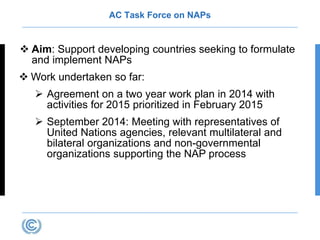
AC Task Force on NAPs
 Aim: Support developing countries seeking to formulate
and implement NAPs
 Work undertaken so far:
 Agreement on a two year work plan in 2014 with
activities for 2015 prioritized in February 2015
 September 2014: Meeting with representatives of
United Nations agencies, relevant multilateral and
bilateral organizations and non-governmental
organizations supporting the NAP process
AC Task Force on NAPs
Main messages from the September 2014 meeting:
 Need for awareness and buy in for the NAP process
at the national level
 Better coordination at all levels
 Making the delivery of support more effective
 Enhancing learning, which would involve improved
institutional arrangements, and M&E
 Relevant outcomes adopted by COP 20: Document
UNFCCC/SB/2014/2, para. 84
NAP Task Force documents, including meeting report,
available at <unfccc.int/8858>
Analysis of technical support provided regionally
Some highlights of the analysis of submissions from regional
institutions, UN agencies and other relevant information
 Main beneficiaries of organizations’ activities are national
governments and communities
 Participants are mainly national governments
 The vast majority of the organizations that responded are
promoting capacity-building for adaptation
 17% of the organizations mentioned that they are involved in
some capacity with the NAP process
 26% mentioned the use of monitoring and evaluation systems
for assessing progress
See documents AC/2014/7 and AC/2014/22
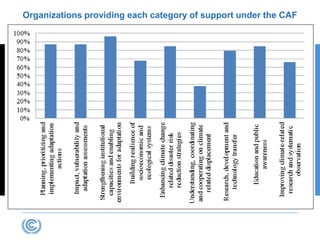
Organizations providing each category of support under the CAF
Monitoring and evaluation (M&E) of adaptation
Some highlights from 2013 workshop on M&E
 M&E frameworks need to be appropriate, relevant to needs and tailored
to country circumstances. A common set of global indicators is not
useful, owing to the context-specific nature of adaptation
 National-level assessments can play a different role in measuring
adaptive capacity from subnational or project-based assessments.
National-level assessments could, for example, measure the degree of
coordination and integration of adaptation in national priorities
 A positive learning environment, which encourages formal and informal
learning, including peer-to-peer learning, and which encourages
learning from negative as well as positive experiences, is important;
 Planning and allocation of resources, both technical and financial, are
key for effective monitoring and evaluation systems
More information on <unfccc.int/7744>
Means of implementation for adaptation
Some preliminary highlights from workshop on the means of
implementation for enhanced adaptation action (February 2015)
 An increasing complexity of the adaptation finance landscape and the
need to address that through more awareness of existing channels, and
capacity-development in countries to better navigate the landscape
 The importance of developing strategic frameworks for implementation
of adaptation action – and the centrality of the NAP process in leading
countries towards that
 The need for enhanced reporting by developing countries to assess and
monitor progress as well as needs in terms of effective finance
 The need for transformational adaptation processes that will support a
continuous implementation, taking into account different
planning/political cycles
The report on the workshop is currently being finalized.
See <unfccc.int/8860>
Engagement with the LEG on NAP Central
 Concept of NAP Central: Connected information
systems: for use as gateway to data, information and
knowledge pertaining to NAPs
 Engagement: The AC engages, though a support
group, with the LEG on the development of the NAP
Central, to support adapting the system to cover the
needs of all developing countries
 Progress: Country Portals for all developing
countries are now operational, with capability for
sharing documents with the Public Pages of the system
<www4.unfccc.int/nap>;
 Next plans: Development of graphical interface for
public pages, and full release of all components under
the menu structure
Current activities by the AC on NAPs
The AC is engaging in a range of activities aiming at enhancing
technical support for NAPs, including:
 Engaging with institutions that have started initiatives on countries’
readiness to access the GCF, and exploring how other countries can
benefit from such initiatives
 Exploring NAPs in the wider economic context, including the relevance
of the private sector
 Engaging with the GEF and the GCF, as well as other bodies, to
advance the effective provision of finance and other means of
implementation
 Sharing information on success factors in the process to formulate and
implement NAPs, including through case studies
 Reaching out to strategic partners of the process to formulate and
implement NAPs, including academia, the media and regional
institutions, and bringing together and enhancing their specific strengths

Nap expo 2015 session 1 AC

  • 1.
    Presentation by theAdaptation Committee 2015 NAP Expo Work of the Adaptation Committee with regards to the National Adaptation Plans process Bonn, Germany, 14-15 April 2015
  • 2.
    Background The Adaptation Committeewas established by COP 16 as part of the Cancun Adaptation Framework, with the mandate to promote the implementation of enhanced action on adaptation in a coherent manner under the Convention (decision 1/CP.16, para. 20) See <unfccc.int/6053> for information on the work of the Adaptation Committee
  • 3.
    Functions of theAdaptation Committee Adaptation Committee Engagement Advice Recommendations Coherence Technical support & guidance to the Parties Promoting synergy & strengthening engagement with centres, networks & organizations at all levels Providing recommendations to COP on means to incentivize implementation Considering information by Parties on monitoring & review support provided and needed Sharing information, knowledge, experience & good practices See decision 1/CP.16, para. 20 (a-e)
  • 4.
    Activities of theAdaptation Committee • Collaborate with Convention bodies, UN agencies & regional centres e.g. Technical advice to LEG, TEC, ADP, GCE, L&D ExCom • Promote national adaptation planning e.g. NAP Task force • Support Monitoring & Evaluation Adaptation Action Technical support and guidance to Parties • Collaborate with Convention bodies, UN agencies & regional centres e.g. Technical advice to SCF, GCF, AFB, GEF, LEG, NWP, TEC • Strengthen engagement to improve support for adaptation e.g. Ad-hoc group on technical support Means of Implementation (finance, technology & capacity building) Technical support and guidance to Parties • Thematic reports Adaptation under the Convention (2013), National Adaptation Planning (Nov 2014) • Adaptation Forum Awareness-raising, outreach and sharing of information Workstreams 4 C o h e r e n c e Mapping – Reducing duplication – Addressing gaps – Promoting synergies Recommendations and guidance to COP
  • 5.
    Overview of theAdaptation Committee’s work on NAPs  Review of LEG technical guidelines for NAPs for applicability to non-LDC developing countries  Establishment of a Task Force on NAPs  Analysis of technical support provided regionally  Monitoring and evaluation of adaptation  Means of implementation of adaptation  Collaboration with LEG on NAP Central
  • 6.
    Review of theLEG’s technical guidance for NAPs  AC reviewed the LEG technical guidelines for NAPs for applicability to non-LDC developing countries  Conclusion: Guidelines are broad and non- prescriptive and there fore flexible enough to also be applied to non-LDC developing countries  See FCCC/SB/2013/2, para. 30)
  • 7.
    AC Task Forceon NAPs  Aim: Support developing countries seeking to formulate and implement NAPs  Work undertaken so far:  Agreement on a two year work plan in 2014 with activities for 2015 prioritized in February 2015  September 2014: Meeting with representatives of United Nations agencies, relevant multilateral and bilateral organizations and non-governmental organizations supporting the NAP process
  • 8.
    AC Task Forceon NAPs Main messages from the September 2014 meeting:  Need for awareness and buy in for the NAP process at the national level  Better coordination at all levels  Making the delivery of support more effective  Enhancing learning, which would involve improved institutional arrangements, and M&E  Relevant outcomes adopted by COP 20: Document UNFCCC/SB/2014/2, para. 84 NAP Task Force documents, including meeting report, available at <unfccc.int/8858>
  • 9.
    Analysis of technicalsupport provided regionally Some highlights of the analysis of submissions from regional institutions, UN agencies and other relevant information  Main beneficiaries of organizations’ activities are national governments and communities  Participants are mainly national governments  The vast majority of the organizations that responded are promoting capacity-building for adaptation  17% of the organizations mentioned that they are involved in some capacity with the NAP process  26% mentioned the use of monitoring and evaluation systems for assessing progress See documents AC/2014/7 and AC/2014/22
  • 10.
    Organizations providing eachcategory of support under the CAF
  • 11.
    Monitoring and evaluation(M&E) of adaptation Some highlights from 2013 workshop on M&E  M&E frameworks need to be appropriate, relevant to needs and tailored to country circumstances. A common set of global indicators is not useful, owing to the context-specific nature of adaptation  National-level assessments can play a different role in measuring adaptive capacity from subnational or project-based assessments. National-level assessments could, for example, measure the degree of coordination and integration of adaptation in national priorities  A positive learning environment, which encourages formal and informal learning, including peer-to-peer learning, and which encourages learning from negative as well as positive experiences, is important;  Planning and allocation of resources, both technical and financial, are key for effective monitoring and evaluation systems More information on <unfccc.int/7744>
  • 12.
    Means of implementationfor adaptation Some preliminary highlights from workshop on the means of implementation for enhanced adaptation action (February 2015)  An increasing complexity of the adaptation finance landscape and the need to address that through more awareness of existing channels, and capacity-development in countries to better navigate the landscape  The importance of developing strategic frameworks for implementation of adaptation action – and the centrality of the NAP process in leading countries towards that  The need for enhanced reporting by developing countries to assess and monitor progress as well as needs in terms of effective finance  The need for transformational adaptation processes that will support a continuous implementation, taking into account different planning/political cycles The report on the workshop is currently being finalized. See <unfccc.int/8860>
  • 13.
    Engagement with theLEG on NAP Central  Concept of NAP Central: Connected information systems: for use as gateway to data, information and knowledge pertaining to NAPs  Engagement: The AC engages, though a support group, with the LEG on the development of the NAP Central, to support adapting the system to cover the needs of all developing countries  Progress: Country Portals for all developing countries are now operational, with capability for sharing documents with the Public Pages of the system <www4.unfccc.int/nap>;  Next plans: Development of graphical interface for public pages, and full release of all components under the menu structure
  • 14.
    Current activities bythe AC on NAPs The AC is engaging in a range of activities aiming at enhancing technical support for NAPs, including:  Engaging with institutions that have started initiatives on countries’ readiness to access the GCF, and exploring how other countries can benefit from such initiatives  Exploring NAPs in the wider economic context, including the relevance of the private sector  Engaging with the GEF and the GCF, as well as other bodies, to advance the effective provision of finance and other means of implementation  Sharing information on success factors in the process to formulate and implement NAPs, including through case studies  Reaching out to strategic partners of the process to formulate and implement NAPs, including academia, the media and regional institutions, and bringing together and enhancing their specific strengths