Document 1 2 December 2014
Guiding document for 2015-2016
Global Partnership Steering Committee
19-20 January 2015, The Hague, Netherlands
This document is designed to help guide the work of the Global Partnership for Effective Development Co-
operation (GPEDC) over its next cycle leading up to the second High-Level Meeting. It also highlights key
entry points for member-driven engagement by the Global Partnership, including with other development
fora at country, regional and global levels, and will be regularly updated as the work and agenda of the
Global Partnership move forward.
This document is shared with Steering Committee members for information and discussion.
Contacts:
Mr. Derek Kilner, tel: +1 212 906 5742, email: derek.kilner@undp.org
Ms. Teresita López-Treussart, tel: +33 1 45 24 19 79, email : teresitakelly.lopez-treussart@oecd.org
2Document 1: Guiding Document for 2015-2016
1. This document has been prepared to help guide the work of Global Partnership for Effective
Development Co-operation (Global Partnership) over its next cycle leading up to the second
High-Level Meeting, expected in 2016. The document highlights key tracks of actions required
by the Partnership’s stakeholders – with a leading role for the Steering Committee – to achieve
the Global Partnership’s vision. In particular, the elements included here can support the
Partnership to position itself as a ‘go-to’ forum to support implementation of the post-2015
development agenda, in line with the Global Partnership vision and inputs prepared for the UN
Secretary General’s synthesis report. This document highlights key entry points for
stakeholder-driven engagement with other development fora at country, regional and global
levels and will be regularly updated as the work and agenda of the Global Partnership
advance.
POSITIONING THE GLOBAL PARTNERSHIP WITHIN THE POST-2015 AGENDA
2. The Co-Chairs’ input to the UNSG Synthesis Report presents a vision for how the Partnership
can contribute to implementation of the post-2015 development agenda. Positioning the
Partnership consists of two broad elements: 1) providing inputs to UN processes establishing
the post-2015 development agenda; 2) establishing the value-added of the Partnership as a
go-to forum to support post-2015 implementation.
3. Inputting to the post-2015 processes may focus less on formal recognition of the Global
Partnership in the structures agreed for the post-2015 agenda, but rather on maintaining a
focus on effectiveness of development co-operation in the post-2015 agenda and the need for
high-quality multi-stakeholder partnerships to support this agenda as part of the means of
implementation. This message should be conveyed by the Global Partnership’s stakeholders –
in particular by UN Member States. Avenues for this input will include:
 The UNSG’s synthesis report – an input has been submitted by the Co-Chairs.
 Negotiations in the UN General Assembly on the post-2015 agenda and sustainable
development goals.
 The Third International Conference on Financing for Development in Addis Ababa, to be
held in July 2015, and preparations within the UN General Assembly.
 Preparatory events for the UN Development Co-operation Forum (DCF), including the
High-Level Symposium in Korea, to be held in April 2015. A joint DCF-GPEDC working
group has prepared suggestions on collaboration.
 The meeting of the High-Level Political Forum in New York, to be held in June-July 2015.
 The summit on establishing the post-2015 development agenda, to be held in September
2015.
4. Alongside providing the input itself, the Global Partnership will need to go beyond asserting
that it is part of the “how” of the post-2015 agenda, to delivering actions and results on the
implementation of the principles of effective development co-operation at the country level,
which will demonstrate the offer of the Global Partnership as a forum to support delivery of the
post-2015 agenda. This will entail in particular facilitating and showcasing country-level
actions and partnerships; and supporting mutual learning and accountability, including by
strengthening the Partnership’s monitoring framework.
SHOWCASING COUNTRY-LEVEL ACTION
5. To further demonstrate its value in delivering country-level results, the Global Partnership will
expand its efforts to serve as a platform to share and showcase progress on implementing
3Document 1: Guiding Document for 2015-2016
Busan principles and on establishing high-quality partnerships on the ground. By the time of
the Post-2015 Summit (September 2015), the Global Partnership will aim to share a catalogue
of good practices and policy recommendations that show how Busan implementation and
multi-stakeholder approaches can effectively support implementation of the post-2015
development agenda. This catalogue can be further developed and refined and showcased at
the second High-Level Meeting (HLM).
6. Work in this area will also be guided by the thematic priorities identified by the Steering
Committee for the coming period, looking at on-the-ground implementation and partnerships in
these areas.
7. Evidence of good practices will draw on a number of sources:
 A call for best practices and experiences with multi-stakeholder partnerships has been
issued, and a number of cases have been submitted.
 Voluntary Initiatives and Building Blocks have been asked to provide updates on their
work and achieved or planned deliverables. Periodical reporting on progress is expected
of all Voluntary Initiatives and Building Blocks. Results will be showcased at Steering
Committee Meetings and at the next HLM (see Document 2 Synthesis Note on the
Building Blocks and Voluntary Initiatives).
 The Partnership has begun collecting country cases on implementation of effective co-
operation with a focus on national-led efforts (see the GPEDC community space).
 A series of workshops is expected over the course of the coming period, showcasing
country-level experiences. The Global Partnership annual workshop (Seoul, November
2014); the Africa Regional Meeting on the Implementation of the Africa Action Plan on
Development Effectiveness (Kinshasa, November 2014); and the workshop on “The
Development Effectiveness Agenda: Approaches from the South” (Mexico, December
2014) will have already taken place when the Steering Committee meets in January. In
addition, workshops are planned for Spring 2015 for the Asia-Pacific region and the LAC
region. Further member-led workshops to facilitate regional/constituency based
discussions on country-level implementation efforts are welcome.
 The Global Partnership Planning Workshop (Brussels, January 2015) will review these
avenues and identify gaps in evidence collection – particularly in mapping against the
thematic priorities agreed by the Steering Committee – and propose additional steps and
responsibilities for filling them.
SUPPORTING MUTUAL LEARNING AND ACCOUNTABILITY, INCLUDING STRENGTHENING THE MONITORING
FRAMEWORK
8. Based on lessons and best practices identified from country-level implementation efforts, the
Global Partnership will invest further to ensure dissemination of lessons and evidence, to
facilitate mutual learning and strengthen accountability.
9. To this end, the monitoring framework is a key tool to identify progress and gaps in the
implementation of the principles of effective development co-operation. Improving the rollout
and technical strength of the current framework are priorities for the second round of
monitoring, the results of which will constitute a key input to the next HLM. At the same time,
the current set of indicators and associated multi-stakeholder process are being reviewed to
ensure relevance for the post-2015 agenda that is agreed. This work will proceed on three
tracks, which are described in further detail in Document 3, Strengthening the Global
Partnership Monitoring Framework:
 Track 1: Preparations to implement a stronger second monitoring round in 2015-16
 Track 2: Further work to refine the remaining four global pilot indicators
4Document 1: Guiding Document for 2015-2016
 Track 3: Reviewing the monitoring framework to ensure its relevance to future
accountability efforts.
OUTREACH AND ENGAGEMENT TO ACHIEVE THE GLOBAL PARTNERSHIP’S OBJECTIVES
10. Achieving the above objectives - positioning the Global Partnership in the post-2015 agenda;
growing the Global Partnership’s role as a platform for good practice on country-level action
and partnerships; and supporting mutual learning and accountability – will require the active
engagement of the Partnership’s stakeholders, with a strong coordinating role by Steering
Committee members within their constituencies. In particular, Steering Committee members
are invited to:
 Help co-ordinate relevant Global Partnership inputs on the post-2015 agenda, at the entry
points listed above, from members of the constituency.
 Raise the profile of the Partnership by conveying messages and raising opportunities for
engagement at relevant regional, constituency, or other meetings (e.g. World Economic
Forum).
 Reach out to members of the constituency to collect submissions on effective
partnerships.
 Ensure that relevant results from Building Blocks and Voluntary Initiatives that Steering
Committee members are affiliated with are reported to the Steering Committee.
 Facilitate concrete action to advance implementation of Busan principles among members
of the constituency, including by supporting the establishment of new initiatives among
Global Partnership members eager to contribute.
 Organise workshops focusing on implementing effective development co-operation within
a particular region, thematic area, or stakeholder group. These should be member-driven
but can be organised in consultation with the Co-Chairs and Joint Support Team to
maximise relevance for the Global Partnership’s workplan..
11. Member-driven engagement will also be complemented by communication activities (see
Document 4 Communications activities update). Effective communications will depend on the
proactive engagement of Steering Committee members and their mobilisation of interested
members of their constituency for providing content for the website and blog, promoting
information on social media, contributing to the newsletter, etc.
ENSURING RESOURCING
12. Achieving the Global Partnership’s vision through the areas above will require adequate
resourcing. While the success of the Global Partnership will depend on member-driven
activities, there is a particular need for funding the work of the OECD-UNDP Support Team. A
resource document has been shared (Overview of funding requirements July 2014 -December
2016). Committee members are invited to support the Co-Chairs’ resource mobilisation efforts,
and to consider providing funding wherever possible.
GUIDING QUESTIONS FOR STEERING COMMITTEE MEMBERS
Information related to questions below, particularly pertaining to additions to the calendar, can be
sent ahead of the meeting to info@effectivecooperation.org.
A. Positioning the Global Partnership within the post-2015 agenda: Are there key avenues for
post-2015 engagement not captured on the list above? Is there a contact point within your
government, organisation, or constituency for coordination on post-2015 processes in New
5Document 1: Guiding Document for 2015-2016
York, who could support conveying structured Global Partnership inputs to UN-led
negotiations on the post-2015 agenda?
B. Showcasing country-level action: Do you have plans to explore interest within your
constituency in providing evidence of good practice, or proposals for sharing lessons learned
in improving the quality of development co-operation? Would you be willing to work with
members of your constituency to organise a workshop or event on implementation? Are there
other mechanisms or tools for gathering evidence on successful implementation of effective
development co-operation and quality partnerships on which the Partnership can draw?
C. Supporting mutual learning and accountability, including strengthening the monitoring
framework: Are there are opportunities outside those listed that could provide additional
avenues for positioning the Global Partnership monitoring framework to support
implementation and accountability efforts in the post-2015 context?
D. Outreach and engagement to achieve GPEDC objectives: Are there plans for consultations
within your constituency on the GPEDC agenda? Are there key events missing from the
calendar below? What type of engagement might be envisioned for the events you are
involved in, to insert in the Action column?
Document 1: Guiding Document for 2015-2016
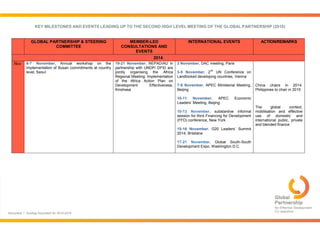
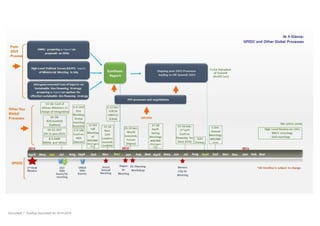
KEY MILESTONES AND EVENTS LEADING UP TO THE SECOND HIGH LEVEL MEETING OF THE GLOBAL PARTNERSHIP (2016)
GLOBAL PARTNERSHIP & STEERING
COMMITTEE
MEMBER-LED
CONSULTATIONS AND
EVENTS
INTERNATIONAL EVENTS ACTION/REMARKS
2014
Nov 6-7 November, Annual workshop on the
implementation of Busan commitments at country
level, Seoul
19-21 November, NEPAD/AU in
partnership with UNDP/ DFID are
jointly organising the Africa
Regional Meeting: Implementation
of the Africa Action Plan on
Development Effectiveness,
Kinshasa
3 November, DAC meeting, Paris
3-5 November, 2
nd
UN Conference on
Landlocked developing countries, Vienna
7-8 November, APEC Ministerial Meeting,
Beijing
10-11 November, APEC Economic
Leaders’ Meeting, Beijing
10-13 November, substantive informal
session for third Financing for Development
(FFD) conference, New York
15-16 November, G20 Leaders’ Summit
2014, Brisbane
17-21 November, Global South-South
Development Expo, Washington D.C.
China chairs in 2014.
Philippines to chair in 2015
The global context,
mobilisation and effective
use of domestic and
international public, private
and blended finance
Document 1: Guiding Document for 2015-2016
GLOBAL PARTNERSHIP & STEERING
COMMITTEE
MEMBER-LED
CONSULTATIONS AND
EVENTS
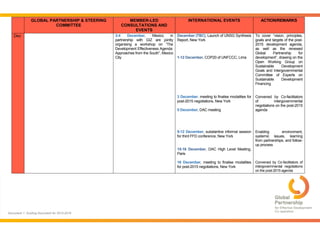
INTERNATIONAL EVENTS ACTION/REMARKS
Dec 3-4 December, Mexico in
partnership with GIZ are jointly
organising a workshop on “The
Development Effectiveness Agenda:
Approaches from the South”, Mexico
City
December (TBC), Launch of UNSG Synthesis
Report, New York
1-12 December, COP20 of UNFCCC, Lima
3 December, meeting to finalise modalities for
post-2015 negotiations, New York
5 December, DAC meeting
9-12 December, substantive informal session
for third FFD conference, New York
15-16 December, DAC High Level Meeting,
Paris
16 December, meeting to finalise modalities
for post-2015 negotiations, New York
To cover “vision, principles,
goals and targets of the post-
2015 development agenda,
as well as the renewed
Global Partnership for
development”, drawing on the
Open Working Group on
Sustainable Development
Goals and Intergovernmental
Committee of Experts on
Sustainable Development
Financing
Convened by Co-facilitators
of intergovernmental
negotiations on the post-2015
agenda
Enabling environment,
systemic issues, learning
from partnerships, and follow-
up process
Convened by Co-facilitators of
intergovernmental negotiations
on the post-2015 agenda
Document 1: Guiding Document for 2015-2016
GLOBAL PARTNERSHIP & STEERING
COMMITTEE
MEMBER-LED
CONSULTATIONS AND
EVENTS
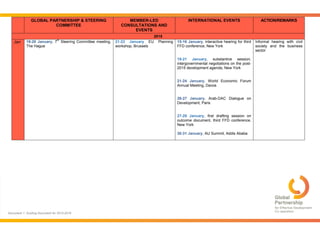
INTERNATIONAL EVENTS ACTION/REMARKS
2015
Jan 19-20 January, 7
th
Steering Committee meeting,
The Hague
21-22 January EU Planning
workshop, Brussels
15-16 January, interactive hearing for third
FFD conference, New York
19-21 January, substantive session,
intergovernmental negotiations on the post-
2015 development agenda, New York
21-24 January, World Economic Forum
Annual Meeting, Davos
26-27 January, Arab-DAC Dialogue on
Development, Paris
27-29 January, first drafting session on
outcome document, third FFD conference,
New York
30-31 January, AU Summit, Addis Ababa
Informal hearing with civil
society and the business
sector
Document 1: Guiding Document for 2015-2016
GLOBAL PARTNERSHIP & STEERING
COMMITTEE
MEMBER-LED
CONSULTATIONS AND
EVENTS
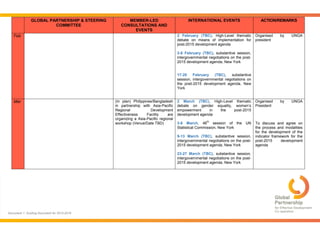
INTERNATIONAL EVENTS ACTION/REMARKS
Feb 2 February (TBC), High-Level thematic
debate on means of implementation for
post-2015 development agenda
3-6 February (TBC), substantive session,
intergovernmental negotiations on the post-
2015 development agenda, New York
17-20 February (TBC), substantive
session, intergovernmental negotiations on
the post-2015 development agenda, New
York
Organised by UNGA
president
Mar (In plan) Philippines/Bangladesh
in partnership with Asia-Pacific
Regional Development
Effectiveness Facility are
organizing a Asia-Pacific regional
workshop (Venue/Date TBD)
2 March (TBC), High-Level thematic
debate on gender equality, women’s
empowerment in the post-2015
development agenda
3-6 March, 46
th
session of the UN
Statistical Commission, New York
9-13 March (TBC), substantive session,
intergovernmental negotiations on the post-
2015 development agenda, New York
23-27 March (TBC), substantive session,
intergovernmental negotiations on the post-
2015 development agenda, New York
Organised by UNGA
President
To discuss and agree on
the process and modalities
for the development of the
indicator framework for the
post-2015 development
agenda
Document 1: Guiding Document for 2015-2016
GLOBAL PARTNERSHIP & STEERING
COMMITTEE
MEMBER-LED
CONSULTATIONS AND
EVENTS
INTERNATIONAL EVENTS ACTION/REMARKS
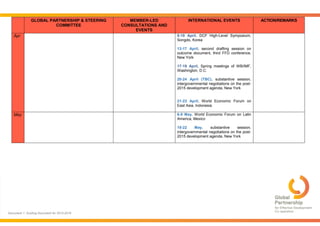
Apr 8-10 April, DCF High-Level Symposium,
Songdo, Korea
13-17 April, second drafting session on
outcome document, third FFD conference,
New York
17-19 April, Spring meetings of WB/IMF,
Washington, D.C.
20-24 April (TBC), substantive session,
intergovernmental negotiations on the post-
2015 development agenda, New York
21-23 April, World Economic Forum on
East Asia, Indonesia
May 6-8 May, World Economic Forum on Latin
America, Mexico
18-22 May, substantive session,
intergovernmental negotiations on the post-
2015 development agenda, New York
Document 1: Guiding Document for 2015-2016
GLOBAL PARTNERSHIP & STEERING
COMMITTEE
MEMBER-LED
CONSULTATIONS AND
EVENTS
INTERNATIONAL EVENTS ACTION/REMARKS
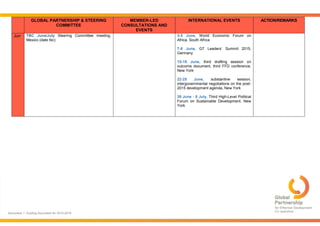
Jun TBC June/July Steering Committee meeting,
Mexico (date tbc)
3-5 June, World Economic Forum on
Africa, South Africa
7-8 June, G7 Leaders’ Summit 2015,
Germany
15-19 June, third drafting session on
outcome document, third FFD conference,
New York
22-25 June, substantive session,
intergovernmental negotiations on the post-
2015 development agenda, New York
26 June - 8 July, Third High-Level Political
Forum on Sustainable Development, New
York
Document 1: Guiding Document for 2015-2016
GLOBAL PARTNERSHIP & STEERING
COMMITTEE
MEMBER-LED
CONSULTATIONS AND
EVENTS
INTERNATIONAL EVENTS ACTION/REMARKS
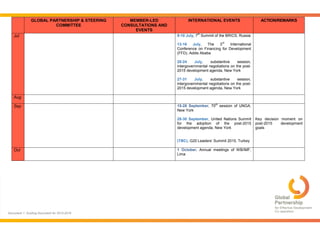
Jul 9-10 July, 7
th
Summit of the BRICS, Russia
13-16 July, The 3
rd
International
Conference on Financing for Development
(FFD), Addis Ababa
20-24 July, substantive session,
intergovernmental negotiations on the post-
2015 development agenda, New York
27-31 July, substantive session,
intergovernmental negotiations on the post-
2015 development agenda, New York
Aug
Sep 15-28 September, 70
th
session of UNGA,
New York
28-30 September, United Nations Summit
for the adoption of the post-2015
development agenda, New York
(TBC), G20 Leaders’ Summit 2015, Turkey
Key decision moment on
post-2015 development
goals
Oct 1 October, Annual meetings of WB/IMF,
Lima
Document 1: Guiding Document for 2015-2016
GLOBAL PARTNERSHIP & STEERING
COMMITTEE
MEMBER-LED
CONSULTATIONS AND
EVENTS
INTERNATIONAL EVENTS ACTION/REMARKS
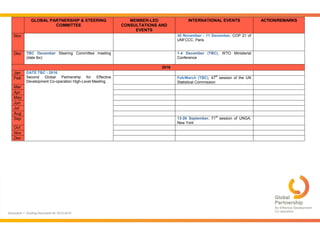
Nov 30 November - 11 December, COP 21 of
UNFCCC, Paris
Dec TBC December Steering Committee meeting
(date tbc)
1-4 December (TBC), WTO Ministerial
Conference
2016
Jan DATE TBC - 2016
Second Global Partnership for Effective
Development Co-operation High-Level Meeting
Feb Feb/March (TBC), 47
th
session of the UN
Statistical Commission
Mar
Apr
May
Jun
Jul
Aug
Sep 13-26 September, 71
st
session of UNGA,
New York
Oct
Nov
Dec
Document 1: Guiding Document for 2015-2016
Key Global Partnership focal points:
Malawi
Betty Ngoma, Deputy Director for Debt and Aid Coordination NgomaB@finance.gov.mw
Ministry of Finance
Mexico
Noel Gonzalez
Deputy Director General for Policy Making
Mexican Agency for International Development Co-operation
ngonzalez@sre.gob.mx
The Netherlands
Jeroen Verheul Jeroen.Verheul@minbuza.nl
Ambassador-at-large for development co-operation
Ministry of Foreign Affairs
Joint Support Team –
Hanna-Mari Kilpeläinen, Policy Analyst, OECD hanna-mari.kilpelainen@oecd.org
Yuko Suzuki, Team Leader, Effective Development yuko.suzuki@undp.org
Co-operation, UNDP

Guiding document for 2015-2016

  • 1.
    Document 1 2December 2014 Guiding document for 2015-2016 Global Partnership Steering Committee 19-20 January 2015, The Hague, Netherlands This document is designed to help guide the work of the Global Partnership for Effective Development Co- operation (GPEDC) over its next cycle leading up to the second High-Level Meeting. It also highlights key entry points for member-driven engagement by the Global Partnership, including with other development fora at country, regional and global levels, and will be regularly updated as the work and agenda of the Global Partnership move forward. This document is shared with Steering Committee members for information and discussion. Contacts: Mr. Derek Kilner, tel: +1 212 906 5742, email: derek.kilner@undp.org Ms. Teresita López-Treussart, tel: +33 1 45 24 19 79, email : teresitakelly.lopez-treussart@oecd.org
  • 2.
    2Document 1: GuidingDocument for 2015-2016 1. This document has been prepared to help guide the work of Global Partnership for Effective Development Co-operation (Global Partnership) over its next cycle leading up to the second High-Level Meeting, expected in 2016. The document highlights key tracks of actions required by the Partnership’s stakeholders – with a leading role for the Steering Committee – to achieve the Global Partnership’s vision. In particular, the elements included here can support the Partnership to position itself as a ‘go-to’ forum to support implementation of the post-2015 development agenda, in line with the Global Partnership vision and inputs prepared for the UN Secretary General’s synthesis report. This document highlights key entry points for stakeholder-driven engagement with other development fora at country, regional and global levels and will be regularly updated as the work and agenda of the Global Partnership advance. POSITIONING THE GLOBAL PARTNERSHIP WITHIN THE POST-2015 AGENDA 2. The Co-Chairs’ input to the UNSG Synthesis Report presents a vision for how the Partnership can contribute to implementation of the post-2015 development agenda. Positioning the Partnership consists of two broad elements: 1) providing inputs to UN processes establishing the post-2015 development agenda; 2) establishing the value-added of the Partnership as a go-to forum to support post-2015 implementation. 3. Inputting to the post-2015 processes may focus less on formal recognition of the Global Partnership in the structures agreed for the post-2015 agenda, but rather on maintaining a focus on effectiveness of development co-operation in the post-2015 agenda and the need for high-quality multi-stakeholder partnerships to support this agenda as part of the means of implementation. This message should be conveyed by the Global Partnership’s stakeholders – in particular by UN Member States. Avenues for this input will include:  The UNSG’s synthesis report – an input has been submitted by the Co-Chairs.  Negotiations in the UN General Assembly on the post-2015 agenda and sustainable development goals.  The Third International Conference on Financing for Development in Addis Ababa, to be held in July 2015, and preparations within the UN General Assembly.  Preparatory events for the UN Development Co-operation Forum (DCF), including the High-Level Symposium in Korea, to be held in April 2015. A joint DCF-GPEDC working group has prepared suggestions on collaboration.  The meeting of the High-Level Political Forum in New York, to be held in June-July 2015.  The summit on establishing the post-2015 development agenda, to be held in September 2015. 4. Alongside providing the input itself, the Global Partnership will need to go beyond asserting that it is part of the “how” of the post-2015 agenda, to delivering actions and results on the implementation of the principles of effective development co-operation at the country level, which will demonstrate the offer of the Global Partnership as a forum to support delivery of the post-2015 agenda. This will entail in particular facilitating and showcasing country-level actions and partnerships; and supporting mutual learning and accountability, including by strengthening the Partnership’s monitoring framework. SHOWCASING COUNTRY-LEVEL ACTION 5. To further demonstrate its value in delivering country-level results, the Global Partnership will expand its efforts to serve as a platform to share and showcase progress on implementing
  • 3.
    3Document 1: GuidingDocument for 2015-2016 Busan principles and on establishing high-quality partnerships on the ground. By the time of the Post-2015 Summit (September 2015), the Global Partnership will aim to share a catalogue of good practices and policy recommendations that show how Busan implementation and multi-stakeholder approaches can effectively support implementation of the post-2015 development agenda. This catalogue can be further developed and refined and showcased at the second High-Level Meeting (HLM). 6. Work in this area will also be guided by the thematic priorities identified by the Steering Committee for the coming period, looking at on-the-ground implementation and partnerships in these areas. 7. Evidence of good practices will draw on a number of sources:  A call for best practices and experiences with multi-stakeholder partnerships has been issued, and a number of cases have been submitted.  Voluntary Initiatives and Building Blocks have been asked to provide updates on their work and achieved or planned deliverables. Periodical reporting on progress is expected of all Voluntary Initiatives and Building Blocks. Results will be showcased at Steering Committee Meetings and at the next HLM (see Document 2 Synthesis Note on the Building Blocks and Voluntary Initiatives).  The Partnership has begun collecting country cases on implementation of effective co- operation with a focus on national-led efforts (see the GPEDC community space).  A series of workshops is expected over the course of the coming period, showcasing country-level experiences. The Global Partnership annual workshop (Seoul, November 2014); the Africa Regional Meeting on the Implementation of the Africa Action Plan on Development Effectiveness (Kinshasa, November 2014); and the workshop on “The Development Effectiveness Agenda: Approaches from the South” (Mexico, December 2014) will have already taken place when the Steering Committee meets in January. In addition, workshops are planned for Spring 2015 for the Asia-Pacific region and the LAC region. Further member-led workshops to facilitate regional/constituency based discussions on country-level implementation efforts are welcome.  The Global Partnership Planning Workshop (Brussels, January 2015) will review these avenues and identify gaps in evidence collection – particularly in mapping against the thematic priorities agreed by the Steering Committee – and propose additional steps and responsibilities for filling them. SUPPORTING MUTUAL LEARNING AND ACCOUNTABILITY, INCLUDING STRENGTHENING THE MONITORING FRAMEWORK 8. Based on lessons and best practices identified from country-level implementation efforts, the Global Partnership will invest further to ensure dissemination of lessons and evidence, to facilitate mutual learning and strengthen accountability. 9. To this end, the monitoring framework is a key tool to identify progress and gaps in the implementation of the principles of effective development co-operation. Improving the rollout and technical strength of the current framework are priorities for the second round of monitoring, the results of which will constitute a key input to the next HLM. At the same time, the current set of indicators and associated multi-stakeholder process are being reviewed to ensure relevance for the post-2015 agenda that is agreed. This work will proceed on three tracks, which are described in further detail in Document 3, Strengthening the Global Partnership Monitoring Framework:  Track 1: Preparations to implement a stronger second monitoring round in 2015-16  Track 2: Further work to refine the remaining four global pilot indicators
  • 4.
    4Document 1: GuidingDocument for 2015-2016  Track 3: Reviewing the monitoring framework to ensure its relevance to future accountability efforts. OUTREACH AND ENGAGEMENT TO ACHIEVE THE GLOBAL PARTNERSHIP’S OBJECTIVES 10. Achieving the above objectives - positioning the Global Partnership in the post-2015 agenda; growing the Global Partnership’s role as a platform for good practice on country-level action and partnerships; and supporting mutual learning and accountability – will require the active engagement of the Partnership’s stakeholders, with a strong coordinating role by Steering Committee members within their constituencies. In particular, Steering Committee members are invited to:  Help co-ordinate relevant Global Partnership inputs on the post-2015 agenda, at the entry points listed above, from members of the constituency.  Raise the profile of the Partnership by conveying messages and raising opportunities for engagement at relevant regional, constituency, or other meetings (e.g. World Economic Forum).  Reach out to members of the constituency to collect submissions on effective partnerships.  Ensure that relevant results from Building Blocks and Voluntary Initiatives that Steering Committee members are affiliated with are reported to the Steering Committee.  Facilitate concrete action to advance implementation of Busan principles among members of the constituency, including by supporting the establishment of new initiatives among Global Partnership members eager to contribute.  Organise workshops focusing on implementing effective development co-operation within a particular region, thematic area, or stakeholder group. These should be member-driven but can be organised in consultation with the Co-Chairs and Joint Support Team to maximise relevance for the Global Partnership’s workplan.. 11. Member-driven engagement will also be complemented by communication activities (see Document 4 Communications activities update). Effective communications will depend on the proactive engagement of Steering Committee members and their mobilisation of interested members of their constituency for providing content for the website and blog, promoting information on social media, contributing to the newsletter, etc. ENSURING RESOURCING 12. Achieving the Global Partnership’s vision through the areas above will require adequate resourcing. While the success of the Global Partnership will depend on member-driven activities, there is a particular need for funding the work of the OECD-UNDP Support Team. A resource document has been shared (Overview of funding requirements July 2014 -December 2016). Committee members are invited to support the Co-Chairs’ resource mobilisation efforts, and to consider providing funding wherever possible. GUIDING QUESTIONS FOR STEERING COMMITTEE MEMBERS Information related to questions below, particularly pertaining to additions to the calendar, can be sent ahead of the meeting to info@effectivecooperation.org. A. Positioning the Global Partnership within the post-2015 agenda: Are there key avenues for post-2015 engagement not captured on the list above? Is there a contact point within your government, organisation, or constituency for coordination on post-2015 processes in New
  • 5.
    5Document 1: GuidingDocument for 2015-2016 York, who could support conveying structured Global Partnership inputs to UN-led negotiations on the post-2015 agenda? B. Showcasing country-level action: Do you have plans to explore interest within your constituency in providing evidence of good practice, or proposals for sharing lessons learned in improving the quality of development co-operation? Would you be willing to work with members of your constituency to organise a workshop or event on implementation? Are there other mechanisms or tools for gathering evidence on successful implementation of effective development co-operation and quality partnerships on which the Partnership can draw? C. Supporting mutual learning and accountability, including strengthening the monitoring framework: Are there are opportunities outside those listed that could provide additional avenues for positioning the Global Partnership monitoring framework to support implementation and accountability efforts in the post-2015 context? D. Outreach and engagement to achieve GPEDC objectives: Are there plans for consultations within your constituency on the GPEDC agenda? Are there key events missing from the calendar below? What type of engagement might be envisioned for the events you are involved in, to insert in the Action column?
  • 6.
    Document 1: GuidingDocument for 2015-2016 KEY MILESTONES AND EVENTS LEADING UP TO THE SECOND HIGH LEVEL MEETING OF THE GLOBAL PARTNERSHIP (2016) GLOBAL PARTNERSHIP & STEERING COMMITTEE MEMBER-LED CONSULTATIONS AND EVENTS INTERNATIONAL EVENTS ACTION/REMARKS 2014 Nov 6-7 November, Annual workshop on the implementation of Busan commitments at country level, Seoul 19-21 November, NEPAD/AU in partnership with UNDP/ DFID are jointly organising the Africa Regional Meeting: Implementation of the Africa Action Plan on Development Effectiveness, Kinshasa 3 November, DAC meeting, Paris 3-5 November, 2 nd UN Conference on Landlocked developing countries, Vienna 7-8 November, APEC Ministerial Meeting, Beijing 10-11 November, APEC Economic Leaders’ Meeting, Beijing 10-13 November, substantive informal session for third Financing for Development (FFD) conference, New York 15-16 November, G20 Leaders’ Summit 2014, Brisbane 17-21 November, Global South-South Development Expo, Washington D.C. China chairs in 2014. Philippines to chair in 2015 The global context, mobilisation and effective use of domestic and international public, private and blended finance
  • 7.
    Document 1: GuidingDocument for 2015-2016 GLOBAL PARTNERSHIP & STEERING COMMITTEE MEMBER-LED CONSULTATIONS AND EVENTS INTERNATIONAL EVENTS ACTION/REMARKS Dec 3-4 December, Mexico in partnership with GIZ are jointly organising a workshop on “The Development Effectiveness Agenda: Approaches from the South”, Mexico City December (TBC), Launch of UNSG Synthesis Report, New York 1-12 December, COP20 of UNFCCC, Lima 3 December, meeting to finalise modalities for post-2015 negotiations, New York 5 December, DAC meeting 9-12 December, substantive informal session for third FFD conference, New York 15-16 December, DAC High Level Meeting, Paris 16 December, meeting to finalise modalities for post-2015 negotiations, New York To cover “vision, principles, goals and targets of the post- 2015 development agenda, as well as the renewed Global Partnership for development”, drawing on the Open Working Group on Sustainable Development Goals and Intergovernmental Committee of Experts on Sustainable Development Financing Convened by Co-facilitators of intergovernmental negotiations on the post-2015 agenda Enabling environment, systemic issues, learning from partnerships, and follow- up process Convened by Co-facilitators of intergovernmental negotiations on the post-2015 agenda
  • 8.
    Document 1: GuidingDocument for 2015-2016 GLOBAL PARTNERSHIP & STEERING COMMITTEE MEMBER-LED CONSULTATIONS AND EVENTS INTERNATIONAL EVENTS ACTION/REMARKS 2015 Jan 19-20 January, 7 th Steering Committee meeting, The Hague 21-22 January EU Planning workshop, Brussels 15-16 January, interactive hearing for third FFD conference, New York 19-21 January, substantive session, intergovernmental negotiations on the post- 2015 development agenda, New York 21-24 January, World Economic Forum Annual Meeting, Davos 26-27 January, Arab-DAC Dialogue on Development, Paris 27-29 January, first drafting session on outcome document, third FFD conference, New York 30-31 January, AU Summit, Addis Ababa Informal hearing with civil society and the business sector
  • 9.
    Document 1: GuidingDocument for 2015-2016 GLOBAL PARTNERSHIP & STEERING COMMITTEE MEMBER-LED CONSULTATIONS AND EVENTS INTERNATIONAL EVENTS ACTION/REMARKS Feb 2 February (TBC), High-Level thematic debate on means of implementation for post-2015 development agenda 3-6 February (TBC), substantive session, intergovernmental negotiations on the post- 2015 development agenda, New York 17-20 February (TBC), substantive session, intergovernmental negotiations on the post-2015 development agenda, New York Organised by UNGA president Mar (In plan) Philippines/Bangladesh in partnership with Asia-Pacific Regional Development Effectiveness Facility are organizing a Asia-Pacific regional workshop (Venue/Date TBD) 2 March (TBC), High-Level thematic debate on gender equality, women’s empowerment in the post-2015 development agenda 3-6 March, 46 th session of the UN Statistical Commission, New York 9-13 March (TBC), substantive session, intergovernmental negotiations on the post- 2015 development agenda, New York 23-27 March (TBC), substantive session, intergovernmental negotiations on the post- 2015 development agenda, New York Organised by UNGA President To discuss and agree on the process and modalities for the development of the indicator framework for the post-2015 development agenda
  • 10.
    Document 1: GuidingDocument for 2015-2016 GLOBAL PARTNERSHIP & STEERING COMMITTEE MEMBER-LED CONSULTATIONS AND EVENTS INTERNATIONAL EVENTS ACTION/REMARKS Apr 8-10 April, DCF High-Level Symposium, Songdo, Korea 13-17 April, second drafting session on outcome document, third FFD conference, New York 17-19 April, Spring meetings of WB/IMF, Washington, D.C. 20-24 April (TBC), substantive session, intergovernmental negotiations on the post- 2015 development agenda, New York 21-23 April, World Economic Forum on East Asia, Indonesia May 6-8 May, World Economic Forum on Latin America, Mexico 18-22 May, substantive session, intergovernmental negotiations on the post- 2015 development agenda, New York
  • 11.
    Document 1: GuidingDocument for 2015-2016 GLOBAL PARTNERSHIP & STEERING COMMITTEE MEMBER-LED CONSULTATIONS AND EVENTS INTERNATIONAL EVENTS ACTION/REMARKS Jun TBC June/July Steering Committee meeting, Mexico (date tbc) 3-5 June, World Economic Forum on Africa, South Africa 7-8 June, G7 Leaders’ Summit 2015, Germany 15-19 June, third drafting session on outcome document, third FFD conference, New York 22-25 June, substantive session, intergovernmental negotiations on the post- 2015 development agenda, New York 26 June - 8 July, Third High-Level Political Forum on Sustainable Development, New York
  • 12.
    Document 1: GuidingDocument for 2015-2016 GLOBAL PARTNERSHIP & STEERING COMMITTEE MEMBER-LED CONSULTATIONS AND EVENTS INTERNATIONAL EVENTS ACTION/REMARKS Jul 9-10 July, 7 th Summit of the BRICS, Russia 13-16 July, The 3 rd International Conference on Financing for Development (FFD), Addis Ababa 20-24 July, substantive session, intergovernmental negotiations on the post- 2015 development agenda, New York 27-31 July, substantive session, intergovernmental negotiations on the post- 2015 development agenda, New York Aug Sep 15-28 September, 70 th session of UNGA, New York 28-30 September, United Nations Summit for the adoption of the post-2015 development agenda, New York (TBC), G20 Leaders’ Summit 2015, Turkey Key decision moment on post-2015 development goals Oct 1 October, Annual meetings of WB/IMF, Lima
  • 13.
    Document 1: GuidingDocument for 2015-2016 GLOBAL PARTNERSHIP & STEERING COMMITTEE MEMBER-LED CONSULTATIONS AND EVENTS INTERNATIONAL EVENTS ACTION/REMARKS Nov 30 November - 11 December, COP 21 of UNFCCC, Paris Dec TBC December Steering Committee meeting (date tbc) 1-4 December (TBC), WTO Ministerial Conference 2016 Jan DATE TBC - 2016 Second Global Partnership for Effective Development Co-operation High-Level Meeting Feb Feb/March (TBC), 47 th session of the UN Statistical Commission Mar Apr May Jun Jul Aug Sep 13-26 September, 71 st session of UNGA, New York Oct Nov Dec
  • 14.
    Document 1: GuidingDocument for 2015-2016
  • 15.
    Document 1: GuidingDocument for 2015-2016 Key Global Partnership focal points: Malawi Betty Ngoma, Deputy Director for Debt and Aid Coordination NgomaB@finance.gov.mw Ministry of Finance Mexico Noel Gonzalez Deputy Director General for Policy Making Mexican Agency for International Development Co-operation ngonzalez@sre.gob.mx The Netherlands Jeroen Verheul Jeroen.Verheul@minbuza.nl Ambassador-at-large for development co-operation Ministry of Foreign Affairs Joint Support Team – Hanna-Mari Kilpeläinen, Policy Analyst, OECD hanna-mari.kilpelainen@oecd.org Yuko Suzuki, Team Leader, Effective Development yuko.suzuki@undp.org Co-operation, UNDP