GRAPHENE,
A route to Nanotechnology
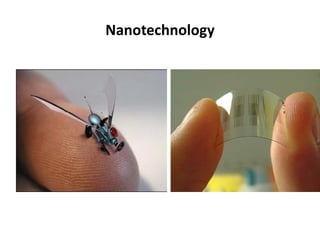
Nanotechnology
Manipulation of matter on an
• atomic,
• molecular, and
• supramolecular scale
• Materials reduced to the nanoscale can show
different properties compared to what they
exhibit on a macroscale, enabling unique
applications.
Nanotechnology is a technology, which allows to work with substances on
the levels of individual atoms.
Nanotechnology
Why Graphene?
• thinnest imaginable material
• stiffest known material (stiffer than diamond)
• most stretchable crystal (up to 20% elastically)
• record thermal conductivity (outperforming
diamond)
• lightest charge carriers (zero rest mass)
• longest mean free path at room T (micron range)
• most impermeable (even He atoms cannot squeeze
through)
History & attempts
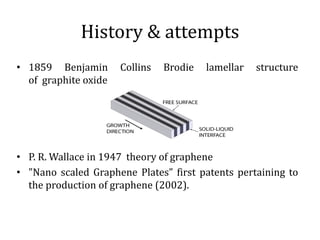
• 1859 Benjamin Collins Brodie lamellar structure
of graphite oxide
• P. R. Wallace in 1947 theory of graphene
• "Nano scaled Graphene Plates” first patents pertaining to
the production of graphene (2002).
Chemical Reaction
Results in Sludge!!
Mechanical Polishing
But Not Graphene
2004…..the time came at last!!
Scotch Tape Method……..
A McIverist Approach
Atomic Force Microscope revealed
their success!!
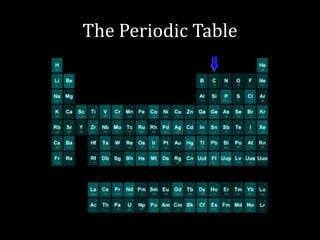
The Periodic Table
Electronic structure
C 1s2 2s2 2p2
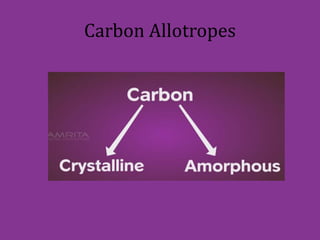
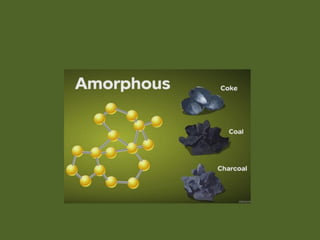
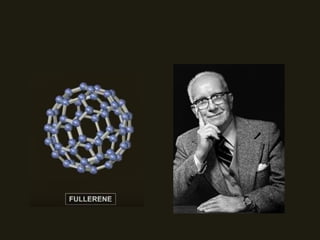
Carbon Allotropes
Structure & Stability
• Crystalline allotrophy of carbon with 2-
dimensional hexagonal lattice.
• sp2 hybridization
• Very thin atomic thickness (of 0.345Nm).
Electronic properties
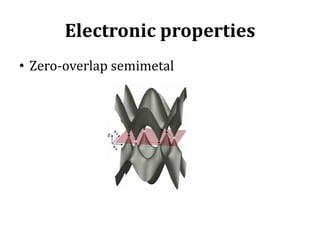
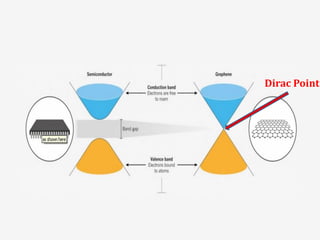
• Zero-overlap semimetal
Dirac Point
Band Gap Variation
Eelectron transport
• Very high electrical conductivity
• But very much different from metals.
• Transport dominated by two modes.
• ballistic and temperature independent
• thermally activated.
Eelectron transport
• Mobility 10×106 times greater than copper.
• displays remarkable electron mobility at room
temperature, with reported values in excess of
15000 cm2⋅V−1⋅s−1
• Scattering by graphene's acoustic phonons
intrinsically limits room temperature mobility to
200000 cm2⋅V−1⋅s−1,
• resistivity of graphene sheets would be 10−6 Ω⋅cm.
This is less than the resistivity of silver,
Thermal properties
 Graphene is a perfect thermal conductor
 Its thermal conductivity > 5000 W/m/K at
room temperature
 Graphite shows a thermal conductivity
about 5 times smaller (1000 W/m/K)
 The ballistic thermal conductance of
graphene is isotropic, i.e. same in all
directions
Lattice waves
• The atoms in a crystal are restricted to
small movements around the points
they occupy in the crystal lattice.
Crystal: Al , Symmetry: Cubic.
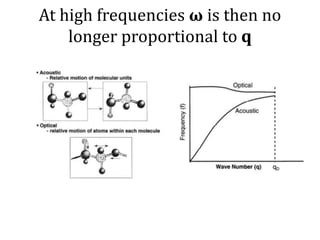
At high frequencies ω is then no
longer proportional to q
Phonon
 a quantum of energy
 trying to control the way heat moves through
solids,
better to think of it as a flow of particles
 Low-frequency vibrations correspond to
sound, while higher frequencies correspond to
heat
phonon
 Acoustic phonons are the main heat
carriers
 The unique nature of two-dimensional
phonontransport translates into unusual
heat conduction in graphene .
 The phonon andthermal properties of
nanostructures are substantially different
from those of bulk crystals
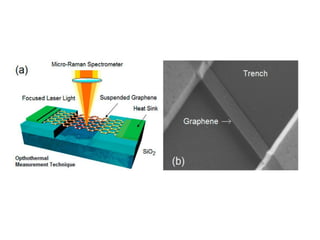
Measurements of heat conduction
• The
first measurements of
heat conduction in
graphene [35–40]
were carried out at UC
Riverside in 2007
•
optothermal Raman
measurement
technique.
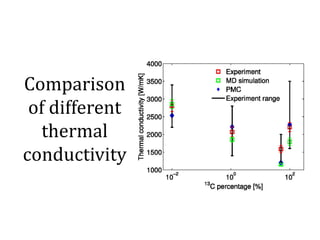
Comparison
of different
thermal
conductivity
Application & Future
GRAPHENE
GRAPHENE

GRAPHENE