MATERIALS & METHODS OF BUILDING CONSTRUCTION
NANOTECHNOLOGY IN
CONSTRUCTION
WASTE MANAGEMENT
FAROOQH PASHA A
SEM - VIII A
USN - 1BQ15AT26
2
Introduction
Nanotechnology is the use of very small pieces of material by themselves or their manipulation to create new
large scale materials.
● At the Nano-scale material properties are altered from that of larger scales.
● The Nano-scale is the size range from approximately 1nm to 100nm.
● Nanotechnology is an enabling technology that allows us to develop materials with improved or totally
new properties.
● Nanomaterials are of interest because at this scale unique optical, magnetic, electrical, and other
properties emerge. These emergent properties have the potential for great impacts in electronics,
construction field, and other fields.
● Some nanomaterials occur naturally, but of particular interest are engineered nanomaterials, which are
designed for and already being used in many commercial products and processes.
● They can be found in cement, paints, plasters, resins and in other building elements.
The construction sector requires products like cement, steel, paints, insulation materials,
window glass, and many others. The quest for sustainable development, including the construction of greener
buildings, influences innovation and encourages the use of products exploiting the unique properties of
nanomaterials. Engineered nanomaterials (ENMs) are usedeither to improve the quality of existing conventional
products or to create completely novel products, functionalities, and applications. For instance ENMs tested in
cement include SiO2, Al2O3, Fe2O3, ZrO2 and CNT, they are used mainly to improve the quality and longevity
of structures.
Ininsulation materials, nano-SiO2 (aerogel) is usedas a noise barrier and for heat loss reduction
(Jelle et al., 2012). Properties such as easy-clean, antibacterial, scratch resistance, fire retardant, UV-protection,
wood preservation and anti-corrosion can be introduced or improved in paints and coatings using the following
ENMs: Ag, CeO2, CNT, Fe2O3, SiO2, TiO2, ZnO.
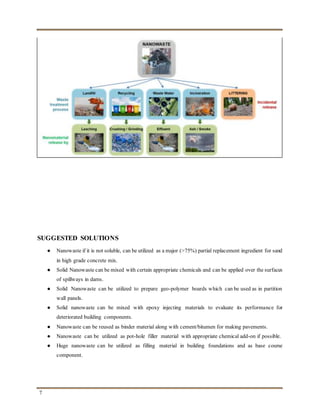
NANO-TECHNOLOGY MATERIALS USED IN
CONSTRUCTION
3
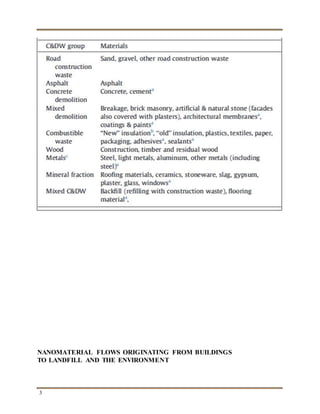
NANOMATERIAL FLOWS ORIGINATING FROM BUILDINGS
TO LANDFILL AND THE ENVIRONMENT
4
To assess the flows of ENMs within the system, we used a bottom-up approach (i.e., beginning with existing
knowledge about nano-products). This approach included the following steps:
1. Determine the quantities sold of each nano-application (market penetration) in the construction sector;
2. Estimate the ENM content of that application (ENM stock in the application) and, if necessary, the fraction of
the material containing the nanomaterial (metal, wood, glass, cement, etc.);
3. Determine the fate of the fraction containing the nanomaterial, based on waste management regulations;
4. If possible, determine any potential release of ENMs from the wastetreatments into technicalor environmental
compartments.
Usually, materials and applications in buildings have long usefullife, ranging from a couple of years (lightbulbs)
to decades, or even centuries if we look at some historic constructions. Because of this, the nature of the present
analysis is prospective. The dynamics of the system were not considered, but it is rather an estimation of how
the ENMs currently present in the system will flow under the current legal and technological framework if they
become waste.
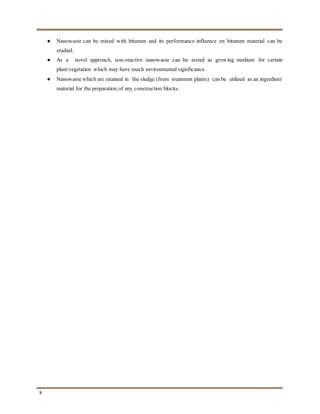
There are three broad origins of waste from nanomaterials, with categorisation similar to conventional waste:
1. Waste generated during the production of nanomaterials or nanotechnology derived products
2. Waste generated during the usage of nanomaterials or nanotechnology derived products (e.g. abrasion,
degradation etc)
3. Waste generated during the end-of-life activities (e.g. recycling, incineration, landfill etc)
Photocatalytically active concrete products and coatings
Under the influence of (UV)-light and water (humidity), nanoscale titanium dioxide accelerates chemical
reactions. This produces oxygen radicals that break down and decompose organic material. This process, known
as photocatalysis, is applied in the construction industry and architecture to create “self cleaning” building
materials and to break down air pollutants. When worked into cement or applied in a layer on concrete, the
photocatalytic activity of nano-TiO2 helps decompose dirt composed of organic matter, which is then washed
off when it rains.
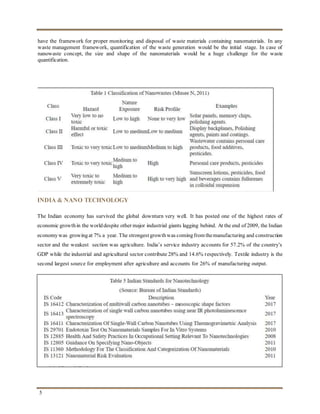
NANO WASTE
Nano pollution is a generic name for wastegenerated bynano-devices or during the nanomaterials manufacturing
process. Nanowaste is mainly the group of particles that are released into the environment, or the particles that
are thrown away when still on their products. Nano materials, even when made of inert elements like gold,
become highly active at nanometer scale. The fact that they are still functioning and are so small is what makes
Nanowaste a concern. It can float easily in the air and might easily penetrate animal and plant cells, causing
unknown effects. Since nanotechnology being a rapidly growing sector in various sectors, it’s a high time to
5
have the framework for proper monitoring and disposal of waste materials containing nanomaterials. In any
waste management framework, quantification of the waste generation would be the initial stage. In case of
nanowaste concept, the size and shape of the nanomaterials would be a huge challenge for the waste
quantification.
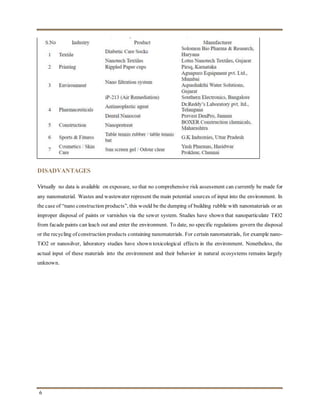
INDIA & NANO TECHNOLOGY
The Indian economy has survived the global downturn very well. It has posted one of the highest rates of
economic growthin the worlddespite other major industrial giants lagging behind. At the end of 2009, the Indian
economywas growingat 7% a year. The strongest growthwas comingfrom themanufacturing and construction
sector and the weakest section was agriculture. India’s service industry accounts for 57.2% of the country’s
GDP while the industrial and agricultural sector contribute 28% and 14.6% respectively. Textile industry is the
second largest source for employment after agriculture and accounts for 26% of manufacturing output.
6
DISADVANTAGES
Virtually no data is available on exposure, so that no comprehensive risk assessment can currently be made for
any nanomaterial. Wastes and wastewater represent the main potential sources of input into the environment. In
the case of “nano construction products”, this would be the dumping of building rubble with nanomaterials or an
improper disposal of paints or varnishes via the sewer system. Studies have shown that nanoparticulate TiO2
from facade paints can leach out and enter the environment. To date, no specific regulations govern the disposal
or the recycling of construction products containing nanomaterials. For certain nanomaterials, for example nano-
TiO2 or nanosilver, laboratory studies have shown toxicological effects in the environment. Nonetheless, the
actual input of these materials into the environment and their behavior in natural ecosystems remains largely
unknown.
7
SUGGESTED SOLUTIONS
● Nanowaste if it is not soluble, can be utilized as a major (>75%) partial replacement ingredient for sand
in high grade concrete mix.
● Solid Nanowaste can be mixed with certain appropriate chemicals and can be applied over the surfaces
of spillways in dams.
● Solid Nanowaste can be utilized to prepare geo-polymer boards which can be used as in partition
wall panels.
● Solid nanowaste can be mixed with epoxy injecting materials to evaluate its performance for
deteriorated building components.
● Nanowaste can be reused as binder material along with cement/bitumen for making pavements.
● Nanowaste can be utilized as pot-hole filler material with appropriate chemical add-on if possible.
● Huge nanowaste can be utilized as filling material in building foundations and as base course
component.
8
● Nanowaste can be mixed with bitumen and its performance influence on bitumen material can be
studied.
● As a novel approach, non-reactive nanowaste can be tested as growing medium for certain
plant/vegetation which may have much environmental significance.
● Nanowaste which are retained in the sludge (from treatment plants) can be utilized as an ingredient
material for the preparation of any construction blocks.

Nano technology in architecture

  • 1.
    MATERIALS & METHODSOF BUILDING CONSTRUCTION NANOTECHNOLOGY IN CONSTRUCTION WASTE MANAGEMENT FAROOQH PASHA A SEM - VIII A USN - 1BQ15AT26
  • 2.
    2 Introduction Nanotechnology is theuse of very small pieces of material by themselves or their manipulation to create new large scale materials. ● At the Nano-scale material properties are altered from that of larger scales. ● The Nano-scale is the size range from approximately 1nm to 100nm. ● Nanotechnology is an enabling technology that allows us to develop materials with improved or totally new properties. ● Nanomaterials are of interest because at this scale unique optical, magnetic, electrical, and other properties emerge. These emergent properties have the potential for great impacts in electronics, construction field, and other fields. ● Some nanomaterials occur naturally, but of particular interest are engineered nanomaterials, which are designed for and already being used in many commercial products and processes. ● They can be found in cement, paints, plasters, resins and in other building elements. The construction sector requires products like cement, steel, paints, insulation materials, window glass, and many others. The quest for sustainable development, including the construction of greener buildings, influences innovation and encourages the use of products exploiting the unique properties of nanomaterials. Engineered nanomaterials (ENMs) are usedeither to improve the quality of existing conventional products or to create completely novel products, functionalities, and applications. For instance ENMs tested in cement include SiO2, Al2O3, Fe2O3, ZrO2 and CNT, they are used mainly to improve the quality and longevity of structures. Ininsulation materials, nano-SiO2 (aerogel) is usedas a noise barrier and for heat loss reduction (Jelle et al., 2012). Properties such as easy-clean, antibacterial, scratch resistance, fire retardant, UV-protection, wood preservation and anti-corrosion can be introduced or improved in paints and coatings using the following ENMs: Ag, CeO2, CNT, Fe2O3, SiO2, TiO2, ZnO. NANO-TECHNOLOGY MATERIALS USED IN CONSTRUCTION
  • 3.
    3 NANOMATERIAL FLOWS ORIGINATINGFROM BUILDINGS TO LANDFILL AND THE ENVIRONMENT
  • 4.
    4 To assess theflows of ENMs within the system, we used a bottom-up approach (i.e., beginning with existing knowledge about nano-products). This approach included the following steps: 1. Determine the quantities sold of each nano-application (market penetration) in the construction sector; 2. Estimate the ENM content of that application (ENM stock in the application) and, if necessary, the fraction of the material containing the nanomaterial (metal, wood, glass, cement, etc.); 3. Determine the fate of the fraction containing the nanomaterial, based on waste management regulations; 4. If possible, determine any potential release of ENMs from the wastetreatments into technicalor environmental compartments. Usually, materials and applications in buildings have long usefullife, ranging from a couple of years (lightbulbs) to decades, or even centuries if we look at some historic constructions. Because of this, the nature of the present analysis is prospective. The dynamics of the system were not considered, but it is rather an estimation of how the ENMs currently present in the system will flow under the current legal and technological framework if they become waste. There are three broad origins of waste from nanomaterials, with categorisation similar to conventional waste: 1. Waste generated during the production of nanomaterials or nanotechnology derived products 2. Waste generated during the usage of nanomaterials or nanotechnology derived products (e.g. abrasion, degradation etc) 3. Waste generated during the end-of-life activities (e.g. recycling, incineration, landfill etc) Photocatalytically active concrete products and coatings Under the influence of (UV)-light and water (humidity), nanoscale titanium dioxide accelerates chemical reactions. This produces oxygen radicals that break down and decompose organic material. This process, known as photocatalysis, is applied in the construction industry and architecture to create “self cleaning” building materials and to break down air pollutants. When worked into cement or applied in a layer on concrete, the photocatalytic activity of nano-TiO2 helps decompose dirt composed of organic matter, which is then washed off when it rains. NANO WASTE Nano pollution is a generic name for wastegenerated bynano-devices or during the nanomaterials manufacturing process. Nanowaste is mainly the group of particles that are released into the environment, or the particles that are thrown away when still on their products. Nano materials, even when made of inert elements like gold, become highly active at nanometer scale. The fact that they are still functioning and are so small is what makes Nanowaste a concern. It can float easily in the air and might easily penetrate animal and plant cells, causing unknown effects. Since nanotechnology being a rapidly growing sector in various sectors, it’s a high time to
  • 5.
    5 have the frameworkfor proper monitoring and disposal of waste materials containing nanomaterials. In any waste management framework, quantification of the waste generation would be the initial stage. In case of nanowaste concept, the size and shape of the nanomaterials would be a huge challenge for the waste quantification. INDIA & NANO TECHNOLOGY The Indian economy has survived the global downturn very well. It has posted one of the highest rates of economic growthin the worlddespite other major industrial giants lagging behind. At the end of 2009, the Indian economywas growingat 7% a year. The strongest growthwas comingfrom themanufacturing and construction sector and the weakest section was agriculture. India’s service industry accounts for 57.2% of the country’s GDP while the industrial and agricultural sector contribute 28% and 14.6% respectively. Textile industry is the second largest source for employment after agriculture and accounts for 26% of manufacturing output.
  • 6.
    6 DISADVANTAGES Virtually no datais available on exposure, so that no comprehensive risk assessment can currently be made for any nanomaterial. Wastes and wastewater represent the main potential sources of input into the environment. In the case of “nano construction products”, this would be the dumping of building rubble with nanomaterials or an improper disposal of paints or varnishes via the sewer system. Studies have shown that nanoparticulate TiO2 from facade paints can leach out and enter the environment. To date, no specific regulations govern the disposal or the recycling of construction products containing nanomaterials. For certain nanomaterials, for example nano- TiO2 or nanosilver, laboratory studies have shown toxicological effects in the environment. Nonetheless, the actual input of these materials into the environment and their behavior in natural ecosystems remains largely unknown.
  • 7.
    7 SUGGESTED SOLUTIONS ● Nanowasteif it is not soluble, can be utilized as a major (>75%) partial replacement ingredient for sand in high grade concrete mix. ● Solid Nanowaste can be mixed with certain appropriate chemicals and can be applied over the surfaces of spillways in dams. ● Solid Nanowaste can be utilized to prepare geo-polymer boards which can be used as in partition wall panels. ● Solid nanowaste can be mixed with epoxy injecting materials to evaluate its performance for deteriorated building components. ● Nanowaste can be reused as binder material along with cement/bitumen for making pavements. ● Nanowaste can be utilized as pot-hole filler material with appropriate chemical add-on if possible. ● Huge nanowaste can be utilized as filling material in building foundations and as base course component.
  • 8.
    8 ● Nanowaste canbe mixed with bitumen and its performance influence on bitumen material can be studied. ● As a novel approach, non-reactive nanowaste can be tested as growing medium for certain plant/vegetation which may have much environmental significance. ● Nanowaste which are retained in the sludge (from treatment plants) can be utilized as an ingredient material for the preparation of any construction blocks.