WELCOME
UNIVERSITY OF HORTICULTURAL SCIENCES, BAGALKOT
COLLEGE OF HORTICULTURE, BENGALURU-560065
Speaker: Shivanand D Ainapur
UHS21PGD422, III Ph.D.
Department of PSM&AC
Major Advisor: Dr. Maruthi Prasad B. N.
Associate Professor,
Department of PSM&AC
Seminar-IV
Nano-priming: An emerging technology in medicinal
and aromatic plants
September 4, 2024 Department of PSM&AC 2/48
Introduction
History and priming techniques
Synthesis of nano-particles
Mechanism of nano-priming
Influence of nano-priming on plant growth and metabolism
Case studies
Conclusion
CONTENTS
September 4, 2024 3
Department of PSM&AC 3/48
09/04/2024 Dept. of FSC
The induction of a particular physiological state in plants by treating the
seeds prior to sowing with natural or synthetic compounds to promote crop
performance by enhancing tolerance to biotic and abiotic stress.
Principle : To minimize the period of emergence and
to protect the seeds from stresses during the critical
phase of seedling establishment.
Heydecker et al., 1973
Introduction
4/48
Timeline of seed priming development towards
nano-priming
Seed priming
Gaius Secundus
(23 A.D)
Theophrastus
(371 B.C)
Charles Darwin
(1855)
Soaked cucumber
seeds in water
Dried the soaked
seeds before sowing
Cucumber seed
priming with honey
Ells (1963)
Seed priming with
seawater treatment
Seed priming with
nutrition
Heydeeker
(1973)
Khodakovskaya et al.,
(2009)
Seeds treated with
nanocarbon
Seed priming with
PEG
Oliver de
Serres (1539)
Seed priming with
salt solution
Koehler (1967)
Berric & Drennam
(1971)
Studied the effect of
seed priming time
Seed Nano-priming Technology
5/48
Nile et al., 2022
Types of seed priming techniques
Seed priming
Conventional
methods
Hydro
priming
Halo-
priming
Osmo-
priming
Bio-priming
PGRs,
hormones and
organic solutes
Advanced
methods
Physical
agents Nano-priming
6/48
Nile et al., 2022
Nanoparticles used in Nano seed priming
• Metal-based Nanoparticles: Silver nanoparticles, zinc oxide
nanoparticles and copper nanoparticles
• Carbon-based Nanoparticles: Carbon nanotubes and graphene
nanoparticles have unique physical and chemical properties
• Metal-Organic Frameworks (MOFs): MOFs are crystalline
nanoporous materials that can serve as carriers for nutrients, water or
bioactive compounds, providing sustained release and targeted
delivery to seeds
7/48
Drummer et al., 2021
Synthesis of nano-particles
8/48
Drummer et al., 2021
Figure 1. Physico-chemical properties for nanomaterial for seed priming
• Particle size – ranging from 1-100
nm
• Particle shape – spherical, rod-
shaped, tubular and plate like
• Zeta potential – indicative of
surface charge
• Composition – ZnO, Fe2O3, SiO2
& Ag-NPs
• Surface corona – layer of
molecules that adsorb on the
Surface of NPs
• Aggregation - NPs clump together
Drummer et al., 2021 9/48
Figure
2.
Mechanism
of
nano-
priming
in
seed
germination
5
4a
4b
3
6
2
7
9
8
Induced expressions of cell division (CycB),
Cell wall extension (NtLRX1 gene) &
enhanced cell respiration enzyme
(dehydrogenase)
Improved seed germination rate, SVI,
induced Rubisco activity, altered
PSI & PSII and Improved
photosynthesis
Facilitate water uptake,
ROS diffusion
Membrane damage
NPs
H2O2/ROS production
(Oxidative stress)
Water molecules
Aquaporins (PIP1 &
PIP2)
Induced radical
growth
Starch
Soluble sugars
Table 1. Influence of nano-priming plant growth and metabolism
Effect on plant physiology Changes in chemical
constituents
Molecular changes in
plant
Growth & biomass,
Photosynthesis [Chlorophyll]
Photosynthetic quantum efficiency,
Gas exchange traits,
Carotenoids,
Cellular electron exchange,
Soluble proteins,
Relative water content,
Antioxidant enzymes [POX, SOD,
CAT & APX]
Gibberellic acid
IAA
ABA:GA
α-amylase
Soluble sugar
Aquaporins
Lipids
DNA content
DNA repair
Cell wall extension (NtLRX1)
Cell division (CycB)
Aquaporin (PIP1, PIP2, NIP1, TIP3
& TIP4)
Phynylalanine ammonia lysase
(PAL1)
Anthocyanin synthase 1 (ANS1) and
Anthocyanin pigment 1 (PAP1)
11/48
Nile et al., 2022
Figure 3. Influence of nano-priming plant metabolism
12/48
Nile et al., 2022
Figure 4. Effect of nanopriming agents to improve seed germination in abiotic and
biotic stress conditions
Nile et al., 2022 13/48
Effect of nanoparticles on seed germination and
Seedling growth of Boswellia Ovalifoliolata – An
endemic and endangered medicinal tree
Objectives: To investigate the effect of biologically synthesized SNPs on seed
germination and seedling growth
Savitramma et al., 2012
Nano Vision – NAAS 7.11
14/56
Department of Botany,
Sri Venkateswara University, Tirupati, Andhra Pradesh,
INDIA.
Material and methods
• SNPs prepared biologenically using the bark extract of Boswellia ovalifoliolata
• The seed germination experiment was carried out with four sets, each set with five
test tubes containing MS basal medium without growth regulators
• Five seeds were placed in each test tube and observed for germination
Savitramma et al., 2012 15/56
Treatment set Details
First set – Control MS basal medium
Second set MS basal medium + 1 ml of SNPs (10 μg/ml)
Third set MS basal medium + 2 ml of SNPs (20 μg/ml)
Forth set MS basal medium + 3 ml of SNPs (30 μg/ml)
Figure 5: (a) The colour change of bark extracts, (b) Absorption at 430nm in UV-Vis
Spectroscopy (c) SEM image of synthesized silver nanoparticles of stem barks of Boswellia
ovalifoliolata
Savitramma et al., 2012 16/56
a. b. c.
Table 2. Effect of Silver nanoparticles on in-vitro seed germination and seedling growth of
Boswellia ovailifoliolata values are an average of five replications ± SE.
S. No. Concentration Germination Percentage Germination period
(Days)
Seedling growth
(cm)
1. Control 70 ± 2.5 17 ± 3 3.0 ± 0.5
2. 10 mg/ml 91 ± 3.2 8.0 ± 1 5.5 ± 1.0
3. 20 mg/ ml 92 ± 2.0 8.0 ± 2 6.3±1.7
4. 30 mg/ml 95 ± 3.1 9.0 ± 2 10.6 ± 0.3
Figure 6. Effect of biologically synthesized silver nanoparticles on seed germination and seedling growth of
Boswellia ovaliofoliolata a) Control, b) SNPs 10 mg/ml, c) 20 mg/ml and d) 30 mg/ml
Savitramma et al., 2012 17/48
Inference
Stimulating effect of biogenic nanoparticles on the
germination of basil (Ocimum basilicum L.) seeds
Objectives: To investigate the effects of various concentrations of biosynthesized NPs
on the germination and germination index of basil seeds
Sencan et al., 2024
Sci. Rep. – NAAS 10.60
18/48
Department of Chemical Engineering, Biology and Bioengineering,
Suleyman Demirel University, 32260 Isparta, Turkey.
Material and methods
• Biosynthesis of NPs (Ag-, ZnO- & Fe3O4-NPs) using lavender (Lavandula
officinalis L.) flowers and thyme leaves (Origanum minutiflorum O. Schwarz &
P.H. Davis)
• Treatments – primed for 24 h
• Relative seed germination (%), Relative root growth (%), Germination Index (GI),
Germination vigour index (GVI) & Seed water content (SWC)
Sencan et al., 2024
Nanoparticles Ag-NPs & ZnO-NPs Magnetite (Fe3O4)-NPs
Concentration (mg L-1
) 0 (Control), 25, 50, 100, 200 0 (Control), 50, 100, 200 & 400
19/48
Figure 7. Response of NPs on germination index. Bars indicate standard errors of the means ― SE (n = 20);
different letters over identical bars indicate significant differences (Duncan post-hoc test; P ≤ 0.05).
Sencan et al., 2024 20/48
Germination Index (%)=
GP – 85%, Root length
– 19.4 mm &
GI – 139.15%
GP – 8-43%, Root
length – 16.6 mm &
GI – 119.68%
GP – 88%, Root length
– 13.2 mm &
GI – 90%
Figure 8. Response of NPs on germination vigor index. Bars indicate standard errors of the means ― SE (n =
20); different letters over identical bars indicate significant differences (Duncan post-hoc test; P ≤ 0.05).
Sencan et al., 2024 21/48
Germination vigour index (%) =
GVI by 21%,
Seedling length – 44.6mm
GVI by 12%
Figure 9. Effects of NPs in seed water content. Bars indicate standard errors of the means ― SE (n= 20);
different letters over identical bars indicate significant differences (Duncan post-hoc test; P ≤ 0.05).
Sencan et al., 2024 22/48
SWC (%) = x 100
Figure 10. The water-holding capacity of basil seeds germinated at different concentrations of NPs on the third day of
germination: a. control; b. Fe3O4-NP (50 mg/L); c. ZnO-NP (25 mg/L); d. Ag-NP (400 mg/L).
Sencan et al., 2024 23/48
Inference
The impact of priming with Al2O3 nanoparticles on growth,
pigments, osmolytes and antioxidant enzymes of Egyptian
Roselle (Hibiscus sabdariffa L.) cultivar
Objectives: To investigate the efficacy of various doses of Al2O3 tested on Egyptian
roselle cultivars to unravel their potential for tolerance
Latef et al., 2020
Agronomy – NAAS 9.70
24/48
Botany and Microbiology Department,
South Valley University, Qena 83523, Egypt.
Material and methods
• Synthesis of Al2O3 Nanoparticles
• Seed treatment – 5 groups
• Growth traits, photosynthetic pigments, organic solutes, Malondialdehyde and antioxidant
enzyme assays
Set Treatment
1st
Set – Control Priming with distilled water for 12 h
2nd
Set Primed with 0.01% Al2O3 NPs for 12 h
3rd
Set Primed with 0.05% Al2O3 NPs for 12 h
4th
Set Primed with 0.1% Al2O3 NPs for 12 h
5th
Set Primed with 0.5% Al2O3 NPs for 12 h
Latef et al., 2020 25/48
Figure 11. Effects of seed-priming with aluminum nanoparticles (Al2O3 NPs) on (A) chlorophyll a, (B)
chlorophyll b and (C) carotenoids content in roselle plants
Latef et al., 2020 26/48
Figure 12. Effects of seed-priming with aluminum nanoparticles (Al2O3 NPs) on (A) fresh weight, (B) dry
weight, (C) root length and shoot length and (D) leaf area in roselle plants
Latef et al., 2020 27/48
Figure 13. Effects of seed-priming with aluminum nanoparticles (Al2O3 NPs) on (A) soluble sugar,
(B) soluble protein, (C) total free amino acid and (D) proline in roselle plants
Latef et al., 2020 28/48
Figure 14. Effects of seed-priming with aluminum nanoparticles (Al2O3 NPs) on the activities of (A) superoxide
dismutase (SOD), (B) catalase (CAT), (C) peroxidase (POD) and (D) ascorbate peroxidase (APX) in leaves of
roselle plants Latef et al., 2020 28/48
Figure 15. Effects of seed-priming with aluminum nanoparticles NPs) on malondialdehyde content
(MDA) in roselle plants
Latef et al., 2020 30/48
Figure 16. (A). Principal component analysis (PCA) to understand the variability relationships of
parameters and treatments in roselle plants. (B) The treatments’ rectangles in different colors included
(control) set was primed with distilled water for 12 h. The 2nd set was primed with 0.01% Al2O3 NPs for
12 h. The 3rd set was primed with 0.05% Al2O3 NPs for 12 h. The 4th
set was primed with 0.1% Al2O3
NPs for 12 h. The 5th set was primed with 0.5% Al2O3 NPs for 12 h
Latef et al., 2020 31/48
Inference
Application of chitosan nano-priming on plant
growth and secondary metabolites of Pancratium
maritimum L.
Objectives: To estimate the potential of primed seed with chitosan nanoparticles on
seed growth and yield by inducing plant secondary metabolism
Allam et al., 2024
BMC Plant Biol. – NASS 9.90
32/48
Department of Botany and Microbiology,
Alexandria University, Alexandria,
Egypt.
Material and Methods
• Preparation of chitosan nanoparticles
• Seeds (Coated and uncoated) were imbibed in each concentration of chitosan
nanoparticles (CsNPs) (0.1, 0.5, 1 mg/ ml) for 4, 8 and 12 h
• Germination bioassay – Petri dish assay
• Growth experiment – In plastic pots
• Growth Parameters – Germination percentage, Gemination velocity, Speed
of germination, Germination energy, Germination index, Mean germination
time and Seedling vigour index
• Determination of plant biomass and water content
• Determination of phytochemicals [Alkaloid] – GC-MS
• Antioxidant activity
Allam et al., 2024 33/48
Figure 17. Effect of different concentrations of nano-priming using chitosan nanoparticles (0.1, 0 5
and 1 mg/ml) on germination of coated and uncoated seeds under various seed priming treatments
for the three different soaking durations.
Coated Seeds Uncoated seeds
34/48
Allam et al., 2024
Figure 18. Variations of a: Germination Percentage (GP%), b: Germination Velocity (GVe) c: Speed of
Germination (SG) and d: Germination energy (GE) in coated and uncoated seeds of Pancratium maritimum
L. in pot experiment in response to different concentration of nano priming under different soaking durations
Allam et al., 2024 35/48
GVe =
GP (%) =
SG =
GE = x 100
Figure 19. Variations of e: Germination index (GI), f: Mean germination time (MGT), g: shoot root ratio, h:
seedling vigor index (SVI) in coated and uncoated seeds of Pancratium maritimum L. in pot experiment in
response to different concentration of nanopriming under different soaking durations
Allam et al., 2024 36/48
GI =
MGT =
SVI = Seedling length * GP%
Figure 20. Variations of i: Biomass in coated and uncoated seeds of Pancratium maritimum L. in pot
experiment in response to different concentration of nanopriming under different soaking durations
Allam et al., 2024 37/48
Table 3. Mean values of a. alkaloids and b. Pancratistatin content (%) (mean ± S.D., n = 3) of Pancratium
maritimum L. in response to different concentrations of nano priming under different soaking durations
a. Alkaloids 4h 8h 12h F P0
Control 13.54bc
± 1.74 13.54a
± 1.74 13.54b
± 1.74 - -
Nano 0.1 mg/ml 9.45deB
± 0.42 12.47abA
± 0.48 13.46bA
± 0.54 55.936*
<0.001*
Nano 0.5 mg/ml 16.34aA
± 0.53 9.87cdB
± 0.86 10.47deB
± 0.39 98.518*
<0.001*
Nano 1 mg/ml 8.69eB
± 0.66 9.87abA
± 0.73 9.65deA
± 0.33 3.318 0.107
F 28.091*
24.978*
42.253*
P0 <0.001*
<0.001*
<0.001*
b. Pancratistatin 4h 8h 12h F P0
Control 2.13a
± 0.22 2.13a
± 0.22 2.13a
± 0.22 - -
Nano 0.1 mg/ml 2.14aA
± 0.05 2.15aA
± 0.05 1.98abA
± 0.27 1.029 0.413
Nano 0.5 mg/ml 2.19aA
± 0.06 1.9abA
± 0.19 1.87abA
± 0.17 3.671 0.091
Nano 1 mg/ml 2.10aA
± 0.10 1.84abA
± 0.00 2.16abA
± 0.21 4.717 0.059
F 1.908 4.116*
3.596*
P0 0.121 0.006*
0.011*
Allam et al., 2024 38/48
Table 4. Mean values of a. Lycorin content and b. Antioxidant content (%) (mean ± S.D., n = 3) of
Pancratium maritimum L. in response to different concentration of nanopriming under different soaking
durations
a. Lycorine 4h 8h 12h F P0
Control 29.45e
± 1.22 29.45f
± 1.22 29.45e
± 1.22 - -
Nano 0.1 mg/ml 29.64deB
± 0.37 29.47fB
± 0.39 46.74abA
± 0.50 1669.25*
<0.001*
Nano 0.5 mg/ml 38.46bA
± 0.52 36.95dB
± 0.48 36.45dB
± 0.18 18.595*
0.003*
Nano 1 mg/ml 41.36aC
± 0.36 54.36aA
± 0.18 48.21aB
± 0.32 1458.31*
<0.001*
F 120.911*
745.604*
42.253*
P0 <0.001*
<0.001*
<0.001*
b. Antioxidant 4h 8h 12h F P0
Control 9.12f
± 0.27 9.12e
± 0.27 9.12d
± 0.27 - -
Nano 0.1 mg/ml 12.14bcB
± 0.32 12.64bcAB
± 0.44 13.24bA
± 0.19 8.356* 0.018*
Nano 0.5 mg/ml 12.89bA
± 0.35 11.67dB
± 0.22 11.58cB
± 0.32 17.549* 0.003*
Nano 1 mg/ml 14.31aC
± 0.10 16.98aA
± 0.53 15.24aB
± 0.22 40.550* <0.001*
F 75.785* 150.746*
130.155*
P0 <0.001* <0.001*
0.011*
Allam et al., 2024 39/48
Inference
Seed nano priming using silica nanoparticles: Effects
‑
in seed germination and physiological properties of
Stevia rebaudiana Bertoni
Objectives: To identify and select the most effective nanoparticles in terms of
germination parameters and physiological properties to enhance stevia seed
germination
Hasanaklou et al., 2023
Chem. Biol. Technol. Agric. – NAAS 12.77
40/48
Department of Nanotechnology and Plant Molecular Physiology, Agricultural
Biotechnology Research Institute of Iran (ABRII), Agricultural Research
Education and Extension Organization (AREEO), Karaj, Iran.
Material and methods
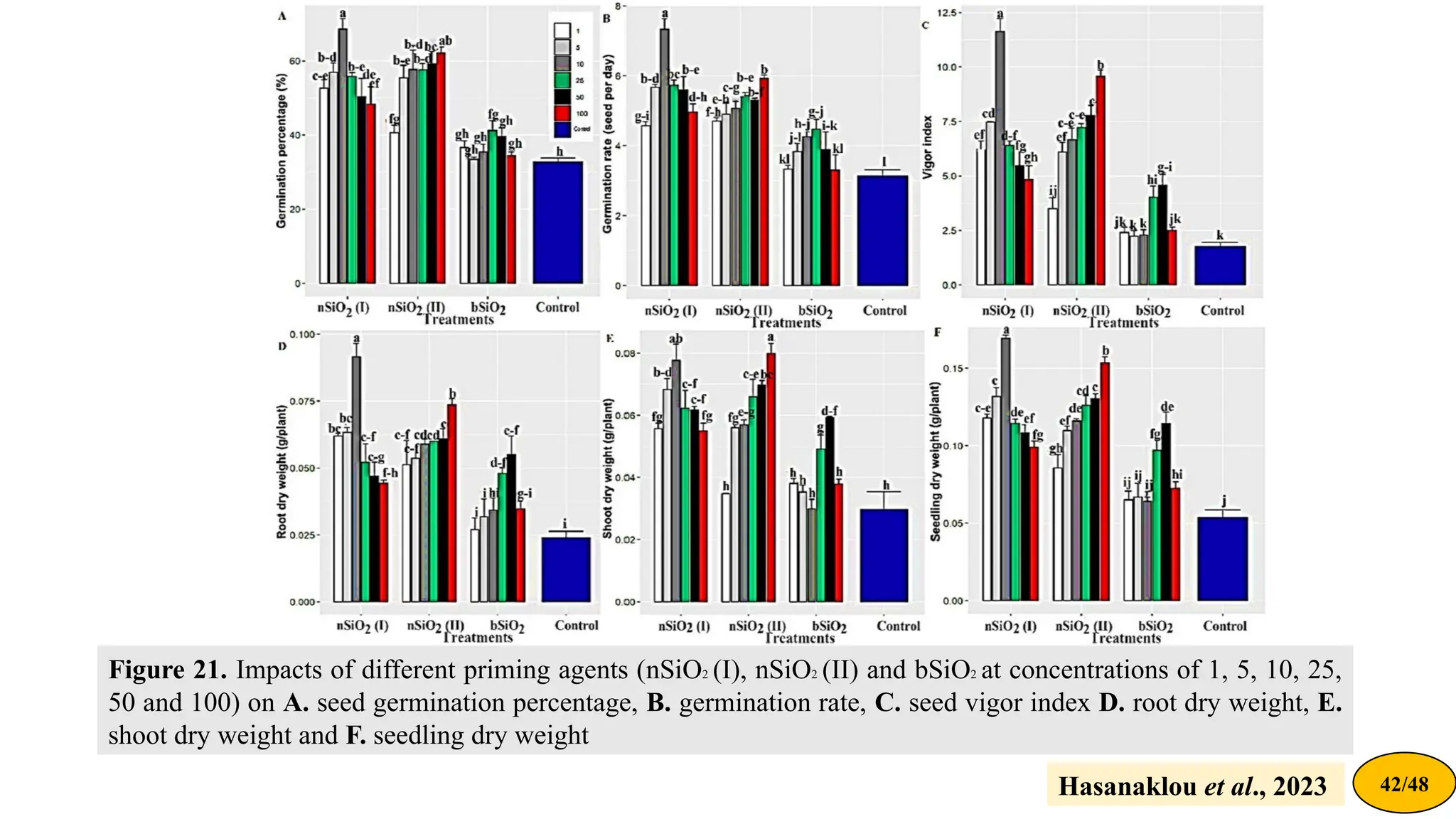
• Synthesis of nanoparticles (nSiO2 (I) and nSiO2 (II) showed
the silica NPs synthesized at 85 °C and 25 °C, respectively)
• Seed treatment with different concentrations (0, 1, 5, 10, 25,
50, and 100 ppm) of nSiO2 (I), nSiO2 (II), and commercial
bulk SiO2 (bSiO2)
• Germination percentage, germination rate & seed vigour
• Starch and sucrose determination
• Antioxidant enzymes activity [CAT & POX]
Hasanaklou et al., 2023 41/48
Figure 21. Impacts of different priming agents (nSiO2 (I), nSiO2 (II) and bSiO2 at concentrations of 1, 5, 10, 25,
50 and 100) on A. seed germination percentage, B. germination rate, C. seed vigor index D. root dry weight, E.
shoot dry weight and F. seedling dry weight
Hasanaklou et al., 2023 42/48
Figure 22. Impacts of different priming agents (nSiO2 (I), nSiO2 (II) & bSiO2 at concentrations of 1, 5,
10, 25, 50, and 100) on A. α-amylase, B. cotyledon starch, C. root sucrose and D. shoot sucrose
content Hasanaklou et al., 2023 43/48
Table 5. CAT and POX activity and H2O2 concentration in the treated seed with SiO2 NPs
Treatments Concentration (ppm) CAT activity (U mg-1
Protein) POX activity (U mg-1
Protein) H2O2 concentration (umol g-1
FW)
Control - 24.77 ― 0.29 0.044 ― 0.0003 4.22 ― 0.09
bSiO2 1 27.74 ― 0.30 0.045 ― 0.0004 4.36 ― 0.04
5 29.82 ― 1.58 0.046 ― 0.0010 4.36 ― 0.07
10 30.38 ― 0.37 0.049 ― 0.0004 4.24 ― 0.05
25 31.61 ― 0.18 0.050 ― 0.0007 4.42 ― 0.03
50 31.20 ― 0.79 0.050 ― 0.0009 4.63 ― 0.01
100 30.24 ― 0.24 0.052 ― 0.0005 4.70 ― 0.02
nSiO2 (I) 1 29.88 ― 0.15 0.047 ― 0.0006 3.1 ― 0.04
5 31.45 ― 0.49 0.056 ― 0.0039 3.46 ― 0.04
10 32.41 ― 0.54 0.058 ― 0.0007 3.68 ― 0.10
25 33.09 ― 0.25 0.057 ― 0.0030 3.87 ― 0.18
50 32.81 ― 0.46 0.056 ― 0.0005 4.53 ― 0.06
100 31.72 ― 0.39 0.055 ― 0.0004 4.69 ― 0.02
nSiO2 (II) 1 29.29 ― 0.37 0.052 ― 0.0012 3.50 ― 0.05
5 29.93 ― 0.37 0.055 ― 0.0004 3.62 ― 0.06
10 36.15 ― 0.29 0.057 ― 0.0003 3.67 ― 0.10
25 34.66 ― 0.21 0.057 ― 0.0003 4.48 ― 0.04
50 33.25 ― 0.23 0.056 ― 0.0003 4.55 ― 0.04
100 32.90 ― 0.65 0.051 ― 0.0005 4.65 ― 0.04
Hasanaklou et al., 2023
44/48
Figure 23. Pearson correlation coefficients among 14 quantitative traits on stevia seedlings under the
influence of SiO2NPs. The correlation coefficients with absolute values higher than 0.20 and 0.26 were
significant at the statistical probability level of 5 and 1 per cent, respectively.
Hasanaklou et al., 2023 45/48
Inference
Available nanoparticles for agricultural use
Cost of NPs
• ZnO-NPs – 20-100$ kg-1
• Ag-NPs – 100-300$ g-1
• Copper NPs – 50-100$ g-1
• TiO2-NP – 20-50$ g-1
• Au-NPs – 80-150$ g-1
• Chitosan NPs – 300-500$
100g-1
• Lipid NPs – 200-500$ g-1
• Magnetite NPs – 380-2255 $
kg-1
• MgO2-NPs – 20-50$ g-1
(Source: Cognitive Market Research, Fortune Business Insights, Fact.MR & IMARC)
46/48
Limitations of nanotechnology in agriculture sector
47a/48
Saritha et al., 2023
Future prospects of nano-priming
• Optimization of size, shape, concentration and treatment duration in various plant
species
• Development of new nano-enabled materials based on bio-polymers viz., chitosan,
sodium aginate, xanthane gum, lignin and gum arabic etc.
• Genome-wide transcriptomic study in different nano-priming conditions will be useful
in understanding the commonly controlled networks responding to NPs
• Utilization of various aquaporin family gene mutants is probably useful to dissect
additional transcription co-factors correlated with the expression of aquaporin
genes in primed seeds
Kandhol et al., 2022 & Nile et al., 2022 47b/48
Conclusion
48/48

Nano-priming - An Emerging technology in Medicinal and Aromatic Plants.pptx

  • 1.
  • 2.
    UNIVERSITY OF HORTICULTURALSCIENCES, BAGALKOT COLLEGE OF HORTICULTURE, BENGALURU-560065 Speaker: Shivanand D Ainapur UHS21PGD422, III Ph.D. Department of PSM&AC Major Advisor: Dr. Maruthi Prasad B. N. Associate Professor, Department of PSM&AC Seminar-IV Nano-priming: An emerging technology in medicinal and aromatic plants September 4, 2024 Department of PSM&AC 2/48
  • 3.
    Introduction History and primingtechniques Synthesis of nano-particles Mechanism of nano-priming Influence of nano-priming on plant growth and metabolism Case studies Conclusion CONTENTS September 4, 2024 3 Department of PSM&AC 3/48
  • 4.
    09/04/2024 Dept. ofFSC The induction of a particular physiological state in plants by treating the seeds prior to sowing with natural or synthetic compounds to promote crop performance by enhancing tolerance to biotic and abiotic stress. Principle : To minimize the period of emergence and to protect the seeds from stresses during the critical phase of seedling establishment. Heydecker et al., 1973 Introduction 4/48
  • 5.
    Timeline of seedpriming development towards nano-priming Seed priming Gaius Secundus (23 A.D) Theophrastus (371 B.C) Charles Darwin (1855) Soaked cucumber seeds in water Dried the soaked seeds before sowing Cucumber seed priming with honey Ells (1963) Seed priming with seawater treatment Seed priming with nutrition Heydeeker (1973) Khodakovskaya et al., (2009) Seeds treated with nanocarbon Seed priming with PEG Oliver de Serres (1539) Seed priming with salt solution Koehler (1967) Berric & Drennam (1971) Studied the effect of seed priming time Seed Nano-priming Technology 5/48 Nile et al., 2022
  • 6.
    Types of seedpriming techniques Seed priming Conventional methods Hydro priming Halo- priming Osmo- priming Bio-priming PGRs, hormones and organic solutes Advanced methods Physical agents Nano-priming 6/48 Nile et al., 2022
  • 7.
    Nanoparticles used inNano seed priming • Metal-based Nanoparticles: Silver nanoparticles, zinc oxide nanoparticles and copper nanoparticles • Carbon-based Nanoparticles: Carbon nanotubes and graphene nanoparticles have unique physical and chemical properties • Metal-Organic Frameworks (MOFs): MOFs are crystalline nanoporous materials that can serve as carriers for nutrients, water or bioactive compounds, providing sustained release and targeted delivery to seeds 7/48 Drummer et al., 2021
  • 8.
  • 9.
    Figure 1. Physico-chemicalproperties for nanomaterial for seed priming • Particle size – ranging from 1-100 nm • Particle shape – spherical, rod- shaped, tubular and plate like • Zeta potential – indicative of surface charge • Composition – ZnO, Fe2O3, SiO2 & Ag-NPs • Surface corona – layer of molecules that adsorb on the Surface of NPs • Aggregation - NPs clump together Drummer et al., 2021 9/48
  • 10.
    Figure 2. Mechanism of nano- priming in seed germination 5 4a 4b 3 6 2 7 9 8 Induced expressions ofcell division (CycB), Cell wall extension (NtLRX1 gene) & enhanced cell respiration enzyme (dehydrogenase) Improved seed germination rate, SVI, induced Rubisco activity, altered PSI & PSII and Improved photosynthesis Facilitate water uptake, ROS diffusion Membrane damage NPs H2O2/ROS production (Oxidative stress) Water molecules Aquaporins (PIP1 & PIP2) Induced radical growth Starch Soluble sugars
  • 11.
    Table 1. Influenceof nano-priming plant growth and metabolism Effect on plant physiology Changes in chemical constituents Molecular changes in plant Growth & biomass, Photosynthesis [Chlorophyll] Photosynthetic quantum efficiency, Gas exchange traits, Carotenoids, Cellular electron exchange, Soluble proteins, Relative water content, Antioxidant enzymes [POX, SOD, CAT & APX] Gibberellic acid IAA ABA:GA α-amylase Soluble sugar Aquaporins Lipids DNA content DNA repair Cell wall extension (NtLRX1) Cell division (CycB) Aquaporin (PIP1, PIP2, NIP1, TIP3 & TIP4) Phynylalanine ammonia lysase (PAL1) Anthocyanin synthase 1 (ANS1) and Anthocyanin pigment 1 (PAP1) 11/48 Nile et al., 2022
  • 12.
    Figure 3. Influenceof nano-priming plant metabolism 12/48 Nile et al., 2022
  • 13.
    Figure 4. Effectof nanopriming agents to improve seed germination in abiotic and biotic stress conditions Nile et al., 2022 13/48
  • 14.
    Effect of nanoparticleson seed germination and Seedling growth of Boswellia Ovalifoliolata – An endemic and endangered medicinal tree Objectives: To investigate the effect of biologically synthesized SNPs on seed germination and seedling growth Savitramma et al., 2012 Nano Vision – NAAS 7.11 14/56 Department of Botany, Sri Venkateswara University, Tirupati, Andhra Pradesh, INDIA.
  • 15.
    Material and methods •SNPs prepared biologenically using the bark extract of Boswellia ovalifoliolata • The seed germination experiment was carried out with four sets, each set with five test tubes containing MS basal medium without growth regulators • Five seeds were placed in each test tube and observed for germination Savitramma et al., 2012 15/56 Treatment set Details First set – Control MS basal medium Second set MS basal medium + 1 ml of SNPs (10 μg/ml) Third set MS basal medium + 2 ml of SNPs (20 μg/ml) Forth set MS basal medium + 3 ml of SNPs (30 μg/ml)
  • 16.
    Figure 5: (a)The colour change of bark extracts, (b) Absorption at 430nm in UV-Vis Spectroscopy (c) SEM image of synthesized silver nanoparticles of stem barks of Boswellia ovalifoliolata Savitramma et al., 2012 16/56 a. b. c.
  • 17.
    Table 2. Effectof Silver nanoparticles on in-vitro seed germination and seedling growth of Boswellia ovailifoliolata values are an average of five replications ± SE. S. No. Concentration Germination Percentage Germination period (Days) Seedling growth (cm) 1. Control 70 ± 2.5 17 ± 3 3.0 ± 0.5 2. 10 mg/ml 91 ± 3.2 8.0 ± 1 5.5 ± 1.0 3. 20 mg/ ml 92 ± 2.0 8.0 ± 2 6.3±1.7 4. 30 mg/ml 95 ± 3.1 9.0 ± 2 10.6 ± 0.3 Figure 6. Effect of biologically synthesized silver nanoparticles on seed germination and seedling growth of Boswellia ovaliofoliolata a) Control, b) SNPs 10 mg/ml, c) 20 mg/ml and d) 30 mg/ml Savitramma et al., 2012 17/48 Inference
  • 18.
    Stimulating effect ofbiogenic nanoparticles on the germination of basil (Ocimum basilicum L.) seeds Objectives: To investigate the effects of various concentrations of biosynthesized NPs on the germination and germination index of basil seeds Sencan et al., 2024 Sci. Rep. – NAAS 10.60 18/48 Department of Chemical Engineering, Biology and Bioengineering, Suleyman Demirel University, 32260 Isparta, Turkey.
  • 19.
    Material and methods •Biosynthesis of NPs (Ag-, ZnO- & Fe3O4-NPs) using lavender (Lavandula officinalis L.) flowers and thyme leaves (Origanum minutiflorum O. Schwarz & P.H. Davis) • Treatments – primed for 24 h • Relative seed germination (%), Relative root growth (%), Germination Index (GI), Germination vigour index (GVI) & Seed water content (SWC) Sencan et al., 2024 Nanoparticles Ag-NPs & ZnO-NPs Magnetite (Fe3O4)-NPs Concentration (mg L-1 ) 0 (Control), 25, 50, 100, 200 0 (Control), 50, 100, 200 & 400 19/48
  • 20.
    Figure 7. Responseof NPs on germination index. Bars indicate standard errors of the means ― SE (n = 20); different letters over identical bars indicate significant differences (Duncan post-hoc test; P ≤ 0.05). Sencan et al., 2024 20/48 Germination Index (%)= GP – 85%, Root length – 19.4 mm & GI – 139.15% GP – 8-43%, Root length – 16.6 mm & GI – 119.68% GP – 88%, Root length – 13.2 mm & GI – 90%
  • 21.
    Figure 8. Responseof NPs on germination vigor index. Bars indicate standard errors of the means ― SE (n = 20); different letters over identical bars indicate significant differences (Duncan post-hoc test; P ≤ 0.05). Sencan et al., 2024 21/48 Germination vigour index (%) = GVI by 21%, Seedling length – 44.6mm GVI by 12%
  • 22.
    Figure 9. Effectsof NPs in seed water content. Bars indicate standard errors of the means ― SE (n= 20); different letters over identical bars indicate significant differences (Duncan post-hoc test; P ≤ 0.05). Sencan et al., 2024 22/48 SWC (%) = x 100
  • 23.
    Figure 10. Thewater-holding capacity of basil seeds germinated at different concentrations of NPs on the third day of germination: a. control; b. Fe3O4-NP (50 mg/L); c. ZnO-NP (25 mg/L); d. Ag-NP (400 mg/L). Sencan et al., 2024 23/48 Inference
  • 24.
    The impact ofpriming with Al2O3 nanoparticles on growth, pigments, osmolytes and antioxidant enzymes of Egyptian Roselle (Hibiscus sabdariffa L.) cultivar Objectives: To investigate the efficacy of various doses of Al2O3 tested on Egyptian roselle cultivars to unravel their potential for tolerance Latef et al., 2020 Agronomy – NAAS 9.70 24/48 Botany and Microbiology Department, South Valley University, Qena 83523, Egypt.
  • 25.
    Material and methods •Synthesis of Al2O3 Nanoparticles • Seed treatment – 5 groups • Growth traits, photosynthetic pigments, organic solutes, Malondialdehyde and antioxidant enzyme assays Set Treatment 1st Set – Control Priming with distilled water for 12 h 2nd Set Primed with 0.01% Al2O3 NPs for 12 h 3rd Set Primed with 0.05% Al2O3 NPs for 12 h 4th Set Primed with 0.1% Al2O3 NPs for 12 h 5th Set Primed with 0.5% Al2O3 NPs for 12 h Latef et al., 2020 25/48
  • 26.
    Figure 11. Effectsof seed-priming with aluminum nanoparticles (Al2O3 NPs) on (A) chlorophyll a, (B) chlorophyll b and (C) carotenoids content in roselle plants Latef et al., 2020 26/48
  • 27.
    Figure 12. Effectsof seed-priming with aluminum nanoparticles (Al2O3 NPs) on (A) fresh weight, (B) dry weight, (C) root length and shoot length and (D) leaf area in roselle plants Latef et al., 2020 27/48
  • 28.
    Figure 13. Effectsof seed-priming with aluminum nanoparticles (Al2O3 NPs) on (A) soluble sugar, (B) soluble protein, (C) total free amino acid and (D) proline in roselle plants Latef et al., 2020 28/48
  • 29.
    Figure 14. Effectsof seed-priming with aluminum nanoparticles (Al2O3 NPs) on the activities of (A) superoxide dismutase (SOD), (B) catalase (CAT), (C) peroxidase (POD) and (D) ascorbate peroxidase (APX) in leaves of roselle plants Latef et al., 2020 28/48
  • 30.
    Figure 15. Effectsof seed-priming with aluminum nanoparticles NPs) on malondialdehyde content (MDA) in roselle plants Latef et al., 2020 30/48
  • 31.
    Figure 16. (A).Principal component analysis (PCA) to understand the variability relationships of parameters and treatments in roselle plants. (B) The treatments’ rectangles in different colors included (control) set was primed with distilled water for 12 h. The 2nd set was primed with 0.01% Al2O3 NPs for 12 h. The 3rd set was primed with 0.05% Al2O3 NPs for 12 h. The 4th set was primed with 0.1% Al2O3 NPs for 12 h. The 5th set was primed with 0.5% Al2O3 NPs for 12 h Latef et al., 2020 31/48 Inference
  • 32.
    Application of chitosannano-priming on plant growth and secondary metabolites of Pancratium maritimum L. Objectives: To estimate the potential of primed seed with chitosan nanoparticles on seed growth and yield by inducing plant secondary metabolism Allam et al., 2024 BMC Plant Biol. – NASS 9.90 32/48 Department of Botany and Microbiology, Alexandria University, Alexandria, Egypt.
  • 33.
    Material and Methods •Preparation of chitosan nanoparticles • Seeds (Coated and uncoated) were imbibed in each concentration of chitosan nanoparticles (CsNPs) (0.1, 0.5, 1 mg/ ml) for 4, 8 and 12 h • Germination bioassay – Petri dish assay • Growth experiment – In plastic pots • Growth Parameters – Germination percentage, Gemination velocity, Speed of germination, Germination energy, Germination index, Mean germination time and Seedling vigour index • Determination of plant biomass and water content • Determination of phytochemicals [Alkaloid] – GC-MS • Antioxidant activity Allam et al., 2024 33/48
  • 34.
    Figure 17. Effectof different concentrations of nano-priming using chitosan nanoparticles (0.1, 0 5 and 1 mg/ml) on germination of coated and uncoated seeds under various seed priming treatments for the three different soaking durations. Coated Seeds Uncoated seeds 34/48 Allam et al., 2024
  • 35.
    Figure 18. Variationsof a: Germination Percentage (GP%), b: Germination Velocity (GVe) c: Speed of Germination (SG) and d: Germination energy (GE) in coated and uncoated seeds of Pancratium maritimum L. in pot experiment in response to different concentration of nano priming under different soaking durations Allam et al., 2024 35/48 GVe = GP (%) = SG = GE = x 100
  • 36.
    Figure 19. Variationsof e: Germination index (GI), f: Mean germination time (MGT), g: shoot root ratio, h: seedling vigor index (SVI) in coated and uncoated seeds of Pancratium maritimum L. in pot experiment in response to different concentration of nanopriming under different soaking durations Allam et al., 2024 36/48 GI = MGT = SVI = Seedling length * GP%
  • 37.
    Figure 20. Variationsof i: Biomass in coated and uncoated seeds of Pancratium maritimum L. in pot experiment in response to different concentration of nanopriming under different soaking durations Allam et al., 2024 37/48
  • 38.
    Table 3. Meanvalues of a. alkaloids and b. Pancratistatin content (%) (mean ± S.D., n = 3) of Pancratium maritimum L. in response to different concentrations of nano priming under different soaking durations a. Alkaloids 4h 8h 12h F P0 Control 13.54bc ± 1.74 13.54a ± 1.74 13.54b ± 1.74 - - Nano 0.1 mg/ml 9.45deB ± 0.42 12.47abA ± 0.48 13.46bA ± 0.54 55.936* <0.001* Nano 0.5 mg/ml 16.34aA ± 0.53 9.87cdB ± 0.86 10.47deB ± 0.39 98.518* <0.001* Nano 1 mg/ml 8.69eB ± 0.66 9.87abA ± 0.73 9.65deA ± 0.33 3.318 0.107 F 28.091* 24.978* 42.253* P0 <0.001* <0.001* <0.001* b. Pancratistatin 4h 8h 12h F P0 Control 2.13a ± 0.22 2.13a ± 0.22 2.13a ± 0.22 - - Nano 0.1 mg/ml 2.14aA ± 0.05 2.15aA ± 0.05 1.98abA ± 0.27 1.029 0.413 Nano 0.5 mg/ml 2.19aA ± 0.06 1.9abA ± 0.19 1.87abA ± 0.17 3.671 0.091 Nano 1 mg/ml 2.10aA ± 0.10 1.84abA ± 0.00 2.16abA ± 0.21 4.717 0.059 F 1.908 4.116* 3.596* P0 0.121 0.006* 0.011* Allam et al., 2024 38/48
  • 39.
    Table 4. Meanvalues of a. Lycorin content and b. Antioxidant content (%) (mean ± S.D., n = 3) of Pancratium maritimum L. in response to different concentration of nanopriming under different soaking durations a. Lycorine 4h 8h 12h F P0 Control 29.45e ± 1.22 29.45f ± 1.22 29.45e ± 1.22 - - Nano 0.1 mg/ml 29.64deB ± 0.37 29.47fB ± 0.39 46.74abA ± 0.50 1669.25* <0.001* Nano 0.5 mg/ml 38.46bA ± 0.52 36.95dB ± 0.48 36.45dB ± 0.18 18.595* 0.003* Nano 1 mg/ml 41.36aC ± 0.36 54.36aA ± 0.18 48.21aB ± 0.32 1458.31* <0.001* F 120.911* 745.604* 42.253* P0 <0.001* <0.001* <0.001* b. Antioxidant 4h 8h 12h F P0 Control 9.12f ± 0.27 9.12e ± 0.27 9.12d ± 0.27 - - Nano 0.1 mg/ml 12.14bcB ± 0.32 12.64bcAB ± 0.44 13.24bA ± 0.19 8.356* 0.018* Nano 0.5 mg/ml 12.89bA ± 0.35 11.67dB ± 0.22 11.58cB ± 0.32 17.549* 0.003* Nano 1 mg/ml 14.31aC ± 0.10 16.98aA ± 0.53 15.24aB ± 0.22 40.550* <0.001* F 75.785* 150.746* 130.155* P0 <0.001* <0.001* 0.011* Allam et al., 2024 39/48 Inference
  • 40.
    Seed nano primingusing silica nanoparticles: Effects ‑ in seed germination and physiological properties of Stevia rebaudiana Bertoni Objectives: To identify and select the most effective nanoparticles in terms of germination parameters and physiological properties to enhance stevia seed germination Hasanaklou et al., 2023 Chem. Biol. Technol. Agric. – NAAS 12.77 40/48 Department of Nanotechnology and Plant Molecular Physiology, Agricultural Biotechnology Research Institute of Iran (ABRII), Agricultural Research Education and Extension Organization (AREEO), Karaj, Iran.
  • 41.
    Material and methods •Synthesis of nanoparticles (nSiO2 (I) and nSiO2 (II) showed the silica NPs synthesized at 85 °C and 25 °C, respectively) • Seed treatment with different concentrations (0, 1, 5, 10, 25, 50, and 100 ppm) of nSiO2 (I), nSiO2 (II), and commercial bulk SiO2 (bSiO2) • Germination percentage, germination rate & seed vigour • Starch and sucrose determination • Antioxidant enzymes activity [CAT & POX] Hasanaklou et al., 2023 41/48
  • 42.
    Figure 21. Impactsof different priming agents (nSiO2 (I), nSiO2 (II) and bSiO2 at concentrations of 1, 5, 10, 25, 50 and 100) on A. seed germination percentage, B. germination rate, C. seed vigor index D. root dry weight, E. shoot dry weight and F. seedling dry weight Hasanaklou et al., 2023 42/48
  • 43.
    Figure 22. Impactsof different priming agents (nSiO2 (I), nSiO2 (II) & bSiO2 at concentrations of 1, 5, 10, 25, 50, and 100) on A. α-amylase, B. cotyledon starch, C. root sucrose and D. shoot sucrose content Hasanaklou et al., 2023 43/48
  • 44.
    Table 5. CATand POX activity and H2O2 concentration in the treated seed with SiO2 NPs Treatments Concentration (ppm) CAT activity (U mg-1 Protein) POX activity (U mg-1 Protein) H2O2 concentration (umol g-1 FW) Control - 24.77 ― 0.29 0.044 ― 0.0003 4.22 ― 0.09 bSiO2 1 27.74 ― 0.30 0.045 ― 0.0004 4.36 ― 0.04 5 29.82 ― 1.58 0.046 ― 0.0010 4.36 ― 0.07 10 30.38 ― 0.37 0.049 ― 0.0004 4.24 ― 0.05 25 31.61 ― 0.18 0.050 ― 0.0007 4.42 ― 0.03 50 31.20 ― 0.79 0.050 ― 0.0009 4.63 ― 0.01 100 30.24 ― 0.24 0.052 ― 0.0005 4.70 ― 0.02 nSiO2 (I) 1 29.88 ― 0.15 0.047 ― 0.0006 3.1 ― 0.04 5 31.45 ― 0.49 0.056 ― 0.0039 3.46 ― 0.04 10 32.41 ― 0.54 0.058 ― 0.0007 3.68 ― 0.10 25 33.09 ― 0.25 0.057 ― 0.0030 3.87 ― 0.18 50 32.81 ― 0.46 0.056 ― 0.0005 4.53 ― 0.06 100 31.72 ― 0.39 0.055 ― 0.0004 4.69 ― 0.02 nSiO2 (II) 1 29.29 ― 0.37 0.052 ― 0.0012 3.50 ― 0.05 5 29.93 ― 0.37 0.055 ― 0.0004 3.62 ― 0.06 10 36.15 ― 0.29 0.057 ― 0.0003 3.67 ― 0.10 25 34.66 ― 0.21 0.057 ― 0.0003 4.48 ― 0.04 50 33.25 ― 0.23 0.056 ― 0.0003 4.55 ― 0.04 100 32.90 ― 0.65 0.051 ― 0.0005 4.65 ― 0.04 Hasanaklou et al., 2023 44/48
  • 45.
    Figure 23. Pearsoncorrelation coefficients among 14 quantitative traits on stevia seedlings under the influence of SiO2NPs. The correlation coefficients with absolute values higher than 0.20 and 0.26 were significant at the statistical probability level of 5 and 1 per cent, respectively. Hasanaklou et al., 2023 45/48 Inference
  • 46.
    Available nanoparticles foragricultural use Cost of NPs • ZnO-NPs – 20-100$ kg-1 • Ag-NPs – 100-300$ g-1 • Copper NPs – 50-100$ g-1 • TiO2-NP – 20-50$ g-1 • Au-NPs – 80-150$ g-1 • Chitosan NPs – 300-500$ 100g-1 • Lipid NPs – 200-500$ g-1 • Magnetite NPs – 380-2255 $ kg-1 • MgO2-NPs – 20-50$ g-1 (Source: Cognitive Market Research, Fortune Business Insights, Fact.MR & IMARC) 46/48
  • 47.
    Limitations of nanotechnologyin agriculture sector 47a/48 Saritha et al., 2023
  • 48.
    Future prospects ofnano-priming • Optimization of size, shape, concentration and treatment duration in various plant species • Development of new nano-enabled materials based on bio-polymers viz., chitosan, sodium aginate, xanthane gum, lignin and gum arabic etc. • Genome-wide transcriptomic study in different nano-priming conditions will be useful in understanding the commonly controlled networks responding to NPs • Utilization of various aquaporin family gene mutants is probably useful to dissect additional transcription co-factors correlated with the expression of aquaporin genes in primed seeds Kandhol et al., 2022 & Nile et al., 2022 47b/48
  • 49.

Editor's Notes

  • #1 Plant growth and development are vastly affected by different abiotic and biotic stresses. Seed priming is an effective tool for increasing seed germination and plant growth that will eventually increase the productivity under different environmental condition. Among them, nano-priming is a cutting-edge technique at the intersection of nanotechnology and agriculture, holds immense promise for enhancing the growth, yield and pharmaceutical properties of medicinal and aromatic plants.
  • #4 Poor germination and non-synchronous emergence of seedling can result in crop yield losses, which makes priming prerequisite as these are two critical stages for determining the plant growth and yield.
  • #6 1. Soaking seeds in an osmotic solution (e.g., polyethylene glycol, mannitol) to control water uptake. 2. Soaking seeds in solutions of inorganic salts (e.g., NaCl, KNO3) for a certain period. 3. Soaking seeds in nutrient solutions (e.g., solutions containing micronutrients like Zn, Fe). 4. Physical agents Priming Techniques – Heat, Cold, Light, Hydrostatic, Ultrasonic waves, Magnetic fields, Electric fields, Cold plasma, Gamma irradiation and Microwaves Thermal Priming: Breaks dormancy, improves germination speed and uniformity. Light Priming: Effective for light-sensitive seeds, enhances germination rate. Pressure Priming: Improves water uptake, useful for hard-coated seeds. Ultrasonic Priming: Enhances water uptake, improves seed coat permeability. Magnetic Field Priming: Stimulates physiological processes, improves stress tolerance. Electric Field Priming: Increases membrane permeability, stimulates cellular activities. Plasma Priming: Enhances water uptake, breaks dormancy, induces beneficial changes.
  • #7 Metal-based Nanoparticles: Silver nanoparticles, zinc oxide nanoparticles and copper nanoparticles have shown potential in improving seed germination, suppressing microbial pathogens and enhancing plant growth Carbon-based Nanoparticles: Carbon nanotubes and graphene nanoparticles have unique physical and chemical properties that can enhance seed germination, nutrient uptake and stress tole Metal-Organic Frameworks (MOFs): MOFs are crystalline nanoporous materials that can serve as carriers for nutrients, water or bioactive compounds, providing sustained release and targeted delivery to seeds
  • #10 Nano-priming causes formation of nanopores for uptake of nanoparticles (NPs), these pores facilitate the increased uptake of water by the seeds. Besides this, NPs induce enhancement in expression of aquaporin genes and alteration in seed metabolism. Nano-priming enhances the oxidative respiration resulting in reactive oxygen species (ROS, e.g. superoxide radical (O2.−), hydrogen peroxide (H2O2)) generation (in oxidative window range) which act as signaling molecules to trigger germination related metabolic processes. Superoxide dismutase (SOD) catalyses the conversion of O2.- to H2O2 followed by diffusion of H2O2 to embryo allows interplay between H2O2 and phytohormone gibberellic acid (GA). GA activates α-amylase to fasten the hydrolysis of starch to highly soluble sugars for supporting growth of embryo and ultimately the seed germination and thereby seedling vigor. Seed nano-priming 1a. Upregulates the AQP genes that facilitate the imbibition  1b. Nanopriming induced imbibition subsequently promotes germination 1c. Nanopriming increases the nutrient uptake  1d. Induces radicle growth / Inhibit the heavy metal uptake 2a. Activates the plant defense mechanism by inducing the mild ROS production 2b. Enhances antioxidant enzymes CAT, SOD, POX activity 2c. Enhances a-amylase and protease activity 3. Improves PSI, PSII and gas exchange attributes, increases overall photosynthetic efficiency 4. Nanopriming induces stress tolerance and promotes overall plant growth and yield Seed nanopriming Production of ROS  1a. Antioxidant mechanism 1b. Altered metabolism 2b. Primary metabolism (CHO, protein and lipids) 3b. Improved seed germination, SVI & Seedling growth and performance 2b. Regulates MAPK P & Ca2+ signaling 2c. Transcriptional reprogramming 2d. Secondary metabolism (Phenols, flavonoids and glucosinolates., ) 2e. Activation of Lignin-phenyl Propanoid pathway 2f. Improved defense mechanism, stress tolerance and yield
  • #12 Seed nanopriming Production of ROS  1a. Antioxidant mechanism 1b. Altered metabolism 2b. Primary metabolism (CHO, protein and lipids) 3b. Improved seed germination, SVI & Seedling growth and performance 2b. Regulates MAPK P & Ca2+ signaling 2c. Transcriptional reprogramming 2d. Secondary metabolism (Phenols, flavonoids and glucosinolates., ) 2e. Activation of Lignin-phenyl Propanoid pathway 2f. Improved defense mechanism, stress tolerance and yield
  • #13 (A) Environmental conditions in combination with soil quality may pose stress to different phases of seed germination affecting biochemical pathways involved in the root-shoot development. The metal chelators and biocatalytic NPs could play a rescue role in mitigating those abiotic conditions, giving healthy plant development. (B) Seed nano priming with broad spectrum NMs with known microbicidal and anti-parasitic effects improves seed germination in biotic stress conditions boosting overall crop yield
  • #14 Boswellia is one of the endemic and endangered medicinal tree species to Seshachalam hill range of Eastern Ghats. Known for its fragrant resin called Dhup The population density is decreasing due to – 1. Seeds are loosing germination capacity with in 15 days after maturation (lack of seed dormancy) 2. Seeds are small with hard seed coat and exhibit less percent of germination 3. Slow growth rate of seedlings Uses – Fresh leaf juice- Ulcers, Decoction of stem bark- Rheumatic pains, Oleogum powdered mixed with water and curd – Amoebic dysentery
  • #16 Colour change indicates the reduction of Ag(NO3)2 – AgNPs exhibit dark yellowish to brown colour (due to surface Plasmon resonance phenomenon). Absorption at 430nm in UV-Vis Spectroscopy – broadening peak indicates the indicates that the particles are polydispersed. SEM image showed relatively spherical shape nanoparticle with diameter ranging from 30-40 nm.
  • #17 The seeds in MS medium containing SNPs showed 90% germination, whereas 70% germination was observed in control seeds due to SNPs can penetrate through seed coat and may be activate the embryo. Sprouting of seeds was observed from 7th day onwards in SNPs treated test tubes. Whereas, the sprouting was observed on 15th day in control seeds. All seeds treated with SNPs completed the germination with in 7 to 10 days. However 10 to 20 days required for control seeds. Adsorption of NPs by complex mechanism with functional groups, physical adsorption, chemical reactions with surface sites, ion exchange and surface precipitations. The seedlings grown in media supplemented with SNPs increased length compared to the control seedlings. The seedlings ' maximum height (10.6 cm) was found in the 4th set, i.e., 30 mg/ml SNPs, whereas the control seedlings are shorter than the other three treatments and took more than 30 days to attain 5 cm in length. All SNPs-treated seedlings attain maximum growth within 20 to 25 days. The increased seedling growth rate may be due to the enhanced water and nutrient uptake by the treated seeds. SNPs may be generated new pores on seed coat during penetration which may helps to influx the nutrients inside the seed or SNPs may carry the nutrients along with which may leads to rapid germination and growth rate. By using this technique it can increase the amplification of plants particularly endemic trees with hard seed coat which are in the verge of extinction.
  • #18 The most feasible and simple way to method improve seed quality and increase crop yield is the administer metal nanoparticles (NPs) to seeds before sowing. For this purpose, NPs are produced by physical and chemical processes that can be controlled, have various morphologies and chemical compositions, and are very small (1–100 nm) and much more effective. However, these methods cause both pollution and high costs, since they require toxic chemicals and high energy consumption. The use of ecologically friendly phyto- NPs, which can meet future agricultural demands, improve product quality and yield, and reduce chemical pollution, is to matter for this reason. Due to their high surface-to-volume ratio, high reactivity, dissolution properties, and strength, as well as their catalytic, magnetic, electrical, mechanical, optical, chemical, and biological properties. Due to its low cost, minimal chemical use, environmental friendliness, and high performance capabilities, green synthesis is more preferred. it has been NPs formed through green synthesis connect with biomolecules including protein, enzyme, and sugar readily and exhibit more activity than NPs obtained through chemical or physical approaches – Biocompatibility. Biological materials have biomolecules that reduce metal ions to NPs of desired shape and size, thanks to the limiting, reducing and stabilizing, phytochemicals and biomolecules necessary to inhibit the aggregation/ agglomeration process. These capping agents enable biosynthesized NPs to disperse superbly in colloidal solution. Biogenic obtained NPs overcome nutrient deficiencies in seed germination and seedling growth, act as agents that promote cell division and elongation, promote growth by causing changes in gene, regulate enzymatic processes in various biochemical reactions, cytokinin and gibberellin during germination, accelerate this process by affecting the activity of the plant, activating the bacteria that encourage plant growth, and making it easier for them to attach to the plant roots. When metal ions are exposed to the phytochemicals of the plant extract, they are reduced to elemental metals and then to NPs, and their optical properties change, so they activate or accelerate some protective mechanisms, promoting plant growth and development.
  • #19 Phytochemicals in lavender flower extract acted as reducing and capping agents in the biosynthesis of Ag-NPs, and phytochemicals in thyme leaves extract acted for the biosynthesis of ZnO-NPs & Fe3O4-NPs. Approximately 60 to basil seed were primed for 24 h at each NPs concentration. For each experiment, 20 seeds of the same size were carefully selected and placed on Whatman papers soaked with 20 ml of distilled water in petri dishes, and should be incubated at 25 °C ― 2 for 7 days. Each experiment was repeated 3 times. The seeds started to germinate on the 3rd day. The ledge of radicle through the seed coat was taken as the criteria of seed germination. Physico-chemical of properties of NPs Mostly spherical shape of the biosynthesized NPs in this study significantly stimulated the germination ability of basil seeds, as their activity was higher than the rod-shaped NPs. The sizes of the biosynthesized NPs are varied. Ag-NPs were detected at 15–28 nm, ZnO-NPs at 50–100 nm, and Fe3O4-NPs at 21–27 nm. The presence of numerous and various combinations of phytochemicals acting as reducing agents in the plant extract may be the cause of the size variation within each NP.
  • #20 Ag-NPs- This indicates that low concentrations of Ag-NPs promote germination, while high concentrations inhibit it. Ag-NPs contribute to germination by promoting water and mineral uptake, due to effective nutrient absorption in the seed coat and its ability to form new pores that promote germination. Ag-NPs increase the permeability of the cell membrane and provide better water uptake. The fact that Ag-NPs has the highest root length of 19.4 mm at 200 mg/L, compared to all NP applications, may be due to the fact that AgNO3, which is an anti-ethylene agent, causes changes in phytohormone levels by inhibiting ethylene receptors. ZnO-NPs- Germination percentage decreased by 15%, 43%, 8%, and 29% at 25, 50,100, and 200 mg/L concentration, respectively, compared to the control. Root length increased by 27%, 9%, 8% at 25, 50 and 100 mg/L, respectively, and decreased by 15% at 200 mg/L, compared to control. The maximum relative root length was 136% at 25 mg/L (16.6 mm), while the maximum relative seed germination was determined as 92% at 100 mg/L. Therefore, the GI was highest at 25 mg/L with 119.68%. ZnO-NPs improve seed germination, seedling emergence, and growth, as they play an important role in the biosynthesis of endogenous hormones such as auxin and gibberellin, and act as an important component in carbohydrate and protein metabolism, breaking dormancy to initiate the germination process. However, due to the seed coat penetration properties of NPs, ZnO-NP positively affected germination at low concentration (25 mg/L), while it caused toxic effects at higher concentrations. The fact that GI parallels the increase in ZnO-NP (25 mg/L) concentration can be explained by the need for Zn, which is the most critical micronutrient, for the activation of enzymes involved in protein and carbohydrate synthesis, nucleic acid and lipid regulation, and the breaking of primary seed dormancy. Higher concentrations negatively affected the GI due to damage to plant cells, even causing toxic effects. Since the high concentration of ZnO-NPs, which has a high photocatalytic effect, promotes ROS production, excessive ROS accumulation causes membrane lipid peroxidation and resulting in cell death. Therefore determining the optimal concentrations for administering ZnO-NP is crucial. The effect of Ag-NPs on the germination percentage and root length of basil seeds changed by its concentration (P ≤ 0.05). Accordingly, the germination percentage is 70%, 65%, 60%, 85% and 45%; root lengths of 16.8, 16.4, 13.8, 19.4 and 10.4 mm, at control, 50, 100, 200 and 400 mg/L concentrations, respectively. Significant increases in both germination percentage and root length were observed at 200 mg/L concentration of Ag-NPs. At the concentration of 200 mg/L, these data demonstrated a germination index of 139.15%, reflecting relative seed germination of 121% and relative root growth of 115%. While this value increased rapidly at its 50 and 100 mg/L concentrations, it resulted in a sharp decrease at 400 mg/L. The effect of different concentrations of Fe3O4- NPs the maximum value of the germination index obtained using data on relative seed germination and relative root growth, was 90% at a concentration of 100 mg/L Fe3O4-NPs. This value was provided by the increase of germination percentage. Because, while the germination percentage was 88% at 100 mg/L, the root length at the same concentration was 13.2 mm, which was the lowest of all treatments. While there was a clear correlation between the concentration rise of Fe3O4-NPs and the increase in germination percentage (Except at 200 mg/L), it did not have a corresponding effect on root length. the germination percentage and root length were 70%, 61%, 73%, 88%, and 61% and measured 18.2, 15.8, 15.4, 13.2, and 14.6 mm, at concentrations of 25, 50, 100, and 200 mg/L Fe3O4- NPs, respectively. These results showed that with the increase in the concentration of Fe3O4- NPs showing peroxidase-like activity and the deterioration of the seed pericarp was promoted, and an increase in the germination percentage was recorded. This explains the reason why GI, which is known to be directly proportional to germination, increases without being affected by these results, although root lengths decrease with increasing concentration. At the same time, Fe, which is bound to the Phytoferritin protein, is released with phytoferritin decomposition during seed germination, and triggers the seed germination process by supporting the formation of hydroxyl ions that break down the protein layer of the seed. On the other hand, the change of germination percentages with NP concentrations can be explained by the positive effect of Fe3O4- NPs on cell membrane permeability, increasing water and nutrient uptake and translocation.
  • #21 Ag-NPs- Germination vigor index (GVI) obtained by considering seedling size and germination percentage data decreased by 17%, 26% and 49% at 50, 100 and 400 mg/L, respectively, and increased by 21% at 200 mg/L, compared to control. The total length of the roots and stems was maximum (44.6 mm), at 200 mg/L Ag-NP concentration. Additionally, the germination percentage was the highest at 115% at the similar concentration resulting in the highest GVI at this concentration. Interestingly, Ag-NPs administration had a beneficial effect at 200 mg/L despite negatively affecting GVI with in risen concentration. The fact that this result is reversed at 400 mg/L and even lower than other applications (50 and 100 mg/L) may be due to the toxic effect that excessively accumulated Ag+in the tissues. Ag-NPs increase GVI at appropriate concentrations by stimulating various metabolic mechanisms (such as α-amylase activity, reactive oxygen species (ROS) production, and antioxidant systems) associated with germination by increasing water and small solute uptake and movement, starch hydrolysis and seed reserve mobilization during seed germination. Priming applied Ag-NPs, stimulates seed germination by breaking seed dormancy by affecting various biochemical processes such as hydrolysis and growth-suppressing metabolites, absorption, and enzyme activation. AgNP administration positively affected GVI at 200 mg/L, while lower and higher concentrations negatively affected it. ZnO-NPs- The difference between concentrations was insignificant in the germination vigor index (GVI). The highest root length was measured at 25 mg/L (16.6 mm), and the highest stem length was measured at 50 mg/L (30.6 mm), however, the maximum germination percentage (65%) was found at 100 mg/L, so that GVI obtained the highest value (27%) at 100 mg/L. The detection of maximum values in root and stem lengths at different concentrations of ZnO-NPs showed that the root closest to the embryonic axis first benefited from the positive effect of Zn, but the stem far from the embryonic axis perceived the positive effect of higher concentrations of Zn. Because after entering the water-soluble Zn micropyle and hilum, it is distributed from the embryonic axis to the cotyledons, where the first root exit organized. Since Zn uptake and distribution from cotyledons during seed germination was not associated with seed viability, the similarity of this result with control application (26%) showed that ZnO-NPs concentrations were not effective on GVI. According to the GVI results, defined as the coordinated and sequential sustained activity of the metabolic activity of the plant embryo, ZnO-NPs did not show discernible effects in this process. Fe-NPs - Fe3O4-NPs concentration differences caused significant changes in GVI. The GVI, which was 31% in the control group, was found to be 26% and 31% at 25 and 50 mg/L, respectively, showed a reduction. However, this ratio was the maximum (35%) for all applications at 100 mg/L. GVI was negatively affected at a higher concentration (200 mg/L), and it was detected even less than the control with 25%. Stem lengths were unaffected by concentration variation. The average root length for all administrations was ― 26.2 mm. The concentration-dependent variability of GVI was due to the difference in germination percentage, as did the GI. The maximum increase rate of GVI was determined with a 12% at 100 mg/L, due to the germination percentage (21%) showing the highest value at 100 mg/L concentration, compared to control. In this case, it can be thought that the proper concentration of Fe3O4-NPs improves the germination process by increasing the seed water intake, especially with the increase in permeability in the seed coat, during the initial stages of seed germination. Fe3O4-NPs photocatalyst activity, and rising concentrations of Fe3O4-NPs positively affected germinating basil seeds. Because photocatalysts have the ability to convert solar energy into chemical energy rapidly, they form strong oxidizing species such as oxide, peroxide and hydroxyl radicals on the surface with the effect of absorbed sun-ray, enabling the conversion of harmful organic molecules into harmless species such as water and carbon dioxide and so this accelerates, the photoreaction. On the other hand, the catalytic effect of NPs (through accelerating photoreactions) due to surface/volume relationship and high surface charges explains the best results of all germination data examined at 100 mg/L Fe3O4- NPs concentration.
  • #22 AgNPs - SWC increased by 29%, 12%, 31% and 37% compared to control at 50, 100, 200 and 400 mg/L, respectively. Interestingly the rate of increase of SWC at 100 mg/L decreases and this value increases with rising concentration. This effect resulted in basil seeds being positive at 50 mg/L and decreasing at 100 mg/L, but further increasing again at 200 and 400 mg/L. The fact that the FW/DW value, at which the estimated cell water content can be determined, changes with the NP concentration indicate Ag-NPs affect the germination process by maintaining sufficient water intake for germination and cell turgor. Ag-NPs promote seed germination and growth since they increase nutrient uptake and transport at the proper concentration. ZnO-NPs- The positive effects, which are that the SWC value increases as the rise of ZnO-NP concentrations, and that high concentrations of Zn did not have a toxic effect, continue depending on the rise in concentration. The amount of SWC increased with rising concentration of ZnO-NPs, compared to control. This parameter, in which the amount of substance is defined, indicates the increase in the amount of Zn penetrating the seeds with the increase in ZnO-NP concentration. The SWC values increase with ZnO-NP concentration, as the increase in the amount of Zn entry from the seed coat and the rate of entry will positively affect its nitrogen metabolism during germination and increase protein production. Since ZnO NPs administration provide a significant increase in dry weight, relative water uptake of seeds, and seedling root length with the presence of appropriate zinc level in the seed, the germination process is positively affected. The dry weights (DW) of seeds have not been affected by the concentration increase (P ≥ 0.05). The seed water content (SWC) was come up by differences in fresh weights that were a result of the variation in NP concentration. Accordingly, the highest value of SWC was determined with 87% at 100 mg/L concentration of Fe3O4-NPs. The tendency to decrease of SWC at 200 mg/L (76%) is due to the blockage in water and nutrient uptake by the high NP concentration causing occlusion in the apoplast. Since the penetration of the appropriate concentration of Fe3O4- NPs into the seed coat accelerates root emergence by preventing, abnormal cell formation in mitotic cell division in root tip cells that allow the uptake of water, inorganic ions, and other nutrients. It was determined that the high surface reactivity of NPs showed a significant increase in germination percentage by increasing the hydro-mineral movement in the roots, expanding or increasing the number of root pores that promote nutrient uptake.
  • #23 Linear relationship can be established b/w germination and SWC as well as SWC to root length. Since changes in seed imbibition rate trigger transcriptomic changes such as lipid metabolism, auxin homeostasis, and upregulation of gibberellin related to germination, a linear relationship can be established between germination and seed water content. While SWC value was 76% in control, 90% at ZnO-NP 25 mg/L, and 86% at Fe3O4- NPs 50 mg/L, SWC was determined to be maximum with 120% in Ag-NPs 400 mg/L. Since Ag-NPs form the seeds with maximum water content when administered to basil seeds at 400 mg/L concentration, it may be deduced that this NP (Ag-NP) is the NP concentration that stimulates the ability to absorb water of seeds the most in comparison to the others. Ag-NPs can provide the optimum use of the water required during the germination period, with the water-retaining feature. Ag-NP concentrations that are appropriate for germination and seedling growth increase water uptake into seeds and storage reserve metabolism, such as starch, by permitting membrane permeability to allow water and small molecules to move through rapidly. On the other hand, the proportional relationship between root length and seed water content indicates that the best germination is at 200 mg/L Ag-NPs. At the same time, the fact that the germination index was determined at the highest value at this concentration compared to other NP applications (139.15%) indicates that Ag-NPs is the application that best achieves nutrient transfer from the cotyledons to the embryonic axis.
  • #26 Bars represent standard deviation (SD) of the means (n = 3). Dierent letters indicate significant dierences among the treatments at p < 0.05, according to Duncan’s multiple range test
  • #27 Bars represent standard deviation (SD) of the means (n = 3). Dierent letters indicate significant dierences among the treatments at p < 0.05, according to Duncan’s multiple range test.
  • #28 Bars represent standard deviation (SD) of the means (n = 3). Dierent letters indicate significant dierences among the treatments at p < 0.05, according to Duncan’s multiple range test.
  • #29 Bars represent standard deviation (SD) of the means (n = 3). Dierent letters indicate significant dierences among the treatments at p < 0.05, according to Duncan’s multiple range test.
  • #30 Bars represent standard deviation (SD) of the means (n = 3). Dierent letters indicate significant dierences among the treatments at p < 0.05, according to Duncan’s multiple range test.
  • #31 The entire dataset was analyzed using a PCA clustering approach. The parameters included FW (fresh weight), DW (dry weight), root length, shoot height, leaf area, Chl a (chlorophyll a), Chl b (chlorophyll b), Carot (carotenoids), soluble sugars, protein, total free amino acids, proline, MDA (malondialdehyde), SOD (superoxide dismutase), CAT (catalase), APX (ascorbate peroxidase), and POD (peroxidase).
  • #33 The unmodified chitosan nanoparticles consisted of clusters of nanoparticles with sizes ranging from 3.6 to 32.33 nm and a spherical shape.
  • #34 The results revealed that there were no significant variations in germination percentage (GP%) between nanopriming when compared to the control in both coated and uncoated seeds. However, there was a significant difference between coated and non-coated seeds, as the results showed that GP% was better in coated seeds
  • #35 The results revealed that there were no significant variations in germination percentage (GP%) between nanopriming when compared to the control in both coated and uncoated seeds. However, there was a significant difference between coated and non-coated seeds, as the results showed that GP% was better in coated seeds. The results for the coated seeds were found to be variable in GVe, but it was noted that data increased when the seeds were treated with 1 mg Nano after seed priming soaking for 12 h. Nano 0.5 mg/ ml, and Nano 1 mg/ml for an 8-hour soaking period. Additionally, Nano 1 mg/ml for a 12-hour soaking period showed lower values of GVe in uncoated seeds compared to coated seeds. There is a significant rise in SG was detected in the case of coated seeds under various seed priming treatments for the three different soaking durations. This increase in SG is approximately 2.36% higher than the control. In contrast, data recorded a significant decrease in SG in individuals treated with Nano 1 mg/ml soaked in the three duration times. Nano 1 mg/ml treatment resulted in a significant decrease in SG Compared to the control, the decrease was 10.81%, 45.4%, and 32.97% respectively. It was observed that the Nano treatment with a concentration of 0.1 mg/ml showed the most significant increase in GE after soaking for 8 and 12 h, with a percentage of 66.69% and 158.36%, respectively. However, when uncoated seeds were soaked for 8 and 12 h in response to Nano 1 mg/ml treatment, a significant decrease in GE was observed by the same percentage (79.95%) compared to the control. No significant difference was observed in the speed of germination (SG) between coated and uncoated P. maritimum seeds after applying different seed priming treatments with varying durations of soaking Several seed priming methods were found to cause a significant reduction in the germination energy (GE) of the chosen plant species when soaking uncoated seeds for 4, 8 and 12 h
  • #36 After soaking for 4 h, there was a noticeable increase in GI, with the highest percentage (1.42%) being recorded in response to Nano 1 mg/ml. After soaking for 12 h, the Nano treatment with 0.1 mg/ ml had the highest value recorded (2.06% higher than the control). Overall, the various seed priming treatments were effective in producing a significant difference in GI between coated and uncoated seeds of P. maritimum increase in MGT After the coated seeds of the plant species were soaked for 4 h,). It was observed that MGT trends increased noticeably after being soaked for 8 h. The treatment with Nano 0.1 mg/ml achieved the highest significant value, displaying a 2.17% increase compared to the control. After being soaked for 12 h, only the Nano treatment with a concentration of 0.1 mg/ml did not affect the mean germination time (MGT) when compared to the control. Other treatments showed an increasing trend in the MGT value by 0.72% compared to the control. soaking for 12 h with 0.5 mg/ml and 1 mg/ml Nano treatment resulted in a 0.72% and 1.45% increase in MGT, respectively when compared to the control. contrasty, when uncoated seeds of the chosen plant species were administered to different seed priming techniques at 4 and 12 h soaking durations, a decreasing trend in the MGI was observed to reach the highest reduction in MGT 7.69% compared to the control in response to Nano 0.1 mg/ml treatment at 12 h. The MGI was constant at 8 h in response to different Nano treatments. Increase in trends for the Shoot Root Ratio data in coated seeds with the highest percentage (177.72%) being recorded in response to Nano 1 mg/ml. For uncoated seeds of the selected plant species, there was a fluctuation in the shoot-root ratio. The SVI showed a significant increase in response to the Nano 1 mg/ml treatment, compared to the control. It was observed that SVI trends increased noticeably after the uncoated seeds of the selected plant species were soaked for three various periods of soaking. There was a significant decrease in the mean germination time (MGT) of nanopriming coated seeds. A decreasing trend was observed to reaching the highest reduction percentage (6.85%) compared to the control in response to the Nano 0.1 mg/ml treatment at 4 h and Nano 0.1 mg/ml treatment at 8 h The plumule/ radicle Ratio data showed a considerable increase after soaking for 4 h with Nano 1 mg/ml treatment, with the greatest percentages (62.42% relative to the control) being recorded, there was a significant increasing trend in plumule: radicle Ratio (139.17%) in uncoated seeds in response to the Nano 1 mg/ml treatment soaked for 12 h. although, the Nano 0.1 mg/ml treatment reduced the plumule/radicle Ratio by 16.62% when compared to the control. In coated seeds soaked for 4 and 8 h, there was a highly significant increase in seedling vigor index (SVI). However, the recorded data showed that there is a distinguished decrease in seedling vigor index (SVI) in the case of 12 h soaking. It was observed that seedling vigor index (SVI) trends decreased noticeably after the uncoated seeds of P. maritimum were soaked for (8, and 12 h) The seedling vigor index (SVI) showed a statistically significant difference between coated seeds compared with uncoated seeds of P. maritimum in response to some seed priming treatments at different soaking periods.
  • #37 Several seed priming methods were found to cause significantly increasing trends in the biomass of the coated seeds of selected plant species when soaking coated seeds. The soaking of the coated seeds for 8 h increases the biomass significantly. the treatment with the following concentrations of Nano (0.1, 0.5 and 1 mg/ml) has a significant impact on biomass. They resulted in a remarkable increase of 0.31%, 0.53%, and 1.64%, respectively, when compared to the control. After soaking uncoated seeds of a selected plant species for 8 h using various priming methods, a significant trend in data was observed in biomass. The highest increase was achieved with Nano 0.5 mg/ml which showed a considerable percentage increase of 1.26% compared to the control. When uncoated seeds were soaked for 8 h, a significant increase in biomass was observed in response to Nano 0.1, 0.5 mg/ ml treatments 1.51% and 1.61%, respectively compared to the control. After soaking uncoated seeds of a selected plant species for 12 h, a significant increase in biomass was observed in response to Nano 0.1 and 0.5 mg/ml treatments by 0.82 and 0.59, respectively compared to the control.
  • #38 GC-MS analysis of P. maritimum with different nanopriming treatments showed that the quantity of alkaloids decreased in all treatments except in Nano 0.5 mg/ml soaked in 4 h it increased 120% as compared to control. There is no significant difference in the amount of pancratistatin due to different treatments.
  • #39 A significant increase in Lycorine in treatment compared to control, the highest increase (140%, 184.6% and 163.7%) recorded in 1 (mg/ml) Nano at 4, 8, 12 h soaking duration respectively. A significant increase in Antioxidant in nanopriming treatment compared to control, the highest increase (156.9%, 186.18% and 167%) recorded in 1 mg/ml Nano at 4, 8, 12 h soaking duration respectively.
  • #42 Data are presented as means of three replicates containing 100 seeds each ― standard error of means. The color of the columns indicates the concentration based on ppm and control was water priming
  • #43 Data are presented as means of three replicates containing 100 seeds each ― standard error of means. The color of the columns indicates the concentration based on ppm and control was water priming
  • #49 Nano-priming is an efficacious process having the ability to alter seed metabolism and possibly activate some biochemical or signaling pathways, which affects the germination and establishment of seedling and subsequently complete life cycle of the plant.