NANOPARTICLES INNANOPARTICLES IN
MEDICINE: Cancer DiagnosisMEDICINE: Cancer Diagnosis
and Therapyand Therapy
Fundamentals of Nanotechnology: From Synthesis to Self-AssemblyFundamentals of Nanotechnology: From Synthesis to Self-Assembly
TAMIL SELVAN R
by
Background and Introduction
 Cancer
Development of abnormal cells that divide uncontrollably which
have the ability to infiltrate and destroy normal body tissue 1
 Chemotherapy
 Nonspecificity
 Toxicity
 Adverse side effects
 Poor solubility
Use of anti-cancer (cytotoxic) drugs to destroy cancer cells.
Work by disrupting the growth of cancer cells 2
DiagnosisDiagnosis
A.A. It must be multiplexed, i.e. multiple biomarkers must beIt must be multiplexed, i.e. multiple biomarkers must be
detected simultaneouslydetected simultaneously
B. A specific phenotype of
cancer cells has a particular
combination of biomarkers on
its membrane D.
C. Different phenotypes show
different aggressiveness on their
metastatic behavior
tumor
Blood
vessels
Cancer cells
metastasis
Source: www.cancernews.com
Medical ImagingMedical Imaging
A. Optical properties of nanoparticles depend greatly on its structure.
Particularly, the color (wavelength) emitted by a quantum dot (a
semiconductor nanoparticle) depends on its diameter.
C. The quantum dots (QD) can be injected to a
subject, and then be detected by exciting them
to emit light
Source: Department of immunology, University of Toronto
Solutions of CdSe QD’s of different diameter
CdSe nanoparticle (QD) structure
Source: Laurence Livermore Laboratories
Imaging of QD’s targeted on cellular structures
Nano Letters 2008., Vol. 8, pp3887-3892
B.
Drug DeliveryDrug Delivery
1
3
2
4
1) A nanoparticle carries the pharmaceutical
agent inside its core, while its shell is
functionalized with a ‘binding’ agent
2) Through the ‘binding’ agent, the ‘targeted’
nanoparticle recognizes the target cell. The
functionalized nanoparticle shell interacts
with the cell membrane
3) The nanoparticle is ingested inside the cell,
and interacts with the biomolecules inside
the cell
4) The nanoparticle particles breaks, and the
pharmaceutical agent is released
Source: Comprehensive Cancer Center Ohio University
Because of their small sizes, nanoparticles are taken by cells where
large particles would be excluded or cleared from the body
.
Nanoparticle structure was designed
by linking hydrophobic cancer drug
(Taxol) and tumor-targeting ligand
to hydrophilic and biodegradable polymer.
Delivers 50% higher dose of active
agent TaxolTM
to the targeted tumor
areas.
Nanoparticle Drugs
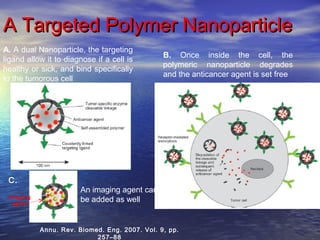
A Targeted Polymer NanoparticleA Targeted Polymer Nanoparticle
A. A dual Nanoparticle, the targeting
ligand allow it to diagnose if a cell is
healthy or sick, and bind specifically
to the tumorous cell
B. Once inside the cell, the
polymeric nanoparticle degrades
and the anticancer agent is set free
C.
An imaging agent can
be added as wellImaging
agent
Annu. Rev. Biomed. Eng. 2007. Vol. 9, pp.
257–88

Nano

  • 1.
    NANOPARTICLES INNANOPARTICLES IN MEDICINE:Cancer DiagnosisMEDICINE: Cancer Diagnosis and Therapyand Therapy Fundamentals of Nanotechnology: From Synthesis to Self-AssemblyFundamentals of Nanotechnology: From Synthesis to Self-Assembly TAMIL SELVAN R by
  • 2.
    Background and Introduction Cancer Development of abnormal cells that divide uncontrollably which have the ability to infiltrate and destroy normal body tissue 1  Chemotherapy  Nonspecificity  Toxicity  Adverse side effects  Poor solubility Use of anti-cancer (cytotoxic) drugs to destroy cancer cells. Work by disrupting the growth of cancer cells 2
  • 3.
    DiagnosisDiagnosis A.A. It mustbe multiplexed, i.e. multiple biomarkers must beIt must be multiplexed, i.e. multiple biomarkers must be detected simultaneouslydetected simultaneously B. A specific phenotype of cancer cells has a particular combination of biomarkers on its membrane D. C. Different phenotypes show different aggressiveness on their metastatic behavior tumor Blood vessels Cancer cells metastasis Source: www.cancernews.com
  • 4.
    Medical ImagingMedical Imaging A.Optical properties of nanoparticles depend greatly on its structure. Particularly, the color (wavelength) emitted by a quantum dot (a semiconductor nanoparticle) depends on its diameter. C. The quantum dots (QD) can be injected to a subject, and then be detected by exciting them to emit light Source: Department of immunology, University of Toronto Solutions of CdSe QD’s of different diameter CdSe nanoparticle (QD) structure Source: Laurence Livermore Laboratories Imaging of QD’s targeted on cellular structures Nano Letters 2008., Vol. 8, pp3887-3892 B.
  • 5.
    Drug DeliveryDrug Delivery 1 3 2 4 1)A nanoparticle carries the pharmaceutical agent inside its core, while its shell is functionalized with a ‘binding’ agent 2) Through the ‘binding’ agent, the ‘targeted’ nanoparticle recognizes the target cell. The functionalized nanoparticle shell interacts with the cell membrane 3) The nanoparticle is ingested inside the cell, and interacts with the biomolecules inside the cell 4) The nanoparticle particles breaks, and the pharmaceutical agent is released Source: Comprehensive Cancer Center Ohio University Because of their small sizes, nanoparticles are taken by cells where large particles would be excluded or cleared from the body
  • 6.
    . Nanoparticle structure wasdesigned by linking hydrophobic cancer drug (Taxol) and tumor-targeting ligand to hydrophilic and biodegradable polymer. Delivers 50% higher dose of active agent TaxolTM to the targeted tumor areas. Nanoparticle Drugs
  • 8.
    A Targeted PolymerNanoparticleA Targeted Polymer Nanoparticle A. A dual Nanoparticle, the targeting ligand allow it to diagnose if a cell is healthy or sick, and bind specifically to the tumorous cell B. Once inside the cell, the polymeric nanoparticle degrades and the anticancer agent is set free C. An imaging agent can be added as wellImaging agent Annu. Rev. Biomed. Eng. 2007. Vol. 9, pp. 257–88