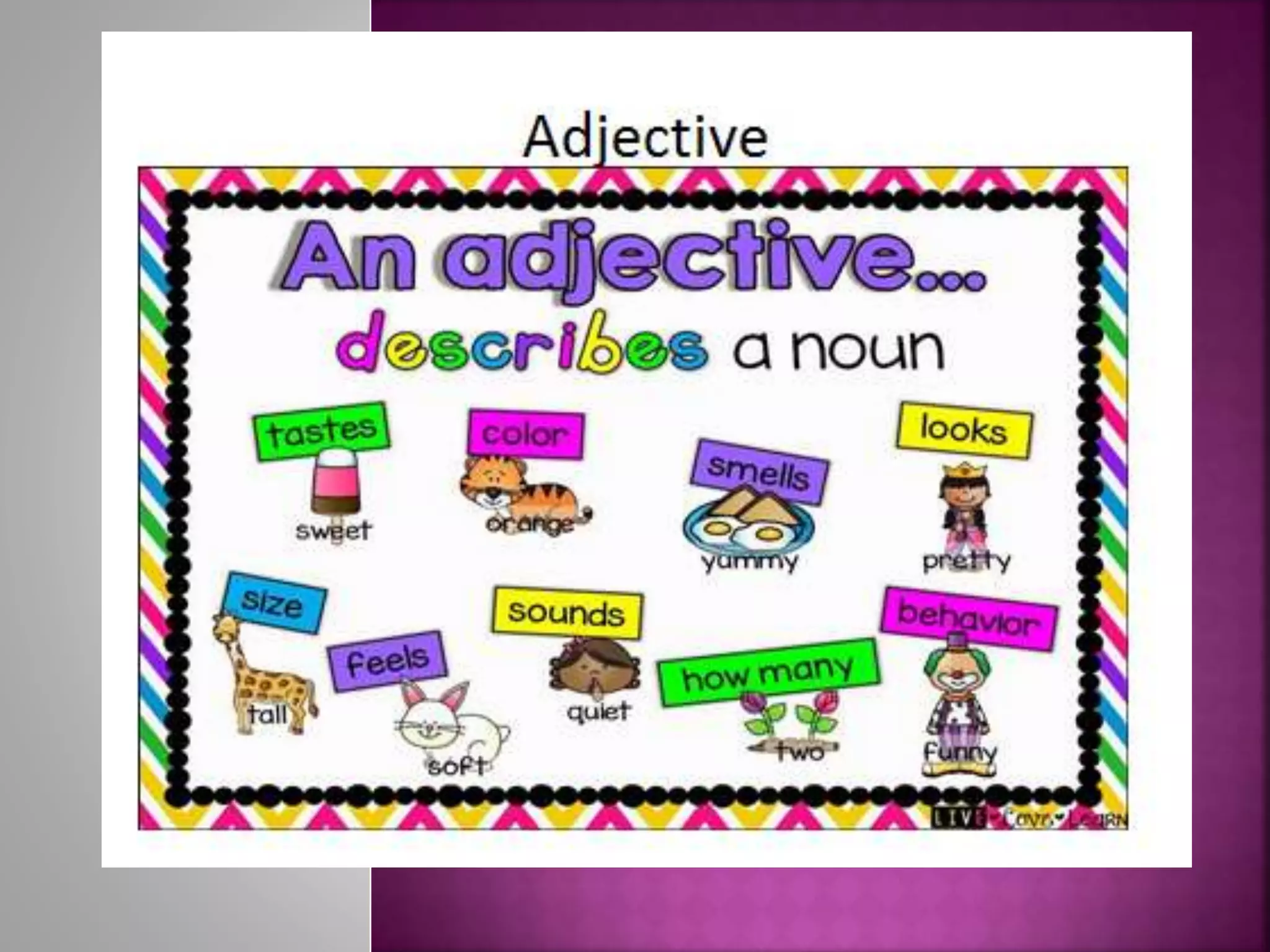
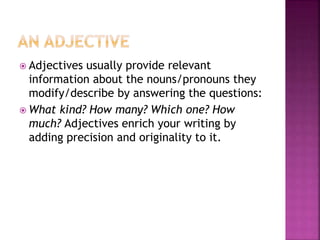
 Adjectives usually provide relevant
information about the nouns/pronouns they
modify/describe by answering the questions:
 What kind? How many? Which one? How
much? Adjectives enrich your writing by
adding precision and originality to it.
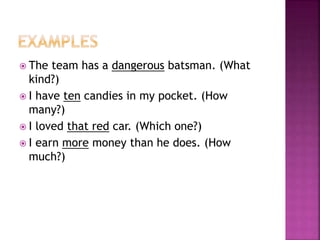
 The team has a dangerous batsman. (What
kind?)
 I have ten candies in my pocket. (How
many?)
 I loved that red car. (Which one?)
 I earn more money than he does. (How
much?)
 A descriptive adjective is a word which
describes nouns and pronouns. Most of the
adjectives belong in this type. These
adjectives provide information and attribute
to the nouns/pronouns they modify or
describe. Descriptive adjectives are also
called qualitative adjectives
 Examples:
 I have a fast car. (The word ‘fast’ is
describing an attribute of the car)
 I am hungry. (The word ‘hungry’ is providing
information about the subject)
 The hungry cats are crying.
 I saw a flying Eagle.
 A quantitative adjective provides
information about the quantity of the
nouns/pronouns. This type belongs to the
question category of ‘how much’ and ‘how
many’.
 Examples:
 I have 20 bucks in my wallet. (How much)
 They have three children. (How many)
 You should have completed the whole task.
(How much)
 are the adjective form of proper nouns. When proper
nouns modify or describe other nouns/pronouns, they
become proper adjectives. ‘Proper’ means ‘specific’
rather than ‘formal’ or ‘polite.’
 A proper adjective allows us to summarize a concept
in just one word. Instead of writing/saying ‘a food
cooked in Chinese recipe’ you can write/say ‘Chinese
food’.
 Proper adjectives are usually capitalized as proper
nouns are.
 Example:
 American cars are very strong.
 Chinese people are hard workers.
 I love KFC burgers.
 A demonstrative adjective directly refers to
something or someone. Demonstrative adjectives
include the words: this, that, these, those.
 A demonstrative pronoun works alone and does not
precede a noun, but a demonstrative adjective
always comes before the word it modifies.
 Examples:
 That building is so gorgeously decorated. (‘That’
refers to a singular noun far from the speaker)
 This car is mine. (‘This’ refers to a singular noun
close to the speaker)
 These cats are cute. (‘These’ refers to a plural noun
close to the speaker)
 Those flowers are heavenly. (‘Those’ refers to a
plural noun far from the speaker)
 A possessive adjective indicates possession or
ownership. It suggests the belongingness of
something to someone/something.
 Some of the most used possessive adjectives
are my, his, her, our, their, your.
 All these adjectives always come before a noun.
Unlike possessive pronouns, these words demand
a noun after them.
 Examples:
 My car is parked outside.
 His cat is very cute.
 Our job is almost done.
 Her books are interesting.
 An interrogative adjective asks a question.
An interrogative adjective must be followed
by a noun or a pronoun. The interrogative
adjectives are: which, what, whose. These
words will not be considered as adjectives if
a noun does not follow right after them.
‘Whose’ also belongs to the possessive
adjective type.
 Examples:
 Which phone do you use?
 What game do you want to play?
 Whose car is this?
 An indefinite adjective describes or modifies a
noun unspecifically. They provide
indefinite/unspecific information about the
noun. The common indefinite adjectives are few,
many, much, most, all, any, each, every, either,
nobody, several, some, etc.
 Examples:
 I gave some candy to her.
 I want a few moments alone.
 Several writers wrote about the recent
incidents.
 Each student will have to submit homework
tomorrow.
 Articles
 When compound nouns/combined words
modify other nouns, they become a
compound adjective. This type of adjective
usually combines more than one word into a
single lexical unit and modifies a noun. They
are often separated by a hyphen or joined
together by a quotation mark.
 Example:
 I have a broken-down sofa.
 I saw a six-foot-long snake.
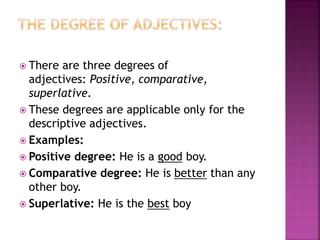
 There are three degrees of
adjectives: Positive, comparative,
superlative.
 These degrees are applicable only for the
descriptive adjectives.
 Examples:
 Positive degree: He is a good boy.
 Comparative degree: He is better than any
other boy.
 Superlative: He is the best boy
Adjective.pptx

Adjective.pptx

  • 2.
     Adjectives usuallyprovide relevant information about the nouns/pronouns they modify/describe by answering the questions:  What kind? How many? Which one? How much? Adjectives enrich your writing by adding precision and originality to it.
  • 3.
     The teamhas a dangerous batsman. (What kind?)  I have ten candies in my pocket. (How many?)  I loved that red car. (Which one?)  I earn more money than he does. (How much?)
  • 4.
     A descriptiveadjective is a word which describes nouns and pronouns. Most of the adjectives belong in this type. These adjectives provide information and attribute to the nouns/pronouns they modify or describe. Descriptive adjectives are also called qualitative adjectives
  • 5.
     Examples:  Ihave a fast car. (The word ‘fast’ is describing an attribute of the car)  I am hungry. (The word ‘hungry’ is providing information about the subject)  The hungry cats are crying.  I saw a flying Eagle.
  • 6.
     A quantitativeadjective provides information about the quantity of the nouns/pronouns. This type belongs to the question category of ‘how much’ and ‘how many’.  Examples:  I have 20 bucks in my wallet. (How much)  They have three children. (How many)  You should have completed the whole task. (How much)
  • 7.
     are theadjective form of proper nouns. When proper nouns modify or describe other nouns/pronouns, they become proper adjectives. ‘Proper’ means ‘specific’ rather than ‘formal’ or ‘polite.’  A proper adjective allows us to summarize a concept in just one word. Instead of writing/saying ‘a food cooked in Chinese recipe’ you can write/say ‘Chinese food’.  Proper adjectives are usually capitalized as proper nouns are.  Example:  American cars are very strong.  Chinese people are hard workers.  I love KFC burgers.
  • 8.
     A demonstrativeadjective directly refers to something or someone. Demonstrative adjectives include the words: this, that, these, those.  A demonstrative pronoun works alone and does not precede a noun, but a demonstrative adjective always comes before the word it modifies.  Examples:  That building is so gorgeously decorated. (‘That’ refers to a singular noun far from the speaker)  This car is mine. (‘This’ refers to a singular noun close to the speaker)  These cats are cute. (‘These’ refers to a plural noun close to the speaker)  Those flowers are heavenly. (‘Those’ refers to a plural noun far from the speaker)
  • 9.
     A possessiveadjective indicates possession or ownership. It suggests the belongingness of something to someone/something.  Some of the most used possessive adjectives are my, his, her, our, their, your.  All these adjectives always come before a noun. Unlike possessive pronouns, these words demand a noun after them.  Examples:  My car is parked outside.  His cat is very cute.  Our job is almost done.  Her books are interesting.
  • 10.
     An interrogativeadjective asks a question. An interrogative adjective must be followed by a noun or a pronoun. The interrogative adjectives are: which, what, whose. These words will not be considered as adjectives if a noun does not follow right after them. ‘Whose’ also belongs to the possessive adjective type.  Examples:  Which phone do you use?  What game do you want to play?  Whose car is this?
  • 11.
     An indefiniteadjective describes or modifies a noun unspecifically. They provide indefinite/unspecific information about the noun. The common indefinite adjectives are few, many, much, most, all, any, each, every, either, nobody, several, some, etc.  Examples:  I gave some candy to her.  I want a few moments alone.  Several writers wrote about the recent incidents.  Each student will have to submit homework tomorrow.  Articles
  • 12.
     When compoundnouns/combined words modify other nouns, they become a compound adjective. This type of adjective usually combines more than one word into a single lexical unit and modifies a noun. They are often separated by a hyphen or joined together by a quotation mark.  Example:  I have a broken-down sofa.  I saw a six-foot-long snake.
  • 13.
     There arethree degrees of adjectives: Positive, comparative, superlative.  These degrees are applicable only for the descriptive adjectives.  Examples:  Positive degree: He is a good boy.  Comparative degree: He is better than any other boy.  Superlative: He is the best boy