What is an Adjective? 
 An adjective is a word that tells us more about a noun. (By 
"noun" we include pronouns and noun phrases.) 
 An adjective "qualifies" or "modifies" a noun (a big dog). 
 Adjectives can be used before a noun (I like Chinese food) or 
after certain verbs (It is hard). 
 We can often use two or more adjectives together (a beautiful 
young French lady).
The scary 
ghost was 
not 
smiling! 
scary describes
The 
colorful 
butterfly 
was 
Evan’s. colorful describes
What words could you use 
describe this picture? 
cute 
smiling 
happy 
friendly 
funny 
blonde 
What other words can you think of?
What words could you use 
describe this picture? 
red 
tasty 
crunchy 
juicy 
smooth 
healthy 
What other words can you think of?
Three Questions 
Adjectives usually answer three questions about the nouns 
they describe: 
1. What kind of? 
· I found a red rose in the cave. 
· What kind of rose? Red 
2. How many? 
· Three tickets, please. 
· How many tickets? Three. 
3. Which one(s)? 
· I would eat these muffins. 
· Which muffins? These.
Kinds of adjectives. 
1. Adjectives of Quality 
2. Adjectives of Quantity 
3. Adjectives of Number 
4. Demonstrative Adjective 
5. Interrogative Adjective
1. Adjectives of Quality 
(Descriptive Adjective) 
Adjectives of Quality (Descriptive Adjective) 
show the kind or quality of a person or thing. 
Example:- 
1. London is a large city. 
2. He is an honest man. 
3. The foolish crow tried to sing. 
Adjectives formed from Proper Nouns (e.g., 
French wines, Indian tea, Turkish tobacco) are 
sometimes called Proper Adjectives. 
Adjectives of Quality answer the question: Of what 
kind?
2. Adjectives of Quantity 
Adjectives of Quantity show how much of a thing 
is meant. 
Examples:- 
1. I ate some rice. 
2. He has little intelligence. 
3. He showed much patience. 
4. He has lost all his wealth. 
Adjectives of Quantity answer the question: How 
much?
3. Adjectives of Number 
(Numeral Adjective) 
Adjectives of Number (Numeral Adjective) 
show how many persons or things are meant, or in 
what order a person or thing stands. 
Example:- 
1. The hand has five fingers. 
2. Most boys like cricket. 
3. Sunday is the first day of the week. 
4. There are no pictures in this book. 
5. Here are some ripe mangoes. 
Adjectives of Number answer the question: How 
many?
Adjectives of Number 
3 kinds 
a). Definite Numeral 
Adjectives, which 
denote an exact 
number as, 
One, two, three, etc. - 
These are called 
Cardinals. 
First, second, third, 
etc. - These are called 
Ordinals. 
b). Indefinite Numeral 
Adjectives, which do not 
denote an exact number, 
All, many, few, some, any, 
several, certain. 
c). Distributive Numeral 
Adjectives, which refer to 
each one of a number, as 
Each boy must take his 
turn. 
India expects every man to 
do his duty. 
Either pen will do.
4. Demonstrative Adjective 
. Demonstrative Adjective point out which 
person or thing is meant. 
Example:- 
That boy is clever. 
These mangoes are sour. 
I hate such things. 
This and that are used with Singular Nouns, 
these and those with Plural Nouns.
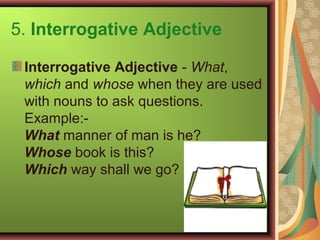
5. Interrogative Adjective 
Interrogative Adjective - What, 
which and whose when they are used 
with nouns to ask questions. 
Example:- 
What manner of man is he? 
Whose book is this? 
Which way shall we go?
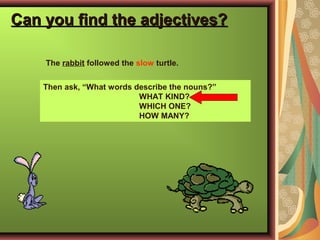
CCaann yyoouu ffiinndd tthhee aaddjjeeccttiivveess?? 
The rabbit followed the slow turtle. 
Then ask, “What words describe the nouns?” 
WHAT KIND? 
WHICH ONE? 
HOW MANY?
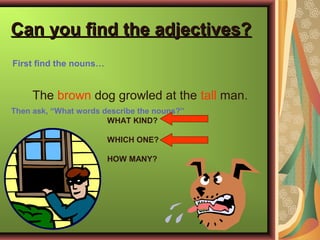
y Can yoouu ffiinndd tthhee aaddjjeeccttiivveess?? 
First find the nouns… 
The brown dog growled at the tall man. 
Then ask, “What words describe the nouns?” 
WHAT KIND? 
WHICH ONE? 
HOW MANY?
Degrees of Comparison 
Degrees of Comparison are used when we compare one 
person or one thing with another. 
There are three Degrees of Comparison in English. 
They are: 
1. Positive degree. 
2. Comparative degree. 
3. Superlative degree.
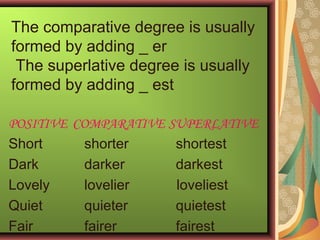
The comparative degree is usually 
formed by adding _ er 
The superlative degree is usually 
formed by adding _ est 
POSITIVE COMPARATIVE SUPERLATIVE 
Short shorter shortest 
Dark darker darkest 
Lovely lovelier loveliest 
Quiet quieter quietest 
Fair fairer fairest 
Early earlier earliest
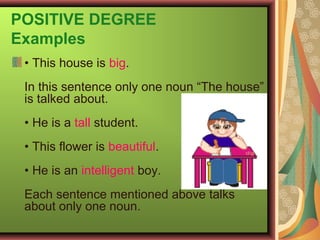
POSITIVE DEGREE 
Examples 
• This house is big. 
In this sentence only one noun “The house” 
is talked about. 
• He is a tall student. 
• This flower is beautiful. 
• He is an intelligent boy. 
Each sentence mentioned above talks 
about only one noun.
Comparative degree 
When we compare two persons or 
two things with each other, 
We use both the Positive degree and 
Comparative degree.
Examples 
a. This church is bigger than that one. 
(Comparative degree) 
This church is not as big as that one. 
(Positive degree) 
The term “bigger” is comparative version of 
the term “big”. 
Both these sentences convey the same 
meaning.
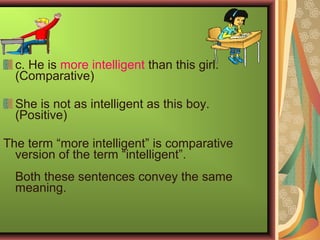
c. He is more intelligent than this girl. 
(Comparative) 
She is not as intelligent as this boy. 
(Positive) 
The term “more intelligent” is comparative 
version of the term “intelligent”. 
Both these sentences convey the same 
meaning.
Superlative Degree 
When we compare more than two 
persons or things with one another, 
We use all the three Positive, 
Comparative and Superlative 
degrees.
THANKS

ADJECTIVESSSS

  • 2.
    What is anAdjective?  An adjective is a word that tells us more about a noun. (By "noun" we include pronouns and noun phrases.)  An adjective "qualifies" or "modifies" a noun (a big dog).  Adjectives can be used before a noun (I like Chinese food) or after certain verbs (It is hard).  We can often use two or more adjectives together (a beautiful young French lady).
  • 3.
    The scary ghostwas not smiling! scary describes
  • 4.
    The colorful butterfly was Evan’s. colorful describes
  • 5.
    What words couldyou use describe this picture? cute smiling happy friendly funny blonde What other words can you think of?
  • 6.
    What words couldyou use describe this picture? red tasty crunchy juicy smooth healthy What other words can you think of?
  • 7.
    Three Questions Adjectivesusually answer three questions about the nouns they describe: 1. What kind of? · I found a red rose in the cave. · What kind of rose? Red 2. How many? · Three tickets, please. · How many tickets? Three. 3. Which one(s)? · I would eat these muffins. · Which muffins? These.
  • 8.
    Kinds of adjectives. 1. Adjectives of Quality 2. Adjectives of Quantity 3. Adjectives of Number 4. Demonstrative Adjective 5. Interrogative Adjective
  • 9.
    1. Adjectives ofQuality (Descriptive Adjective) Adjectives of Quality (Descriptive Adjective) show the kind or quality of a person or thing. Example:- 1. London is a large city. 2. He is an honest man. 3. The foolish crow tried to sing. Adjectives formed from Proper Nouns (e.g., French wines, Indian tea, Turkish tobacco) are sometimes called Proper Adjectives. Adjectives of Quality answer the question: Of what kind?
  • 10.
    2. Adjectives ofQuantity Adjectives of Quantity show how much of a thing is meant. Examples:- 1. I ate some rice. 2. He has little intelligence. 3. He showed much patience. 4. He has lost all his wealth. Adjectives of Quantity answer the question: How much?
  • 11.
    3. Adjectives ofNumber (Numeral Adjective) Adjectives of Number (Numeral Adjective) show how many persons or things are meant, or in what order a person or thing stands. Example:- 1. The hand has five fingers. 2. Most boys like cricket. 3. Sunday is the first day of the week. 4. There are no pictures in this book. 5. Here are some ripe mangoes. Adjectives of Number answer the question: How many?
  • 12.
    Adjectives of Number 3 kinds a). Definite Numeral Adjectives, which denote an exact number as, One, two, three, etc. - These are called Cardinals. First, second, third, etc. - These are called Ordinals. b). Indefinite Numeral Adjectives, which do not denote an exact number, All, many, few, some, any, several, certain. c). Distributive Numeral Adjectives, which refer to each one of a number, as Each boy must take his turn. India expects every man to do his duty. Either pen will do.
  • 13.
    4. Demonstrative Adjective . Demonstrative Adjective point out which person or thing is meant. Example:- That boy is clever. These mangoes are sour. I hate such things. This and that are used with Singular Nouns, these and those with Plural Nouns.
  • 14.
    5. Interrogative Adjective Interrogative Adjective - What, which and whose when they are used with nouns to ask questions. Example:- What manner of man is he? Whose book is this? Which way shall we go?
  • 15.
    CCaann yyoouu ffiinnddtthhee aaddjjeeccttiivveess?? The rabbit followed the slow turtle. Then ask, “What words describe the nouns?” WHAT KIND? WHICH ONE? HOW MANY?
  • 16.
    y Can yoouuffiinndd tthhee aaddjjeeccttiivveess?? First find the nouns… The brown dog growled at the tall man. Then ask, “What words describe the nouns?” WHAT KIND? WHICH ONE? HOW MANY?
  • 17.
    Degrees of Comparison Degrees of Comparison are used when we compare one person or one thing with another. There are three Degrees of Comparison in English. They are: 1. Positive degree. 2. Comparative degree. 3. Superlative degree.
  • 18.
    The comparative degreeis usually formed by adding _ er The superlative degree is usually formed by adding _ est POSITIVE COMPARATIVE SUPERLATIVE Short shorter shortest Dark darker darkest Lovely lovelier loveliest Quiet quieter quietest Fair fairer fairest Early earlier earliest
  • 19.
    POSITIVE DEGREE Examples • This house is big. In this sentence only one noun “The house” is talked about. • He is a tall student. • This flower is beautiful. • He is an intelligent boy. Each sentence mentioned above talks about only one noun.
  • 20.
    Comparative degree Whenwe compare two persons or two things with each other, We use both the Positive degree and Comparative degree.
  • 21.
    Examples a. Thischurch is bigger than that one. (Comparative degree) This church is not as big as that one. (Positive degree) The term “bigger” is comparative version of the term “big”. Both these sentences convey the same meaning.
  • 22.
    c. He ismore intelligent than this girl. (Comparative) She is not as intelligent as this boy. (Positive) The term “more intelligent” is comparative version of the term “intelligent”. Both these sentences convey the same meaning.
  • 23.
    Superlative Degree Whenwe compare more than two persons or things with one another, We use all the three Positive, Comparative and Superlative degrees.
  • 24.