THE ADJECTIVE
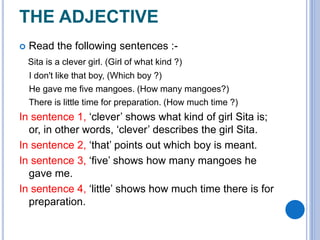
 Read the following sentences :-
Sita is a clever girl. (Girl of what kind ?)
I don't like that boy, (Which boy ?)
He gave me five mangoes. (How many mangoes?)
There is little time for preparation. (How much time ?)
In sentence 1, ‘clever’ shows what kind of girl Sita is;
or, in other words, ‘clever’ describes the girl Sita.
In sentence 2, ‘that’ points out which boy is meant.
In sentence 3, ‘five’ shows how many mangoes he
gave me.
In sentence 4, ‘little’ shows how much time there is for
preparation.
 A word used with a noun to describe or point out,
the person, animal, place or thing which the noun
names, or to tell the number or quantity, is called an
Adjective.
So we may define an Adjective as a word used with a
noun to add something for its meaning.
[Adjective means added to.]
Look at the following sentences:-
The lazy boy was punished.
The boy is lazy.
In sentence 1, the Adjective lazy is used along with
the noun boy as an epithet or attribute. It is,
therefore, said to be used Attributively.
In sentence 2, the Adjective lazy is used along with
the verb is,
and forms part of the Predicate. It is, therefore, said to be
used Predicatively. Some Adjectives can be used only
Predicatively; as,
She is afraid of ghosts.
I am quite well.
Kinds of Adjectives
 Adjectives may be divided into the following classes:-
Adjectives of Quality (or Descriptive Adjective) show the
kind or quality of a person or thing; as,
Kolkata is a large city.
He is an honest man.
The foolish old crow tried to sing.
This is a Grammar of the English language.
(Adjectives formed from Proper Nouns (e.g., French
wines, Turkish tobacco, Indian tea, etc.) are sometimes
called Proper Adjectives. They are generally classed
with Adjectives of Quality)
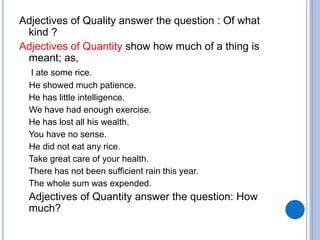
Adjectives of Quality answer the question : Of what
kind ?
Adjectives of Quantity show how much of a thing is
meant; as,
I ate some rice.
He showed much patience.
He has little intelligence.
We have had enough exercise.
He has lost all his wealth.
You have no sense.
He did not eat any rice.
Take great care of your health.
There has not been sufficient rain this year.
The whole sum was expended.
Adjectives of Quantity answer the question: How
much?
Adjectives of Number (or Numeral Adjectives) show
how many persons or things are meant, or in what
order a person or thing stands; as,
The hand has five fingers.
Few cats like cold water.
There are no pictures in this book.
I have taught you many things.
All men must die.
Most boys like cricket.
There are several mistakes in your exercise.
Sunday is the first day of the week.
Adjectives of Number (or Numeral Adjectives) are of
three kinds:-
 Definite Numeral Adjectives, which denote an exact number;
as, One, two, three, etc. -- These are called Cardinals.
First, second, third, etc. -- These are called Ordinals.
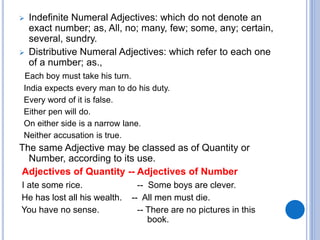
 Indefinite Numeral Adjectives: which do not denote an
exact number; as, All, no; many, few; some, any; certain,
several, sundry.
 Distributive Numeral Adjectives: which refer to each one
of a number; as.,
Each boy must take his turn.
India expects every man to do his duty.
Every word of it is false.
Either pen will do.
On either side is a narrow lane.
Neither accusation is true.
The same Adjective may be classed as of Quantity or
Number, according to its use.
Adjectives of Quantity -- Adjectives of Number
I ate some rice. -- Some boys are clever.
He has lost all his wealth. -- All men must die.
You have no sense. -- There are no pictures in this
book.
He did not eat any rice. -- Are there any mango-trees in
this garden?
I have enough sugar. -- There are not enough spoons.
 Demonstrative Adjectives :point out which person or
thing is meant; as,
This boy is stronger than Hari.
That boy is industrious.
These mangoes are sour.
Those rascals must be punished.
Don't be in such a hurry.
I hate such things.
Demonstrative Adjectives answer the question: Which
?
[It will be noticed that this and that are used with
Singular nouns and these and those with Plural
nouns.]
 What, which and whose, when they are used with nouns
to ask questions, are called Interrogative Adjectives; as,
What manner of man is he?
Which way shall we go?
Whose book is this?
[It will be seen that what is used in a general sense, and
which in a selective sense.]
 In the following sentences the words own and very are
used as Emphasizing Adjectives: -
I saw it with my own eyes.
He was beaten at his own game.
Mind your own business.
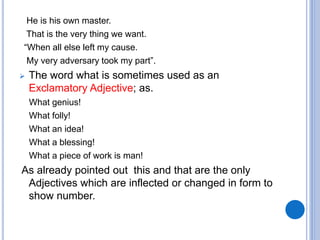
He is his own master.
That is the very thing we want.
“When all else left my cause.
My very adversary took my part”.
 The word what is sometimes used as an
Exclamatory Adjective; as.
What genius!
What folly!
What an idea!
What a blessing!
What a piece of work is man!
As already pointed out this and that are the only
Adjectives which are inflected or changed in form to
show number.
This girl sings. These girls sing.
That boy plays. Those boys play.
This, these indicate something near to the speaker.
That, those indicate more distant objects.
Formation of Adjectives
(I) Many Adjectives are formed from Nouns.
Noun -- Adjective
Boy -- boyish
Fool -- foolish
Dirt -- dirty
Storm -- stormy
Care -- careful
Pardon -- pardonable
Play -- playful
Laugh -- laughable
Hope -- hopeful
Outrage -- outrageous
Venture -- venturesome
Courage -- courageous
Trouble -- troublesome
Glory -- glorious
Shame -- shameless
Envy -- envious
Sense -- senseless
Man -- manly
Silk -- silken
King -- kingly
Gold -- golden
Gift -- gifted
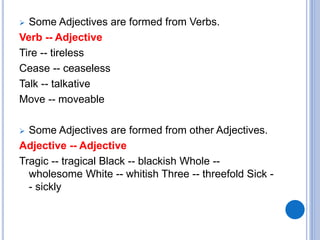
 Some Adjectives are formed from Verbs.
Verb -- Adjective
Tire -- tireless
Cease -- ceaseless
Talk -- talkative
Move -- moveable
 Some Adjectives are formed from other Adjectives.
Adjective -- Adjective
Tragic -- tragical Black -- blackish Whole --
wholesome White -- whitish Three -- threefold Sick -
- sickly
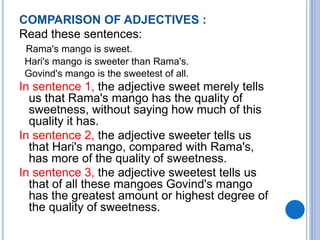
COMPARISON OF ADJECTIVES :
Read these sentences:
Rama's mango is sweet.
Hari's mango is sweeter than Rama's.
Govind's mango is the sweetest of all.
In sentence 1, the adjective sweet merely tells
us that Rama's mango has the quality of
sweetness, without saying how much of this
quality it has.
In sentence 2, the adjective sweeter tells us
that Hari's mango, compared with Rama's,
has more of the quality of sweetness.
In sentence 3, the adjective sweetest tells us
that of all these mangoes Govind's mango
has the greatest amount or highest degree of
the quality of sweetness.
We thus see that Adjectives change in form (sweet,
sweeter, sweetest) to show comparison. They are called
the three Degrees of Comparison.
The Adjective sweet is said to be in the Positive Degree.
The Adjective sweeter is said to be in the Comparative
Degree. The Adjective sweetest is said to be in the
Superlative Degree.
The Positive Degree of an Adjective is the Adjective in its
simple form. It is used to denote the mere existence of
some quality of what we speak about. It is used when no
comparison is made.
The Comparative Degree of an Adjective denotes a higher
degree of the quality than the Positive, and is used
when two things (or sets of things) are compared; as,
This boy is stronger than that.
Which of these two pens is the better?
Apples are dearer than oranges.
The Superlative Degree of an Adjective denotes the
highest degree of the quality, and is used when more
than two things (or sets of things) are compared; as,
This boy is the strongest in the class.
Note 1:- There is another way in which we can compare
things. Instead of saying 'Rama is stronger than Balu we
can say 'Balu is less strong than Rama'. Instead of
saying 'Hari is the laziest boy in the class', we can say
'Hari is the least industrious boy in the class7.
Note 2:- The Superlative with most is sometimes used
where there is no idea of comparison, but merely a
desire to indicate the possession of a quality in a very
high degree; as,
This is most unfortunate.
It was a most eloquent speech. Truly, a most ingenious
device!
This usage has been called the Superlative of Eminence,
or the Absolute Superlative.
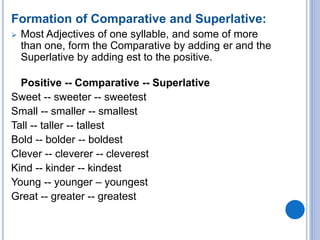
Formation of Comparative and Superlative:
 Most Adjectives of one syllable, and some of more
than one, form the Comparative by adding er and the
Superlative by adding est to the positive.
Positive -- Comparative -- Superlative
Sweet -- sweeter -- sweetest
Small -- smaller -- smallest
Tall -- taller -- tallest
Bold -- bolder -- boldest
Clever -- cleverer -- cleverest
Kind -- kinder -- kindest
Young -- younger – youngest
Great -- greater -- greatest
 When the Positive ends in e, only r and st are
added.
Brave -- braver -- bravest
Fine -- finer -- finest
White -- whiter -- whitest
Large -- larger -- largest
Able -- abler -- ablest
Noble -- nobler -- noblest
Wise -- wiser -- wisest
 When the Positive ends in j, preceded by a
consonant, the y is changed into i before adding er
and est.
Happy -- happier -- happiest
Easy -- easier -- easiest
Heavy -- heavier – heaviest
Merry -- merrier -- merriest
Wealthy -- wealthier -- wealthiest
 When the Positive is a word of one syllable and
ends in a single consonant, preceded by a short
vowel, this consonant is doubled before adding er
and est.
Red -- redder -- reddest
Big -- bigger -- biggest
Hot -- hoter -- hotest
Thin -- thinner -- thinnest
Sad -- sadder -- saddest
Fat -- fater -- fatest
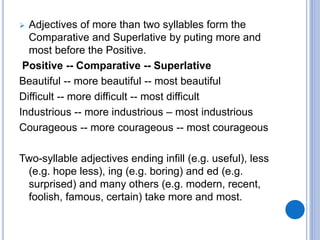
 Adjectives of more than two syllables form the
Comparative and Superlative by puting more and
most before the Positive.
Positive -- Comparative -- Superlative
Beautiful -- more beautiful -- most beautiful
Difficult -- more difficult -- most difficult
Industrious -- more industrious – most industrious
Courageous -- more courageous -- most courageous
Two-syllable adjectives ending infill (e.g. useful), less
(e.g. hope less), ing (e.g. boring) and ed (e.g.
surprised) and many others (e.g. modern, recent,
foolish, famous, certain) take more and most.
 The following take either er and est or more and
most. :
polite simple feeble gentle narrow cruel
common
handsome
pleasant
stupid
She is politer/more polite than her sister.
He is the politest/most polite of them.
 The-Comparative-in er is not used when we
compare two qualities in the same person or thing.
If we wish to say that the courage of Rama is
greater than the courage of Balu, we say;
Rama is braver than Balu.
 But if we wish to say that the courage of Rama is
greater than his prudence, we must say, Rama is
more brave than prudent.
 When two objects are compared with each other,
the later term of comparison must exclude the
former; as,
Iron is more useful than any other metal.
If we say,
Iron is more useful than any metal.
that is the same thing as saying 'Iron is more useful
than iron' since iron is itself a metal.
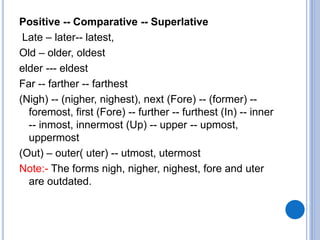
Irregular Comparison
The following Adjectives are compared irregularly,
that is, their Comparative and Superlative are not
formed from the Positive:-
Positive -- Comparative -- Superlative
Late – later-- latest,
Old – older, oldest
elder --- eldest
Far -- farther -- farthest
(Nigh) -- (nigher, nighest), next (Fore) -- (former) --
foremost, first (Fore) -- further -- furthest (In) -- inner
-- inmost, innermost (Up) -- upper -- upmost,
uppermost
(Out) – outer( uter) -- utmost, utermost
Note:- The forms nigh, nigher, nighest, fore and uter
are outdated.
 The double forms of the Comparative and
Superlative of the Adjectives given are used in
different ways;
Later, later; latest, last. - Later and latest refer to
time; later and last refer to position.
He is later than I expected.
I have not heard the latest news.
The later chapters are lacking in interest.
The last chapter is carelessly written .
Ours is the last house in the street.
 Elder, older; eldest, oldest.- Elder and eldest are
used only of persons, not of animals or things; and
are now confined to members of the same family.
 Elder is not used with “than” following. Older and
oldest are used of both persons and things.
John is my elder brother.
Tom is my eldest son.
He is older than his sister.
Rama is the oldest boy in the eleven.
This is the oldest temple in Kolkata.
 Farther, further- Both farther and further are used to
express distance. Further, not farther, is used to
mean “additional”.
Kolkata is farther/further from the equator than Colombo.
After this he made no further remarks.
I must have a reply without further delay.
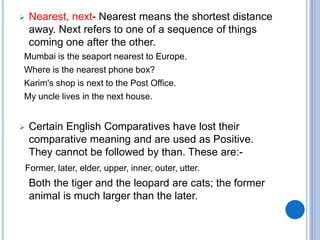
 Nearest, next- Nearest means the shortest distance
away. Next refers to one of a sequence of things
coming one after the other.
Mumbai is the seaport nearest to Europe.
Where is the nearest phone box?
Karim's shop is next to the Post Office.
My uncle lives in the next house.
 Certain English Comparatives have lost their
comparative meaning and are used as Positive.
They cannot be followed by than. These are:-
Former, later, elder, upper, inner, outer, utter.
Both the tiger and the leopard are cats; the former
animal is much larger than the later.
The inner meaning of this letter is not clear.
The soldiers ran to defend the outer wall.
My elder brother is an engineer.
This man is an utter fool.
 Certain Comparatives borrowed from Latin have no
Positive or Superlative degree. They all end in or,
not er. They are twelve in all. Five of them have lost
their Comparative meaning, and are used as
Positive Adjectives. These are:-
Interior, exterior, ulterior, major, minor.
The exterior wall of the house is made of stone; the interior walls
are of wood.
His age is a mater of minor importance.
I have no ulterior motive in offering you help.
The other seven are used as Comparative Adjectives but are
followed by to instead of than.
 The comparative degree is generally followed by
than; but Comparative Adjectives ending in -or are
followed by the preposition to; as,
Inferior, superior, prior, anterior, posterior, senior, junior.
Hari is inferior to Ram in intelligence.
Rama's intelligence is superior to Hari's.
His marriage was prior to his father's death.
He is junior to all his colleagues.
All his colleagues are senior to him.
 Adjectives expressing qualities that do not admit of
different degrees cannot, strictly speaking, be
compared; as,
Square, round, perfect, eternal, universal, unique. Strictly
speaking, a thing cannot be more square, more round, more
perfect. But we say, for instance.
Interchange of the Degrees of Comparison:
 As the following examples show, it is possible to change the
Degree of Comparison of an Adjective in a sentence, without
changing the meaning of the sentence:-
Superlative - Lead is the heaviest of all metals.
Comparative - Lead is heavier than all other metals.
Positive - He is as wise as Solomon.
Comparative - Soloman was not wiser than he is.
Superlative - Shakuntala is the best drama in Sanskrit.
Comparative - Shakuntala is beter than any other drama in
Sanskrit.
Positive - No other drama in Sanskrit is so good as Shakuntala.
Superlative - Chennai is one of the biggest of Indian cities.
Comparative - Chennai is bigger than most other Indian
cities.
Positive - Very few Indian cities are as big as Chennai.

Adjectives.pptx

  • 1.
    THE ADJECTIVE  Readthe following sentences :- Sita is a clever girl. (Girl of what kind ?) I don't like that boy, (Which boy ?) He gave me five mangoes. (How many mangoes?) There is little time for preparation. (How much time ?) In sentence 1, ‘clever’ shows what kind of girl Sita is; or, in other words, ‘clever’ describes the girl Sita. In sentence 2, ‘that’ points out which boy is meant. In sentence 3, ‘five’ shows how many mangoes he gave me. In sentence 4, ‘little’ shows how much time there is for preparation.
  • 2.
     A wordused with a noun to describe or point out, the person, animal, place or thing which the noun names, or to tell the number or quantity, is called an Adjective. So we may define an Adjective as a word used with a noun to add something for its meaning. [Adjective means added to.] Look at the following sentences:- The lazy boy was punished. The boy is lazy. In sentence 1, the Adjective lazy is used along with the noun boy as an epithet or attribute. It is, therefore, said to be used Attributively. In sentence 2, the Adjective lazy is used along with the verb is,
  • 3.
    and forms partof the Predicate. It is, therefore, said to be used Predicatively. Some Adjectives can be used only Predicatively; as, She is afraid of ghosts. I am quite well. Kinds of Adjectives  Adjectives may be divided into the following classes:- Adjectives of Quality (or Descriptive Adjective) show the kind or quality of a person or thing; as, Kolkata is a large city. He is an honest man. The foolish old crow tried to sing. This is a Grammar of the English language. (Adjectives formed from Proper Nouns (e.g., French wines, Turkish tobacco, Indian tea, etc.) are sometimes called Proper Adjectives. They are generally classed with Adjectives of Quality)
  • 4.
    Adjectives of Qualityanswer the question : Of what kind ? Adjectives of Quantity show how much of a thing is meant; as, I ate some rice. He showed much patience. He has little intelligence. We have had enough exercise. He has lost all his wealth. You have no sense. He did not eat any rice. Take great care of your health. There has not been sufficient rain this year. The whole sum was expended. Adjectives of Quantity answer the question: How much?
  • 5.
    Adjectives of Number(or Numeral Adjectives) show how many persons or things are meant, or in what order a person or thing stands; as, The hand has five fingers. Few cats like cold water. There are no pictures in this book. I have taught you many things. All men must die. Most boys like cricket. There are several mistakes in your exercise. Sunday is the first day of the week. Adjectives of Number (or Numeral Adjectives) are of three kinds:-  Definite Numeral Adjectives, which denote an exact number; as, One, two, three, etc. -- These are called Cardinals. First, second, third, etc. -- These are called Ordinals.
  • 6.
     Indefinite NumeralAdjectives: which do not denote an exact number; as, All, no; many, few; some, any; certain, several, sundry.  Distributive Numeral Adjectives: which refer to each one of a number; as., Each boy must take his turn. India expects every man to do his duty. Every word of it is false. Either pen will do. On either side is a narrow lane. Neither accusation is true. The same Adjective may be classed as of Quantity or Number, according to its use. Adjectives of Quantity -- Adjectives of Number I ate some rice. -- Some boys are clever. He has lost all his wealth. -- All men must die. You have no sense. -- There are no pictures in this book.
  • 7.
    He did noteat any rice. -- Are there any mango-trees in this garden? I have enough sugar. -- There are not enough spoons.  Demonstrative Adjectives :point out which person or thing is meant; as, This boy is stronger than Hari. That boy is industrious. These mangoes are sour. Those rascals must be punished. Don't be in such a hurry. I hate such things. Demonstrative Adjectives answer the question: Which ? [It will be noticed that this and that are used with Singular nouns and these and those with Plural nouns.]
  • 8.
     What, whichand whose, when they are used with nouns to ask questions, are called Interrogative Adjectives; as, What manner of man is he? Which way shall we go? Whose book is this? [It will be seen that what is used in a general sense, and which in a selective sense.]  In the following sentences the words own and very are used as Emphasizing Adjectives: - I saw it with my own eyes. He was beaten at his own game. Mind your own business. He is his own master.
  • 9.
    He is hisown master. That is the very thing we want. “When all else left my cause. My very adversary took my part”.  The word what is sometimes used as an Exclamatory Adjective; as. What genius! What folly! What an idea! What a blessing! What a piece of work is man! As already pointed out this and that are the only Adjectives which are inflected or changed in form to show number.
  • 10.
    This girl sings.These girls sing. That boy plays. Those boys play. This, these indicate something near to the speaker. That, those indicate more distant objects. Formation of Adjectives (I) Many Adjectives are formed from Nouns. Noun -- Adjective Boy -- boyish Fool -- foolish Dirt -- dirty Storm -- stormy
  • 11.
    Care -- careful Pardon-- pardonable Play -- playful Laugh -- laughable Hope -- hopeful Outrage -- outrageous Venture -- venturesome Courage -- courageous Trouble -- troublesome Glory -- glorious Shame -- shameless Envy -- envious Sense -- senseless Man -- manly Silk -- silken King -- kingly Gold -- golden Gift -- gifted
  • 12.
     Some Adjectivesare formed from Verbs. Verb -- Adjective Tire -- tireless Cease -- ceaseless Talk -- talkative Move -- moveable  Some Adjectives are formed from other Adjectives. Adjective -- Adjective Tragic -- tragical Black -- blackish Whole -- wholesome White -- whitish Three -- threefold Sick - - sickly
  • 13.
    COMPARISON OF ADJECTIVES: Read these sentences: Rama's mango is sweet. Hari's mango is sweeter than Rama's. Govind's mango is the sweetest of all. In sentence 1, the adjective sweet merely tells us that Rama's mango has the quality of sweetness, without saying how much of this quality it has. In sentence 2, the adjective sweeter tells us that Hari's mango, compared with Rama's, has more of the quality of sweetness. In sentence 3, the adjective sweetest tells us that of all these mangoes Govind's mango has the greatest amount or highest degree of the quality of sweetness.
  • 14.
    We thus seethat Adjectives change in form (sweet, sweeter, sweetest) to show comparison. They are called the three Degrees of Comparison. The Adjective sweet is said to be in the Positive Degree. The Adjective sweeter is said to be in the Comparative Degree. The Adjective sweetest is said to be in the Superlative Degree. The Positive Degree of an Adjective is the Adjective in its simple form. It is used to denote the mere existence of some quality of what we speak about. It is used when no comparison is made. The Comparative Degree of an Adjective denotes a higher degree of the quality than the Positive, and is used when two things (or sets of things) are compared; as, This boy is stronger than that. Which of these two pens is the better? Apples are dearer than oranges.
  • 15.
    The Superlative Degreeof an Adjective denotes the highest degree of the quality, and is used when more than two things (or sets of things) are compared; as, This boy is the strongest in the class. Note 1:- There is another way in which we can compare things. Instead of saying 'Rama is stronger than Balu we can say 'Balu is less strong than Rama'. Instead of saying 'Hari is the laziest boy in the class', we can say 'Hari is the least industrious boy in the class7. Note 2:- The Superlative with most is sometimes used where there is no idea of comparison, but merely a desire to indicate the possession of a quality in a very high degree; as, This is most unfortunate. It was a most eloquent speech. Truly, a most ingenious device! This usage has been called the Superlative of Eminence, or the Absolute Superlative.
  • 16.
    Formation of Comparativeand Superlative:  Most Adjectives of one syllable, and some of more than one, form the Comparative by adding er and the Superlative by adding est to the positive. Positive -- Comparative -- Superlative Sweet -- sweeter -- sweetest Small -- smaller -- smallest Tall -- taller -- tallest Bold -- bolder -- boldest Clever -- cleverer -- cleverest Kind -- kinder -- kindest Young -- younger – youngest Great -- greater -- greatest
  • 17.
     When thePositive ends in e, only r and st are added. Brave -- braver -- bravest Fine -- finer -- finest White -- whiter -- whitest Large -- larger -- largest Able -- abler -- ablest Noble -- nobler -- noblest Wise -- wiser -- wisest  When the Positive ends in j, preceded by a consonant, the y is changed into i before adding er and est. Happy -- happier -- happiest Easy -- easier -- easiest Heavy -- heavier – heaviest Merry -- merrier -- merriest Wealthy -- wealthier -- wealthiest
  • 18.
     When thePositive is a word of one syllable and ends in a single consonant, preceded by a short vowel, this consonant is doubled before adding er and est. Red -- redder -- reddest Big -- bigger -- biggest Hot -- hoter -- hotest Thin -- thinner -- thinnest Sad -- sadder -- saddest Fat -- fater -- fatest
  • 19.
     Adjectives ofmore than two syllables form the Comparative and Superlative by puting more and most before the Positive. Positive -- Comparative -- Superlative Beautiful -- more beautiful -- most beautiful Difficult -- more difficult -- most difficult Industrious -- more industrious – most industrious Courageous -- more courageous -- most courageous Two-syllable adjectives ending infill (e.g. useful), less (e.g. hope less), ing (e.g. boring) and ed (e.g. surprised) and many others (e.g. modern, recent, foolish, famous, certain) take more and most.
  • 20.
     The followingtake either er and est or more and most. : polite simple feeble gentle narrow cruel common handsome pleasant stupid She is politer/more polite than her sister. He is the politest/most polite of them.  The-Comparative-in er is not used when we compare two qualities in the same person or thing. If we wish to say that the courage of Rama is greater than the courage of Balu, we say; Rama is braver than Balu.
  • 21.
     But ifwe wish to say that the courage of Rama is greater than his prudence, we must say, Rama is more brave than prudent.  When two objects are compared with each other, the later term of comparison must exclude the former; as, Iron is more useful than any other metal. If we say, Iron is more useful than any metal. that is the same thing as saying 'Iron is more useful than iron' since iron is itself a metal. Irregular Comparison The following Adjectives are compared irregularly, that is, their Comparative and Superlative are not formed from the Positive:-
  • 22.
    Positive -- Comparative-- Superlative Late – later-- latest, Old – older, oldest elder --- eldest Far -- farther -- farthest (Nigh) -- (nigher, nighest), next (Fore) -- (former) -- foremost, first (Fore) -- further -- furthest (In) -- inner -- inmost, innermost (Up) -- upper -- upmost, uppermost (Out) – outer( uter) -- utmost, utermost Note:- The forms nigh, nigher, nighest, fore and uter are outdated.
  • 23.
     The doubleforms of the Comparative and Superlative of the Adjectives given are used in different ways; Later, later; latest, last. - Later and latest refer to time; later and last refer to position. He is later than I expected. I have not heard the latest news. The later chapters are lacking in interest. The last chapter is carelessly written . Ours is the last house in the street.  Elder, older; eldest, oldest.- Elder and eldest are used only of persons, not of animals or things; and are now confined to members of the same family.
  • 24.
     Elder isnot used with “than” following. Older and oldest are used of both persons and things. John is my elder brother. Tom is my eldest son. He is older than his sister. Rama is the oldest boy in the eleven. This is the oldest temple in Kolkata.  Farther, further- Both farther and further are used to express distance. Further, not farther, is used to mean “additional”. Kolkata is farther/further from the equator than Colombo. After this he made no further remarks. I must have a reply without further delay.
  • 25.
     Nearest, next-Nearest means the shortest distance away. Next refers to one of a sequence of things coming one after the other. Mumbai is the seaport nearest to Europe. Where is the nearest phone box? Karim's shop is next to the Post Office. My uncle lives in the next house.  Certain English Comparatives have lost their comparative meaning and are used as Positive. They cannot be followed by than. These are:- Former, later, elder, upper, inner, outer, utter. Both the tiger and the leopard are cats; the former animal is much larger than the later.
  • 26.
    The inner meaningof this letter is not clear. The soldiers ran to defend the outer wall. My elder brother is an engineer. This man is an utter fool.  Certain Comparatives borrowed from Latin have no Positive or Superlative degree. They all end in or, not er. They are twelve in all. Five of them have lost their Comparative meaning, and are used as Positive Adjectives. These are:- Interior, exterior, ulterior, major, minor. The exterior wall of the house is made of stone; the interior walls are of wood. His age is a mater of minor importance. I have no ulterior motive in offering you help. The other seven are used as Comparative Adjectives but are followed by to instead of than.
  • 27.
     The comparativedegree is generally followed by than; but Comparative Adjectives ending in -or are followed by the preposition to; as, Inferior, superior, prior, anterior, posterior, senior, junior. Hari is inferior to Ram in intelligence. Rama's intelligence is superior to Hari's. His marriage was prior to his father's death. He is junior to all his colleagues. All his colleagues are senior to him.  Adjectives expressing qualities that do not admit of different degrees cannot, strictly speaking, be compared; as, Square, round, perfect, eternal, universal, unique. Strictly speaking, a thing cannot be more square, more round, more perfect. But we say, for instance.
  • 28.
    Interchange of theDegrees of Comparison:  As the following examples show, it is possible to change the Degree of Comparison of an Adjective in a sentence, without changing the meaning of the sentence:- Superlative - Lead is the heaviest of all metals. Comparative - Lead is heavier than all other metals. Positive - He is as wise as Solomon. Comparative - Soloman was not wiser than he is. Superlative - Shakuntala is the best drama in Sanskrit. Comparative - Shakuntala is beter than any other drama in Sanskrit. Positive - No other drama in Sanskrit is so good as Shakuntala. Superlative - Chennai is one of the biggest of Indian cities. Comparative - Chennai is bigger than most other Indian cities. Positive - Very few Indian cities are as big as Chennai.