Volcanoes
How do volcanoes work? 
• Magma is forced onto 
Earth’s surface. 
• It dries and hardens, this 
happens many times over 
thousands of years. 
• Eventually a mountain 
called a volcano is formed.
Parts of a Volcano 
• Most volcanoes share a 
specific set of features. 
• The magma that feeds the 
eruptions pools deep 
underground in a structure 
called a magma 
chamber. 
• At Earth’s surface, lava is 
released through openings 
called vents. 
• Flowing lava in the interior 
travels through long, pipelike 
structures known as lava 
tubes.
Where do most volcanoes occur? 
• Volcanoes occur at 
both divergent and 
convergent 
boundaries and also 
at hot spots.
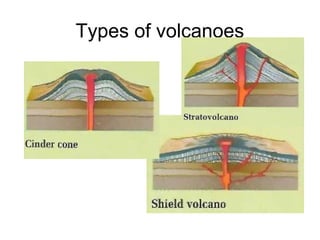
Types of volcanoes
Types of volcanoes 
• Shield volcano: usually form at hot spots, 
from non explosive eruptions 
• Cinder cone volcano: form from explosive 
eruptions, very steep. 
• Composite volcano: form from both 
explosive and non explosive eruptions.
Shield volcano 
• Form from many layers of “runny” lava. 
• Very wide, not to steep. 
• Biggest type of volcanoes 
• Tallest mountain in the world is Mauna Kea 
(measures from sea floor to top) 
• non explosive eruptions
Mauna Kea, Hawaii
Cinder cone volcano 
• Smallest type of volcano 
• Most common 
• Made from pyroclastic material (material 
shot out of a volcano) 
• Form a large crater 
• Explosive!
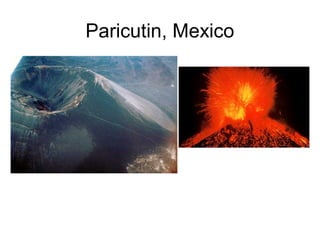
Paricutin, Mexico
Composite volcano: 
• Eruptions alternate between explosive and 
non-explosive. 
• Sometimes they have runny lava layers, 
other times the have pyroclastic materials 
form layers. 
• Have a wide base and steep sides. 
• Have a crater 
• Mount Fuji
Mount Fuji
2 Types of eruptions 
• Explosive: volcanoes 
that build enough 
pressure to blow its 
top, sending 
pyroclastic material 
into the air. 
• Non explosive: Build 
only enough pressure 
to allow lava to run 
down its sides.
Non explosive eruption 
• Mafic: refers to rocks and magma rich in 
iron and magnesium. 
• This type of lava that is very runny. 
• As magma nears the surface there is little 
pressure, causing gasses escape easily. 
• Magma low in Silica have quiet eruptions
Explosive eruptions 
• Felsic: means magma with high silica and 
feldspar content. 
• Felsic magma traps water and gas 
bubbles, which leads to lots of pressure. 
• Silica acts like a cork 
• Explosive eruptions are caused by a build 
up of high pressure. 
• Convergent zones contain lots of water, 
therefore have explosive eruptions.
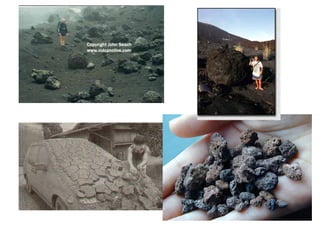
Pyroclastic materials 
• Material that is thrown into the air during 
an explosion. 
• Volcanic bombs: large blobs of magma 
that harden in the air. 
• Lapilli: pebble size rocks 
• Volcanic ash: tiny powder like material
Four types of lava 
• Aa: lava that is thick and sharp 
• Pahoehoe: lava that forms thin crust and 
wrinkles 
• Pillow lava: lava that erupts under water, 
has a round shape 
• Blocky lava: cooler, lava that does not 
travel far from eruption, jagged when it 
dries.
Aa 
• lava that is thick and sharp
Pahoehoe: 
• lava that forms thin 
crust and wrinkles
Pillow lava 
• lava that erupts under 
water, has a round 
shape
Blocky lava 
• cooler, lava that does 
not travel far from 
eruption, jagged when 
it dries.

8 -2

  • 1.
  • 2.
    How do volcanoeswork? • Magma is forced onto Earth’s surface. • It dries and hardens, this happens many times over thousands of years. • Eventually a mountain called a volcano is formed.
  • 4.
    Parts of aVolcano • Most volcanoes share a specific set of features. • The magma that feeds the eruptions pools deep underground in a structure called a magma chamber. • At Earth’s surface, lava is released through openings called vents. • Flowing lava in the interior travels through long, pipelike structures known as lava tubes.
  • 5.
    Where do mostvolcanoes occur? • Volcanoes occur at both divergent and convergent boundaries and also at hot spots.
  • 6.
  • 7.
    Types of volcanoes • Shield volcano: usually form at hot spots, from non explosive eruptions • Cinder cone volcano: form from explosive eruptions, very steep. • Composite volcano: form from both explosive and non explosive eruptions.
  • 8.
    Shield volcano •Form from many layers of “runny” lava. • Very wide, not to steep. • Biggest type of volcanoes • Tallest mountain in the world is Mauna Kea (measures from sea floor to top) • non explosive eruptions
  • 9.
  • 10.
    Cinder cone volcano • Smallest type of volcano • Most common • Made from pyroclastic material (material shot out of a volcano) • Form a large crater • Explosive!
  • 11.
  • 12.
    Composite volcano: •Eruptions alternate between explosive and non-explosive. • Sometimes they have runny lava layers, other times the have pyroclastic materials form layers. • Have a wide base and steep sides. • Have a crater • Mount Fuji
  • 13.
  • 14.
    2 Types oferuptions • Explosive: volcanoes that build enough pressure to blow its top, sending pyroclastic material into the air. • Non explosive: Build only enough pressure to allow lava to run down its sides.
  • 15.
    Non explosive eruption • Mafic: refers to rocks and magma rich in iron and magnesium. • This type of lava that is very runny. • As magma nears the surface there is little pressure, causing gasses escape easily. • Magma low in Silica have quiet eruptions
  • 16.
    Explosive eruptions •Felsic: means magma with high silica and feldspar content. • Felsic magma traps water and gas bubbles, which leads to lots of pressure. • Silica acts like a cork • Explosive eruptions are caused by a build up of high pressure. • Convergent zones contain lots of water, therefore have explosive eruptions.
  • 17.
    Pyroclastic materials •Material that is thrown into the air during an explosion. • Volcanic bombs: large blobs of magma that harden in the air. • Lapilli: pebble size rocks • Volcanic ash: tiny powder like material
  • 19.
    Four types oflava • Aa: lava that is thick and sharp • Pahoehoe: lava that forms thin crust and wrinkles • Pillow lava: lava that erupts under water, has a round shape • Blocky lava: cooler, lava that does not travel far from eruption, jagged when it dries.
  • 20.
    Aa • lavathat is thick and sharp
  • 21.
    Pahoehoe: • lavathat forms thin crust and wrinkles
  • 22.
    Pillow lava •lava that erupts under water, has a round shape
  • 23.
    Blocky lava •cooler, lava that does not travel far from eruption, jagged when it dries.