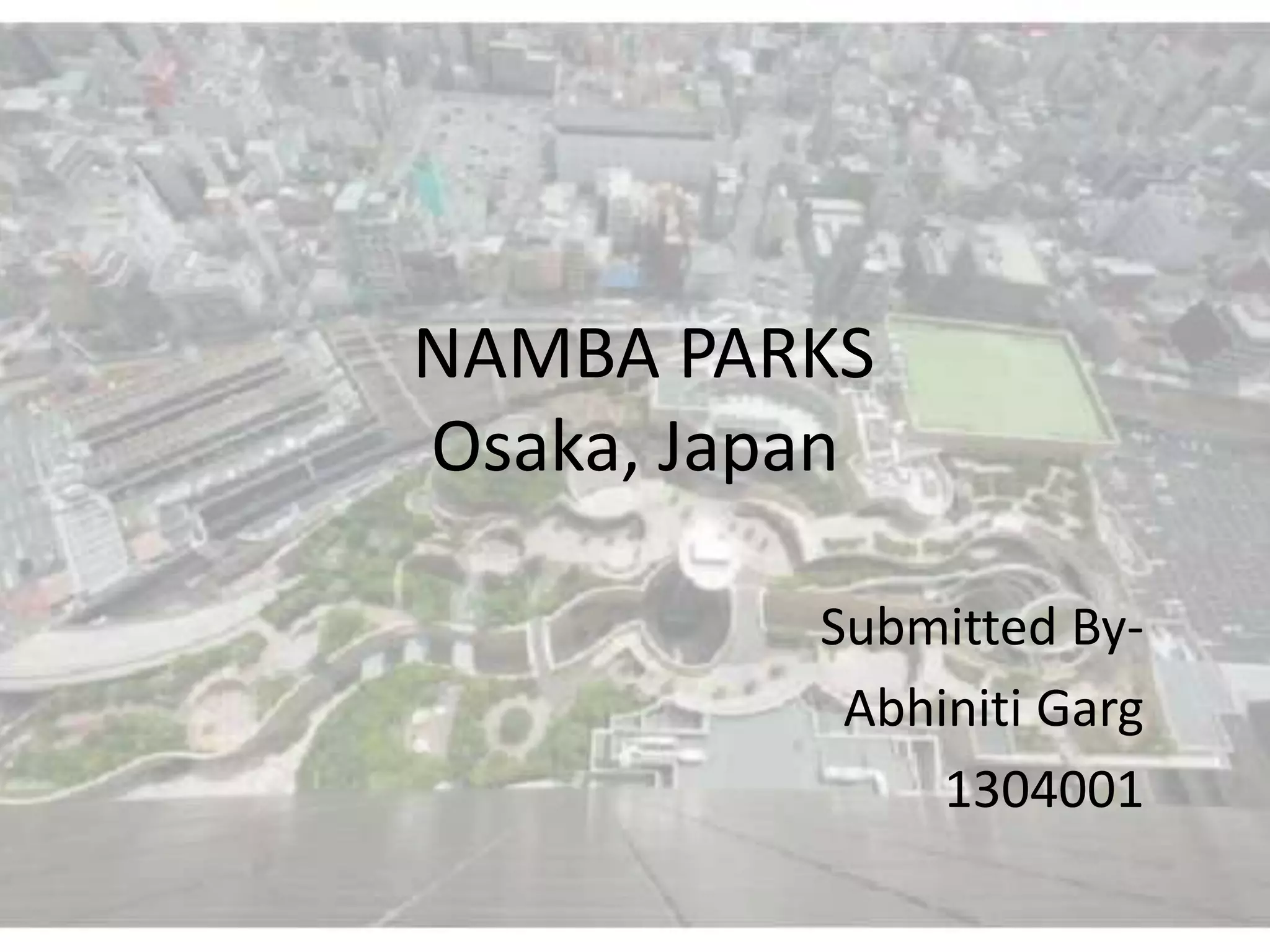
NAMBA PARKS
Osaka, Japan
Submitted By-
Abhiniti Garg
1304001
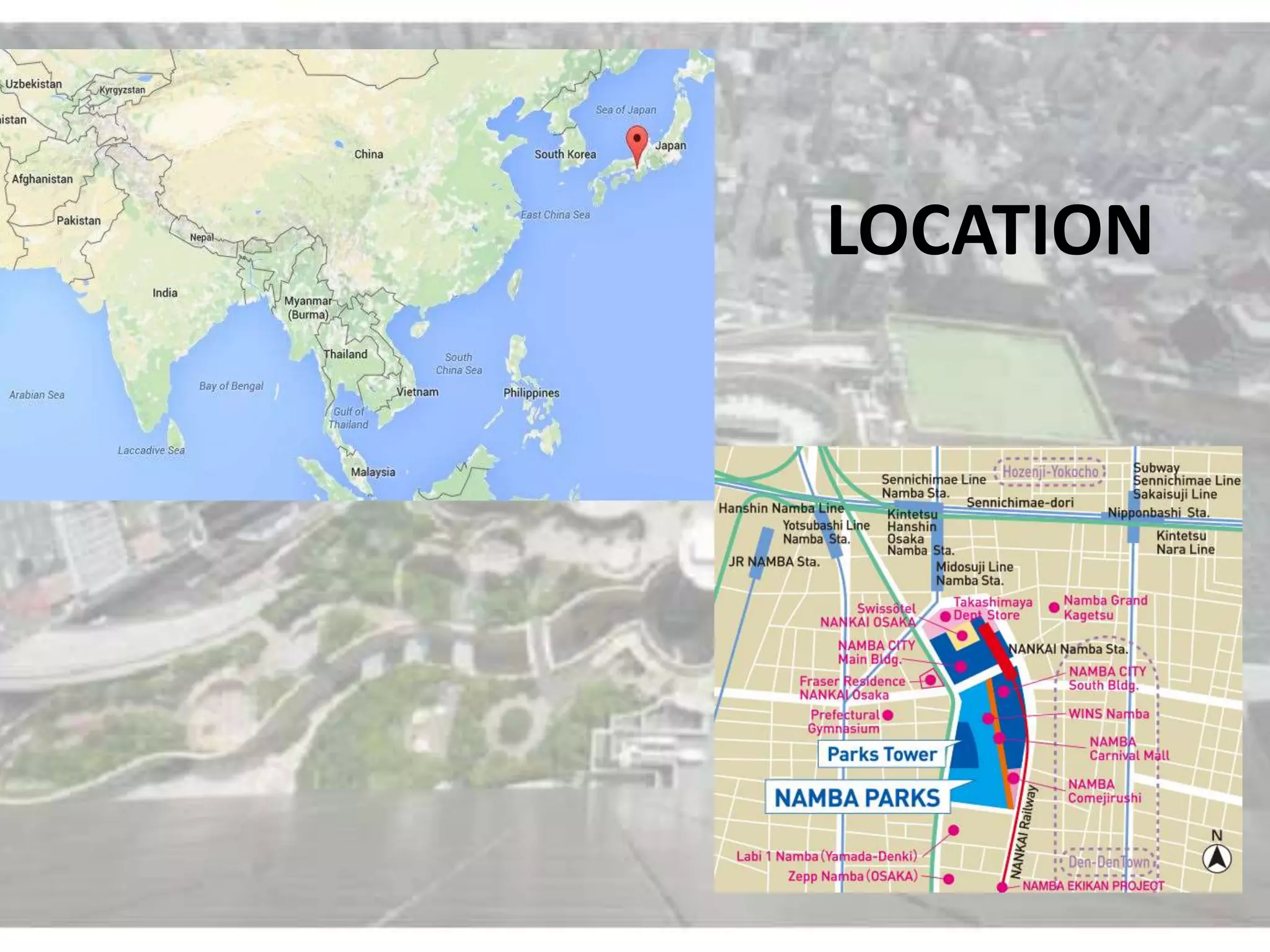
LOCATION
INTRODUCTION
• Namba Parks is an urban lifestyle center fitted onto a 3.37-hectare (8.33-
acre) underutilized parcel in the heart of Osaka’s central business district
(CBD). The site is part of a narrow strip of land owned by Nankai Electric,
which has been progressively developing it over the course of half a
century, starting from the densest end.
• Surrounded by raised railroad tracks to the east and an urban boulevard
and elevated via duct to the west, Namba Parks offers green space atop an
eight-level assemblage of 108 shops and restaurants arranged to form an
indoor-outdoor urban retail and entertainment complex visually anchored
by a 30-floor office tower.
• Metro Area: Osaka
• World Region: Asia Pacific
• Project Type: Mixed Use/Multiuse
• Location: Central business district
• Land uses: high-rise building, lifestyle center, urban park, enclosed mall,
open-air center, retail, restaurants
• Developer(s) : Nankai Electric Railway Co., Ltd. Takashimaya Co., Ltd.
• Designer(s) :The Jerde Partnership Nikken Sekkei Obayashi Co. Ltd.
• Site size: 3.37 hectares/8.33 acres
• Office: 645,835 sq.ft. / 60,000 sq.m
• Retail space: 430,556 sq.ft. / 40,000 sq.m
• Parking: 336
• Maximum floors: 30
SITE STATISTICS
DESIGN
• At Namba Parks, the conceptual premise is that of a canyon coursing
through an urban park. A terraced complex of retail spaces envelopes an
open space in the center, starting out as an oval vertical space, open to
the sky and flowing out to the entrance. Near the entrance, up a ramp
from street level, replicas of a home plate and pitcher’s rubber are set in
the paving to mark the exact location of the demolished Osaka Stadium.
• During excavations, deposits of prehistoric seashells were discovered in
the soil beneath Namba Parks, the location of which was once Osaka Bay,
now four kilometres (2.5 miles)to the west. The use of replica seashells as
a motif throughout Namba Parks lends further meaning to the theme of a
canyon cutting across the layers of time.
• The open space is irregular, curvilinear, and non planar in all dimensions.
An elevator tower rises in the oval center and glass-enclosed pedestrian
bridges traverse the canyon at various points at different levels,
connecting the interior spaces.
• At the uppermost roof level, surrounding the central opening—the mouth
of the “canyon”—are hardscaped common areas where people can
congregate outdoors. Its apex is a terraced amphitheatre, circular in plan
and facing a flat stage area.
• Nearby is the crown of the elevator tower, terminating in an inverted
hemispherical finial. The underside of the hemisphere reflects a laser light
show that can be programmed for different night time occasions and
which serves as a light beacon when entertainment is being produced.
• Cascading down from the eighth-level rooftop is another Jerde innovation:
a series of green terraces atop the roofs of the retail spaces below.
Extending the canyon the meto the roof, Jerde brings the canyon-top
landscape to its very precipice. Forming 1.15hectares (2.8 acres) of
rooftop park space, one of Japan’s largest, this “Big Park” is a counter part
to the “Big City” contained below in Namba Parks’ retail spaces. The roof
park features trees, miniature ponds, shrubbery, and planting beds—all
irrigated by recycled water filtered from the gray water of the restaurants
within the complex. During the summer, when asphalt can reach a surface
temperature of 51 degrees Celsius (124 degrees Fahrenheit) and concrete
is 45 (113), the rooftop park is only 34 (93).
• The retail complex is of steel-frame construction, clad on all non glazed
surfaces with preformed exposed-aggregate concrete panels in banded
colors reminiscent of a desert canyon. There is extensive glazing,
especially in the storefronts that open to the roof terraces, and within the
canyon itself.
• Its architect, Nikken Sekkei, designed one of the biggest floor plates in
Osaka—measuring about 1,500 square meters (16,146 square feet) per
floor, steel-framed, using the latest in earthquake-resistant
design technology. The rectilinear street facade is banded with glazing,
and the curvilinear facade facing Namba Parks is clad in concrete panels
with patterned fenestration.
• Three levels of subterranean parking accommodate 363 cars. As is the
case with most development projects in Japan, the construction drawings
and contract administration were completed by the Obayashi Group.
• The phase II is about half the size of Namba Parks Phase I, and will is
seamlessly contiguous with, and essentially lengthen, the canyon concept.
While the canyon in the first phase flowed north, in the second phase the
canyon will emanate from the same source but flow south. It comprises
80shops , adding 20,000 square meters (215,275 square feet)of retail
space, and 0.35 hectare (0.86 acre) of rooftop green space.
• A residential tower will stand at the southwest corner of the Namba Parks
complex and is being developed with Oryx Real Estate. Some of the
tower’s 60,000 square meters (645,856 square feet) will be used for 146
rental apartments, rendering Namba Parks a true mixed-use complex.
• Unlike in U.S. malls, there are no food courts—for the most part,
restaurants are situated to take advantage of rooftop terraces.
• Nankai provides soft programming in the form of open-air entertainment
in the roof top amphitheatre, and by conducting the aforementioned light
shows on the underside of the highly visible hemispherical elevator roof.
• The open-air, pedestrian-scaled arcade is 14 meters (46 feet)wide and
allows for off-hours vehicular traffic for maintenance and deliveries.
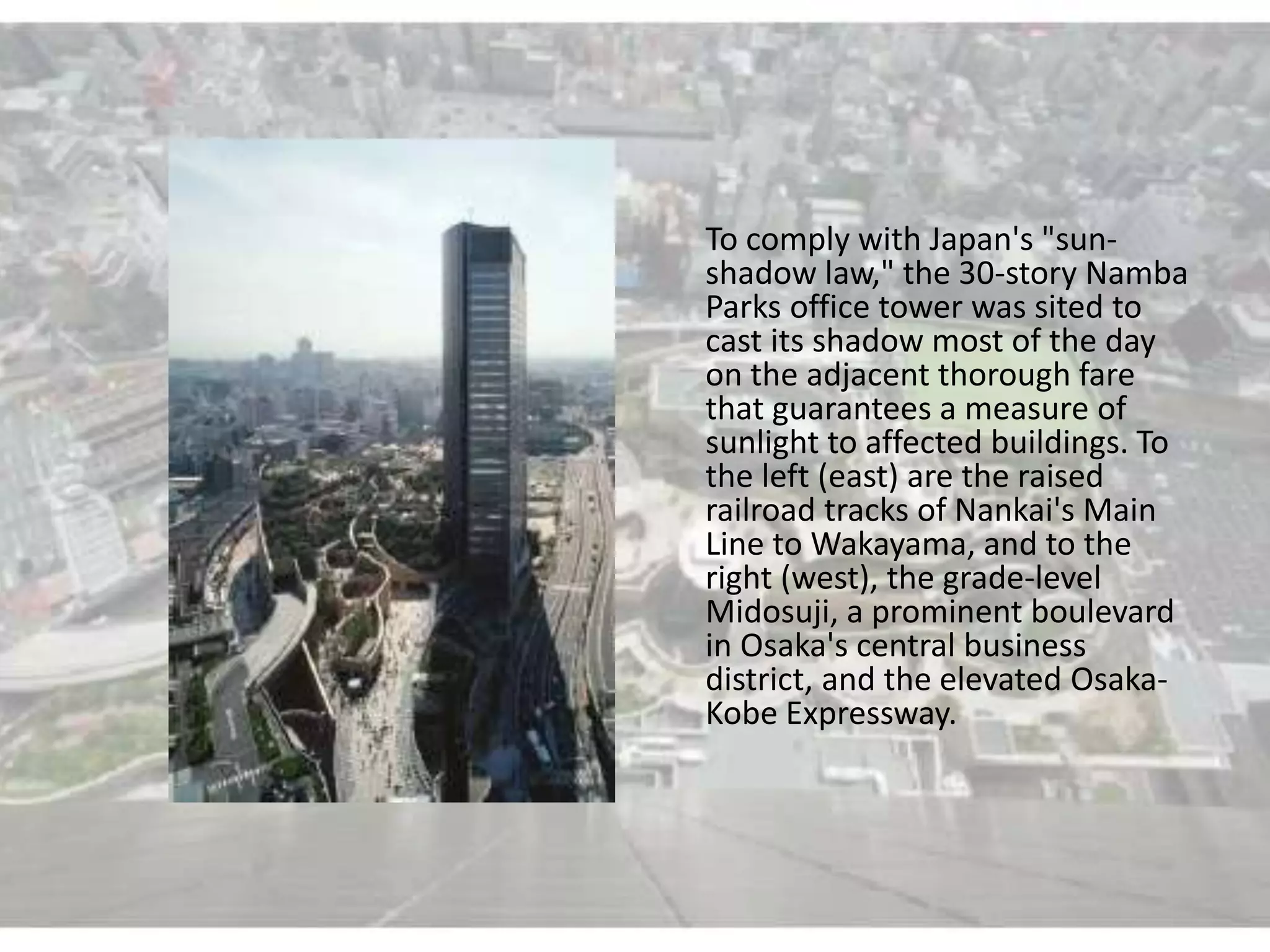
To comply with Japan's "sun-
shadow law," the 30-story Namba
Parks office tower was sited to
cast its shadow most of the day
on the adjacent thorough fare
that guarantees a measure of
sunlight to affected buildings. To
the left (east) are the raised
railroad tracks of Nankai's Main
Line to Wakayama, and to the
right (west), the grade-level
Midosuji, a prominent boulevard
in Osaka's central business
district, and the elevated Osaka-
Kobe Expressway.
Serving as the main entry for
patrons, the mouth of Namba
Parks' "canyon," at the
left(north), leads to the oval-
shaped center at the right
(south). Nautilus shaped motifs
pay homage to the discovery of
seashells, deposited back when
the Namba district was part
of Osaka Bay. At the top (east) are
Nankai's elevated railroad tracks.
At the pedestrian level, near
Namba Parks' oval-shaped center,
a glass elevator shaft rises to an
inverted hemispherical roof that
serves as a projection screen for
night time lightshows and
advertisements.
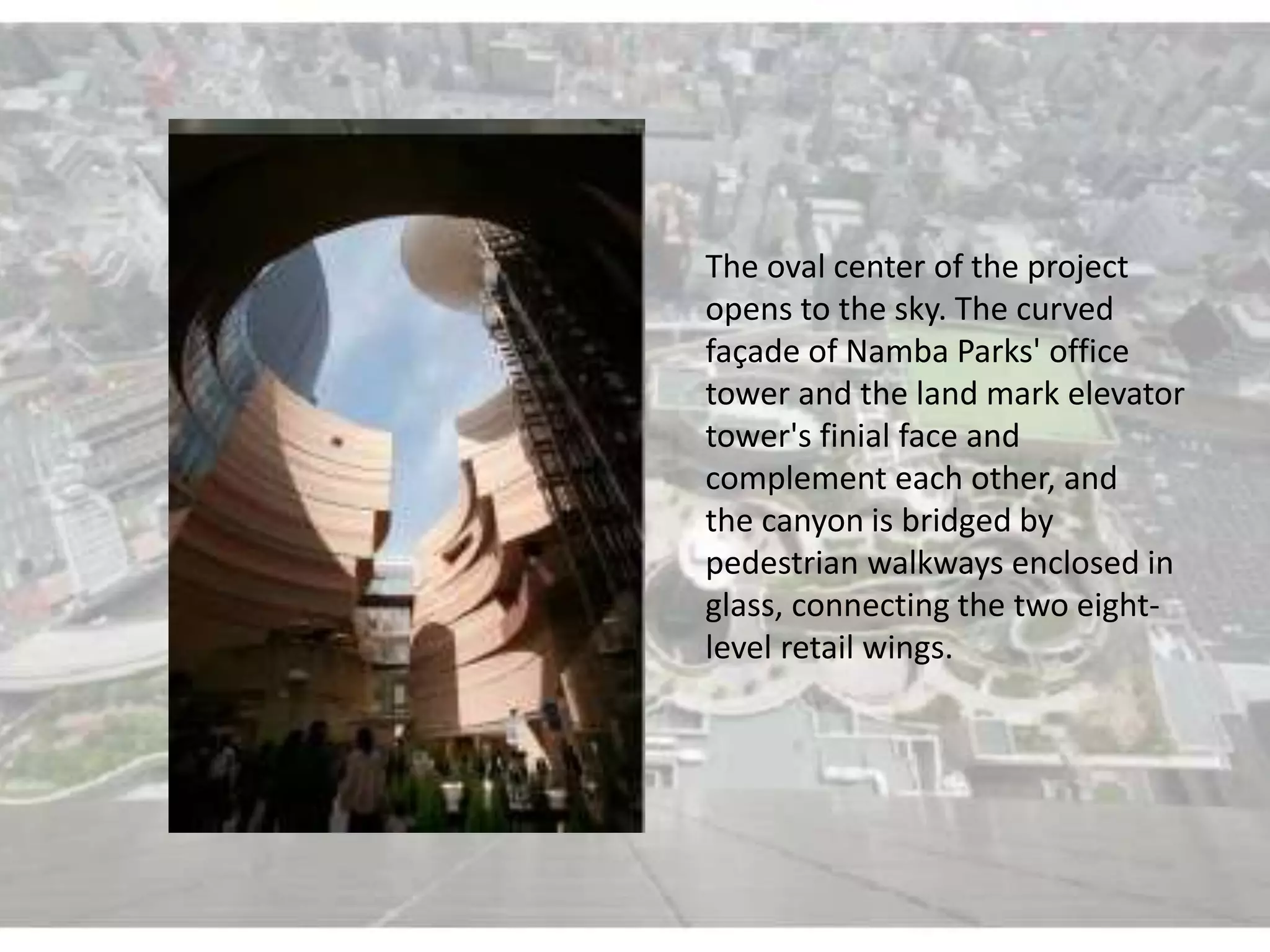
The oval center of the project
opens to the sky. The curved
façade of Namba Parks' office
tower and the land mark elevator
tower's finial face and
complement each other, and
the canyon is bridged by
pedestrian walkways enclosed in
glass, connecting the two eight-
level retail wings.
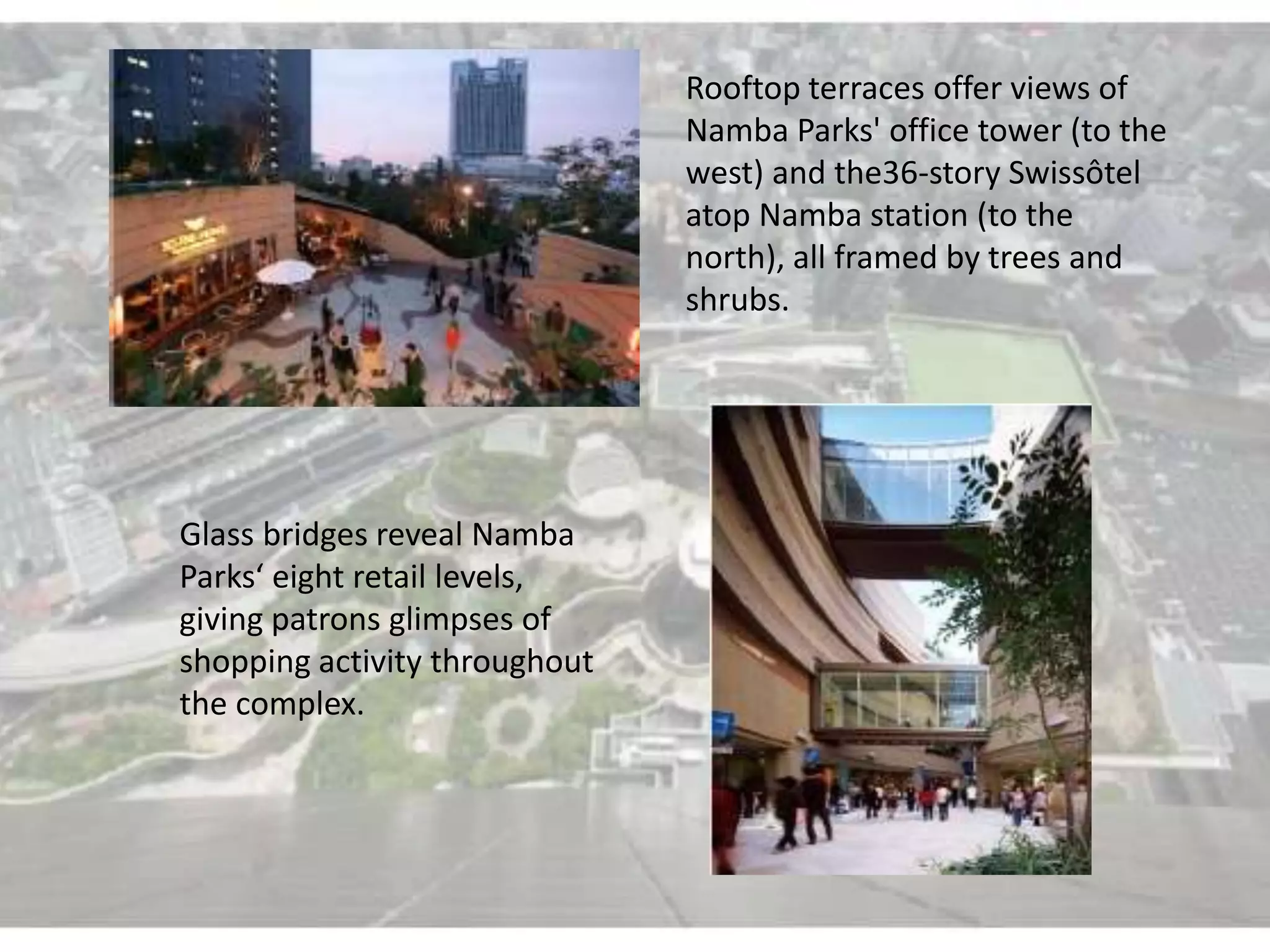
Rooftop terraces offer views of
Namba Parks' office tower (to the
west) and the36-story Swissôtel
atop Namba station (to the
north), all framed by trees and
shrubs.
Glass bridges reveal Namba
Parks‘ eight retail levels,
giving patrons glimpses of
shopping activity throughout
the complex.
At street level are the entrances to the
office tower and to the Japan Racing
Association's off-track betting facility.
The curved Carnival Street is a 14-meter-
wide (46-foot-wide) pedestrian arcade
serving Nankai's Namba City shops, built
under the Nankai rail tracks. Phase II
(shaded), to be started in 2005, will
increase Namba Parks' retail space by 50
percent and add 146 condominium
units.
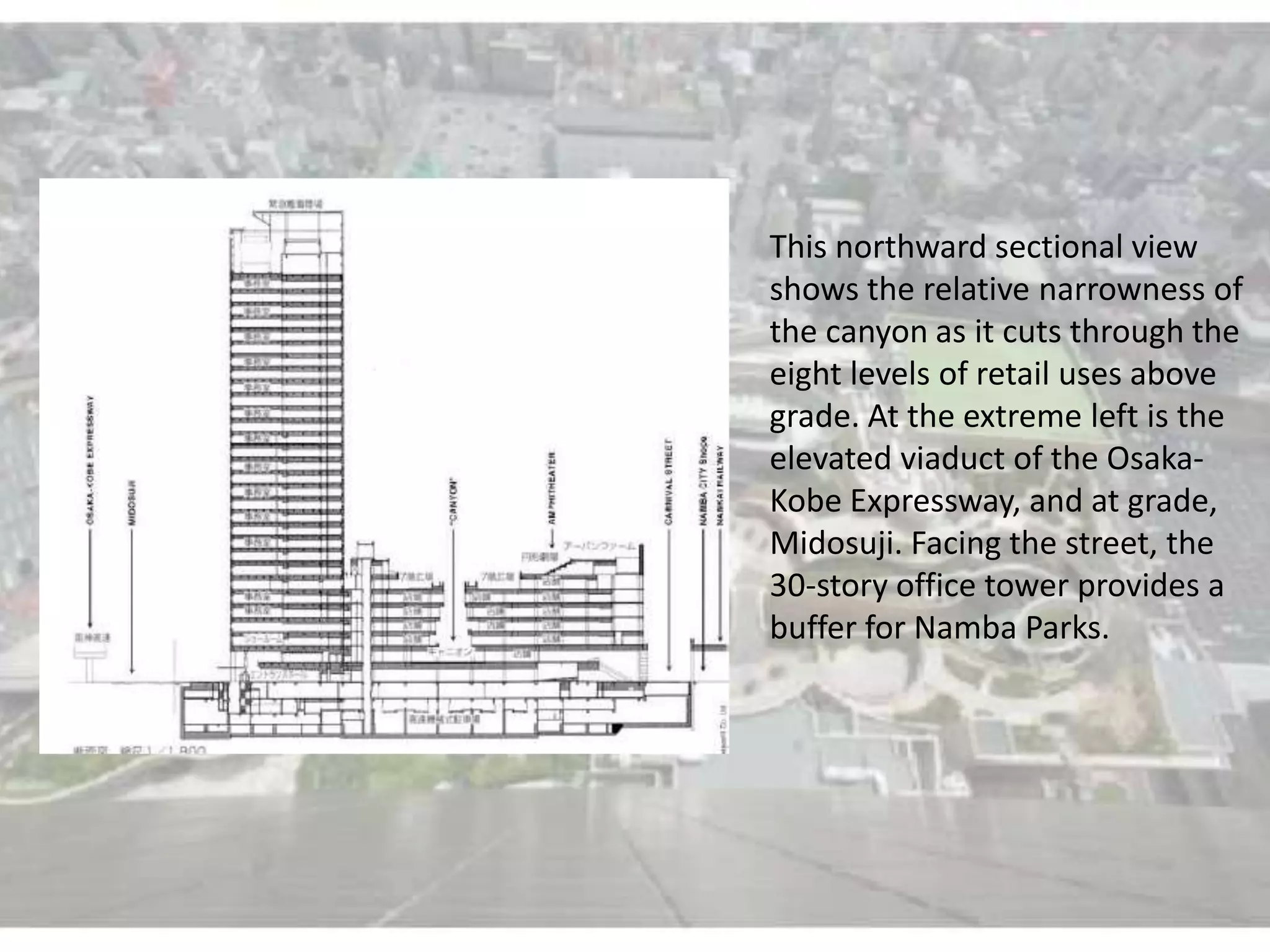
This northward sectional view
shows the relative narrowness of
the canyon as it cuts through the
eight levels of retail uses above
grade. At the extreme left is the
elevated viaduct of the Osaka-
Kobe Expressway, and at grade,
Midosuji. Facing the street, the
30-story office tower provides a
buffer for Namba Parks.
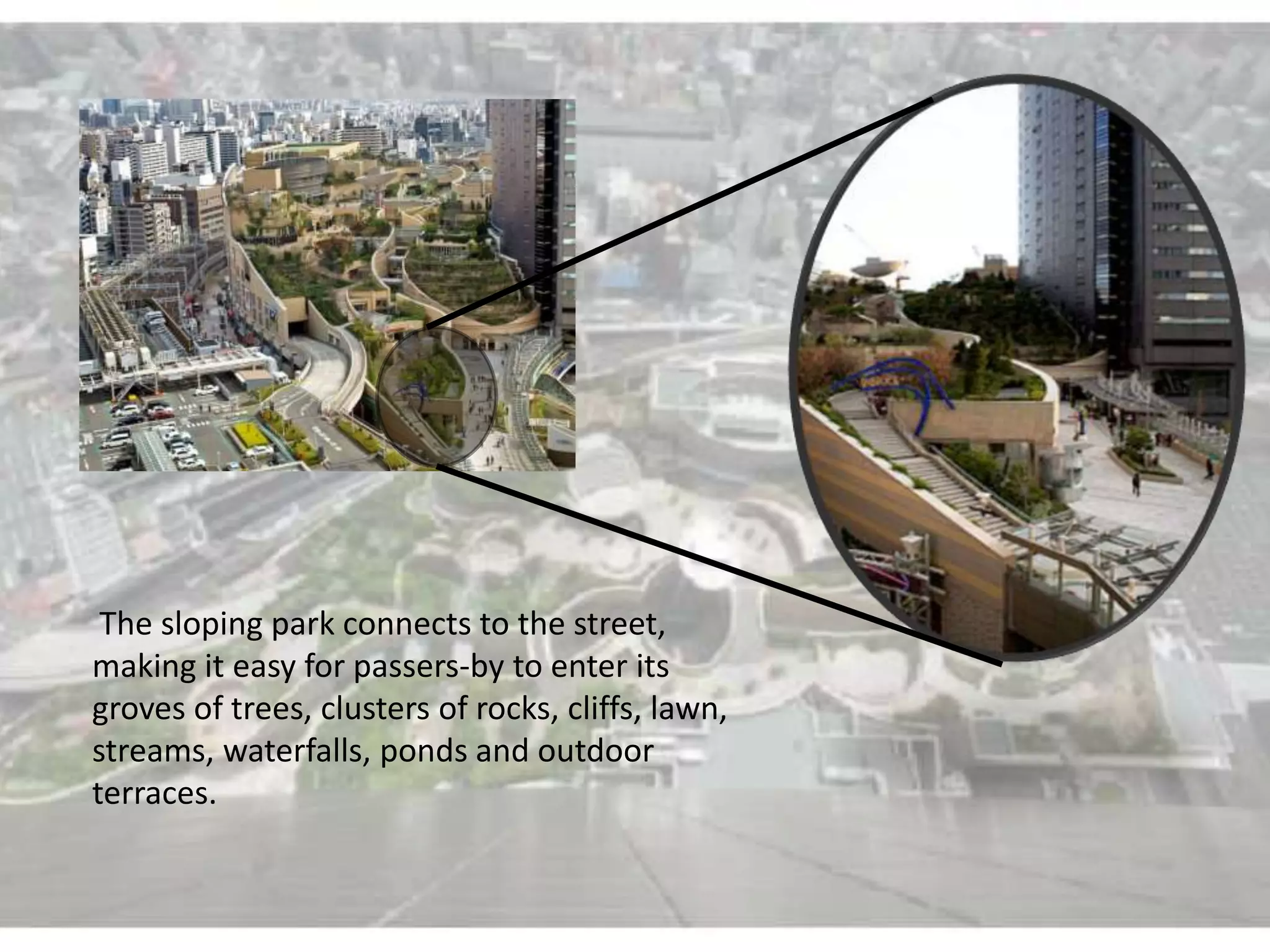
The sloping park connects to the street,
making it easy for passers-by to enter its
groves of trees, clusters of rocks, cliffs, lawn,
streams, waterfalls, ponds and outdoor
terraces.
INFERENCES
• Positives –
o Providing a highly visible green component in a
city where nature is sparse.
o Providing an earthquake resistant structure
(made up of steel frame) in a city which is prone
to earthquakes.
• Negatives -
REFERENCES
• The Architecture of Shopping Malls – The Jerde Partnership, Namba
ParksULI –the Urban Land Institute1025 Thomas Jefferson Street, N.W.,
Suite 500 West, Washington D.C. 20007-5201
• www.wikipedia.com
• www.jerde.com

Namba parks, Osaka, Japan

  • 1.
    NAMBA PARKS Osaka, Japan SubmittedBy- Abhiniti Garg 1304001
  • 2.
  • 3.
    INTRODUCTION • Namba Parksis an urban lifestyle center fitted onto a 3.37-hectare (8.33- acre) underutilized parcel in the heart of Osaka’s central business district (CBD). The site is part of a narrow strip of land owned by Nankai Electric, which has been progressively developing it over the course of half a century, starting from the densest end. • Surrounded by raised railroad tracks to the east and an urban boulevard and elevated via duct to the west, Namba Parks offers green space atop an eight-level assemblage of 108 shops and restaurants arranged to form an indoor-outdoor urban retail and entertainment complex visually anchored by a 30-floor office tower.
  • 4.
    • Metro Area:Osaka • World Region: Asia Pacific • Project Type: Mixed Use/Multiuse • Location: Central business district • Land uses: high-rise building, lifestyle center, urban park, enclosed mall, open-air center, retail, restaurants • Developer(s) : Nankai Electric Railway Co., Ltd. Takashimaya Co., Ltd. • Designer(s) :The Jerde Partnership Nikken Sekkei Obayashi Co. Ltd. • Site size: 3.37 hectares/8.33 acres • Office: 645,835 sq.ft. / 60,000 sq.m • Retail space: 430,556 sq.ft. / 40,000 sq.m • Parking: 336 • Maximum floors: 30 SITE STATISTICS
  • 6.
    DESIGN • At NambaParks, the conceptual premise is that of a canyon coursing through an urban park. A terraced complex of retail spaces envelopes an open space in the center, starting out as an oval vertical space, open to the sky and flowing out to the entrance. Near the entrance, up a ramp from street level, replicas of a home plate and pitcher’s rubber are set in the paving to mark the exact location of the demolished Osaka Stadium. • During excavations, deposits of prehistoric seashells were discovered in the soil beneath Namba Parks, the location of which was once Osaka Bay, now four kilometres (2.5 miles)to the west. The use of replica seashells as a motif throughout Namba Parks lends further meaning to the theme of a canyon cutting across the layers of time. • The open space is irregular, curvilinear, and non planar in all dimensions. An elevator tower rises in the oval center and glass-enclosed pedestrian bridges traverse the canyon at various points at different levels, connecting the interior spaces.
  • 7.
    • At theuppermost roof level, surrounding the central opening—the mouth of the “canyon”—are hardscaped common areas where people can congregate outdoors. Its apex is a terraced amphitheatre, circular in plan and facing a flat stage area. • Nearby is the crown of the elevator tower, terminating in an inverted hemispherical finial. The underside of the hemisphere reflects a laser light show that can be programmed for different night time occasions and which serves as a light beacon when entertainment is being produced. • Cascading down from the eighth-level rooftop is another Jerde innovation: a series of green terraces atop the roofs of the retail spaces below. Extending the canyon the meto the roof, Jerde brings the canyon-top landscape to its very precipice. Forming 1.15hectares (2.8 acres) of rooftop park space, one of Japan’s largest, this “Big Park” is a counter part to the “Big City” contained below in Namba Parks’ retail spaces. The roof park features trees, miniature ponds, shrubbery, and planting beds—all irrigated by recycled water filtered from the gray water of the restaurants within the complex. During the summer, when asphalt can reach a surface temperature of 51 degrees Celsius (124 degrees Fahrenheit) and concrete is 45 (113), the rooftop park is only 34 (93).
  • 8.
    • The retailcomplex is of steel-frame construction, clad on all non glazed surfaces with preformed exposed-aggregate concrete panels in banded colors reminiscent of a desert canyon. There is extensive glazing, especially in the storefronts that open to the roof terraces, and within the canyon itself. • Its architect, Nikken Sekkei, designed one of the biggest floor plates in Osaka—measuring about 1,500 square meters (16,146 square feet) per floor, steel-framed, using the latest in earthquake-resistant design technology. The rectilinear street facade is banded with glazing, and the curvilinear facade facing Namba Parks is clad in concrete panels with patterned fenestration. • Three levels of subterranean parking accommodate 363 cars. As is the case with most development projects in Japan, the construction drawings and contract administration were completed by the Obayashi Group.
  • 9.
    • The phaseII is about half the size of Namba Parks Phase I, and will is seamlessly contiguous with, and essentially lengthen, the canyon concept. While the canyon in the first phase flowed north, in the second phase the canyon will emanate from the same source but flow south. It comprises 80shops , adding 20,000 square meters (215,275 square feet)of retail space, and 0.35 hectare (0.86 acre) of rooftop green space. • A residential tower will stand at the southwest corner of the Namba Parks complex and is being developed with Oryx Real Estate. Some of the tower’s 60,000 square meters (645,856 square feet) will be used for 146 rental apartments, rendering Namba Parks a true mixed-use complex. • Unlike in U.S. malls, there are no food courts—for the most part, restaurants are situated to take advantage of rooftop terraces. • Nankai provides soft programming in the form of open-air entertainment in the roof top amphitheatre, and by conducting the aforementioned light shows on the underside of the highly visible hemispherical elevator roof. • The open-air, pedestrian-scaled arcade is 14 meters (46 feet)wide and allows for off-hours vehicular traffic for maintenance and deliveries.
  • 10.
    To comply withJapan's "sun- shadow law," the 30-story Namba Parks office tower was sited to cast its shadow most of the day on the adjacent thorough fare that guarantees a measure of sunlight to affected buildings. To the left (east) are the raised railroad tracks of Nankai's Main Line to Wakayama, and to the right (west), the grade-level Midosuji, a prominent boulevard in Osaka's central business district, and the elevated Osaka- Kobe Expressway.
  • 11.
    Serving as themain entry for patrons, the mouth of Namba Parks' "canyon," at the left(north), leads to the oval- shaped center at the right (south). Nautilus shaped motifs pay homage to the discovery of seashells, deposited back when the Namba district was part of Osaka Bay. At the top (east) are Nankai's elevated railroad tracks.
  • 12.
    At the pedestrianlevel, near Namba Parks' oval-shaped center, a glass elevator shaft rises to an inverted hemispherical roof that serves as a projection screen for night time lightshows and advertisements.
  • 13.
    The oval centerof the project opens to the sky. The curved façade of Namba Parks' office tower and the land mark elevator tower's finial face and complement each other, and the canyon is bridged by pedestrian walkways enclosed in glass, connecting the two eight- level retail wings.
  • 14.
    Rooftop terraces offerviews of Namba Parks' office tower (to the west) and the36-story Swissôtel atop Namba station (to the north), all framed by trees and shrubs. Glass bridges reveal Namba Parks‘ eight retail levels, giving patrons glimpses of shopping activity throughout the complex.
  • 15.
    At street levelare the entrances to the office tower and to the Japan Racing Association's off-track betting facility. The curved Carnival Street is a 14-meter- wide (46-foot-wide) pedestrian arcade serving Nankai's Namba City shops, built under the Nankai rail tracks. Phase II (shaded), to be started in 2005, will increase Namba Parks' retail space by 50 percent and add 146 condominium units.
  • 16.
    This northward sectionalview shows the relative narrowness of the canyon as it cuts through the eight levels of retail uses above grade. At the extreme left is the elevated viaduct of the Osaka- Kobe Expressway, and at grade, Midosuji. Facing the street, the 30-story office tower provides a buffer for Namba Parks.
  • 17.
    The sloping parkconnects to the street, making it easy for passers-by to enter its groves of trees, clusters of rocks, cliffs, lawn, streams, waterfalls, ponds and outdoor terraces.
  • 18.
    INFERENCES • Positives – oProviding a highly visible green component in a city where nature is sparse. o Providing an earthquake resistant structure (made up of steel frame) in a city which is prone to earthquakes. • Negatives -
  • 19.
    REFERENCES • The Architectureof Shopping Malls – The Jerde Partnership, Namba ParksULI –the Urban Land Institute1025 Thomas Jefferson Street, N.W., Suite 500 West, Washington D.C. 20007-5201 • www.wikipedia.com • www.jerde.com