Financial Planning 101 Investment Advisory Services offered through Investment Advisor Representatives of MetLife Securities, Inc. (MSI), 200 Park Avenue, New York, NY 10166, a Registered Investment Advisor. MSI is a MetLife, Inc. company L0609046410[exp0510][AZ]
Financial Planning Profession and Industry Overview Financial Planner profession description Industry Changes / Trends Employment / Earnings Job Outlook Education / Training Qualifications / Skill Sets Certifications / Advancement Resources
Where are you today? Where do you want to go? How do you get there? What Is Financial Planning?
The Planning Process Get organized Analyze and compare financial resources against goals Develop personalized, written analysis Evaluate recommendations and alternatives Put the plan into action (implementation) Keep the plan up-to-date
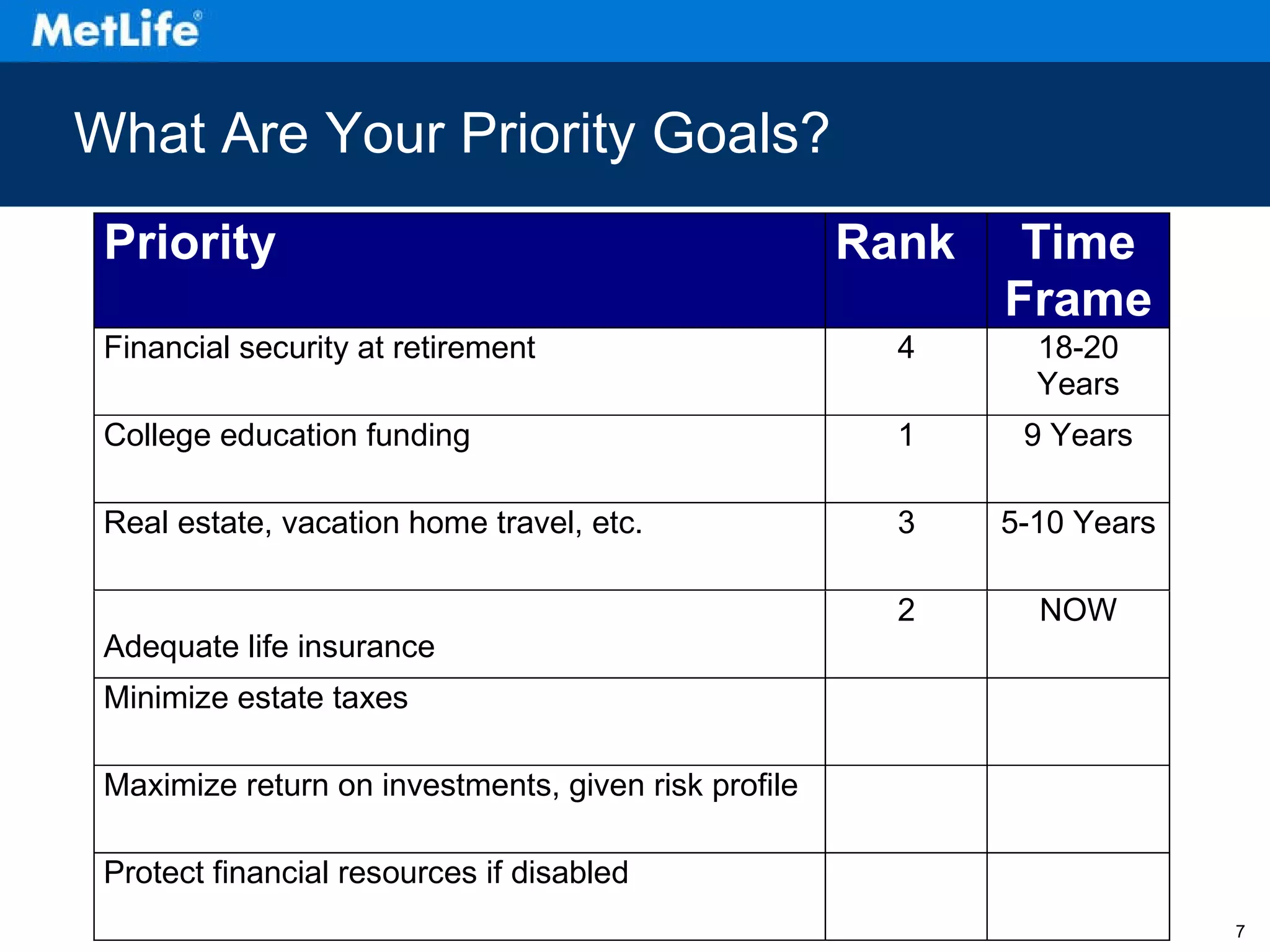
What Are Your Priority Goals?
How Are You Going to Achieve Your Goals? Current assets Additional savings and investments Earnings and compound earnings
An Illustration of Goal Achievement $100,000 Goal in 20 Years: Monthly Contributions Assuming an 8% return in a tax-deferred vehicle.  $175 $264 $422 $752 $1,774 Note:  Hypothetical example for illustrative purposes only. Does not represent an investment in any a specific product.  This chart does not take into account product Charges, fees or expanses and does not account for inflation.  If it did, the monthly contribution amount would need to be increased .
What Are the Benefits of  Financial Planning? Set your goals and prioritize them Have a plan to help you achieve your goals Learn to have more financial control and to take advantage of investment opportunities Prepare for the unexpected Develop solid financial strategies Get professional direction every step of the way Work toward financial security for your: Estate (wills, trusts, tax issues, etc.) Retirement plans Employee Benefits
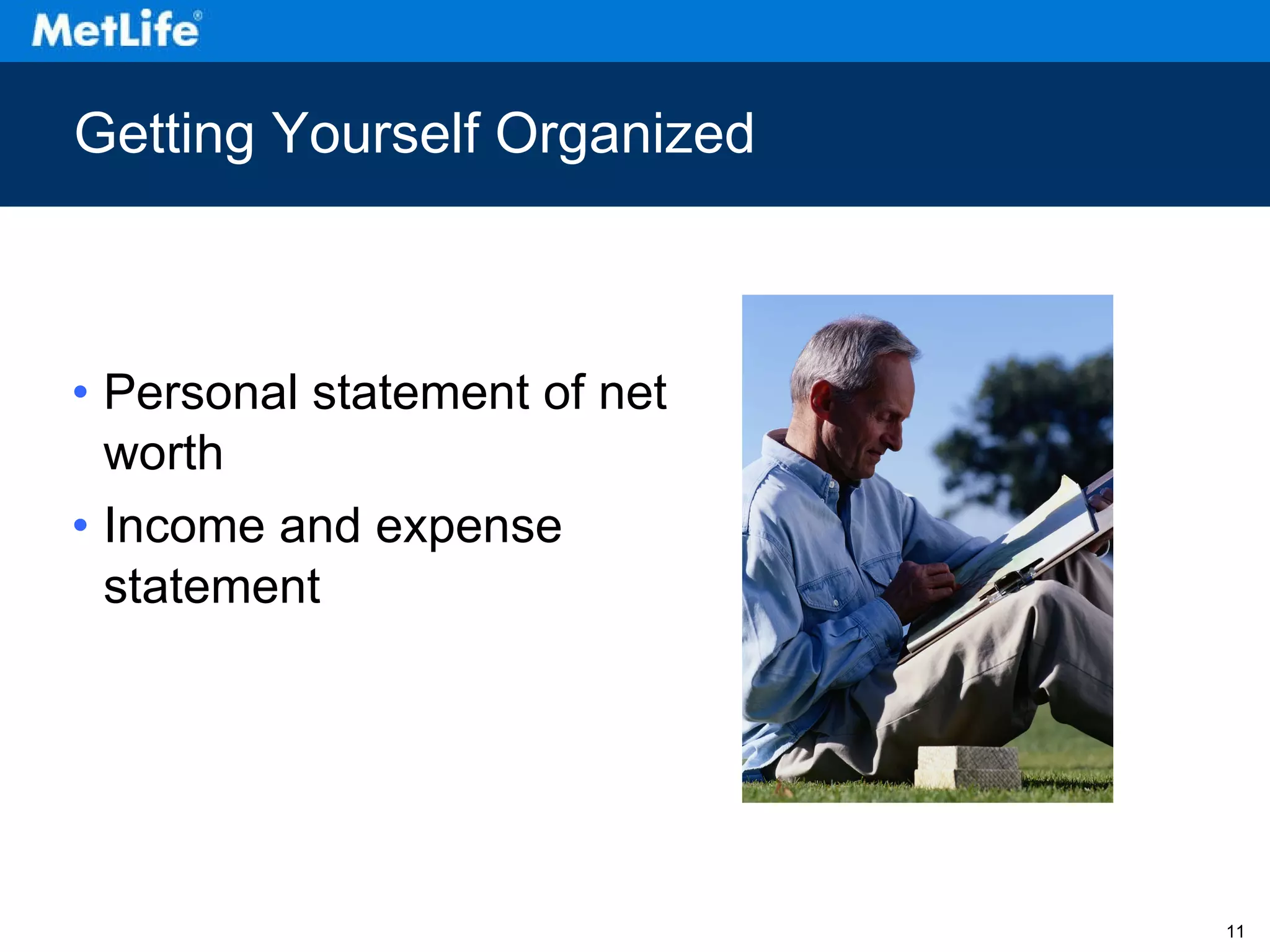
Getting Yourself Organized Personal statement of net worth Income and expense statement
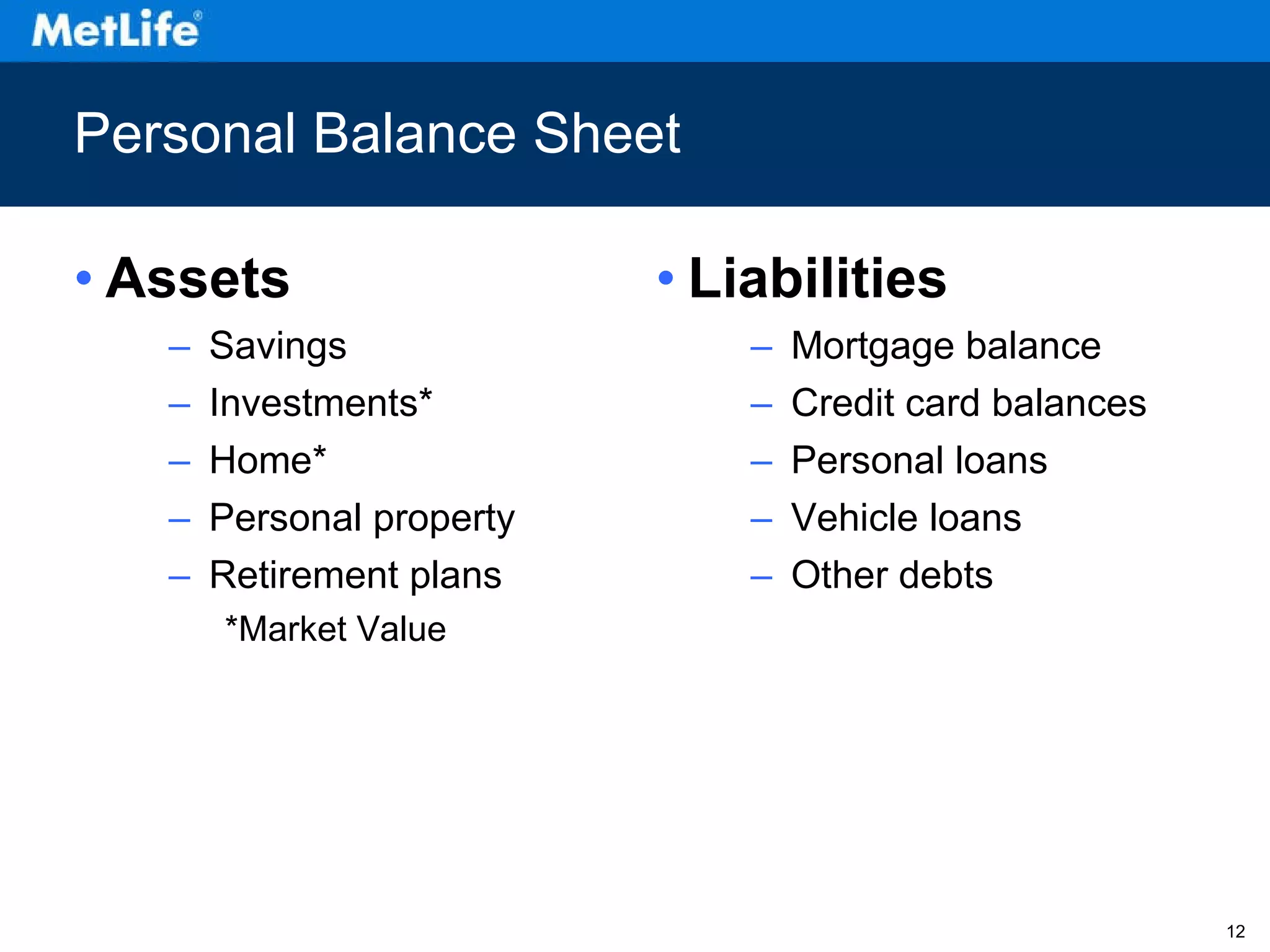
Personal Balance Sheet Assets Savings Investments* Home* Personal property Retirement plans *Market Value Liabilities Mortgage balance Credit card balances Personal loans Vehicle loans Other debts
Three Ways to Increase Your Net Worth Save or invest more money Pay down debts Increase asset value through appreciation or reinvestment
Income & Expense Statement Income Salary Savings and investment earnings Self-employment Social Security and pensions Expenses Housing Transportation Food and clothing Medical and insurance Discretionary Personal Income and employment taxes
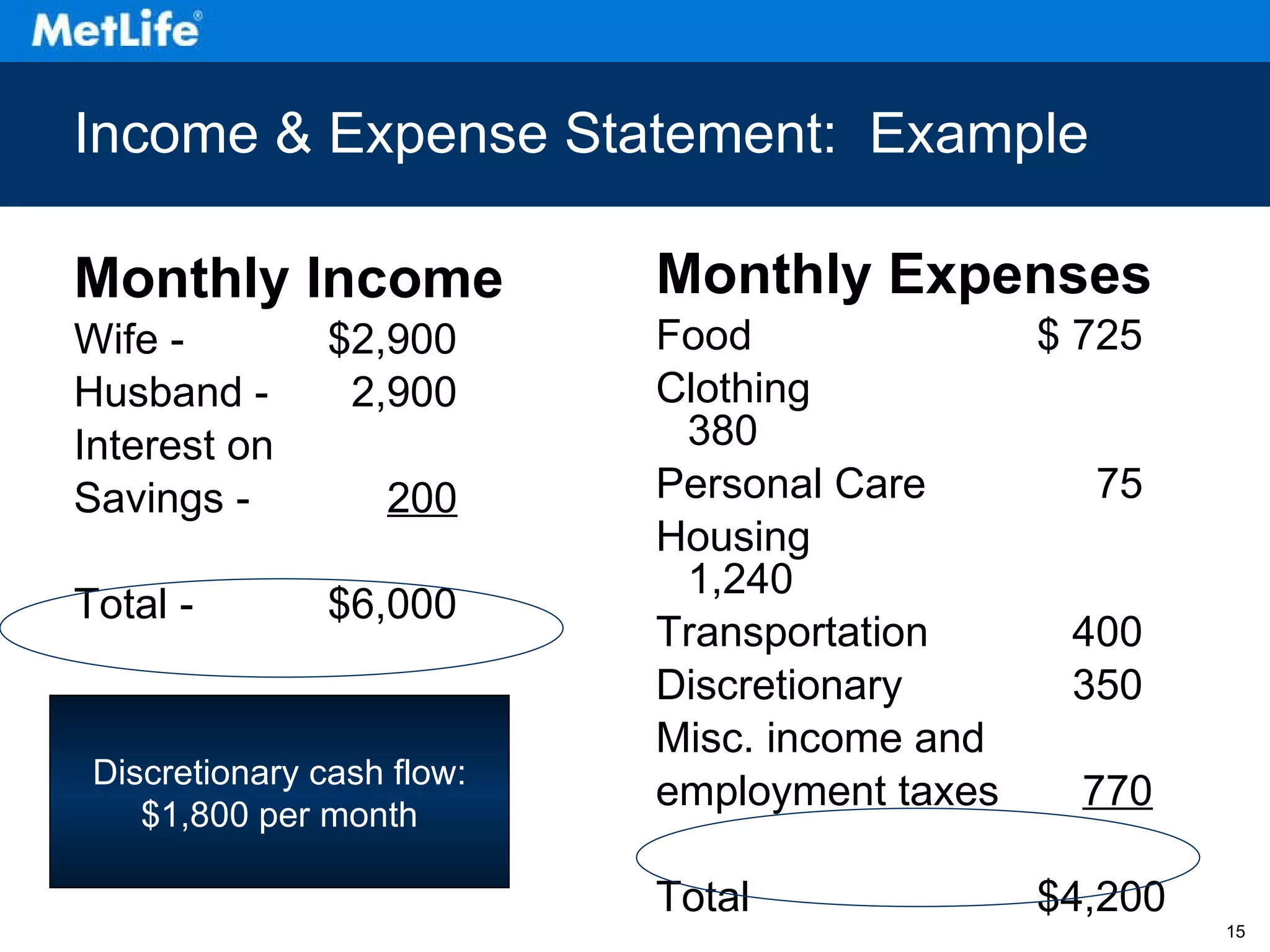
Income & Expense Statement:  Example Monthly Income Wife - $2,900 Husband -    2,900 Interest on Savings -    200 Total - $6,000 Monthly Expenses Food $ 725 Clothing     380 Personal Care   75 Housing 1,240 Transportation    400 Discretionary   350 Misc. income and employment taxes  770 Total $4,200 Discretionary cash flow: $1,800 per month
Impact of Taxes: Tax Deferred Vs. Taxable $10,000 investment that assumes a 28% tax bracket; does not take any other taxes into consideration . Hypothetical example, for illustrative purposes only. Does not represent an investment in any specific product. *The $14,326 will be taxable at your federal and, if applicable,  state rates upon withdrawal. $14,326*  Difference!
$10,000 @ 3% interest =  $10,300 3% inflation  -  309 25% Federal tax -  75 ____________________________     $ 9,916 Real return = -.991% *Does not consider any state, local, or other taxes that may be applicable. Real Rate of Return*
In Summary Recognize that financial planning is a process, not a product. It can help you to: Determine where you are today and where you want to be in the future Get organized with a personal statement of net worth and income and expense statement Increase your net worth through new savings, paying down debt, and realizing appreciation on your assets Invest discretionary cash flow systematically for the future Take into account both inflation and taxes
Pursuant to IRS Circular 230, MetLife is providing you with the following notification: The information contained in this document is not intended to (and cannot) be used by anyone to avoid IRS penalties. This document supports the promotion and marketing of  financial products and services. You should seek advice based on your particular circumstances from an independent tax advisor. MetLife, its affiliates, agents, and representatives may not give legal or tax advice. Any discussion of taxes herein or related to this document is for general information purposes only and does not purport to be complete or cover every situation. Tax law is subject to interpretation and legislative change. Tax results and the appropriateness of any product for any specific taxpayer may vary depending on the facts and circumstances. You should consult with and rely on your own independent legal and tax advisers regarding your particular set of facts and circumstances.
Thank you for attending today’s seminar!

Naf.seminar.09

  • 1.
    Financial Planning 101Investment Advisory Services offered through Investment Advisor Representatives of MetLife Securities, Inc. (MSI), 200 Park Avenue, New York, NY 10166, a Registered Investment Advisor. MSI is a MetLife, Inc. company L0609046410[exp0510][AZ]
  • 2.
    Financial Planning Professionand Industry Overview Financial Planner profession description Industry Changes / Trends Employment / Earnings Job Outlook Education / Training Qualifications / Skill Sets Certifications / Advancement Resources
  • 3.
    Where are youtoday? Where do you want to go? How do you get there? What Is Financial Planning?
  • 4.
    The Planning ProcessGet organized Analyze and compare financial resources against goals Develop personalized, written analysis Evaluate recommendations and alternatives Put the plan into action (implementation) Keep the plan up-to-date
  • 5.
    What Are YourPriority Goals?
  • 6.
    What Are YourPriority Goals?
  • 7.
    What Are YourPriority Goals?
  • 8.
    How Are YouGoing to Achieve Your Goals? Current assets Additional savings and investments Earnings and compound earnings
  • 9.
    An Illustration ofGoal Achievement $100,000 Goal in 20 Years: Monthly Contributions Assuming an 8% return in a tax-deferred vehicle. $175 $264 $422 $752 $1,774 Note: Hypothetical example for illustrative purposes only. Does not represent an investment in any a specific product. This chart does not take into account product Charges, fees or expanses and does not account for inflation. If it did, the monthly contribution amount would need to be increased .
  • 10.
    What Are theBenefits of Financial Planning? Set your goals and prioritize them Have a plan to help you achieve your goals Learn to have more financial control and to take advantage of investment opportunities Prepare for the unexpected Develop solid financial strategies Get professional direction every step of the way Work toward financial security for your: Estate (wills, trusts, tax issues, etc.) Retirement plans Employee Benefits
  • 11.
    Getting Yourself OrganizedPersonal statement of net worth Income and expense statement
  • 12.
    Personal Balance SheetAssets Savings Investments* Home* Personal property Retirement plans *Market Value Liabilities Mortgage balance Credit card balances Personal loans Vehicle loans Other debts
  • 13.
    Three Ways toIncrease Your Net Worth Save or invest more money Pay down debts Increase asset value through appreciation or reinvestment
  • 14.
    Income & ExpenseStatement Income Salary Savings and investment earnings Self-employment Social Security and pensions Expenses Housing Transportation Food and clothing Medical and insurance Discretionary Personal Income and employment taxes
  • 15.
    Income & ExpenseStatement: Example Monthly Income Wife - $2,900 Husband - 2,900 Interest on Savings - 200 Total - $6,000 Monthly Expenses Food $ 725 Clothing 380 Personal Care 75 Housing 1,240 Transportation 400 Discretionary 350 Misc. income and employment taxes 770 Total $4,200 Discretionary cash flow: $1,800 per month
  • 16.
    Impact of Taxes:Tax Deferred Vs. Taxable $10,000 investment that assumes a 28% tax bracket; does not take any other taxes into consideration . Hypothetical example, for illustrative purposes only. Does not represent an investment in any specific product. *The $14,326 will be taxable at your federal and, if applicable, state rates upon withdrawal. $14,326* Difference!
  • 17.
    $10,000 @ 3%interest = $10,300 3% inflation - 309 25% Federal tax - 75 ____________________________ $ 9,916 Real return = -.991% *Does not consider any state, local, or other taxes that may be applicable. Real Rate of Return*
  • 18.
    In Summary Recognizethat financial planning is a process, not a product. It can help you to: Determine where you are today and where you want to be in the future Get organized with a personal statement of net worth and income and expense statement Increase your net worth through new savings, paying down debt, and realizing appreciation on your assets Invest discretionary cash flow systematically for the future Take into account both inflation and taxes
  • 19.
    Pursuant to IRSCircular 230, MetLife is providing you with the following notification: The information contained in this document is not intended to (and cannot) be used by anyone to avoid IRS penalties. This document supports the promotion and marketing of financial products and services. You should seek advice based on your particular circumstances from an independent tax advisor. MetLife, its affiliates, agents, and representatives may not give legal or tax advice. Any discussion of taxes herein or related to this document is for general information purposes only and does not purport to be complete or cover every situation. Tax law is subject to interpretation and legislative change. Tax results and the appropriateness of any product for any specific taxpayer may vary depending on the facts and circumstances. You should consult with and rely on your own independent legal and tax advisers regarding your particular set of facts and circumstances.
  • 20.
    Thank you forattending today’s seminar!

Editor's Notes

  • #4 Welcome to today’s presentation, “Introduction to Financial Planning.” My name is [Rep’s Name] and I am a Financial Planner with [MSI or NES] Our first step is to put a definition around “Financial Planning.” It all starts by asking three questions. (READ SLIDE)
  • #5 Now that we’ve identified what financial planning is, let’s talk about the process. Here are the steps (READ SLIDE).
  • #6 You have to know where you’re going before you get there. So, let’s identify what your own personal goals in order of priority. The left column has some common goals. The right column is where you would rank each goal in order of your priority. Maybe number one for you is making sure that you minimize estate taxes, while number one for the person next to you may be paying for a child’s education. It all depends on your own situation.
  • #7 Here’s an example of how one may rate their goals.
  • #8 Once you’ve identified and prioritized your goals, the next step is to identify when you want to reach that goal.
  • #9 You’ve identified your goals. You’ve prioritized them. You’ve assigned time frames to them. Now – how are you going to get there? You need to identify where you are now. (READ SLIDE)
  • #10 04/27/11 15:47 Let’s say that your goal is to accumulate $100,000 in 20 years. How can you do this – and when should you start? Here’s an example of “the cost of waiting.” Hypothetically, if you were to earn a consistent 8% return in a tax deferred vehicle, you would need to start saving $175 a month starting today. Wait 8 years and that number jumps to $422. Wait 16 years, and it jumps to $1,774. Of course, we’re speaking hypothetically and this graphic does not represent an actual product. What it does do, however, is to present the concept of the value of time when it comes to saving for a financial goal.
  • #11 Let’s review the benefits of financial planning. (READ SLIDE)
  • #12 Now, let’s get organized! You’ve identified your goals, prioritized them, and set time frames. To determine where you are now, you need to determine your net worth, your income and expenses.
  • #13 You can create a personal balance sheet, listing out assets and liabilities. Assets can include (READ SLIDE). And liabilities can include (READ SLIDE).
  • #14 There are three ways to increase your net worth (READ SLIDE).
  • #15 Now, let’s identify your income. Income is more than your salary. Income also can include things like (READ SLIDE). And your expenses can include (READ SLIDE.)
  • #16 Here’s an example of income against expenses. Here the total income is $6,000 a month and expenses are $4,200. Subtract expenses from income and you have a discretionary cash flow of $1,800 per month.
  • #17 04/27/11 15:47 And let’s look at the impact of taxes by looking at a graphic of a hypothetical $10,000 investment in a tax deferred and a taxable vehicle. To keep it simple, let’s assume our hypothetical vehicle earns a consistent 5% return. As you can see, the tax deferred investment grows quicker – but do keep in mind that taxes will be due upon withdrawal and that retirement products do not enjoy the lower tax rate for long term capital gains or qualified dividends.
  • #18 04/27/11 15:47 Let’s say you have $10,000 earning 3% interest in the bank. After one year, your account would be worth $10,300. Let’s assume that inflation is at 3%, so we have to subtract that $309 [to stay even] from what you earned, but you are still coming out ahead, right?? Not quite. Because we have to figure in the taxes, remember? And 25% on your $300 of interest is $75 to taxes. So, $10,300 minus $309 for inflation and minus $75 for federal tax is $9,916. That is a real rate of return of .991%.
  • #19 READ SLIDE
  • #20 READ SLIDE