Year End 

Tax Planning
2021 Tax Saving Ideas for 

Individuals and Businesses
TABLE OF CONTENTS
1. Planning vs. Preparation
2. Stages of Tax Planning
3. Tax Planning Strategies
4. Year-End Tax Planning for Businesses
Planning vs.
Preparation
There’s a distinction between
reactive, past-looking
preparation and forward-looking,
proactive planning.
Tax Planning
Planning vs. Preparation
Tax Preparation
The process of looking
at a person’s life,
business, and
regulatory
requirements to legally
reduce taxes.
The process of
reviewing the year’s
financial results and
preparing tax returns
for submission to the
IRS.
Before Year End After Year End
12/31/2021
Stages of Tax Planning
While planning is the first step, that plan needs to be implemented in a
legal manner, maintained, and reflected in the tax return.
PLANNING
This is the most
important part of our
engagement.
We perform a review of
your tax positioning and
make recommendations
for how much you can 

save with with proactive
strategies.
Some savings may be 

from prior years, but
most will be in the
current year and beyond.
IMPLEMENTATION
Once we complete the tax
plan, we present you with
anywhere from 1-25+
strategies depending on
the circumstances.
Some of the strategies
require minimal
implementation, others
may be complex and
involve 3rd parties.
We are here to guide you
every step of the way.
QUARTERLY
Keeping up with the
compliance to ensure the
savings are defendable
and realized in the
returns, is where tax
planning gets finalized.
Working together on a
quarterly basis, this
includes implementing
basic planning strategies
and a review of financial
results to make proper
estimated payments.
PREPARATION
The preparation of
returns is the last stage
of the process.
At this point, we can
actually calculate what
your final tax payment
will be and compare it to
what you would have
paid without doing
proactive tax planning.
Preparation does not
cover monthly
accounting, clean up, or
closing the books.
Tax Planning
Strategies
We review hundreds of strategies
and their combinations to
optimize your savings.
These are a few categories
of Tax Planning strategy we
will assess:
▪ Deductions
▪ Legal Entity Design
▪ Retirement
▪ Tax Cuts & Jobs Act
(TCJA)
▪ Families First
Coronavirus Response
Act (FFCRA)
▪ Coronavirus Aid, Relief,
and Economic Security
(CARES)
▪ Insurance & Asset
Protection
▪ Niche Specific
Strategies
▪ Advanced Strategies
▪ International
▪ Asset & Gift Freeze
▪ Tax Advantaged Wealth
Management
▪ Exit & Capital Gains
Tax Planning Strategies
Defer or Accelerate
Income
Income is taxed in the
year it is received.
Defer a year-end bonus
into the next year.
Delay billings until late
December.
Take capital gains in
2022 instead of 2021.
If additional income could
push you into a higher
tax bracket, accelerate
income into 2021.
Tax Planning Strategies
Bunch Deductions Timing expenses to
produce ‘lean’ and ‘fat’
years.
Bunch deductible
expenses in ‘fat’ years.
Surpass the standard-
deduction amount and
claim a larger write-off.
Donate appreciated
stock or property rather
than cash.
Deduct the property’s
market value on the date
of the gift and you avoid
paying capital gains taxes.
Tax Planning Strategies
Max Out
Retirement
Account
Contributions
You usually have until the filing deadline to
make IRA contributions.
Deductible contributions also reduces your
taxable income.
Some plans must be established by December
31, but contributions may still be made until the
tax filing deadline.
Tax Planning Strategies
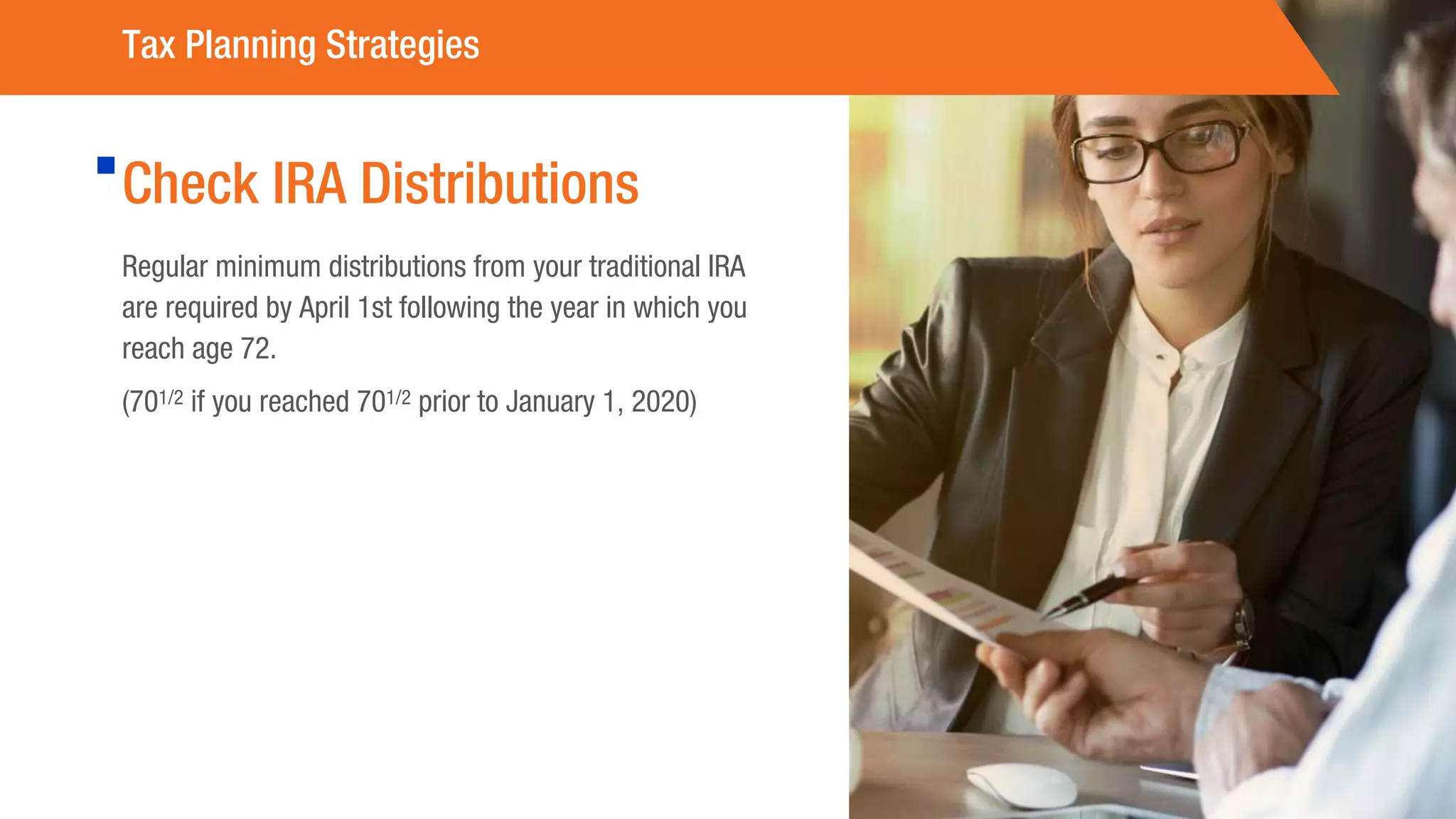
Check IRA Distributions
Regular minimum distributions from your traditional IRA
are required by April 1st following the year in which you
reach age 72.
(701/2 if you reached 701/2 prior to January 1, 2020)
Tax Planning Strategies
Failing to take out enough triggers one of the most
draconian of all IRS penalties:
A 50% excise tax on the amount you should have
withdrawn based on your age, your life expectancy, and
the amount in the account at the beginning of the year.
After that, annual withdrawals must be made by
December 31 to avoid the penalty.
Check IRA Distributions
Tax Planning Strategies
Roth IRA Conversion
Pay current income tax on your
Roth IRA if:
▪ You'll be in the same or higher tax bracket when you
withdraw.
▪ Won't need the converted funds for at least five years.
▪ Can pay the conversion tax in cash.
▪ Want to leave a tax-free financial legacy to your heirs.
Tax Planning Strategies
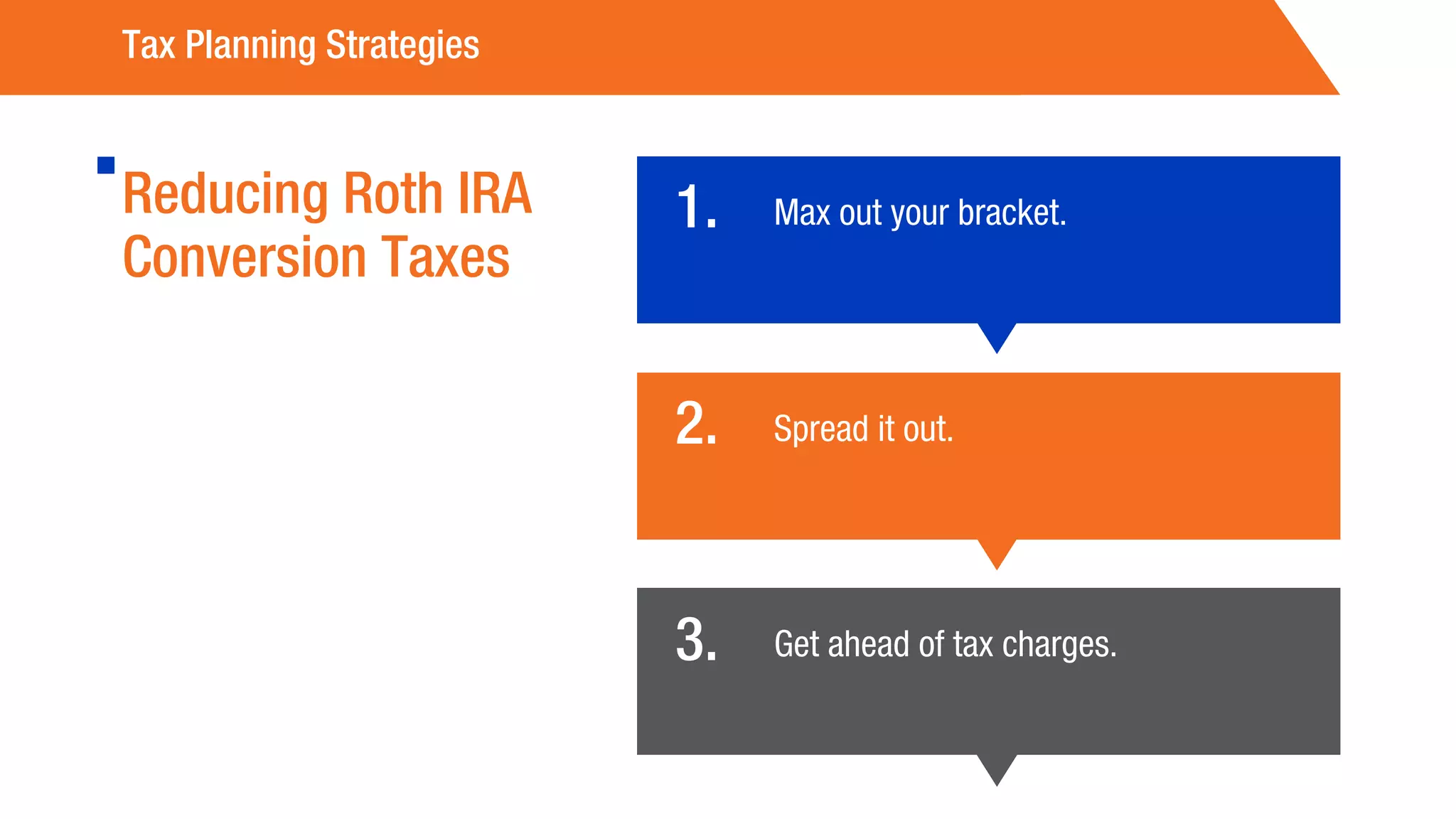
Reducing Roth IRA
Conversion Taxes
Max out your bracket.
Spread it out.
Get ahead of tax charges.
1.
2.
3.
Tax Planning Strategies
Year End Tax
Planning for
Businesses
Tax provisions businesses
should consider as we
approach the end of 2021
Employee Retention Credit
Eligible employers can claim a credit equal to
70% of qualified wages up to a maximum of
$10,000 in wages per employee, per quarter.
Maximum credit for any one employee could
total $28,000 for calendar-year 2021.
Wages you are allowed to deduct on your 2021
income tax return is reduced by the amount of
the 2021 credit.
Year End Tax Planning for Businesses
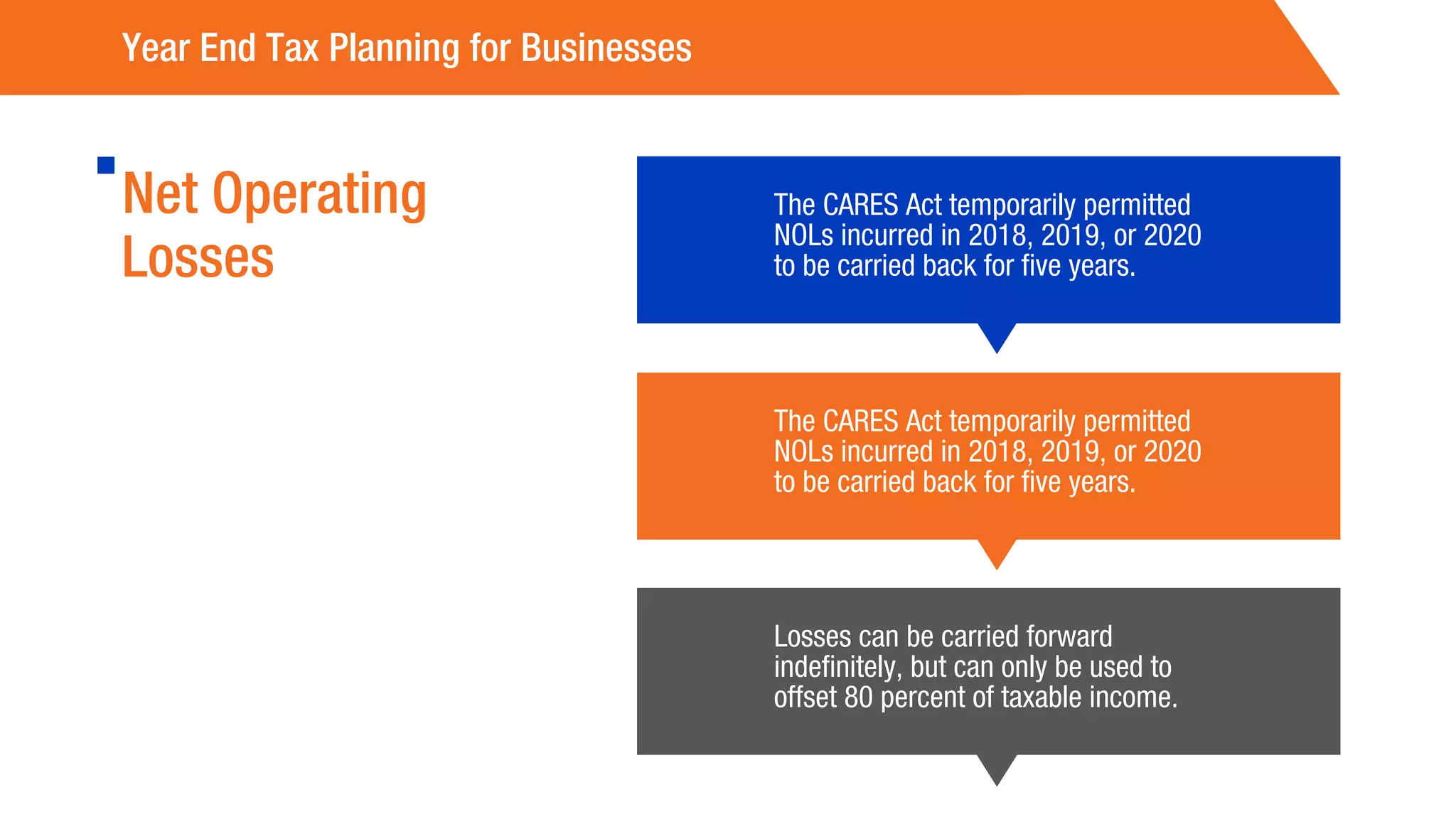
Net Operating
Losses
The CARES Act temporarily permitted
NOLs incurred in 2018, 2019, or 2020
to be carried back for five years.
The CARES Act temporarily permitted
NOLs incurred in 2018, 2019, or 2020
to be carried back for five years.
Losses can be carried forward
indefinitely, but can only be used to
offset 80 percent of taxable income.
Year End Tax Planning for Businesses
▪ Research and development costs incurred in the U.S.
will have an amortization period of five years.
▪ Currently businesses can either deduct these costs or
choose to capitalize and amortize these costs.
▪ Budget Reconciliation Bill would delay the effective
date of the R&D capitalization and amortization
requirement to 2026.
Research & Development Costs
After 2021, research and development
costs must be capitalized and amortized.
Year End Tax Planning for Businesses
Contact the legal team 

at Moskowitz LLP for a 

free consultation today.
1700 Broadway | 4th Floor | Oakland, CA 94612

ph: (Toll Free ) 888.829.332  fax: 415.398.6501  web: moskowitzllp.com
DISCLAIMER
This presentation and these materials are designed to provide information in regard to the subject matter
covered. This presentation and these materials are provided solely as a teaching tool, with the
understanding that Stephen Moskowitz, Moskowitz LLP, and the instructor are not engaged in rendering
legal, accounting, or other professional service and that they are not offering such advice in this
presentation and these accompanying materials. If legal advice or other professional assistance is
required, the service of a competent professional person should be sought. Attendance at this seminar or
use of these materials does not establish an attorney-client relationship with Stephen Moskowitz and/or
Moskowitz LLP. Further, and information or discussions provided to the Moskowitz, LLP before
establishing an attorney-client relationship, as evidenced by a signed engagement letter agreement can
and will be used for the benefit of the firm’s existing clients; according, until Moskowitz LLP has formally
established an attorney-client relationship, do not send or disclose any confidential information you
would expect to be maintained in confidence. The results of the cases portrayed in this advertisement/
seminar were dependent on the facts of those cases, and the results of those cases will differ if based on
different facts. As such, depending on the facts and circumstances of your case, your results may vary. No
guarantees, predictions, or actions should be inferred from these actual cases. In addition, no
representations are made that these actual cases are typical. Consequently, Moskowitz, LLP is not
responsible for any damages which may arise from the misuse of the information stated at this seminar
or in materials distributed at this seminar.
IN ACCORDANCE WITH TREASURY REGULATIONS CIRCULAR 230, WE INFORM YOU THAT ANY TAX ADVICE
CONTAINED IN THIS COMMUNICATION WAS NOT INTENDED OR WRITTEN TO BE USED, AND CANNOT BE
USED, FOR THE PURPOSE OF (I) AVOIDING TAX-RELATED PENALTIES UNDER THE INTERNAL REVENUE
CODE OR (II) PROMOTING, MARKETING, OR RECOMMENDING TO ANOTHER PARTY ANY TAX-RELATED
MATTER ADDRESSED HEREIN.

Tax Planning with Moskowitz LLP

  • 1.
    Year End 
 TaxPlanning 2021 Tax Saving Ideas for 
 Individuals and Businesses
  • 2.
    TABLE OF CONTENTS 1.Planning vs. Preparation 2. Stages of Tax Planning 3. Tax Planning Strategies 4. Year-End Tax Planning for Businesses
  • 3.
    Planning vs. Preparation There’s adistinction between reactive, past-looking preparation and forward-looking, proactive planning.
  • 4.
    Tax Planning Planning vs.Preparation Tax Preparation The process of looking at a person’s life, business, and regulatory requirements to legally reduce taxes. The process of reviewing the year’s financial results and preparing tax returns for submission to the IRS. Before Year End After Year End 12/31/2021
  • 5.
    Stages of TaxPlanning While planning is the first step, that plan needs to be implemented in a legal manner, maintained, and reflected in the tax return. PLANNING This is the most important part of our engagement. We perform a review of your tax positioning and make recommendations for how much you can 
 save with with proactive strategies. Some savings may be 
 from prior years, but most will be in the current year and beyond. IMPLEMENTATION Once we complete the tax plan, we present you with anywhere from 1-25+ strategies depending on the circumstances. Some of the strategies require minimal implementation, others may be complex and involve 3rd parties. We are here to guide you every step of the way. QUARTERLY Keeping up with the compliance to ensure the savings are defendable and realized in the returns, is where tax planning gets finalized. Working together on a quarterly basis, this includes implementing basic planning strategies and a review of financial results to make proper estimated payments. PREPARATION The preparation of returns is the last stage of the process. At this point, we can actually calculate what your final tax payment will be and compare it to what you would have paid without doing proactive tax planning. Preparation does not cover monthly accounting, clean up, or closing the books.
  • 6.
    Tax Planning Strategies We reviewhundreds of strategies and their combinations to optimize your savings.
  • 7.
    These are afew categories of Tax Planning strategy we will assess: ▪ Deductions ▪ Legal Entity Design ▪ Retirement ▪ Tax Cuts & Jobs Act (TCJA) ▪ Families First Coronavirus Response Act (FFCRA) ▪ Coronavirus Aid, Relief, and Economic Security (CARES) ▪ Insurance & Asset Protection ▪ Niche Specific Strategies ▪ Advanced Strategies ▪ International ▪ Asset & Gift Freeze ▪ Tax Advantaged Wealth Management ▪ Exit & Capital Gains Tax Planning Strategies
  • 8.
    Defer or Accelerate Income Incomeis taxed in the year it is received. Defer a year-end bonus into the next year. Delay billings until late December. Take capital gains in 2022 instead of 2021. If additional income could push you into a higher tax bracket, accelerate income into 2021. Tax Planning Strategies
  • 9.
    Bunch Deductions Timingexpenses to produce ‘lean’ and ‘fat’ years. Bunch deductible expenses in ‘fat’ years. Surpass the standard- deduction amount and claim a larger write-off. Donate appreciated stock or property rather than cash. Deduct the property’s market value on the date of the gift and you avoid paying capital gains taxes. Tax Planning Strategies
  • 10.
    Max Out Retirement Account Contributions You usuallyhave until the filing deadline to make IRA contributions. Deductible contributions also reduces your taxable income. Some plans must be established by December 31, but contributions may still be made until the tax filing deadline. Tax Planning Strategies
  • 11.
    Check IRA Distributions Regularminimum distributions from your traditional IRA are required by April 1st following the year in which you reach age 72. (701/2 if you reached 701/2 prior to January 1, 2020) Tax Planning Strategies
  • 12.
    Failing to takeout enough triggers one of the most draconian of all IRS penalties: A 50% excise tax on the amount you should have withdrawn based on your age, your life expectancy, and the amount in the account at the beginning of the year. After that, annual withdrawals must be made by December 31 to avoid the penalty. Check IRA Distributions Tax Planning Strategies
  • 13.
    Roth IRA Conversion Paycurrent income tax on your Roth IRA if: ▪ You'll be in the same or higher tax bracket when you withdraw. ▪ Won't need the converted funds for at least five years. ▪ Can pay the conversion tax in cash. ▪ Want to leave a tax-free financial legacy to your heirs. Tax Planning Strategies
  • 14.
    Reducing Roth IRA ConversionTaxes Max out your bracket. Spread it out. Get ahead of tax charges. 1. 2. 3. Tax Planning Strategies
  • 15.
    Year End Tax Planningfor Businesses Tax provisions businesses should consider as we approach the end of 2021
  • 16.
    Employee Retention Credit Eligibleemployers can claim a credit equal to 70% of qualified wages up to a maximum of $10,000 in wages per employee, per quarter. Maximum credit for any one employee could total $28,000 for calendar-year 2021. Wages you are allowed to deduct on your 2021 income tax return is reduced by the amount of the 2021 credit. Year End Tax Planning for Businesses
  • 17.
    Net Operating Losses The CARESAct temporarily permitted NOLs incurred in 2018, 2019, or 2020 to be carried back for five years. The CARES Act temporarily permitted NOLs incurred in 2018, 2019, or 2020 to be carried back for five years. Losses can be carried forward indefinitely, but can only be used to offset 80 percent of taxable income. Year End Tax Planning for Businesses
  • 18.
    ▪ Research anddevelopment costs incurred in the U.S. will have an amortization period of five years. ▪ Currently businesses can either deduct these costs or choose to capitalize and amortize these costs. ▪ Budget Reconciliation Bill would delay the effective date of the R&D capitalization and amortization requirement to 2026. Research & Development Costs After 2021, research and development costs must be capitalized and amortized. Year End Tax Planning for Businesses
  • 19.
    Contact the legalteam 
 at Moskowitz LLP for a 
 free consultation today. 1700 Broadway | 4th Floor | Oakland, CA 94612
 ph: (Toll Free ) 888.829.332  fax: 415.398.6501  web: moskowitzllp.com
  • 20.
    DISCLAIMER This presentation andthese materials are designed to provide information in regard to the subject matter covered. This presentation and these materials are provided solely as a teaching tool, with the understanding that Stephen Moskowitz, Moskowitz LLP, and the instructor are not engaged in rendering legal, accounting, or other professional service and that they are not offering such advice in this presentation and these accompanying materials. If legal advice or other professional assistance is required, the service of a competent professional person should be sought. Attendance at this seminar or use of these materials does not establish an attorney-client relationship with Stephen Moskowitz and/or Moskowitz LLP. Further, and information or discussions provided to the Moskowitz, LLP before establishing an attorney-client relationship, as evidenced by a signed engagement letter agreement can and will be used for the benefit of the firm’s existing clients; according, until Moskowitz LLP has formally established an attorney-client relationship, do not send or disclose any confidential information you would expect to be maintained in confidence. The results of the cases portrayed in this advertisement/ seminar were dependent on the facts of those cases, and the results of those cases will differ if based on different facts. As such, depending on the facts and circumstances of your case, your results may vary. No guarantees, predictions, or actions should be inferred from these actual cases. In addition, no representations are made that these actual cases are typical. Consequently, Moskowitz, LLP is not responsible for any damages which may arise from the misuse of the information stated at this seminar or in materials distributed at this seminar. IN ACCORDANCE WITH TREASURY REGULATIONS CIRCULAR 230, WE INFORM YOU THAT ANY TAX ADVICE CONTAINED IN THIS COMMUNICATION WAS NOT INTENDED OR WRITTEN TO BE USED, AND CANNOT BE USED, FOR THE PURPOSE OF (I) AVOIDING TAX-RELATED PENALTIES UNDER THE INTERNAL REVENUE CODE OR (II) PROMOTING, MARKETING, OR RECOMMENDING TO ANOTHER PARTY ANY TAX-RELATED MATTER ADDRESSED HEREIN.