Introduction to Standards-based Curriculum Integration Part I and IIDr. Penni Hudis - Director of Pathway and Curriculum Development,  ConnectEDKathleen Harris - Director of Coaching and Technical Assistance,  ConnectEDRob Atterbury- Director of Professional Development, Connect Ed
www.connectedcalifornia.org510-849-4945          Partnering with NAF, NCAC, CASN,  EDC
ObjectivesRecognize quality curriculum integrationIdentify levels and typesDescribe teacher rolesSurface obstacles and explore solutionsAccess key resources3
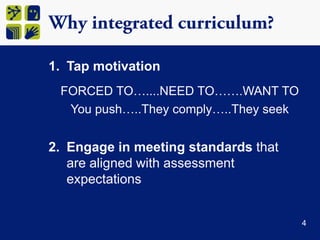
Why integrated curriculum?Tap motivationFORCED TO…....NEED TO…….WANT TO	   You push…..They comply…..They seekEngage in meeting standards that are aligned with assessment expectations4
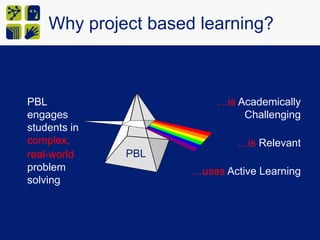
Why project based learning?PBL engages students in complex, real-world problem solving…is Academically Challenging          …is Relevant…uses Active LearningPBL
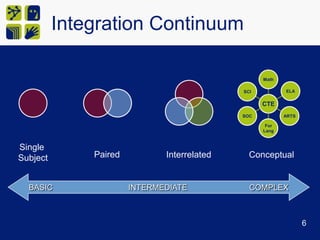
Integration ContinuumSingle SubjectPairedInterrelatedConceptualBASIC                                INTERMEDIATE                            COMPLEX6
Activity 1Review and critique a curriculum sample using the Integrated Lesson and Project Quality Criteria7
Integrated curriculum designCurriculum/Performance mappingConnecting concept or themeEssential questionsPerformance assessmentsIndustry partnersReflection and revision8
Integrated planning in action9
Integrated projects should beStandards/performance driven –
Inquiry based
Authentic
Personalized10
ACTIVITY 2: Reflection Question 111
Begin with the end in mind”All things are created twice:first mentally and then physically.The key to creativity is to begin with the end in mind, with a vision and a blueprint of the desired result.”Stephen R Covey12
What is the end?The project or activityThe content topicsPerformance of standards13
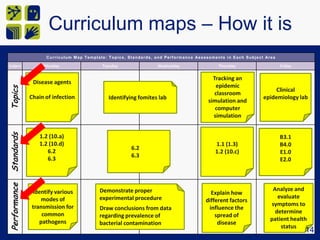
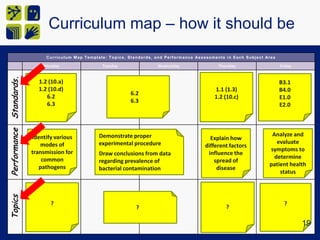
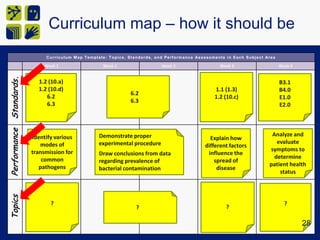
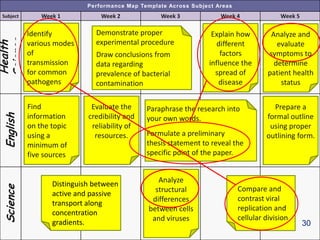
Curriculum maps – How it isIdentifying fomites labTracking an epidemic classroom simulation and computer simulationDisease agentsChain of infectionClinical epidemiology lab6.26.31.1 (1.3)1.2 (10.c)1.2 (10.a)1.2 (10.d)6.26.3B3.1B4.0E1.0E2.0Demonstrate proper experimental procedureDraw conclusions from data regarding prevalence of bacterial contaminationAnalyze and evaluate symptoms to determine patient health statusExplain how different factors influence the spread of diseaseIdentify various modes of transmission for common pathogens14
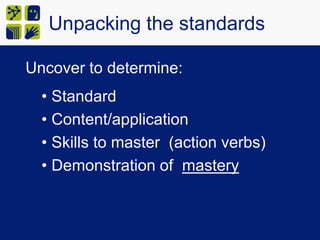
Unpacking the standardsUncover to determine:Standard
Content/application
Skills to master  (action verbs)
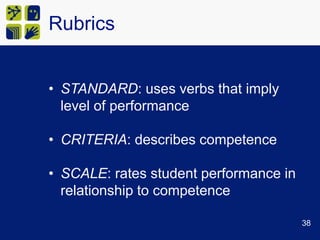
Demonstration of  masteryUnpacking the standardsVerbs matter!Verbs establish the level of learning and drive the assessment methodsActivities in the project should require students to acquire and/or demonstrate the desired level of mastery16
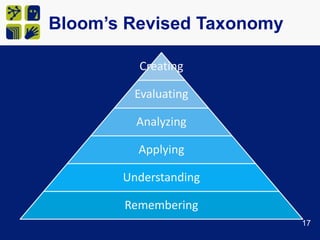
Bloom’s Revised Taxonomy17
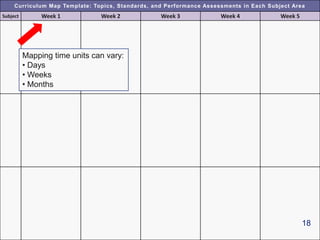
Mapping time units can vary: Days
 Weeks
 Months18
Curriculum map – how it should be6.26.31.1 (1.3)1.2 (10.c)1.2 (10.a)1.2 (10.d)6.26.3B3.1B4.0E1.0E2.0Demonstrate proper experimental procedureDraw conclusions from data regarding prevalence of bacterial contaminationAnalyze and evaluate symptoms to determine patient health statusExplain how different factors influence the spread of diseaseIdentify various modes of transmission for common pathogens????19
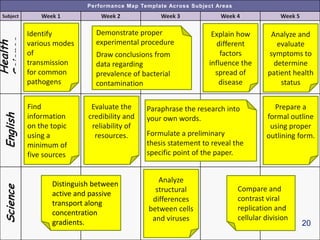
Demonstrate proper experimental procedureDraw conclusions from data regarding prevalence of bacterial contaminationIdentify various modes of transmission for common pathogensExplain how different factors influence the spread of diseaseAnalyze and evaluate symptoms to determine patient health statusParaphrase the research into your own words.Formulate a preliminary thesis statement to reveal the specific point of the paper. Find information on the topic using a minimum of five sources Evaluate the credibility and reliability of resources. Prepare a formal outline using proper outlining form. Distinguish between active and passive transport along concentration gradients.Compare and contrast viral replication and cellular divisionAnalyze structural differences between cells and viruses20
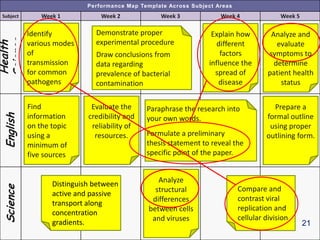
Demonstrate proper experimental procedureDraw conclusions from data regarding prevalence of bacterial contaminationIdentify various modes of transmission for common pathogensExplain how different factors influence the spread of diseaseAnalyze and evaluate symptoms to determine patient health statusParaphrase the research into your own words.Formulate a preliminary thesis statement to reveal the specific point of the paper. Find information on the topic using a minimum of five sources Evaluate the credibility and reliability of resources. Prepare a formal outline using proper outlining form. Distinguish between active and passive transport along concentration gradients.Compare and contrast viral replication and cellular divisionAnalyze structural differences between cells and viruses21
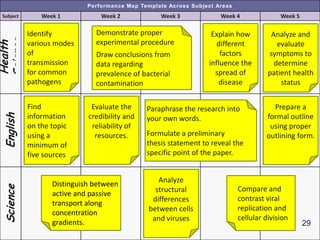
Connections across subjects come from both verbs (skills) AND applications (content)22
The goal of performance mapping is to create integrated lessons or projects that are standards-based and reflect and aligned to scope and sequence  23
ACTIVITY 3Practice building performance maps and finding connections24
Getting started on performance mappingAgree on the level of granularity (week vs. month) of mapEstablish the time spans for your mapsDecide on the physical format25
Getting started on performance mappingDetermine the means for sharing the mapsSchedule curriculum design meetingsEstablish a strategy for providing technical assistance26
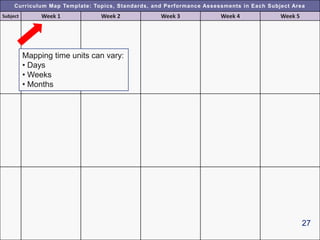
Mapping time units can vary: Days
 Weeks
 Months27
Curriculum map – how it should be6.26.31.1 (1.3)1.2 (10.c)1.2 (10.a)1.2 (10.d)6.26.3B3.1B4.0E1.0E2.0Demonstrate proper experimental procedureDraw conclusions from data regarding prevalence of bacterial contaminationAnalyze and evaluate symptoms to determine patient health statusExplain how different factors influence the spread of diseaseIdentify various modes of transmission for common pathogens????28
Demonstrate proper experimental procedureDraw conclusions from data regarding prevalence of bacterial contaminationIdentify various modes of transmission for common pathogensExplain how different factors influence the spread of diseaseAnalyze and evaluate symptoms to determine patient health statusParaphrase the research into your own words.Formulate a preliminary thesis statement to reveal the specific point of the paper. Find information on the topic using a minimum of five sources Evaluate the credibility and reliability of resources. Prepare a formal outline using proper outlining form. Distinguish between active and passive transport along concentration gradients.Compare and contrast viral replication and cellular divisionAnalyze structural differences between cells and viruses29
Demonstrate proper experimental procedureDraw conclusions from data regarding prevalence of bacterial contaminationIdentify various modes of transmission for common pathogensExplain how different factors influence the spread of diseaseAnalyze and evaluate symptoms to determine patient health statusParaphrase the research into your own words.Formulate a preliminary thesis statement to reveal the specific point of the paper. Find information on the topic using a minimum of five sources Evaluate the credibility and reliability of resources. Prepare a formal outline using proper outlining form. Distinguish between active and passive transport along concentration gradients.Compare and contrast viral replication and cellular divisionAnalyze structural differences between cells and viruses30
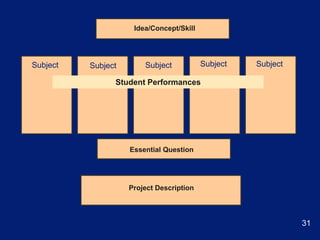
Idea/Concept/SkillSubjectSubjectSubjectSubjectSubjectStudent PerformancesEssential QuestionProject Description31
Online Toolhttp://devconnectedstudios.org/
33

Naf 2010 presentation teachers rev 7.10 copy

  • 1.
    Introduction to Standards-basedCurriculum Integration Part I and IIDr. Penni Hudis - Director of Pathway and Curriculum Development, ConnectEDKathleen Harris - Director of Coaching and Technical Assistance, ConnectEDRob Atterbury- Director of Professional Development, Connect Ed
  • 2.
    www.connectedcalifornia.org510-849-4945 Partnering with NAF, NCAC, CASN, EDC
  • 3.
    ObjectivesRecognize quality curriculumintegrationIdentify levels and typesDescribe teacher rolesSurface obstacles and explore solutionsAccess key resources3
  • 4.
    Why integrated curriculum?TapmotivationFORCED TO…....NEED TO…….WANT TO You push…..They comply…..They seekEngage in meeting standards that are aligned with assessment expectations4
  • 5.
    Why project basedlearning?PBL engages students in complex, real-world problem solving…is Academically Challenging …is Relevant…uses Active LearningPBL
  • 6.
  • 7.
    Activity 1Review andcritique a curriculum sample using the Integrated Lesson and Project Quality Criteria7
  • 8.
    Integrated curriculum designCurriculum/PerformancemappingConnecting concept or themeEssential questionsPerformance assessmentsIndustry partnersReflection and revision8
  • 9.
  • 10.
    Integrated projects shouldbeStandards/performance driven –
  • 11.
  • 12.
  • 13.
  • 14.
  • 15.
    Begin with theend in mind”All things are created twice:first mentally and then physically.The key to creativity is to begin with the end in mind, with a vision and a blueprint of the desired result.”Stephen R Covey12
  • 16.
    What is theend?The project or activityThe content topicsPerformance of standards13
  • 17.
    Curriculum maps –How it isIdentifying fomites labTracking an epidemic classroom simulation and computer simulationDisease agentsChain of infectionClinical epidemiology lab6.26.31.1 (1.3)1.2 (10.c)1.2 (10.a)1.2 (10.d)6.26.3B3.1B4.0E1.0E2.0Demonstrate proper experimental procedureDraw conclusions from data regarding prevalence of bacterial contaminationAnalyze and evaluate symptoms to determine patient health statusExplain how different factors influence the spread of diseaseIdentify various modes of transmission for common pathogens14
  • 18.
    Unpacking the standardsUncoverto determine:Standard
  • 19.
  • 20.
    Skills to master (action verbs)
  • 21.
    Demonstration of masteryUnpacking the standardsVerbs matter!Verbs establish the level of learning and drive the assessment methodsActivities in the project should require students to acquire and/or demonstrate the desired level of mastery16
  • 22.
  • 23.
    Mapping time unitscan vary: Days
  • 24.
  • 25.
  • 26.
    Curriculum map –how it should be6.26.31.1 (1.3)1.2 (10.c)1.2 (10.a)1.2 (10.d)6.26.3B3.1B4.0E1.0E2.0Demonstrate proper experimental procedureDraw conclusions from data regarding prevalence of bacterial contaminationAnalyze and evaluate symptoms to determine patient health statusExplain how different factors influence the spread of diseaseIdentify various modes of transmission for common pathogens????19
  • 27.
    Demonstrate proper experimentalprocedureDraw conclusions from data regarding prevalence of bacterial contaminationIdentify various modes of transmission for common pathogensExplain how different factors influence the spread of diseaseAnalyze and evaluate symptoms to determine patient health statusParaphrase the research into your own words.Formulate a preliminary thesis statement to reveal the specific point of the paper. Find information on the topic using a minimum of five sources Evaluate the credibility and reliability of resources. Prepare a formal outline using proper outlining form. Distinguish between active and passive transport along concentration gradients.Compare and contrast viral replication and cellular divisionAnalyze structural differences between cells and viruses20
  • 28.
    Demonstrate proper experimentalprocedureDraw conclusions from data regarding prevalence of bacterial contaminationIdentify various modes of transmission for common pathogensExplain how different factors influence the spread of diseaseAnalyze and evaluate symptoms to determine patient health statusParaphrase the research into your own words.Formulate a preliminary thesis statement to reveal the specific point of the paper. Find information on the topic using a minimum of five sources Evaluate the credibility and reliability of resources. Prepare a formal outline using proper outlining form. Distinguish between active and passive transport along concentration gradients.Compare and contrast viral replication and cellular divisionAnalyze structural differences between cells and viruses21
  • 29.
    Connections across subjectscome from both verbs (skills) AND applications (content)22
  • 30.
    The goal ofperformance mapping is to create integrated lessons or projects that are standards-based and reflect and aligned to scope and sequence 23
  • 31.
    ACTIVITY 3Practice buildingperformance maps and finding connections24
  • 32.
    Getting started onperformance mappingAgree on the level of granularity (week vs. month) of mapEstablish the time spans for your mapsDecide on the physical format25
  • 33.
    Getting started onperformance mappingDetermine the means for sharing the mapsSchedule curriculum design meetingsEstablish a strategy for providing technical assistance26
  • 34.
    Mapping time unitscan vary: Days
  • 35.
  • 36.
  • 37.
    Curriculum map –how it should be6.26.31.1 (1.3)1.2 (10.c)1.2 (10.a)1.2 (10.d)6.26.3B3.1B4.0E1.0E2.0Demonstrate proper experimental procedureDraw conclusions from data regarding prevalence of bacterial contaminationAnalyze and evaluate symptoms to determine patient health statusExplain how different factors influence the spread of diseaseIdentify various modes of transmission for common pathogens????28
  • 38.
    Demonstrate proper experimentalprocedureDraw conclusions from data regarding prevalence of bacterial contaminationIdentify various modes of transmission for common pathogensExplain how different factors influence the spread of diseaseAnalyze and evaluate symptoms to determine patient health statusParaphrase the research into your own words.Formulate a preliminary thesis statement to reveal the specific point of the paper. Find information on the topic using a minimum of five sources Evaluate the credibility and reliability of resources. Prepare a formal outline using proper outlining form. Distinguish between active and passive transport along concentration gradients.Compare and contrast viral replication and cellular divisionAnalyze structural differences between cells and viruses29
  • 39.
    Demonstrate proper experimentalprocedureDraw conclusions from data regarding prevalence of bacterial contaminationIdentify various modes of transmission for common pathogensExplain how different factors influence the spread of diseaseAnalyze and evaluate symptoms to determine patient health statusParaphrase the research into your own words.Formulate a preliminary thesis statement to reveal the specific point of the paper. Find information on the topic using a minimum of five sources Evaluate the credibility and reliability of resources. Prepare a formal outline using proper outlining form. Distinguish between active and passive transport along concentration gradients.Compare and contrast viral replication and cellular divisionAnalyze structural differences between cells and viruses30
  • 40.
  • 41.
  • 42.

Editor's Notes

  • #4 P. 1 of handout, review objectives and frame the day
  • #6 So, why do we focus on project/problem-based? Refer to examples from previous sharing. Conclusion: PBL is an instructional strategy (not the only one, but a powerful one) that brings together (almost) all of the elements associated with powerful and engaging learning experiences.Stuff like:Inquiry driven – becomes the students’ problemAuthentic – complex, real world product, performance, service or solutionPersonalized – differentiated based on students’ motivation and skillsAnd lastly, though maybe not mentioned, when properly designed: Standards driven – timely and identifies level of mastery
  • #8 A. Discuss in small groups and report out the levels of integration in for each discipline
  • #9 Overview of development process on p. 2
  • #10 Reattach video from hard drive, if necessary…Right-click on video screenOpen “Properties” menuIn the “URL” row, type in location of video on your hard driveIn the “fullscreen” row, set to “True” (you need to reset to “True” everytime you test or play the video)
  • #12 A. Discuss in small groups and report out the levels of integration in for each discipline
  • #14 Project is the blueprint, not the desired result
  • #15 Teachers usually start with topics based on textbook or course outlines provided by district, or with standards, providing by state and pacing guides(Remind that standards need to be written out)But we really want to end up looking at what students are actually being asked to demonstrate – the performance measures make the best map Where do you think your subject area teachers are with this task?
  • #17 Activities in the project must allow students to demonstrate the desired level of learning
  • #19 Template sample on p. 12Granularity of map can vary – this by week
  • #20 Where do you think your subject area teachers are with this task?
  • #21 See example on page 13 of handoutYou can look for connections based on skillsAND on content
  • #22 See example on page 13 of handoutYou can look for connections based on skillsAND on content
  • #25 Subject area specialists work together on one month of performance map, and they put their stuff together. Compare level of performance and language used. These need to be aligned for map to be helpful. How can you get teacher teams to agree on this?
  • #28 Template sample on p. 12Granularity of map can vary – this by week
  • #29 Where do you think your subject area teachers are with this task?
  • #30 See example on page 13 of handoutYou can look for connections based on skillsAND on content
  • #31 See example on page 13 of handoutYou can look for connections based on skillsAND on content
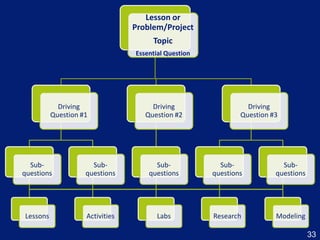
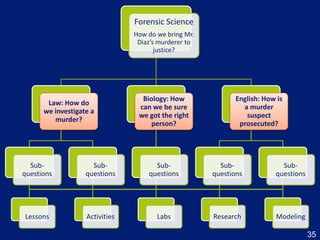
  • #34 Essential questions are what drive the instruction. They set up the need-to-know situations that make learning relevant and engaging for students. But their other, equally important goal, is to connect the context of the project to the underlying, standards-based content.
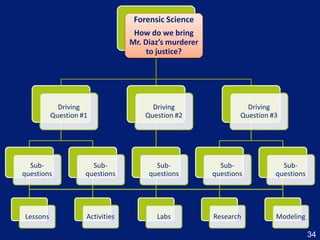
  • #35 In a forensics unit, a common essential question that shapes the unit is asking about the crime: How can be bring Mr. Diaz’s murderer to justice? This seems like a simple question, but actually it’s very complex. There is a lot stuff involved in fully answering that question.
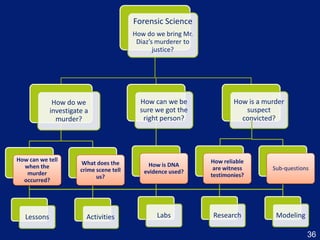
  • #36 So you break it down. How do we bring Mr. Diaz’s murderer to justice? What does that entail? You need to know how do you go about investigating the crime. How can you be sure you got the right person? Once you’re sure, how are they prosecuted?
  • #37 Each of these questions leads to more, and more specific sub-questions, which subject area teachers can use introduce and apply their content. How can we tell when the murder occurred? Newton’s Law of Cooling, an exponential equation, is often used to determine time of death. What does the crime scene tell us? angle of an entry wound, distance between footprints give can give information about physical characteristics of the perpetrator. How can we be sure we got the right person? How reliable are witnesses? Evaluating credibility is a concept in English language arts. These questions are how you link your standards to the larger project, so you need to be thoughtful about crafting an essential question that will be engaging and interesting for students yet still legitimately require the learning you need them to engage in.
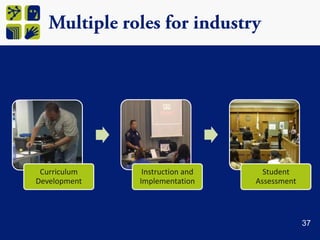
  • #38 Industry professionals, like Detective Holliday provide specialized industry content expertiseIndustry partners can suggest connections that may not be apparent to teacher teamStudents visit crime labStudents observe autopsyDetectives provide supplemental instruction, mentor students during investigationLawyer visits classroom to talk about courtroom proceduresLaw professionals serve on the jury during the “trial”Judges render verdictWeb designers evaluate final project to industry standardsForensic scientists evaluate site content
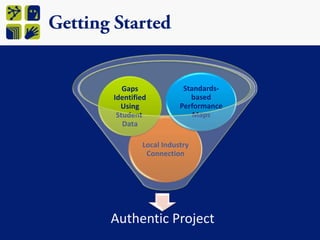
  • #41 Strongly encourage starting the design process from standards, but keep in mind that data and local industry/community connections can also provide valuable information/opportunities for project ideas.