UNIVERSIDAD DE LAS FUERZAS ARMADAS
ESPE
“An Introduction to Educational Design Research”
Curriculum Design Research
TUTOR:
Msc. Miguel Ponce
Students:
Almeida Aragon, Eliana Marcela (coordinator)
Lopez Jaramillo, Daysi Carolina
Introduction
(Curriculum Design Research) intentionally combines two
fields:
‘curriculum design’ and ‘design research’. It symbolizes the
aim of this text to discuss the function and forms of design
research from a curricular perspective
Curriculum, what’s in a name?
The Latin word ‘curriculum’ (related to
the verb ‘currere’ i.e. running) refers to
a ‘course’ or ‘track’ to be followed. The
most obvious interpretation of the
word curriculum is then to view it as a
course, trajectory, or ‘plan for learning’
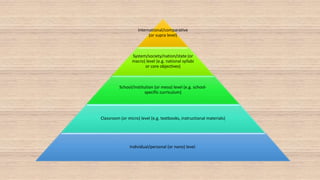
International/comparative
(or supra level)
System/society/nation/state (or
macro) level (e.g. national syllabi
or core objectives)
School/institution (or meso) level (e.g. school-
specific curriculum)
Classroom (or micro) level (e.g. textbooks, instructional materials)
Individual/personal (or nano) level.
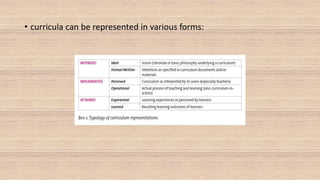
• curricula can be represented in various forms:
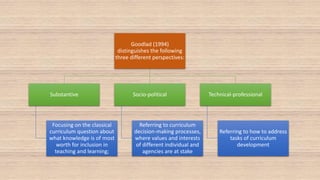
Goodlad (1994)
distinguishes the following
three different perspectives:
Substantive
Focusing on the classical
curriculum question about
what knowledge is of most
worth for inclusion in
teaching and learning;
Socio-political
Referring to curriculum
decision-making processes,
where values and interests
of different individual and
agencies are at stake
Technical-professional
Referring to how to address
tasks of curriculum
development
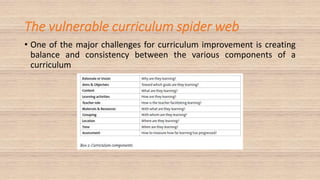
The vulnerable curriculum spider web
• One of the major challenges for curriculum improvement is creating
balance and consistency between the various components of a
curriculum
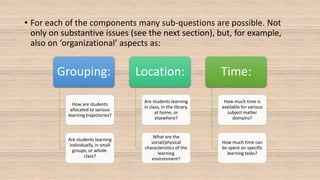
• For each of the components many sub-questions are possible. Not
only on substantive issues (see the next section), but, for example,
also on ‘organizational’ aspects as:
Grouping:
How are students
allocated to various
learning trajectories?
Are students learning
individually, in small
groups, or whole-
class?
Location:
Are students learning
in class, in the library,
at home, or
elsewhere?
What are the
social/physical
characteristics of the
learning
environment?
Time:
How much time is
available for various
subject matter
domains?
How much time can
be spent on specific
learning tasks?
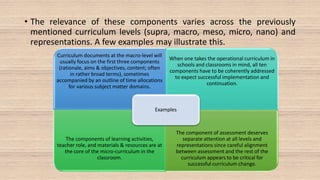
• The relevance of these components varies across the previously
mentioned curriculum levels (supra, macro, meso, micro, nano) and
representations. A few examples may illustrate this.
Curriculum documents at the macro-level will
usually focus on the first three components
(rationale, aims & objectives, content; often
in rather broad terms), sometimes
accompanied by an outline of time allocations
for various subject matter domains.
When one takes the operational curriculum in
schools and classrooms in mind, all ten
components have to be coherently addressed
to expect successful implementation and
continuation.
The components of learning activities,
teacher role, and materials & resources are at
the core of the micro-curriculum in the
classroom.
The component of assessment deserves
separate attention at all levels and
representations since careful alignment
between assessment and the rest of the
curriculum appears to be critical for
successful curriculum change.
Examples
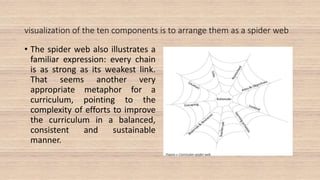
visualization of the ten components is to arrange them as a spider web
• The spider web also illustrates a
familiar expression: every chain
is as strong as its weakest link.
That seems another very
appropriate metaphor for a
curriculum, pointing to the
complexity of efforts to improve
the curriculum in a balanced,
consistent and sustainable
manner.
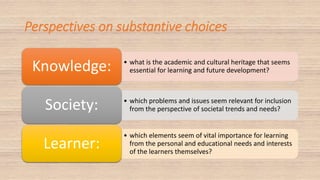
Perspectives on substantive choices
• what is the academic and cultural heritage that seems
essential for learning and future development?Knowledge:
• which problems and issues seem relevant for inclusion
from the perspective of societal trends and needs?Society:
• which elements seem of vital importance for learning
from the personal and educational needs and interests
of the learners themselves?
Learner:
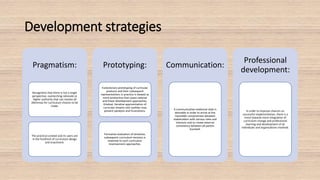
Development strategies
Pragmatism:
Recognition that there is not a single
perspective, overarching rationale or
higher authority that can resolve all
dilemmas for curriculum choices to be
made.
The practical context and its users are
in the forefront of curriculum design
and enactment.
Prototyping:
Evolutionary prototyping of curricular
products and their subsequent
representations in practice is viewed as
more productive than quasi-rational
and linear development approaches.
Gradual, iterative approximation of
curricular dreams into realities may
prevent paralysis and frustrations.
Formative evaluation of tentative,
subsequent curriculum versions is
essential to such curriculum
improvement approaches.
Communication:
A communicative-relational style is
desirable in order to arrive at the
inevitable compromises between
stakeholders with various roles and
interests and to create external
consistency between all parties
involved.
Professional
development:
In order to improve chances on
successful implementation, there is a
trend towards more integration of
curriculum change and professional
learning and development of all
individuals and organizations involved.
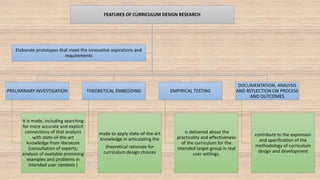
FEATURES OF CURRICULUM DESIGN RESEARCH
PRELIMINARY INVESTIGATION
It is made, including searching
for more accurate and explicit
connections of that analysis
with state-of-the-art
knowledge from literature
(consultation of experts;
analysis of available promising
examples and problems in
intended user contexts )
THEORETICAL EMBEDDING
made to apply state-of-the-art
knowledge in articulating the
theoretical rationale for
curriculum design choices
EMPIRICAL TESTING
is delivered about the
practicality and effectiveness
of the curriculum for the
intended target group in real
user settings.
DOCUMENTATION, ANALYSIS
AND REFLECTION ON PROCESS
AND OUTCOMES
contribute to the expansion
and specification of the
methodology of curriculum
design and development
Elaborate prototypes that meet the innovative aspirations and
requirements
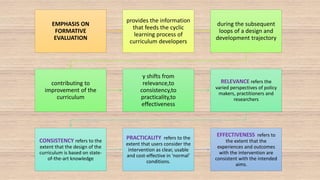
EMPHASIS ON
FORMATIVE
EVALUATION
provides the information
that feeds the cyclic
learning process of
curriculum developers
during the subsequent
loops of a design and
development trajectory
contributing to
improvement of the
curriculum
y shifts from
relevance,to
consistency,to
practicality,to
effectiveness
RELEVANCE refers the
varied perspectives of policy
makers, practitioners and
researchers
CONSISTENCY refers to the
extent that the design of the
curriculum is based on state-
of-the-art knowledge
PRACTICALITY refers to the
extent that users consider the
intervention as clear, usable
and cost-effective in ‘normal’
conditions.
EFFECTIVENESS refers to
the extent that the
experiences and outcomes
with the intervention are
consistent with the intended
aims.
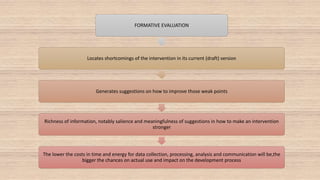
FORMATIVE EVALUATION
Locates shortcomings of the intervention in its current (draft) version
Generates suggestions on how to improve those weak points
Richness of information, notably salience and meaningfulness of suggestions in how to make an intervention
stronger
The lower the costs in time and energy for data collection, processing, analysis and communication will be,the
bigger the chances on actual use and impact on the development process
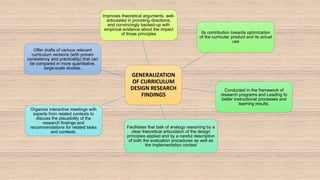
GENERALIZATION
OF CURRICULUM
DESIGN RESEARCH
FINDINGS
Improves theoretical arguments, well-
articulated in providing directions,
and convincingly backed-up with
empirical evidence about the impact
of those principles Its contribution towards optimization
of the curricular product and its actual
use
Conducted in the framework of
research programs and Leading to
better instructional processes and
learning results.
Facilitates that task of analogy reasoning by a
clear theoretical articulation of the design
principles applied and by a careful description
of both the evaluation procedures as well as
the implementation context
Organize interactive meetings with
experts from related contexts to
discuss the plausibility of the
research findings and
recommendations for related tasks
and contexts.
Offer drafts of various relevant
curriculum versions (with proven
consistency and practicality) that can
be compared in more quantitative,
large-scale studies.

Forum2.collaborative work

  • 1.
    UNIVERSIDAD DE LASFUERZAS ARMADAS ESPE “An Introduction to Educational Design Research” Curriculum Design Research TUTOR: Msc. Miguel Ponce Students: Almeida Aragon, Eliana Marcela (coordinator) Lopez Jaramillo, Daysi Carolina
  • 2.
    Introduction (Curriculum Design Research)intentionally combines two fields: ‘curriculum design’ and ‘design research’. It symbolizes the aim of this text to discuss the function and forms of design research from a curricular perspective
  • 3.
    Curriculum, what’s ina name? The Latin word ‘curriculum’ (related to the verb ‘currere’ i.e. running) refers to a ‘course’ or ‘track’ to be followed. The most obvious interpretation of the word curriculum is then to view it as a course, trajectory, or ‘plan for learning’
  • 4.
    International/comparative (or supra level) System/society/nation/state(or macro) level (e.g. national syllabi or core objectives) School/institution (or meso) level (e.g. school- specific curriculum) Classroom (or micro) level (e.g. textbooks, instructional materials) Individual/personal (or nano) level.
  • 5.
    • curricula canbe represented in various forms:
  • 6.
    Goodlad (1994) distinguishes thefollowing three different perspectives: Substantive Focusing on the classical curriculum question about what knowledge is of most worth for inclusion in teaching and learning; Socio-political Referring to curriculum decision-making processes, where values and interests of different individual and agencies are at stake Technical-professional Referring to how to address tasks of curriculum development
  • 7.
    The vulnerable curriculumspider web • One of the major challenges for curriculum improvement is creating balance and consistency between the various components of a curriculum
  • 8.
    • For eachof the components many sub-questions are possible. Not only on substantive issues (see the next section), but, for example, also on ‘organizational’ aspects as: Grouping: How are students allocated to various learning trajectories? Are students learning individually, in small groups, or whole- class? Location: Are students learning in class, in the library, at home, or elsewhere? What are the social/physical characteristics of the learning environment? Time: How much time is available for various subject matter domains? How much time can be spent on specific learning tasks?
  • 9.
    • The relevanceof these components varies across the previously mentioned curriculum levels (supra, macro, meso, micro, nano) and representations. A few examples may illustrate this. Curriculum documents at the macro-level will usually focus on the first three components (rationale, aims & objectives, content; often in rather broad terms), sometimes accompanied by an outline of time allocations for various subject matter domains. When one takes the operational curriculum in schools and classrooms in mind, all ten components have to be coherently addressed to expect successful implementation and continuation. The components of learning activities, teacher role, and materials & resources are at the core of the micro-curriculum in the classroom. The component of assessment deserves separate attention at all levels and representations since careful alignment between assessment and the rest of the curriculum appears to be critical for successful curriculum change. Examples
  • 10.
    visualization of theten components is to arrange them as a spider web • The spider web also illustrates a familiar expression: every chain is as strong as its weakest link. That seems another very appropriate metaphor for a curriculum, pointing to the complexity of efforts to improve the curriculum in a balanced, consistent and sustainable manner.
  • 11.
    Perspectives on substantivechoices • what is the academic and cultural heritage that seems essential for learning and future development?Knowledge: • which problems and issues seem relevant for inclusion from the perspective of societal trends and needs?Society: • which elements seem of vital importance for learning from the personal and educational needs and interests of the learners themselves? Learner:
  • 12.
    Development strategies Pragmatism: Recognition thatthere is not a single perspective, overarching rationale or higher authority that can resolve all dilemmas for curriculum choices to be made. The practical context and its users are in the forefront of curriculum design and enactment. Prototyping: Evolutionary prototyping of curricular products and their subsequent representations in practice is viewed as more productive than quasi-rational and linear development approaches. Gradual, iterative approximation of curricular dreams into realities may prevent paralysis and frustrations. Formative evaluation of tentative, subsequent curriculum versions is essential to such curriculum improvement approaches. Communication: A communicative-relational style is desirable in order to arrive at the inevitable compromises between stakeholders with various roles and interests and to create external consistency between all parties involved. Professional development: In order to improve chances on successful implementation, there is a trend towards more integration of curriculum change and professional learning and development of all individuals and organizations involved.
  • 14.
    FEATURES OF CURRICULUMDESIGN RESEARCH PRELIMINARY INVESTIGATION It is made, including searching for more accurate and explicit connections of that analysis with state-of-the-art knowledge from literature (consultation of experts; analysis of available promising examples and problems in intended user contexts ) THEORETICAL EMBEDDING made to apply state-of-the-art knowledge in articulating the theoretical rationale for curriculum design choices EMPIRICAL TESTING is delivered about the practicality and effectiveness of the curriculum for the intended target group in real user settings. DOCUMENTATION, ANALYSIS AND REFLECTION ON PROCESS AND OUTCOMES contribute to the expansion and specification of the methodology of curriculum design and development Elaborate prototypes that meet the innovative aspirations and requirements
  • 15.
    EMPHASIS ON FORMATIVE EVALUATION provides theinformation that feeds the cyclic learning process of curriculum developers during the subsequent loops of a design and development trajectory contributing to improvement of the curriculum y shifts from relevance,to consistency,to practicality,to effectiveness RELEVANCE refers the varied perspectives of policy makers, practitioners and researchers CONSISTENCY refers to the extent that the design of the curriculum is based on state- of-the-art knowledge PRACTICALITY refers to the extent that users consider the intervention as clear, usable and cost-effective in ‘normal’ conditions. EFFECTIVENESS refers to the extent that the experiences and outcomes with the intervention are consistent with the intended aims.
  • 16.
    FORMATIVE EVALUATION Locates shortcomingsof the intervention in its current (draft) version Generates suggestions on how to improve those weak points Richness of information, notably salience and meaningfulness of suggestions in how to make an intervention stronger The lower the costs in time and energy for data collection, processing, analysis and communication will be,the bigger the chances on actual use and impact on the development process
  • 17.
    GENERALIZATION OF CURRICULUM DESIGN RESEARCH FINDINGS Improvestheoretical arguments, well- articulated in providing directions, and convincingly backed-up with empirical evidence about the impact of those principles Its contribution towards optimization of the curricular product and its actual use Conducted in the framework of research programs and Leading to better instructional processes and learning results. Facilitates that task of analogy reasoning by a clear theoretical articulation of the design principles applied and by a careful description of both the evaluation procedures as well as the implementation context Organize interactive meetings with experts from related contexts to discuss the plausibility of the research findings and recommendations for related tasks and contexts. Offer drafts of various relevant curriculum versions (with proven consistency and practicality) that can be compared in more quantitative, large-scale studies.