NACT WORKSHOP
Take away points
Dr. K. K. Mukherjee
Dr. Rajib
Bhattacharjee
Dept. of Medical Oncology
Indication of NACT
 Locally Advanced Nasopharyngeal Carcinoma-
improves OS.
 Hypopharynx and Larynx- organ preservation.
Oral Cavity-mandibular preservation.
Rare tumors are not necessity Chemo resistant.
Surgeon’s Viewpoint
 Borderline operable tumors
 Downstage tumor for resection
 Downstage tumor for organ preservation
 Select Responders and Non Responders
How to choose eligible patients
 Patient Factors – Age, PS, Co-morbidities
 Lab works – CBC,KFT, LFT, Biochemistry & Serology
Cardiac Evaluation –ECG, ECHO and MUGA Scan
 Audiometry
 DPD Testing
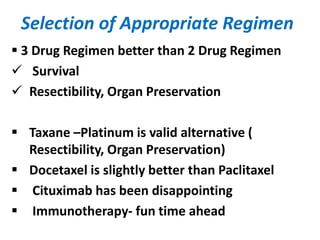
Selection of Appropriate Regimen
 3 Drug Regimen better than 2 Drug Regimen
 Survival
 Resectibility, Organ Preservation
 Taxane –Platinum is valid alternative (
Resectibility, Organ Preservation)
 Docetaxel is slightly better than Paclitaxel
 Cituximab has been disappointing
 Immunotherapy- fun time ahead
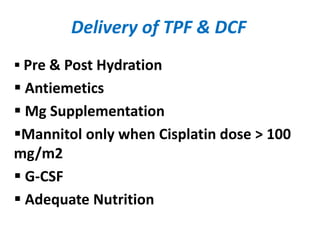
Delivery of TPF & DCF
 Pre & Post Hydration
 Antiemetics
 Mg Supplementation
Mannitol only when Cisplatin dose > 100
mg/m2
 G-CSF
 Adequate Nutrition
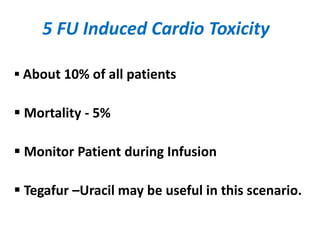
5 FU Induced Cardio Toxicity
 About 10% of all patients
 Mortality - 5%
 Monitor Patient during Infusion
 Tegafur –Uracil may be useful in this scenario.
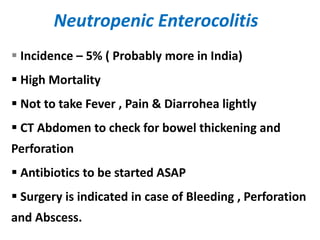
Neutropenic Enterocolitis
 Incidence – 5% ( Probably more in India)
 High Mortality
 Not to take Fever , Pain & Diarrohea lightly
 CT Abdomen to check for bowel thickening and
Perforation
 Antibiotics to be started ASAP
 Surgery is indicated in case of Bleeding , Perforation
and Abscess.
Reponse Assessment to NACT
Exact Measurements , Diagram, Photographs
 At regular interval- may modify plan of
treatment
 Radiological Response Assessment to be done
by a Radiologist experienced in Radio Oncology
 PET may help to detect responders
 Separate Response Assessment for
Immunotherapy
 Joint Clinic decision making.
Surgery after NACT
 Resection as per post NACT disease volume.
 Reduction in tumor volume predicts overall
survival
 Tumor regression is non-uniform and
heterogeneous
Micro vascular free flap reconstruction allows
more aggressive resection
Increased risk of flap failure post NACT
NACT leads to decreased PNI status
Radiation Post NACT
• Increased toxicity is an issue
• De-escalation of therapy possible in certain cases
• NACT may help in prevention of xerostomia
• Accelerated repopulation is an issue
• Concurrent Cisplatin post TPF lead to increased
toxicities (Cetuximab and Carboplatin are
alternatives)
“Don’t just add days to life but
life to those days”

Nact workshop

  • 1.
    NACT WORKSHOP Take awaypoints Dr. K. K. Mukherjee Dr. Rajib Bhattacharjee Dept. of Medical Oncology
  • 2.
    Indication of NACT Locally Advanced Nasopharyngeal Carcinoma- improves OS.  Hypopharynx and Larynx- organ preservation. Oral Cavity-mandibular preservation. Rare tumors are not necessity Chemo resistant.
  • 3.
    Surgeon’s Viewpoint  Borderlineoperable tumors  Downstage tumor for resection  Downstage tumor for organ preservation  Select Responders and Non Responders
  • 4.
    How to chooseeligible patients  Patient Factors – Age, PS, Co-morbidities  Lab works – CBC,KFT, LFT, Biochemistry & Serology Cardiac Evaluation –ECG, ECHO and MUGA Scan  Audiometry  DPD Testing
  • 5.
    Selection of AppropriateRegimen  3 Drug Regimen better than 2 Drug Regimen  Survival  Resectibility, Organ Preservation  Taxane –Platinum is valid alternative ( Resectibility, Organ Preservation)  Docetaxel is slightly better than Paclitaxel  Cituximab has been disappointing  Immunotherapy- fun time ahead
  • 6.
    Delivery of TPF& DCF  Pre & Post Hydration  Antiemetics  Mg Supplementation Mannitol only when Cisplatin dose > 100 mg/m2  G-CSF  Adequate Nutrition
  • 7.
    5 FU InducedCardio Toxicity  About 10% of all patients  Mortality - 5%  Monitor Patient during Infusion  Tegafur –Uracil may be useful in this scenario.
  • 8.
    Neutropenic Enterocolitis  Incidence– 5% ( Probably more in India)  High Mortality  Not to take Fever , Pain & Diarrohea lightly  CT Abdomen to check for bowel thickening and Perforation  Antibiotics to be started ASAP  Surgery is indicated in case of Bleeding , Perforation and Abscess.
  • 9.
    Reponse Assessment toNACT Exact Measurements , Diagram, Photographs  At regular interval- may modify plan of treatment  Radiological Response Assessment to be done by a Radiologist experienced in Radio Oncology  PET may help to detect responders  Separate Response Assessment for Immunotherapy  Joint Clinic decision making.
  • 10.
    Surgery after NACT Resection as per post NACT disease volume.  Reduction in tumor volume predicts overall survival  Tumor regression is non-uniform and heterogeneous Micro vascular free flap reconstruction allows more aggressive resection Increased risk of flap failure post NACT NACT leads to decreased PNI status
  • 11.
    Radiation Post NACT •Increased toxicity is an issue • De-escalation of therapy possible in certain cases • NACT may help in prevention of xerostomia • Accelerated repopulation is an issue • Concurrent Cisplatin post TPF lead to increased toxicities (Cetuximab and Carboplatin are alternatives)
  • 12.
    “Don’t just adddays to life but life to those days”