Brain Gain : Promoting Research and
Innovation
An effective Industry Academia Interface
model to bridge the gap
Team Detail : Shyam SundEr PRASAD, IITB
Prudhvi Tej Immadi, IITB
Rahul Prajapat, IITB
Sagar Sharma, IITB
DEEPAK MALANI, IITB
Two outcomes of good
education
Enabling to migrate to a
better attractive society
“Conveyance”
Following the first world
countries and delivering
their needs
Betterment in situ
elevation
Interpreting societal
needs and translating to
application
The dormant potential of 54% youth in the 130 crore
population
• ‘Drinking water Problem’ is not really a technical problem. Even though it is, it is a
research problem for ‘lower’ Indian Institutions to address.
Great deficit of courses
in societal modeling.
Inverted incentive
structure in socio-
economically important
engineering job market.
Separated R&D and
curricular teaching.
Research of relevance to
state and society of
developed world and not
ours.
Poor skillset in
undergraduate students.
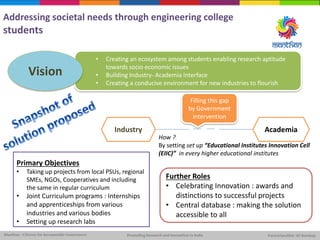
Addressing societal needs through engineering college
students
• Creating an ecosystem among students enabling research aptitude
towards socio economic issues
• Building Industry- Academia Interface
• Creating a conducive environment for new industries to flourish
Vision
Industry Academia
Filling this gap
by Government
intervention
How ?
By setting set up “Educational Institutes Innovation Cell
(EIIC)” in every higher educational institutes
Primary Objectives
• Taking up projects from local PSUs, regional
SMEs, NGOs, Cooperatives and including
the same in regular curriculum
• Joint Curriculum programs : Internships
and apprenticeships from various
industries and various bodies
• Setting up research labs
Further Roles
• Celebrating Innovation : awards and
distinctions to successful projects
• Central database : making the solution
accessible to all
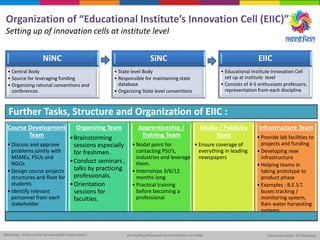
Organization of “Educational Institute’s Innovation Cell (EIIC)”
Setting up of innovation cells at institute level
NiNC
• Central Body
• Source for leveraging funding
• Organizing rational conventions and
conferences
SiNC
• State level Body
• Responsible for maintaining state
database
• Organizing State level conventions
EIIC
• Educational Institute Innovation Cell
set up at institute level
• Consists of 4-5 enthusiasts professors,
representation from each discipline
Further Tasks, Structure and Organization of EIIC :
Course Development
Team
• Discuss and approve
problems jointly with
MSMEs, PSUs and
NGOs
• Design course projects
structures and float for
students
• Identify relevant
personnel from each
stakeholder
Organizing Team
•Brainstorming
sessions especially
for freshmen.
•Conduct seminars ,
talks by practicing
professionals.
•Orientation
sessions for
faculties.
Apprenticeship /
Training Team
• Nodal point for
contacting PSU’s,
industries and leverage
them.
• Internships 3/6/12
months long
• Practical training
before becoming a
professional
Media / Publicity
Team
• Ensure coverage of
everything in leading
newspapers
Infrastructure Team
• Provide lab facilities to
projects and funding
• Developing new
infrastructure
• Helping teams in
taking prototype to
product phase
• Examples : B.E.S.T.
buses tracking /
monitoring system,
Rain water harvesting
systems
Working of EIIC
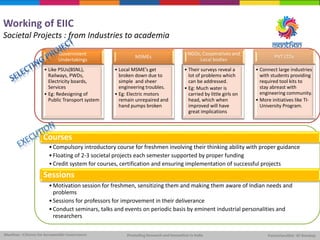
Societal Projects : from Industries to academia
Government
Undertakings
• Like PSUs(BSNL),
Railways, PWDs,
Electricity boards,
Services
• Eg: Redesigning of
Public Transport system
MSMEs
• Local MSME’s get
broken down due to
simple and sheer
engineering troubles.
• Eg: Electric motors
remain unrepaired and
hand pumps broken
NGOs, Cooperatives and
Local bodies
• Their surveys reveal a
lot of problems which
can be addressed.
• Eg: Much water is
carried by little girls on
head, which when
improved will have
great implications
PVT LTDs
• Connect large industries
with students providing
required tool kits to
stay abreast with
engineering community.
• More initiatives like TI-
University Program.
Courses
•Compulsory introductory course for freshmen involving their thinking ability with proper guidance
•Floating of 2-3 societal projects each semester supported by proper funding
•Credit system for courses, certification and ensuring implementation of successful projects
Sessions
•Motivation session for freshmen, sensitizing them and making them aware of Indian needs and
problems
•Sessions for professors for improvement in their deliverance
•Conduct seminars, talks and events on periodic basis by eminent industrial personalities and
researchers
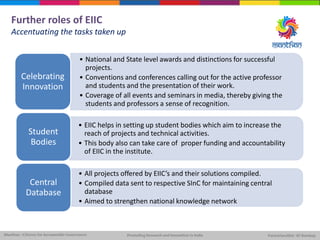
Further roles of EIIC
Accentuating the tasks taken up
• National and State level awards and distinctions for successful
projects.
• Conventions and conferences calling out for the active professor
and students and the presentation of their work.
• Coverage of all events and seminars in media, thereby giving the
students and professors a sense of recognition.
Celebrating
Innovation
• EIIC helps in setting up student bodies which aim to increase the
reach of projects and technical activities.
• This body also can take care of proper funding and accountability
of EIIC in the institute.
Student
Bodies
• All projects offered by EIIC’s and their solutions compiled.
• Compiled data sent to respective SInC for maintaining central
database
• Aimed to strengthen national knowledge network
Central
Database
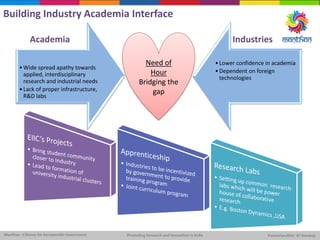
Building Industry Academia Interface
•Wide spread apathy towards
applied, interdisciplinary
research and industrial needs
•Lack of proper infrastructure,
R&D labs
•Lower confidence in academia
•Dependent on foreign
technologies
Academia Industries
Need of
Hour
Bridging the
gap
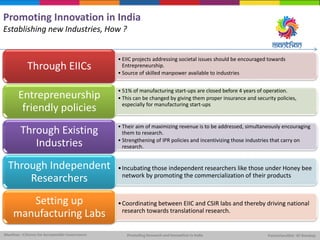
Promoting Innovation in India
Establishing new Industries, How ?
• EIIC projects addressing societal issues should be encouraged towards
Entrepreneurship.
• Source of skilled manpower available to industries
Through EIICs
• 51% of manufacturing start-ups are closed before 4 years of operation.
• This can be changed by giving them proper insurance and security policies,
especially for manufacturing start-ups
Entrepreneurship
friendly policies
• Their aim of maximizing revenue is to be addressed, simultaneously encouraging
them to research.
• Strengthening of IPR policies and incentivizing those industries that carry on
research.
Through Existing
Industries
•Incubating those independent researchers like those under Honey bee
network by promoting the commercialization of their products
Through Independent
Researchers
•Coordinating between EIIC and CSIR labs and thereby driving national
research towards translational research.
Setting up
manufacturing Labs
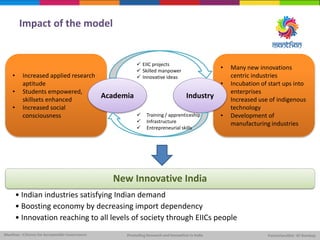
Impact of the model
New Innovative India
• Indian industries satisfying Indian demand
• Boosting economy by decreasing import dependency
• Innovation reaching to all levels of society through EIICs people
• Increased applied research
aptitude
• Students empowered,
skillsets enhanced
• Increased social
consciousness
• Many new innovations
centric industries
• Incubation of start ups into
enterprises
• Increased use of indigenous
technology
• Development of
manufacturing industries
Academia Industry
 EIIC projects
 Skilled manpower
 Innovative ideas
 Training / apprenticeship
 Infrastructure
 Entrepreneurial skills
Total
Funding
Required
Fixed Cost
EIIC
establish
ment cost
Research
labs
Technical
Equipmen
t's
Running
Cost
Equipment
AMC
Contingency Consumables
Funding from Government and corporate bodies
* Flexibility of funding depending on the impact of solution of the problem
• Existing government organizations like institute bodies, NInC, SInCs, National knowledge Commission (NKC) etc
• Government R&D labs (CSIR)
• Government undertakings like PSUs, Railways, PWDs etc.
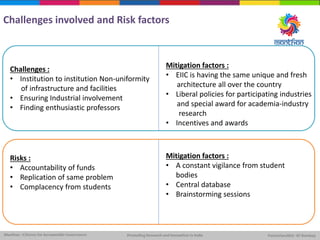
Challenges involved and Risk factors
Challenges :
• Institution to institution Non-uniformity
of infrastructure and facilities
• Ensuring Industrial involvement
• Finding enthusiastic professors
Risks :
• Accountability of funds
• Replication of same problem
• Complacency from students
Mitigation factors :
• EIIC is having the same unique and fresh
architecture all over the country
• Liberal policies for participating industries
and special award for academia-industry
research
• Incentives and awards
Mitigation factors :
• A constant vigilance from student
bodies
• Central database
• Brainstorming sessions
Appendix
References
• Science, Technology and Innovation Policy 2013, Government of India.
• Engineering R&D at the IITs and its impact on India, appeared in Current Science,
June 2012 – Milind Sohoni.
• Towards An Integrated Model for Academia-Industry Interface in India,Vinay K.
Nangia, Cashmira Pramanik, World Academy of Sciences.
• Innovation in India, National Knowledge Commission, 2007.
• Chapter-7 Innovation Cluster Initiative, Samir Mitra, Office of Advisor to Prime
Minister of India.
• Ministry of Statistics and Programme Implementation.-mospi.nic.in
• www.innovationcouncil.gov.in – National Innovation council

Parivartan2014

  • 1.
    Brain Gain :Promoting Research and Innovation An effective Industry Academia Interface model to bridge the gap Team Detail : Shyam SundEr PRASAD, IITB Prudhvi Tej Immadi, IITB Rahul Prajapat, IITB Sagar Sharma, IITB DEEPAK MALANI, IITB
  • 2.
    Two outcomes ofgood education Enabling to migrate to a better attractive society “Conveyance” Following the first world countries and delivering their needs Betterment in situ elevation Interpreting societal needs and translating to application The dormant potential of 54% youth in the 130 crore population • ‘Drinking water Problem’ is not really a technical problem. Even though it is, it is a research problem for ‘lower’ Indian Institutions to address. Great deficit of courses in societal modeling. Inverted incentive structure in socio- economically important engineering job market. Separated R&D and curricular teaching. Research of relevance to state and society of developed world and not ours. Poor skillset in undergraduate students.
  • 3.
    Addressing societal needsthrough engineering college students • Creating an ecosystem among students enabling research aptitude towards socio economic issues • Building Industry- Academia Interface • Creating a conducive environment for new industries to flourish Vision Industry Academia Filling this gap by Government intervention How ? By setting set up “Educational Institutes Innovation Cell (EIIC)” in every higher educational institutes Primary Objectives • Taking up projects from local PSUs, regional SMEs, NGOs, Cooperatives and including the same in regular curriculum • Joint Curriculum programs : Internships and apprenticeships from various industries and various bodies • Setting up research labs Further Roles • Celebrating Innovation : awards and distinctions to successful projects • Central database : making the solution accessible to all
  • 4.
    Organization of “EducationalInstitute’s Innovation Cell (EIIC)” Setting up of innovation cells at institute level NiNC • Central Body • Source for leveraging funding • Organizing rational conventions and conferences SiNC • State level Body • Responsible for maintaining state database • Organizing State level conventions EIIC • Educational Institute Innovation Cell set up at institute level • Consists of 4-5 enthusiasts professors, representation from each discipline Further Tasks, Structure and Organization of EIIC : Course Development Team • Discuss and approve problems jointly with MSMEs, PSUs and NGOs • Design course projects structures and float for students • Identify relevant personnel from each stakeholder Organizing Team •Brainstorming sessions especially for freshmen. •Conduct seminars , talks by practicing professionals. •Orientation sessions for faculties. Apprenticeship / Training Team • Nodal point for contacting PSU’s, industries and leverage them. • Internships 3/6/12 months long • Practical training before becoming a professional Media / Publicity Team • Ensure coverage of everything in leading newspapers Infrastructure Team • Provide lab facilities to projects and funding • Developing new infrastructure • Helping teams in taking prototype to product phase • Examples : B.E.S.T. buses tracking / monitoring system, Rain water harvesting systems
  • 5.
    Working of EIIC SocietalProjects : from Industries to academia Government Undertakings • Like PSUs(BSNL), Railways, PWDs, Electricity boards, Services • Eg: Redesigning of Public Transport system MSMEs • Local MSME’s get broken down due to simple and sheer engineering troubles. • Eg: Electric motors remain unrepaired and hand pumps broken NGOs, Cooperatives and Local bodies • Their surveys reveal a lot of problems which can be addressed. • Eg: Much water is carried by little girls on head, which when improved will have great implications PVT LTDs • Connect large industries with students providing required tool kits to stay abreast with engineering community. • More initiatives like TI- University Program. Courses •Compulsory introductory course for freshmen involving their thinking ability with proper guidance •Floating of 2-3 societal projects each semester supported by proper funding •Credit system for courses, certification and ensuring implementation of successful projects Sessions •Motivation session for freshmen, sensitizing them and making them aware of Indian needs and problems •Sessions for professors for improvement in their deliverance •Conduct seminars, talks and events on periodic basis by eminent industrial personalities and researchers
  • 6.
    Further roles ofEIIC Accentuating the tasks taken up • National and State level awards and distinctions for successful projects. • Conventions and conferences calling out for the active professor and students and the presentation of their work. • Coverage of all events and seminars in media, thereby giving the students and professors a sense of recognition. Celebrating Innovation • EIIC helps in setting up student bodies which aim to increase the reach of projects and technical activities. • This body also can take care of proper funding and accountability of EIIC in the institute. Student Bodies • All projects offered by EIIC’s and their solutions compiled. • Compiled data sent to respective SInC for maintaining central database • Aimed to strengthen national knowledge network Central Database
  • 7.
    Building Industry AcademiaInterface •Wide spread apathy towards applied, interdisciplinary research and industrial needs •Lack of proper infrastructure, R&D labs •Lower confidence in academia •Dependent on foreign technologies Academia Industries Need of Hour Bridging the gap
  • 8.
    Promoting Innovation inIndia Establishing new Industries, How ? • EIIC projects addressing societal issues should be encouraged towards Entrepreneurship. • Source of skilled manpower available to industries Through EIICs • 51% of manufacturing start-ups are closed before 4 years of operation. • This can be changed by giving them proper insurance and security policies, especially for manufacturing start-ups Entrepreneurship friendly policies • Their aim of maximizing revenue is to be addressed, simultaneously encouraging them to research. • Strengthening of IPR policies and incentivizing those industries that carry on research. Through Existing Industries •Incubating those independent researchers like those under Honey bee network by promoting the commercialization of their products Through Independent Researchers •Coordinating between EIIC and CSIR labs and thereby driving national research towards translational research. Setting up manufacturing Labs
  • 9.
    Impact of themodel New Innovative India • Indian industries satisfying Indian demand • Boosting economy by decreasing import dependency • Innovation reaching to all levels of society through EIICs people • Increased applied research aptitude • Students empowered, skillsets enhanced • Increased social consciousness • Many new innovations centric industries • Incubation of start ups into enterprises • Increased use of indigenous technology • Development of manufacturing industries Academia Industry  EIIC projects  Skilled manpower  Innovative ideas  Training / apprenticeship  Infrastructure  Entrepreneurial skills
  • 10.
    Total Funding Required Fixed Cost EIIC establish ment cost Research labs Technical Equipmen t's Running Cost Equipment AMC ContingencyConsumables Funding from Government and corporate bodies * Flexibility of funding depending on the impact of solution of the problem • Existing government organizations like institute bodies, NInC, SInCs, National knowledge Commission (NKC) etc • Government R&D labs (CSIR) • Government undertakings like PSUs, Railways, PWDs etc.
  • 11.
    Challenges involved andRisk factors Challenges : • Institution to institution Non-uniformity of infrastructure and facilities • Ensuring Industrial involvement • Finding enthusiastic professors Risks : • Accountability of funds • Replication of same problem • Complacency from students Mitigation factors : • EIIC is having the same unique and fresh architecture all over the country • Liberal policies for participating industries and special award for academia-industry research • Incentives and awards Mitigation factors : • A constant vigilance from student bodies • Central database • Brainstorming sessions
  • 12.
    Appendix References • Science, Technologyand Innovation Policy 2013, Government of India. • Engineering R&D at the IITs and its impact on India, appeared in Current Science, June 2012 – Milind Sohoni. • Towards An Integrated Model for Academia-Industry Interface in India,Vinay K. Nangia, Cashmira Pramanik, World Academy of Sciences. • Innovation in India, National Knowledge Commission, 2007. • Chapter-7 Innovation Cluster Initiative, Samir Mitra, Office of Advisor to Prime Minister of India. • Ministry of Statistics and Programme Implementation.-mospi.nic.in • www.innovationcouncil.gov.in – National Innovation council