BRAIN GAIN : Promoting Research and Innovation
Presnted By :
Jimmy Shah
Ushir Shah
Jay Vakotar
Darshil Makwana
Nihar Brahmbhatt
 What is Research and Innovation?
• Research and experimental development (R&D) comprise creative work undertaken on a systematic basis in order
to increase the stock of knowledge, including knowledge of man, culture and society, and the use of this stock of
knowledge to devise new applications.
• Innovation is the application of new solutions that meet new requirements, inarticulate needs, or existing market
needs. This is accomplished through more effective products, processes, services, technologies, or ideas that are
readily available to markets, governments and society.
 Where India stands in Research and Innovation?
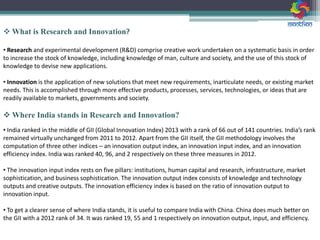
• India ranked in the middle of GII (Global Innovation Index) 2013 with a rank of 66 out of 141 countries. India’s rank
remained virtually unchanged from 2011 to 2012. Apart from the GII itself, the GII methodology involves the
computation of three other indices – an innovation output index, an innovation input index, and an innovation
efficiency index. India was ranked 40, 96, and 2 respectively on these three measures in 2012.
• The innovation input index rests on five pillars: institutions, human capital and research, infrastructure, market
sophistication, and business sophistication. The innovation output index consists of knowledge and technology
outputs and creative outputs. The innovation efficiency index is based on the ratio of innovation output to
innovation input.
• To get a clearer sense of where India stands, it is useful to compare India with China. China does much better on
the GII with a 2012 rank of 34. It was ranked 19, 55 and 1 respectively on innovation output, input, and efficiency.
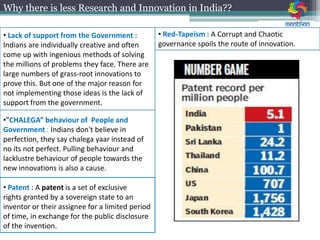
• Lack of support from the Government :
Indians are individually creative and often
come up with ingenious methods of solving
the millions of problems they face. There are
large numbers of grass-root innovations to
prove this. But one of the major reason for
not implementing those ideas is the lack of
support from the government.
•“CHALEGA” behaviour of People and
Government : Indians don't believe in
perfection, they say chalega yaar instead of
no its not perfect. Pulling behaviour and
lacklustre behaviour of people towards the
new innovations is also a cause.
• Red-Tapeism : A Corrupt and Chaotic
governance spoils the route of innovation.
• Patent : A patent is a set of exclusive
rights granted by a sovereign state to an
inventor or their assignee for a limited period
of time, in exchange for the public disclosure
of the invention.
Why there is less Research and Innovation in India??
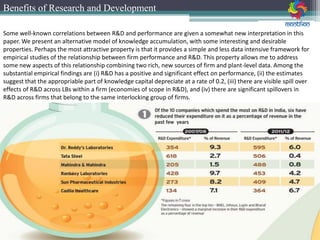
Some well-known correlations between R&D and performance are given a somewhat new interpretation in this
paper. We present an alternative model of knowledge accumulation, with some interesting and desirable
properties. Perhaps the most attractive property is that it provides a simple and less data intensive framework for
empirical studies of the relationship between firm performance and R&D. This property allows me to address
some new aspects of this relationship combining two rich, new sources of firm and plant-level data. Among the
substantial empirical findings are (i) R&D has a positive and significant effect on performance, (ii) the estimates
suggest that the appropriable part of knowledge capital depreciate at a rate of 0.2, (iii) there are visible spill over
effects of R&D across LBs within a firm (economies of scope in R&D), and (iv) there are significant spillovers in
R&D across firms that belong to the same interlocking group of firms.
Benefits of Research and Development
Government can:
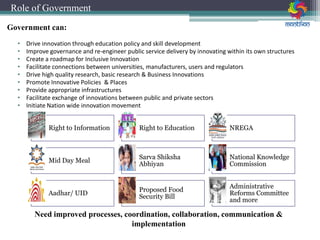
• Drive innovation through education policy and skill development
• Improve governance and re-engineer public service delivery by innovating within its own structures
• Create a roadmap for Inclusive Innovation
• Facilitate connections between universities, manufacturers, users and regulators
• Drive high quality research, basic research & Business Innovations
• Promote Innovative Policies & Places
• Provide appropriate infrastructures
• Facilitate exchange of innovations between public and private sectors
• Initiate Nation wide innovation movement
Right to Information Right to Education NREGA
Mid Day Meal
Sarva Shiksha
Abhiyan
National Knowledge
Commission
Aadhar/ UID
Proposed Food
Security Bill
Administrative
Reforms Committee
and more
Need improved processes, coordination, collaboration, communication &
implementation
Role of Government
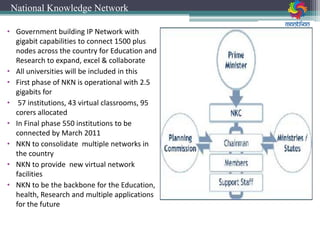
• Government building IP Network with
gigabit capabilities to connect 1500 plus
nodes across the country for Education and
Research to expand, excel & collaborate
• All universities will be included in this
• First phase of NKN is operational with 2.5
gigabits for
• 57 institutions, 43 virtual classrooms, 95
corers allocated
• In Final phase 550 institutions to be
connected by March 2011
• NKN to consolidate multiple networks in
the country
• NKN to provide new virtual network
facilities
• NKN to be the backbone for the Education,
health, Research and multiple applications
for the future
National Knowledge Network
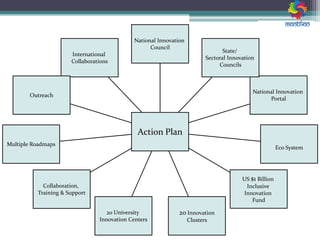
International
Collaborations
Outreach
Multiple Roadmaps
Collaboration,
Training & Support
20 University
Innovation Centers
20 Innovation
Clusters
US $1 Billion
Inclusive
Innovation
Fund
Eco System
National Innovation
Portal
State/
Sectoral Innovation
Councils
National Innovation
Council
Action Plan
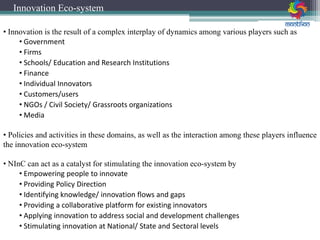
• Innovation is the result of a complex interplay of dynamics among various players such as
• Government
• Firms
• Schools/ Education and Research Institutions
• Finance
• Individual Innovators
• Customers/users
• NGOs / Civil Society/ Grassroots organizations
• Media
• Policies and activities in these domains, as well as the interaction among these players influence
the innovation eco-system
• NInC can act as a catalyst for stimulating the innovation eco-system by
• Empowering people to innovate
• Providing Policy Direction
• Identifying knowledge/ innovation flows and gaps
• Providing a collaborative platform for existing innovators
• Applying innovation to address social and development challenges
• Stimulating innovation at National/ State and Sectoral levels
Innovation Eco-system
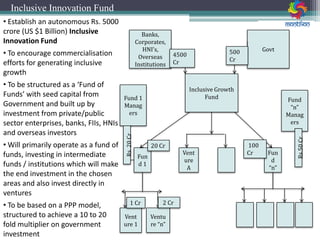
• Establish an autonomous Rs. 5000
crore (US $1 Billion) Inclusive
Innovation Fund
• To encourage commercialisation
efforts for generating inclusive
growth
• To be structured as a ‘Fund of
Funds’ with seed capital from
Government and built up by
investment from private/public
sector enterprises, banks, FIIs, HNIs
and overseas investors
• Will primarily operate as a fund of
funds, investing in intermediate
funds / institutions which will make
the end investment in the chosen
areas and also invest directly in
ventures
• To be based on a PPP model,
structured to achieve a 10 to 20
fold multiplier on government
investment
Inclusive Growth
Fund
Banks,
Corporates,
HNI’s,
Overseas
Institutions
Govt
4500
Cr
500
Cr
Fun
d 1
Ventu
re “n”
Vent
ure 1
Vent
ure
A
Fun
d
“n”
Fund
“n”
Manag
ers
Fund 1
Manag
ers
Rs.20Cr
Rs.50Cr
1 Cr 2 Cr
20 Cr 100
Cr
Inclusive Innovation Fund
• Biotech
• Nanotech
• Genetics
• Robotics and AI
• GIS
• Sensors
• Materials
• Space
• Ocean
• Construction
• Textiles
• Automobile
• Gems and Jewellery
• Chemicals
• Agro Foods
• Natural resources
• Waste Management
• Sanitation
• Urbanisation
• Disaster Management
• Pharmaceuticals
• Tourism & Hospitality
• Environment
• Agriculture
• Transport
• ICT
• Science and Technology
• Manufacturing
• Rural Development
• Transport (Aviation,
Railways, Water, Road)
• Defence
• Quality Testing,
Certification and Assurance
• Patents and
Commercialisation of
innovations
• Exports
• Traditional Knowledge
• North East
• Education
• Health
• Energy
• Water
• Food
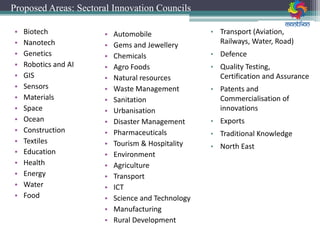
Proposed Areas: Sectoral Innovation Councils
• In 2003, the world’s largest companies spent $70.6 billion in R&D outside their home
countries, up from $33.9 billion in 1995
• Around 2.5 million students were studying outside their home country in 2004, up from 1.75
million in 1999
• Global Exchanges develop “Absorptive capacities” which help places channel global flows
into their local economies and become even more connected to the global economy in
return
• New hotspots of innovation being created beyond the US and Europe: Sao Paolo in Brazil,
Shanghai in China and Bangalore in India
• Global research and faculty linkages: UK-India Science and Innovation Council; UK-India
Education and Research Initiative (UKIERI), US-India Business Council, proposed US-India
Education Council
• Global Research and Innovation Forum for coordination
• Global Grassroots Innovation Platforms
• Eco-system for innovation created through government policies, private initiative & start up
culture
• Government push for developing the domestic venture capital industry through schemes
such as Yozma
• High level of investment in R&D
• Room for failure
Global Lessons
Websites
• Official website: www.iii.gov.in
• National Innovation Council: www.innovationcouncil.gov.in
• National Knowledge Commission: www.knowledgecommission.gov.in
• National Knowledge Network: http://www.nkn.in/
Portals
• National Innovation Portal: www.innovation.gov.in
• India Biodiversity Portal: www.indiabiodiversity.org
• Teachers of India: www.teachersofindia.org
Social Media:
• Facebook: http://www.facebook.com/pages/New-Delhi-India/Adviser-to-
the-PM-on-Public-Information-Infrastructure-and-
Innovations/100738043327407?v=wall
• Youtube: http://www.youtube.com/iii

BrainGainer

  • 1.
    BRAIN GAIN :Promoting Research and Innovation Presnted By : Jimmy Shah Ushir Shah Jay Vakotar Darshil Makwana Nihar Brahmbhatt
  • 2.
     What isResearch and Innovation? • Research and experimental development (R&D) comprise creative work undertaken on a systematic basis in order to increase the stock of knowledge, including knowledge of man, culture and society, and the use of this stock of knowledge to devise new applications. • Innovation is the application of new solutions that meet new requirements, inarticulate needs, or existing market needs. This is accomplished through more effective products, processes, services, technologies, or ideas that are readily available to markets, governments and society.  Where India stands in Research and Innovation? • India ranked in the middle of GII (Global Innovation Index) 2013 with a rank of 66 out of 141 countries. India’s rank remained virtually unchanged from 2011 to 2012. Apart from the GII itself, the GII methodology involves the computation of three other indices – an innovation output index, an innovation input index, and an innovation efficiency index. India was ranked 40, 96, and 2 respectively on these three measures in 2012. • The innovation input index rests on five pillars: institutions, human capital and research, infrastructure, market sophistication, and business sophistication. The innovation output index consists of knowledge and technology outputs and creative outputs. The innovation efficiency index is based on the ratio of innovation output to innovation input. • To get a clearer sense of where India stands, it is useful to compare India with China. China does much better on the GII with a 2012 rank of 34. It was ranked 19, 55 and 1 respectively on innovation output, input, and efficiency.
  • 3.
    • Lack ofsupport from the Government : Indians are individually creative and often come up with ingenious methods of solving the millions of problems they face. There are large numbers of grass-root innovations to prove this. But one of the major reason for not implementing those ideas is the lack of support from the government. •“CHALEGA” behaviour of People and Government : Indians don't believe in perfection, they say chalega yaar instead of no its not perfect. Pulling behaviour and lacklustre behaviour of people towards the new innovations is also a cause. • Red-Tapeism : A Corrupt and Chaotic governance spoils the route of innovation. • Patent : A patent is a set of exclusive rights granted by a sovereign state to an inventor or their assignee for a limited period of time, in exchange for the public disclosure of the invention. Why there is less Research and Innovation in India??
  • 4.
    Some well-known correlationsbetween R&D and performance are given a somewhat new interpretation in this paper. We present an alternative model of knowledge accumulation, with some interesting and desirable properties. Perhaps the most attractive property is that it provides a simple and less data intensive framework for empirical studies of the relationship between firm performance and R&D. This property allows me to address some new aspects of this relationship combining two rich, new sources of firm and plant-level data. Among the substantial empirical findings are (i) R&D has a positive and significant effect on performance, (ii) the estimates suggest that the appropriable part of knowledge capital depreciate at a rate of 0.2, (iii) there are visible spill over effects of R&D across LBs within a firm (economies of scope in R&D), and (iv) there are significant spillovers in R&D across firms that belong to the same interlocking group of firms. Benefits of Research and Development
  • 5.
    Government can: • Driveinnovation through education policy and skill development • Improve governance and re-engineer public service delivery by innovating within its own structures • Create a roadmap for Inclusive Innovation • Facilitate connections between universities, manufacturers, users and regulators • Drive high quality research, basic research & Business Innovations • Promote Innovative Policies & Places • Provide appropriate infrastructures • Facilitate exchange of innovations between public and private sectors • Initiate Nation wide innovation movement Right to Information Right to Education NREGA Mid Day Meal Sarva Shiksha Abhiyan National Knowledge Commission Aadhar/ UID Proposed Food Security Bill Administrative Reforms Committee and more Need improved processes, coordination, collaboration, communication & implementation Role of Government
  • 6.
    • Government buildingIP Network with gigabit capabilities to connect 1500 plus nodes across the country for Education and Research to expand, excel & collaborate • All universities will be included in this • First phase of NKN is operational with 2.5 gigabits for • 57 institutions, 43 virtual classrooms, 95 corers allocated • In Final phase 550 institutions to be connected by March 2011 • NKN to consolidate multiple networks in the country • NKN to provide new virtual network facilities • NKN to be the backbone for the Education, health, Research and multiple applications for the future National Knowledge Network
  • 7.
    International Collaborations Outreach Multiple Roadmaps Collaboration, Training &Support 20 University Innovation Centers 20 Innovation Clusters US $1 Billion Inclusive Innovation Fund Eco System National Innovation Portal State/ Sectoral Innovation Councils National Innovation Council Action Plan
  • 8.
    • Innovation isthe result of a complex interplay of dynamics among various players such as • Government • Firms • Schools/ Education and Research Institutions • Finance • Individual Innovators • Customers/users • NGOs / Civil Society/ Grassroots organizations • Media • Policies and activities in these domains, as well as the interaction among these players influence the innovation eco-system • NInC can act as a catalyst for stimulating the innovation eco-system by • Empowering people to innovate • Providing Policy Direction • Identifying knowledge/ innovation flows and gaps • Providing a collaborative platform for existing innovators • Applying innovation to address social and development challenges • Stimulating innovation at National/ State and Sectoral levels Innovation Eco-system
  • 9.
    • Establish anautonomous Rs. 5000 crore (US $1 Billion) Inclusive Innovation Fund • To encourage commercialisation efforts for generating inclusive growth • To be structured as a ‘Fund of Funds’ with seed capital from Government and built up by investment from private/public sector enterprises, banks, FIIs, HNIs and overseas investors • Will primarily operate as a fund of funds, investing in intermediate funds / institutions which will make the end investment in the chosen areas and also invest directly in ventures • To be based on a PPP model, structured to achieve a 10 to 20 fold multiplier on government investment Inclusive Growth Fund Banks, Corporates, HNI’s, Overseas Institutions Govt 4500 Cr 500 Cr Fun d 1 Ventu re “n” Vent ure 1 Vent ure A Fun d “n” Fund “n” Manag ers Fund 1 Manag ers Rs.20Cr Rs.50Cr 1 Cr 2 Cr 20 Cr 100 Cr Inclusive Innovation Fund
  • 10.
    • Biotech • Nanotech •Genetics • Robotics and AI • GIS • Sensors • Materials • Space • Ocean • Construction • Textiles • Automobile • Gems and Jewellery • Chemicals • Agro Foods • Natural resources • Waste Management • Sanitation • Urbanisation • Disaster Management • Pharmaceuticals • Tourism & Hospitality • Environment • Agriculture • Transport • ICT • Science and Technology • Manufacturing • Rural Development • Transport (Aviation, Railways, Water, Road) • Defence • Quality Testing, Certification and Assurance • Patents and Commercialisation of innovations • Exports • Traditional Knowledge • North East • Education • Health • Energy • Water • Food Proposed Areas: Sectoral Innovation Councils
  • 11.
    • In 2003,the world’s largest companies spent $70.6 billion in R&D outside their home countries, up from $33.9 billion in 1995 • Around 2.5 million students were studying outside their home country in 2004, up from 1.75 million in 1999 • Global Exchanges develop “Absorptive capacities” which help places channel global flows into their local economies and become even more connected to the global economy in return • New hotspots of innovation being created beyond the US and Europe: Sao Paolo in Brazil, Shanghai in China and Bangalore in India • Global research and faculty linkages: UK-India Science and Innovation Council; UK-India Education and Research Initiative (UKIERI), US-India Business Council, proposed US-India Education Council • Global Research and Innovation Forum for coordination • Global Grassroots Innovation Platforms • Eco-system for innovation created through government policies, private initiative & start up culture • Government push for developing the domestic venture capital industry through schemes such as Yozma • High level of investment in R&D • Room for failure Global Lessons
  • 12.
    Websites • Official website:www.iii.gov.in • National Innovation Council: www.innovationcouncil.gov.in • National Knowledge Commission: www.knowledgecommission.gov.in • National Knowledge Network: http://www.nkn.in/ Portals • National Innovation Portal: www.innovation.gov.in • India Biodiversity Portal: www.indiabiodiversity.org • Teachers of India: www.teachersofindia.org Social Media: • Facebook: http://www.facebook.com/pages/New-Delhi-India/Adviser-to- the-PM-on-Public-Information-Infrastructure-and- Innovations/100738043327407?v=wall • Youtube: http://www.youtube.com/iii