G. Arun Kumar et al. Int. Journal of Engineering Research and Applications www.ijera.com
ISSN : 2248-9622, Vol. 5, Issue 4, ( Part -4) April 2015, pp.65-70
www.ijera.com 65 | P a g e
Physico-Chemical Analysis of Selected Groundwater Samples of
Inkollu Mandal, Prakasam District, Andhra Pradesh, India
G. Arun Kumar1
, P. Sankara Pitchaiah2
, G. Sudhakar3
, Swarnalatha. G4
1
Research Scholar, Dept. of Geology, Acharya Nagarjuna University, Guntur, Andhra Pradesh, India.
2
Professor, Dept. of Geology, Acharya Nagarjuna University, Guntur, Andhra Pradesh, India.
3 &4
Research Scholar, Dept. of Environmental Sciences, Acharya Nagarjuna University, Guntur, Andhra
Pradesh, India.
ABSTRACT
Physico-chemical parameters of groundwater quality based on Physic-chemical parameters at Inkollu mandal,
Prakasam district, Andhra Pradesh, India have been taken up to evaluate its suitability for Drinking purpose.
Nine ground water samples were collected from different places of Inkollu mandal of Prakasam district. The
quality analysis has been made through the pH, EC, TDS, Total Hardness, Sodium, Potassium, Calcium,
Magnesium, Chloride, Sulphate, Nitrate, Fluoride and Iron. By observing the results, it was shown that the
parameters from the water samples were compared with WHO (World Health Organization) and BIS
(Bureau of Indian Standards), USPH (United state Public health ) for ground water .The results revealed
that some parameters were in high concentration and quality of the potable water has deteriorated to a
large extent at some sampling locations.
Key words: Drinking, Groundwater, Physicochemical, Water Quality.
I. INTRODUCTION
Water is indispensable to all life on earth. The
modern civilization, industrialization, urbanization
and increase in population have lead to fast
degradation of our ground water quality, the
problems of groundwater quality is much more acute
in areas which are densely populated, with
localization of industries. Water for human
consumption must be free from organisms and
chemical substances in concentration large enough to
affect health (APHA, 1995; WSC, 2007; Brian 2007),
he addition of various kinds of pollutants through
sewage, industrial effluents, agricultural runoff etc.
into the water main stream brings about a series of
changes in the physicochemical characteristics of the
water, which have been the subject of several
investigations (Ayodele and Abubakar, 1998,
WHO/UNEP, 2011,).
II. Materials and Methods
II.i. Study area
Geographical location of study area is shown in
the figure 1.the location of Inkollu mandal, Prakasam
District, Andhra Pradesh, India, in between 800
.07’
50” East longitude and 150
.55’ 56” North latitude.
Inkollu is under lined by the varied geological
formation ranging in the age from the achean to the
recent, Gondawana Supergroup, the Rock Types
Budawada sandstone, Vemavaram shales, Pavuluru
sandstone in the study area.
III. ii Sample collection and methods
The samples are collected from the different
villages such as Gollapalem-S1, Inkollu-S2,
Idupulapadu-S3, Nagandla-S4, Nakkalapalem-S5,
Pavuluru-S6, Gangavaran-S7, Koniki-S8,
Bimavaram-S9 are selected for collection of
groundwater samples. The groundwater samples were
collected carefully in new 500ml Plastic bottles. The
sample bottles are washed with 10% HNO3 and 1:1
HCl for 48 h. The Plastic bottles were labeled and
immediately few drops of HNO3 was added in order
to prevent loss of metals, bacterial and fungal growth.
Some samples which were turbid or containing
suspended matter were filtered at the time of
collection (Sudhakar et al, 2014 a. APHA, 1998),
RESEARCH ARTICLE OPEN ACCESS
G. Arun Kumar et al. Int. Journal of Engineering Research and Applications www.ijera.com
ISSN : 2248-9622, Vol. 5, Issue 4, ( Part -4) April 2015, pp.65-70
www.ijera.com 66 | P a g e
Fig 1: Study area map
II.iii. Physicochemical Analysis.
The ground water samples were analyzed in the
laboratory according to the physico-chemical per
American Public Health Association (APHA, 1998)
standard methods. The quality analysis has been
made through the pH, EC, TDS, Total Hardness,
Sodium, Potassium, Calcium, Magnesium, Chloride,
Sulphate, Nitrate, Fluoride and Iron. By observing
the results, it was shown that the parameters from the
water samples were compared with WHO (World
Health Organization) and BIS (Bureau of Indian
Standards), USPH (United state Public health ) for
ground water.
IV. RESULTS AND DISCURSION
The various physico-chemical characteristics
were analyzed for ground water from ten different
sampling locations. The details of the parameter
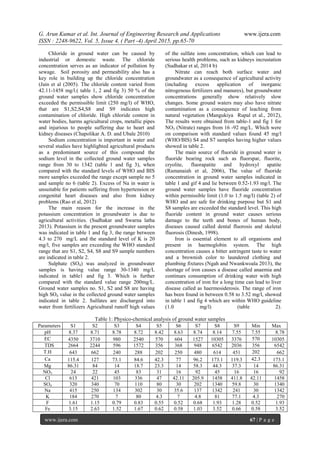
results were summarized in table 1.
Studies regarding to ground water quality
analysis has been made by many authors like
M.R. Rajan and I. Paneerselvam (2005), S.B.
Thakare et. al. 2005, Shikha Bisht et. al. (2007)
Most of the biological and chemical reactions are
influenced by the pH of water system. In the present
study all the ground water samples have pH values of
water samples ranges in between 7.55-8.78 (table 1 &
Fig 1) against the standard of (6.5-8.5)
WHO/BIS/USPH. Five samples such as S2, S3, S4,
S6 and S7 are exceeding the permissible limit
remaining four samples are in permissible
limit.(Table 2) If pH is beyond the permissible
limit, it damages the mucous membrane of cells
(Koul Nishtha et al 2012)
Electrical conductivity of water is a direct
function of its total dissolved salts (Pradeep, 1998)
and it is the measure of the ability of water to conduct
electrical current. It may depend on the concentration
of ions, ionic mobility, valence of ions and
temperature. The Electrical conductivity was ranging
from 570 to10305 µm/cm all samples the E.C. was
out of maximum permissible limit when compared
with the standards. The results are indicated in Table
1 and the standard and exceeded sample numbers are
showed in table 2, and the graphical representation in
fig 2.
The solids can be iron, manganese, magnesium,
potassium, sodium, calcium, carbonates,
bicarbonates, chlorides, phosphates and other
minerals. In the present groundwater samples the
TDS minimum and maximum values were observed
from 356 to 6542 mg/l, showed in the Table 1and fig
2. The most desirable limit of TDS is 500 mg/l
except S5 and S6 samples are in permissible limit
remaining all exceeded the standard value indicated
in table 2. The high values of TDS causes
gastrointestinal irritation to the human beings but
long time use of water with high TDS can cause
kidney stones and heart diseases (Jain et al 2003).
Hardness of water is an aesthetic quality of water
and is caused by carbonates, bicarbonates, sulphates
and chlorides of calcium and magnesium. It prevents
the lather formation with soap and increases the
boiling point of water. Das N.C, (2013), the
maximum permissible limit of total hardness for
drinking purpose is 300 mg/l (BIS). Table 1and fig 3
showed the hardness range from 202 to 662 mg/l and
classified as The water having hardness up to 75 mg/l
is classified as soft, 76 - 150 mg/l is moderately soft,
soft, 151-300 mg/l as hard and more than 300
mg/l as very hard. Hardness more than 300 mg/l
may cause heart and kidney problems (BIS 1991,
Bhattacharya et al 2012), the five samples such as S1,
S2, S7, S8, and S9 are exceeding the standards
indicated in table 2.
Table 2 showed the permissible limit of calcium
is 75 mg/l according to WHO the maximum range is
200 mg/l. The concentration of calcium in the area
varied from 42.3 to 173.1 mg/l. indicated in table 1
and fig 1. Calcium plays an important role for proper
bone growth (Dilip, 2001),
G. Arun Kumar et al. Int. Journal of Engineering Research and Applications www.ijera.com
ISSN : 2248-9622, Vol. 5, Issue 4, ( Part -4) April 2015, pp.65-70
www.ijera.com 67 | P a g e
Chloride in ground water can be caused by
industrial or domestic waste. The chloride
concentration serves as an indicator of pollution by
sewage. Soil porosity and permeability also has a
key role in building up the chloride concentration
(Jain et al (2005). The chloride content varied from
42.11-1458 mg/l.( table 1, 2 and fig 3) 50 % of the
ground water samples show chloride concentration
exceeded the permissible limit (250 mg/l) of WHO,
that are S1,S2,S4,S8 and S9 indicates high
contamination of chloride. High chloride content in
water bodies, harms agricultural crops, metallic pipes
and injurious to people suffering due to heart and
kidney diseases (Chapolikar A. D. and Ubale 2010)
Sodium concentration is important in water and
several studies have highlighted agricultural products
as a predominant source of this compound the
sodium level in the collected ground water samples
range from 30 to 1342 (table 1 and fig 3), when
compared with the standard levels of WHO and BIS
more samples exceeded the range except sample no 5
and sample no 6 (table 2). Excess of Na in water is
unsuitable for patients suffering from hypertension or
congenital heart diseases and also from kidney
problems (Rao et al, 2012)
The main reason for the increase in the
potassium concentration in groundwater is due to
agricultural activities. (Sudhakar and Swarna latha
2013). Potassium in the present groundwater samples
was indicated in table 1 and fig 3, the range between
4.3 to 270 mg/L and the standard level of K is 20
mg/l, five samples are exceeding the WHO standard
range that are S1, S2, S4, S8 and S9 sample numbers
are indicated in table 2.
Sulphate (SO4) was analyzed in groundwater
samples is having value range 30-1340 mg/L
indicated in table1 and fig 3. Which is further
compared with the standard value range 200mg/L.
Ground water samples no. S1, S2 and S8 are having
high SO4 value in the collected ground water samples
indicated in table 2. Sulfates are discharged into
water from fertilizers Agricultural runoff high values
of the sulfate ions concentration, which can lead to
serious health problems, such as kidneys incrustation
(Sudhakar et al, 2014 b)
Nitrate can reach both surface water and
groundwater as a consequence of agricultural activity
(including excess application of inorganic
nitrogenous fertilizers and manures), but groundwater
concentrations generally show relatively slow
changes. Some ground waters may also have nitrate
contamination as a consequence of leaching from
natural vegetation (Mangukiya Rupal et al., 2012),
The results were obtained from table-1 and fig 1 for
NO3 (Nitrate) ranges from 16 -92 mg/L. Which were
on comparison with standard values found 45 mg/l
(WHO/BIS) S4 and S7 samples having higher values
showed in table 2.
The main source of fluoride in ground water is
fluoride bearing rock such as fluorspar, fluorite,
cryolite, fluorapatite and hydroxyl apatite
(Ramanaiah et al, 2006), The value of fluoride
concentration in ground water samples indicated in
table 1 and gif 4 and lie between 0.52-1.93 mg/l. The
ground water samples have fluoride concentration
within permissible limit (1.0 to 1.5 mg/l) (table 2) of
WHO and are safe for drinking purpose but S1 and
S8 samples are exceeded the standard level. This high
fluoride content in ground water causes serious
damage to the teeth and bones of human body,
diseases caused called dental fluorosis and skeletal
fluorosis (Dinesh, 1998).
Iron is essential element to all organisms and
present in haemoglobin system. The high
concentration causes a bitter astringent taste to water
and a brownish color to laundered clothing and
plumbing fixtures (Ngah and Nwankwoala 2013), the
shortage of iron causes a disease called anaemia and
continues consumption of drinking water with high
concentration of iron for a long time can lead to liver
disease called as haermosiderosis. The range of iron
has been found in between 0.58 to 3.52 mg/l, showed
in table 1 and fig 4 which are within WHO guideline
(1.0 mg/l) (table 2).
Table 1: Physico-chemical analysis of ground water samples
Parameters S1 S2 S3 S4 S5 S6 S7 S8 S9 Min Max
pH 8.37 8.71 8.78 8.72 8.42 8.63 8.74 8.14 7.55 7.55 8.78
EC 4350 3710 980 2540 570 604 1527 10305 3376 570 10305
TDS 2664 2244 596 1572 356 368 948 6542 2036 356 6542
T.H 643 662 240 288 202 250 480 614 451 202 662
Ca 115.4 127 73.1 84.6 42.3 77 96.2 173.1 119.3 42.3 173.1
Mg 86.31 84 14 18.7 23.3 14 58.3 44.3 37.3 14 86.31
NO3 24 22 45 83 31 16 92 45 16 16 92
Cl 613 421 103 336 47 42.11 205.9 1458 411.8 42.11 1458
SO4 320 340 70 110 80 30 202 1340 59.8 30 1340
Na 415 250 134 302 30 35.6 137 1342 241 30 1342
K 184 270 7 80 4.3 7 4.8 81 77.1 4.3 270
F 1.61 1.15 0.79 0.83 0.55 0.52 0.68 1.93 1.28 0.52 1.93
Fe 3.15 2.63 1.52 1.67 0.62 0.58 1.03 3.52 0.66 0.58 3.52
G. Arun Kumar et al. Int. Journal of Engineering Research and Applications www.ijera.com
ISSN : 2248-9622, Vol. 5, Issue 4, ( Part -4) April 2015, pp.65-70
www.ijera.com 68 | P a g e
Table 2: Standards of the drinking water parameters and no of exceeding sample
S/No Parameters Range Standards Exceeding samples
1 pH 6.5-8.5 WHO/BIS/USPH (5) S2,S3,S4,S6,S7
2 EC 300 WHO/BIS/USPH (9) all Samples
3 TDS 500 WHO/BIS/USPH (7) Except S5 and S6
4 T.H 300 WHO/BIS/USPH (5) S1,S2,S7,S8,S9
5 Ca 75-200 WHO/USPH -----
6 Mg 30 WHO/BIS/USPH (5) S1,S2,S7,S8,S9
7 NO3 45 WHO/BIS (2) S4 and S7
8 Cl 250 WHO/BIS/USPH (5) S1,S2,S4,S8,S9
9 SO4 200 WHO/BIS/USPH (3) S1,S2,S8
10 Na 50-60 WHO (7) Except S5 and S6
11 K 20 WHO (5) S1,S2,S4,S8,S9
12 F 1-1.5 WHO/BIS (2) S1 and S8
13 Fe 0.1 WHO/BIS (9) all Samples
Fig 1: Graphical representation of pH, Ca, Mg, and NO3 concentration in ground water samples
Fig 2: Graphical representation of EC and Total Dissolved solids concentrations in ground water samples
G. Arun Kumar et al. Int. Journal of Engineering Research and Applications www.ijera.com
ISSN : 2248-9622, Vol. 5, Issue 4, ( Part -4) April 2015, pp.65-70
www.ijera.com 69 | P a g e
Fig 3: Graphical representation of K, Na, SO4, Cl, and TH concentrations in ground water samples
Fig 4: F and Fe Concentrations in Groundwater samples
V. CONCLUSION
After analysis of various Physico-chemical
parameters, so improving access to safe drinking-water
can result in tangible benefits to health. Every effort
should be made to achieve drinking-water quality as
safe as practicable. On the basis of above discussion, it
may be concluded that the quality of ground water is
not suitable for drinking purpose as directly from the
sources. The ground water of Inkollu mandal villages
possessed higher values of pH, EC, TDS, Na, Mg,
T.H, Cl, K and Fe, and slightly higher levels in NO3,
SO4, and F. Remaining all parameters were in the
permissible limits. Hence in all sampling stations are
required some degree of treatment before consumption
and it also needs to be protecting from contamination.
Reference
[1] APHA (American Public Health
Association), 1995. 19 th
Edition.
[2] Water System Council (2007) “Wellcare
Publications” Retrieved from
www.wellcarehotline.org.
[3] Brian O. (2007) Environmental Quality
Centre Environmental Engineering and Earth
Sciences Wilkes University. Wilkes- Barre,
PA 1876. Webmaster.
[4] Ayodele, J.Tand Abubakar, M. B,
(1998).Trace Elements Contamination of
Rainwater in the Semi arid Region of Kano.
Nigeria. Journal of Environmental
Management and Health, vol. 9, No. 4.
[5] World Health Organization: (2011) Drinking
Water Standards and Health Advisories
Office of Water U.S. Environmental
Protection Agency Washington, DC.
[6] Sudhakar Gummadi, Swarnalatha. G, Z.
Vishnuvardhan, Harika.D,(2014 a). Statistical
Analysis of the Groundwater Samples from
Bapatla Mandal, Guntur District, Andhra
Pradesh, India. Journal of Envi sci,
Toxicology & Food Tech. 8(1) PP 27-32.
[7] American Public Health Association (APHA)
1998. Standard Methods for the examination
of water and waste water, 18th
edition.
MWWA&WPCF, Washington.
G. Arun Kumar et al. Int. Journal of Engineering Research and Applications www.ijera.com
ISSN : 2248-9622, Vol. 5, Issue 4, ( Part -4) April 2015, pp.65-70
www.ijera.com 70 | P a g e
[8] Rajan M. R. and I. Paneerselvam. 2005.
Indian J. Environ and Ecoplan. Vol. 10, No.3:
771-776.
[9] Thakare S. B., A.V. Parvate and M. Rao.
2005. Indian J. Environ and Ecoplan. Vol.
10 No.3: 657-661.
[10] Bisht Shikha, Patra, B. A.,Gupta N. C., Arora
Saurabh, and R. Singh. 2007 Assessment of
Drinking Water Quality of Delhi, India
.In:12th ISMAS-WS-2007, March 25-30,
Cidade de Goa, Dona Paula, Goa. Nitrate
pollution of groundwater in northern China
[11] Koul Nishtha, Lokhande R.S.and DharJ.K.,
(2012) Physicochemical, bacteriological and
pesticide analysis of tap water in
Millennium city Gurgoan, Haryana, India,
Int. Res. J. Environment Sci., 1(2),1-7.
[12] Pradeep J. K., (1998) Hydrology and quality
of ground water Hirapur district, Sagar
(M.P.), Pollution Research,17 (1), 91-94.
[13] Jain C.K., Kumar C. P. and Sharma M. K.,
(2003), Ground water qualities of
Ghataprabha command area Karnataka,
Indian Journal Environ and Ecoplan, 7(2),
251-262
[14] Das N.C , (2013 )Physico-Chemical
Characteristics of Selected GroundWater
Samples of Ballarpur City of Chandrapur
District, Maharashtra,India. Int. Res. J.
Environment Sci. Vol. 2(11), 96-100,
November ISSN 2319–1414
[15] BIS, (1991) Indian standards specifications
for drinking water, Bureau of Indian
Standards, IS:10500.
[16] Bhattacharya T., Chakraborty S. and Tuck
Neha, (2012) Physico-chemical
characterization of ground water of Anand
district, Gujrat, India, Int. Res. J. Envi Sci.,
1(1), 28-33.
[17] Dilip B. P., Rajndra V.T.and Rewatkar S.
B.,(2001),Physicochemical characteristics of
ground water of Armori town of Gadchiroli
district, Maharashtra, India, Poll. Res.,
20(2), 207-209.
[18] Jain C.K., Bhatio K. K. and Kumar S.
R.,(2005) Groundwater quality in
Malaprabha sub-basin Karnataka,
International Journal of Environmental
protection, 23(3), 321-329
[19] Chapolikar A. D. and Ubale M. B., (2010), A
correlation study on physico-chemical
characteristics of ground water in Thane
Belapur industrial area, Mumbai, Current
World Environment, 5(1), 67-71
[20] Rao G T, Rao V V S G, Sarma V S, Dhakate
R, Surinaidu L, Mahesh J, Ramesh G, 2012,
Int. J. Environ. Sci. Technol. 9:297–310.
[21] Sudhakar.Gummadi and Swarna latha. G,
(2013), Seasonal Variation of Groundwater
Analysis from Bapatla mandal, Guntur
District, Andhra Pradesh, International
Journal of Scientific Research, Vol: 2. 11.
ISSN No 2277 - 8179
[22] Sudhakar Gummadi, Swarnalatha.G, V.
Venkataratnamma, Z.Vishnuvardhan. (2014
b), Water quality index for groundwater of
Bapatla Mandal, coastal Andhra Pradesh,
India, International Journal of Environmental
Sciences, V- 5, 1,
[23] Mangukiya Rupal, Bhattacharya Tanushree
and Chakraborty Sukalyan, (2012), Quality
Characterization of Groundwater using Water
Quality Index in Surat city, Gujarat, India,
International Research Journal of
Environment Sciences, 1(4), pp 14-23. ISSN
2319–1414.
[24] Ramanaiah S.V., Venkata M. S., Rajkumar B.
and Sharma P. N., (2006), Monitoring of
fluoride concentration in ground water of
Prakasham district in India: Correlation
with physicochemical parameters, Journal of
Environ Science & Engg., 48(2), 129-13416
[25] Ranjana Agrawal, (2009), Study of Physico-
chemical Parameters of Groundwater Quality
of dudu town in rajasthan, Rasayan J.Chem,
Vol.2, (4), pp-969-971,ISSN: 0974-1496
[26] Dinesh C., Fluoride and human health-
cause for concern, Indian J. of Environ Prot.,
19(2), 81-89 (1998)
[27] Ngah S.A. and Nwankwoala H. O., (2013),
Iron (Fe 2+
) occurrence and distribution in
ground water source in different
geomorphological zones of Eastern Niger
Delta, Arch. Appl. Sci. Res., 5(2), 266-277

Physico-Chemical Analysis of Selected Groundwater Samples of Inkollu Mandal, Prakasam District, Andhra Pradesh, India

  • 1.
    G. Arun Kumaret al. Int. Journal of Engineering Research and Applications www.ijera.com ISSN : 2248-9622, Vol. 5, Issue 4, ( Part -4) April 2015, pp.65-70 www.ijera.com 65 | P a g e Physico-Chemical Analysis of Selected Groundwater Samples of Inkollu Mandal, Prakasam District, Andhra Pradesh, India G. Arun Kumar1 , P. Sankara Pitchaiah2 , G. Sudhakar3 , Swarnalatha. G4 1 Research Scholar, Dept. of Geology, Acharya Nagarjuna University, Guntur, Andhra Pradesh, India. 2 Professor, Dept. of Geology, Acharya Nagarjuna University, Guntur, Andhra Pradesh, India. 3 &4 Research Scholar, Dept. of Environmental Sciences, Acharya Nagarjuna University, Guntur, Andhra Pradesh, India. ABSTRACT Physico-chemical parameters of groundwater quality based on Physic-chemical parameters at Inkollu mandal, Prakasam district, Andhra Pradesh, India have been taken up to evaluate its suitability for Drinking purpose. Nine ground water samples were collected from different places of Inkollu mandal of Prakasam district. The quality analysis has been made through the pH, EC, TDS, Total Hardness, Sodium, Potassium, Calcium, Magnesium, Chloride, Sulphate, Nitrate, Fluoride and Iron. By observing the results, it was shown that the parameters from the water samples were compared with WHO (World Health Organization) and BIS (Bureau of Indian Standards), USPH (United state Public health ) for ground water .The results revealed that some parameters were in high concentration and quality of the potable water has deteriorated to a large extent at some sampling locations. Key words: Drinking, Groundwater, Physicochemical, Water Quality. I. INTRODUCTION Water is indispensable to all life on earth. The modern civilization, industrialization, urbanization and increase in population have lead to fast degradation of our ground water quality, the problems of groundwater quality is much more acute in areas which are densely populated, with localization of industries. Water for human consumption must be free from organisms and chemical substances in concentration large enough to affect health (APHA, 1995; WSC, 2007; Brian 2007), he addition of various kinds of pollutants through sewage, industrial effluents, agricultural runoff etc. into the water main stream brings about a series of changes in the physicochemical characteristics of the water, which have been the subject of several investigations (Ayodele and Abubakar, 1998, WHO/UNEP, 2011,). II. Materials and Methods II.i. Study area Geographical location of study area is shown in the figure 1.the location of Inkollu mandal, Prakasam District, Andhra Pradesh, India, in between 800 .07’ 50” East longitude and 150 .55’ 56” North latitude. Inkollu is under lined by the varied geological formation ranging in the age from the achean to the recent, Gondawana Supergroup, the Rock Types Budawada sandstone, Vemavaram shales, Pavuluru sandstone in the study area. III. ii Sample collection and methods The samples are collected from the different villages such as Gollapalem-S1, Inkollu-S2, Idupulapadu-S3, Nagandla-S4, Nakkalapalem-S5, Pavuluru-S6, Gangavaran-S7, Koniki-S8, Bimavaram-S9 are selected for collection of groundwater samples. The groundwater samples were collected carefully in new 500ml Plastic bottles. The sample bottles are washed with 10% HNO3 and 1:1 HCl for 48 h. The Plastic bottles were labeled and immediately few drops of HNO3 was added in order to prevent loss of metals, bacterial and fungal growth. Some samples which were turbid or containing suspended matter were filtered at the time of collection (Sudhakar et al, 2014 a. APHA, 1998), RESEARCH ARTICLE OPEN ACCESS
  • 2.
    G. Arun Kumaret al. Int. Journal of Engineering Research and Applications www.ijera.com ISSN : 2248-9622, Vol. 5, Issue 4, ( Part -4) April 2015, pp.65-70 www.ijera.com 66 | P a g e Fig 1: Study area map II.iii. Physicochemical Analysis. The ground water samples were analyzed in the laboratory according to the physico-chemical per American Public Health Association (APHA, 1998) standard methods. The quality analysis has been made through the pH, EC, TDS, Total Hardness, Sodium, Potassium, Calcium, Magnesium, Chloride, Sulphate, Nitrate, Fluoride and Iron. By observing the results, it was shown that the parameters from the water samples were compared with WHO (World Health Organization) and BIS (Bureau of Indian Standards), USPH (United state Public health ) for ground water. IV. RESULTS AND DISCURSION The various physico-chemical characteristics were analyzed for ground water from ten different sampling locations. The details of the parameter results were summarized in table 1. Studies regarding to ground water quality analysis has been made by many authors like M.R. Rajan and I. Paneerselvam (2005), S.B. Thakare et. al. 2005, Shikha Bisht et. al. (2007) Most of the biological and chemical reactions are influenced by the pH of water system. In the present study all the ground water samples have pH values of water samples ranges in between 7.55-8.78 (table 1 & Fig 1) against the standard of (6.5-8.5) WHO/BIS/USPH. Five samples such as S2, S3, S4, S6 and S7 are exceeding the permissible limit remaining four samples are in permissible limit.(Table 2) If pH is beyond the permissible limit, it damages the mucous membrane of cells (Koul Nishtha et al 2012) Electrical conductivity of water is a direct function of its total dissolved salts (Pradeep, 1998) and it is the measure of the ability of water to conduct electrical current. It may depend on the concentration of ions, ionic mobility, valence of ions and temperature. The Electrical conductivity was ranging from 570 to10305 µm/cm all samples the E.C. was out of maximum permissible limit when compared with the standards. The results are indicated in Table 1 and the standard and exceeded sample numbers are showed in table 2, and the graphical representation in fig 2. The solids can be iron, manganese, magnesium, potassium, sodium, calcium, carbonates, bicarbonates, chlorides, phosphates and other minerals. In the present groundwater samples the TDS minimum and maximum values were observed from 356 to 6542 mg/l, showed in the Table 1and fig 2. The most desirable limit of TDS is 500 mg/l except S5 and S6 samples are in permissible limit remaining all exceeded the standard value indicated in table 2. The high values of TDS causes gastrointestinal irritation to the human beings but long time use of water with high TDS can cause kidney stones and heart diseases (Jain et al 2003). Hardness of water is an aesthetic quality of water and is caused by carbonates, bicarbonates, sulphates and chlorides of calcium and magnesium. It prevents the lather formation with soap and increases the boiling point of water. Das N.C, (2013), the maximum permissible limit of total hardness for drinking purpose is 300 mg/l (BIS). Table 1and fig 3 showed the hardness range from 202 to 662 mg/l and classified as The water having hardness up to 75 mg/l is classified as soft, 76 - 150 mg/l is moderately soft, soft, 151-300 mg/l as hard and more than 300 mg/l as very hard. Hardness more than 300 mg/l may cause heart and kidney problems (BIS 1991, Bhattacharya et al 2012), the five samples such as S1, S2, S7, S8, and S9 are exceeding the standards indicated in table 2. Table 2 showed the permissible limit of calcium is 75 mg/l according to WHO the maximum range is 200 mg/l. The concentration of calcium in the area varied from 42.3 to 173.1 mg/l. indicated in table 1 and fig 1. Calcium plays an important role for proper bone growth (Dilip, 2001),
  • 3.
    G. Arun Kumaret al. Int. Journal of Engineering Research and Applications www.ijera.com ISSN : 2248-9622, Vol. 5, Issue 4, ( Part -4) April 2015, pp.65-70 www.ijera.com 67 | P a g e Chloride in ground water can be caused by industrial or domestic waste. The chloride concentration serves as an indicator of pollution by sewage. Soil porosity and permeability also has a key role in building up the chloride concentration (Jain et al (2005). The chloride content varied from 42.11-1458 mg/l.( table 1, 2 and fig 3) 50 % of the ground water samples show chloride concentration exceeded the permissible limit (250 mg/l) of WHO, that are S1,S2,S4,S8 and S9 indicates high contamination of chloride. High chloride content in water bodies, harms agricultural crops, metallic pipes and injurious to people suffering due to heart and kidney diseases (Chapolikar A. D. and Ubale 2010) Sodium concentration is important in water and several studies have highlighted agricultural products as a predominant source of this compound the sodium level in the collected ground water samples range from 30 to 1342 (table 1 and fig 3), when compared with the standard levels of WHO and BIS more samples exceeded the range except sample no 5 and sample no 6 (table 2). Excess of Na in water is unsuitable for patients suffering from hypertension or congenital heart diseases and also from kidney problems (Rao et al, 2012) The main reason for the increase in the potassium concentration in groundwater is due to agricultural activities. (Sudhakar and Swarna latha 2013). Potassium in the present groundwater samples was indicated in table 1 and fig 3, the range between 4.3 to 270 mg/L and the standard level of K is 20 mg/l, five samples are exceeding the WHO standard range that are S1, S2, S4, S8 and S9 sample numbers are indicated in table 2. Sulphate (SO4) was analyzed in groundwater samples is having value range 30-1340 mg/L indicated in table1 and fig 3. Which is further compared with the standard value range 200mg/L. Ground water samples no. S1, S2 and S8 are having high SO4 value in the collected ground water samples indicated in table 2. Sulfates are discharged into water from fertilizers Agricultural runoff high values of the sulfate ions concentration, which can lead to serious health problems, such as kidneys incrustation (Sudhakar et al, 2014 b) Nitrate can reach both surface water and groundwater as a consequence of agricultural activity (including excess application of inorganic nitrogenous fertilizers and manures), but groundwater concentrations generally show relatively slow changes. Some ground waters may also have nitrate contamination as a consequence of leaching from natural vegetation (Mangukiya Rupal et al., 2012), The results were obtained from table-1 and fig 1 for NO3 (Nitrate) ranges from 16 -92 mg/L. Which were on comparison with standard values found 45 mg/l (WHO/BIS) S4 and S7 samples having higher values showed in table 2. The main source of fluoride in ground water is fluoride bearing rock such as fluorspar, fluorite, cryolite, fluorapatite and hydroxyl apatite (Ramanaiah et al, 2006), The value of fluoride concentration in ground water samples indicated in table 1 and gif 4 and lie between 0.52-1.93 mg/l. The ground water samples have fluoride concentration within permissible limit (1.0 to 1.5 mg/l) (table 2) of WHO and are safe for drinking purpose but S1 and S8 samples are exceeded the standard level. This high fluoride content in ground water causes serious damage to the teeth and bones of human body, diseases caused called dental fluorosis and skeletal fluorosis (Dinesh, 1998). Iron is essential element to all organisms and present in haemoglobin system. The high concentration causes a bitter astringent taste to water and a brownish color to laundered clothing and plumbing fixtures (Ngah and Nwankwoala 2013), the shortage of iron causes a disease called anaemia and continues consumption of drinking water with high concentration of iron for a long time can lead to liver disease called as haermosiderosis. The range of iron has been found in between 0.58 to 3.52 mg/l, showed in table 1 and fig 4 which are within WHO guideline (1.0 mg/l) (table 2). Table 1: Physico-chemical analysis of ground water samples Parameters S1 S2 S3 S4 S5 S6 S7 S8 S9 Min Max pH 8.37 8.71 8.78 8.72 8.42 8.63 8.74 8.14 7.55 7.55 8.78 EC 4350 3710 980 2540 570 604 1527 10305 3376 570 10305 TDS 2664 2244 596 1572 356 368 948 6542 2036 356 6542 T.H 643 662 240 288 202 250 480 614 451 202 662 Ca 115.4 127 73.1 84.6 42.3 77 96.2 173.1 119.3 42.3 173.1 Mg 86.31 84 14 18.7 23.3 14 58.3 44.3 37.3 14 86.31 NO3 24 22 45 83 31 16 92 45 16 16 92 Cl 613 421 103 336 47 42.11 205.9 1458 411.8 42.11 1458 SO4 320 340 70 110 80 30 202 1340 59.8 30 1340 Na 415 250 134 302 30 35.6 137 1342 241 30 1342 K 184 270 7 80 4.3 7 4.8 81 77.1 4.3 270 F 1.61 1.15 0.79 0.83 0.55 0.52 0.68 1.93 1.28 0.52 1.93 Fe 3.15 2.63 1.52 1.67 0.62 0.58 1.03 3.52 0.66 0.58 3.52
  • 4.
    G. Arun Kumaret al. Int. Journal of Engineering Research and Applications www.ijera.com ISSN : 2248-9622, Vol. 5, Issue 4, ( Part -4) April 2015, pp.65-70 www.ijera.com 68 | P a g e Table 2: Standards of the drinking water parameters and no of exceeding sample S/No Parameters Range Standards Exceeding samples 1 pH 6.5-8.5 WHO/BIS/USPH (5) S2,S3,S4,S6,S7 2 EC 300 WHO/BIS/USPH (9) all Samples 3 TDS 500 WHO/BIS/USPH (7) Except S5 and S6 4 T.H 300 WHO/BIS/USPH (5) S1,S2,S7,S8,S9 5 Ca 75-200 WHO/USPH ----- 6 Mg 30 WHO/BIS/USPH (5) S1,S2,S7,S8,S9 7 NO3 45 WHO/BIS (2) S4 and S7 8 Cl 250 WHO/BIS/USPH (5) S1,S2,S4,S8,S9 9 SO4 200 WHO/BIS/USPH (3) S1,S2,S8 10 Na 50-60 WHO (7) Except S5 and S6 11 K 20 WHO (5) S1,S2,S4,S8,S9 12 F 1-1.5 WHO/BIS (2) S1 and S8 13 Fe 0.1 WHO/BIS (9) all Samples Fig 1: Graphical representation of pH, Ca, Mg, and NO3 concentration in ground water samples Fig 2: Graphical representation of EC and Total Dissolved solids concentrations in ground water samples
  • 5.
    G. Arun Kumaret al. Int. Journal of Engineering Research and Applications www.ijera.com ISSN : 2248-9622, Vol. 5, Issue 4, ( Part -4) April 2015, pp.65-70 www.ijera.com 69 | P a g e Fig 3: Graphical representation of K, Na, SO4, Cl, and TH concentrations in ground water samples Fig 4: F and Fe Concentrations in Groundwater samples V. CONCLUSION After analysis of various Physico-chemical parameters, so improving access to safe drinking-water can result in tangible benefits to health. Every effort should be made to achieve drinking-water quality as safe as practicable. On the basis of above discussion, it may be concluded that the quality of ground water is not suitable for drinking purpose as directly from the sources. The ground water of Inkollu mandal villages possessed higher values of pH, EC, TDS, Na, Mg, T.H, Cl, K and Fe, and slightly higher levels in NO3, SO4, and F. Remaining all parameters were in the permissible limits. Hence in all sampling stations are required some degree of treatment before consumption and it also needs to be protecting from contamination. Reference [1] APHA (American Public Health Association), 1995. 19 th Edition. [2] Water System Council (2007) “Wellcare Publications” Retrieved from www.wellcarehotline.org. [3] Brian O. (2007) Environmental Quality Centre Environmental Engineering and Earth Sciences Wilkes University. Wilkes- Barre, PA 1876. Webmaster. [4] Ayodele, J.Tand Abubakar, M. B, (1998).Trace Elements Contamination of Rainwater in the Semi arid Region of Kano. Nigeria. Journal of Environmental Management and Health, vol. 9, No. 4. [5] World Health Organization: (2011) Drinking Water Standards and Health Advisories Office of Water U.S. Environmental Protection Agency Washington, DC. [6] Sudhakar Gummadi, Swarnalatha. G, Z. Vishnuvardhan, Harika.D,(2014 a). Statistical Analysis of the Groundwater Samples from Bapatla Mandal, Guntur District, Andhra Pradesh, India. Journal of Envi sci, Toxicology & Food Tech. 8(1) PP 27-32. [7] American Public Health Association (APHA) 1998. Standard Methods for the examination of water and waste water, 18th edition. MWWA&WPCF, Washington.
  • 6.
    G. Arun Kumaret al. Int. Journal of Engineering Research and Applications www.ijera.com ISSN : 2248-9622, Vol. 5, Issue 4, ( Part -4) April 2015, pp.65-70 www.ijera.com 70 | P a g e [8] Rajan M. R. and I. Paneerselvam. 2005. Indian J. Environ and Ecoplan. Vol. 10, No.3: 771-776. [9] Thakare S. B., A.V. Parvate and M. Rao. 2005. Indian J. Environ and Ecoplan. Vol. 10 No.3: 657-661. [10] Bisht Shikha, Patra, B. A.,Gupta N. C., Arora Saurabh, and R. Singh. 2007 Assessment of Drinking Water Quality of Delhi, India .In:12th ISMAS-WS-2007, March 25-30, Cidade de Goa, Dona Paula, Goa. Nitrate pollution of groundwater in northern China [11] Koul Nishtha, Lokhande R.S.and DharJ.K., (2012) Physicochemical, bacteriological and pesticide analysis of tap water in Millennium city Gurgoan, Haryana, India, Int. Res. J. Environment Sci., 1(2),1-7. [12] Pradeep J. K., (1998) Hydrology and quality of ground water Hirapur district, Sagar (M.P.), Pollution Research,17 (1), 91-94. [13] Jain C.K., Kumar C. P. and Sharma M. K., (2003), Ground water qualities of Ghataprabha command area Karnataka, Indian Journal Environ and Ecoplan, 7(2), 251-262 [14] Das N.C , (2013 )Physico-Chemical Characteristics of Selected GroundWater Samples of Ballarpur City of Chandrapur District, Maharashtra,India. Int. Res. J. Environment Sci. Vol. 2(11), 96-100, November ISSN 2319–1414 [15] BIS, (1991) Indian standards specifications for drinking water, Bureau of Indian Standards, IS:10500. [16] Bhattacharya T., Chakraborty S. and Tuck Neha, (2012) Physico-chemical characterization of ground water of Anand district, Gujrat, India, Int. Res. J. Envi Sci., 1(1), 28-33. [17] Dilip B. P., Rajndra V.T.and Rewatkar S. B.,(2001),Physicochemical characteristics of ground water of Armori town of Gadchiroli district, Maharashtra, India, Poll. Res., 20(2), 207-209. [18] Jain C.K., Bhatio K. K. and Kumar S. R.,(2005) Groundwater quality in Malaprabha sub-basin Karnataka, International Journal of Environmental protection, 23(3), 321-329 [19] Chapolikar A. D. and Ubale M. B., (2010), A correlation study on physico-chemical characteristics of ground water in Thane Belapur industrial area, Mumbai, Current World Environment, 5(1), 67-71 [20] Rao G T, Rao V V S G, Sarma V S, Dhakate R, Surinaidu L, Mahesh J, Ramesh G, 2012, Int. J. Environ. Sci. Technol. 9:297–310. [21] Sudhakar.Gummadi and Swarna latha. G, (2013), Seasonal Variation of Groundwater Analysis from Bapatla mandal, Guntur District, Andhra Pradesh, International Journal of Scientific Research, Vol: 2. 11. ISSN No 2277 - 8179 [22] Sudhakar Gummadi, Swarnalatha.G, V. Venkataratnamma, Z.Vishnuvardhan. (2014 b), Water quality index for groundwater of Bapatla Mandal, coastal Andhra Pradesh, India, International Journal of Environmental Sciences, V- 5, 1, [23] Mangukiya Rupal, Bhattacharya Tanushree and Chakraborty Sukalyan, (2012), Quality Characterization of Groundwater using Water Quality Index in Surat city, Gujarat, India, International Research Journal of Environment Sciences, 1(4), pp 14-23. ISSN 2319–1414. [24] Ramanaiah S.V., Venkata M. S., Rajkumar B. and Sharma P. N., (2006), Monitoring of fluoride concentration in ground water of Prakasham district in India: Correlation with physicochemical parameters, Journal of Environ Science & Engg., 48(2), 129-13416 [25] Ranjana Agrawal, (2009), Study of Physico- chemical Parameters of Groundwater Quality of dudu town in rajasthan, Rasayan J.Chem, Vol.2, (4), pp-969-971,ISSN: 0974-1496 [26] Dinesh C., Fluoride and human health- cause for concern, Indian J. of Environ Prot., 19(2), 81-89 (1998) [27] Ngah S.A. and Nwankwoala H. O., (2013), Iron (Fe 2+ ) occurrence and distribution in ground water source in different geomorphological zones of Eastern Niger Delta, Arch. Appl. Sci. Res., 5(2), 266-277