Myth
If you describe a belief or explanation as a myth, you mean that
many people believe it but it is actually untrue.
Synonyms: Fantasy, illusion.
https://www.collinsdictionary.com/dictionary/english/myth
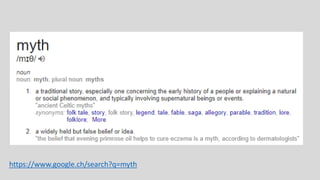
https://www.google.ch/search?q=myth
https://www.apa.org/helpcenter/stress-myths.aspx
Why is it a myth that stress is the same for everybody?
Because it is wrong. Stress is different for each of us. What is stressful
for one person may or may not be stressful for another. Each of us
responds to stress in an entirely different way.
Example
The mythical core of civilization describes that aspect
of our experience not revealed by scientific
questions and beliefs.
https://www.thenewatlantis.com/publications/wokeness-and-myth-on-campus
In Greek mythology, Scylla is a sea monster, who lives
on the rocks of a narrow water channel opposite of the whirlpool
Charybdis. Ships caught in between Scylla and Charybdis often end
up being sunk by either Scylla or Charybdis.
Over the centuries, Scylla has been the subject of many stories as
well as pieces of art.
https://greekgodsandgoddesses.net/myths/scylla/
In the “mythos” stage of development, the Greeks saw events of the world as
being caused by a multitude of clashing personalities - the “gods.” There were gods
for natural phenomena such as the sun and the sea, and gods for human activities
such as war and love. The primary mode of explanation of reality consisted of highly
imaginative stories about these personalities.
As time went on, Greek thinkers became critical of the old myths and proposed
alternative explanations of natural phenomena based on observation and logical
deduction. Under “logos,” the highly personalized worldview of the Greeks became
transformed into one in which natural phenomena were explained not by invisible
superhuman persons, but by impersonal natural causes.
https://mythoslogos.org/2014/12/21/what-is-mythos-and-logos/
Unlike “mythos”, “logos” must relate exactly to facts and correspond to
external reality. “Logos” is practical and logical.
“Logos” cannot answer questions about the ultimate value of human life.
In other words, a scientist cannot explain the meaning of life. “Mythos”
is concerned with meaning.
https://www.malaysiakini.com/letters/41468
When the Greeks built temples and offered sacrifices, they were also
worshipping the values that the gods represented.
Examples:
 Apollo was the god of light, knowledge, and healing.
 Hera was the goddess of marriage and family.
 Aphrodite was the goddess of love.
 Athena was the goddess of wisdom.
 Zeus was the god of order and justice.
https://mythoslogos.org/2014/12/21/what-is-mythos-and-logos/
Many countries in Southeast Asia trace their origins to a mythic
founder, who may be a dragon, like Vietnam's Lac Long Quan, or a
hero or a princess married to a dragon.
These cultural ancestors were to be honoured. Often they were the
ones who had shown a people an essential skill like
rice planting, cooking, or weaving.
http://teacher.scholastic.com/writewit/mff/southeast.htm
Most of India's myths are part of Hinduism. Hindu beliefs and
myths are driven by two very powerful forces: Creation and
destruction.
Everything in the cosmos / the universe, even gods and goddesses,
spirals through an everlasting cycle of birth, death or
dissolution, and reincarnation.
http://teacher.scholastic.com/writewit/mff/india.htm
Like the rising sun on its flag, Japan's mythology celebrates two
important concepts: Nature and nation.
Japanese myths explain the origins of its islands and the divine line
of its emperors. They honour the nature spirits of an
agricultural community and the warriors and gods
of an imperial culture.
http://teacher.scholastic.com/writewit/mff/japan.htm

Myth

  • 1.
  • 2.
    If you describea belief or explanation as a myth, you mean that many people believe it but it is actually untrue. Synonyms: Fantasy, illusion. https://www.collinsdictionary.com/dictionary/english/myth
  • 3.
  • 4.
    https://www.apa.org/helpcenter/stress-myths.aspx Why is ita myth that stress is the same for everybody? Because it is wrong. Stress is different for each of us. What is stressful for one person may or may not be stressful for another. Each of us responds to stress in an entirely different way. Example
  • 5.
    The mythical coreof civilization describes that aspect of our experience not revealed by scientific questions and beliefs. https://www.thenewatlantis.com/publications/wokeness-and-myth-on-campus
  • 6.
    In Greek mythology,Scylla is a sea monster, who lives on the rocks of a narrow water channel opposite of the whirlpool Charybdis. Ships caught in between Scylla and Charybdis often end up being sunk by either Scylla or Charybdis. Over the centuries, Scylla has been the subject of many stories as well as pieces of art. https://greekgodsandgoddesses.net/myths/scylla/
  • 7.
    In the “mythos”stage of development, the Greeks saw events of the world as being caused by a multitude of clashing personalities - the “gods.” There were gods for natural phenomena such as the sun and the sea, and gods for human activities such as war and love. The primary mode of explanation of reality consisted of highly imaginative stories about these personalities. As time went on, Greek thinkers became critical of the old myths and proposed alternative explanations of natural phenomena based on observation and logical deduction. Under “logos,” the highly personalized worldview of the Greeks became transformed into one in which natural phenomena were explained not by invisible superhuman persons, but by impersonal natural causes. https://mythoslogos.org/2014/12/21/what-is-mythos-and-logos/
  • 8.
    Unlike “mythos”, “logos”must relate exactly to facts and correspond to external reality. “Logos” is practical and logical. “Logos” cannot answer questions about the ultimate value of human life. In other words, a scientist cannot explain the meaning of life. “Mythos” is concerned with meaning. https://www.malaysiakini.com/letters/41468
  • 9.
    When the Greeksbuilt temples and offered sacrifices, they were also worshipping the values that the gods represented. Examples:  Apollo was the god of light, knowledge, and healing.  Hera was the goddess of marriage and family.  Aphrodite was the goddess of love.  Athena was the goddess of wisdom.  Zeus was the god of order and justice. https://mythoslogos.org/2014/12/21/what-is-mythos-and-logos/
  • 10.
    Many countries inSoutheast Asia trace their origins to a mythic founder, who may be a dragon, like Vietnam's Lac Long Quan, or a hero or a princess married to a dragon. These cultural ancestors were to be honoured. Often they were the ones who had shown a people an essential skill like rice planting, cooking, or weaving. http://teacher.scholastic.com/writewit/mff/southeast.htm
  • 11.
    Most of India'smyths are part of Hinduism. Hindu beliefs and myths are driven by two very powerful forces: Creation and destruction. Everything in the cosmos / the universe, even gods and goddesses, spirals through an everlasting cycle of birth, death or dissolution, and reincarnation. http://teacher.scholastic.com/writewit/mff/india.htm
  • 12.
    Like the risingsun on its flag, Japan's mythology celebrates two important concepts: Nature and nation. Japanese myths explain the origins of its islands and the divine line of its emperors. They honour the nature spirits of an agricultural community and the warriors and gods of an imperial culture. http://teacher.scholastic.com/writewit/mff/japan.htm