MYTHOLOGY AND
FOLKLORE
THE NATURE OF MYTHOLOGY AND FOLKLORE
MYTH
• It is the study of myths and the myths themselves, which
are stories told as symbols of fundamental truths within
societies having a strong oral traditions.
FOLKLORE
• This includes the traditional elements of the way of life
of a group of people and creative expressions
developing naturally as part of this culture.
THE NATURE OF MYTHOLOGY
Mythology is the study of
myths
Collecting Stories
• literary evidence
• archaeological evidence
Examining their Functions
• teller or audience
• society
Comparing Myths
• motifs
• traditions
Assessing Myths
• significance
• truth
THE NATURE OF MYTHOLOGY
DEFINITIONS OF MYTH
• A story that is usually of unknown origin and at least
partially traditional that ostensibly relates historical
events usually of such description as to serve to explain
some particular event, institution, or natural
phenomenon.
– Webster
• A myth is a story about gods, other supernatural beings,
or heroes of a long past time.
– M. Reinhold, Past and Present
THE NATURE OF MYTHOLOGY
DEFINITIONS OF MYTH
• Myths are certain products of the imagination of a
people which take the form of stories.
– H.J. Rose, A Handbook of Greek Mythology
• Myth is a cognitive structure analogous to language
through which primitive people organize their
experiences.
– J. Peradotto, Classical Mythology
THE NATURE OF MYTHOLOGY
DEFINITIONS OF MYTH
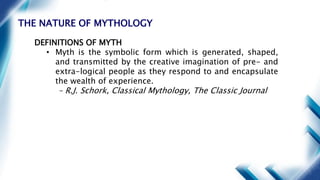
• Myth is the symbolic form which is generated, shaped,
and transmitted by the creative imagination of pre- and
extra-logical people as they respond to and encapsulate
the wealth of experience.
– R.J. Schork, Classical Mythology, The Classic Journal
THE NATURE OF MYTHOLOGY
CHARACTERISTICS OF MYTH
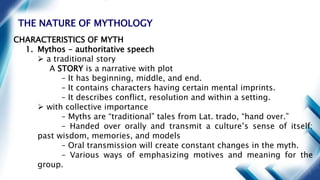
1. Mythos - authoritative speech
 a traditional story
A STORY is a narrative with plot
– It has beginning, middle, and end.
– It contains characters having certain mental imprints.
– It describes conflict, resolution and within a setting.
 with collective importance
– Myths are “traditional” tales from Lat. trado, “hand over.”
– Handed over orally and transmit a culture’s sense of itself:
past wisdom, memories, and models
– Oral transmission will create constant changes in the myth.
– Various ways of emphasizing motives and meaning for the
group.
THE NATURE OF MYTHOLOGY
CHARACTERISTICS OF MYTH
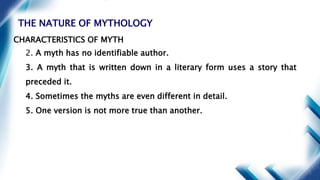
2. A myth has no identifiable author.
3. A myth that is written down in a literary form uses a story that
preceded it.
4. Sometimes the myths are even different in detail.
5. One version is not more true than another.
THE NATURE OF MYTHOLOGY
TYPES OF MYTHS by Morford and Lenardon
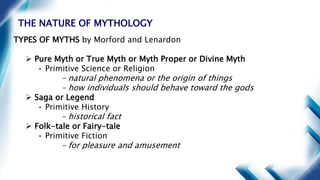
 Pure Myth or True Myth or Myth Proper or Divine Myth
• Primitive Science or Religion
– natural phenomena or the origin of things
– how individuals should behave toward the gods
 Saga or Legend
• Primitive History
– historical fact
 Folk-tale or Fairy-tale
• Primitive Fiction
– for pleasure and amusement
THE NATURE OF MYTHOLOGY
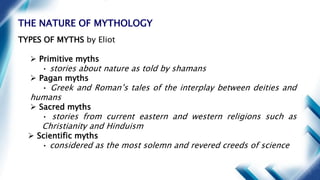
TYPES OF MYTHS by Eliot
 Primitive myths
• stories about nature as told by shamans
 Pagan myths
• Greek and Roman’s tales of the interplay between deities and
humans
 Sacred myths
• stories from current eastern and western religions such as
Christianity and Hinduism
 Scientific myths
• considered as the most solemn and revered creeds of science
THE NATURE OF MYTHOLOGY
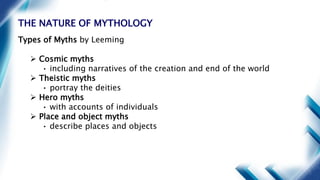
Types of Myths by Leeming
 Cosmic myths
• including narratives of the creation and end of the world
 Theistic myths
• portray the deities
 Hero myths
• with accounts of individuals
 Place and object myths
• describe places and objects
THE NATURE OF MYTHOLOGY
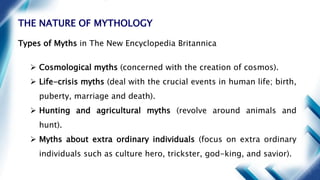
Types of Myths in The New Encyclopedia Britannica
 Cosmological myths (concerned with the creation of cosmos).
 Life-crisis myths (deal with the crucial events in human life; birth,
puberty, marriage and death).
 Hunting and agricultural myths (revolve around animals and
hunt).
 Myths about extra ordinary individuals (focus on extra ordinary
individuals such as culture hero, trickster, god-king, and savior).
THE NATURE OF MYTHOLOGY
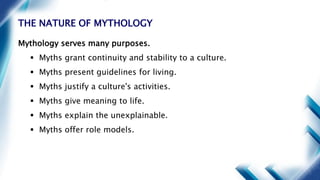
Mythology serves many purposes.
 Myths grant continuity and stability to a culture.
 Myths present guidelines for living.
 Myths justify a culture's activities.
 Myths give meaning to life.
 Myths explain the unexplainable.
 Myths offer role models.
THE NATURE OF MYTHOLOGY
CLASSIFICATION OF MYTHS
1. Ritual myths – explain the performance of certain religious
practices or patterns and are associated with temples or center of
worship.
2. Origin myths – describe the beginnings of a custom, name, or
object.
3. Cult myths – often seen as an explanations for elaborate festivals
that magnify the power of deity.
4. Prestige myths – associated with divinely chosen hero, city, or
people.
5. Chthonic myths – involves death and rebirth motifs, typically
characterized by a journey to and return from underworld.
6. Eschatological myths – stories that describes catastrophic ends to
the present world order of the writers. These extend beyond any
potential historical scope, and thus can only be described in
THE NATURE OF MYTHOLOGY
CLASSIFICATION OF MYTHS
7. Social myths – reinforce or defend current social values or
practices.
8. Creation myths – describe how a culture believes the universe
was created.
9. Trickster myths – concerned with the pranks or tricks played
gods or heroes.
Mythology and Folklore.pptx

Mythology and Folklore.pptx

  • 1.
  • 2.
    THE NATURE OFMYTHOLOGY AND FOLKLORE MYTH • It is the study of myths and the myths themselves, which are stories told as symbols of fundamental truths within societies having a strong oral traditions. FOLKLORE • This includes the traditional elements of the way of life of a group of people and creative expressions developing naturally as part of this culture.
  • 3.
    THE NATURE OFMYTHOLOGY Mythology is the study of myths Collecting Stories • literary evidence • archaeological evidence Examining their Functions • teller or audience • society Comparing Myths • motifs • traditions Assessing Myths • significance • truth
  • 4.
    THE NATURE OFMYTHOLOGY DEFINITIONS OF MYTH • A story that is usually of unknown origin and at least partially traditional that ostensibly relates historical events usually of such description as to serve to explain some particular event, institution, or natural phenomenon. – Webster • A myth is a story about gods, other supernatural beings, or heroes of a long past time. – M. Reinhold, Past and Present
  • 5.
    THE NATURE OFMYTHOLOGY DEFINITIONS OF MYTH • Myths are certain products of the imagination of a people which take the form of stories. – H.J. Rose, A Handbook of Greek Mythology • Myth is a cognitive structure analogous to language through which primitive people organize their experiences. – J. Peradotto, Classical Mythology
  • 6.
    THE NATURE OFMYTHOLOGY DEFINITIONS OF MYTH • Myth is the symbolic form which is generated, shaped, and transmitted by the creative imagination of pre- and extra-logical people as they respond to and encapsulate the wealth of experience. – R.J. Schork, Classical Mythology, The Classic Journal
  • 7.
    THE NATURE OFMYTHOLOGY CHARACTERISTICS OF MYTH 1. Mythos - authoritative speech  a traditional story A STORY is a narrative with plot – It has beginning, middle, and end. – It contains characters having certain mental imprints. – It describes conflict, resolution and within a setting.  with collective importance – Myths are “traditional” tales from Lat. trado, “hand over.” – Handed over orally and transmit a culture’s sense of itself: past wisdom, memories, and models – Oral transmission will create constant changes in the myth. – Various ways of emphasizing motives and meaning for the group.
  • 8.
    THE NATURE OFMYTHOLOGY CHARACTERISTICS OF MYTH 2. A myth has no identifiable author. 3. A myth that is written down in a literary form uses a story that preceded it. 4. Sometimes the myths are even different in detail. 5. One version is not more true than another.
  • 9.
    THE NATURE OFMYTHOLOGY TYPES OF MYTHS by Morford and Lenardon  Pure Myth or True Myth or Myth Proper or Divine Myth • Primitive Science or Religion – natural phenomena or the origin of things – how individuals should behave toward the gods  Saga or Legend • Primitive History – historical fact  Folk-tale or Fairy-tale • Primitive Fiction – for pleasure and amusement
  • 10.
    THE NATURE OFMYTHOLOGY TYPES OF MYTHS by Eliot  Primitive myths • stories about nature as told by shamans  Pagan myths • Greek and Roman’s tales of the interplay between deities and humans  Sacred myths • stories from current eastern and western religions such as Christianity and Hinduism  Scientific myths • considered as the most solemn and revered creeds of science
  • 11.
    THE NATURE OFMYTHOLOGY Types of Myths by Leeming  Cosmic myths • including narratives of the creation and end of the world  Theistic myths • portray the deities  Hero myths • with accounts of individuals  Place and object myths • describe places and objects
  • 12.
    THE NATURE OFMYTHOLOGY Types of Myths in The New Encyclopedia Britannica  Cosmological myths (concerned with the creation of cosmos).  Life-crisis myths (deal with the crucial events in human life; birth, puberty, marriage and death).  Hunting and agricultural myths (revolve around animals and hunt).  Myths about extra ordinary individuals (focus on extra ordinary individuals such as culture hero, trickster, god-king, and savior).
  • 13.
    THE NATURE OFMYTHOLOGY Mythology serves many purposes.  Myths grant continuity and stability to a culture.  Myths present guidelines for living.  Myths justify a culture's activities.  Myths give meaning to life.  Myths explain the unexplainable.  Myths offer role models.
  • 14.
    THE NATURE OFMYTHOLOGY CLASSIFICATION OF MYTHS 1. Ritual myths – explain the performance of certain religious practices or patterns and are associated with temples or center of worship. 2. Origin myths – describe the beginnings of a custom, name, or object. 3. Cult myths – often seen as an explanations for elaborate festivals that magnify the power of deity. 4. Prestige myths – associated with divinely chosen hero, city, or people. 5. Chthonic myths – involves death and rebirth motifs, typically characterized by a journey to and return from underworld. 6. Eschatological myths – stories that describes catastrophic ends to the present world order of the writers. These extend beyond any potential historical scope, and thus can only be described in
  • 15.
    THE NATURE OFMYTHOLOGY CLASSIFICATION OF MYTHS 7. Social myths – reinforce or defend current social values or practices. 8. Creation myths – describe how a culture believes the universe was created. 9. Trickster myths – concerned with the pranks or tricks played gods or heroes.