1
Galera Cluster For MySQL
Alexey Yurchenko, Codership Oy
Percona Live MySQL User Conference and Expo, 2012
2
Follow the tutorial
Using Percona XtraDB Cluster RPMs, at Amazon
EC2
Datacenters:
us-west-1
us-east-1
eu-west-1
(look for galera_tutorial_* images)
3
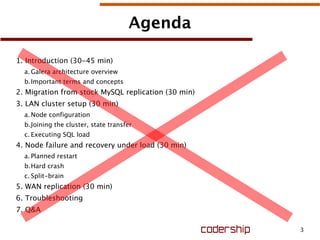
Agenda
1. Introduction (30-45 min)
a. Galera architecture overview
b.Important terms and concepts
2. Migration from stock MySQL replication (30 min)
3. LAN cluster setup (30 min)
a. Node configuration
b.Joining the cluster, state transfer
c. Executing SQL load
4. Node failure and recovery under load (30 min)
a. Planned restart
b.Hard crash
c. Split-brain
5. WAN replication (30 min)
6. Troubleshooting
7. Q&A
4
What Is Galera Cluster for MySQL?
MySQL
server ✕ N
Galera
Cluster
for
MySQL
=
5
What is Galera Cluster for MySQL
Each node is fully representative of the cluster:
1. No single point of failure
2. Synchronous...............
3. 99.9% transparency
●
No data loss
●
No slave lag
●
No master failover
●
Full multi-master
6
What Is Galera Cluster for MySQL?
MySQL
Galera
Cluster
for
MySQLMySQL
MySQL
MySQL
7
What Is Galera Cluster for MySQL?
Galera
Cluster
for
MySQL
MySQL
server
Server
as a
part of
the
cluster
8
Migrating from MySQL master-slave
to Galera
9
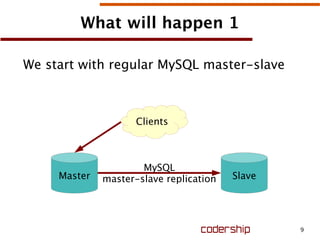
What will happen 1
Master Slave
MySQL
master-slave replication
Clients
We start with regular MySQL master-slave
10
What will happen 2
Master
Slave /
G. node1
MySQL
master-slave replication
Clients
Upgrade MySQL slave to Galera node
Single node
Galera cluster
11
What will happen 3
Master
Slave /
G. node1
MySQL
master-slave replication
Clients
Add a second Galera node using state
snapshot transfer (SST) 2-node
Galera cluster
G. node2
12
What will happen 4
Master
Slave /
G. node1
Clients
Failover client connections to Galera cluster
and stop master-slave. 2-node
Galera cluster
G. node2
13
What will happen 5
Master /
G. node3
Slave /
G. node1
Clients
Upgrade MySQL master to Galera and join to
cluster using incremental state transfer (IST)
3-node Galera cluster
G. node2
14
Converting slave to Galera node
1. Stop the slave: slave> STOP SLAVE;
2. Upgrade the software:
slave# rpm -e MySQL-server
slave# rpm -Uvh percona-xtrabackup-2.0.0-*.rpm 
Percona-XtraDB-Cluster-galera-2.0-*.rpm 
Percona-XtraDB-Cluster-server-5.5.20-23.4*.rpm
3. Configure wsrep options in my.cnf
4. Add log_slave_updates=1 to my.cnf
Remove read_only = 1 from my.cnf
5. Restart the server.
6. Start the slave: slave> START SLAVE;
15
Sample my.cnf for slave after upgrade
[mysqld]
wsrep_cluster_address=/usr/lib64/libgalera_smm.so
wsrep_node_address=gcomm:// # NOTE: This must be changed to peer address ASAP!
wsrep_node_name=node1
wsrep_provider='/usr/lib64/galera/libgalera_smm.so'
wsrep_provider_options='gcache.size=1G;socket.ssl_key=my_key;socket.ssl_cert=my_cert'
wsrep_slave_threads=16
wsrep_sst_method=xtrabackup
wsrep_sst_auth=root:
innodb_buffer_pool_size=1G
innodb_log_file_size=256M
innodb_autoinc_lock_mode=2
innodb_flush_log_at_trx_commit=0
innodb_doublewrite=0
innodb_file_per_table=1
binlog_format=ROW
datadir=/var/lib/mysql
log-bin = mysql-bin
server-id = 2
relay-log = mysql-relay-bin
#read-only = 1
log-slave-updates = 1
16
Important wsrep variables 1
wsrep_provider:
A path to wsrep provider library.
17
Important wsrep variables 2
wsrep_cluster_address:
Where to connect to cluster. Has a URI form:
'gcomm://another_node_address?opt1=val1&opt2=val2'
But normally just
'gcomm://another_node_address'
A special form to start a new cluster:
'gcomm://'
!!! Danger !!! Never leave it in my.cnf !!!
18
Important wsrep variables 3
wsrep_node_address:
An optional address of the node. A short-cut
way to configure listen addresses for
replication and state transfers.
By default it will be initialized to the first
network interface returned by ifconfig. This
however is unreliable. For best results it must
be initialized explicitly.
19
Important wsrep variables 4
wsrep_node_name:
An optional name for the node. It will be used
in logging and to identify the desired donor
for state transfer.
By default it will be initialized to hostname,
but that may turn out to be not unique (it does
not have to) or unwieldy.
20
Important wsrep variables 5
wsrep_provider_options:
Semicolon-separated list of options specific to
provider. Some useful Galera options:
gcache.size – a size of the permanent
transaction on-disk cache.
socket.ssl_key, socket.ssl_cert – SSL key and
certificate files.
21
Important wsrep variables 6
wsrep_slave_threads:
How many threads to launch for parallel
applying.
> 1 requires certain InnoDB settings. Applying
of STATEMENT-based events is always
serialized.
22
Important wsrep variables 7
wsrep_sst_method:
Base package contains scripts for mysqldump,
rsync and xtrabackup based state snapshot
transfers. Own scripts can be crafted (handy for
backup). Default is mysqldump. It also requires
setting wsrep_sst_auth to MySQL root
user:password pair.
23
Status of Galera Replication
wsrep_ready
wsrep_cluster_status
wsrep_connected
Wait for node to sync with
cluster
No
Non-Primary
Primary
Network partitioning!
wsrep_local_state_uuid
wsrep_last_committed
Yes
Yes
No: reconnect
24
Starting a 2nd
Galera node
1. Install Percona RPMs. No need to configure
initial database, it will be brought by SST.
2. Edit my.cnf. Set wsrep_cluster_address to
slave node IP.
3. Start mysqld:
node2# service mysql start
4. Update my.cnf on slave:
set wsrep_cluster_address to 2nd
node IP.
25
Important Concepts 1
Application State:
For Galera application state is a set of data that
application decides to replicate. By default it is a
whole of MySQL databases (i.e. every node is a
complete replica of another).
Application state is identified by a Global Transation
ID.
26
Important Concepts 1
Global Transaction ID (GTID):
f7720ae0-6f9b-11e1-0800-598d1b386dce:13989753562f7720ae0-6f9b-11e1-0800-598d1b386dce 32520198989
CLUSTER/HISTORY/STATE
UUID
TRX/STATE
SEQNO
27
Important Concepts 1
Initial State:
f7720ae0-6f9b-11e1-0800-598d1b386dce:0
Undefined State:
00000000-0000-0000-0000-000000000000:-1
28
Important Concepts 1
State Snapshot Transfer (SST):
A transfer of a consistent snapshot of a node
state corresponding to a certain GTID in order to
initialize the state of a newly joining cluster node
from an already initialized node (donor).
29
Performance of Galera replication
wsrep_flow_control_paused: what fraction of the
time replication was paused.
wsrep_flow_control_sent: how many times this
node paused replication.
wsrep_local_recv_queue_avg: average length of
slave trx queue – a sign of slave side bottleneck.
wsrep_cert_deps_distance: how many transactions
can be applied in parallel.
wsrep_local_send_queue_avg: a sign of network
bottleneck.
30
Failover to Galera cluster
1. Briefly pause the load.
2. Make sure slave caught up with the master:
master> SHOW MASTER STATUSG
slave> SHOW SLAVE STATUSG
3. Take note of GTID on slave:
slave> SHOW STATUS LIKE 'wsrep_%';
4. Set binary log format to ROW on slave:
slave> SET GLOBAL binlog_format=ROW;
5. Direct the load to slave and the 2nd
Galera node.
31
Make former master a Galera node
1. Upgrade software.
2. Configure my.cnf.
Set wsrep_cluster_address to any of Galera
nodes' names.
3. Copy/forge grastate.dat file. Set state
information to the GTID we noted previous
page.
4. Start mysqld.
32
Important Concepts 2
Incremental State Transfer (IST):
Catch up with the cluster by replaying
missing transactions. Requires
➔
known initial node state;
➔
enough transactions cached at the donor.
33
Important Concepts 3
Node Failure:
For Galera node a peer crash is indistinguishable from
network failure. Hence node is considered failed when it
no longer can be communicated with. Communication is
verified by receiving messages or keepalives.
evs.inactive_timeout sets the timeout after which node
is considered inactive (dead).
evs.suspect_timeout sets the timeout after which the
node can be pronounced dead if everyone else agrees.
34
Galera WAN Replication
Currently Galera has no notion of a local or
remote node – it works as long as TCP works.
May need tuning to be more tolerant to
network hiccups – Galera (wsrep provider)
options:
evs.keepalive_period = PT3S;
evs.inactive_check_period = PT10S;
evs.suspect_timeout = PT30S;
evs.inactive_timeout = PT1M;
evs.consensus_timeout = PT1M
35
Important Concepts 4
Primary Component (PC):
PC
PC PC
36
Important Concepts 5
Split-brain:
PC
?
DC1
DC2
37
Galera Arbitrator
DC1 DC2
garbd
38
Galera Arbitrator
DC1 DC2
garbd
X
39
Galera Arbitrator
DC1 DC2
garbd
+
X
40
Galera Arbitrator
DC1 DC2
garbd
X
relay
41
Backup, backup, backup
Just backup one of the nodes. But backup
without GTID is not that useful - backup with
GTID:
1) xtrabackup:
node# innobackupex --galera-info
creates xtrabackup_galera_info in the datadir
2) Custom backup with arbitrator:
node# garbd … --donor node1 --sst custom
calls wsrep_sst_custom on node1.

MySQL Galera 集群

  • 1.
    1 Galera Cluster ForMySQL Alexey Yurchenko, Codership Oy Percona Live MySQL User Conference and Expo, 2012
  • 2.
    2 Follow the tutorial UsingPercona XtraDB Cluster RPMs, at Amazon EC2 Datacenters: us-west-1 us-east-1 eu-west-1 (look for galera_tutorial_* images)
  • 3.
    3 Agenda 1. Introduction (30-45min) a. Galera architecture overview b.Important terms and concepts 2. Migration from stock MySQL replication (30 min) 3. LAN cluster setup (30 min) a. Node configuration b.Joining the cluster, state transfer c. Executing SQL load 4. Node failure and recovery under load (30 min) a. Planned restart b.Hard crash c. Split-brain 5. WAN replication (30 min) 6. Troubleshooting 7. Q&A
  • 4.
    4 What Is GaleraCluster for MySQL? MySQL server ✕ N Galera Cluster for MySQL =
  • 5.
    5 What is GaleraCluster for MySQL Each node is fully representative of the cluster: 1. No single point of failure 2. Synchronous............... 3. 99.9% transparency ● No data loss ● No slave lag ● No master failover ● Full multi-master
  • 6.
    6 What Is GaleraCluster for MySQL? MySQL Galera Cluster for MySQLMySQL MySQL MySQL
  • 7.
    7 What Is GaleraCluster for MySQL? Galera Cluster for MySQL MySQL server Server as a part of the cluster
  • 8.
    8 Migrating from MySQLmaster-slave to Galera
  • 9.
    9 What will happen1 Master Slave MySQL master-slave replication Clients We start with regular MySQL master-slave
  • 10.
    10 What will happen2 Master Slave / G. node1 MySQL master-slave replication Clients Upgrade MySQL slave to Galera node Single node Galera cluster
  • 11.
    11 What will happen3 Master Slave / G. node1 MySQL master-slave replication Clients Add a second Galera node using state snapshot transfer (SST) 2-node Galera cluster G. node2
  • 12.
    12 What will happen4 Master Slave / G. node1 Clients Failover client connections to Galera cluster and stop master-slave. 2-node Galera cluster G. node2
  • 13.
    13 What will happen5 Master / G. node3 Slave / G. node1 Clients Upgrade MySQL master to Galera and join to cluster using incremental state transfer (IST) 3-node Galera cluster G. node2
  • 14.
    14 Converting slave toGalera node 1. Stop the slave: slave> STOP SLAVE; 2. Upgrade the software: slave# rpm -e MySQL-server slave# rpm -Uvh percona-xtrabackup-2.0.0-*.rpm Percona-XtraDB-Cluster-galera-2.0-*.rpm Percona-XtraDB-Cluster-server-5.5.20-23.4*.rpm 3. Configure wsrep options in my.cnf 4. Add log_slave_updates=1 to my.cnf Remove read_only = 1 from my.cnf 5. Restart the server. 6. Start the slave: slave> START SLAVE;
  • 15.
    15 Sample my.cnf forslave after upgrade [mysqld] wsrep_cluster_address=/usr/lib64/libgalera_smm.so wsrep_node_address=gcomm:// # NOTE: This must be changed to peer address ASAP! wsrep_node_name=node1 wsrep_provider='/usr/lib64/galera/libgalera_smm.so' wsrep_provider_options='gcache.size=1G;socket.ssl_key=my_key;socket.ssl_cert=my_cert' wsrep_slave_threads=16 wsrep_sst_method=xtrabackup wsrep_sst_auth=root: innodb_buffer_pool_size=1G innodb_log_file_size=256M innodb_autoinc_lock_mode=2 innodb_flush_log_at_trx_commit=0 innodb_doublewrite=0 innodb_file_per_table=1 binlog_format=ROW datadir=/var/lib/mysql log-bin = mysql-bin server-id = 2 relay-log = mysql-relay-bin #read-only = 1 log-slave-updates = 1
  • 16.
    16 Important wsrep variables1 wsrep_provider: A path to wsrep provider library.
  • 17.
    17 Important wsrep variables2 wsrep_cluster_address: Where to connect to cluster. Has a URI form: 'gcomm://another_node_address?opt1=val1&opt2=val2' But normally just 'gcomm://another_node_address' A special form to start a new cluster: 'gcomm://' !!! Danger !!! Never leave it in my.cnf !!!
  • 18.
    18 Important wsrep variables3 wsrep_node_address: An optional address of the node. A short-cut way to configure listen addresses for replication and state transfers. By default it will be initialized to the first network interface returned by ifconfig. This however is unreliable. For best results it must be initialized explicitly.
  • 19.
    19 Important wsrep variables4 wsrep_node_name: An optional name for the node. It will be used in logging and to identify the desired donor for state transfer. By default it will be initialized to hostname, but that may turn out to be not unique (it does not have to) or unwieldy.
  • 20.
    20 Important wsrep variables5 wsrep_provider_options: Semicolon-separated list of options specific to provider. Some useful Galera options: gcache.size – a size of the permanent transaction on-disk cache. socket.ssl_key, socket.ssl_cert – SSL key and certificate files.
  • 21.
    21 Important wsrep variables6 wsrep_slave_threads: How many threads to launch for parallel applying. > 1 requires certain InnoDB settings. Applying of STATEMENT-based events is always serialized.
  • 22.
    22 Important wsrep variables7 wsrep_sst_method: Base package contains scripts for mysqldump, rsync and xtrabackup based state snapshot transfers. Own scripts can be crafted (handy for backup). Default is mysqldump. It also requires setting wsrep_sst_auth to MySQL root user:password pair.
  • 23.
    23 Status of GaleraReplication wsrep_ready wsrep_cluster_status wsrep_connected Wait for node to sync with cluster No Non-Primary Primary Network partitioning! wsrep_local_state_uuid wsrep_last_committed Yes Yes No: reconnect
  • 24.
    24 Starting a 2nd Galeranode 1. Install Percona RPMs. No need to configure initial database, it will be brought by SST. 2. Edit my.cnf. Set wsrep_cluster_address to slave node IP. 3. Start mysqld: node2# service mysql start 4. Update my.cnf on slave: set wsrep_cluster_address to 2nd node IP.
  • 25.
    25 Important Concepts 1 ApplicationState: For Galera application state is a set of data that application decides to replicate. By default it is a whole of MySQL databases (i.e. every node is a complete replica of another). Application state is identified by a Global Transation ID.
  • 26.
    26 Important Concepts 1 GlobalTransaction ID (GTID): f7720ae0-6f9b-11e1-0800-598d1b386dce:13989753562f7720ae0-6f9b-11e1-0800-598d1b386dce 32520198989 CLUSTER/HISTORY/STATE UUID TRX/STATE SEQNO
  • 27.
    27 Important Concepts 1 InitialState: f7720ae0-6f9b-11e1-0800-598d1b386dce:0 Undefined State: 00000000-0000-0000-0000-000000000000:-1
  • 28.
    28 Important Concepts 1 StateSnapshot Transfer (SST): A transfer of a consistent snapshot of a node state corresponding to a certain GTID in order to initialize the state of a newly joining cluster node from an already initialized node (donor).
  • 29.
    29 Performance of Galerareplication wsrep_flow_control_paused: what fraction of the time replication was paused. wsrep_flow_control_sent: how many times this node paused replication. wsrep_local_recv_queue_avg: average length of slave trx queue – a sign of slave side bottleneck. wsrep_cert_deps_distance: how many transactions can be applied in parallel. wsrep_local_send_queue_avg: a sign of network bottleneck.
  • 30.
    30 Failover to Galeracluster 1. Briefly pause the load. 2. Make sure slave caught up with the master: master> SHOW MASTER STATUSG slave> SHOW SLAVE STATUSG 3. Take note of GTID on slave: slave> SHOW STATUS LIKE 'wsrep_%'; 4. Set binary log format to ROW on slave: slave> SET GLOBAL binlog_format=ROW; 5. Direct the load to slave and the 2nd Galera node.
  • 31.
    31 Make former mastera Galera node 1. Upgrade software. 2. Configure my.cnf. Set wsrep_cluster_address to any of Galera nodes' names. 3. Copy/forge grastate.dat file. Set state information to the GTID we noted previous page. 4. Start mysqld.
  • 32.
    32 Important Concepts 2 IncrementalState Transfer (IST): Catch up with the cluster by replaying missing transactions. Requires ➔ known initial node state; ➔ enough transactions cached at the donor.
  • 33.
    33 Important Concepts 3 NodeFailure: For Galera node a peer crash is indistinguishable from network failure. Hence node is considered failed when it no longer can be communicated with. Communication is verified by receiving messages or keepalives. evs.inactive_timeout sets the timeout after which node is considered inactive (dead). evs.suspect_timeout sets the timeout after which the node can be pronounced dead if everyone else agrees.
  • 34.
    34 Galera WAN Replication CurrentlyGalera has no notion of a local or remote node – it works as long as TCP works. May need tuning to be more tolerant to network hiccups – Galera (wsrep provider) options: evs.keepalive_period = PT3S; evs.inactive_check_period = PT10S; evs.suspect_timeout = PT30S; evs.inactive_timeout = PT1M; evs.consensus_timeout = PT1M
  • 35.
    35 Important Concepts 4 PrimaryComponent (PC): PC PC PC
  • 36.
  • 37.
  • 38.
  • 39.
  • 40.
  • 41.
    41 Backup, backup, backup Justbackup one of the nodes. But backup without GTID is not that useful - backup with GTID: 1) xtrabackup: node# innobackupex --galera-info creates xtrabackup_galera_info in the datadir 2) Custom backup with arbitrator: node# garbd … --donor node1 --sst custom calls wsrep_sst_custom on node1.