Multi-master replication for
Postgres
K. Knizhnik, C. Pan, S. Kelvich
Design objectives
Implementation/internals
Tests
Configuration
Roadmap
Contents
2
Design objectives
3
We want:
Fault-tolerance in easy way
OLTP-style load
Compatibility with standalone postgres
Possibility to reuse as metadata storage for sharded cluster
Design objectives
4
Replication:
Identical replicated data on all nodes
Possibility to have local tables
Writes allowed to any node
=> Easy to use
=> We need to take care about proper isolation
Design objectives
5
Transaction manager. We want:
Avoid single point of failure.
+: Spanner, Cockroach, Clock-SI
—: Pg-XL, ...
Avoid network communication for Read-Only transactions
+: HANA, Spanner, Cockroach, Clock-SI
—: Pg-XL, ...
Design objectives
6
Fault tolerance.
Paxos. Distributed consensus, low level.
Raft. Complete state-machine replication solution with failure
detector on timeouts and autorecovery. But all writes are
proxied to one node.
2PC. Blocks in case of node and coordinator failure. Postgres
already support 2pc.
3PC-like. Extra message between "P"and "C". 3PC, Paxos
commit, E3PC.
Design objectives
7
Summary.
No performance penalty for reads.
Tx can be issued to any node.
No special actions required in case of failure.
Design objectives
8
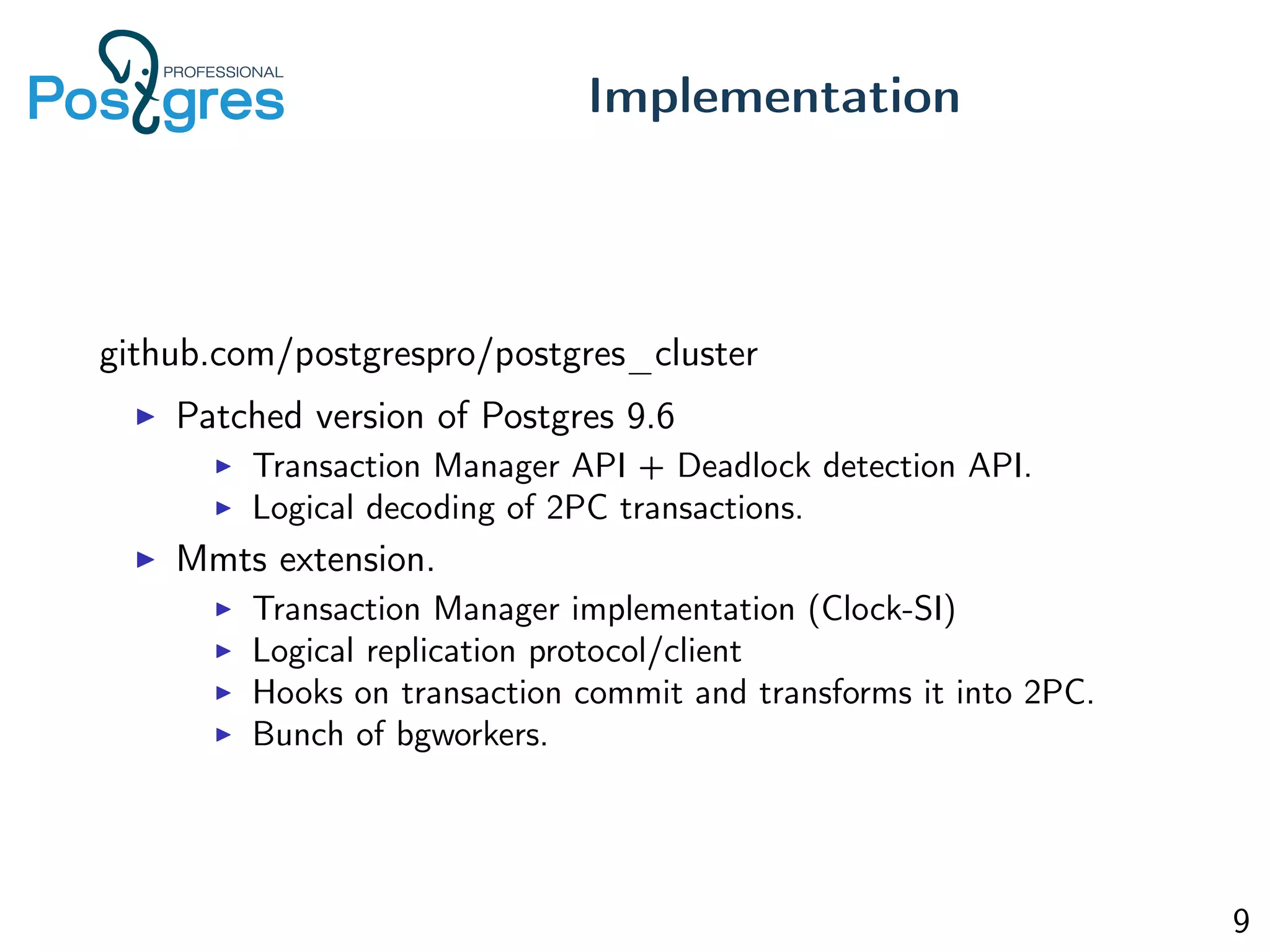
github.com/postgrespro/postgres_cluster
Patched version of Postgres 9.6
Transaction Manager API + Deadlock detection API.
Logical decoding of 2PC transactions.
Mmts extension.
Transaction Manager implementation (Clock-SI)
Logical replication protocol/client
Hooks on transaction commit and transforms it into 2PC.
Bunch of bgworkers.
Implementation
9
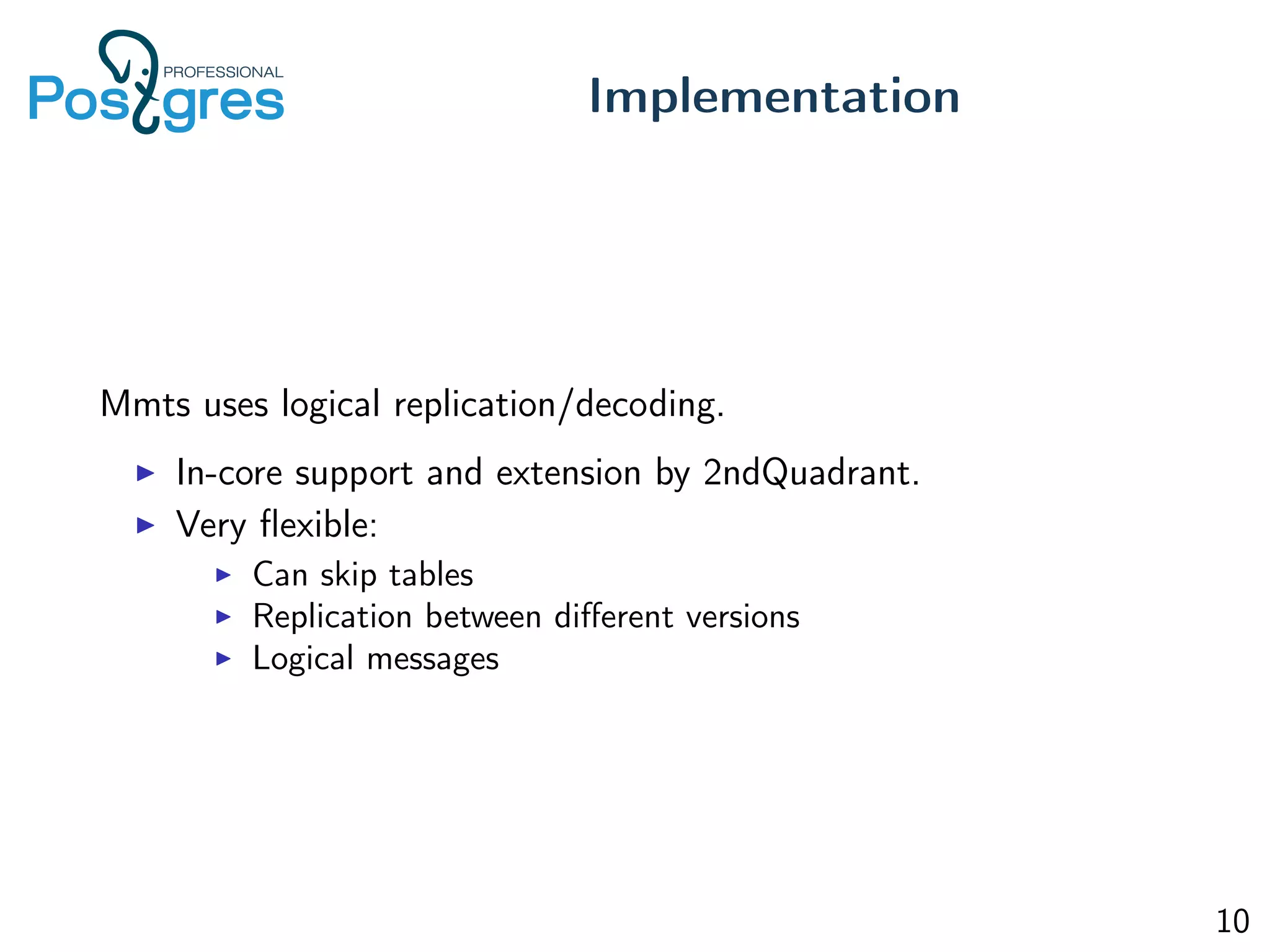
Mmts uses logical replication/decoding.
In-core support and extension by 2ndQuadrant.
Very flexible:
Can skip tables
Replication between different versions
Logical messages
Implementation
10
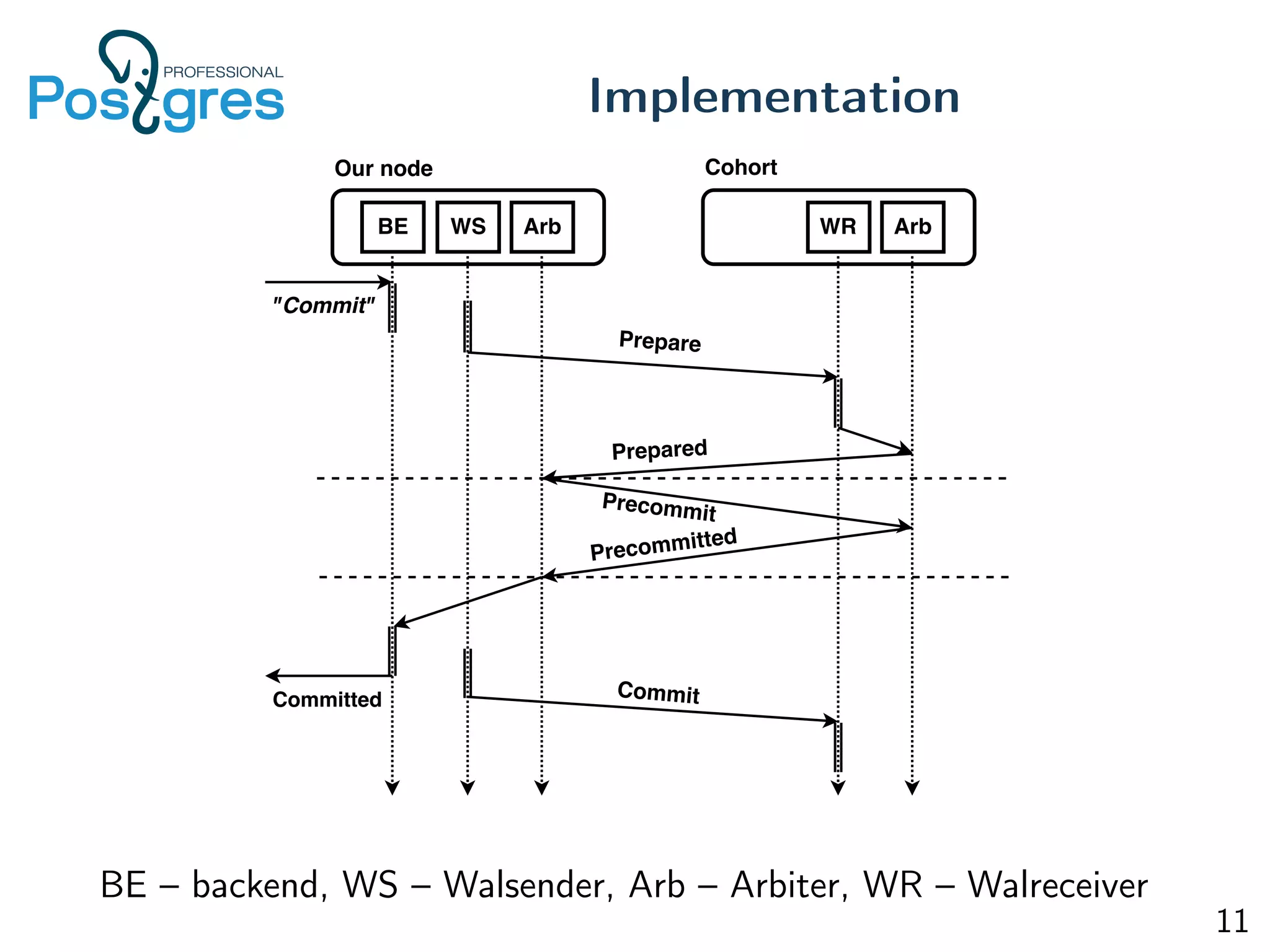
BE – backend, WS – Walsender, Arb – Arbiter, WR – Walreceiver
Implementation
11
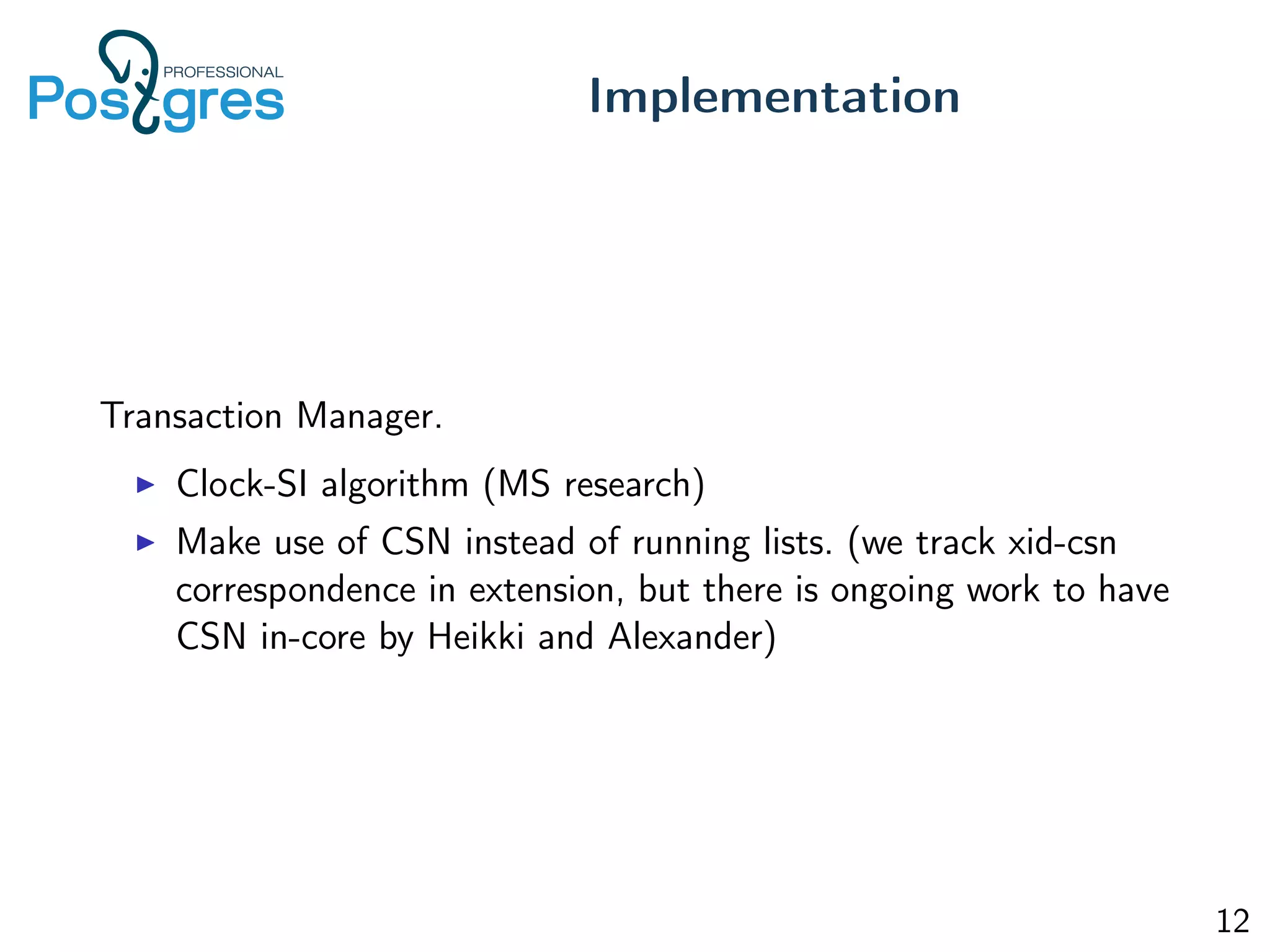
Transaction Manager.
Clock-SI algorithm (MS research)
Make use of CSN instead of running lists. (we track xid-csn
correspondence in extension, but there is ongoing work to have
CSN in-core by Heikki and Alexander)
Implementation
12
DDL replication.
Statement-based.
Happily, postgres support 2PC for almost all DDL (alter enum
already fixed in -master)
CREATE TABLE AS, CREATE MATVIEW, etc – tricky, mixes
DDL and DML.
Temp tables are tricky – shouldn’t be replicted.
Depends on environment (search_path, auth, etc.)
Implementation
13
Postgres compatibility.
almost FULLY compatible with pg.
162 of 166 regressions tests pass as is.
1 test is using prepared statement inside CREATE TABLE AS
(CTA).
3 tests are using CTA(CTA(TEMP TABLE)).
Some obvious way to abuse statement based replication, e.g.
write function that create table with name based on current
timestamp.
Also sequences can add pain.
Implementation
14
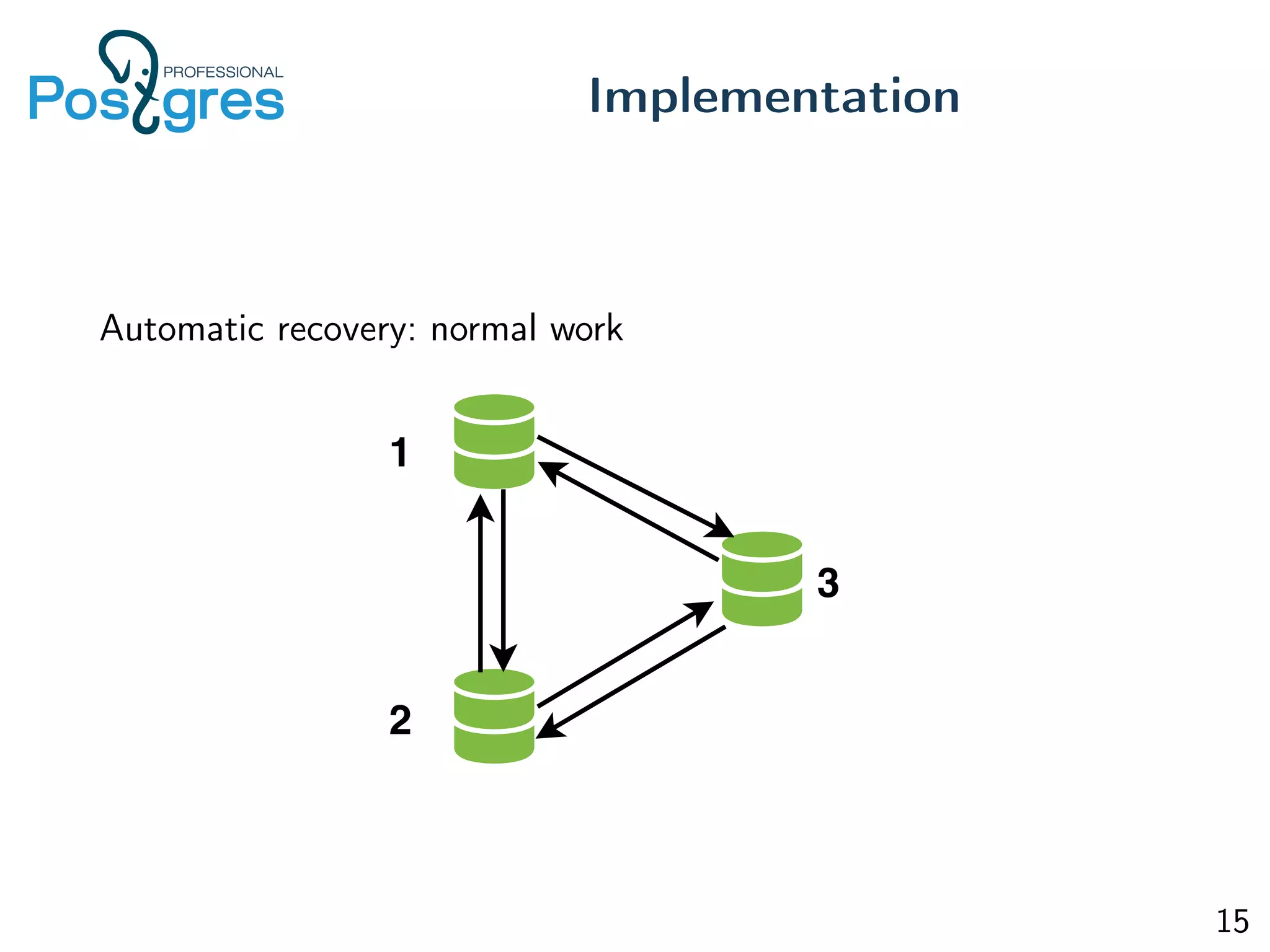
Automatic recovery: normal work
Implementation
15
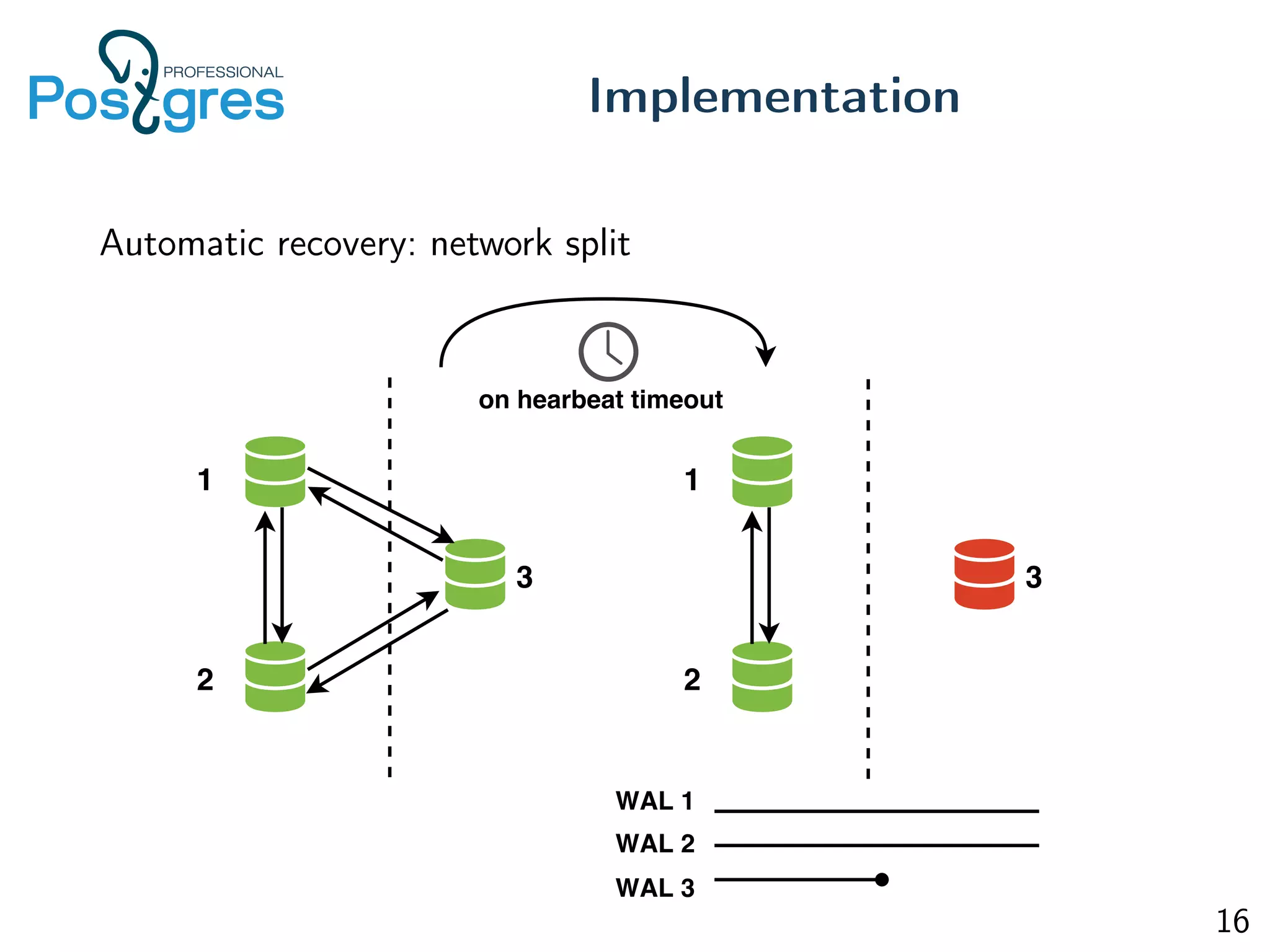
Automatic recovery: network split
Implementation
16
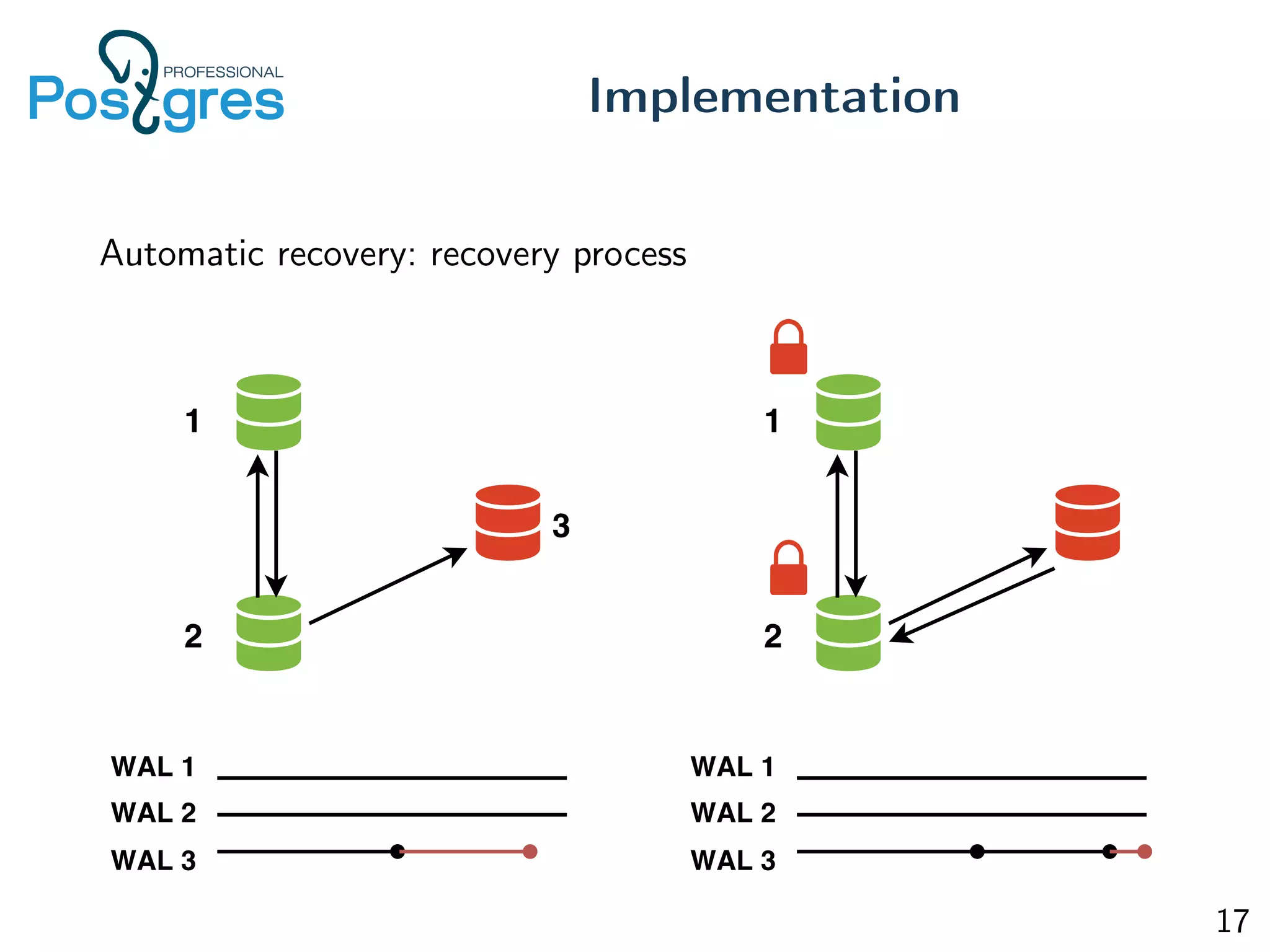
Automatic recovery: recovery process
Implementation
17
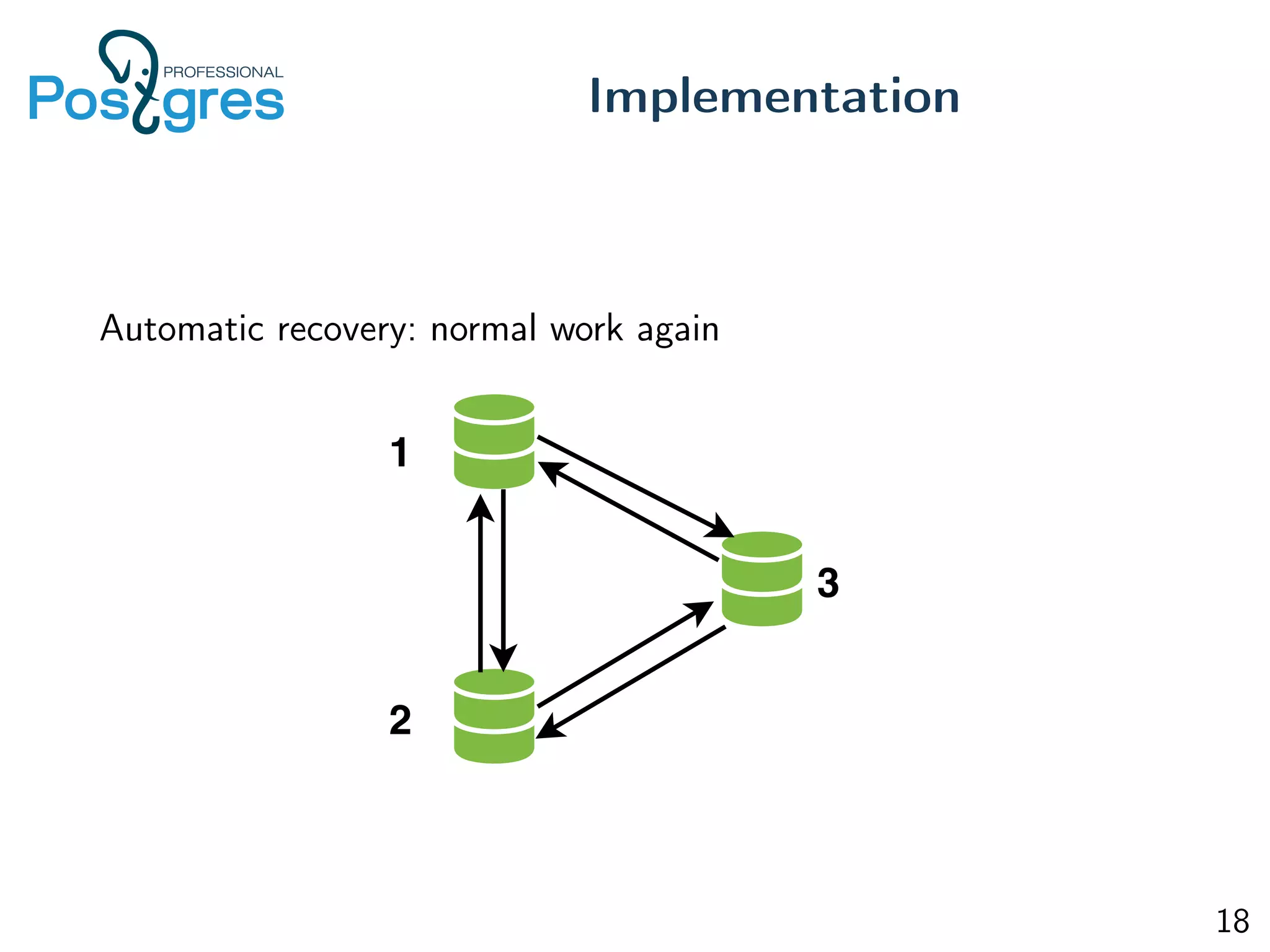
Automatic recovery: normal work again
Implementation
18
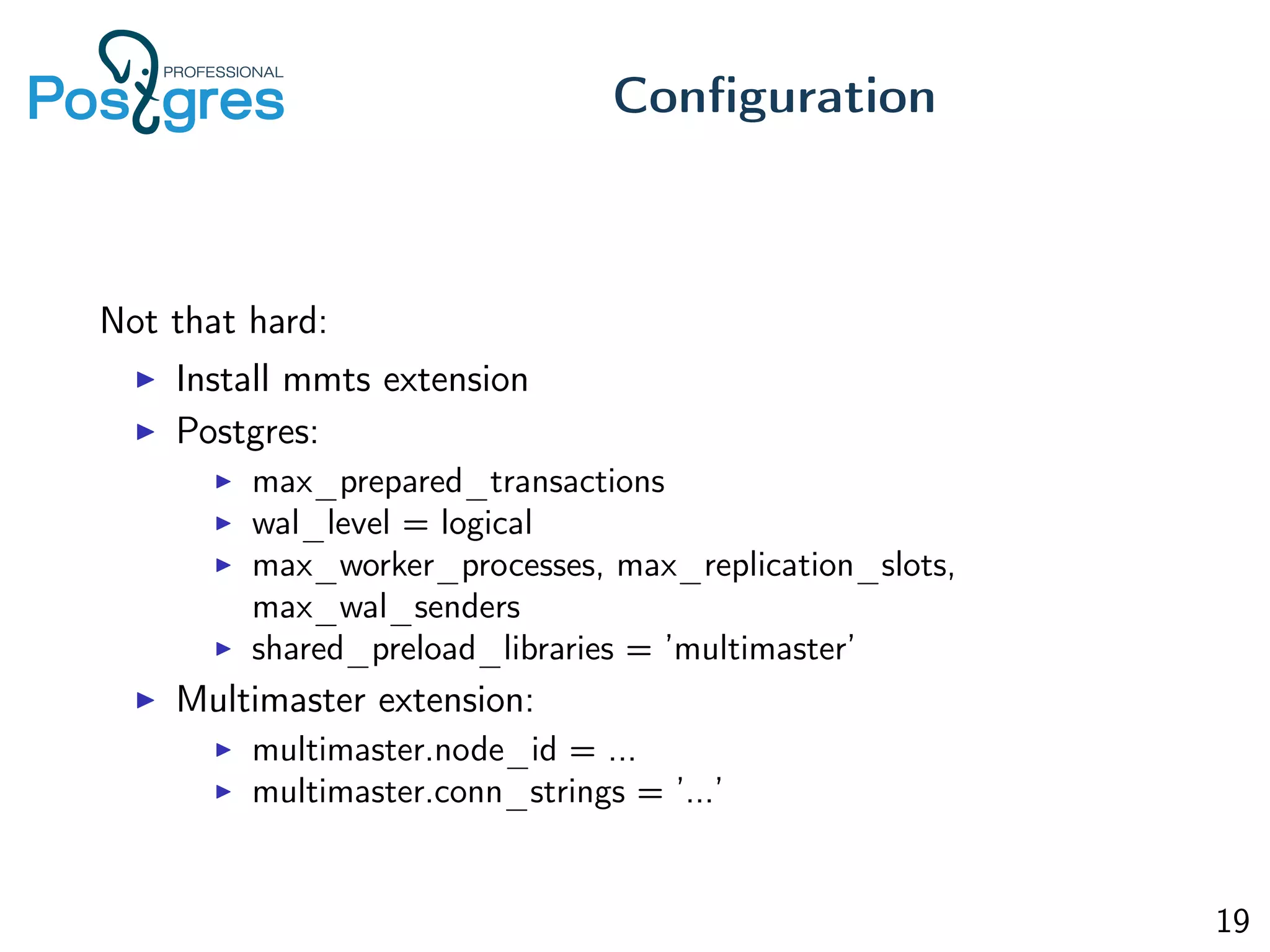
Not that hard:
Install mmts extension
Postgres:
max_prepared_transactions
wal_level = logical
max_worker_processes, max_replication_slots,
max_wal_senders
shared_preload_libraries = ’multimaster’
Multimaster extension:
multimaster.node_id = ...
multimaster.conn_strings = ’...’
Configuration
19
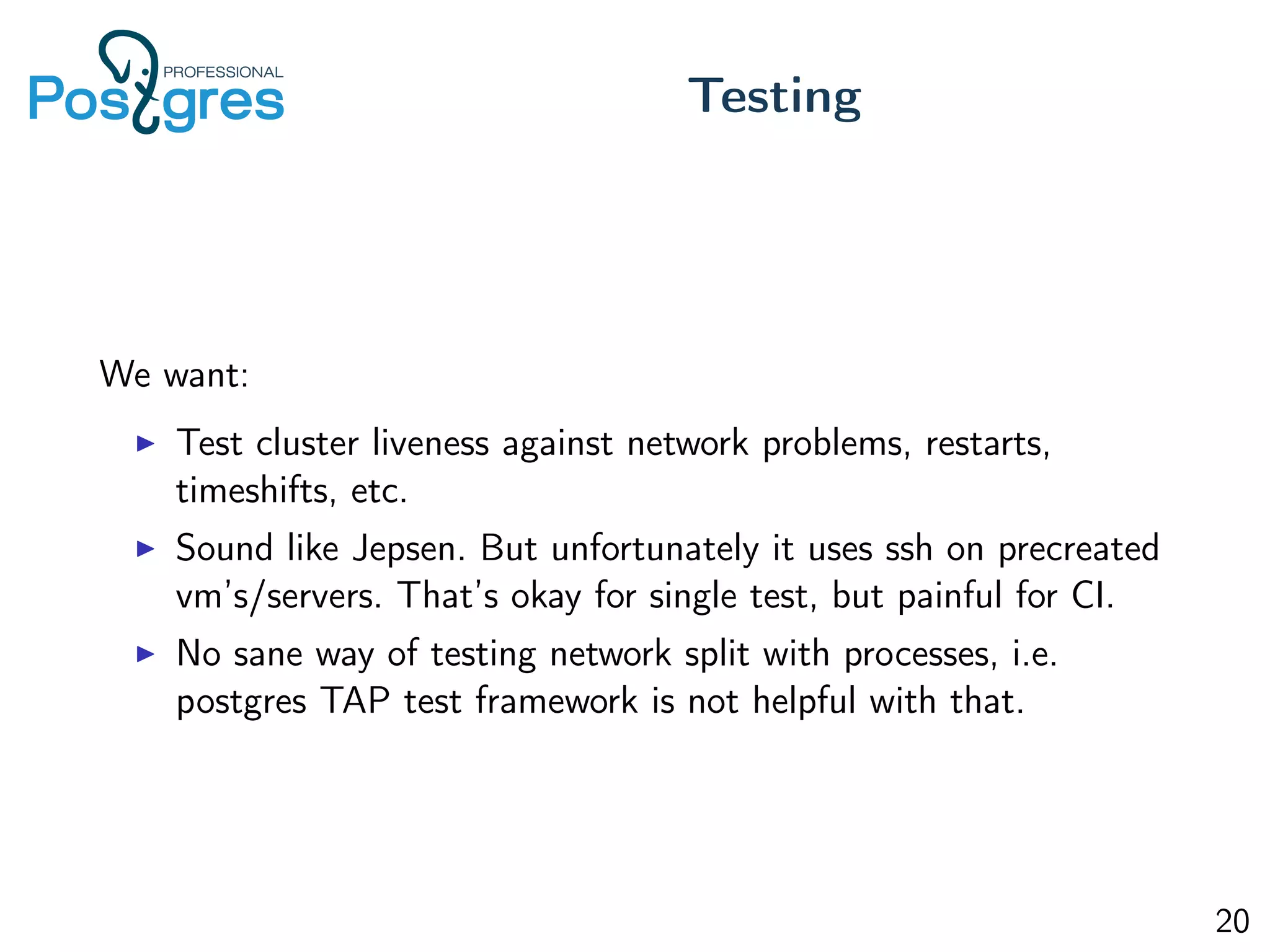
We want:
Test cluster liveness against network problems, restarts,
timeshifts, etc.
Sound like Jepsen. But unfortunately it uses ssh on precreated
vm’s/servers. That’s okay for single test, but painful for CI.
No sane way of testing network split with processes, i.e.
postgres TAP test framework is not helpful with that.
Testing
20
So we are using python unittest with docker.
3-5 containers is _way_ faster to start than vm’s.
takes 10 seconds to compile mmts extension, init and start
cluster.
failure injection via docker.exec (iptables, shift time, etc).
compatible with Travis-CI.
Testing
21
Testing itself: attach clients to each node of cluster and start
abusing nodes.
Client: bank-like test case. Transfer money between accounts
with concurrent total balance calculation.
Testing
22
Failures injected:
Node stop-start
Node kill-start
Node in network partition
Edge network split (a.k.a. majority rings)
Shift time
Change clock speed on nodes with libfaketime *
* – not yet implemented.
Testing
23
Performance.
Read-only tx speed is the same as in standalone postgres.
Commit takes more time (two net roundtrips).
Logical decoding slows down big transactions – but that
should be fixed, patch on commitfest.
Testing
24
Release a public beta
Try to commit twophase decoding patch to pg
Try to commit transation manager patch to pg
Raise discussion about replication/decoding of catalog content
Roadmap
25

Multimaster

  • 1.
    Multi-master replication for Postgres K.Knizhnik, C. Pan, S. Kelvich
  • 2.
  • 3.
  • 4.
    We want: Fault-tolerance ineasy way OLTP-style load Compatibility with standalone postgres Possibility to reuse as metadata storage for sharded cluster Design objectives 4
  • 5.
    Replication: Identical replicated dataon all nodes Possibility to have local tables Writes allowed to any node => Easy to use => We need to take care about proper isolation Design objectives 5
  • 6.
    Transaction manager. Wewant: Avoid single point of failure. +: Spanner, Cockroach, Clock-SI —: Pg-XL, ... Avoid network communication for Read-Only transactions +: HANA, Spanner, Cockroach, Clock-SI —: Pg-XL, ... Design objectives 6
  • 7.
    Fault tolerance. Paxos. Distributedconsensus, low level. Raft. Complete state-machine replication solution with failure detector on timeouts and autorecovery. But all writes are proxied to one node. 2PC. Blocks in case of node and coordinator failure. Postgres already support 2pc. 3PC-like. Extra message between "P"and "C". 3PC, Paxos commit, E3PC. Design objectives 7
  • 8.
    Summary. No performance penaltyfor reads. Tx can be issued to any node. No special actions required in case of failure. Design objectives 8
  • 9.
    github.com/postgrespro/postgres_cluster Patched version ofPostgres 9.6 Transaction Manager API + Deadlock detection API. Logical decoding of 2PC transactions. Mmts extension. Transaction Manager implementation (Clock-SI) Logical replication protocol/client Hooks on transaction commit and transforms it into 2PC. Bunch of bgworkers. Implementation 9
  • 10.
    Mmts uses logicalreplication/decoding. In-core support and extension by 2ndQuadrant. Very flexible: Can skip tables Replication between different versions Logical messages Implementation 10
  • 11.
    BE – backend,WS – Walsender, Arb – Arbiter, WR – Walreceiver Implementation 11
  • 12.
    Transaction Manager. Clock-SI algorithm(MS research) Make use of CSN instead of running lists. (we track xid-csn correspondence in extension, but there is ongoing work to have CSN in-core by Heikki and Alexander) Implementation 12
  • 13.
    DDL replication. Statement-based. Happily, postgressupport 2PC for almost all DDL (alter enum already fixed in -master) CREATE TABLE AS, CREATE MATVIEW, etc – tricky, mixes DDL and DML. Temp tables are tricky – shouldn’t be replicted. Depends on environment (search_path, auth, etc.) Implementation 13
  • 14.
    Postgres compatibility. almost FULLYcompatible with pg. 162 of 166 regressions tests pass as is. 1 test is using prepared statement inside CREATE TABLE AS (CTA). 3 tests are using CTA(CTA(TEMP TABLE)). Some obvious way to abuse statement based replication, e.g. write function that create table with name based on current timestamp. Also sequences can add pain. Implementation 14
  • 15.
    Automatic recovery: normalwork Implementation 15
  • 16.
    Automatic recovery: networksplit Implementation 16
  • 17.
    Automatic recovery: recoveryprocess Implementation 17
  • 18.
    Automatic recovery: normalwork again Implementation 18
  • 19.
    Not that hard: Installmmts extension Postgres: max_prepared_transactions wal_level = logical max_worker_processes, max_replication_slots, max_wal_senders shared_preload_libraries = ’multimaster’ Multimaster extension: multimaster.node_id = ... multimaster.conn_strings = ’...’ Configuration 19
  • 20.
    We want: Test clusterliveness against network problems, restarts, timeshifts, etc. Sound like Jepsen. But unfortunately it uses ssh on precreated vm’s/servers. That’s okay for single test, but painful for CI. No sane way of testing network split with processes, i.e. postgres TAP test framework is not helpful with that. Testing 20
  • 21.
    So we areusing python unittest with docker. 3-5 containers is _way_ faster to start than vm’s. takes 10 seconds to compile mmts extension, init and start cluster. failure injection via docker.exec (iptables, shift time, etc). compatible with Travis-CI. Testing 21
  • 22.
    Testing itself: attachclients to each node of cluster and start abusing nodes. Client: bank-like test case. Transfer money between accounts with concurrent total balance calculation. Testing 22
  • 23.
    Failures injected: Node stop-start Nodekill-start Node in network partition Edge network split (a.k.a. majority rings) Shift time Change clock speed on nodes with libfaketime * * – not yet implemented. Testing 23
  • 24.
    Performance. Read-only tx speedis the same as in standalone postgres. Commit takes more time (two net roundtrips). Logical decoding slows down big transactions – but that should be fixed, patch on commitfest. Testing 24
  • 25.
    Release a publicbeta Try to commit twophase decoding patch to pg Try to commit transation manager patch to pg Raise discussion about replication/decoding of catalog content Roadmap 25