Naveen Kumar Veligeti

SQL Data Types for Various DBs
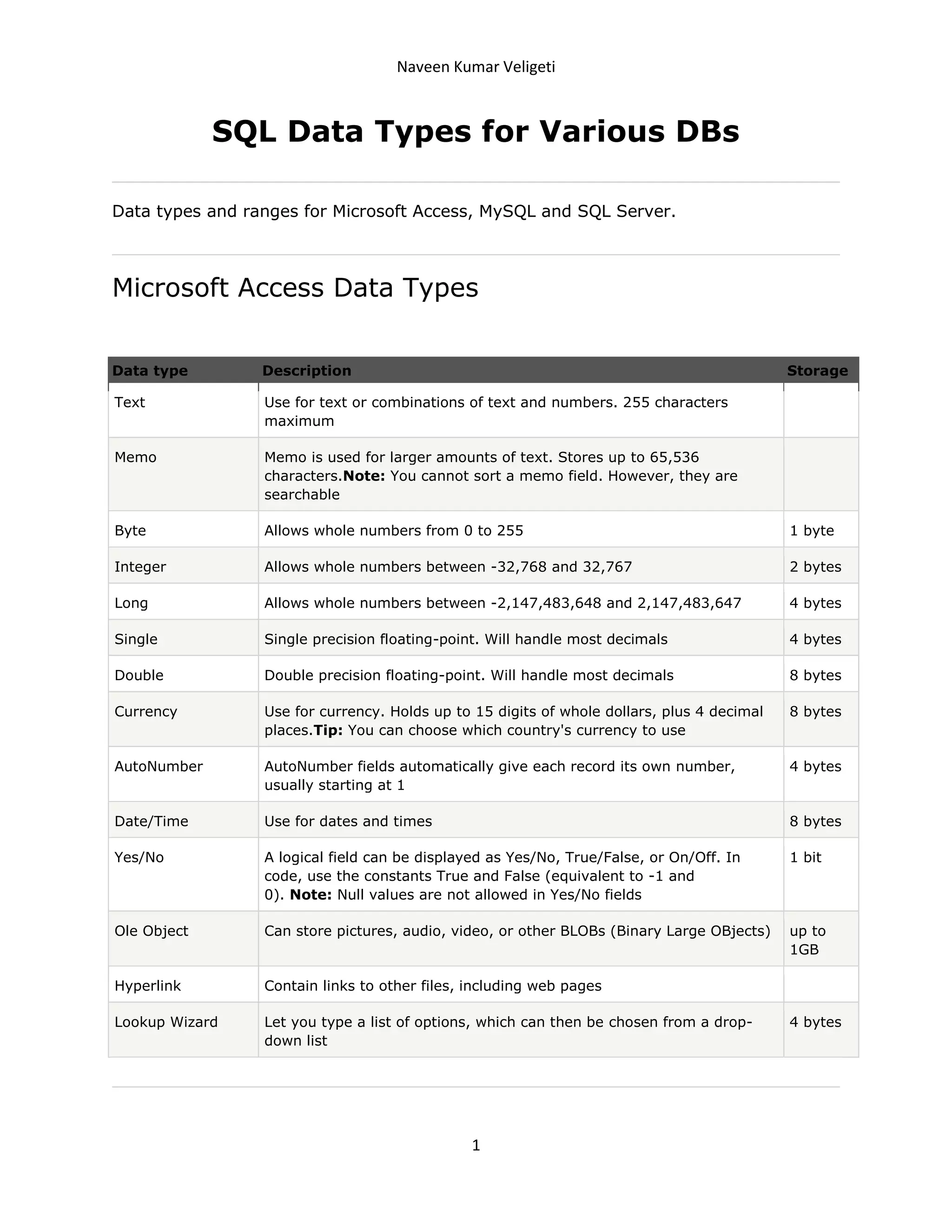
Data types and ranges for Microsoft Access, MySQL and SQL Server.

Microsoft Access Data Types
Data type

Description

Storage

Text

Use for text or combinations of text and numbers. 255 characters
maximum

Memo

Memo is used for larger amounts of text. Stores up to 65,536
characters.Note: You cannot sort a memo field. However, they are
searchable

Byte

Allows whole numbers from 0 to 255

1 byte

Integer

Allows whole numbers between -32,768 and 32,767

2 bytes

Long

Allows whole numbers between -2,147,483,648 and 2,147,483,647

4 bytes

Single

Single precision floating-point. Will handle most decimals

4 bytes

Double

Double precision floating-point. Will handle most decimals

8 bytes

Currency

Use for currency. Holds up to 15 digits of whole dollars, plus 4 decimal
places.Tip: You can choose which country's currency to use

8 bytes

AutoNumber

AutoNumber fields automatically give each record its own number,
usually starting at 1

4 bytes

Date/Time

Use for dates and times

8 bytes

Yes/No

A logical field can be displayed as Yes/No, True/False, or On/Off. In
code, use the constants True and False (equivalent to -1 and
0). Note: Null values are not allowed in Yes/No fields

1 bit

Ole Object

Can store pictures, audio, video, or other BLOBs (Binary Large OBjects)

up to
1GB

Hyperlink

Contain links to other files, including web pages

Lookup Wizard

Let you type a list of options, which can then be chosen from a dropdown list

1

4 bytes
Naveen Kumar Veligeti

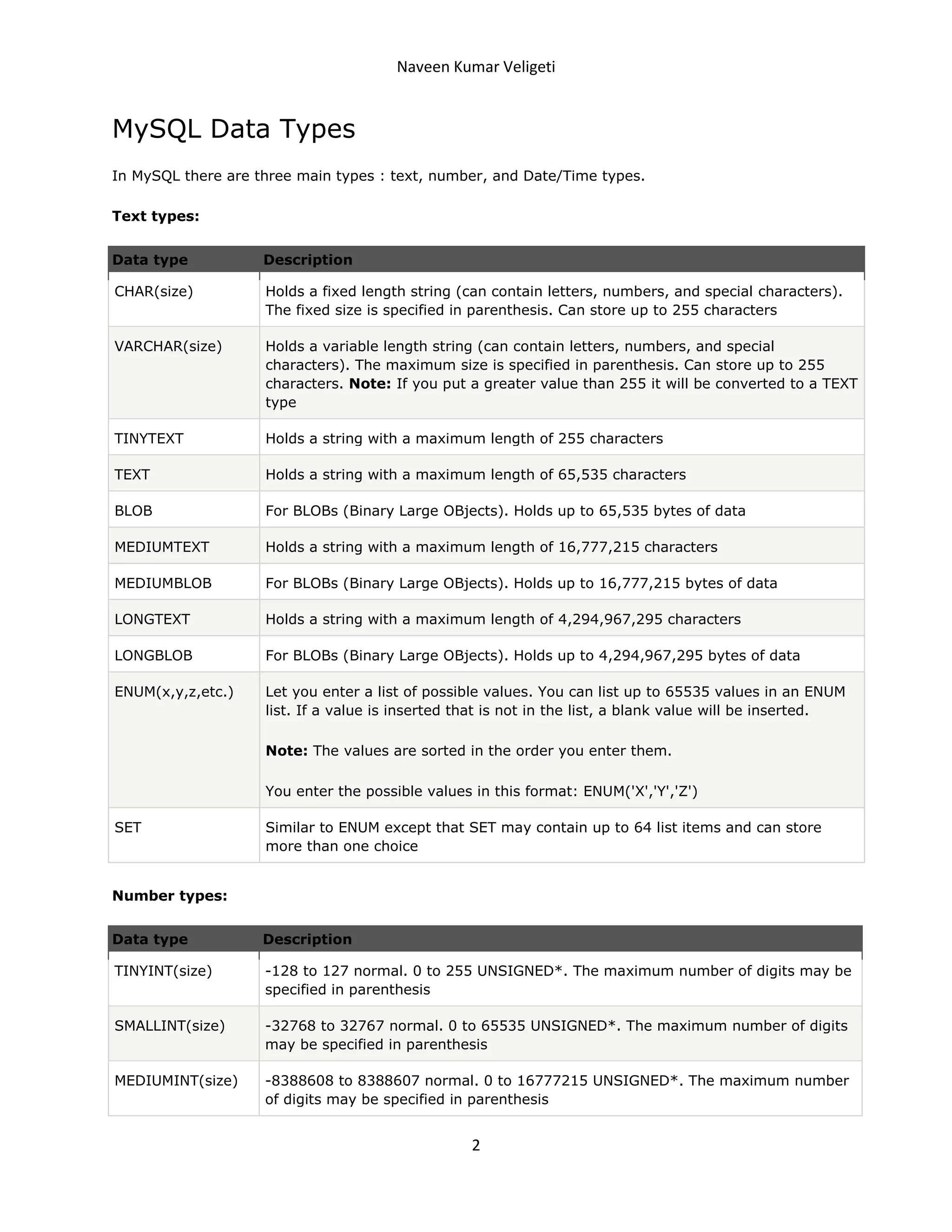
MySQL Data Types
In MySQL there are three main types : text, number, and Date/Time types.
Text types:
Data type

Description

CHAR(size)

Holds a fixed length string (can contain letters, numbers, and special characters).
The fixed size is specified in parenthesis. Can store up to 255 characters

VARCHAR(size)

Holds a variable length string (can contain letters, numbers, and special
characters). The maximum size is specified in parenthesis. Can store up to 255
characters. Note: If you put a greater value than 255 it will be converted to a TEXT
type

TINYTEXT

Holds a string with a maximum length of 255 characters

TEXT

Holds a string with a maximum length of 65,535 characters

BLOB

For BLOBs (Binary Large OBjects). Holds up to 65,535 bytes of data

MEDIUMTEXT

Holds a string with a maximum length of 16,777,215 characters

MEDIUMBLOB

For BLOBs (Binary Large OBjects). Holds up to 16,777,215 bytes of data

LONGTEXT

Holds a string with a maximum length of 4,294,967,295 characters

LONGBLOB

For BLOBs (Binary Large OBjects). Holds up to 4,294,967,295 bytes of data

ENUM(x,y,z,etc.)

Let you enter a list of possible values. You can list up to 65535 values in an ENUM
list. If a value is inserted that is not in the list, a blank value will be inserted.
Note: The values are sorted in the order you enter them.
You enter the possible values in this format: ENUM('X','Y','Z')

SET

Similar to ENUM except that SET may contain up to 64 list items and can store
more than one choice

Number types:
Data type

Description

TINYINT(size)

-128 to 127 normal. 0 to 255 UNSIGNED*. The maximum number of digits may be
specified in parenthesis

SMALLINT(size)

-32768 to 32767 normal. 0 to 65535 UNSIGNED*. The maximum number of digits
may be specified in parenthesis

MEDIUMINT(size)

-8388608 to 8388607 normal. 0 to 16777215 UNSIGNED*. The maximum number
of digits may be specified in parenthesis

2
Naveen Kumar Veligeti

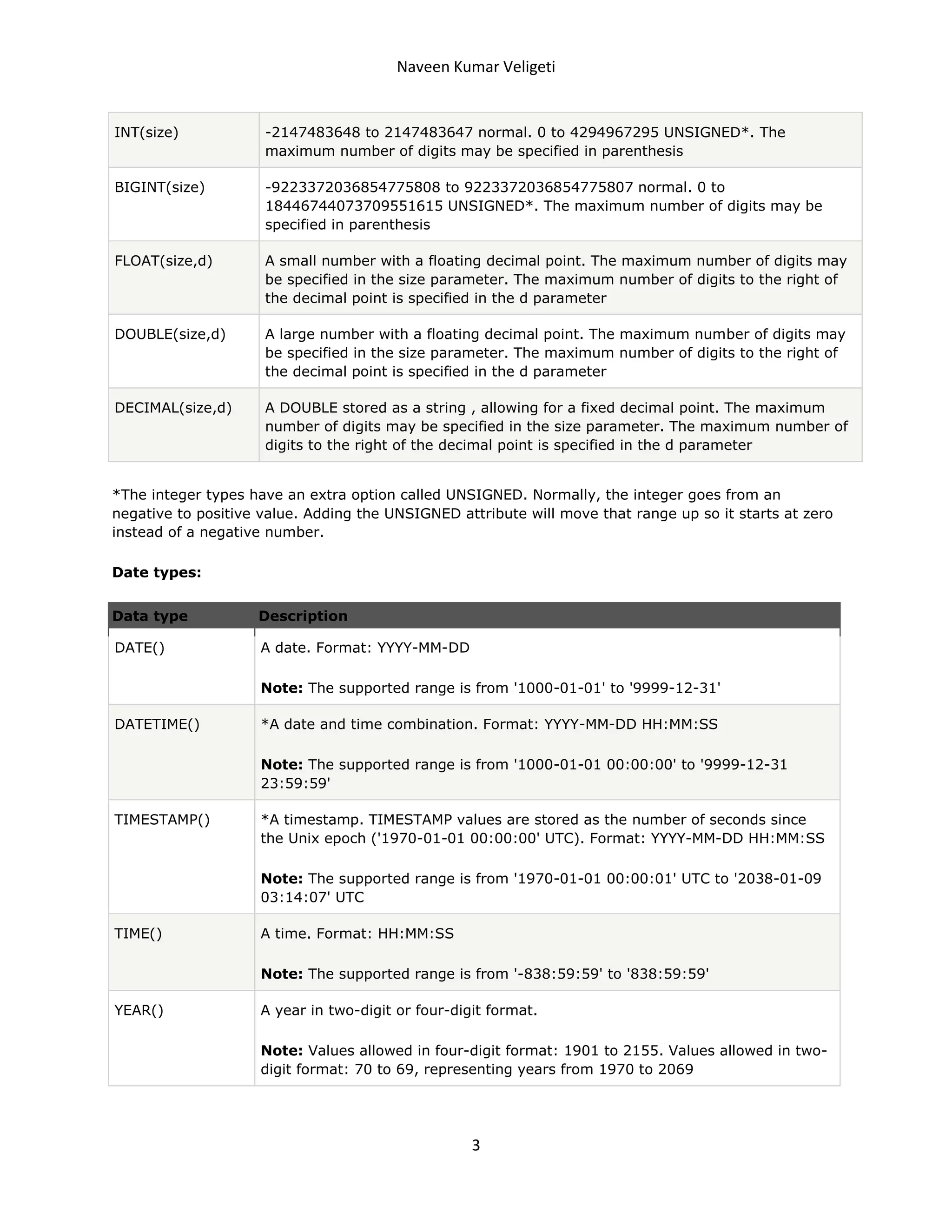
INT(size)

-2147483648 to 2147483647 normal. 0 to 4294967295 UNSIGNED*. The
maximum number of digits may be specified in parenthesis

BIGINT(size)

-9223372036854775808 to 9223372036854775807 normal. 0 to
18446744073709551615 UNSIGNED*. The maximum number of digits may be
specified in parenthesis

FLOAT(size,d)

A small number with a floating decimal point. The maximum number of digits may
be specified in the size parameter. The maximum number of digits to the right of
the decimal point is specified in the d parameter

DOUBLE(size,d)

A large number with a floating decimal point. The maximum number of digits may
be specified in the size parameter. The maximum number of digits to the right of
the decimal point is specified in the d parameter

DECIMAL(size,d)

A DOUBLE stored as a string , allowing for a fixed decimal point. The maximum
number of digits may be specified in the size parameter. The maximum number of
digits to the right of the decimal point is specified in the d parameter

*The integer types have an extra option called UNSIGNED. Normally, the integer goes from an
negative to positive value. Adding the UNSIGNED attribute will move that range up so it starts at zero
instead of a negative number.
Date types:
Data type

Description

DATE()

A date. Format: YYYY-MM-DD
Note: The supported range is from '1000-01-01' to '9999-12-31'

DATETIME()

*A date and time combination. Format: YYYY-MM-DD HH:MM:SS
Note: The supported range is from '1000-01-01 00:00:00' to '9999-12-31
23:59:59'

TIMESTAMP()

*A timestamp. TIMESTAMP values are stored as the number of seconds since
the Unix epoch ('1970-01-01 00:00:00' UTC). Format: YYYY-MM-DD HH:MM:SS
Note: The supported range is from '1970-01-01 00:00:01' UTC to '2038-01-09
03:14:07' UTC

TIME()

A time. Format: HH:MM:SS
Note: The supported range is from '-838:59:59' to '838:59:59'

YEAR()

A year in two-digit or four-digit format.
Note: Values allowed in four-digit format: 1901 to 2155. Values allowed in twodigit format: 70 to 69, representing years from 1970 to 2069

3
Naveen Kumar Veligeti
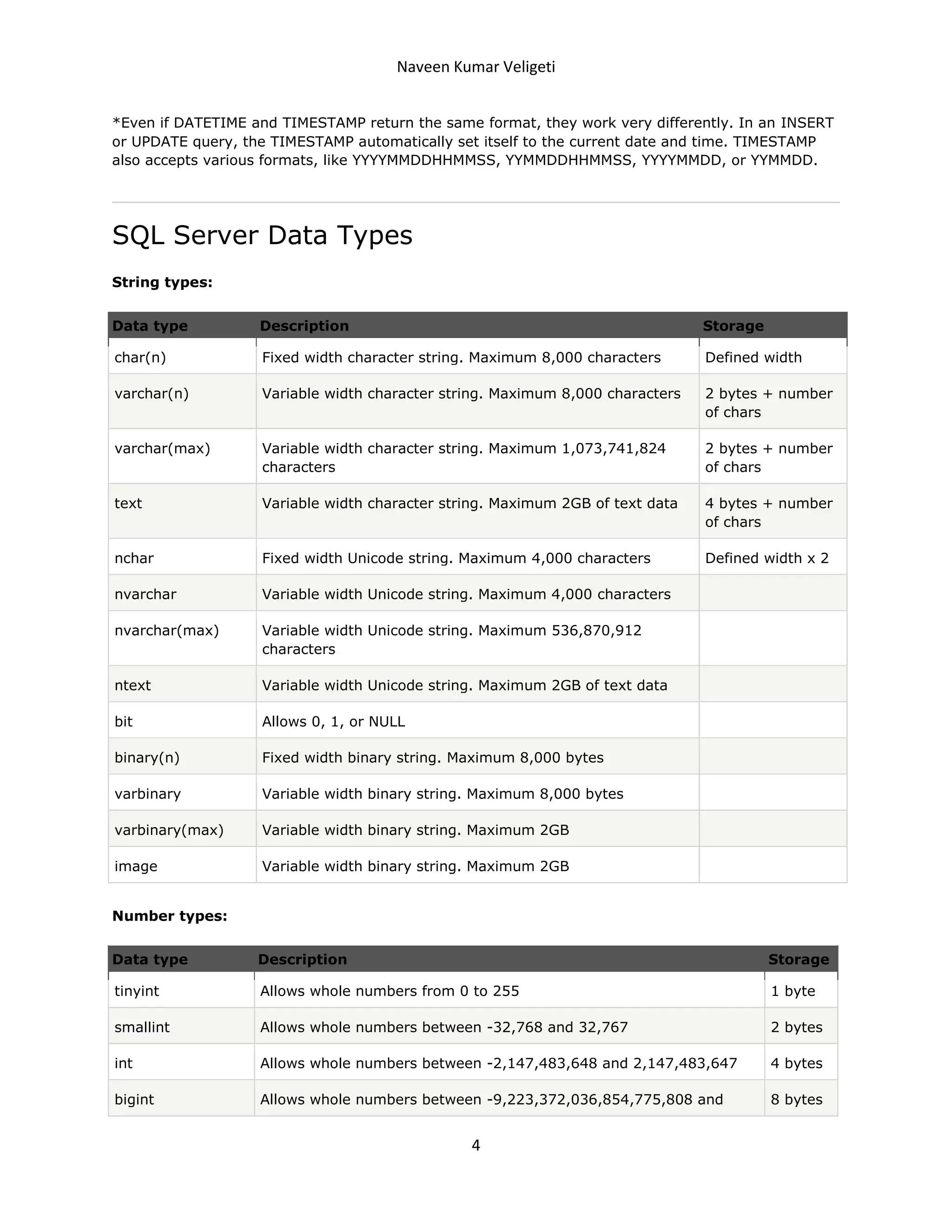
*Even if DATETIME and TIMESTAMP return the same format, they work very differently. In an INSERT
or UPDATE query, the TIMESTAMP automatically set itself to the current date and time. TIMESTAMP
also accepts various formats, like YYYYMMDDHHMMSS, YYMMDDHHMMSS, YYYYMMDD, or YYMMDD.

SQL Server Data Types
String types:
Data type

Description

Storage

char(n)

Fixed width character string. Maximum 8,000 characters

Defined width

varchar(n)

Variable width character string. Maximum 8,000 characters

2 bytes + number
of chars

varchar(max)

Variable width character string. Maximum 1,073,741,824
characters

2 bytes + number
of chars

text

Variable width character string. Maximum 2GB of text data

4 bytes + number
of chars

nchar

Fixed width Unicode string. Maximum 4,000 characters

Defined width x 2

nvarchar

Variable width Unicode string. Maximum 4,000 characters

nvarchar(max)

Variable width Unicode string. Maximum 536,870,912
characters

ntext

Variable width Unicode string. Maximum 2GB of text data

bit

Allows 0, 1, or NULL

binary(n)

Fixed width binary string. Maximum 8,000 bytes

varbinary

Variable width binary string. Maximum 8,000 bytes

varbinary(max)

Variable width binary string. Maximum 2GB

image

Variable width binary string. Maximum 2GB

Number types:
Data type

Description

Storage

tinyint

Allows whole numbers from 0 to 255

1 byte

smallint

Allows whole numbers between -32,768 and 32,767

2 bytes

int

Allows whole numbers between -2,147,483,648 and 2,147,483,647

4 bytes

bigint

Allows whole numbers between -9,223,372,036,854,775,808 and

8 bytes

4
Naveen Kumar Veligeti

9,223,372,036,854,775,807
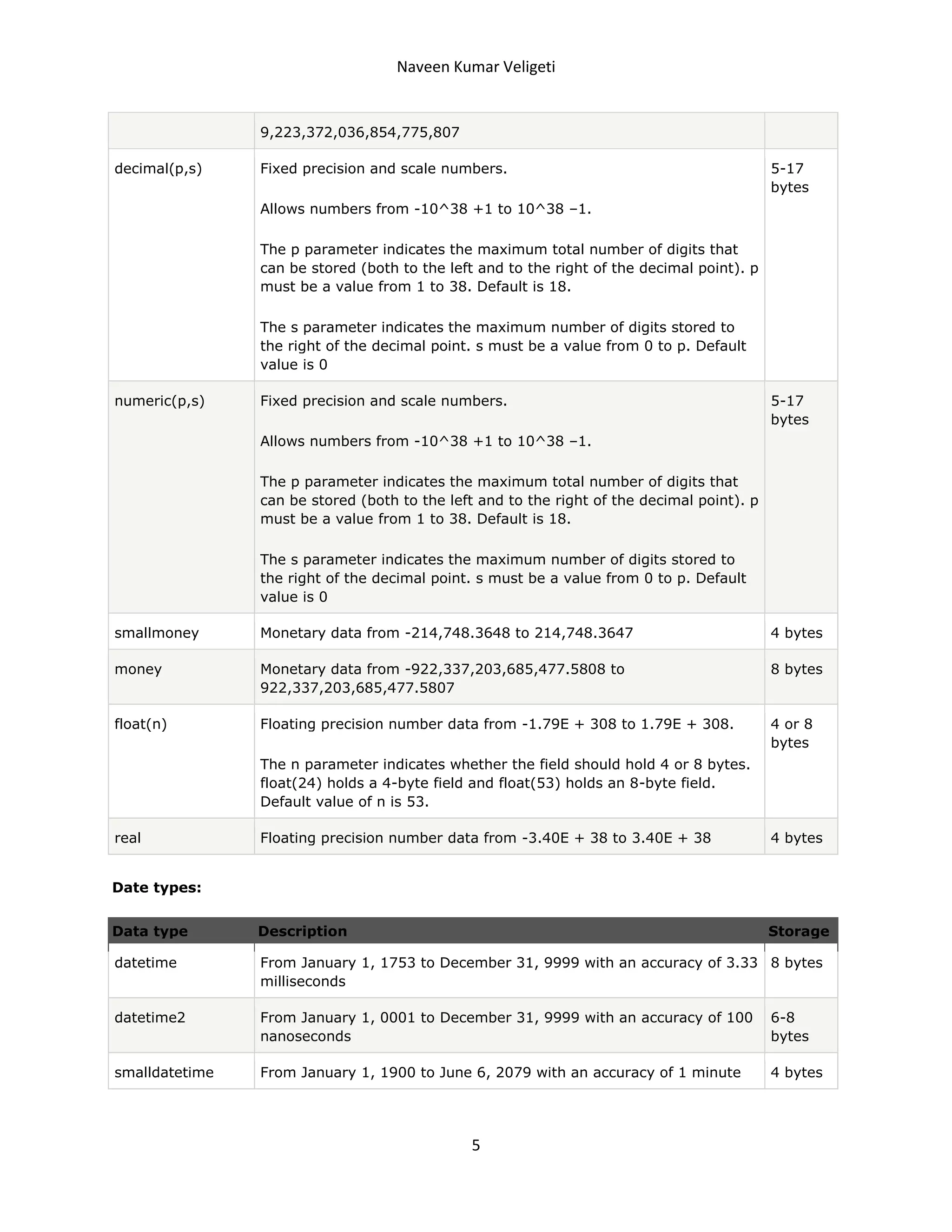
decimal(p,s)

Fixed precision and scale numbers.

5-17
bytes

Allows numbers from -10^38 +1 to 10^38 –1.
The p parameter indicates the maximum total number of digits that
can be stored (both to the left and to the right of the decimal point). p
must be a value from 1 to 38. Default is 18.
The s parameter indicates the maximum number of digits stored to
the right of the decimal point. s must be a value from 0 to p. Default
value is 0
numeric(p,s)

Fixed precision and scale numbers.

5-17
bytes

Allows numbers from -10^38 +1 to 10^38 –1.
The p parameter indicates the maximum total number of digits that
can be stored (both to the left and to the right of the decimal point). p
must be a value from 1 to 38. Default is 18.
The s parameter indicates the maximum number of digits stored to
the right of the decimal point. s must be a value from 0 to p. Default
value is 0
smallmoney

Monetary data from -214,748.3648 to 214,748.3647

4 bytes

money

Monetary data from -922,337,203,685,477.5808 to
922,337,203,685,477.5807

8 bytes

float(n)

Floating precision number data from -1.79E + 308 to 1.79E + 308.

4 or 8
bytes

The n parameter indicates whether the field should hold 4 or 8 bytes.
float(24) holds a 4-byte field and float(53) holds an 8-byte field.
Default value of n is 53.
real

Floating precision number data from -3.40E + 38 to 3.40E + 38

4 bytes

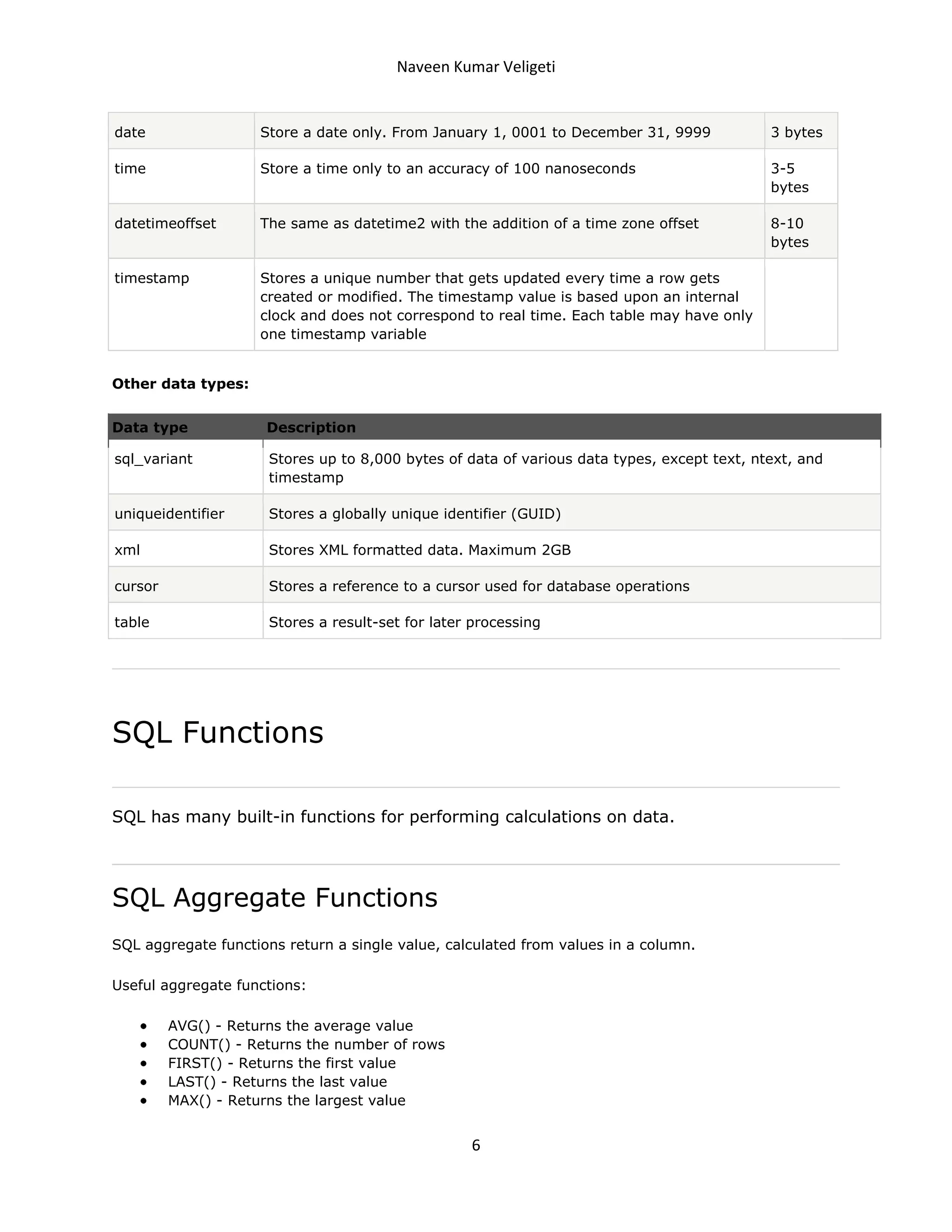
Data type

Description

Storage

datetime

From January 1, 1753 to December 31, 9999 with an accuracy of 3.33 8 bytes
milliseconds

datetime2

From January 1, 0001 to December 31, 9999 with an accuracy of 100
nanoseconds

6-8
bytes

smalldatetime

From January 1, 1900 to June 6, 2079 with an accuracy of 1 minute

4 bytes

Date types:

5
Naveen Kumar Veligeti

date

Store a date only. From January 1, 0001 to December 31, 9999

3 bytes

time

Store a time only to an accuracy of 100 nanoseconds

3-5
bytes

datetimeoffset

The same as datetime2 with the addition of a time zone offset

8-10
bytes

timestamp

Stores a unique number that gets updated every time a row gets
created or modified. The timestamp value is based upon an internal
clock and does not correspond to real time. Each table may have only
one timestamp variable

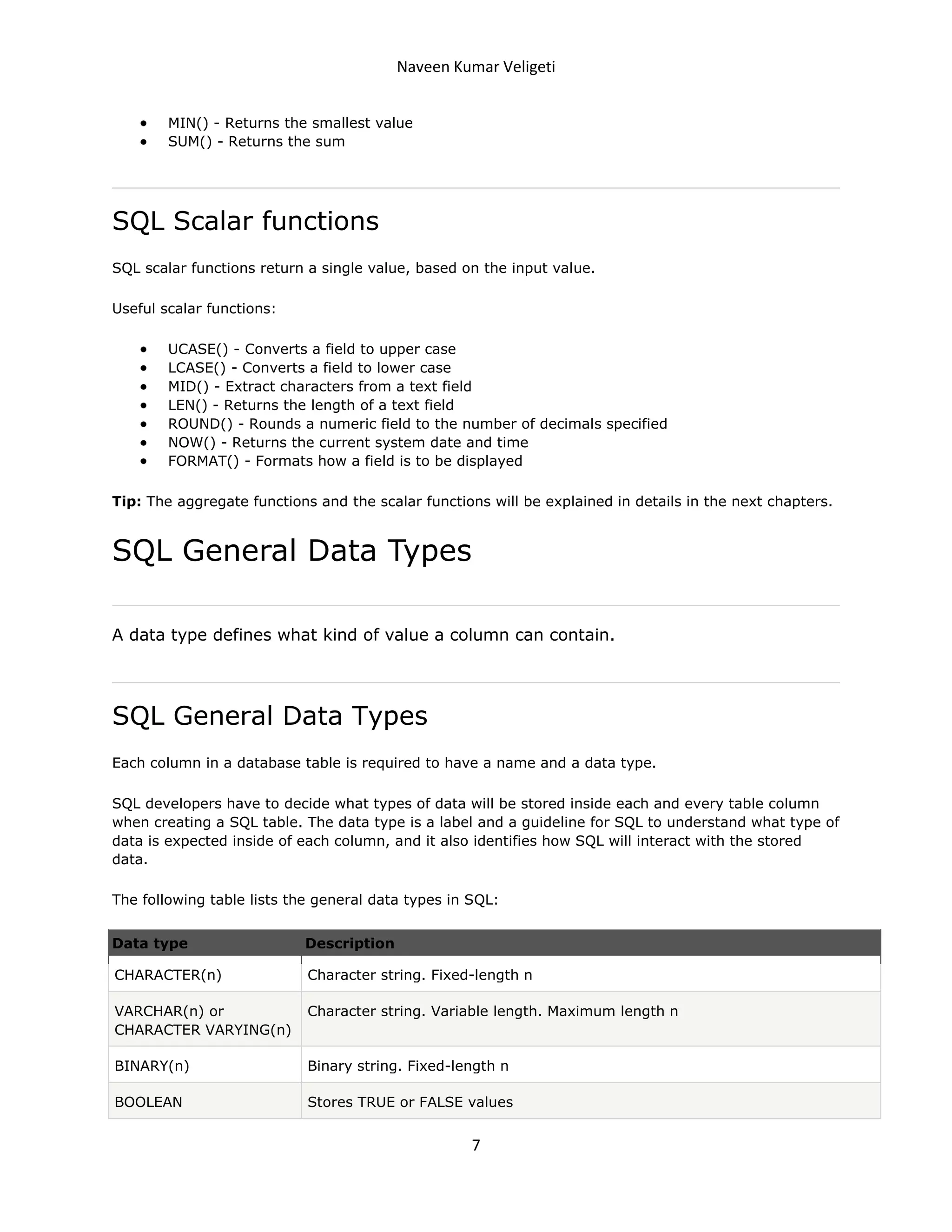
Other data types:
Data type

Description

sql_variant

Stores up to 8,000 bytes of data of various data types, except text, ntext, and
timestamp

uniqueidentifier

Stores a globally unique identifier (GUID)

xml

Stores XML formatted data. Maximum 2GB

cursor

Stores a reference to a cursor used for database operations

table

Stores a result-set for later processing

SQL Functions
SQL has many built-in functions for performing calculations on data.

SQL Aggregate Functions
SQL aggregate functions return a single value, calculated from values in a column.
Useful aggregate functions:
AVG() - Returns the average value
COUNT() - Returns the number of rows
FIRST() - Returns the first value
LAST() - Returns the last value
MAX() - Returns the largest value

6
Naveen Kumar Veligeti
MIN() - Returns the smallest value
SUM() - Returns the sum

SQL Scalar functions
SQL scalar functions return a single value, based on the input value.
Useful scalar functions:
UCASE() - Converts a field to upper case
LCASE() - Converts a field to lower case
MID() - Extract characters from a text field
LEN() - Returns the length of a text field
ROUND() - Rounds a numeric field to the number of decimals specified
NOW() - Returns the current system date and time
FORMAT() - Formats how a field is to be displayed
Tip: The aggregate functions and the scalar functions will be explained in details in the next chapters.

SQL General Data Types
A data type defines what kind of value a column can contain.

SQL General Data Types
Each column in a database table is required to have a name and a data type.
SQL developers have to decide what types of data will be stored inside each and every table column
when creating a SQL table. The data type is a label and a guideline for SQL to understand what type of
data is expected inside of each column, and it also identifies how SQL will interact with the stored
data.
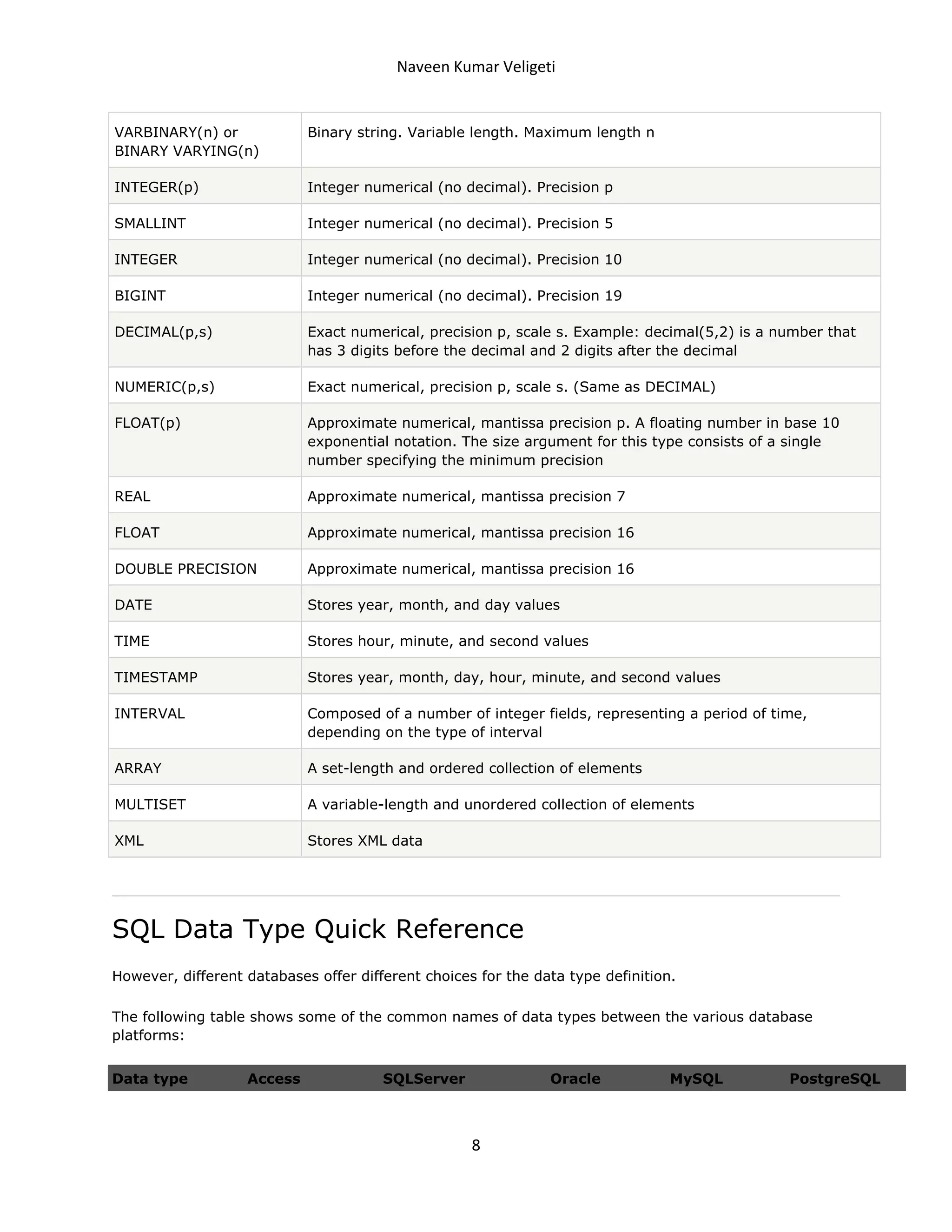
The following table lists the general data types in SQL:
Data type

Description

CHARACTER(n)

Character string. Fixed-length n

VARCHAR(n) or
CHARACTER VARYING(n)

Character string. Variable length. Maximum length n

BINARY(n)

Binary string. Fixed-length n

BOOLEAN

Stores TRUE or FALSE values

7
Naveen Kumar Veligeti

VARBINARY(n) or
BINARY VARYING(n)

Binary string. Variable length. Maximum length n

INTEGER(p)

Integer numerical (no decimal). Precision p

SMALLINT

Integer numerical (no decimal). Precision 5

INTEGER

Integer numerical (no decimal). Precision 10

BIGINT

Integer numerical (no decimal). Precision 19

DECIMAL(p,s)

Exact numerical, precision p, scale s. Example: decimal(5,2) is a number that
has 3 digits before the decimal and 2 digits after the decimal

NUMERIC(p,s)

Exact numerical, precision p, scale s. (Same as DECIMAL)

FLOAT(p)

Approximate numerical, mantissa precision p. A floating number in base 10
exponential notation. The size argument for this type consists of a single
number specifying the minimum precision

REAL

Approximate numerical, mantissa precision 7

FLOAT

Approximate numerical, mantissa precision 16

DOUBLE PRECISION

Approximate numerical, mantissa precision 16

DATE

Stores year, month, and day values

TIME

Stores hour, minute, and second values

TIMESTAMP

Stores year, month, day, hour, minute, and second values

INTERVAL

Composed of a number of integer fields, representing a period of time,
depending on the type of interval

ARRAY

A set-length and ordered collection of elements

MULTISET

A variable-length and unordered collection of elements

XML

Stores XML data

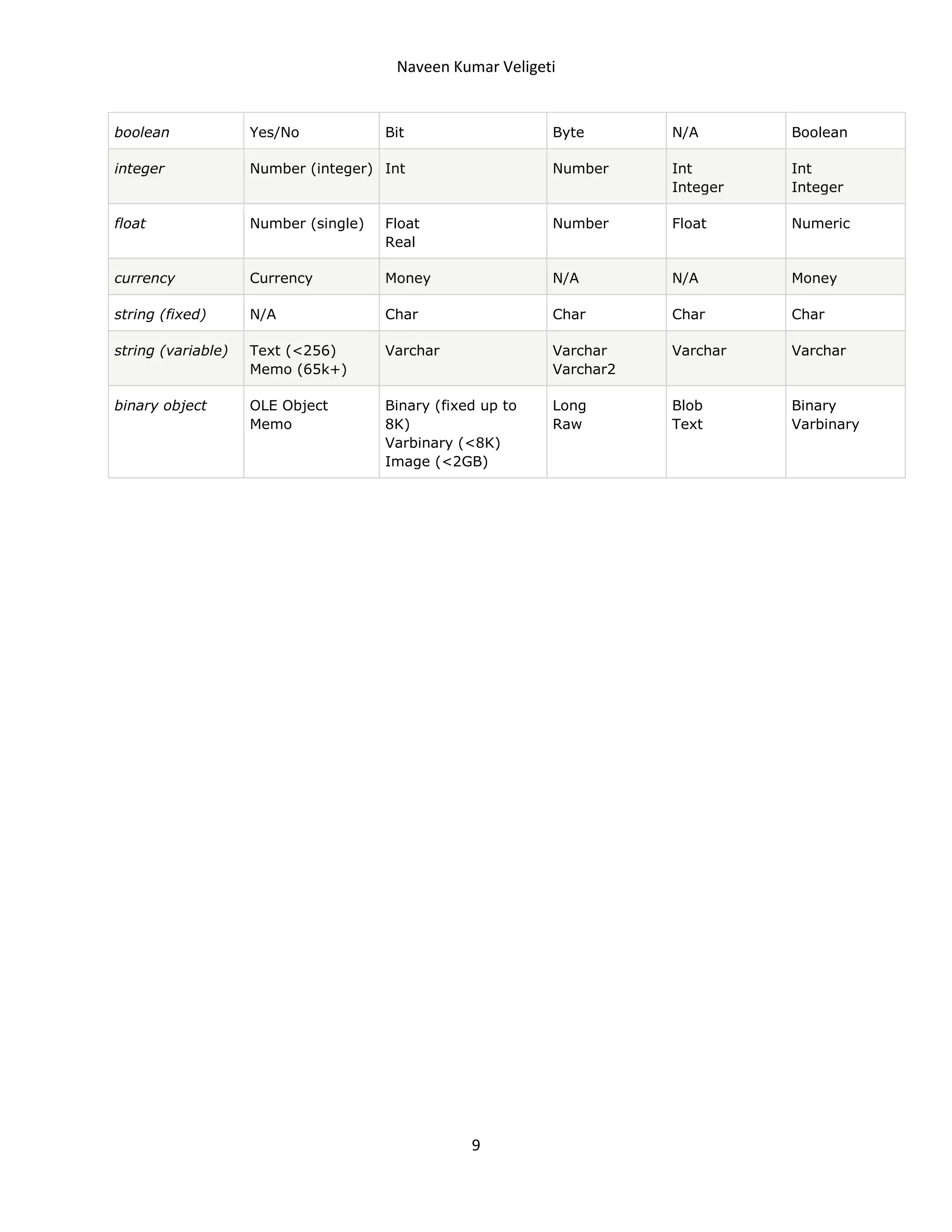
SQL Data Type Quick Reference
However, different databases offer different choices for the data type definition.
The following table shows some of the common names of data types between the various database
platforms:
Data type

Access

SQLServer

Oracle

8

MySQL

PostgreSQL
Naveen Kumar Veligeti

boolean

Yes/No

integer

Bit

Byte

N/A

Boolean

Number (integer) Int

Number

Int
Integer

Int
Integer

float

Number (single)

Float
Real

Number

Float

Numeric

currency

Currency

Money

N/A

N/A

Money

string (fixed)

N/A

Char

Char

Char

Char

string (variable)

Text (<256)
Memo (65k+)

Varchar

Varchar
Varchar2

Varchar

Varchar

binary object

OLE Object
Memo

Binary (fixed up to
8K)
Varbinary (<8K)
Image (<2GB)

Long
Raw

Blob
Text

Binary
Varbinary

9

Sql data types for various d bs by naveen kumar veligeti

  • 1.
    Naveen Kumar Veligeti SQLData Types for Various DBs Data types and ranges for Microsoft Access, MySQL and SQL Server. Microsoft Access Data Types Data type Description Storage Text Use for text or combinations of text and numbers. 255 characters maximum Memo Memo is used for larger amounts of text. Stores up to 65,536 characters.Note: You cannot sort a memo field. However, they are searchable Byte Allows whole numbers from 0 to 255 1 byte Integer Allows whole numbers between -32,768 and 32,767 2 bytes Long Allows whole numbers between -2,147,483,648 and 2,147,483,647 4 bytes Single Single precision floating-point. Will handle most decimals 4 bytes Double Double precision floating-point. Will handle most decimals 8 bytes Currency Use for currency. Holds up to 15 digits of whole dollars, plus 4 decimal places.Tip: You can choose which country's currency to use 8 bytes AutoNumber AutoNumber fields automatically give each record its own number, usually starting at 1 4 bytes Date/Time Use for dates and times 8 bytes Yes/No A logical field can be displayed as Yes/No, True/False, or On/Off. In code, use the constants True and False (equivalent to -1 and 0). Note: Null values are not allowed in Yes/No fields 1 bit Ole Object Can store pictures, audio, video, or other BLOBs (Binary Large OBjects) up to 1GB Hyperlink Contain links to other files, including web pages Lookup Wizard Let you type a list of options, which can then be chosen from a dropdown list 1 4 bytes
  • 2.
    Naveen Kumar Veligeti MySQLData Types In MySQL there are three main types : text, number, and Date/Time types. Text types: Data type Description CHAR(size) Holds a fixed length string (can contain letters, numbers, and special characters). The fixed size is specified in parenthesis. Can store up to 255 characters VARCHAR(size) Holds a variable length string (can contain letters, numbers, and special characters). The maximum size is specified in parenthesis. Can store up to 255 characters. Note: If you put a greater value than 255 it will be converted to a TEXT type TINYTEXT Holds a string with a maximum length of 255 characters TEXT Holds a string with a maximum length of 65,535 characters BLOB For BLOBs (Binary Large OBjects). Holds up to 65,535 bytes of data MEDIUMTEXT Holds a string with a maximum length of 16,777,215 characters MEDIUMBLOB For BLOBs (Binary Large OBjects). Holds up to 16,777,215 bytes of data LONGTEXT Holds a string with a maximum length of 4,294,967,295 characters LONGBLOB For BLOBs (Binary Large OBjects). Holds up to 4,294,967,295 bytes of data ENUM(x,y,z,etc.) Let you enter a list of possible values. You can list up to 65535 values in an ENUM list. If a value is inserted that is not in the list, a blank value will be inserted. Note: The values are sorted in the order you enter them. You enter the possible values in this format: ENUM('X','Y','Z') SET Similar to ENUM except that SET may contain up to 64 list items and can store more than one choice Number types: Data type Description TINYINT(size) -128 to 127 normal. 0 to 255 UNSIGNED*. The maximum number of digits may be specified in parenthesis SMALLINT(size) -32768 to 32767 normal. 0 to 65535 UNSIGNED*. The maximum number of digits may be specified in parenthesis MEDIUMINT(size) -8388608 to 8388607 normal. 0 to 16777215 UNSIGNED*. The maximum number of digits may be specified in parenthesis 2
  • 3.
    Naveen Kumar Veligeti INT(size) -2147483648to 2147483647 normal. 0 to 4294967295 UNSIGNED*. The maximum number of digits may be specified in parenthesis BIGINT(size) -9223372036854775808 to 9223372036854775807 normal. 0 to 18446744073709551615 UNSIGNED*. The maximum number of digits may be specified in parenthesis FLOAT(size,d) A small number with a floating decimal point. The maximum number of digits may be specified in the size parameter. The maximum number of digits to the right of the decimal point is specified in the d parameter DOUBLE(size,d) A large number with a floating decimal point. The maximum number of digits may be specified in the size parameter. The maximum number of digits to the right of the decimal point is specified in the d parameter DECIMAL(size,d) A DOUBLE stored as a string , allowing for a fixed decimal point. The maximum number of digits may be specified in the size parameter. The maximum number of digits to the right of the decimal point is specified in the d parameter *The integer types have an extra option called UNSIGNED. Normally, the integer goes from an negative to positive value. Adding the UNSIGNED attribute will move that range up so it starts at zero instead of a negative number. Date types: Data type Description DATE() A date. Format: YYYY-MM-DD Note: The supported range is from '1000-01-01' to '9999-12-31' DATETIME() *A date and time combination. Format: YYYY-MM-DD HH:MM:SS Note: The supported range is from '1000-01-01 00:00:00' to '9999-12-31 23:59:59' TIMESTAMP() *A timestamp. TIMESTAMP values are stored as the number of seconds since the Unix epoch ('1970-01-01 00:00:00' UTC). Format: YYYY-MM-DD HH:MM:SS Note: The supported range is from '1970-01-01 00:00:01' UTC to '2038-01-09 03:14:07' UTC TIME() A time. Format: HH:MM:SS Note: The supported range is from '-838:59:59' to '838:59:59' YEAR() A year in two-digit or four-digit format. Note: Values allowed in four-digit format: 1901 to 2155. Values allowed in twodigit format: 70 to 69, representing years from 1970 to 2069 3
  • 4.
    Naveen Kumar Veligeti *Evenif DATETIME and TIMESTAMP return the same format, they work very differently. In an INSERT or UPDATE query, the TIMESTAMP automatically set itself to the current date and time. TIMESTAMP also accepts various formats, like YYYYMMDDHHMMSS, YYMMDDHHMMSS, YYYYMMDD, or YYMMDD. SQL Server Data Types String types: Data type Description Storage char(n) Fixed width character string. Maximum 8,000 characters Defined width varchar(n) Variable width character string. Maximum 8,000 characters 2 bytes + number of chars varchar(max) Variable width character string. Maximum 1,073,741,824 characters 2 bytes + number of chars text Variable width character string. Maximum 2GB of text data 4 bytes + number of chars nchar Fixed width Unicode string. Maximum 4,000 characters Defined width x 2 nvarchar Variable width Unicode string. Maximum 4,000 characters nvarchar(max) Variable width Unicode string. Maximum 536,870,912 characters ntext Variable width Unicode string. Maximum 2GB of text data bit Allows 0, 1, or NULL binary(n) Fixed width binary string. Maximum 8,000 bytes varbinary Variable width binary string. Maximum 8,000 bytes varbinary(max) Variable width binary string. Maximum 2GB image Variable width binary string. Maximum 2GB Number types: Data type Description Storage tinyint Allows whole numbers from 0 to 255 1 byte smallint Allows whole numbers between -32,768 and 32,767 2 bytes int Allows whole numbers between -2,147,483,648 and 2,147,483,647 4 bytes bigint Allows whole numbers between -9,223,372,036,854,775,808 and 8 bytes 4
  • 5.
    Naveen Kumar Veligeti 9,223,372,036,854,775,807 decimal(p,s) Fixedprecision and scale numbers. 5-17 bytes Allows numbers from -10^38 +1 to 10^38 –1. The p parameter indicates the maximum total number of digits that can be stored (both to the left and to the right of the decimal point). p must be a value from 1 to 38. Default is 18. The s parameter indicates the maximum number of digits stored to the right of the decimal point. s must be a value from 0 to p. Default value is 0 numeric(p,s) Fixed precision and scale numbers. 5-17 bytes Allows numbers from -10^38 +1 to 10^38 –1. The p parameter indicates the maximum total number of digits that can be stored (both to the left and to the right of the decimal point). p must be a value from 1 to 38. Default is 18. The s parameter indicates the maximum number of digits stored to the right of the decimal point. s must be a value from 0 to p. Default value is 0 smallmoney Monetary data from -214,748.3648 to 214,748.3647 4 bytes money Monetary data from -922,337,203,685,477.5808 to 922,337,203,685,477.5807 8 bytes float(n) Floating precision number data from -1.79E + 308 to 1.79E + 308. 4 or 8 bytes The n parameter indicates whether the field should hold 4 or 8 bytes. float(24) holds a 4-byte field and float(53) holds an 8-byte field. Default value of n is 53. real Floating precision number data from -3.40E + 38 to 3.40E + 38 4 bytes Data type Description Storage datetime From January 1, 1753 to December 31, 9999 with an accuracy of 3.33 8 bytes milliseconds datetime2 From January 1, 0001 to December 31, 9999 with an accuracy of 100 nanoseconds 6-8 bytes smalldatetime From January 1, 1900 to June 6, 2079 with an accuracy of 1 minute 4 bytes Date types: 5
  • 6.
    Naveen Kumar Veligeti date Storea date only. From January 1, 0001 to December 31, 9999 3 bytes time Store a time only to an accuracy of 100 nanoseconds 3-5 bytes datetimeoffset The same as datetime2 with the addition of a time zone offset 8-10 bytes timestamp Stores a unique number that gets updated every time a row gets created or modified. The timestamp value is based upon an internal clock and does not correspond to real time. Each table may have only one timestamp variable Other data types: Data type Description sql_variant Stores up to 8,000 bytes of data of various data types, except text, ntext, and timestamp uniqueidentifier Stores a globally unique identifier (GUID) xml Stores XML formatted data. Maximum 2GB cursor Stores a reference to a cursor used for database operations table Stores a result-set for later processing SQL Functions SQL has many built-in functions for performing calculations on data. SQL Aggregate Functions SQL aggregate functions return a single value, calculated from values in a column. Useful aggregate functions: AVG() - Returns the average value COUNT() - Returns the number of rows FIRST() - Returns the first value LAST() - Returns the last value MAX() - Returns the largest value 6
  • 7.
    Naveen Kumar Veligeti MIN()- Returns the smallest value SUM() - Returns the sum SQL Scalar functions SQL scalar functions return a single value, based on the input value. Useful scalar functions: UCASE() - Converts a field to upper case LCASE() - Converts a field to lower case MID() - Extract characters from a text field LEN() - Returns the length of a text field ROUND() - Rounds a numeric field to the number of decimals specified NOW() - Returns the current system date and time FORMAT() - Formats how a field is to be displayed Tip: The aggregate functions and the scalar functions will be explained in details in the next chapters. SQL General Data Types A data type defines what kind of value a column can contain. SQL General Data Types Each column in a database table is required to have a name and a data type. SQL developers have to decide what types of data will be stored inside each and every table column when creating a SQL table. The data type is a label and a guideline for SQL to understand what type of data is expected inside of each column, and it also identifies how SQL will interact with the stored data. The following table lists the general data types in SQL: Data type Description CHARACTER(n) Character string. Fixed-length n VARCHAR(n) or CHARACTER VARYING(n) Character string. Variable length. Maximum length n BINARY(n) Binary string. Fixed-length n BOOLEAN Stores TRUE or FALSE values 7
  • 8.
    Naveen Kumar Veligeti VARBINARY(n)or BINARY VARYING(n) Binary string. Variable length. Maximum length n INTEGER(p) Integer numerical (no decimal). Precision p SMALLINT Integer numerical (no decimal). Precision 5 INTEGER Integer numerical (no decimal). Precision 10 BIGINT Integer numerical (no decimal). Precision 19 DECIMAL(p,s) Exact numerical, precision p, scale s. Example: decimal(5,2) is a number that has 3 digits before the decimal and 2 digits after the decimal NUMERIC(p,s) Exact numerical, precision p, scale s. (Same as DECIMAL) FLOAT(p) Approximate numerical, mantissa precision p. A floating number in base 10 exponential notation. The size argument for this type consists of a single number specifying the minimum precision REAL Approximate numerical, mantissa precision 7 FLOAT Approximate numerical, mantissa precision 16 DOUBLE PRECISION Approximate numerical, mantissa precision 16 DATE Stores year, month, and day values TIME Stores hour, minute, and second values TIMESTAMP Stores year, month, day, hour, minute, and second values INTERVAL Composed of a number of integer fields, representing a period of time, depending on the type of interval ARRAY A set-length and ordered collection of elements MULTISET A variable-length and unordered collection of elements XML Stores XML data SQL Data Type Quick Reference However, different databases offer different choices for the data type definition. The following table shows some of the common names of data types between the various database platforms: Data type Access SQLServer Oracle 8 MySQL PostgreSQL
  • 9.
    Naveen Kumar Veligeti boolean Yes/No integer Bit Byte N/A Boolean Number(integer) Int Number Int Integer Int Integer float Number (single) Float Real Number Float Numeric currency Currency Money N/A N/A Money string (fixed) N/A Char Char Char Char string (variable) Text (<256) Memo (65k+) Varchar Varchar Varchar2 Varchar Varchar binary object OLE Object Memo Binary (fixed up to 8K) Varbinary (<8K) Image (<2GB) Long Raw Blob Text Binary Varbinary 9