DATA TYPES
•Data types are used to define a variable before it
can be used in a program.
•C data types are defined as the data storage format
that a variable can store a data to perform a specific
operation.
Data Types
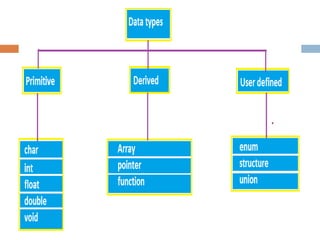
 Data Types is further divided into 3 parts.
1. Primitive
2. Derived
3. User Defined
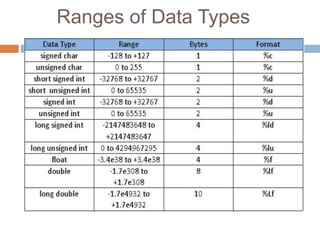
Ranges of Data Types
Integer Data Type
 Integer data type allows a variable to store
numeric values.
 “int” keyword is used to refer integer data type.
 The storage size of int data type is 2 bytes.
 int (2 byte) can store values from -32,768 to
+32,767
 If you want to use the integer value that
crosses the above limit, you can go for “long
int” for which the limits are very high.
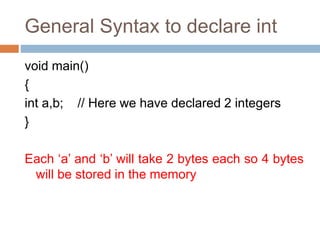
General Syntax to declare int
void main()
{
int a,b; // Here we have declared 2 integers
}
Each ‘a’ and ‘b’ will take 2 bytes each so 4 bytes
will be stored in the memory
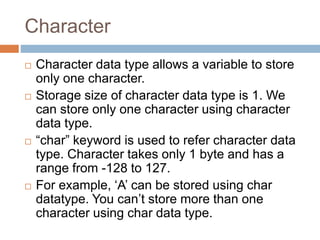
Character
 Character data type allows a variable to store
only one character.
 Storage size of character data type is 1. We
can store only one character using character
data type.
 “char” keyword is used to refer character data
type. Character takes only 1 byte and has a
range from -128 to 127.
 For example, ‘A’ can be stored using char
datatype. You can’t store more than one
character using char data type.
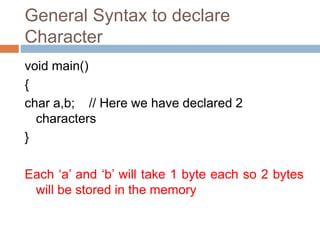
General Syntax to declare
Character
void main()
{
char a,b; // Here we have declared 2
characters
}
Each ‘a’ and ‘b’ will take 1 byte each so 2 bytes
will be stored in the memory
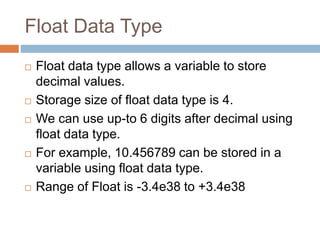
Float Data Type
 Float data type allows a variable to store
decimal values.
 Storage size of float data type is 4.
 We can use up-to 6 digits after decimal using
float data type.
 For example, 10.456789 can be stored in a
variable using float data type.
 Range of Float is -3.4e38 to +3.4e38
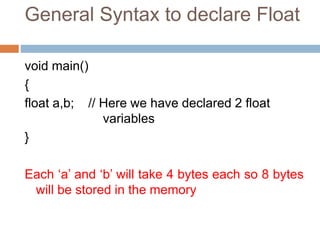
General Syntax to declare Float
void main()
{
float a,b; // Here we have declared 2 float
variables
}
Each ‘a’ and ‘b’ will take 4 bytes each so 8 bytes
will be stored in the memory
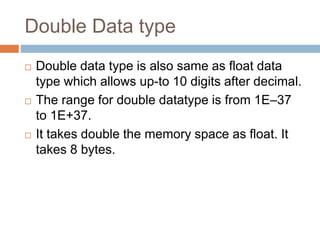
Double Data type
 Double data type is also same as float data
type which allows up-to 10 digits after decimal.
 The range for double datatype is from 1E–37
to 1E+37.
 It takes double the memory space as float. It
takes 8 bytes.
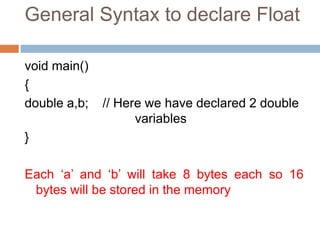
General Syntax to declare Float
void main()
{
double a,b; // Here we have declared 2 double
variables
}
Each ‘a’ and ‘b’ will take 8 bytes each so 16
bytes will be stored in the memory
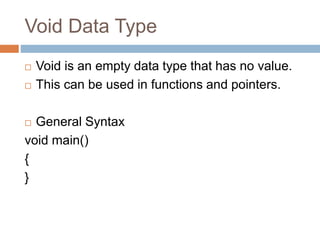
Void Data Type
 Void is an empty data type that has no value.
 This can be used in functions and pointers.
 General Syntax
void main()
{
}
Enum
 An enum is a keyword, it is an user defined
data type. All properties of integer are applied
on Enumeration data type so size of the
enumerator data type is 2 byte. It work like the
Integer.
 It is used for creating an user defined data
type of integer. Using enum we can create
sequence of integer constant value.
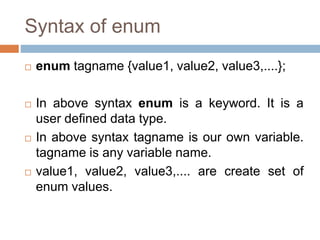
Syntax of enum
 enum tagname {value1, value2, value3,....};
 In above syntax enum is a keyword. It is a
user defined data type.
 In above syntax tagname is our own variable.
tagname is any variable name.
 value1, value2, value3,.... are create set of
enum values.
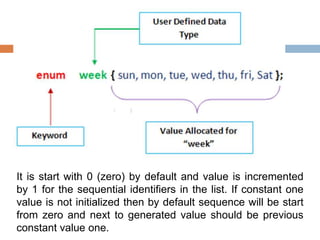
It is start with 0 (zero) by default and value is incremented
by 1 for the sequential identifiers in the list. If constant one
value is not initialized then by default sequence will be start
from zero and next to generated value should be previous
constant value one.
Program of Enum
#include<stdio.h>
#include<conio.h>
void main()
{
int a;
enum ABC {x,y,z};
clrscr();
a=x+y+z;
printf("Sum: %d",a);
getch();
}
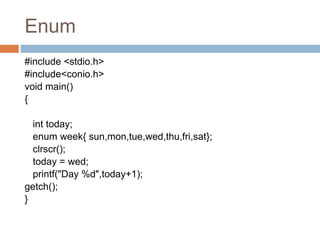
Enum
#include <stdio.h>
#include<conio.h>
void main()
{
int today;
enum week{ sun,mon,tue,wed,thu,fri,sat};
clrscr();
today = wed;
printf("Day %d",today+1);
getch();
}

Data types

  • 1.
    DATA TYPES •Data typesare used to define a variable before it can be used in a program. •C data types are defined as the data storage format that a variable can store a data to perform a specific operation.
  • 2.
    Data Types  DataTypes is further divided into 3 parts. 1. Primitive 2. Derived 3. User Defined
  • 4.
  • 5.
    Integer Data Type Integer data type allows a variable to store numeric values.  “int” keyword is used to refer integer data type.  The storage size of int data type is 2 bytes.  int (2 byte) can store values from -32,768 to +32,767  If you want to use the integer value that crosses the above limit, you can go for “long int” for which the limits are very high.
  • 6.
    General Syntax todeclare int void main() { int a,b; // Here we have declared 2 integers } Each ‘a’ and ‘b’ will take 2 bytes each so 4 bytes will be stored in the memory
  • 7.
    Character  Character datatype allows a variable to store only one character.  Storage size of character data type is 1. We can store only one character using character data type.  “char” keyword is used to refer character data type. Character takes only 1 byte and has a range from -128 to 127.  For example, ‘A’ can be stored using char datatype. You can’t store more than one character using char data type.
  • 8.
    General Syntax todeclare Character void main() { char a,b; // Here we have declared 2 characters } Each ‘a’ and ‘b’ will take 1 byte each so 2 bytes will be stored in the memory
  • 9.
    Float Data Type Float data type allows a variable to store decimal values.  Storage size of float data type is 4.  We can use up-to 6 digits after decimal using float data type.  For example, 10.456789 can be stored in a variable using float data type.  Range of Float is -3.4e38 to +3.4e38
  • 10.
    General Syntax todeclare Float void main() { float a,b; // Here we have declared 2 float variables } Each ‘a’ and ‘b’ will take 4 bytes each so 8 bytes will be stored in the memory
  • 11.
    Double Data type Double data type is also same as float data type which allows up-to 10 digits after decimal.  The range for double datatype is from 1E–37 to 1E+37.  It takes double the memory space as float. It takes 8 bytes.
  • 12.
    General Syntax todeclare Float void main() { double a,b; // Here we have declared 2 double variables } Each ‘a’ and ‘b’ will take 8 bytes each so 16 bytes will be stored in the memory
  • 13.
    Void Data Type Void is an empty data type that has no value.  This can be used in functions and pointers.  General Syntax void main() { }
  • 14.
    Enum  An enumis a keyword, it is an user defined data type. All properties of integer are applied on Enumeration data type so size of the enumerator data type is 2 byte. It work like the Integer.  It is used for creating an user defined data type of integer. Using enum we can create sequence of integer constant value.
  • 15.
    Syntax of enum enum tagname {value1, value2, value3,....};  In above syntax enum is a keyword. It is a user defined data type.  In above syntax tagname is our own variable. tagname is any variable name.  value1, value2, value3,.... are create set of enum values.
  • 16.
    It is startwith 0 (zero) by default and value is incremented by 1 for the sequential identifiers in the list. If constant one value is not initialized then by default sequence will be start from zero and next to generated value should be previous constant value one.
  • 17.
    Program of Enum #include<stdio.h> #include<conio.h> voidmain() { int a; enum ABC {x,y,z}; clrscr(); a=x+y+z; printf("Sum: %d",a); getch(); }
  • 18.
    Enum #include <stdio.h> #include<conio.h> void main() { inttoday; enum week{ sun,mon,tue,wed,thu,fri,sat}; clrscr(); today = wed; printf("Day %d",today+1); getch(); }