Advanced query optimizer
tuning and analysis
Sergei Petrunia
Timour Katchaounov
Monty Program Ab
MySQL Conference And Expo 2013
2 07:48:08 AM
● Introduction
– What is an optimizer problem
– How to catch it
● old an new tools
● Single-table selects
– brief recap from 2012
● JOINs
– ref access
● index statistics
– join condition pushdown
– join plan efficiency
– query plan vs reality
● Big I/O bound JOINs
– Batched Key Access
● Aggregate functions
● ORDER BY ... LIMIT
● GROUP BY
● Subqueries
3 07:48:08 AM
Is there a problem with query optimizer?
• Database
performance is
affected by many
factors
• One of them is the
query optimizer
• Is my performance
problem caused by
the optimizer?
4 07:48:08 AM
Sings that there is a query optimizer problem
• Some (not all) queries are slow
• A query seems to run longer than it ought to
– And examines more records than it ought to
• Usually, query remains slow regardless of
other activity on the server
5 07:48:08 AM
Catching slow queries, the old ways
● Watch the Slow query log
– Percona Server/MariaDB:
--log_slow_verbosity=query_plan
# Thread_id: 1 Schema: dbt3sf10 QC_hit: No
# Query_time: 2.452373 Lock_time: 0.000113 Rows_sent: 0 Rows_examined: 1500000
# Full_scan: Yes Full_join: No Tmp_table: No Tmp_table_on_disk: No
# Filesort: No Filesort_on_disk: No Merge_passes: 0
SET timestamp=1333385770;
select * from customer where c_acctbal < -1000;
• Run SHOW PROCESSLIST periodically
– Run pt-query-digest on the log
6 07:48:08 AM
The new way: SHOW PROCESSLIST + SHOW EXPLAIN
• Available in MariaDB 10.0+
• Displays EXPLAIN of a running statement
MariaDB> show processlist;
+--+----+---------+-------+-------+----+------------+-------------------------...
|Id|User|Host |db |Command|Time|State |Info
+--+----+---------+-------+-------+----+------------+-------------------------...
| 1|root|localhost|dbt3sf1|Query | 10|Sending data|select max(o_totalprice) ...
| 2|root|localhost|dbt3sf1|Query | 0|init |show processlist
+--+----+---------+-------+-------+----+------------+-------------------------...
MariaDB> show explain for 1;
+--+-----------+------+----+-------------+----+-------+----+-------+-----------+
|id|select_type|table |type|possible_keys|key |key_len|ref |rows |Extra |
+--+-----------+------+----+-------------+----+-------+----+-------+-----------+
|1 |SIMPLE |orders|ALL |NULL |NULL|NULL |NULL|1498194|Using where|
+--+-----------+------+----+-------------+----+-------+----+-------+-----------+
MariaDB [dbt3sf1]> show warnings;
+-----+----+-----------------------------------------------------------------+
|Level|Code|Message |
+-----+----+-----------------------------------------------------------------+
|Note |1003|select max(o_totalprice) from orders where year(o_orderDATE)=1995|
+-----+----+-----------------------------------------------------------------+
7 07:48:08 AM
SHOW EXPLAIN usage
● Intended usage
– SHOW PROCESSLIST ...
– SHOW EXPLAIN FOR ...
● Why not just run EXPLAIN again
– Difficult to replicate setups
● Temporary tables
● Optimizer settings
● Storage engine's index statistics
● ...
– No uncertainty about whether you're looking at
the same query plan or not.
8 07:48:08 AM
Catching slow queries (NEW)
PERFORMANCE SCHEMA [MySQL 5.6, MariaDB 10.0]
● use performance_schema
● Many ways to analyze via queries
– events_statements_summary_by_digest
● count_star, sum_timer_wait,
min_timer_wait, avg_timer_wait, max_timer_wait
● digest_text, digest
● sum_rows_examined, sum_created_tmp_disk_tables,
sum_select_full_join
– events_statements_history
● sql_text, digest_text, digest
● timer_start, timer_end, timer_wait
● rows_examined, created_tmp_disk_tables,
select_full_join
8
9 07:48:08 AM
Catching slow queries (NEW)
PERFORMANCE SCHEMA [MySQL 5.6, MariaDB 10.0]
• Modified Q18 from DBT3
select c_name, c_custkey, o_orderkey, o_orderdate,
o_totalprice, sum(l_quantity)
from customer, orders, lineitem
where
o_totalprice > ?
and c_custkey = o_custkey
and o_orderkey = l_orderkey
group by c_name, c_custkey, o_orderkey,
o_orderdate, o_totalprice
order by o_totalprice desc, o_orderdate
LIMIT 10;
• App executes Q18 many times with
? = 550000, 500000, 400000, ...
9
10 07:48:08 AM
Catching slow queries (NEW)
PERFORMANCE SCHEMA [MySQL 5.6, MariaDB 10.0]
● Find candidate slow queries
● Simple tests: select_full_join > 0,
created_tmp_disk_tables > 0, etc
● Complex conditions:
max execution time > X sec OR
min/max time vary a lot:
select max_timer_wait/avg_timer_wait as max_ratio,
avg_timer_wait/min_timer_wait as min_ratio
from events_statements_summary_by_digest
where max_timer_wait > 1000000000000
or max_timer_wait / avg_timer_wait > 2
or avg_timer_wait / min_timer_wait > 2G
11 07:48:08 AM
Catching slow queries (NEW)
PERFORMANCE SCHEMA [MySQL 5.6, MariaDB 10.0]
*************************** 5. row ***************************
DIGEST: 3cd7b881cbc0102f65fe8a290ec1bd6b
DIGEST_TEXT: SELECT `c_name` , `c_custkey` , `o_orderkey` , `o_orderdate` ,
`o_totalprice` , SUM ( `l_quantity` ) FROM `customer` , `orders` , `lineitem` WHERE
`o_totalprice` > ? AND `c_custkey` = `o_custkey` AND `o_orderkey` = `l_orderkey` GROUP BY
`c_name` , `c_custkey` , `o_orderkey` , `o_orderdate` , `o_totalprice` ORDER BY `o_totalprice`
DESC , `o_orderdate` LIMIT ?
COUNT_STAR: 3
SUM_TIMER_WAIT: 3251758347000
MIN_TIMER_WAIT: 3914209000 → 0.0039 sec
AVG_TIMER_WAIT: 1083919449000
MAX_TIMER_WAIT: 3204044053000 → 3.2 sec
SUM_LOCK_TIME: 555000000
SUM_ROWS_SENT: 25
SUM_ROWS_EXAMINED: 0
SUM_CREATED_TMP_DISK_TABLES: 0
SUM_CREATED_TMP_TABLES: 3
SUM_SELECT_FULL_JOIN: 0
SUM_SELECT_RANGE: 3
SUM_SELECT_SCAN: 0
SUM_SORT_RANGE: 0
SUM_SORT_ROWS: 25
SUM_SORT_SCAN: 3
SUM_NO_INDEX_USED: 0
SUM_NO_GOOD_INDEX_USED: 0
FIRST_SEEN: 1970-01-01 03:38:27
LAST_SEEN: 1970-01-01 03:38:43
max_ratio: 2.9560
min_ratio: 276.9192
High variance of
execution time
12 07:48:08 AM
Catching slow queries (NEW)
PERFORMANCE SCHEMA [MySQL 5.6, MariaDB 10.0]
● Check the actual queries and constants
● The events_statements_history table
select timer_wait/1000000000000 as exec_time, sql_text
from events_statements_history
where digest in
(select digest from events_statements_summary_by_digest
where max_timer_wait > 1000000000000
or max_timer_wait / avg_timer_wait > 2
or avg_timer_wait / min_timer_wait > 2)
order by timer_wait;
13 07:48:08 AM
Catching slow queries (NEW)
PERFORMANCE SCHEMA [MySQL 5.6, MariaDB 10.0]
+-----------+-----------------------------------------------------------------------------------+
| exec_time | sql_text |
+-----------+-----------------------------------------------------------------------------------+
| 0.0039 | select c_name, c_custkey, o_orderkey, o_orderdate, o_totalprice, sum(l_quantity)
from customer, orders, lineitem
where o_totalprice > 550000 and c_custkey = o_custkey ... LIMIT 10 |
| 0.0438 | select c_name, c_custkey, o_orderkey, o_orderdate, o_totalprice, sum(l_quantity)
from customer, orders, lineitem
where o_totalprice > 500000 and c_custkey = o_custkey ... LIMIT 10 |
| 3.2040 | select c_name, c_custkey, o_orderkey, o_orderdate, o_totalprice, sum(l_quantity)
from customer, orders, lineitem
where o_totalprice > 400000 and c_custkey = o_custkey ... LIMIT 10 |
+-----------+-----------------------------------------------------------------------------------+
Observation:
orders.o_totalprice > ? is less and less selective
14 07:48:08 AM
Actions after finding the slow query
Bad query plan
– Rewrite the query
– Force a good query plan
• Bad optimizer settings
– Do tuning
• Query is inherently complex
– Don't waste time with it
– Look for other solutions.
15 07:48:08 AM
● Introduction
– What is an optimizer problem
– How to catch it
● old an new tools
● Single-table selects
– brief recap from 2012
● JOINs
– ref access
● index statistics
– join condition pushdown
– join plan efficiency
– query plan vs reality
● Big I/O bound JOINs
– Batched Key Access
● Aggregate functions
● ORDER BY ... LIMIT
● GROUP BY
● Subqueries
16 07:48:08 AM
Consider a simple select
• 15M rows were scanned, 19 rows in output
• Query plan seems inefficient
– (note: this logic doesn't directly apply to group/order by queries).
select * from orders
where
o_orderDate BETWEEN '1992-06-06' and '1992-07-06' and
o_clerk='Clerk#000009506'
+----+-------------+--------+------+---------------+------+---------+------+----------+-------------+
| id | select_type | table | type | possible_keys | key | key_len | ref | rows | Extra |
+----+-------------+--------+------+---------------+------+---------+------+----------+-------------+
| 1 | SIMPLE | orders | ALL | NULL | NULL | NULL | NULL | 15084733 | Using where |
+----+-------------+--------+------+---------------+------+---------+------+----------+-------------+
19 rows in set (7.65 sec)
● Check the query plan:
● Run the query:
17 07:48:08 AM
Query plan analysis
• Entire table is scanned
• WHERE condition checked
after records are read
– Not used to limit
#examined rows.
+----+-------------+--------+------+---------------+------+---------+------+----------+-------------+
| id | select_type | table | type | possible_keys | key | key_len | ref | rows | Extra |
+----+-------------+--------+------+---------------+------+---------+------+----------+-------------+
| 1 | SIMPLE | orders | ALL | NULL | NULL | NULL | NULL | 15084733 | Using where |
+----+-------------+--------+------+---------------+------+---------+------+----------+-------------+
select * from orders
where
o_orderDate BETWEEN '1992-06-06' and '1992-07-06' and
o_clerk='Clerk#000009506'
18 07:48:08 AM
Let's add an index
• Outcome
– Down to reading 300K rows
– Still, 300K >> 19 rows.
alter table orders add key i_o_orderdate (o_orderdate);
select * from orders
where
o_orderDate BETWEEN '1992-06-06' and '1992-07-06' and
o_clerk='Clerk#000009506'
+--+-----------+------+-----+-------------+-------------+-------+----+------+-----------+
|id|select_type|table |type |possible_keys|key |key_len|ref |rows |Extra |
+--+-----------+------+-----+-------------+-------------+-------+----+------+-----------+
|1 |SIMPLE |orders|range|i_o_orderdate|i_o_orderdate|4 |NULL|306322|Using where|
+--+-----------+------+-----+-------------+-------------+-------+----+------+-----------+
19 rows in set (0.76 sec)
● Query time:
19 07:48:08 AM
Finding out which indexes to add
● index (o_orderdate)
● index (o_clerk)
Check selectivity of conditions that will use the index
select * from orders
where
o_orderDate BETWEEN '1992-06-06' and '1992-07-06' and
o_clerk='Clerk#000009506'
select count(*) from orders
where
o_orderDate BETWEEN '1992-06-06' and '1992-07-06';
306322 rows
select count(*) from orders where o_clerk='Clerk#000009506'
1507 rows.
20 07:48:08 AM
+--+-----------+------+-----+-------------+--------------+-------+----+----+-----------+
|id|select_type|table |type |possible_keys|key |key_len|ref |rows|Extra |
+--+-----------+------+-----+-------------+--------------+-------+----+----+-----------+
|1 |SIMPLE |orders|range|i_o_clerk_...|i_o_clerk_date|20 |NULL|19 |Using where|
+--+-----------+------+-----+-------------+--------------+-------+----+----+-----------+
+--+-----------+------+-----+-------------+--------------+-------+----+------+-----------+
|id|select_type|table |type |possible_keys|key |key_len|ref |rows |Extra |
+--+-----------+------+-----+-------------+--------------+-------+----+------+-----------+
|1 |SIMPLE |orders|range|i_o_date_c...|i_o_date_clerk|20 |NULL|360354|Using where|
+--+-----------+------+-----+-------------+--------------+-------+----+------+-----------+
Try adding composite indexes
● index (o_clerk, o_orderdate)
● index (o_orderdate, o_clerk)
Bingo! 100% efficiency
Much worse!
• If condition uses multiple columns, composite index will be most efficient
• Order of column matters
– Explanation why is outside of scope of this tutorial. Covered in last year's
tutorial
21 07:48:08 AM
Conditions must be in SARGable form
• Condition must represent a range
• It must have form that is recognized by the optimizer
o_orderDate BETWEEN '1992-06-01' and '1992-06-30'
day(o_orderDate)=1992 and month(o_orderdate)=6
TO_DAYS(o_orderDATE) between TO_DAYS('1992-06-06') and
TO_DAYS('1992-07-06')
o_clerk='Clerk#000009506'
o_clerk LIKE 'Clerk#000009506'
o_clerk LIKE '%Clerk#000009506%'






column IN (1,10,15,21, ...)
(col1, col2) IN ( (1,1), (2,2), (3,3), …). 

22 07:48:08 AM
New in MySQL-5.6: optimizer_trace
● Lets you see the ranges
set optimizer_trace=1;
explain select * from orders
where o_orderDATE between '1992-06-01' and '1992-07-03' and
o_orderdate not in ('1992-01-01', '1992-06-12','1992-07-04')
select * from information_schema.optimizer_traceG
● Will print a big JSON struct
● Search for range_scan_alternatives.
23 07:48:08 AM
New in MySQL-5.6: optimizer_trace
...
"range_scan_alternatives": [
{
"index": "i_o_orderdate",
"ranges": [
"1992-06-01 <= o_orderDATE < 1992-06-12",
"1992-06-12 < o_orderDATE <= 1992-07-03"
],
"index_dives_for_eq_ranges": true,
"rowid_ordered": false,
"using_mrr": false,
"index_only": false,
"rows": 319082,
"cost": 382900,
"chosen": true
},
{
"index": "i_o_date_clerk",
"ranges": [
"1992-06-01 <= o_orderDATE < 1992-06-12",
"1992-06-12 < o_orderDATE <= 1992-07-03"
],
"index_dives_for_eq_ranges": true,
"rowid_ordered": false,
"using_mrr": false,
"index_only": false,
"rows": 406336,
"cost": 487605,
"chosen": false,
"cause": "cost"
}
],
...
● Considered ranges are shown
in range_scan_alternatives
section
● This is actually original use
case of optimizer_trace
● Alas, recent mysql-5.6 displays
misleading info about ranges
on multi-component keys (will
file a bug)
● Still, very useful.
24 07:48:08 AM
Source of #rows estimates for range
select * from orders
where o_orderDate BETWEEN '1992-06-06' and '1992-07-06'
+--+-----------+------+-----+-------------+-------------+-------+----+------+-----------+
|id|select_type|table |type |possible_keys|key |key_len|ref |rows |Extra |
+--+-----------+------+-----+-------------+-------------+-------+----+------+-----------+
|1 |SIMPLE |orders|range|i_o_orderdate|i_o_orderdate|4 |NULL|306322|Using where|
+--+-----------+------+-----+-------------+-------------+-------+----+------+-----------+
?
• “records_in_range” estimate
• Done by diving into index
• Usually is fairly accurate
• Not affected by ANALYZE
TABLE.
25 07:48:08 AM
Simple selects: conclusions
• Efficiency == “#rows_scanned is close to #rows_returned”
• Indexes and WHERE conditions reduce #rows scanned
• Index estimates are usually accurate
• Multi-column indexes
– “handle” conditions on multiple columns
– Order of columns in the index matters
• optimizer_trace allows to view the ranges
– But misrepresents ranges over multi-column indexes.
26 07:48:08 AM
Now, will skip some topics
One can also speedup simple selects with
● index_merge access method
● index access method
● Index Condition Pushdown
We don't have time for these now, check out the last
year's tutorial.
27 07:48:08 AM
● Introduction
– What is an optimizer problem
– How to catch it
● old an new tools
● Single-table selects
– brief recap from 2012
● JOINs
– ref access
● index statistics
– join condition pushdown
– join plan efficiency
– query plan vs reality
● Big I/O bound JOINs
– Batched Key Access
● Aggregate functions
● ORDER BY ... LIMIT
● GROUP BY
● Subqueries
28 07:48:08 AM
A simple join
select * from customer, orders where c_custkey=o_custkey
• “Customers with their orders”
29 07:48:08 AM
Execution: Nested Loops join
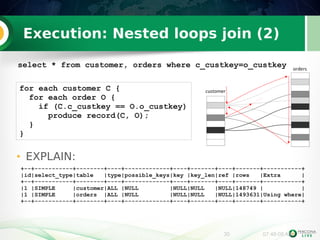
select * from customer, orders where c_custkey=o_custkey
for each customer C {
for each order O {
if (C.c_custkey == O.o_custkey)
produce record(C, O);
}
}
• Complexity:
– Scans table customer
– For each record in customer, scans table orders
• Is this ok?
30 07:48:08 AM
Execution: Nested loops join (2)
select * from customer, orders where c_custkey=o_custkey
for each customer C {
for each order O {
if (C.c_custkey == O.o_custkey)
produce record(C, O);
}
}
• EXPLAIN:
+--+-----------+--------+----+-------------+----+-------+----+-------+-----------+
|id|select_type|table |type|possible_keys|key |key_len|ref |rows |Extra |
+--+-----------+--------+----+-------------+----+-------+----+-------+-----------+
|1 |SIMPLE |customer|ALL |NULL |NULL|NULL |NULL|148749 | |
|1 |SIMPLE |orders |ALL |NULL |NULL|NULL |NULL|1493631|Using where|
+--+-----------+--------+----+-------------+----+-------+----+-------+-----------+
31 07:48:08 AM
Execution: Nested loops join (3)
select * from customer, orders where c_custkey=o_custkey
for each customer C {
for each order O {
if (C.c_custkey == O.o_custkey)
produce record(C, O);
}
}
• EXPLAIN:
+--+-----------+--------+----+-------------+----+-------+----+-------+-----------+
|id|select_type|table |type|possible_keys|key |key_len|ref |rows |Extra |
+--+-----------+--------+----+-------------+----+-------+----+-------+-----------+
|1 |SIMPLE |customer|ALL |NULL |NULL|NULL |NULL|148749 | |
|1 |SIMPLE |orders |ALL |NULL |NULL|NULL |NULL|1493631|Using where|
+--+-----------+--------+----+-------------+----+-------+----+-------+-----------+
rows to read
from customer
rows to read from orders
c_custkey=o_custkey
32 07:48:08 AM
Execution: Nested loops join (4)
select * from customer, orders where c_custkey=o_custkey
+--+-----------+--------+----+-------------+----+-------+----+-------+-----------+
|id|select_type|table |type|possible_keys|key |key_len|ref |rows |Extra |
+--+-----------+--------+----+-------------+----+-------+----+-------+-----------+
|1 |SIMPLE |customer|ALL |NULL |NULL|NULL |NULL|148749 | |
|1 |SIMPLE |orders |ALL |NULL |NULL|NULL |NULL|1493631|Using where|
+--+-----------+--------+----+-------------+----+-------+----+-------+-----------+
• Scan a 1,493,361-row table 148,749 times
– Consider 1,493,361 * 148,749 row combinations
• Is this query inherently complex?
– We know each customer has his own orders
– size(customer x orders)= size(orders)
– Lower bound is
1,493,361 + 148,749 + costs to match customer<->order.
33 07:48:08 AM
Using index for join: ref access
alter table orders add index i_o_custkey(o_custkey)
select * from customer, orders where c_custkey=o_custkey
34 07:48:08 AM
ref access - analysis
+--+-----------+--------+----+-------------+-----------+-------+------------------+------+-----+
|id|select_type|table |type|possible_keys|key |key_len|ref |rows |Extra|
+--+-----------+--------+----+-------------+-----------+-------+------------------+------+-----+
|1 |SIMPLE |customer|ALL |PRIMARY |NULL |NULL |NULL |148749| |
|1 |SIMPLE |orders |ref |i_o_custkey |i_o_custkey|5 |customer.c_custkey|7 | |
+--+-----------+--------+----+-------------+-----------+-------+------------------+------+-----+
select * from customer, orders where c_custkey=o_custkey
● One ref lookup scans 7 rows.
● In total: 7 * 148,749=1,041,243 rows
– `orders` has 1.4M rows
– no redundant reads from `orders`
● The whole query plan
– Reads all customers
– Reads 1M orders (of 1.4M)
● Efficient!
35 07:48:08 AM
Conditions that can be used for ref access
● Can use equalities
– tbl.key=other_table.col
– tbl.key=const
– tbl.key IS NULL
● For multipart keys, will use largest prefix
– keypart1=... AND keypart2= … AND keypartK=... .
36 07:48:08 AM
Conditions that can't be used for ref access
● Doesn't work for non-equalities
t1.key BETWEEN t2.col1 AND t2.col2
● Doesn't work for OR-ed equalities
t1.key=t2.col1 OR t1.key=t2.col2
– Except for ref_or_null
t1.key=... OR t1.key IS NULL
● Doesn't “combine” ref and range
access
– t.keypart1 BETWEEN c1 AND c2 AND
t.keypart2=t2.col
– t.keypart2 BETWEEN c1 AND c2 AND
t.keypart1=t2.col .
37 07:48:08 AM
Is ref always efficient?
● Efficient, if column has many different values
– Best case – unique index (eq_ref)
● A few different values – not useful
● Skewed distribution: depends on which part the
join touches
good
bad
depends
38 07:48:08 AM
ref access estimates - index statistics
• How many rows will match
tbl.key_column = $value
for an arbitrary $value?
• Index statistics
show keys from orders where key_name='i_o_custkey'
*************************** 1. row ***************
Table: orders
Non_unique: 1
Key_name: i_o_custkey
Seq_in_index: 1
Column_name: o_custkey
Collation: A
Cardinality: 214462
Sub_part: NULL
Packed: NULL
Null: YES
Index_type: BTREE
show table status like 'orders'
*************************** 1. row ****
Name: orders
Engine: InnoDB
Version: 10
Row_format: Compact
Rows: 1495152
Avg_row_length: 133
Data_length: 199966720
Max_data_length: 0
Index_length: 122421248
Data_free: 6291456
...
average = Rows /Cardinality = 1495152 / 214462 = 6.97.
39 07:48:08 AM
ref access – conclusions
● Based on t.key=... equality conditions
● Can make joins very efficient
● Relies on index statistics for estimates.
40 07:48:08 AM
Optimizer statistics
● MySQL/Percona Server
– Index statistics
– Persistent/transient InnoDB stats
● MariaDB
– Index statistics, persistent/transient
● Same as Percona Server (via XtraDB)
– Persistent,
engine-independent,
index-independent statistics.
41 07:48:08 AM
Index statistics
● Cardinality allows to calculate a table-wide
average #rows-per-key-prefix
● It is a statistical value (inexact)
● Exact collection procedure depends on the
storage engine
– InnoDB – random sampling
– MyISAM – index scan
– Engine-independent – index scan.
42 07:48:08 AM
Index statistics in MySQL 5.6
● Sample [8] random index leaf pages
● Table statistics (stored)
– rows - estimated number of rows in a table
– Other stats not used by optimizer
● Index statistics (stored)
– fields - #fields in the index
– rows_per_key - rows per 1 key value, per prefix fields
([1 column value], [2 columns value], [3 columns value], …)
– Other stats not used by optimizer.
43 07:48:08 AM
Index statics updates
● Statistics updated when:
– ANALYZE TABLE tbl_name [, tbl_name] …
– SHOW TABLE STATUS, SHOW INDEX
– Access to INFORMATION_SCHEMA.[TABLES|
STATISTICS]
– A table is opened for the first time
(after server restart)
– A table has changed >10%
– When InnoDB Monitor is turned ON.
44 07:48:08 AM
Displaying optimizer statistics
● MySQL 5.5, MariaDB 5.3, and older
– Issue SQL statements to count rows/keys
– Indirectly, look at EXPLAIN for simple queries
● MariaDB 5.5, Percona Server 5.5 (using XtraDB)
– information_schema.[innodb_index_stats, innodb_table_stats]
– Read-only, always visible
● MySQL 5.6
– mysql.[innodb_index_stats, innodb_table_stats]
– User updatetable
– Only available if innodb_analyze_is_persistent=ON
● MariaDB 10.0
– Persistent updateable tables mysql.[index_stats, column_stats, table_stats]
– User updateable
– + current XtraDB mechanisms.
45 07:48:08 AM
Plan [in]stability
● Statistics may vary a lot (orders)
MariaDB [dbt3]> select * from information_schema.innodb_index_stats;
+------------+-----------------+--------------+ +---------------+
| table_name | index_name | rows_per_key | | rows_per_key | error (actual)
+------------+-----------------+--------------+ +---------------+
| partsupp | PRIMARY | 3, 1 | | 4, 1 | 25%
| partsupp | i_ps_partkey | 3, 0 | => | 4, 1 | 25% (4)
| partsupp | i_ps_suppkey | 64, 0 | | 91, 1 | 30% (80)
| orders | i_o_orderdate | 9597, 1 | | 1660956, 0 | 99% (6234)
| orders | i_o_custkey | 15, 1 | | 15, 0 | 0% (15)
| lineitem | i_l_receiptdate | 7425, 1, 1 | | 6665850, 1, 1 | 99.9% (23477)
+------------+-----------------+--------------+ +---------------+
MariaDB [dbt3]> select * from information_schema.innodb_table_stats;
+-----------------+----------+ +----------+
| table_name | rows | | rows |
+-----------------+----------+ +----------+
| partsupp | 6524766 | | 9101065 | 28% (8000000)
| orders | 15039855 | ==> | 14948612 | 0.6% (15000000)
| lineitem | 60062904 | | 59992655 | 0.1% (59986052)
+-----------------+----------+ +----------+
.
46 07:48:08 AM
Controlling statistics (MySQL 5.6)
● Persistent and user-updatetable InnoDB statistics
– innodb_analyze_is_persistent = ON,
– updated manually by ANALYZE TABLE or
– automatically by innodb_stats_auto_recalc = ON
● Control the precision of sampling [default 8]
– innodb_stats_persistent_sample_pages,
– innodb_stats_transient_sample_pages
●
No new statistics compared to older versions.
47 07:48:08 AM
Controlling statistics (MariaDB 10.0)
Current XtraDB index statistics
+
● Engine-independent, persistent, user-updateable statistics
● Precise
● Additional statistics per column (even when there is no
index):
– min_value, max_value: minimum/maximum value per
column
– nulls_ratio: fraction of null values in a column
– avg_length: average size of values in a column
– avg_frequency: average number of rows with the same
value.
48 07:48:08 AM
Join condition
pushdown
49 07:48:08 AM
Join condition pushdown
select *
from
customer, orders
where
c_custkey=o_custkey and c_acctbal < -500 and
o_orderpriority='1-URGENT';
+--+-----------+--------+----+-------------+-----------+-------+------------------+------+-----------+
|id|select_type|table |type|possible_keys|key |key_len|ref |rows |Extra |
+--+-----------+--------+----+-------------+-----------+-------+------------------+------+-----------+
|1 |SIMPLE |customer|ALL |PRIMARY |NULL |NULL |NULL |150081|Using where|
|1 |SIMPLE |orders |ref |i_o_custkey |i_o_custkey|5 |customer.c_custkey|7 |Using where|
+--+-----------+--------+----+-------------+-----------+-------+------------------+------+-----------+.
50 07:48:08 AM
Join condition pushdown
select *
from
customer, orders
where
c_custkey=o_custkey and c_acctbal < -500 and
o_orderpriority='1-URGENT';
+--+-----------+--------+----+-------------+-----------+-------+------------------+------+-----------+
|id|select_type|table |type|possible_keys|key |key_len|ref |rows |Extra |
+--+-----------+--------+----+-------------+-----------+-------+------------------+------+-----------+
|1 |SIMPLE |customer|ALL |PRIMARY |NULL |NULL |NULL |150081|Using where|
|1 |SIMPLE |orders |ref |i_o_custkey |i_o_custkey|5 |customer.c_custkey|7 |Using where|
+--+-----------+--------+----+-------------+-----------+-------+------------------+------+-----------+
51 07:48:08 AM
Join condition pushdown
select *
from
customer, orders
where
c_custkey=o_custkey and c_acctbal < -500 and
o_orderpriority='1-URGENT';
+--+-----------+--------+----+-------------+-----------+-------+------------------+------+-----------+
|id|select_type|table |type|possible_keys|key |key_len|ref |rows |Extra |
+--+-----------+--------+----+-------------+-----------+-------+------------------+------+-----------+
|1 |SIMPLE |customer|ALL |PRIMARY |NULL |NULL |NULL |150081|Using where|
|1 |SIMPLE |orders |ref |i_o_custkey |i_o_custkey|5 |customer.c_custkey|7 |Using where|
+--+-----------+--------+----+-------------+-----------+-------+------------------+------+-----------+
52 07:48:08 AM
Join condition pushdown
select *
from
customer, orders
where
c_custkey=o_custkey and c_acctbal < -500 and
o_orderpriority='1-URGENT';
+--+-----------+--------+----+-------------+-----------+-------+------------------+------+-----------+
|id|select_type|table |type|possible_keys|key |key_len|ref |rows |Extra |
+--+-----------+--------+----+-------------+-----------+-------+------------------+------+-----------+
|1 |SIMPLE |customer|ALL |PRIMARY |NULL |NULL |NULL |150081|Using where|
|1 |SIMPLE |orders |ref |i_o_custkey |i_o_custkey|5 |customer.c_custkey|7 |Using where|
+--+-----------+--------+----+-------------+-----------+-------+------------------+------+-----------+
● Conjunctive (ANDed) conditions are split into parts
● Each part is attached as early as possible
– Either as “Using where”
– Or as table access method.
53 07:48:08 AM
Observing join condition pushdown
EXPLAIN: {
"query_block": {
"select_id": 1,
"nested_loop": [
{
"table": {
"table_name": "orders",
"access_type": "ALL",
"possible_keys": [
"i_o_custkey"
],
"rows": 1499715,
"filtered": 100,
"attached_condition": "((`dbt3sf1`.`orders`.`o_orderpriority` =
'1-URGENT') and (`dbt3sf1`.`orders`.`o_custkey` is not null))"
}
},
{
"table": {
"table_name": "customer",
"access_type": "eq_ref",
"possible_keys": [
"PRIMARY"
],
"key": "PRIMARY",
"used_key_parts": [
"c_custkey"
],
"key_length": "4",
"ref": [
"dbt3sf1.orders.o_custkey"
],
"rows": 1,
"filtered": 100,
"attached_condition": "(`dbt3sf1`.`customer`.`c_acctbal` <
<cache>(-(500)))"
}
● Before mysql-5.6:
EXPLAIN shows only
“Using where”
– The condition itself
only visible in debug
trace
● Starting from 5.6:
EXPLAIN FORMAT=JSON
shows attached
conditions.
54 07:48:08 AM
Reasoning about join plan efficiency
select *
from
customer, orders
where
c_custkey=o_custkey and c_acctbal < -500 and o_orderpriority='1-URGENT';
+--+-----------+--------+----+-------------+-----------+-------+------------------+------+-----------+
|id|select_type|table |type|possible_keys|key |key_len|ref |rows |Extra |
+--+-----------+--------+----+-------------+-----------+-------+------------------+------+-----------+
|1 |SIMPLE |customer|ALL |PRIMARY |NULL |NULL |NULL |150081|Using where|
|1 |SIMPLE |orders |ref |i_o_custkey |i_o_custkey|5 |customer.c_custkey|7 |Using where|
+--+-----------+--------+----+-------------+-----------+-------+------------------+------+-----------+
First table, “customer”
● type=ALL, 150 K rows
●
select count(*) from customer where c_acctbal < -500 gives 6804.
● alter table customer add index (c_acctbal).
55 07:48:08 AM
Reasoning about join plan efficiency
select *
from
customer, orders
where
c_custkey=o_custkey and c_acctbal < -500 and o_orderpriority='1-URGENT';
First table, “customer”
● type=ALL, 150 K rows
●
select count(*) from customer where c_acctbal < -500 gives 6804.
● alter table customer add index (c_acctbal)
+--+-----------+--------+----+-------------+-----------+-------+------------------+------+-----------+
|id|select_type|table |type|possible_keys|key |key_len|ref |rows |Extra |
+--+-----------+--------+----+-------------+-----------+-------+------------------+------+-----------+
|1 |SIMPLE |customer|ALL |PRIMARY |NULL |NULL |NULL |150081|Using where|
|1 |SIMPLE |orders |ref |i_o_custkey |i_o_custkey|5 |customer.c_custkey|7 |Using where|
+--+-----------+--------+----+-------------+-----------+-------+------------------+------+-----------+
+--+-----------+--------+-----+-------------+-----------+-------+------------------+----+---------------------+
|id|select_type|table |type |possible_keys|key |key_len|ref |rows|Extra |
+--+-----------+--------+-----+-------------+-----------+-------+------------------+----+---------------------+
|1 |SIMPLE |customer|range|PRIMARY,c_...|c_acctbal |9 |NULL |6802|Using index condition|
|1 |SIMPLE |orders |ref |i_o_custkey |i_o_custkey|5 |customer.c_custkey|7 |Using where |
+--+-----------+--------+-----+-------------+-----------+-------+------------------+----+---------------------+
Now, access to 'customer' is efficient.
56 07:48:08 AM
Reasoning about join plan efficiency
select *
from
customer, orders
where
c_custkey=o_custkey and c_acctbal < -500 and o_orderpriority='1-URGENT';
Second table, “orders”
● Attached condition: c_custkey=o_custkey and o_orderpriority='1-URGENT'
● ref access uses only c_custkey=o_custkey
● What about o_orderpriority='1-URGENT'?.
+--+-----------+--------+-----+-------------+-----------+-------+------------------+----+---------------------+
|id|select_type|table |type |possible_keys|key |key_len|ref |rows|Extra |
+--+-----------+--------+-----+-------------+-----------+-------+------------------+----+---------------------+
|1 |SIMPLE |customer|range|PRIMARY,c_...|c_acctbal |9 |NULL |6802|Using index condition|
|1 |SIMPLE |orders |ref |i_o_custkey |i_o_custkey|5 |customer.c_custkey|7 |Using where |
+--+-----------+--------+-----+-------------+-----------+-------+------------------+----+---------------------+
57 07:48:08 AM
●o_orderpriority='1-URGENT'
o_orderpriority='1-URGENT'
● select count(*) from orders – 1.5M rows
● select count(*) from orders where o_orderpriority='1-URGENT' - 300K
rows
● 300K / 1.5M = 0.2
58 07:48:08 AM
Reasoning about join plan efficiency
select *
from
customer, orders
where
c_custkey=o_custkey and c_acctbal < -500 and o_orderpriority='1-URGENT';
Second table, “orders”
● Attached condition: c_custkey=o_custkey and o_orderpriority='1-URGENT'
● ref access uses only c_custkey=o_custkey
● What about o_orderpriority='1-URGENT'? Selectivity= 0.2
– Can examine 7*0.2=1.4 rows, 6802 times if we add an index:
alter table orders add index (o_custkey, o_orderpriority)
or
alter table orders add index (o_orderpriority, o_custkey)
+--+-----------+--------+-----+-------------+-----------+-------+------------------+----+---------------------+
|id|select_type|table |type |possible_keys|key |key_len|ref |rows|Extra |
+--+-----------+--------+-----+-------------+-----------+-------+------------------+----+---------------------+
|1 |SIMPLE |customer|range|PRIMARY,c_...|c_acctbal |9 |NULL |6802|Using index condition|
|1 |SIMPLE |orders |ref |i_o_custkey |i_o_custkey|5 |customer.c_custkey|7 |Using where |
+--+-----------+--------+-----+-------------+-----------+-------+------------------+----+---------------------+
59 07:48:08 AM
Reasoning about join plan efficiency - summary
Basic* approach to evaluation of join plan efficiency:
for each table $T in the join order {
Look at conditions attached to table $T (condition must
use table $T, may also use previous tables)
Does access method used with $T make a good use
of attached conditions?
}
+--+-----------+--------+-----+-------------+-----------+-------+------------------+----+---------------------+
|id|select_type|table |type |possible_keys|key |key_len|ref |rows|Extra |
+--+-----------+--------+-----+-------------+-----------+-------+------------------+----+---------------------+
|1 |SIMPLE |customer|range|PRIMARY,c_...|c_acctbal |9 |NULL |6802|Using index condition|
|1 |SIMPLE |orders |ref |i_o_custkey |i_o_custkey|5 |customer.c_custkey|7 |Using where |
+--+-----------+--------+-----+-------------+-----------+-------+------------------+----+---------------------+
* some other details may also affect join performance
60 07:48:08 AM
Attached conditions
61 07:48:08 AM
Attached conditions
● Ideally, should be used for table access
● Not all conditions can be used [at the same time]
– Unused ones are still useful
– They reduce number of scans for subsequent tables
select *
from
customer, orders
where
c_custkey=o_custkey and c_acctbal < -500 and
o_orderpriority='1-URGENT';
+--+-----------+--------+----+-------------+-----------+-------+------------------+------+-----------+
|id|select_type|table |type|possible_keys|key |key_len|ref |rows |Extra |
+--+-----------+--------+----+-------------+-----------+-------+------------------+------+-----------+
|1 |SIMPLE |customer|ALL |PRIMARY |NULL |NULL |NULL |150081|Using where|
|1 |SIMPLE |orders |ref |i_o_custkey |i_o_custkey|5 |customer.c_custkey|7 |Using where|
+--+-----------+--------+----+-------------+-----------+-------+------------------+------+-----------+
62 07:48:08 AM
Informing optimizer about attached conditions
Currently: a range access that's too expensive to use
+--+-----------+--------+----+-----------------+-----------+-------+------------------+------+--------+-----------+
|id|select_type|table |type|possible_keys |key |key_len|ref |rows |filtered|Extra |
+--+-----------+--------+----+-----------------+-----------+-------+------------------+------+--------+-----------+
|1 |SIMPLE |customer|ALL |PRIMARY,c_acctbal|NULL |NULL |NULL |150081| 36.22 |Using where|
|1 |SIMPLE |orders |ref |i_o_custkey |i_o_custkey|5 |customer.c_custkey|7 | 100.00 |Using where|
+--+-----------+--------+----+-----------------+-----------+-------+------------------+------+--------+-----------+
explain extended
select *
from
customer, orders
where
c_custkey=o_custkey and c_acctbal > 8000 and
o_orderpriority='1-URGENT';
● `orders` will be scanned 150081 * 36.22%= 54359 times
● This reduces the cost of join
– Has an effect when comparing potential join plans
● => Index i_o_custkey is not used. But may help the optimizer.
63 07:48:08 AM
Attached condition selectivity
● Unused indexes provide info about selectivity
– Works, but very expensive
● MariaDB 10.0 has engine-independent statistics
– Index statistics
– Non-indexed Column statistics
● Histograms
– Further info:
Tomorrow, 2:20 pm @ Ballroom D
Igor Babaev
Engine-independent persistent statistics with histograms
in MariaDB.
64 07:48:08 AM
How to check if the query plan
matches the reality
65 07:48:08 AM
Check if query plan is realistic
● EXPLAIN shows what optimizer
expects. It may be wrong
– Out-of-date index statistics
– Non-uniform data distribution
● Other DBMS: EXPLAIN ANALYZE
● MySQL: no equivalent. Instead, have
– Handler counters
– “User statistics” (Percona, MariaDB)
– PERFORMANCE_SCHEMA
66 07:48:08 AM
Join analysis: example query (Q18, DBT3)
<reset counters>
select c_name, c_custkey, o_orderkey, o_orderdate,
o_totalprice, sum(l_quantity)
from customer, orders, lineitem
where
o_totalprice > 500000
and c_custkey = o_custkey
and o_orderkey = l_orderkey
group by c_name, c_custkey, o_orderkey, o_orderdate,
o_totalprice
order by o_totalprice desc, o_orderdate
LIMIT 10;
<collect statistics>
67 07:48:08 AM
Join analysis: handler counters (old)
FLUSH STATUS;
=> RUN QUERY
SHOW STATUS LIKE "Handler%";
+----------------------------+-------+
| Handler_mrr_key_refills | 0 |
| Handler_mrr_rowid_refills | 0 |
| Handler_read_first | 0 |
| Handler_read_key | 1646 |
| Handler_read_last | 0 |
| Handler_read_next | 1462 |
| Handler_read_prev | 0 |
| Handler_read_rnd | 10 |
| Handler_read_rnd_deleted | 0 |
| Handler_read_rnd_next | 184 |
| Handler_tmp_update | 1096 |
| Handler_tmp_write | 183 |
| Handler_update | 0 |
| Handler_write | 0 |
68 07:48:08 AM
Join analysis: USERSTAT by Facebook
MariaDB, Percona Server
SET GLOBAL USERSTAT=1;
FLUSH TABLE_STATISTICS;
FLUSH INDEX_STATISTICS;
=> RUN QUERY
SHOW TABLE_STATISTICS;
+--------------+------------+-----------+--------------+-------------------------+
| Table_schema | Table_name | Rows_read | Rows_changed | Rows_changed_x_#indexes |
+--------------+------------+-----------+--------------+-------------------------+
| dbt3 | orders | 183 | 0 | 0 |
| dbt3 | lineitem | 1279 | 0 | 0 |
| dbt3 | customer | 183 | 0 | 0 |
+--------------+------------+-----------+--------------+-------------------------+
SHOW INDEX_STATISTICS;
+--------------+------------+-----------------------+-----------+
| Table_schema | Table_name | Index_name | Rows_read |
+--------------+------------+-----------------------+-----------+
| dbt3 | customer | PRIMARY | 183 |
| dbt3 | lineitem | i_l_orderkey_quantity | 1279 |
| dbt3 | orders | i_o_totalprice | 183 |
+--------------+------------+-----------------------+-----------+
69 07:48:08 AM
Join analysis: PERFORMANCE SCHEMA
[MySQL 5.6, MariaDB 10.0]
● summary tables with read/write statistics
– table_io_waits_summary_by_table
– table_io_waits_summary_by_index_usage
● Superset of the userstat tables
● More overhead
● Not possible to associate statistics with a query
=> truncate stats tables before running a query
● Possible bug
– performance schema not ignored
– Disable by
UPDATE setup_consumers SET ENABLED = 'NO'
where name = 'global_instrumentation';
70 07:48:08 AM
Analyze joins via PERFORMANCE SCHEMA:
SHOW TABLE_STATISTICS analogue
select object_schema, object_name, count_read, count_write,
sum_timer_read, sum_timer_write, ...
from table_io_waits_summary_by_table
where object_schema = 'dbt3' and count_star > 0;
+---------------+-------------+------------+-------------+
| object_schema | object_name | count_read | count_write |
+---------------+-------------+------------+-------------+
| dbt3 | customer | 183 | 0 |
| dbt3 | lineitem | 1462 | 0 |
| dbt3 | orders | 184 | 0 |
+---------------+-------------+------------+-------------+
+----------------+-----------------+
| sum_timer_read | sum_timer_write | ...
+----------------+-----------------+
| 8326528406 | 0 |
| 12117332778 | 0 |
| 7946312812 | 0 |
+----------------+-----------------+
71 07:48:08 AM
Analyze joins via PERFORMANCE SCHEMA:
SHOW INDEX_STATISTICS analogue
select object_schema, object_name, index_name, count_read,
sum_timer_read, sum_timer_write, ...
from table_io_waits_summary_by_index_usage
where object_schema = 'dbt3' and count_star > 0
and index_name is not null;
+---------------+-------------+-----------------------+------------+
| object_schema | object_name | index_name | count_read |
+---------------+-------------+-----------------------+------------+
| dbt3 | customer | PRIMARY | 183 |
| dbt3 | lineitem | i_l_orderkey_quantity | 1462 |
| dbt3 | orders | i_o_totalprice | 184 |
+---------------+-------------+-----------------------+------------+
+----------------+-----------------+
| sum_timer_read | sum_timer_write | ...
+----------------+-----------------+
| 8326528406 | 0 |
| 12117332778 | 0 |
| 7946312812 | 0 |
+----------------+-----------------+
72 07:48:08 AM
● Introduction
– What is an optimizer problem
– How to catch it
● old an new tools
● Single-table selects
– brief recap from 2012
● JOINs
– ref access
● index statistics
– join condition pushdown
– join plan efficiency
– query plan vs reality
● Big I/O bound JOINs
– Batched Key Access
● Aggregate functions
● ORDER BY ... LIMIT
● GROUP BY
● Subqueries
73 07:48:08 AM
Batched joins
● Optimization for analytical queries
● Analytic queries shovel through lots of data
– e.g. “average size of order in the last month”
– or “pairs of goods purchased together”
● Indexes,etc won't help when you really need to
look at all data
● More data means greater chance of being io-bound
● Solution: batched joins
74 07:48:08 AM
Batched Key Access Idea
75 07:48:08 AM
Batched Key Access Idea
76 07:48:08 AM
Batched Key Access Idea
77 07:48:08 AM
Batched Key Access Idea
78 07:48:08 AM
Batched Key Access Idea
79 07:48:08 AM
Batched Key Access Idea
80 07:48:08 AM
Batched Key Access Idea
● Non-BKA join hits data at random
● Caches are not used efficiently
● Prefetching is not useful
81 07:48:08 AM
Batched Key Access Idea
● BKA implementation accesses data
in order
● Takes advantages of caches and
prefetching
82 07:48:08 AM
Batched Key access effect
set join_cache_level=6;
select max(l_extendedprice)
from orders, lineitem
where
l_orderkey=o_orderkey and
o_orderdate between $DATE1 and $DATE2
The benchmark was run with
● Various BKA buffer size
● Various size of $DATE1...$DATE2 range
83 07:48:08 AM
Batched Key Access Performance
-2,000,000 3,000,000 8,000,000 13,000,000 18,000,000 23,000,000 28,000,000 33,000,000
0
500
1000
1500
2000
2500
3000
BKA join performance depending on buffer size
query_size=1, regular
query_size=1, BKA
query_size=2, regular
query_size=2, BKA
query_size=3, regular
query_size=3, BKA
Buffer size, bytes
Querytime,sec
Performance without BKA
Performance with BKA,
given sufficient buffer size● 4x-10x speedup
● The more the data, the bigger the speedup
● Buffer size setting is very important.
84 07:48:08 AM
Batched Key Access settings
● Needs to be turned on
set join_buffer_size= 32*1024*1024;
set join_cache_level=6; -- MariaDB
set optimizer_switch='batched_key_access=on' -- MySQL 5.6
set optimizer_switch='mrr=on';
set optimizer_switch='mrr_sort_keys=on'; -- MariaDB only
● Further join_buffer_size tuning is watching
– Query performance
– Handler_mrr_init counter
and increasing join_buffer_size until either saturates.
85 07:48:08 AM
Batched Key Access - conclusions
● Targeted at big joins
● Needs to be enabled manually
● @@join_buffer_size is the most important
setting
● MariaDB's implementation is a superset of
MySQL's.
86 07:48:08 AM
● Introduction
– What is an optimizer problem
– How to catch it
● old an new tools
● Single-table selects
– brief recap from 2012
● JOINs
– ref access
● index statistics
– join condition pushdown
– join plan efficiency
– query plan vs reality
● Big I/O bound JOINs
– Batched Key Access
● Aggregate functions
● ORDER BY ... LIMIT
● GROUP BY
● Subqueries
87 07:48:08 AM
ORDER BY
GROUP BY
aggregates
88 07:48:08 AM
Aggregate functions, no GROUP BY
● COUNT, SUM, AVG, etc need to examine all rows
select SUM(column) from tbl needs to examine the whole tbl.
● MIN and MAX can use index for lookup
+--+-----------+-----+----+-------------+----+-------+----+----+----------------------------+
|id|select_type|table|type|possible_keys|key |key_len|ref |rows|Extra |
+--+-----------+-----+----+-------------+----+-------+----+----+----------------------------+
|1 |SIMPLE |NULL |NULL|NULL |NULL|NULL |NULL|NULL|Select tables optimized away|
+--+-----------+-----+----+-------------+----+-------+----+----+----------------------------+
index (o_orderdate)
select max(o_orderdate) from orders
select min(o_orderdate) from orders where o_orderdate > '1995-05-01'
select max(o_orderdate) from orders where o_orderpriority='1-URGENT'
index (o_orderpriority, o_orderdate)
89 07:48:08 AM
ORDER BY … LIMIT
Three algorithms
● Use an index to read in order
● Read one table, sort, join - “Using filesort”
● Execute join into temporary table and then
sort - “Using temporary; Using filesort”
90 07:48:08 AM
Using index to read data in order
● No special indication
in EXPLAIN output
● LIMIT n: as soon as
we read n records,
we can stop!
91 07:48:08 AM
A problem with LIMIT N optimization
`orders` has 1.5 M rows
explain select * from orders order by o_orderdate desc limit 10;
+--+-----------+------+-----+-------------+-------------+-------+----+----+-----+
|id|select_type|table |type |possible_keys|key |key_len|ref |rows|Extra|
+--+-----------+------+-----+-------------+-------------+-------+----+----+-----+
|1 |SIMPLE |orders|index|NULL |i_o_orderdate|4 |NULL|10 | |
+--+-----------+------+-----+-------------+-------------+-------+----+----+-----+
select * from orders where o_orderpriority='1-URGENT' order by o_orderdate desc limit 10;
+--+-----------+------+-----+-------------+-------------+-------+----+----+-----------+
|id|select_type|table |type |possible_keys|key |key_len|ref |rows|Extra |
+--+-----------+------+-----+-------------+-------------+-------+----+----+-----------+
|1 |SIMPLE |orders|index|NULL |i_o_orderdate|4 |NULL|10 |Using where|
+--+-----------+------+-----+-------------+-------------+-------+----+----+-----------+
● A problem:
– 1.5M rows, 300K of them 'URGENT'
– Scanning by date, when will we find 10 'URGENT' rows?
– No good solution so far.
92 07:48:08 AM
Using filesort strategy
● Have to read the entire
first table
● For remaining, can apply
LIMIT n
● ORDER BY can only use
columns of tbl1.
93 07:48:08 AM
Using temporary; Using filesort
● ORDER BY clause
can use columns of
any table
● LIMIT is applied only
after executing the
entire join and
sorting.
94 07:48:08 AM
ORDER BY - conclusions
● Resolving ORDER BY with index allows very
efficient handling for LIMIT
– Optimization for
WHERE unused_condition ORDER BY … LIMIT n
is challenging.
● Use sql_big_result, IGNORE INDEX FOR ORDER BY
● Using filesort
– Needs all ORDER BY columns in the first table
– Take advantage of LIMIT when doing join to non-first tables
● Using where; Using filesort is least efficient.
95 07:48:08 AM
GROUP BY strategies
There are three strategies
● Ordered index scan
● Loose Index Scan (LooseScan)
● Groups table
(Using temporary; [Using filesort]).
96 07:48:08 AM
Ordered index scan
● Groups are
enumerated one after
another
● Can compute
aggregates on the fly
● Loose index scan is
also able to jump to
next group.
97 07:48:08 AM
Execution of GROUP BY with temptable
98 07:48:08 AM
Subqueries
99 07:48:08 AM
Subquery optimizations
● Before MariaDB 5.3/MySQL 5.6 - “don't use subqueries”
● Queries that caused most of the pain
– SELECT … FROM tbl WHERE col IN (SELECT …) - semi-joins
– SELECT … FROM (SELECT …) - derived tables
● MariaDB 5.3 and MySQL 5.6
– Have common inheritance, MySQL 6.0 alpha
– Huge (100x, 1000x) speedups for painful areas
– Other kinds of subqueries received a speedup, too
– MariaDB 5.3/5.5 has a superset of MySQL 5.6's optimizations
● 5.6 handles some un-handled edge cases, too
100 07:48:08 AM
Tuning for subqueries
● “Before”: one execution strategy
– No tuning possible
● “After”: similar to joins
– Reasonable execution strategies supported
– Need indexes
– Need selective conditions
– Support batching in most important cases
● Should be better 9x% of the time.
101 07:48:08 AM
What if it still picks a poor query plan?
For both MariaDB and MySQL:
● Check EXPLAIN [EXTENDED], find a keyword around a
subquery table
● Google “site:kb.askmonty.org $subuqery_keyword”
or https://kb.askmonty.org/en/subquery-optimizations-map/
● Find which optimization it was
● set optimizer_switch='$subquery_optimization=off'
102 07:48:08 AM
Thanks!
Q & A

MySQL/MariaDB query optimizer tuning tutorial from Percona Live 2013

  • 1.
    Advanced query optimizer tuningand analysis Sergei Petrunia Timour Katchaounov Monty Program Ab MySQL Conference And Expo 2013
  • 2.
    2 07:48:08 AM ●Introduction – What is an optimizer problem – How to catch it ● old an new tools ● Single-table selects – brief recap from 2012 ● JOINs – ref access ● index statistics – join condition pushdown – join plan efficiency – query plan vs reality ● Big I/O bound JOINs – Batched Key Access ● Aggregate functions ● ORDER BY ... LIMIT ● GROUP BY ● Subqueries
  • 3.
    3 07:48:08 AM Isthere a problem with query optimizer? • Database performance is affected by many factors • One of them is the query optimizer • Is my performance problem caused by the optimizer?
  • 4.
    4 07:48:08 AM Singsthat there is a query optimizer problem • Some (not all) queries are slow • A query seems to run longer than it ought to – And examines more records than it ought to • Usually, query remains slow regardless of other activity on the server
  • 5.
    5 07:48:08 AM Catchingslow queries, the old ways ● Watch the Slow query log – Percona Server/MariaDB: --log_slow_verbosity=query_plan # Thread_id: 1 Schema: dbt3sf10 QC_hit: No # Query_time: 2.452373 Lock_time: 0.000113 Rows_sent: 0 Rows_examined: 1500000 # Full_scan: Yes Full_join: No Tmp_table: No Tmp_table_on_disk: No # Filesort: No Filesort_on_disk: No Merge_passes: 0 SET timestamp=1333385770; select * from customer where c_acctbal < -1000; • Run SHOW PROCESSLIST periodically – Run pt-query-digest on the log
  • 6.
    6 07:48:08 AM Thenew way: SHOW PROCESSLIST + SHOW EXPLAIN • Available in MariaDB 10.0+ • Displays EXPLAIN of a running statement MariaDB> show processlist; +--+----+---------+-------+-------+----+------------+-------------------------... |Id|User|Host |db |Command|Time|State |Info +--+----+---------+-------+-------+----+------------+-------------------------... | 1|root|localhost|dbt3sf1|Query | 10|Sending data|select max(o_totalprice) ... | 2|root|localhost|dbt3sf1|Query | 0|init |show processlist +--+----+---------+-------+-------+----+------------+-------------------------... MariaDB> show explain for 1; +--+-----------+------+----+-------------+----+-------+----+-------+-----------+ |id|select_type|table |type|possible_keys|key |key_len|ref |rows |Extra | +--+-----------+------+----+-------------+----+-------+----+-------+-----------+ |1 |SIMPLE |orders|ALL |NULL |NULL|NULL |NULL|1498194|Using where| +--+-----------+------+----+-------------+----+-------+----+-------+-----------+ MariaDB [dbt3sf1]> show warnings; +-----+----+-----------------------------------------------------------------+ |Level|Code|Message | +-----+----+-----------------------------------------------------------------+ |Note |1003|select max(o_totalprice) from orders where year(o_orderDATE)=1995| +-----+----+-----------------------------------------------------------------+
  • 7.
    7 07:48:08 AM SHOWEXPLAIN usage ● Intended usage – SHOW PROCESSLIST ... – SHOW EXPLAIN FOR ... ● Why not just run EXPLAIN again – Difficult to replicate setups ● Temporary tables ● Optimizer settings ● Storage engine's index statistics ● ... – No uncertainty about whether you're looking at the same query plan or not.
  • 8.
    8 07:48:08 AM Catchingslow queries (NEW) PERFORMANCE SCHEMA [MySQL 5.6, MariaDB 10.0] ● use performance_schema ● Many ways to analyze via queries – events_statements_summary_by_digest ● count_star, sum_timer_wait, min_timer_wait, avg_timer_wait, max_timer_wait ● digest_text, digest ● sum_rows_examined, sum_created_tmp_disk_tables, sum_select_full_join – events_statements_history ● sql_text, digest_text, digest ● timer_start, timer_end, timer_wait ● rows_examined, created_tmp_disk_tables, select_full_join 8
  • 9.
    9 07:48:08 AM Catchingslow queries (NEW) PERFORMANCE SCHEMA [MySQL 5.6, MariaDB 10.0] • Modified Q18 from DBT3 select c_name, c_custkey, o_orderkey, o_orderdate, o_totalprice, sum(l_quantity) from customer, orders, lineitem where o_totalprice > ? and c_custkey = o_custkey and o_orderkey = l_orderkey group by c_name, c_custkey, o_orderkey, o_orderdate, o_totalprice order by o_totalprice desc, o_orderdate LIMIT 10; • App executes Q18 many times with ? = 550000, 500000, 400000, ... 9
  • 10.
    10 07:48:08 AM Catchingslow queries (NEW) PERFORMANCE SCHEMA [MySQL 5.6, MariaDB 10.0] ● Find candidate slow queries ● Simple tests: select_full_join > 0, created_tmp_disk_tables > 0, etc ● Complex conditions: max execution time > X sec OR min/max time vary a lot: select max_timer_wait/avg_timer_wait as max_ratio, avg_timer_wait/min_timer_wait as min_ratio from events_statements_summary_by_digest where max_timer_wait > 1000000000000 or max_timer_wait / avg_timer_wait > 2 or avg_timer_wait / min_timer_wait > 2G
  • 11.
    11 07:48:08 AM Catchingslow queries (NEW) PERFORMANCE SCHEMA [MySQL 5.6, MariaDB 10.0] *************************** 5. row *************************** DIGEST: 3cd7b881cbc0102f65fe8a290ec1bd6b DIGEST_TEXT: SELECT `c_name` , `c_custkey` , `o_orderkey` , `o_orderdate` , `o_totalprice` , SUM ( `l_quantity` ) FROM `customer` , `orders` , `lineitem` WHERE `o_totalprice` > ? AND `c_custkey` = `o_custkey` AND `o_orderkey` = `l_orderkey` GROUP BY `c_name` , `c_custkey` , `o_orderkey` , `o_orderdate` , `o_totalprice` ORDER BY `o_totalprice` DESC , `o_orderdate` LIMIT ? COUNT_STAR: 3 SUM_TIMER_WAIT: 3251758347000 MIN_TIMER_WAIT: 3914209000 → 0.0039 sec AVG_TIMER_WAIT: 1083919449000 MAX_TIMER_WAIT: 3204044053000 → 3.2 sec SUM_LOCK_TIME: 555000000 SUM_ROWS_SENT: 25 SUM_ROWS_EXAMINED: 0 SUM_CREATED_TMP_DISK_TABLES: 0 SUM_CREATED_TMP_TABLES: 3 SUM_SELECT_FULL_JOIN: 0 SUM_SELECT_RANGE: 3 SUM_SELECT_SCAN: 0 SUM_SORT_RANGE: 0 SUM_SORT_ROWS: 25 SUM_SORT_SCAN: 3 SUM_NO_INDEX_USED: 0 SUM_NO_GOOD_INDEX_USED: 0 FIRST_SEEN: 1970-01-01 03:38:27 LAST_SEEN: 1970-01-01 03:38:43 max_ratio: 2.9560 min_ratio: 276.9192 High variance of execution time
  • 12.
    12 07:48:08 AM Catchingslow queries (NEW) PERFORMANCE SCHEMA [MySQL 5.6, MariaDB 10.0] ● Check the actual queries and constants ● The events_statements_history table select timer_wait/1000000000000 as exec_time, sql_text from events_statements_history where digest in (select digest from events_statements_summary_by_digest where max_timer_wait > 1000000000000 or max_timer_wait / avg_timer_wait > 2 or avg_timer_wait / min_timer_wait > 2) order by timer_wait;
  • 13.
    13 07:48:08 AM Catchingslow queries (NEW) PERFORMANCE SCHEMA [MySQL 5.6, MariaDB 10.0] +-----------+-----------------------------------------------------------------------------------+ | exec_time | sql_text | +-----------+-----------------------------------------------------------------------------------+ | 0.0039 | select c_name, c_custkey, o_orderkey, o_orderdate, o_totalprice, sum(l_quantity) from customer, orders, lineitem where o_totalprice > 550000 and c_custkey = o_custkey ... LIMIT 10 | | 0.0438 | select c_name, c_custkey, o_orderkey, o_orderdate, o_totalprice, sum(l_quantity) from customer, orders, lineitem where o_totalprice > 500000 and c_custkey = o_custkey ... LIMIT 10 | | 3.2040 | select c_name, c_custkey, o_orderkey, o_orderdate, o_totalprice, sum(l_quantity) from customer, orders, lineitem where o_totalprice > 400000 and c_custkey = o_custkey ... LIMIT 10 | +-----------+-----------------------------------------------------------------------------------+ Observation: orders.o_totalprice > ? is less and less selective
  • 14.
    14 07:48:08 AM Actionsafter finding the slow query Bad query plan – Rewrite the query – Force a good query plan • Bad optimizer settings – Do tuning • Query is inherently complex – Don't waste time with it – Look for other solutions.
  • 15.
    15 07:48:08 AM ●Introduction – What is an optimizer problem – How to catch it ● old an new tools ● Single-table selects – brief recap from 2012 ● JOINs – ref access ● index statistics – join condition pushdown – join plan efficiency – query plan vs reality ● Big I/O bound JOINs – Batched Key Access ● Aggregate functions ● ORDER BY ... LIMIT ● GROUP BY ● Subqueries
  • 16.
    16 07:48:08 AM Considera simple select • 15M rows were scanned, 19 rows in output • Query plan seems inefficient – (note: this logic doesn't directly apply to group/order by queries). select * from orders where o_orderDate BETWEEN '1992-06-06' and '1992-07-06' and o_clerk='Clerk#000009506' +----+-------------+--------+------+---------------+------+---------+------+----------+-------------+ | id | select_type | table | type | possible_keys | key | key_len | ref | rows | Extra | +----+-------------+--------+------+---------------+------+---------+------+----------+-------------+ | 1 | SIMPLE | orders | ALL | NULL | NULL | NULL | NULL | 15084733 | Using where | +----+-------------+--------+------+---------------+------+---------+------+----------+-------------+ 19 rows in set (7.65 sec) ● Check the query plan: ● Run the query:
  • 17.
    17 07:48:08 AM Queryplan analysis • Entire table is scanned • WHERE condition checked after records are read – Not used to limit #examined rows. +----+-------------+--------+------+---------------+------+---------+------+----------+-------------+ | id | select_type | table | type | possible_keys | key | key_len | ref | rows | Extra | +----+-------------+--------+------+---------------+------+---------+------+----------+-------------+ | 1 | SIMPLE | orders | ALL | NULL | NULL | NULL | NULL | 15084733 | Using where | +----+-------------+--------+------+---------------+------+---------+------+----------+-------------+ select * from orders where o_orderDate BETWEEN '1992-06-06' and '1992-07-06' and o_clerk='Clerk#000009506'
  • 18.
    18 07:48:08 AM Let'sadd an index • Outcome – Down to reading 300K rows – Still, 300K >> 19 rows. alter table orders add key i_o_orderdate (o_orderdate); select * from orders where o_orderDate BETWEEN '1992-06-06' and '1992-07-06' and o_clerk='Clerk#000009506' +--+-----------+------+-----+-------------+-------------+-------+----+------+-----------+ |id|select_type|table |type |possible_keys|key |key_len|ref |rows |Extra | +--+-----------+------+-----+-------------+-------------+-------+----+------+-----------+ |1 |SIMPLE |orders|range|i_o_orderdate|i_o_orderdate|4 |NULL|306322|Using where| +--+-----------+------+-----+-------------+-------------+-------+----+------+-----------+ 19 rows in set (0.76 sec) ● Query time:
  • 19.
    19 07:48:08 AM Findingout which indexes to add ● index (o_orderdate) ● index (o_clerk) Check selectivity of conditions that will use the index select * from orders where o_orderDate BETWEEN '1992-06-06' and '1992-07-06' and o_clerk='Clerk#000009506' select count(*) from orders where o_orderDate BETWEEN '1992-06-06' and '1992-07-06'; 306322 rows select count(*) from orders where o_clerk='Clerk#000009506' 1507 rows.
  • 20.
    20 07:48:08 AM +--+-----------+------+-----+-------------+--------------+-------+----+----+-----------+ |id|select_type|table|type |possible_keys|key |key_len|ref |rows|Extra | +--+-----------+------+-----+-------------+--------------+-------+----+----+-----------+ |1 |SIMPLE |orders|range|i_o_clerk_...|i_o_clerk_date|20 |NULL|19 |Using where| +--+-----------+------+-----+-------------+--------------+-------+----+----+-----------+ +--+-----------+------+-----+-------------+--------------+-------+----+------+-----------+ |id|select_type|table |type |possible_keys|key |key_len|ref |rows |Extra | +--+-----------+------+-----+-------------+--------------+-------+----+------+-----------+ |1 |SIMPLE |orders|range|i_o_date_c...|i_o_date_clerk|20 |NULL|360354|Using where| +--+-----------+------+-----+-------------+--------------+-------+----+------+-----------+ Try adding composite indexes ● index (o_clerk, o_orderdate) ● index (o_orderdate, o_clerk) Bingo! 100% efficiency Much worse! • If condition uses multiple columns, composite index will be most efficient • Order of column matters – Explanation why is outside of scope of this tutorial. Covered in last year's tutorial
  • 21.
    21 07:48:08 AM Conditionsmust be in SARGable form • Condition must represent a range • It must have form that is recognized by the optimizer o_orderDate BETWEEN '1992-06-01' and '1992-06-30' day(o_orderDate)=1992 and month(o_orderdate)=6 TO_DAYS(o_orderDATE) between TO_DAYS('1992-06-06') and TO_DAYS('1992-07-06') o_clerk='Clerk#000009506' o_clerk LIKE 'Clerk#000009506' o_clerk LIKE '%Clerk#000009506%'       column IN (1,10,15,21, ...) (col1, col2) IN ( (1,1), (2,2), (3,3), …).  
  • 22.
    22 07:48:08 AM Newin MySQL-5.6: optimizer_trace ● Lets you see the ranges set optimizer_trace=1; explain select * from orders where o_orderDATE between '1992-06-01' and '1992-07-03' and o_orderdate not in ('1992-01-01', '1992-06-12','1992-07-04') select * from information_schema.optimizer_traceG ● Will print a big JSON struct ● Search for range_scan_alternatives.
  • 23.
    23 07:48:08 AM Newin MySQL-5.6: optimizer_trace ... "range_scan_alternatives": [ { "index": "i_o_orderdate", "ranges": [ "1992-06-01 <= o_orderDATE < 1992-06-12", "1992-06-12 < o_orderDATE <= 1992-07-03" ], "index_dives_for_eq_ranges": true, "rowid_ordered": false, "using_mrr": false, "index_only": false, "rows": 319082, "cost": 382900, "chosen": true }, { "index": "i_o_date_clerk", "ranges": [ "1992-06-01 <= o_orderDATE < 1992-06-12", "1992-06-12 < o_orderDATE <= 1992-07-03" ], "index_dives_for_eq_ranges": true, "rowid_ordered": false, "using_mrr": false, "index_only": false, "rows": 406336, "cost": 487605, "chosen": false, "cause": "cost" } ], ... ● Considered ranges are shown in range_scan_alternatives section ● This is actually original use case of optimizer_trace ● Alas, recent mysql-5.6 displays misleading info about ranges on multi-component keys (will file a bug) ● Still, very useful.
  • 24.
    24 07:48:08 AM Sourceof #rows estimates for range select * from orders where o_orderDate BETWEEN '1992-06-06' and '1992-07-06' +--+-----------+------+-----+-------------+-------------+-------+----+------+-----------+ |id|select_type|table |type |possible_keys|key |key_len|ref |rows |Extra | +--+-----------+------+-----+-------------+-------------+-------+----+------+-----------+ |1 |SIMPLE |orders|range|i_o_orderdate|i_o_orderdate|4 |NULL|306322|Using where| +--+-----------+------+-----+-------------+-------------+-------+----+------+-----------+ ? • “records_in_range” estimate • Done by diving into index • Usually is fairly accurate • Not affected by ANALYZE TABLE.
  • 25.
    25 07:48:08 AM Simpleselects: conclusions • Efficiency == “#rows_scanned is close to #rows_returned” • Indexes and WHERE conditions reduce #rows scanned • Index estimates are usually accurate • Multi-column indexes – “handle” conditions on multiple columns – Order of columns in the index matters • optimizer_trace allows to view the ranges – But misrepresents ranges over multi-column indexes.
  • 26.
    26 07:48:08 AM Now,will skip some topics One can also speedup simple selects with ● index_merge access method ● index access method ● Index Condition Pushdown We don't have time for these now, check out the last year's tutorial.
  • 27.
    27 07:48:08 AM ●Introduction – What is an optimizer problem – How to catch it ● old an new tools ● Single-table selects – brief recap from 2012 ● JOINs – ref access ● index statistics – join condition pushdown – join plan efficiency – query plan vs reality ● Big I/O bound JOINs – Batched Key Access ● Aggregate functions ● ORDER BY ... LIMIT ● GROUP BY ● Subqueries
  • 28.
    28 07:48:08 AM Asimple join select * from customer, orders where c_custkey=o_custkey • “Customers with their orders”
  • 29.
    29 07:48:08 AM Execution:Nested Loops join select * from customer, orders where c_custkey=o_custkey for each customer C { for each order O { if (C.c_custkey == O.o_custkey) produce record(C, O); } } • Complexity: – Scans table customer – For each record in customer, scans table orders • Is this ok?
  • 30.
    30 07:48:08 AM Execution:Nested loops join (2) select * from customer, orders where c_custkey=o_custkey for each customer C { for each order O { if (C.c_custkey == O.o_custkey) produce record(C, O); } } • EXPLAIN: +--+-----------+--------+----+-------------+----+-------+----+-------+-----------+ |id|select_type|table |type|possible_keys|key |key_len|ref |rows |Extra | +--+-----------+--------+----+-------------+----+-------+----+-------+-----------+ |1 |SIMPLE |customer|ALL |NULL |NULL|NULL |NULL|148749 | | |1 |SIMPLE |orders |ALL |NULL |NULL|NULL |NULL|1493631|Using where| +--+-----------+--------+----+-------------+----+-------+----+-------+-----------+
  • 31.
    31 07:48:08 AM Execution:Nested loops join (3) select * from customer, orders where c_custkey=o_custkey for each customer C { for each order O { if (C.c_custkey == O.o_custkey) produce record(C, O); } } • EXPLAIN: +--+-----------+--------+----+-------------+----+-------+----+-------+-----------+ |id|select_type|table |type|possible_keys|key |key_len|ref |rows |Extra | +--+-----------+--------+----+-------------+----+-------+----+-------+-----------+ |1 |SIMPLE |customer|ALL |NULL |NULL|NULL |NULL|148749 | | |1 |SIMPLE |orders |ALL |NULL |NULL|NULL |NULL|1493631|Using where| +--+-----------+--------+----+-------------+----+-------+----+-------+-----------+ rows to read from customer rows to read from orders c_custkey=o_custkey
  • 32.
    32 07:48:08 AM Execution:Nested loops join (4) select * from customer, orders where c_custkey=o_custkey +--+-----------+--------+----+-------------+----+-------+----+-------+-----------+ |id|select_type|table |type|possible_keys|key |key_len|ref |rows |Extra | +--+-----------+--------+----+-------------+----+-------+----+-------+-----------+ |1 |SIMPLE |customer|ALL |NULL |NULL|NULL |NULL|148749 | | |1 |SIMPLE |orders |ALL |NULL |NULL|NULL |NULL|1493631|Using where| +--+-----------+--------+----+-------------+----+-------+----+-------+-----------+ • Scan a 1,493,361-row table 148,749 times – Consider 1,493,361 * 148,749 row combinations • Is this query inherently complex? – We know each customer has his own orders – size(customer x orders)= size(orders) – Lower bound is 1,493,361 + 148,749 + costs to match customer<->order.
  • 33.
    33 07:48:08 AM Usingindex for join: ref access alter table orders add index i_o_custkey(o_custkey) select * from customer, orders where c_custkey=o_custkey
  • 34.
    34 07:48:08 AM refaccess - analysis +--+-----------+--------+----+-------------+-----------+-------+------------------+------+-----+ |id|select_type|table |type|possible_keys|key |key_len|ref |rows |Extra| +--+-----------+--------+----+-------------+-----------+-------+------------------+------+-----+ |1 |SIMPLE |customer|ALL |PRIMARY |NULL |NULL |NULL |148749| | |1 |SIMPLE |orders |ref |i_o_custkey |i_o_custkey|5 |customer.c_custkey|7 | | +--+-----------+--------+----+-------------+-----------+-------+------------------+------+-----+ select * from customer, orders where c_custkey=o_custkey ● One ref lookup scans 7 rows. ● In total: 7 * 148,749=1,041,243 rows – `orders` has 1.4M rows – no redundant reads from `orders` ● The whole query plan – Reads all customers – Reads 1M orders (of 1.4M) ● Efficient!
  • 35.
    35 07:48:08 AM Conditionsthat can be used for ref access ● Can use equalities – tbl.key=other_table.col – tbl.key=const – tbl.key IS NULL ● For multipart keys, will use largest prefix – keypart1=... AND keypart2= … AND keypartK=... .
  • 36.
    36 07:48:08 AM Conditionsthat can't be used for ref access ● Doesn't work for non-equalities t1.key BETWEEN t2.col1 AND t2.col2 ● Doesn't work for OR-ed equalities t1.key=t2.col1 OR t1.key=t2.col2 – Except for ref_or_null t1.key=... OR t1.key IS NULL ● Doesn't “combine” ref and range access – t.keypart1 BETWEEN c1 AND c2 AND t.keypart2=t2.col – t.keypart2 BETWEEN c1 AND c2 AND t.keypart1=t2.col .
  • 37.
    37 07:48:08 AM Isref always efficient? ● Efficient, if column has many different values – Best case – unique index (eq_ref) ● A few different values – not useful ● Skewed distribution: depends on which part the join touches good bad depends
  • 38.
    38 07:48:08 AM refaccess estimates - index statistics • How many rows will match tbl.key_column = $value for an arbitrary $value? • Index statistics show keys from orders where key_name='i_o_custkey' *************************** 1. row *************** Table: orders Non_unique: 1 Key_name: i_o_custkey Seq_in_index: 1 Column_name: o_custkey Collation: A Cardinality: 214462 Sub_part: NULL Packed: NULL Null: YES Index_type: BTREE show table status like 'orders' *************************** 1. row **** Name: orders Engine: InnoDB Version: 10 Row_format: Compact Rows: 1495152 Avg_row_length: 133 Data_length: 199966720 Max_data_length: 0 Index_length: 122421248 Data_free: 6291456 ... average = Rows /Cardinality = 1495152 / 214462 = 6.97.
  • 39.
    39 07:48:08 AM refaccess – conclusions ● Based on t.key=... equality conditions ● Can make joins very efficient ● Relies on index statistics for estimates.
  • 40.
    40 07:48:08 AM Optimizerstatistics ● MySQL/Percona Server – Index statistics – Persistent/transient InnoDB stats ● MariaDB – Index statistics, persistent/transient ● Same as Percona Server (via XtraDB) – Persistent, engine-independent, index-independent statistics.
  • 41.
    41 07:48:08 AM Indexstatistics ● Cardinality allows to calculate a table-wide average #rows-per-key-prefix ● It is a statistical value (inexact) ● Exact collection procedure depends on the storage engine – InnoDB – random sampling – MyISAM – index scan – Engine-independent – index scan.
  • 42.
    42 07:48:08 AM Indexstatistics in MySQL 5.6 ● Sample [8] random index leaf pages ● Table statistics (stored) – rows - estimated number of rows in a table – Other stats not used by optimizer ● Index statistics (stored) – fields - #fields in the index – rows_per_key - rows per 1 key value, per prefix fields ([1 column value], [2 columns value], [3 columns value], …) – Other stats not used by optimizer.
  • 43.
    43 07:48:08 AM Indexstatics updates ● Statistics updated when: – ANALYZE TABLE tbl_name [, tbl_name] … – SHOW TABLE STATUS, SHOW INDEX – Access to INFORMATION_SCHEMA.[TABLES| STATISTICS] – A table is opened for the first time (after server restart) – A table has changed >10% – When InnoDB Monitor is turned ON.
  • 44.
    44 07:48:08 AM Displayingoptimizer statistics ● MySQL 5.5, MariaDB 5.3, and older – Issue SQL statements to count rows/keys – Indirectly, look at EXPLAIN for simple queries ● MariaDB 5.5, Percona Server 5.5 (using XtraDB) – information_schema.[innodb_index_stats, innodb_table_stats] – Read-only, always visible ● MySQL 5.6 – mysql.[innodb_index_stats, innodb_table_stats] – User updatetable – Only available if innodb_analyze_is_persistent=ON ● MariaDB 10.0 – Persistent updateable tables mysql.[index_stats, column_stats, table_stats] – User updateable – + current XtraDB mechanisms.
  • 45.
    45 07:48:08 AM Plan[in]stability ● Statistics may vary a lot (orders) MariaDB [dbt3]> select * from information_schema.innodb_index_stats; +------------+-----------------+--------------+ +---------------+ | table_name | index_name | rows_per_key | | rows_per_key | error (actual) +------------+-----------------+--------------+ +---------------+ | partsupp | PRIMARY | 3, 1 | | 4, 1 | 25% | partsupp | i_ps_partkey | 3, 0 | => | 4, 1 | 25% (4) | partsupp | i_ps_suppkey | 64, 0 | | 91, 1 | 30% (80) | orders | i_o_orderdate | 9597, 1 | | 1660956, 0 | 99% (6234) | orders | i_o_custkey | 15, 1 | | 15, 0 | 0% (15) | lineitem | i_l_receiptdate | 7425, 1, 1 | | 6665850, 1, 1 | 99.9% (23477) +------------+-----------------+--------------+ +---------------+ MariaDB [dbt3]> select * from information_schema.innodb_table_stats; +-----------------+----------+ +----------+ | table_name | rows | | rows | +-----------------+----------+ +----------+ | partsupp | 6524766 | | 9101065 | 28% (8000000) | orders | 15039855 | ==> | 14948612 | 0.6% (15000000) | lineitem | 60062904 | | 59992655 | 0.1% (59986052) +-----------------+----------+ +----------+ .
  • 46.
    46 07:48:08 AM Controllingstatistics (MySQL 5.6) ● Persistent and user-updatetable InnoDB statistics – innodb_analyze_is_persistent = ON, – updated manually by ANALYZE TABLE or – automatically by innodb_stats_auto_recalc = ON ● Control the precision of sampling [default 8] – innodb_stats_persistent_sample_pages, – innodb_stats_transient_sample_pages ● No new statistics compared to older versions.
  • 47.
    47 07:48:08 AM Controllingstatistics (MariaDB 10.0) Current XtraDB index statistics + ● Engine-independent, persistent, user-updateable statistics ● Precise ● Additional statistics per column (even when there is no index): – min_value, max_value: minimum/maximum value per column – nulls_ratio: fraction of null values in a column – avg_length: average size of values in a column – avg_frequency: average number of rows with the same value.
  • 48.
    48 07:48:08 AM Joincondition pushdown
  • 49.
    49 07:48:08 AM Joincondition pushdown select * from customer, orders where c_custkey=o_custkey and c_acctbal < -500 and o_orderpriority='1-URGENT'; +--+-----------+--------+----+-------------+-----------+-------+------------------+------+-----------+ |id|select_type|table |type|possible_keys|key |key_len|ref |rows |Extra | +--+-----------+--------+----+-------------+-----------+-------+------------------+------+-----------+ |1 |SIMPLE |customer|ALL |PRIMARY |NULL |NULL |NULL |150081|Using where| |1 |SIMPLE |orders |ref |i_o_custkey |i_o_custkey|5 |customer.c_custkey|7 |Using where| +--+-----------+--------+----+-------------+-----------+-------+------------------+------+-----------+.
  • 50.
    50 07:48:08 AM Joincondition pushdown select * from customer, orders where c_custkey=o_custkey and c_acctbal < -500 and o_orderpriority='1-URGENT'; +--+-----------+--------+----+-------------+-----------+-------+------------------+------+-----------+ |id|select_type|table |type|possible_keys|key |key_len|ref |rows |Extra | +--+-----------+--------+----+-------------+-----------+-------+------------------+------+-----------+ |1 |SIMPLE |customer|ALL |PRIMARY |NULL |NULL |NULL |150081|Using where| |1 |SIMPLE |orders |ref |i_o_custkey |i_o_custkey|5 |customer.c_custkey|7 |Using where| +--+-----------+--------+----+-------------+-----------+-------+------------------+------+-----------+
  • 51.
    51 07:48:08 AM Joincondition pushdown select * from customer, orders where c_custkey=o_custkey and c_acctbal < -500 and o_orderpriority='1-URGENT'; +--+-----------+--------+----+-------------+-----------+-------+------------------+------+-----------+ |id|select_type|table |type|possible_keys|key |key_len|ref |rows |Extra | +--+-----------+--------+----+-------------+-----------+-------+------------------+------+-----------+ |1 |SIMPLE |customer|ALL |PRIMARY |NULL |NULL |NULL |150081|Using where| |1 |SIMPLE |orders |ref |i_o_custkey |i_o_custkey|5 |customer.c_custkey|7 |Using where| +--+-----------+--------+----+-------------+-----------+-------+------------------+------+-----------+
  • 52.
    52 07:48:08 AM Joincondition pushdown select * from customer, orders where c_custkey=o_custkey and c_acctbal < -500 and o_orderpriority='1-URGENT'; +--+-----------+--------+----+-------------+-----------+-------+------------------+------+-----------+ |id|select_type|table |type|possible_keys|key |key_len|ref |rows |Extra | +--+-----------+--------+----+-------------+-----------+-------+------------------+------+-----------+ |1 |SIMPLE |customer|ALL |PRIMARY |NULL |NULL |NULL |150081|Using where| |1 |SIMPLE |orders |ref |i_o_custkey |i_o_custkey|5 |customer.c_custkey|7 |Using where| +--+-----------+--------+----+-------------+-----------+-------+------------------+------+-----------+ ● Conjunctive (ANDed) conditions are split into parts ● Each part is attached as early as possible – Either as “Using where” – Or as table access method.
  • 53.
    53 07:48:08 AM Observingjoin condition pushdown EXPLAIN: { "query_block": { "select_id": 1, "nested_loop": [ { "table": { "table_name": "orders", "access_type": "ALL", "possible_keys": [ "i_o_custkey" ], "rows": 1499715, "filtered": 100, "attached_condition": "((`dbt3sf1`.`orders`.`o_orderpriority` = '1-URGENT') and (`dbt3sf1`.`orders`.`o_custkey` is not null))" } }, { "table": { "table_name": "customer", "access_type": "eq_ref", "possible_keys": [ "PRIMARY" ], "key": "PRIMARY", "used_key_parts": [ "c_custkey" ], "key_length": "4", "ref": [ "dbt3sf1.orders.o_custkey" ], "rows": 1, "filtered": 100, "attached_condition": "(`dbt3sf1`.`customer`.`c_acctbal` < <cache>(-(500)))" } ● Before mysql-5.6: EXPLAIN shows only “Using where” – The condition itself only visible in debug trace ● Starting from 5.6: EXPLAIN FORMAT=JSON shows attached conditions.
  • 54.
    54 07:48:08 AM Reasoningabout join plan efficiency select * from customer, orders where c_custkey=o_custkey and c_acctbal < -500 and o_orderpriority='1-URGENT'; +--+-----------+--------+----+-------------+-----------+-------+------------------+------+-----------+ |id|select_type|table |type|possible_keys|key |key_len|ref |rows |Extra | +--+-----------+--------+----+-------------+-----------+-------+------------------+------+-----------+ |1 |SIMPLE |customer|ALL |PRIMARY |NULL |NULL |NULL |150081|Using where| |1 |SIMPLE |orders |ref |i_o_custkey |i_o_custkey|5 |customer.c_custkey|7 |Using where| +--+-----------+--------+----+-------------+-----------+-------+------------------+------+-----------+ First table, “customer” ● type=ALL, 150 K rows ● select count(*) from customer where c_acctbal < -500 gives 6804. ● alter table customer add index (c_acctbal).
  • 55.
    55 07:48:08 AM Reasoningabout join plan efficiency select * from customer, orders where c_custkey=o_custkey and c_acctbal < -500 and o_orderpriority='1-URGENT'; First table, “customer” ● type=ALL, 150 K rows ● select count(*) from customer where c_acctbal < -500 gives 6804. ● alter table customer add index (c_acctbal) +--+-----------+--------+----+-------------+-----------+-------+------------------+------+-----------+ |id|select_type|table |type|possible_keys|key |key_len|ref |rows |Extra | +--+-----------+--------+----+-------------+-----------+-------+------------------+------+-----------+ |1 |SIMPLE |customer|ALL |PRIMARY |NULL |NULL |NULL |150081|Using where| |1 |SIMPLE |orders |ref |i_o_custkey |i_o_custkey|5 |customer.c_custkey|7 |Using where| +--+-----------+--------+----+-------------+-----------+-------+------------------+------+-----------+ +--+-----------+--------+-----+-------------+-----------+-------+------------------+----+---------------------+ |id|select_type|table |type |possible_keys|key |key_len|ref |rows|Extra | +--+-----------+--------+-----+-------------+-----------+-------+------------------+----+---------------------+ |1 |SIMPLE |customer|range|PRIMARY,c_...|c_acctbal |9 |NULL |6802|Using index condition| |1 |SIMPLE |orders |ref |i_o_custkey |i_o_custkey|5 |customer.c_custkey|7 |Using where | +--+-----------+--------+-----+-------------+-----------+-------+------------------+----+---------------------+ Now, access to 'customer' is efficient.
  • 56.
    56 07:48:08 AM Reasoningabout join plan efficiency select * from customer, orders where c_custkey=o_custkey and c_acctbal < -500 and o_orderpriority='1-URGENT'; Second table, “orders” ● Attached condition: c_custkey=o_custkey and o_orderpriority='1-URGENT' ● ref access uses only c_custkey=o_custkey ● What about o_orderpriority='1-URGENT'?. +--+-----------+--------+-----+-------------+-----------+-------+------------------+----+---------------------+ |id|select_type|table |type |possible_keys|key |key_len|ref |rows|Extra | +--+-----------+--------+-----+-------------+-----------+-------+------------------+----+---------------------+ |1 |SIMPLE |customer|range|PRIMARY,c_...|c_acctbal |9 |NULL |6802|Using index condition| |1 |SIMPLE |orders |ref |i_o_custkey |i_o_custkey|5 |customer.c_custkey|7 |Using where | +--+-----------+--------+-----+-------------+-----------+-------+------------------+----+---------------------+
  • 57.
    57 07:48:08 AM ●o_orderpriority='1-URGENT' o_orderpriority='1-URGENT' ●select count(*) from orders – 1.5M rows ● select count(*) from orders where o_orderpriority='1-URGENT' - 300K rows ● 300K / 1.5M = 0.2
  • 58.
    58 07:48:08 AM Reasoningabout join plan efficiency select * from customer, orders where c_custkey=o_custkey and c_acctbal < -500 and o_orderpriority='1-URGENT'; Second table, “orders” ● Attached condition: c_custkey=o_custkey and o_orderpriority='1-URGENT' ● ref access uses only c_custkey=o_custkey ● What about o_orderpriority='1-URGENT'? Selectivity= 0.2 – Can examine 7*0.2=1.4 rows, 6802 times if we add an index: alter table orders add index (o_custkey, o_orderpriority) or alter table orders add index (o_orderpriority, o_custkey) +--+-----------+--------+-----+-------------+-----------+-------+------------------+----+---------------------+ |id|select_type|table |type |possible_keys|key |key_len|ref |rows|Extra | +--+-----------+--------+-----+-------------+-----------+-------+------------------+----+---------------------+ |1 |SIMPLE |customer|range|PRIMARY,c_...|c_acctbal |9 |NULL |6802|Using index condition| |1 |SIMPLE |orders |ref |i_o_custkey |i_o_custkey|5 |customer.c_custkey|7 |Using where | +--+-----------+--------+-----+-------------+-----------+-------+------------------+----+---------------------+
  • 59.
    59 07:48:08 AM Reasoningabout join plan efficiency - summary Basic* approach to evaluation of join plan efficiency: for each table $T in the join order { Look at conditions attached to table $T (condition must use table $T, may also use previous tables) Does access method used with $T make a good use of attached conditions? } +--+-----------+--------+-----+-------------+-----------+-------+------------------+----+---------------------+ |id|select_type|table |type |possible_keys|key |key_len|ref |rows|Extra | +--+-----------+--------+-----+-------------+-----------+-------+------------------+----+---------------------+ |1 |SIMPLE |customer|range|PRIMARY,c_...|c_acctbal |9 |NULL |6802|Using index condition| |1 |SIMPLE |orders |ref |i_o_custkey |i_o_custkey|5 |customer.c_custkey|7 |Using where | +--+-----------+--------+-----+-------------+-----------+-------+------------------+----+---------------------+ * some other details may also affect join performance
  • 60.
  • 61.
    61 07:48:08 AM Attachedconditions ● Ideally, should be used for table access ● Not all conditions can be used [at the same time] – Unused ones are still useful – They reduce number of scans for subsequent tables select * from customer, orders where c_custkey=o_custkey and c_acctbal < -500 and o_orderpriority='1-URGENT'; +--+-----------+--------+----+-------------+-----------+-------+------------------+------+-----------+ |id|select_type|table |type|possible_keys|key |key_len|ref |rows |Extra | +--+-----------+--------+----+-------------+-----------+-------+------------------+------+-----------+ |1 |SIMPLE |customer|ALL |PRIMARY |NULL |NULL |NULL |150081|Using where| |1 |SIMPLE |orders |ref |i_o_custkey |i_o_custkey|5 |customer.c_custkey|7 |Using where| +--+-----------+--------+----+-------------+-----------+-------+------------------+------+-----------+
  • 62.
    62 07:48:08 AM Informingoptimizer about attached conditions Currently: a range access that's too expensive to use +--+-----------+--------+----+-----------------+-----------+-------+------------------+------+--------+-----------+ |id|select_type|table |type|possible_keys |key |key_len|ref |rows |filtered|Extra | +--+-----------+--------+----+-----------------+-----------+-------+------------------+------+--------+-----------+ |1 |SIMPLE |customer|ALL |PRIMARY,c_acctbal|NULL |NULL |NULL |150081| 36.22 |Using where| |1 |SIMPLE |orders |ref |i_o_custkey |i_o_custkey|5 |customer.c_custkey|7 | 100.00 |Using where| +--+-----------+--------+----+-----------------+-----------+-------+------------------+------+--------+-----------+ explain extended select * from customer, orders where c_custkey=o_custkey and c_acctbal > 8000 and o_orderpriority='1-URGENT'; ● `orders` will be scanned 150081 * 36.22%= 54359 times ● This reduces the cost of join – Has an effect when comparing potential join plans ● => Index i_o_custkey is not used. But may help the optimizer.
  • 63.
    63 07:48:08 AM Attachedcondition selectivity ● Unused indexes provide info about selectivity – Works, but very expensive ● MariaDB 10.0 has engine-independent statistics – Index statistics – Non-indexed Column statistics ● Histograms – Further info: Tomorrow, 2:20 pm @ Ballroom D Igor Babaev Engine-independent persistent statistics with histograms in MariaDB.
  • 64.
    64 07:48:08 AM Howto check if the query plan matches the reality
  • 65.
    65 07:48:08 AM Checkif query plan is realistic ● EXPLAIN shows what optimizer expects. It may be wrong – Out-of-date index statistics – Non-uniform data distribution ● Other DBMS: EXPLAIN ANALYZE ● MySQL: no equivalent. Instead, have – Handler counters – “User statistics” (Percona, MariaDB) – PERFORMANCE_SCHEMA
  • 66.
    66 07:48:08 AM Joinanalysis: example query (Q18, DBT3) <reset counters> select c_name, c_custkey, o_orderkey, o_orderdate, o_totalprice, sum(l_quantity) from customer, orders, lineitem where o_totalprice > 500000 and c_custkey = o_custkey and o_orderkey = l_orderkey group by c_name, c_custkey, o_orderkey, o_orderdate, o_totalprice order by o_totalprice desc, o_orderdate LIMIT 10; <collect statistics>
  • 67.
    67 07:48:08 AM Joinanalysis: handler counters (old) FLUSH STATUS; => RUN QUERY SHOW STATUS LIKE "Handler%"; +----------------------------+-------+ | Handler_mrr_key_refills | 0 | | Handler_mrr_rowid_refills | 0 | | Handler_read_first | 0 | | Handler_read_key | 1646 | | Handler_read_last | 0 | | Handler_read_next | 1462 | | Handler_read_prev | 0 | | Handler_read_rnd | 10 | | Handler_read_rnd_deleted | 0 | | Handler_read_rnd_next | 184 | | Handler_tmp_update | 1096 | | Handler_tmp_write | 183 | | Handler_update | 0 | | Handler_write | 0 |
  • 68.
    68 07:48:08 AM Joinanalysis: USERSTAT by Facebook MariaDB, Percona Server SET GLOBAL USERSTAT=1; FLUSH TABLE_STATISTICS; FLUSH INDEX_STATISTICS; => RUN QUERY SHOW TABLE_STATISTICS; +--------------+------------+-----------+--------------+-------------------------+ | Table_schema | Table_name | Rows_read | Rows_changed | Rows_changed_x_#indexes | +--------------+------------+-----------+--------------+-------------------------+ | dbt3 | orders | 183 | 0 | 0 | | dbt3 | lineitem | 1279 | 0 | 0 | | dbt3 | customer | 183 | 0 | 0 | +--------------+------------+-----------+--------------+-------------------------+ SHOW INDEX_STATISTICS; +--------------+------------+-----------------------+-----------+ | Table_schema | Table_name | Index_name | Rows_read | +--------------+------------+-----------------------+-----------+ | dbt3 | customer | PRIMARY | 183 | | dbt3 | lineitem | i_l_orderkey_quantity | 1279 | | dbt3 | orders | i_o_totalprice | 183 | +--------------+------------+-----------------------+-----------+
  • 69.
    69 07:48:08 AM Joinanalysis: PERFORMANCE SCHEMA [MySQL 5.6, MariaDB 10.0] ● summary tables with read/write statistics – table_io_waits_summary_by_table – table_io_waits_summary_by_index_usage ● Superset of the userstat tables ● More overhead ● Not possible to associate statistics with a query => truncate stats tables before running a query ● Possible bug – performance schema not ignored – Disable by UPDATE setup_consumers SET ENABLED = 'NO' where name = 'global_instrumentation';
  • 70.
    70 07:48:08 AM Analyzejoins via PERFORMANCE SCHEMA: SHOW TABLE_STATISTICS analogue select object_schema, object_name, count_read, count_write, sum_timer_read, sum_timer_write, ... from table_io_waits_summary_by_table where object_schema = 'dbt3' and count_star > 0; +---------------+-------------+------------+-------------+ | object_schema | object_name | count_read | count_write | +---------------+-------------+------------+-------------+ | dbt3 | customer | 183 | 0 | | dbt3 | lineitem | 1462 | 0 | | dbt3 | orders | 184 | 0 | +---------------+-------------+------------+-------------+ +----------------+-----------------+ | sum_timer_read | sum_timer_write | ... +----------------+-----------------+ | 8326528406 | 0 | | 12117332778 | 0 | | 7946312812 | 0 | +----------------+-----------------+
  • 71.
    71 07:48:08 AM Analyzejoins via PERFORMANCE SCHEMA: SHOW INDEX_STATISTICS analogue select object_schema, object_name, index_name, count_read, sum_timer_read, sum_timer_write, ... from table_io_waits_summary_by_index_usage where object_schema = 'dbt3' and count_star > 0 and index_name is not null; +---------------+-------------+-----------------------+------------+ | object_schema | object_name | index_name | count_read | +---------------+-------------+-----------------------+------------+ | dbt3 | customer | PRIMARY | 183 | | dbt3 | lineitem | i_l_orderkey_quantity | 1462 | | dbt3 | orders | i_o_totalprice | 184 | +---------------+-------------+-----------------------+------------+ +----------------+-----------------+ | sum_timer_read | sum_timer_write | ... +----------------+-----------------+ | 8326528406 | 0 | | 12117332778 | 0 | | 7946312812 | 0 | +----------------+-----------------+
  • 72.
    72 07:48:08 AM ●Introduction – What is an optimizer problem – How to catch it ● old an new tools ● Single-table selects – brief recap from 2012 ● JOINs – ref access ● index statistics – join condition pushdown – join plan efficiency – query plan vs reality ● Big I/O bound JOINs – Batched Key Access ● Aggregate functions ● ORDER BY ... LIMIT ● GROUP BY ● Subqueries
  • 73.
    73 07:48:08 AM Batchedjoins ● Optimization for analytical queries ● Analytic queries shovel through lots of data – e.g. “average size of order in the last month” – or “pairs of goods purchased together” ● Indexes,etc won't help when you really need to look at all data ● More data means greater chance of being io-bound ● Solution: batched joins
  • 74.
    74 07:48:08 AM BatchedKey Access Idea
  • 75.
    75 07:48:08 AM BatchedKey Access Idea
  • 76.
    76 07:48:08 AM BatchedKey Access Idea
  • 77.
    77 07:48:08 AM BatchedKey Access Idea
  • 78.
    78 07:48:08 AM BatchedKey Access Idea
  • 79.
    79 07:48:08 AM BatchedKey Access Idea
  • 80.
    80 07:48:08 AM BatchedKey Access Idea ● Non-BKA join hits data at random ● Caches are not used efficiently ● Prefetching is not useful
  • 81.
    81 07:48:08 AM BatchedKey Access Idea ● BKA implementation accesses data in order ● Takes advantages of caches and prefetching
  • 82.
    82 07:48:08 AM BatchedKey access effect set join_cache_level=6; select max(l_extendedprice) from orders, lineitem where l_orderkey=o_orderkey and o_orderdate between $DATE1 and $DATE2 The benchmark was run with ● Various BKA buffer size ● Various size of $DATE1...$DATE2 range
  • 83.
    83 07:48:08 AM BatchedKey Access Performance -2,000,000 3,000,000 8,000,000 13,000,000 18,000,000 23,000,000 28,000,000 33,000,000 0 500 1000 1500 2000 2500 3000 BKA join performance depending on buffer size query_size=1, regular query_size=1, BKA query_size=2, regular query_size=2, BKA query_size=3, regular query_size=3, BKA Buffer size, bytes Querytime,sec Performance without BKA Performance with BKA, given sufficient buffer size● 4x-10x speedup ● The more the data, the bigger the speedup ● Buffer size setting is very important.
  • 84.
    84 07:48:08 AM BatchedKey Access settings ● Needs to be turned on set join_buffer_size= 32*1024*1024; set join_cache_level=6; -- MariaDB set optimizer_switch='batched_key_access=on' -- MySQL 5.6 set optimizer_switch='mrr=on'; set optimizer_switch='mrr_sort_keys=on'; -- MariaDB only ● Further join_buffer_size tuning is watching – Query performance – Handler_mrr_init counter and increasing join_buffer_size until either saturates.
  • 85.
    85 07:48:08 AM BatchedKey Access - conclusions ● Targeted at big joins ● Needs to be enabled manually ● @@join_buffer_size is the most important setting ● MariaDB's implementation is a superset of MySQL's.
  • 86.
    86 07:48:08 AM ●Introduction – What is an optimizer problem – How to catch it ● old an new tools ● Single-table selects – brief recap from 2012 ● JOINs – ref access ● index statistics – join condition pushdown – join plan efficiency – query plan vs reality ● Big I/O bound JOINs – Batched Key Access ● Aggregate functions ● ORDER BY ... LIMIT ● GROUP BY ● Subqueries
  • 87.
    87 07:48:08 AM ORDERBY GROUP BY aggregates
  • 88.
    88 07:48:08 AM Aggregatefunctions, no GROUP BY ● COUNT, SUM, AVG, etc need to examine all rows select SUM(column) from tbl needs to examine the whole tbl. ● MIN and MAX can use index for lookup +--+-----------+-----+----+-------------+----+-------+----+----+----------------------------+ |id|select_type|table|type|possible_keys|key |key_len|ref |rows|Extra | +--+-----------+-----+----+-------------+----+-------+----+----+----------------------------+ |1 |SIMPLE |NULL |NULL|NULL |NULL|NULL |NULL|NULL|Select tables optimized away| +--+-----------+-----+----+-------------+----+-------+----+----+----------------------------+ index (o_orderdate) select max(o_orderdate) from orders select min(o_orderdate) from orders where o_orderdate > '1995-05-01' select max(o_orderdate) from orders where o_orderpriority='1-URGENT' index (o_orderpriority, o_orderdate)
  • 89.
    89 07:48:08 AM ORDERBY … LIMIT Three algorithms ● Use an index to read in order ● Read one table, sort, join - “Using filesort” ● Execute join into temporary table and then sort - “Using temporary; Using filesort”
  • 90.
    90 07:48:08 AM Usingindex to read data in order ● No special indication in EXPLAIN output ● LIMIT n: as soon as we read n records, we can stop!
  • 91.
    91 07:48:08 AM Aproblem with LIMIT N optimization `orders` has 1.5 M rows explain select * from orders order by o_orderdate desc limit 10; +--+-----------+------+-----+-------------+-------------+-------+----+----+-----+ |id|select_type|table |type |possible_keys|key |key_len|ref |rows|Extra| +--+-----------+------+-----+-------------+-------------+-------+----+----+-----+ |1 |SIMPLE |orders|index|NULL |i_o_orderdate|4 |NULL|10 | | +--+-----------+------+-----+-------------+-------------+-------+----+----+-----+ select * from orders where o_orderpriority='1-URGENT' order by o_orderdate desc limit 10; +--+-----------+------+-----+-------------+-------------+-------+----+----+-----------+ |id|select_type|table |type |possible_keys|key |key_len|ref |rows|Extra | +--+-----------+------+-----+-------------+-------------+-------+----+----+-----------+ |1 |SIMPLE |orders|index|NULL |i_o_orderdate|4 |NULL|10 |Using where| +--+-----------+------+-----+-------------+-------------+-------+----+----+-----------+ ● A problem: – 1.5M rows, 300K of them 'URGENT' – Scanning by date, when will we find 10 'URGENT' rows? – No good solution so far.
  • 92.
    92 07:48:08 AM Usingfilesort strategy ● Have to read the entire first table ● For remaining, can apply LIMIT n ● ORDER BY can only use columns of tbl1.
  • 93.
    93 07:48:08 AM Usingtemporary; Using filesort ● ORDER BY clause can use columns of any table ● LIMIT is applied only after executing the entire join and sorting.
  • 94.
    94 07:48:08 AM ORDERBY - conclusions ● Resolving ORDER BY with index allows very efficient handling for LIMIT – Optimization for WHERE unused_condition ORDER BY … LIMIT n is challenging. ● Use sql_big_result, IGNORE INDEX FOR ORDER BY ● Using filesort – Needs all ORDER BY columns in the first table – Take advantage of LIMIT when doing join to non-first tables ● Using where; Using filesort is least efficient.
  • 95.
    95 07:48:08 AM GROUPBY strategies There are three strategies ● Ordered index scan ● Loose Index Scan (LooseScan) ● Groups table (Using temporary; [Using filesort]).
  • 96.
    96 07:48:08 AM Orderedindex scan ● Groups are enumerated one after another ● Can compute aggregates on the fly ● Loose index scan is also able to jump to next group.
  • 97.
    97 07:48:08 AM Executionof GROUP BY with temptable
  • 98.
  • 99.
    99 07:48:08 AM Subqueryoptimizations ● Before MariaDB 5.3/MySQL 5.6 - “don't use subqueries” ● Queries that caused most of the pain – SELECT … FROM tbl WHERE col IN (SELECT …) - semi-joins – SELECT … FROM (SELECT …) - derived tables ● MariaDB 5.3 and MySQL 5.6 – Have common inheritance, MySQL 6.0 alpha – Huge (100x, 1000x) speedups for painful areas – Other kinds of subqueries received a speedup, too – MariaDB 5.3/5.5 has a superset of MySQL 5.6's optimizations ● 5.6 handles some un-handled edge cases, too
  • 100.
    100 07:48:08 AM Tuningfor subqueries ● “Before”: one execution strategy – No tuning possible ● “After”: similar to joins – Reasonable execution strategies supported – Need indexes – Need selective conditions – Support batching in most important cases ● Should be better 9x% of the time.
  • 101.
    101 07:48:08 AM Whatif it still picks a poor query plan? For both MariaDB and MySQL: ● Check EXPLAIN [EXTENDED], find a keyword around a subquery table ● Google “site:kb.askmonty.org $subuqery_keyword” or https://kb.askmonty.org/en/subquery-optimizations-map/ ● Find which optimization it was ● set optimizer_switch='$subquery_optimization=off'
  • 102.