Download to read offline


![4
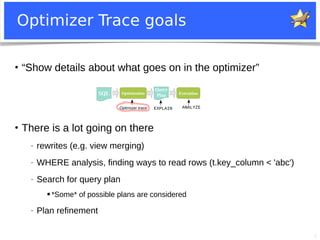
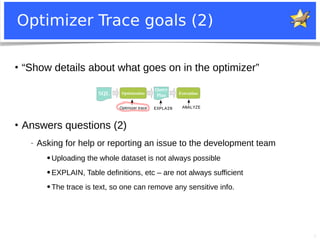
Optimizer Trace goals
●
“Show details about what goes on in the optimizer”
EXPLAIN ANALYZEOptimizer trace
Optimization
Query
PlanSQL Execution
●
Answers questions
− Why query plan X is [not] chosen
● Can strategy Y be used for index Z?
● Is restriction on indexed column C sargable?
● ...
− Why are query plans different across db instances
● different db version (upgrades)
● different statistics or “minor” DDL changes](https://image.slidesharecdn.com/mariadb-fest-2020-optimizer-trace-200915182342/85/Optimizer-Trace-Walkthrough-4-320.jpg)
![7
Getting Optimizer Trace
●
Enable trace
●
Run the query
− Its trace is kept in memory, per-
session.
●
Examine the trace
MariaDB> set optimizer_trace=1;
MariaDB> <query>;
MariaDB> select * from
-> information_schema.optimizer_trace;
TRACE: {
"steps": [
{
"join_preparation": {
"select_id": 1,
"steps": [
{
"expanded_query": "select orders.o_orderkey AS o_orderkey,...
}
]
}
},
{
"join_optimization": {
"select_id": 1,
"steps": [
{
"condition_processing": {
"condition": "WHERE",
"original_condition": "orders.o_orderDATE =
lineitem.l_shipDATE and orders.o_orderDATE = '1995-01-01' and
orders.o_orderkey = lineitem.l_orderkey",
"steps": [
{
"transformation": "equality_propagation",
"resulting_condition": "multiple equal(DATE'1995-01-01',
orders.o_orderDATE, lineitem.l_shipDATE) and multiple
equal(orders.o_orderkey, lineitem.l_orderkey)"
},
{
"transformation": "constant_propagation",
"resulting_condition": "multiple equal(DATE'1995-01-01',
orders.o_orderDATE, lineitem.l_shipDATE) and multiple
equal(orders.o_orderkey, lineitem.l_orderkey)"
},
{
"transformation": "trivial_condition_removal",
"resulting_condition": "multiple equal(DATE'1995-01-01',
orders.o_orderDATE, lineitem.l_shipDATE) and multiple
equal(orders.o_orderkey, lineitem.l_orderkey)"
}
]
}
},
{
"table_dependencies": [
{
"table": "orders",
"row_may_be_null": false,
"map_bit": 0,
"depends_on_map_bits": []
},
{
"table": "lineitem",
"row_may_be_null": false,
"map_bit": 1,
"depends_on_map_bits": []
}
]
},](https://image.slidesharecdn.com/mariadb-fest-2020-optimizer-trace-200915182342/85/Optimizer-Trace-Walkthrough-7-320.jpg)
![8
Optimizer trace contents
●
It’s a huge JSON document
●
“A log of actions done by the
optimizer”
− I would like to say “all actions”
− But this isn’t the case.
− A good subset of all actions.
TRACE: {
"steps": [
{
"join_preparation": {
"select_id": 1,
"steps": [
{
"expanded_query": "select orders.o_orderkey AS o_orderkey,...
}
]
}
},
{
"join_optimization": {
"select_id": 1,
"steps": [
{
"condition_processing": {
"condition": "WHERE",
"original_condition": "orders.o_orderDATE =
lineitem.l_shipDATE and orders.o_orderDATE = '1995-01-01' and
orders.o_orderkey = lineitem.l_orderkey",
"steps": [
{
"transformation": "equality_propagation",
"resulting_condition": "multiple equal(DATE'1995-01-01',
orders.o_orderDATE, lineitem.l_shipDATE) and multiple
equal(orders.o_orderkey, lineitem.l_orderkey)"
},
{
"transformation": "constant_propagation",
"resulting_condition": "multiple equal(DATE'1995-01-01',
orders.o_orderDATE, lineitem.l_shipDATE) and multiple
equal(orders.o_orderkey, lineitem.l_orderkey)"
},
{
"transformation": "trivial_condition_removal",
"resulting_condition": "multiple equal(DATE'1995-01-01',
orders.o_orderDATE, lineitem.l_shipDATE) and multiple
equal(orders.o_orderkey, lineitem.l_orderkey)"
}
]
}
},
{
"table_dependencies": [
{
"table": "orders",
"row_may_be_null": false,
"map_bit": 0,
"depends_on_map_bits": []
},
{
"table": "lineitem",
"row_may_be_null": false,
"map_bit": 1,
"depends_on_map_bits": []
}
]
},](https://image.slidesharecdn.com/mariadb-fest-2020-optimizer-trace-200915182342/85/Optimizer-Trace-Walkthrough-8-320.jpg)
![9
Why JSON?
●
It’s human-readable
●
It’s easy to extend
●
It’s machine-readable
...
},
{
"rows_estimation": [
{
"selectivity_for_indexes": [],
"selectivity_for_columns": [],
"cond_selectivity": 1
},
{
"table": "t1",
"table_scan": {
"rows": 1000,
"cost": 4
}
}
]
},
{
"considered_execution_plans": [
{
...
select
JSON_DETAILED(JSON_EXTRACT(trace, '$**.rows_estimation'))
from
information_schema.optimizer_trace;
[
[
{
"selectivity_for_indexes": [],
"selectivity_for_columns": [],
"cond_selectivity": 1
},
{
"table": "t1",
"table_scan":
{
"rows": 1000,
"cost": 4
}
}
]
]](https://image.slidesharecdn.com/mariadb-fest-2020-optimizer-trace-200915182342/85/Optimizer-Trace-Walkthrough-9-320.jpg)
![10
Insert: JSON 101
●
value:
object | array |
"string" | number | true | false | null
●
array:
[ value, ... ]
●
object:
{ "name" : value, .... }](https://image.slidesharecdn.com/mariadb-fest-2020-optimizer-trace-200915182342/85/Optimizer-Trace-Walkthrough-10-320.jpg)
![13
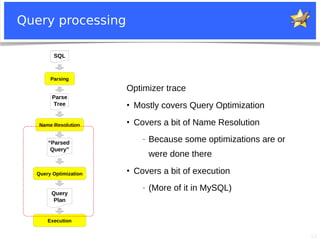
Query processing in optimizer trace
TRACE: {
"steps": [
{
"join_preparation": {
"select_id": 1,
"steps": [
{
"expanded_query": "select t1.col1 AS
col1,t1.col2 AS col2,t1.col3 AS col3 from t1 where t1.col1
< 3 and t1.col2 = 'foo'"
}
]
}
},
{
"join_optimization": {
"select_id": 1,
"steps": [
...
...
...
]
}
},
{
"join_execution": {
"select_id": 1,
"steps": []
}
}
]
}
Parsing
SQLSQL
Parse
Tree
Name Resolution
“Parsed
Query”
Query Optimization
Query
Plan
Execution
select * from t1 where col1 <3 and col2 ='foo'](https://image.slidesharecdn.com/mariadb-fest-2020-optimizer-trace-200915182342/85/Optimizer-Trace-Walkthrough-13-320.jpg)
![15
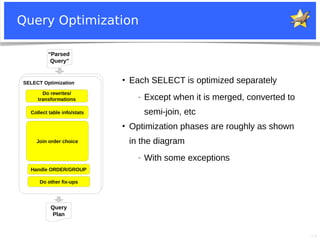
Query Optimization in optimizer trace
“Parsed
Query”
SELECT Optimization
Query
Plan
Do rewrites/
transformations
Collect table info/stats
Join order choice
Handle ORDER/GROUP
Do other fix-ups
"join_optimization": {
"select_id": 1,
"steps": [
{
"condition_processing": { }
},
{
"table_dependencies": [... ]
},
...
{
"ref_optimizer_key_uses": [
...
]
},
{
"rows_estimation": [
...
]
},
{
"considered_execution_plans": [
...
]
},
{
"best_join_order": ["table1", "table2", ...]
},
...
{
"attaching_conditions_to_tables": { ... }
}
]
}
}](https://image.slidesharecdn.com/mariadb-fest-2020-optimizer-trace-200915182342/85/Optimizer-Trace-Walkthrough-15-320.jpg)
![16
ref optimizer
●
Try a join
+------+-------------+-------+------+---------------+---------+---------+------------+------+-----------------------+
| id | select_type | table | type | possible_keys | key | key_len | ref | rows | Extra |
+------+-------------+-------+------+---------------+---------+---------+------------+------+-----------------------+
| 1 | SIMPLE | t2 | ALL | key_col | NULL | NULL | NULL | 1000 | Using where |
| 1 | SIMPLE | t1 | ref | key_col | key_col | 5 | t2.key_col | 1 | Using index condition |
+------+-------------+-------+------+---------------+---------+---------+------------+------+-----------------------+
explain select * from t1, t2 where t1.key_col=t2.key_col
●
Could this use join order t1->t2 and use ref(t2.key_col) ?
− t1.key_col is INT
− t2.key_col is VARCHAR(100) collate utf8_general_ci
●
Look at ref_optimizer_keyuses
− Can make lookups using t1.key_col
− Not vice-versa.
"ref_optimizer_key_uses": [
{
"table": "t1",
"field": "key_col",
"equals": "t2.key_col",
"null_rejecting": true
}
]](https://image.slidesharecdn.com/mariadb-fest-2020-optimizer-trace-200915182342/85/Optimizer-Trace-Walkthrough-16-320.jpg)
![17
ref optimizer (2)
●
Change table t1 for t3:
− t3.key_col is VARCHAR(100) collate utf8_unicode_ci
− t2.key_col is VARCHAR(100) collate utf8_general_ci
explain select * from t1, t2 where t3.key_col=t2.key_col
●
Check the trace
− Now, lookup is possible in
both directions.
●
Take-away:
− ref_optimizer_keyuses lists
potential ref accesses.
"ref_optimizer_key_uses": [
{
"table": "t3",
"field": "key_col",
"equals": "t2.key_col",
"null_rejecting": true
},
{
"table": "t2",
"field": "key_col",
"equals": "t3.key_col",
"null_rejecting": true
}
]](https://image.slidesharecdn.com/mariadb-fest-2020-optimizer-trace-200915182342/85/Optimizer-Trace-Walkthrough-17-320.jpg)
![19
Range optimizer: ranges (1)
create table some_events (
start_date DATE,
end_date DATE,
...
KEY (start_date, end_date)
);
select ...
from some_events as TBL
where
start_date >= '2019-06-24'
and
end_date <= '2019-06-28'
●
Inference of ranges from WHERE/ON conditions can get complex
− Multi-part keys
− Inference using equalities (col1=col2 AND col1<10 -> col2<10)
− EXPLAIN [FORMAT=JSON] just shows used_key_parts
●
Example with multi-part keys:
"rows_estimation": [
{
"table": "some_events",
"range_analysis": {
...
"analyzing_range_alternatives": {
"range_scan_alternatives": [
{
"index": "start_date",
"ranges": ["(2019-06-24,NULL) < (start_date,end_date)"],
"rowid_ordered": false,
"using_mrr": false,
"index_only": false,
"rows": 4503,
"cost": 5638.8,
"chosen": true
}
]](https://image.slidesharecdn.com/mariadb-fest-2020-optimizer-trace-200915182342/85/Optimizer-Trace-Walkthrough-19-320.jpg)
![20
Range optimizer: ranges (2)
create table some_events (
start_date DATE,
end_date DATE,
...
KEY (start_date, end_date)
);
select ...
from some_events as TBL
where
start_date >= '2019-06-24'
and
end_date <= '2019-06-28'
●
Inference of ranges from WHERE/ON conditions can get complex
− Multi-part keys
− Inference using equalities (col1=col2 AND col1<10 -> col2<10)
− EXPLAIN [FORMAT=JSON] just shows used_key_parts
●
Example with multi-part keys:
"rows_estimation": [
{
"table": "some_events",
"range_analysis": {
...
"analyzing_range_alternatives": {
"range_scan_alternatives": [
{
"index": "start_date",
"ranges": [
"(2019-06-24,2019-06-24) <= (start_date,end_date) <=
(2019-06-28,2019-06-28)"
],
"rowid_ordered": false,
"using_mrr": false,
"index_only": false,
"rows": 1,
"cost": 1.345170888,
"chosen": true
}
],
start_date <= end_date, so:
and
start_date <= '2019-06-28'
and
end_date >= '2019-06-24'](https://image.slidesharecdn.com/mariadb-fest-2020-optimizer-trace-200915182342/85/Optimizer-Trace-Walkthrough-20-320.jpg)
![21
Range optimizer: multiple ranges
●
Another example: multiple ranges
"rows_estimation": [
{
"table": "some_events",
"range_analysis": {
...
"analyzing_range_alternatives": {
"range_scan_alternatives": [
{
"index": "start_date",
"ranges": [
"(2019-06-01,2019-06-10) <= (start_date,end_date) <= (2019-06-01,2019-06-10)",
"(2019-06-02,2019-06-10) <= (start_date,end_date) <= (2019-06-02,2019-06-10)",
"(2019-06-03,2019-06-10) <= (start_date,end_date) <= (2019-06-03,2019-06-10)"
],
"rowid_ordered": false,
"using_mrr": false,
"index_only": false,
"rows": 3,
"cost": 3.995512664,
"chosen": true
}
],
select *
from some_events
where start_date in ('2019-06-01','2019-06-02','2019-06-03') and end_date='2019-06-10'](https://image.slidesharecdn.com/mariadb-fest-2020-optimizer-trace-200915182342/85/Optimizer-Trace-Walkthrough-21-320.jpg)
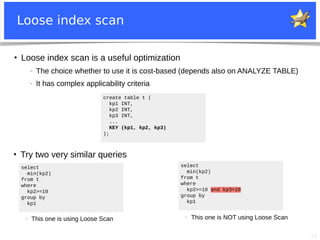
![23
Loose Index Scan (2)
"rows_estimation": [
{
"table": "t",
"range_analysis": {
...
"group_index_range": {
"potential_group_range_indexes": [
{
"index": "kp1",
"covering": true,
"ranges": ["(10) <= (kp2)"],
"rows": 67,
"cost": 90.45
}
]
},
"best_group_range_summary": {
"type": "index_group",
"index": "kp1",
"min_max_arg": "kp2",
"min_aggregate": true,
"max_aggregate": false,
"distinct_aggregate": false,
"rows": 67,
"cost": 90.45,
"key_parts_used_for_access": ["kp1"],
"ranges": ["(10) <= (kp2)"],
"chosen": true
},
"rows_estimation": [
{
"table": "t23",
"range_analysis": {
...
"group_index_range": {
"potential_group_range_indexes": [
{
"index": "kp1",
"covering": true,
"usable": false,
"cause": "keypart after infix in query"
}
]
●
Compare optimizer traces:](https://image.slidesharecdn.com/mariadb-fest-2020-optimizer-trace-200915182342/85/Optimizer-Trace-Walkthrough-23-320.jpg)
![25
Tracing JOIN Optimizer
“Parsed
Query”
SELECT Optimization
Query
Plan
Do rewrites/
transformations
Collect table info/stats
Join order choice
Handle ORDER/GROUP
Do other fix-ups
"join_optimization": {
"select_id": 1,
"steps": [
{
"condition_processing": { }
},
{
"table_dependencies": [... ]
},
...
{
"ref_optimizer_key_uses": [
...
]
},
{
"rows_estimation": [
...
]
},
{
"considered_execution_plans": [
...
]
},
{
"best_join_order": ["table1", "table2", ...]
},
...
{
"attaching_conditions_to_tables": { ... }
}
]
}
}](https://image.slidesharecdn.com/mariadb-fest-2020-optimizer-trace-200915182342/85/Optimizer-Trace-Walkthrough-25-320.jpg)
![26
A join query
select *
from
part, supplier, partsupp
where
p_partkey=ps_partkey and ps_suppkey=s_suppkey and
s_acctbal<0 and
ps_availqty > 0 and
p_mfgr='Manufacturer#3'
part
partsupp
supplier
p_mfgr=... s_acctbal<0
ps_availqty>0
+------+-------------+----------+--------+---------------------+--------------+---------+---------------------+------+-----------------------+
| id | select_type | table | type | possible_keys | key | key_len | ref | rows | Extra |
+------+-------------+----------+--------+---------------------+--------------+---------+---------------------+------+-----------------------+
| 1 | SIMPLE | supplier | range | PRIMARY,s_acctbal | s_acctbal | 9 | NULL | 886 | Using index condition |
| 1 | SIMPLE | partsupp | ref | PRIMARY,i_ps_par... | i_ps_suppkey | 4 | supplier.s_suppkey | 45 | Using where |
| 1 | SIMPLE | part | eq_ref | PRIMARY | PRIMARY | 4 | partsupp.ps_partkey | 1 | Using where |
+------+-------------+----------+--------+---------------------+--------------+---------+---------------------+------+-----------------------+
"join_optimization": {
...
{
"considered_execution_plans": [
...
...
...
]
},
{
"best_join_order": ["supplier", "partsupp", "part"]
},
●
best_join_order shows the final picked join
order
●
considered_execution_plans is a log of join
order choice.
− it can have *a lot* of content](https://image.slidesharecdn.com/mariadb-fest-2020-optimizer-trace-200915182342/85/Optimizer-Trace-Walkthrough-26-320.jpg)
![27
+------+-------------+----------+--------+---------------------+--------------+---------+---------------------+------+-----------------------+
| id | select_type | table | type | possible_keys | key | key_len | ref | rows | Extra |
+------+-------------+----------+--------+---------------------+--------------+---------+---------------------+------+-----------------------+
| 1 | SIMPLE | supplier | range | PRIMARY,s_acctbal | s_acctbal | 9 | NULL | 886 | Using index condition |
| 1 | SIMPLE | partsupp | ref | PRIMARY,i_ps_par... | i_ps_suppkey | 4 | supplier.s_suppkey | 45 | Using where |
| 1 | SIMPLE | part | eq_ref | PRIMARY | PRIMARY | 4 | partsupp.ps_partkey | 1 | Using where |
+------+-------------+----------+--------+---------------------+--------------+---------+---------------------+------+-----------------------+
Join order enumeration
part
partsupp
supplier
p_mfgr=... s_acctbal<0
ps_availqty>0
$ grep -A1 plan_prefix /tmp/trace.txt
"plan_prefix": [],
"table": "supplier",
--
"plan_prefix": ["supplier"],
"table": "part",
--
"plan_prefix": ["supplier", "part"],
"table": "partsupp",
--
"plan_prefix": ["supplier"],
"table": "partsupp",
--
"plan_prefix": ["supplier", "partsupp"],
"table": "part",
--
"plan_prefix": [],
"table": "part",
--
"plan_prefix": ["part"],
"table": "supplier",
--
"plan_prefix": ["part"],
"table": "partsupp",
--
"plan_prefix": [],
"table": "partsupp",
●
There is so much content we’ll use grep.
●
Join order is constructed in a top-down (first-
to-last) way
− plan_prefix – already constructed
− table – the table we’re trying to add
●
Shows considered join prefixes
− Non-promising prefixes are pruned
away](https://image.slidesharecdn.com/mariadb-fest-2020-optimizer-trace-200915182342/85/Optimizer-Trace-Walkthrough-27-320.jpg)
![28
+------+-------------+----------+--------+---------------------+--------------+---------+---------------------+------+-----------------------+
| id | select_type | table | type | possible_keys | key | key_len | ref | rows | Extra |
+------+-------------+----------+--------+---------------------+--------------+---------+---------------------+------+-----------------------+
| 1 | SIMPLE | supplier | range | PRIMARY,s_acctbal | s_acctbal | 9 | NULL | 886 | Using index condition |
| 1 | SIMPLE | partsupp | ref | PRIMARY,i_ps_par... | i_ps_suppkey | 4 | supplier.s_suppkey | 45 | Using where |
| 1 | SIMPLE | part | eq_ref | PRIMARY | PRIMARY | 4 | partsupp.ps_partkey | 1 | Using where |
+------+-------------+----------+--------+---------------------+--------------+---------+---------------------+------+-----------------------+
Join order enumeration: supplier
part
partsupp
supplier
p_mfgr=... s_acctbal<0
ps_availqty>0
{
"plan_prefix": [],
"table": "supplier",
"best_access_path": {
"considered_access_paths": [
{
"access_type": "range",
"resulting_rows": 886,
"cost": 1063.485592,
"chosen": true
}
],
"chosen_access_method": {
"type": "range",
"records": 886,
"cost": 1063.485592,
"uses_join_buffering": false
}
},
"rows_for_plan": 886,
"cost_for_plan": 1240.685592,
●
best_access_path – a function adding a
table the prefix.
●
Shows considered ways to read the table
and the picked one
− Also #rows and costs.](https://image.slidesharecdn.com/mariadb-fest-2020-optimizer-trace-200915182342/85/Optimizer-Trace-Walkthrough-28-320.jpg)
![29
+------+-------------+----------+--------+---------------------+--------------+---------+---------------------+------+-----------------------+
| id | select_type | table | type | possible_keys | key | key_len | ref | rows | Extra |
+------+-------------+----------+--------+---------------------+--------------+---------+---------------------+------+-----------------------+
| 1 | SIMPLE | supplier | range | PRIMARY,s_acctbal | s_acctbal | 9 | NULL | 886 | Using index condition |
| 1 | SIMPLE | partsupp | ref | PRIMARY,i_ps_par... | i_ps_suppkey | 4 | supplier.s_suppkey | 45 | Using where |
| 1 | SIMPLE | part | eq_ref | PRIMARY | PRIMARY | 4 | partsupp.ps_partkey | 1 | Using where |
+------+-------------+----------+--------+---------------------+--------------+---------+---------------------+------+-----------------------+
Join order enumeration: supplier,partsupp
part
partsupp
supplier
p_mfgr=... s_acctbal<0
ps_availqty>0
{
"plan_prefix": ["supplier"],
"table": "partsupp",
"best_access_path": {
"considered_access_paths": [
{
"access_type": "ref",
"index": "i_ps_suppkey",
"rows": 45,
"cost": 40761.83998,
"chosen": true
},
{
"access_type": "scan",
"resulting_rows": 909440,
"cost": 12847,
"chosen": false
}
],
"chosen_access_method": {
"type": "ref",
"records": 45,
"cost": 40761.83998,
"uses_join_buffering": false
}
},
"rows_for_plan": 39870,
"cost_for_plan": 49976.52557,](https://image.slidesharecdn.com/mariadb-fest-2020-optimizer-trace-200915182342/85/Optimizer-Trace-Walkthrough-29-320.jpg)
![30
+------+-------------+----------+--------+---------------------+--------------+---------+---------------------+------+-----------------------+
| id | select_type | table | type | possible_keys | key | key_len | ref | rows | Extra |
+------+-------------+----------+--------+---------------------+--------------+---------+---------------------+------+-----------------------+
| 1 | SIMPLE | supplier | range | PRIMARY,s_acctbal | s_acctbal | 9 | NULL | 886 | Using index condition |
| 1 | SIMPLE | partsupp | ref | PRIMARY,i_ps_par... | i_ps_suppkey | 4 | supplier.s_suppkey | 45 | Using where |
| 1 | SIMPLE | part | eq_ref | PRIMARY | PRIMARY | 4 | partsupp.ps_partkey | 1 | Using where |
+------+-------------+----------+--------+---------------------+--------------+---------+---------------------+------+-----------------------+
Join order enumeration: supplier, partsupp, part
part
partsupp
supplier
p_mfgr=... s_acctbal<0
ps_availqty>0
{
"plan_prefix": ["supplier", "partsupp"],
"table": "part",
"best_access_path": {
"considered_access_paths": [
{
"access_type": "eq_ref",
"index": "PRIMARY",
"rows": 1,
"cost": 39870,
"chosen": true
},
{
"access_type": "scan",
"resulting_rows": 197805,
"cost": 131300,
"chosen": false
}
],
"chosen_access_method": {
"type": "eq_ref",
"records": 1,
"cost": 39870,
"uses_join_buffering": false
}
},
"rows_for_plan": 39870,
"cost_for_plan": 97820.52557,
"estimated_join_cardinality": 39870
}](https://image.slidesharecdn.com/mariadb-fest-2020-optimizer-trace-200915182342/85/Optimizer-Trace-Walkthrough-30-320.jpg)
![31
+------+-------------+----------+--------+---------------------+--------------+---------+---------------------+------+-----------------------+
| id | select_type | table | type | possible_keys | key | key_len | ref | rows | Extra |
+------+-------------+----------+--------+---------------------+--------------+---------+---------------------+------+-----------------------+
| 1 | SIMPLE | supplier | range | PRIMARY,s_acctbal | s_acctbal | 9 | NULL | 886 | Using index condition |
| 1 | SIMPLE | partsupp | ref | PRIMARY,i_ps_par... | i_ps_suppkey | 4 | supplier.s_suppkey | 45 | Using where |
| 1 | SIMPLE | part | eq_ref | PRIMARY | PRIMARY | 4 | partsupp.ps_partkey | 1 | Using where |
+------+-------------+----------+--------+---------------------+--------------+---------+---------------------+------+-----------------------+
Join order enumeration: part
part
partsupp
supplier
p_mfgr=... s_acctbal<0
ps_availqty>0
{
"plan_prefix": [],
"table": "part",
"best_access_path": {
"considered_access_paths": [
{
"access_type": "scan",
"resulting_rows": 197805,
"cost": 2020,
"chosen": true
}
],
"chosen_access_method": {
"type": "scan",
"records": 197805,
"cost": 2020,
"uses_join_buffering": false
}
},
"rows_for_plan": 197805,
"cost_for_plan": 41581,
●
Let’s follow the other possible plan,
part->partsupp->supplier.](https://image.slidesharecdn.com/mariadb-fest-2020-optimizer-trace-200915182342/85/Optimizer-Trace-Walkthrough-31-320.jpg)
![32
+------+-------------+----------+--------+---------------------+--------------+---------+---------------------+------+-----------------------+
| id | select_type | table | type | possible_keys | key | key_len | ref | rows | Extra |
+------+-------------+----------+--------+---------------------+--------------+---------+---------------------+------+-----------------------+
| 1 | SIMPLE | supplier | range | PRIMARY,s_acctbal | s_acctbal | 9 | NULL | 886 | Using index condition |
| 1 | SIMPLE | partsupp | ref | PRIMARY,i_ps_par... | i_ps_suppkey | 4 | supplier.s_suppkey | 45 | Using where |
| 1 | SIMPLE | part | eq_ref | PRIMARY | PRIMARY | 4 | partsupp.ps_partkey | 1 | Using where |
+------+-------------+----------+--------+---------------------+--------------+---------+---------------------+------+-----------------------+
Join order enumeration: part, partsupp
part
partsupp
supplier
p_mfgr=... s_acctbal<0
ps_availqty>0
{
"plan_prefix": ["part"],
"table": "partsupp",
"best_access_path": {
"considered_access_paths": [
{
"access_type": "ref",
"index": "PRIMARY",
"rows": 1,
"cost": 198088.8932,
"chosen": true
},
{
"access_type": "ref",
"index": "i_ps_partkey",
"rows": 2,
"cost": 593472.9471,
"chosen": false,
"cause": "cost"
},
{
"access_type": "scan",
"resulting_rows": 909440,
"cost": 1631569,
"chosen": false
}
],
"chosen_access_method": {
"type": "ref",
"records": 1,
"cost": 198088.8932,
"uses_join_buffering": false
}
},
"rows_for_plan": 197805,
"cost_for_plan": 279230.8932,
"pruned_by_cost": true
}
●
pruned_by_cost: true.](https://image.slidesharecdn.com/mariadb-fest-2020-optimizer-trace-200915182342/85/Optimizer-Trace-Walkthrough-32-320.jpg)
![33
Join optimizer take-aways
"join_optimization": {
"select_id": 1,
"steps": [
{
"condition_processing": { }
},
{
"table_dependencies": [... ]
},
...
{
"ref_optimizer_key_uses": [
...
]
},
{
"rows_estimation": [
...
]
},
{
"considered_execution_plans": [
...
]
},
{
"best_join_order": ["table1", "table2", ...]
},
...
{
"attaching_conditions_to_tables": { ... }
}
]
}
}
●
considered_execution_paths traces
the join order choice
− It can get very large, use grep
● plan_prefix, table
●
best_join_order shows the picked order.
JSON_EXTRACT(trace,
'$**.considered_execution_plans[?(@table="supplier")]')
Can’t do this, because MariaDB’s JSONPath
engine doesn’t support filters.
●
Hardcore JSONPath users might want to use
searches like](https://image.slidesharecdn.com/mariadb-fest-2020-optimizer-trace-200915182342/85/Optimizer-Trace-Walkthrough-33-320.jpg)
![34
Covered so far
“Parsed
Query”
SELECT Optimization
Query
Plan
Do rewrites/
transformations
Collect table info/stats
Join order choice
Handle ORDER/GROUP
Do other fix-ups
"join_optimization": {
"select_id": 1,
"steps": [
{
"condition_processing": { }
},
{
"table_dependencies": [... ]
},
...
{
"ref_optimizer_key_uses": [
...
]
},
{
"rows_estimation": [
...
]
},
{
"considered_execution_plans": [
...
]
},
{
"best_join_order": ["table1", "table2", ...]
},
...
{
"attaching_conditions_to_tables": { ... }
}
]
}
}](https://image.slidesharecdn.com/mariadb-fest-2020-optimizer-trace-200915182342/85/Optimizer-Trace-Walkthrough-34-320.jpg)
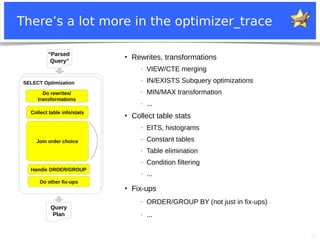
![37
Optimizer Trace in MySQL
●
Similar to MariaDB’s
− User interface
− Trace elements and structure
●
There are differences
− Optimizers are different
− Slightly different set of things traced
− The tracing module has extra
features
●
Let’s review
− Anything to learn?
{
"steps": [
{
"join_preparation": {
"select#": 1,
"steps": [
{
"expanded_query": "/* select#1 */ select `t1`.`col1` AS
`col1`,`t1`.`col2` AS `col2`,`t1`.`col3` AS `col3` from `t1` where
((`t1`.`col1` < 3) and (`t1`.`col2` = 'foo'))"
}
]
}
},
{
"join_optimization": {
"select#": 1,
"steps": [
{
"condition_processing": {
"condition": "WHERE",
"original_condition": "((`t1`.`col1` < 3) and (`t1`.`col2` =
'foo'))",
"steps": [
{
"transformation": "equality_propagation",
"resulting_condition": "((`t1`.`col1` < 3) and
(`t1`.`col2` = 'foo'))"
},
{
"transformation": "constant_propagation",
"resulting_condition": "((`t1`.`col1` < 3) and
(`t1`.`col2` = 'foo'))"
},
{
"transformation": "trivial_condition_removal",
"resulting_condition": "((`t1`.`col1` < 3) and
(`t1`.`col2` = 'foo'))"
}
]
}
},
{
"substitute_generated_columns": {
}
},
{
"table_dependencies": [
{
"table": "`t1`",
"row_may_be_null": false,
"map_bit": 0,
"depends_on_map_bits": [
]
}
]
},
{
"ref_optimizer_key_uses": [
]
},](https://image.slidesharecdn.com/mariadb-fest-2020-optimizer-trace-200915182342/85/Optimizer-Trace-Walkthrough-37-320.jpg)
![38
Extras in MySQL
●
Can capture multiple traces for nested statements
− Controlled with @@optimizer_trace_{offset,limit}
● Can set to save first/last N traces.
− Allows to trace statements inside stored procedure/function calls
− The issue is that other support for nested statements is not present:
● Can’t get EXPLAINs for sub-statements.
● Can’t get statement_time* (*- in some cases, can infer #rows_examined and statement_time from
PERFORMANCE_SCHEMA.
● Is this useful?
●
Can omit parts of trace
− Controlled by @@optimizer_trace_features
greedy_search=on,range_optimizer=on,dynamic_range=on,repeated_subselect=on
− Why not use JSON_EXTRACT to get the part of trace you need, instead?
− Would be useful for global settings e.g. “[Don’t] print cost values everywhere”.](https://image.slidesharecdn.com/mariadb-fest-2020-optimizer-trace-200915182342/85/Optimizer-Trace-Walkthrough-38-320.jpg)
![39
Extras in MySQL (2)
●
Can control JSON formatting
− SET @@optimizer_trace='enabled=on,one_line=on'
− SET @@end_markers_in_json=on;
● Note: the output is not a valid
JSON anymore, can’t be processed.
"filesort_priority_queue_optimization": {
"usable": false,
"cause": "not applicable (no LIMIT)"
},
"filesort_execution": [
],
"filesort_summary": {
"memory_available": 998483,
"key_size": 1022,
"row_size": 66561,
"max_rows_per_buffer": 14,
"num_rows_estimate": 215,
"num_rows_found": 0,
"num_initial_chunks_spilled_to_disk": 0,
"peak_memory_used": 0,
"sort_algorithm": "none",
"sort_mode": "<fixed_sort_key,
packed_additional_fields>"
}
●
Tracing covers some parts of query execution
− Because MySQL didn’t have EXPLAIN
ANALYZE back then?
− Can produce a lot of repetitive JSON
− In MariaDB, this kind of info is shown in
ANALYZE FORMAT=JSON output.
"join_preparation": {
"select#": 1,
"steps": [
...
] /* steps */
} /* join_preparation */](https://image.slidesharecdn.com/mariadb-fest-2020-optimizer-trace-200915182342/85/Optimizer-Trace-Walkthrough-39-320.jpg)
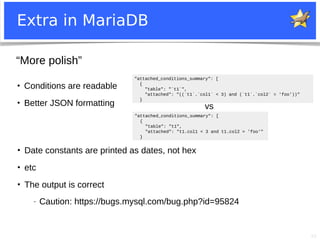

The optimizer trace provides a detailed log of the actions taken by the query optimizer. It traces the major stages of query optimization including join preparation, join optimization, and join execution. During join optimization, it records steps like condition processing, determining table dependencies, estimating rows for plans, considering different execution plans, and choosing the best join order. The trace helps understand why certain query plans are chosen and catch differences in plans that may occur due to factors like database version changes.


![Introduction into MySQL Query Tuning for Dev[Op]s](https://cdn.slidesharecdn.com/ss_thumbnails/qtdevops-210717011329-thumbnail.jpg?width=640&height=640&fit=bounds)


![谷歌留痕技术教程[ 𝙩𝙤𝙥 𝟮𝟯𝟯. 𝙘 𝙤𝙢 ]](https://cdn.slidesharecdn.com/ss_thumbnails/top233-260130173900-2eb784f9-thumbnail.jpg?width=640&height=640&fit=bounds)
![20260201 [FOSDEM] gomodjail - library sandboxing for Go modules.pdf](https://cdn.slidesharecdn.com/ss_thumbnails/20260201fosdemgomodjail-librarysandboxingforgomodules-260201225659-76609ec4-thumbnail.jpg?width=640&height=640&fit=bounds)


