MYOTOME
Shamima Akter
B. Sc (Honors) in Occupational Therapy
& M. Sc in Rehabilitation Science
Assistant Professor,
Department of Occupational Therapy
Bangladesh Health Professions Institute (BHPI)
Centre for the Rehabilitation of the Paralysed (CRP)
Chapain, Savar
• A myotome is the group of muscles that a single spinal
nerve innervates.
• The motor level is determined by examining a key
muscle function within each of 10 myotomes on each
side of the body and is defined by the lowest key
muscle function that has a grade of at least 3 [on
manual muscle testing (MMT) in the supine position],
providing the key muscle functions represented by
segments above that level are judged to be intact
(graded as a 5 on MMT).
• This may be different for the right and left side of the
body.
Motor level
TS2_by_Shamima_2017
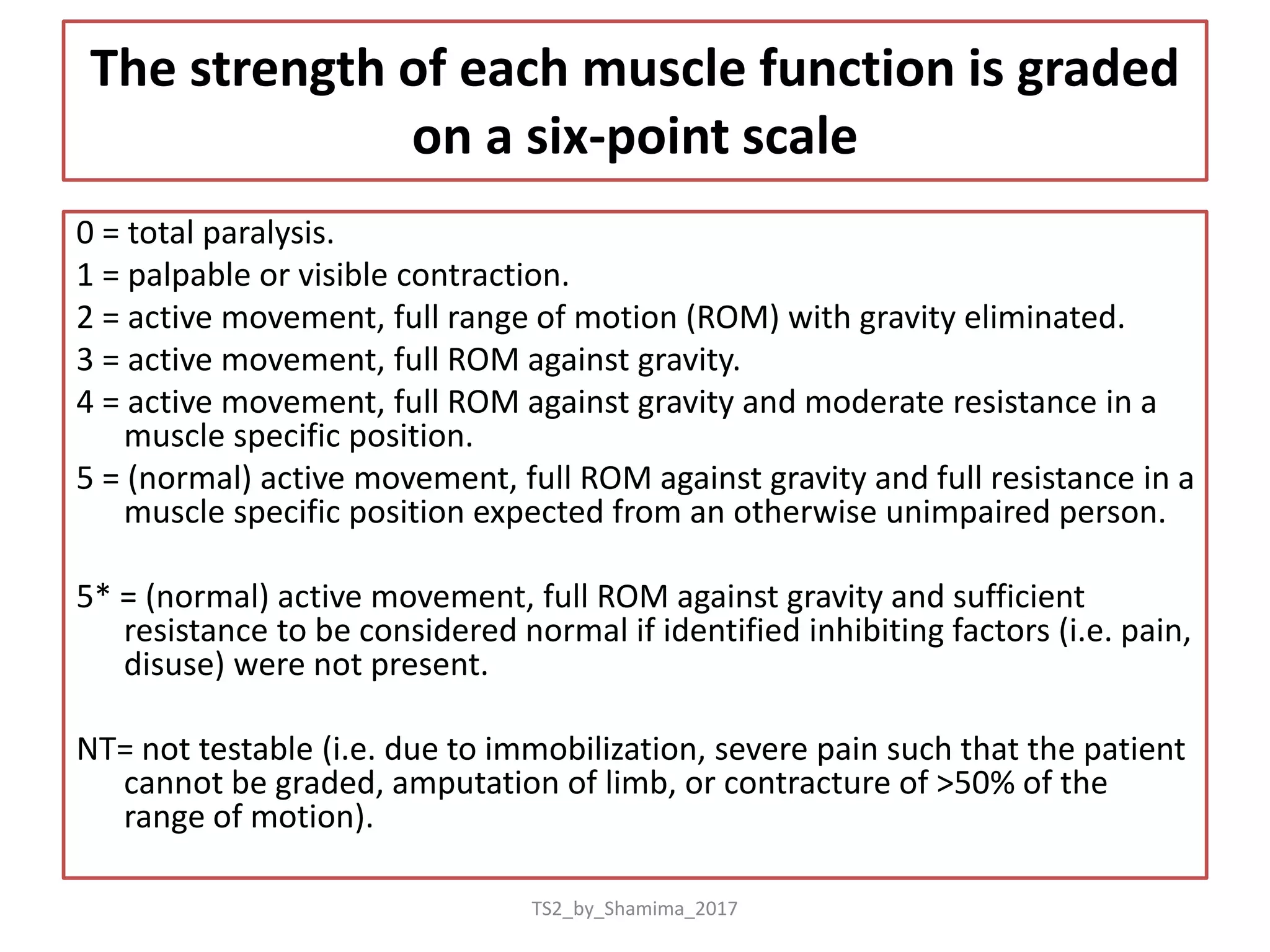
The strength of each muscle function is graded
on a six-point scale
0 = total paralysis.
1 = palpable or visible contraction.
2 = active movement, full range of motion (ROM) with gravity eliminated.
3 = active movement, full ROM against gravity.
4 = active movement, full ROM against gravity and moderate resistance in a
muscle specific position.
5 = (normal) active movement, full ROM against gravity and full resistance in a
muscle specific position expected from an otherwise unimpaired person.
5* = (normal) active movement, full ROM against gravity and sufficient
resistance to be considered normal if identified inhibiting factors (i.e. pain,
disuse) were not present.
NT= not testable (i.e. due to immobilization, severe pain such that the patient
cannot be graded, amputation of limb, or contracture of >50% of the
range of motion).
TS2_by_Shamima_2017
Continue…
• Plus and minus scores are not used when the
International Standards examination is applied
in a research setting and not recommended
when comparing data across institutions.
• In cases of a muscle function whose ROM is
limited by a contracture, if the patient exhibits
≥50% of the normal range, then the muscle
function can be graded through its available
range with the same 0–5 scale. If the ROM is
limited to <50% of the normal ROM, “NT”
should be documented.
TS2_by_Shamima_2017
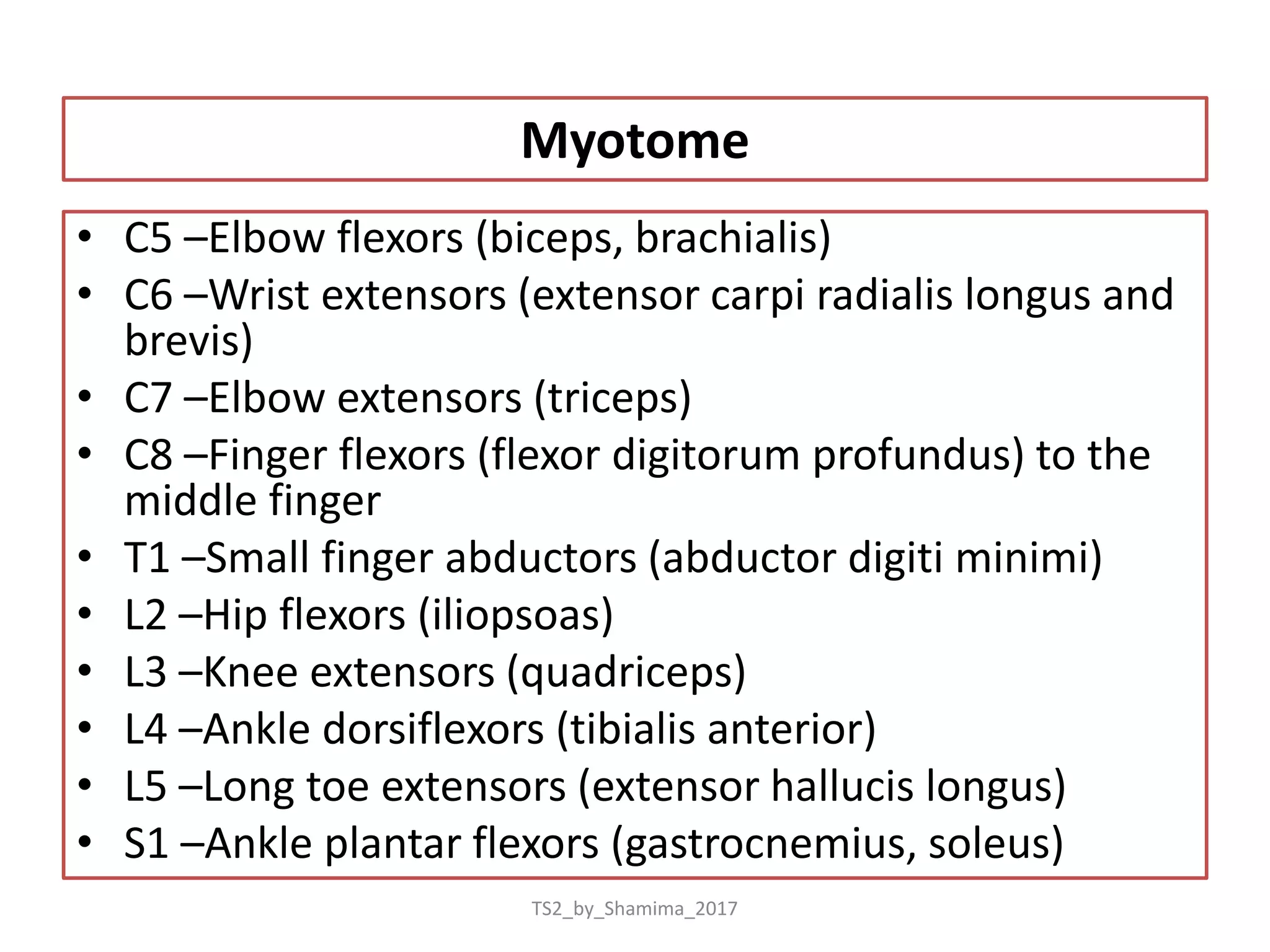
Myotome
• C5 –Elbow flexors (biceps, brachialis)
• C6 –Wrist extensors (extensor carpi radialis longus and
brevis)
• C7 –Elbow extensors (triceps)
• C8 –Finger flexors (flexor digitorum profundus) to the
middle finger
• T1 –Small finger abductors (abductor digiti minimi)
• L2 –Hip flexors (iliopsoas)
• L3 –Knee extensors (quadriceps)
• L4 –Ankle dorsiflexors (tibialis anterior)
• L5 –Long toe extensors (extensor hallucis longus)
• S1 –Ankle plantar flexors (gastrocnemius, soleus)
TS2_by_Shamima_2017
Position of patient
• C5 –Elbow flexed at 90 degrees, arm at the patient's side and
forearm supinated
• C6 –Wrist in full extension
• C7 –Shoulder is neutral rotation, adducted and in 90 degrees of
flexion with elbow in 45 degrees of flexion
• C8 –Full flexed position of the distal phalanx with the proximal
finger joints stabilized in a extended position
• T1 –Full abducted position of fingers
• L2 –Hip flexed to 90 degrees
• L3 –Knee flexed to 15 degrees
• L4 –Full dorsiflexed position of ankle
• L5 –First toe fully extended
• S1 –Hip in neutral rotation, neutral flexion/extension, and neutral
abduction/adduction, the knee is fully extended and the ankle in
full plantarflexion
TS2_by_Shamima_2017

MYOTOME.pptx

  • 1.
    MYOTOME Shamima Akter B. Sc(Honors) in Occupational Therapy & M. Sc in Rehabilitation Science Assistant Professor, Department of Occupational Therapy Bangladesh Health Professions Institute (BHPI) Centre for the Rehabilitation of the Paralysed (CRP) Chapain, Savar
  • 2.
    • A myotomeis the group of muscles that a single spinal nerve innervates. • The motor level is determined by examining a key muscle function within each of 10 myotomes on each side of the body and is defined by the lowest key muscle function that has a grade of at least 3 [on manual muscle testing (MMT) in the supine position], providing the key muscle functions represented by segments above that level are judged to be intact (graded as a 5 on MMT). • This may be different for the right and left side of the body. Motor level TS2_by_Shamima_2017
  • 3.
    The strength ofeach muscle function is graded on a six-point scale 0 = total paralysis. 1 = palpable or visible contraction. 2 = active movement, full range of motion (ROM) with gravity eliminated. 3 = active movement, full ROM against gravity. 4 = active movement, full ROM against gravity and moderate resistance in a muscle specific position. 5 = (normal) active movement, full ROM against gravity and full resistance in a muscle specific position expected from an otherwise unimpaired person. 5* = (normal) active movement, full ROM against gravity and sufficient resistance to be considered normal if identified inhibiting factors (i.e. pain, disuse) were not present. NT= not testable (i.e. due to immobilization, severe pain such that the patient cannot be graded, amputation of limb, or contracture of >50% of the range of motion). TS2_by_Shamima_2017
  • 4.
    Continue… • Plus andminus scores are not used when the International Standards examination is applied in a research setting and not recommended when comparing data across institutions. • In cases of a muscle function whose ROM is limited by a contracture, if the patient exhibits ≥50% of the normal range, then the muscle function can be graded through its available range with the same 0–5 scale. If the ROM is limited to <50% of the normal ROM, “NT” should be documented. TS2_by_Shamima_2017
  • 5.
    Myotome • C5 –Elbowflexors (biceps, brachialis) • C6 –Wrist extensors (extensor carpi radialis longus and brevis) • C7 –Elbow extensors (triceps) • C8 –Finger flexors (flexor digitorum profundus) to the middle finger • T1 –Small finger abductors (abductor digiti minimi) • L2 –Hip flexors (iliopsoas) • L3 –Knee extensors (quadriceps) • L4 –Ankle dorsiflexors (tibialis anterior) • L5 –Long toe extensors (extensor hallucis longus) • S1 –Ankle plantar flexors (gastrocnemius, soleus) TS2_by_Shamima_2017
  • 6.
    Position of patient •C5 –Elbow flexed at 90 degrees, arm at the patient's side and forearm supinated • C6 –Wrist in full extension • C7 –Shoulder is neutral rotation, adducted and in 90 degrees of flexion with elbow in 45 degrees of flexion • C8 –Full flexed position of the distal phalanx with the proximal finger joints stabilized in a extended position • T1 –Full abducted position of fingers • L2 –Hip flexed to 90 degrees • L3 –Knee flexed to 15 degrees • L4 –Full dorsiflexed position of ankle • L5 –First toe fully extended • S1 –Hip in neutral rotation, neutral flexion/extension, and neutral abduction/adduction, the knee is fully extended and the ankle in full plantarflexion TS2_by_Shamima_2017