Latest WHO Classification of Myeloproliferative
Neoplasm
Moderator: Dr Ranjana Deka
Associate Professor, Dept of Pathology
Tezpur Medical College Hospital
Presenter: Dr Lekhraaj Gautam
Post Graduate Trainee, Dept of
Pathology
Tezpur Medical College Hospital
Introduction
Myeloproliferative neoplasms (MPNs) are clonal hematological
disorders, characterized by increased proliferation of the myeloid
lineages in the bone marrow.
Clinical-laboratory features of MPNs depend on the main
lineage of differentiation, the molecular landscape, and the
disease stage.
Associated with normal maturation and effective hematopoiesis
Organomegaly is common and often symptomatic..
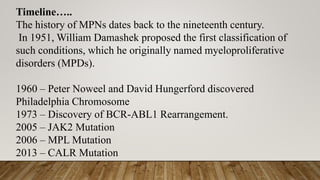
Timeline…..
The history of MPNs dates back to the nineteenth century.
In 1951, William Damashek proposed the first classification of
such conditions, which he originally named myeloproliferative
disorders (MPDs).
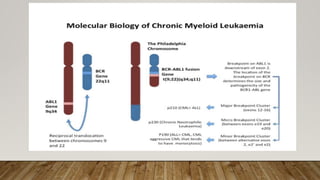
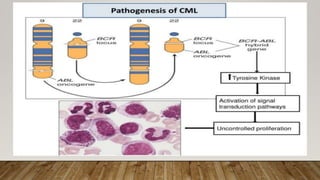
1960 – Peter Noweel and David Hungerford discovered
Philadelphia Chromosome
1973 – Discovery of BCR-ABL1 Rearrangement.
2005 – JAK2 Mutation
2006 – MPL Mutation
2013 – CALR Mutation
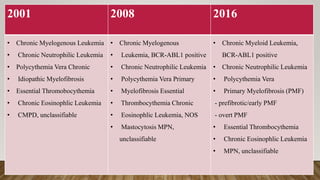
2001 2008 2016
• Chronic Myelogenous Leukemia
• Chronic Neutrophilic Leukemia
• Polycythemia Vera Chronic
• Idiopathic Myelofibrosis
• Essential Thromobocythemia
• Chronic Eosinophlic Leukemia
• CMPD, unclassifiable
• Chronic Myelogenous
• Leukemia, BCR-ABL1 positive
• Chronic Neutrophilic Leukemia
• Polycythemia Vera Primary
• Myelofibrosis Essential
• Thrombocythemia Chronic
• Eosinophlic Leukemia, NOS
• Mastocytosis MPN,
unclassifiable
• Chronic Myeloid Leukemia,
BCR-ABL1 positive
• Chronic Neutrophilic Leukemia
• Polycythemia Vera
• Primary Myelofibrosis (PMF)
- prefibrotic/early PMF
- overt PMF
• Essential Thrombocythemia
• Chronic Eosinophlic Leukemia
• MPN, unclassifiable
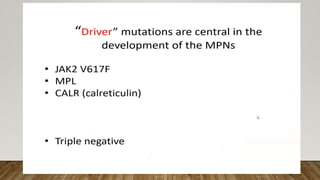
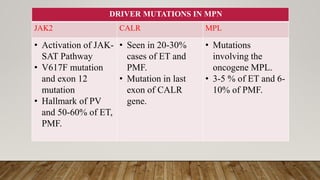
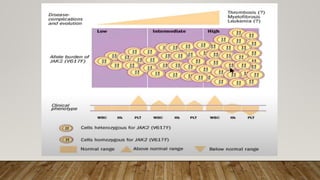
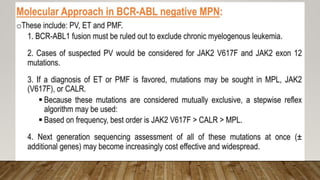
DRIVER MUTATIONS IN MPN
JAK2 CALR MPL
• Activation of JAK-
SAT Pathway
• V617F mutation
and exon 12
mutation
• Hallmark of PV
and 50-60% of ET,
PMF.
• Seen in 20-30%
cases of ET and
PMF.
• Mutation in last
exon of CALR
gene.
• Mutations
involving the
oncogene MPL.
• 3-5 % of ET and 6-
10% of PMF.
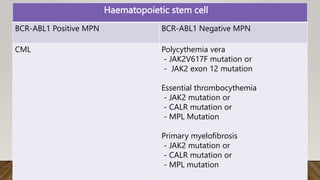
Haematopoietic stem cell
BCR-ABL1 Positive MPN BCR-ABL1 Negative MPN
CML Polycythemia vera
- JAK2V617F mutation or
- JAK2 exon 12 mutation
Essential thrombocythemia
- JAK2 mutation or
- CALR mutation or
- MPL Mutation
Primary myelofibrosis
- JAK2 mutation or
- CALR mutation or
- MPL mutation
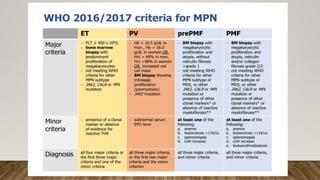
 Revised criteria for diagnosing accelerated phase CML.
 CNL now includes specific mention of CSF3R T6181I as a
major diagnostic criterion. Diagnostic criteria for PV are
notably changed to lower the haemoglobin threshold and thus
prevents underdiagnosis. Bone marrow morphology is now
considered a major criteria.
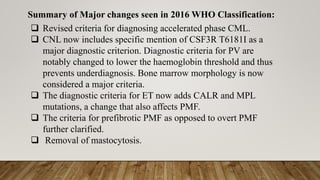
 The diagnostic criteria for ET now adds CALR and MPL
mutations, a change that also affects PMF.
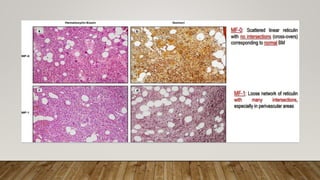
 The criteria for prefibrotic PMF as opposed to overt PMF
further clarified.
 Removal of mastocytosis.
Summary of Major changes seen in 2016 WHO Classification:
Conclusions
The WHO committee of haemato-pathologists, clinicians, and
scientists with special interest in MPN has now delivered the most
comprehensive and practically useful outline of diagnostic criteria for
for ET, PV, and PMF. The authors of the current review strongly
recommend the collection of BM examination at time of diagnosis of
MPN and encourage repeating the procedure during follow-up, in
the presence of signs of progressive disease.
According to the 2016 WHO classification, all patients must be
studied for the driver mutations and virtually all for BM morphology.
Myeloproliferative Neoplasm

Myeloproliferative Neoplasm

  • 1.
    Latest WHO Classificationof Myeloproliferative Neoplasm Moderator: Dr Ranjana Deka Associate Professor, Dept of Pathology Tezpur Medical College Hospital Presenter: Dr Lekhraaj Gautam Post Graduate Trainee, Dept of Pathology Tezpur Medical College Hospital
  • 2.
    Introduction Myeloproliferative neoplasms (MPNs)are clonal hematological disorders, characterized by increased proliferation of the myeloid lineages in the bone marrow. Clinical-laboratory features of MPNs depend on the main lineage of differentiation, the molecular landscape, and the disease stage. Associated with normal maturation and effective hematopoiesis Organomegaly is common and often symptomatic..
  • 3.
    Timeline….. The history ofMPNs dates back to the nineteenth century. In 1951, William Damashek proposed the first classification of such conditions, which he originally named myeloproliferative disorders (MPDs). 1960 – Peter Noweel and David Hungerford discovered Philadelphia Chromosome 1973 – Discovery of BCR-ABL1 Rearrangement. 2005 – JAK2 Mutation 2006 – MPL Mutation 2013 – CALR Mutation
  • 5.
    2001 2008 2016 •Chronic Myelogenous Leukemia • Chronic Neutrophilic Leukemia • Polycythemia Vera Chronic • Idiopathic Myelofibrosis • Essential Thromobocythemia • Chronic Eosinophlic Leukemia • CMPD, unclassifiable • Chronic Myelogenous • Leukemia, BCR-ABL1 positive • Chronic Neutrophilic Leukemia • Polycythemia Vera Primary • Myelofibrosis Essential • Thrombocythemia Chronic • Eosinophlic Leukemia, NOS • Mastocytosis MPN, unclassifiable • Chronic Myeloid Leukemia, BCR-ABL1 positive • Chronic Neutrophilic Leukemia • Polycythemia Vera • Primary Myelofibrosis (PMF) - prefibrotic/early PMF - overt PMF • Essential Thrombocythemia • Chronic Eosinophlic Leukemia • MPN, unclassifiable
  • 8.
    DRIVER MUTATIONS INMPN JAK2 CALR MPL • Activation of JAK- SAT Pathway • V617F mutation and exon 12 mutation • Hallmark of PV and 50-60% of ET, PMF. • Seen in 20-30% cases of ET and PMF. • Mutation in last exon of CALR gene. • Mutations involving the oncogene MPL. • 3-5 % of ET and 6- 10% of PMF.
  • 9.
    Haematopoietic stem cell BCR-ABL1Positive MPN BCR-ABL1 Negative MPN CML Polycythemia vera - JAK2V617F mutation or - JAK2 exon 12 mutation Essential thrombocythemia - JAK2 mutation or - CALR mutation or - MPL Mutation Primary myelofibrosis - JAK2 mutation or - CALR mutation or - MPL mutation
  • 38.
     Revised criteriafor diagnosing accelerated phase CML.  CNL now includes specific mention of CSF3R T6181I as a major diagnostic criterion. Diagnostic criteria for PV are notably changed to lower the haemoglobin threshold and thus prevents underdiagnosis. Bone marrow morphology is now considered a major criteria.  The diagnostic criteria for ET now adds CALR and MPL mutations, a change that also affects PMF.  The criteria for prefibrotic PMF as opposed to overt PMF further clarified.  Removal of mastocytosis. Summary of Major changes seen in 2016 WHO Classification:
  • 39.
    Conclusions The WHO committeeof haemato-pathologists, clinicians, and scientists with special interest in MPN has now delivered the most comprehensive and practically useful outline of diagnostic criteria for for ET, PV, and PMF. The authors of the current review strongly recommend the collection of BM examination at time of diagnosis of MPN and encourage repeating the procedure during follow-up, in the presence of signs of progressive disease. According to the 2016 WHO classification, all patients must be studied for the driver mutations and virtually all for BM morphology.