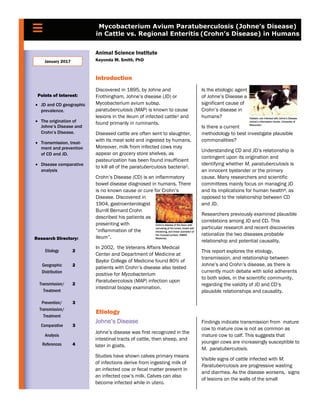
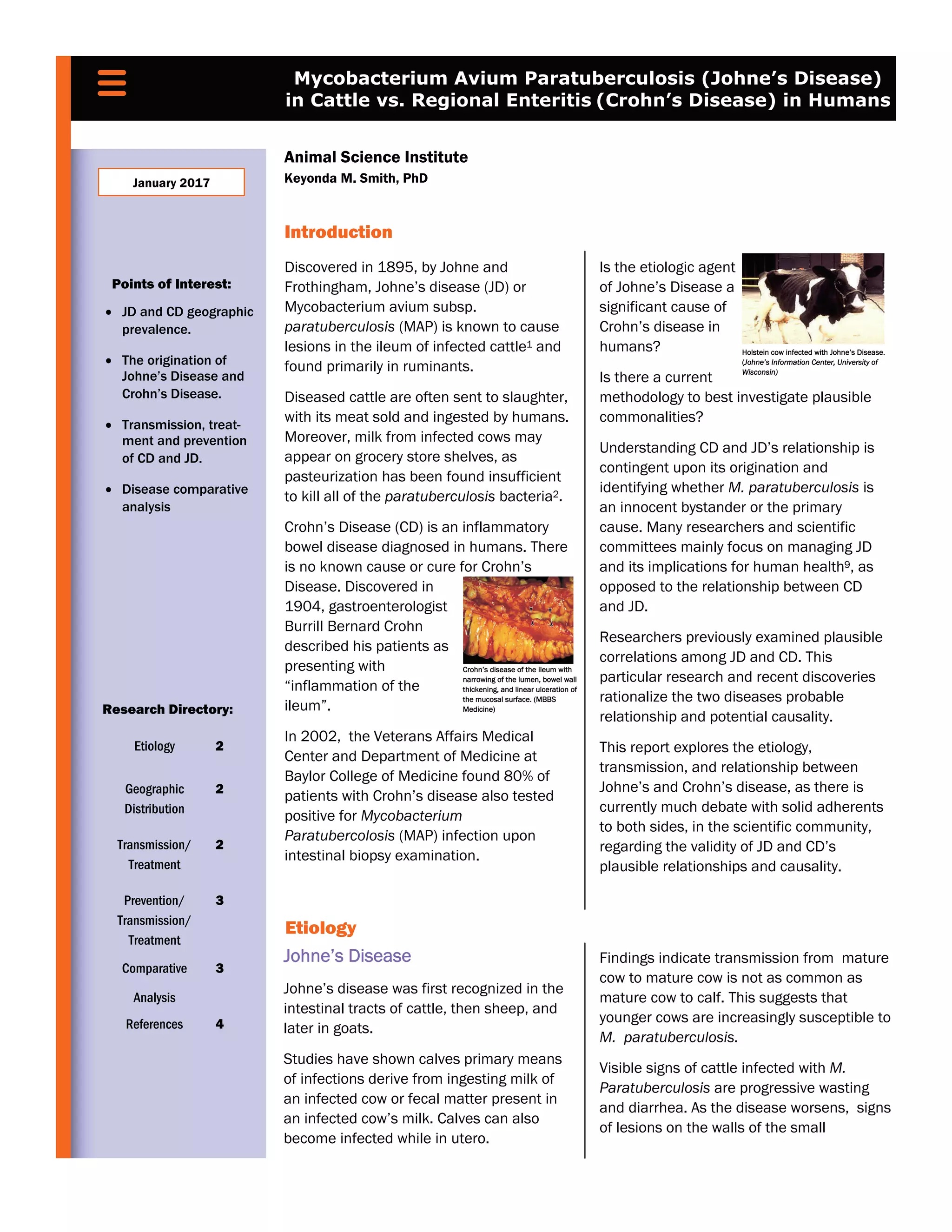
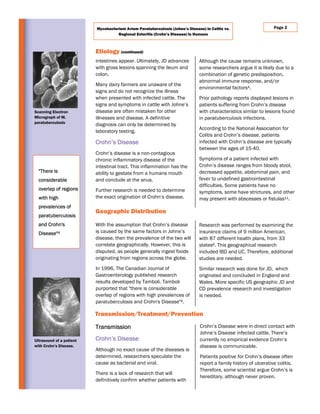
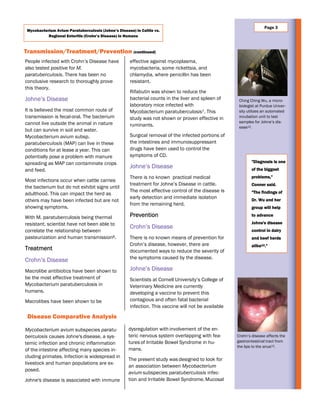
Discovered in 1895, by Johne and
Frothingham, Johne’s disease (JD) or
Mycobacterium avium subsp.
paratuberculosis (MAP) is known to cause
lesions in the ileum of infected cattle1 and
found primarily in ruminants.
Diseased cattle are often sent to slaughter,
with its meat sold and ingested by humans.
Moreover, milk from infected cows may
appear on grocery store shelves, as
pasteurization has been found insufficient
to kill all of the paratuberculosis bacteria2.
Crohn’s Disease (CD) is an inflammatory
bowel disease diagnosed in humans. There
is no known cause or cure for Crohn’s
Disease. Discovered in
1904, gastroenterologist
Burrill Bernard Crohn
described his patients as
presenting with
“inflammation of the
ileum”.
In 2002, the Veterans Affairs Medical
Center and Department of Medicine at
Baylor College of Medicine found 80% of
patients with Crohn’s disease also tested
positive for Mycobacterium
Paratubercolosis (MAP) infection upon
intestinal biopsy examination.
Is the etiologic agent
of Johne’s Disease a
significant cause of
Crohn’s disease in
humans?
Is there a current
methodology to best investigate plausible
commonalities?
Understanding CD and JD’s relationship is
contingent upon its origination and
identifying whether M. paratuberculosis is
an innocent bystander or the primary
cause. Many researchers and scientific
committees mainly focus on managing JD
and its implications for human health9, as
opposed to the relationship between CD
and JD.
Researchers previously examined plausible
correlations among JD and CD. This
particular research and recent discoveries
rationalize the two diseases probable
relationship and potential causality.
This report explores the etiology,
transmission, and relationship between
Johne’s and Crohn’s disease, as there is
currently much debate with solid adherents
to both sides, in the scientific community,
regarding the validity of JD and CD’s
plausible relationships and causality.
Introduction
Etiology
Johne’s Disease
Johne’s disease was first recognized in the
intestinal tracts of cattle, then sheep, and
later in goats.
Studies have shown calves primary means
of infections derive from ingesting milk of
an infected cow or fecal matter present in
an infected cow’s milk. Calves can also
become infected while in utero.
Findings indicate transmission from mature
cow to mature cow is not as common as
mature cow to calf. This suggests that
younger cows are increasingly susceptible to
M. paratuberculosis.
Visible signs of cattle infected with M.
Paratuberculosis are progressive wasting
and diarrhea. As the disease worsens, signs
of lesions on the walls of the small
Mycobacterium Avium Paratuberculosis (Johne’s Disease)
in Cattle vs. Regional Enteritis (Crohn’s Disease) in Humans
Points of Interest:
 JD and CD geographic
prevalence.
 The origination of
Johne’s Disease and
Crohn’s Disease.
 Transmission, treat-
ment and prevention
of CD and JD.
 Disease comparative
analysis
Animal Science Institute
Keyonda M. Smith, PhDJanuary 2017
Research Directory:
Etiology 2
Geographic
Distribution
2
Transmission/
Treatment
2
Prevention/
Transmission/
Treatment
3
Comparative
Analysis
3
References 4
Holstein cow infected with Johne’s Disease.
(Johne’s Information Center, University of
Wisconsin)
Crohn’s disease of the ileum with
narrowing of the lumen, bowel wall
thickening, and linear ulceration of
the mucosal surface. (MBBS
Medicine)
intestines appear. Ultimately, JD advances
with gross lesions spanning the ileum and
colon.
Many dairy farmers are unaware of the
signs and do not recognize the illness
when presented with infected cattle. The
signs and symptoms in cattle with Johne’s
disease are often mistaken for other
illnesses and disease. A definitive
diagnosis can only be determined by
laboratory testing.
Crohn’s Disease
Crohn’s disease is a non-contagious
chronic inflammatory disease of the
intestinal tract. This inflammation has the
ability to gestate from a humans mouth
and conclude at the anus.
Further research is needed to determine
the exact origination of Crohn’s disease.
Although the cause remains unknown,
some researchers argue it is likely due to a
combination of genetic predisposition,
abnormal immune response, and/or
environmental factors4.
Prior pathology reports displayed lesions in
patients suffering from Crohn’s disease
with characteristics similar to lesions found
in paratuberculosis infections.
According to the National Association for
Colitis and Crohn’s disease, patients
infected with Crohn’s disease are typically
between the ages of 15-40.
Symptoms of a patient infected with
Crohn’s disease ranges from bloody stool,
decreased appetite, abdominal pain, and
fever to undefined gastrointestinal
difficulties. Some patients have no
symptoms, some have strictures, and other
may present with abscesses or fistulas11.
Crohn’s Disease were in direct contact with
Johne’s Disease infected cattle. There’s
currently no empirical evidence Crohn’s
disease is communicable.
Patients positive for Crohn’s disease often
report a family history of ulcerative colitis.
Therefore, some scientist argue Crohn’s is
hereditary, although never proven.
Transmission
Crohn’s Disease
Although no exact cause of the diseases is
determined, researchers speculate the
cause as bacterial and viral.
There is a lack of research that will
definitively confirm whether patients with
Etiology (continued)
Transmission/Treatment/Prevention
Geographic Distribution
Research was performed by examining the
insurance claims of 9 million American,
with 87 different health plans, from 33
states6. This geographical research
included IBD and UC. Therefore, additional
studies are needed.
Similar research was done for JD, which
originated and concluded in England and
Wales. More specific US geographic JD and
CD prevalence research and investigation
is needed.
With the assumption that Crohn’s disease
is caused by the same factors in Johne’s
disease, then the prevalence of the two will
correlate geographically. However, this is
disputed, as people generally ingest foods
originating from regions across the globe.
In 1996, The Canadian Journal of
Gastroenterology published research
results developed by Tamboli. Tamboli
purported that "there is considerable
overlap of regions with high prevalences of
paratuberculosis and Crohn's Disease"4.
Page 2Mycobacterium Avium Paratuberculosis (Johne’s Disease) in Cattle vs.
Regional Enteritis (Crohn’s Disease) in Humans
"There is
considerable
overlap of regions
with high
prevalences of
paratuberculosis
and Crohn's
Disease"4
Scanning Electron
Micrograph of M.
paratuberculosis
Ultrasound of a patient
with Crohn’s Disease.
effective against mycoplasma,
mycobacteria, some rickettsia, and
chlamydia, where penicillin has been
resistant.
Rifabutin was shown to reduce the
bacterial counts in the liver and spleen of
laboratory mice infected with
Mycobacterium paratuberculosis7. This
study was not shown or proven effective in
ruminants.
Surgical removal of the infected portions of
the intestines and immunosuppressant
drugs have been used to control the
symptoms of CD.
Johne’s Disease
There is no known practical medical
treatment for Johne’s Disease in cattle.
The most effective control of the disease is
early detection and immediate isolation
from the remaining herd.
Prevention
Crohn’s Disease
There is no known means of prevention for
Crohn’s disease, however, there are
documented ways to reduce the severity of
the symptoms caused by the disease.
Johne’s Disease
Scientists at Cornell University’s College of
Veterinary Medicine are currently
developing a vaccine to prevent this
contagious and often fatal bacterial
infection. This vaccine will not be available
Transmission/Treatment/Prevention (continued)
"Diagnosis is one
of the biggest
problems,"
Conner said.
"The findings of
Dr. Wu and her
group will help
to advance
Johne's disease
control in dairy
and beef herds
alike12."
Page 3
Disease Comparative Analysis
People infected with Crohn’s Disease have
also tested positive for M.
paratuberculosis. There has been no
conclusive research to thoroughly prove
this theory.
Johne’s Disease
It is believed the most common route of
transmission is fecal-oral. The bacterium
cannot live outside the animal in nature
but can survive in soil and water.
Mycobacterium avium subsp.
paratuberculosis (MAP) can live in these
conditions for at lease a year. This can
potentially pose a problem with manure
spreading as MAP can contaminate crops
and feed.
Most infections occur when cattle carries
the bacterium but do not exhibit signs until
adulthood. This can impact the herd as
others may have been infected but are not
showing symptoms.
With M. paratuberculosis being thermal
resistant, scientist have not been able to
correlate the relationship between
pasteurization and human transmission8.
Treatment
Crohn’s Disease
Macrolibe antibiotics have been shown to
be the most effective treatment of
Mycobacterium paratuberculosis in
humans.
Macrolibes have been shown to be
Ching Ching Wu, a micro-
biologist at Purdue Univer-
sity utilizes an automated
incubation unit to test
samples for Johne’s dis-
ease12.
Crohn’s disease affects the
gastrointestinal tract from
the lips to the anus13.
dysregulation with involvement of the en-
teric nervous system overlapping with fea-
tures of Irritable Bowel Syndrome in hu-
mans.
The present study was designed to look for
an association between Mycobacterium
avium subspecies paratuberculosis infec-
tion and Irritable Bowel Syndrome. Mucosal
Mycobacterium avium subspecies paratu-
berculosis causes Johne's disease, a sys-
temic infection and chronic inflammation
of the intestine affecting many species in-
cluding primates. Infection is widespread in
livestock and human populations are ex-
posed.
Johne's disease is associated with immune
Mycobacterium Avium Paratuberculosis (Johne’s Disease) in Cattle vs.
Regional Enteritis (Crohn’s Disease) in Humans
ger, WR Thayer—Department of Medicine, Rhode
Island Hospital. 1993, Aug.
8. http://jds.fass.org/cgi/reprint/80/12/3445.pdf.
Michael T. Collins. Nov 12 1997. Accessed Dec 29
08
9. Diagnosis and Control of Johne’s Disease (2003).
ISBN-10: 0-309-08611-6. Committee on Diagnosis
and Control of Johne's Disease, National Research
Council
10.http://www.farmanddairy.com/news/new-vaccine-
for-johnes-disease/10700.html. 2008 Dec 18. Ac-
cessed Dec 28 2008
11. http://www.badgut.com/index.php?
contentFile=crohns&title=Crohn%27s%20Disease.
Canadian Society of IntestinalResearch. Accessed
Dec 30 2008.
12.http://news.uns.purdue.edu/UNS/
html4ever/020719.Wu.johnes.html. Purdue News.
Jul 19 2002. Accessed Dec 31 08
13. http://www.gastrolab.net/mg025.htm. Dec 01 08.
Accessed Dec 31 08.
1. http://en.wikipedia.org/wiki/Johne%27s_disease. Ac-
cessed Dec 03 08
2. Author: Dickrell, Jim Publication: Dairy Today, Publication
Date: 18-SEP-04 http://www.accessmylibrary.com/
coms2/summary_0286-8308813_ITMAccessed Dec 03
2008
3. El-Zaataria, F., Osatob, M., Graham, D. (2002) Inflammatory
Bowel Disease Laboratory, Veterans Affairs Medical Center
and Department of Medicine, Baylor College of Medicine
4. Rubery ED (Judge Institute of Management, University of
Cambridge, UK). A review of the evidence for a link be-
tween exposure to Mycobacterium paratuberculosis (MAP)
and Crohn’s disease (CD) in humans. A report for the Food
Standards Agency [monograph online]. Food Standards
Agency, United Kingdom; 2002 Jan 22. 52 p. Available at:
http://www.foodstandards.gov.uk/multimedia/pdfs/
mapcrohnreport.pdf. Accessed Dec 08 2008
5. http://alan.kennedy.name/crohns/epidem.htm. The Epi-
demiology of Crohn’s Disease. Alan Kennedy. Accessed
Dec 28 08.
6. http://www.biomedexperts.com/
Abstract.bme/17904915/
The_prevalence_and_geographic_distribution_of_Crohn_s
_disease_and_ulcerative_colitis_in_the_United_States.
Accessed Dec 28 08.
7. http://lib.bioinfo.pl/meid:273328. RJ Chiodini, JM Kree-
References
disease (p=0.0003 for Irritable Bowel Syndrome vs
normal and p=0.0000 for Crohn's disease vs normal).
One subject in each group had a conserved SNP at
position 247 of IS900 also found in isolates from 7 of
8 dairy sheep. There was a significant association
(p=0.0018) between Mycobacterium avium
subspecies paratuberculosis infection and the
consumption of hand madecheese. Mycobacterium
avium subspecies paratuberculosis is a candidate
pathogen in the causation of a proportion of Irritable
Bowel Syndrome as well as in Crohn's disease.
biopsies from the ileum, ascending and descending colon
were obtained from patients with Irritable Bowel Syndrome
attending the University of Sassari, Sardinia.
Crohn's disease and normal control groups were also
included. Mycobacterium avium subspecies
paratuberculosis was detected using IS900PCR with
amplicon sequencing. Data on potential risk factors for
human exposure to these pathogensand on isolates from
Sardinian dairy sheep were also obtained. Mycobacterium
avium subspecies paratuberculosis was detected in 15 of 20
(75%) patients with Irritable Bowel Syndrome, 3 of 20 (15%)
normal controls and 20 of 23 (87%) people with Crohn's
Disease Comparative Analysis (continued)
Animal Science Institute
The Animal Science Institute provides continuing education to individuals interested in Laboratory Animal Enrichment, Veteri-
nary Assistance, Animal Facilities Management and Ruminant Nutrition.
Page 4
Mycobacterium Avium Paratuberculosis (Johne’s Disease) in Cattle vs.
Regional Enteritis (Crohn’s Disease) in Humans

Mycobacterium Avium Paratuberculosis (Johne’s Disease)

  • 1.
    Discovered in 1895,by Johne and Frothingham, Johne’s disease (JD) or Mycobacterium avium subsp. paratuberculosis (MAP) is known to cause lesions in the ileum of infected cattle1 and found primarily in ruminants. Diseased cattle are often sent to slaughter, with its meat sold and ingested by humans. Moreover, milk from infected cows may appear on grocery store shelves, as pasteurization has been found insufficient to kill all of the paratuberculosis bacteria2. Crohn’s Disease (CD) is an inflammatory bowel disease diagnosed in humans. There is no known cause or cure for Crohn’s Disease. Discovered in 1904, gastroenterologist Burrill Bernard Crohn described his patients as presenting with “inflammation of the ileum”. In 2002, the Veterans Affairs Medical Center and Department of Medicine at Baylor College of Medicine found 80% of patients with Crohn’s disease also tested positive for Mycobacterium Paratubercolosis (MAP) infection upon intestinal biopsy examination. Is the etiologic agent of Johne’s Disease a significant cause of Crohn’s disease in humans? Is there a current methodology to best investigate plausible commonalities? Understanding CD and JD’s relationship is contingent upon its origination and identifying whether M. paratuberculosis is an innocent bystander or the primary cause. Many researchers and scientific committees mainly focus on managing JD and its implications for human health9, as opposed to the relationship between CD and JD. Researchers previously examined plausible correlations among JD and CD. This particular research and recent discoveries rationalize the two diseases probable relationship and potential causality. This report explores the etiology, transmission, and relationship between Johne’s and Crohn’s disease, as there is currently much debate with solid adherents to both sides, in the scientific community, regarding the validity of JD and CD’s plausible relationships and causality. Introduction Etiology Johne’s Disease Johne’s disease was first recognized in the intestinal tracts of cattle, then sheep, and later in goats. Studies have shown calves primary means of infections derive from ingesting milk of an infected cow or fecal matter present in an infected cow’s milk. Calves can also become infected while in utero. Findings indicate transmission from mature cow to mature cow is not as common as mature cow to calf. This suggests that younger cows are increasingly susceptible to M. paratuberculosis. Visible signs of cattle infected with M. Paratuberculosis are progressive wasting and diarrhea. As the disease worsens, signs of lesions on the walls of the small Mycobacterium Avium Paratuberculosis (Johne’s Disease) in Cattle vs. Regional Enteritis (Crohn’s Disease) in Humans Points of Interest:  JD and CD geographic prevalence.  The origination of Johne’s Disease and Crohn’s Disease.  Transmission, treat- ment and prevention of CD and JD.  Disease comparative analysis Animal Science Institute Keyonda M. Smith, PhDJanuary 2017 Research Directory: Etiology 2 Geographic Distribution 2 Transmission/ Treatment 2 Prevention/ Transmission/ Treatment 3 Comparative Analysis 3 References 4 Holstein cow infected with Johne’s Disease. (Johne’s Information Center, University of Wisconsin) Crohn’s disease of the ileum with narrowing of the lumen, bowel wall thickening, and linear ulceration of the mucosal surface. (MBBS Medicine)
  • 2.
    intestines appear. Ultimately,JD advances with gross lesions spanning the ileum and colon. Many dairy farmers are unaware of the signs and do not recognize the illness when presented with infected cattle. The signs and symptoms in cattle with Johne’s disease are often mistaken for other illnesses and disease. A definitive diagnosis can only be determined by laboratory testing. Crohn’s Disease Crohn’s disease is a non-contagious chronic inflammatory disease of the intestinal tract. This inflammation has the ability to gestate from a humans mouth and conclude at the anus. Further research is needed to determine the exact origination of Crohn’s disease. Although the cause remains unknown, some researchers argue it is likely due to a combination of genetic predisposition, abnormal immune response, and/or environmental factors4. Prior pathology reports displayed lesions in patients suffering from Crohn’s disease with characteristics similar to lesions found in paratuberculosis infections. According to the National Association for Colitis and Crohn’s disease, patients infected with Crohn’s disease are typically between the ages of 15-40. Symptoms of a patient infected with Crohn’s disease ranges from bloody stool, decreased appetite, abdominal pain, and fever to undefined gastrointestinal difficulties. Some patients have no symptoms, some have strictures, and other may present with abscesses or fistulas11. Crohn’s Disease were in direct contact with Johne’s Disease infected cattle. There’s currently no empirical evidence Crohn’s disease is communicable. Patients positive for Crohn’s disease often report a family history of ulcerative colitis. Therefore, some scientist argue Crohn’s is hereditary, although never proven. Transmission Crohn’s Disease Although no exact cause of the diseases is determined, researchers speculate the cause as bacterial and viral. There is a lack of research that will definitively confirm whether patients with Etiology (continued) Transmission/Treatment/Prevention Geographic Distribution Research was performed by examining the insurance claims of 9 million American, with 87 different health plans, from 33 states6. This geographical research included IBD and UC. Therefore, additional studies are needed. Similar research was done for JD, which originated and concluded in England and Wales. More specific US geographic JD and CD prevalence research and investigation is needed. With the assumption that Crohn’s disease is caused by the same factors in Johne’s disease, then the prevalence of the two will correlate geographically. However, this is disputed, as people generally ingest foods originating from regions across the globe. In 1996, The Canadian Journal of Gastroenterology published research results developed by Tamboli. Tamboli purported that "there is considerable overlap of regions with high prevalences of paratuberculosis and Crohn's Disease"4. Page 2Mycobacterium Avium Paratuberculosis (Johne’s Disease) in Cattle vs. Regional Enteritis (Crohn’s Disease) in Humans "There is considerable overlap of regions with high prevalences of paratuberculosis and Crohn's Disease"4 Scanning Electron Micrograph of M. paratuberculosis Ultrasound of a patient with Crohn’s Disease.
  • 3.
    effective against mycoplasma, mycobacteria,some rickettsia, and chlamydia, where penicillin has been resistant. Rifabutin was shown to reduce the bacterial counts in the liver and spleen of laboratory mice infected with Mycobacterium paratuberculosis7. This study was not shown or proven effective in ruminants. Surgical removal of the infected portions of the intestines and immunosuppressant drugs have been used to control the symptoms of CD. Johne’s Disease There is no known practical medical treatment for Johne’s Disease in cattle. The most effective control of the disease is early detection and immediate isolation from the remaining herd. Prevention Crohn’s Disease There is no known means of prevention for Crohn’s disease, however, there are documented ways to reduce the severity of the symptoms caused by the disease. Johne’s Disease Scientists at Cornell University’s College of Veterinary Medicine are currently developing a vaccine to prevent this contagious and often fatal bacterial infection. This vaccine will not be available Transmission/Treatment/Prevention (continued) "Diagnosis is one of the biggest problems," Conner said. "The findings of Dr. Wu and her group will help to advance Johne's disease control in dairy and beef herds alike12." Page 3 Disease Comparative Analysis People infected with Crohn’s Disease have also tested positive for M. paratuberculosis. There has been no conclusive research to thoroughly prove this theory. Johne’s Disease It is believed the most common route of transmission is fecal-oral. The bacterium cannot live outside the animal in nature but can survive in soil and water. Mycobacterium avium subsp. paratuberculosis (MAP) can live in these conditions for at lease a year. This can potentially pose a problem with manure spreading as MAP can contaminate crops and feed. Most infections occur when cattle carries the bacterium but do not exhibit signs until adulthood. This can impact the herd as others may have been infected but are not showing symptoms. With M. paratuberculosis being thermal resistant, scientist have not been able to correlate the relationship between pasteurization and human transmission8. Treatment Crohn’s Disease Macrolibe antibiotics have been shown to be the most effective treatment of Mycobacterium paratuberculosis in humans. Macrolibes have been shown to be Ching Ching Wu, a micro- biologist at Purdue Univer- sity utilizes an automated incubation unit to test samples for Johne’s dis- ease12. Crohn’s disease affects the gastrointestinal tract from the lips to the anus13. dysregulation with involvement of the en- teric nervous system overlapping with fea- tures of Irritable Bowel Syndrome in hu- mans. The present study was designed to look for an association between Mycobacterium avium subspecies paratuberculosis infec- tion and Irritable Bowel Syndrome. Mucosal Mycobacterium avium subspecies paratu- berculosis causes Johne's disease, a sys- temic infection and chronic inflammation of the intestine affecting many species in- cluding primates. Infection is widespread in livestock and human populations are ex- posed. Johne's disease is associated with immune Mycobacterium Avium Paratuberculosis (Johne’s Disease) in Cattle vs. Regional Enteritis (Crohn’s Disease) in Humans
  • 4.
    ger, WR Thayer—Departmentof Medicine, Rhode Island Hospital. 1993, Aug. 8. http://jds.fass.org/cgi/reprint/80/12/3445.pdf. Michael T. Collins. Nov 12 1997. Accessed Dec 29 08 9. Diagnosis and Control of Johne’s Disease (2003). ISBN-10: 0-309-08611-6. Committee on Diagnosis and Control of Johne's Disease, National Research Council 10.http://www.farmanddairy.com/news/new-vaccine- for-johnes-disease/10700.html. 2008 Dec 18. Ac- cessed Dec 28 2008 11. http://www.badgut.com/index.php? contentFile=crohns&title=Crohn%27s%20Disease. Canadian Society of IntestinalResearch. Accessed Dec 30 2008. 12.http://news.uns.purdue.edu/UNS/ html4ever/020719.Wu.johnes.html. Purdue News. Jul 19 2002. Accessed Dec 31 08 13. http://www.gastrolab.net/mg025.htm. Dec 01 08. Accessed Dec 31 08. 1. http://en.wikipedia.org/wiki/Johne%27s_disease. Ac- cessed Dec 03 08 2. Author: Dickrell, Jim Publication: Dairy Today, Publication Date: 18-SEP-04 http://www.accessmylibrary.com/ coms2/summary_0286-8308813_ITMAccessed Dec 03 2008 3. El-Zaataria, F., Osatob, M., Graham, D. (2002) Inflammatory Bowel Disease Laboratory, Veterans Affairs Medical Center and Department of Medicine, Baylor College of Medicine 4. Rubery ED (Judge Institute of Management, University of Cambridge, UK). A review of the evidence for a link be- tween exposure to Mycobacterium paratuberculosis (MAP) and Crohn’s disease (CD) in humans. A report for the Food Standards Agency [monograph online]. Food Standards Agency, United Kingdom; 2002 Jan 22. 52 p. Available at: http://www.foodstandards.gov.uk/multimedia/pdfs/ mapcrohnreport.pdf. Accessed Dec 08 2008 5. http://alan.kennedy.name/crohns/epidem.htm. The Epi- demiology of Crohn’s Disease. Alan Kennedy. Accessed Dec 28 08. 6. http://www.biomedexperts.com/ Abstract.bme/17904915/ The_prevalence_and_geographic_distribution_of_Crohn_s _disease_and_ulcerative_colitis_in_the_United_States. Accessed Dec 28 08. 7. http://lib.bioinfo.pl/meid:273328. RJ Chiodini, JM Kree- References disease (p=0.0003 for Irritable Bowel Syndrome vs normal and p=0.0000 for Crohn's disease vs normal). One subject in each group had a conserved SNP at position 247 of IS900 also found in isolates from 7 of 8 dairy sheep. There was a significant association (p=0.0018) between Mycobacterium avium subspecies paratuberculosis infection and the consumption of hand madecheese. Mycobacterium avium subspecies paratuberculosis is a candidate pathogen in the causation of a proportion of Irritable Bowel Syndrome as well as in Crohn's disease. biopsies from the ileum, ascending and descending colon were obtained from patients with Irritable Bowel Syndrome attending the University of Sassari, Sardinia. Crohn's disease and normal control groups were also included. Mycobacterium avium subspecies paratuberculosis was detected using IS900PCR with amplicon sequencing. Data on potential risk factors for human exposure to these pathogensand on isolates from Sardinian dairy sheep were also obtained. Mycobacterium avium subspecies paratuberculosis was detected in 15 of 20 (75%) patients with Irritable Bowel Syndrome, 3 of 20 (15%) normal controls and 20 of 23 (87%) people with Crohn's Disease Comparative Analysis (continued) Animal Science Institute The Animal Science Institute provides continuing education to individuals interested in Laboratory Animal Enrichment, Veteri- nary Assistance, Animal Facilities Management and Ruminant Nutrition. Page 4 Mycobacterium Avium Paratuberculosis (Johne’s Disease) in Cattle vs. Regional Enteritis (Crohn’s Disease) in Humans