Database Management Systems 3ed, R. Ramakrishnan and J. Gehrke
Overview of Storage and Indexing
Chapter 8
“How index-learning turns no student pale
Yet holds the eel of science by the tail.”
-- Alexander Pope (1688-1744)
Database Management Systems 3ed, R. Ramakrishnan and J. Gehrke
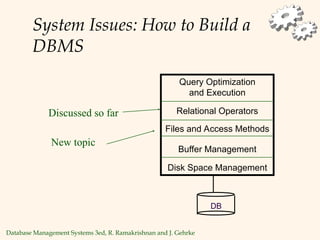
System Issues: How to Build a
DBMS
Query Optimization
and Execution
Relational Operators
Files and Access Methods
Buffer Management
Disk Space Management
DB
Discussed so far
New topic
Database Management Systems 3ed, R. Ramakrishnan and J. Gehrke
Data on External Storage
 Disks: Can retrieve random page at fixed cost
 But reading several consecutive pages is much cheaper than
reading them in random order
 Tapes: Can read pages only in sequence
 Cheaper than disks; used for archival storage
 File organization: Method of arranging a file of records
on external storage.
 Record id (rid) is sufficient to physically locate record
 Indexes are data structures that allow us to find the record ids
of records with given values in index search key fields
 Architecture: Buffer manager stages pages from external
storage to main memory buffer pool. File and index
layers make calls to the buffer manager.
Database Management Systems 3ed, R. Ramakrishnan and J. Gehrke
Alternative File Organizations
Many alternatives exist, each ideal for some
situations, and not so good in others:
 Heap (random order) files: Suitable when typical
access is a file scan retrieving all records.
 Sorted Files: Best if records must be retrieved in
some order, or only a `range’ of records is needed.
 Indexes: Data structures to organize records via
trees or hashing.
• Like sorted files, they speed up searches for a subset of
records, based on values in certain (“search key”) fields
• Updates are much faster than in sorted files.
Database Management Systems 3ed, R. Ramakrishnan and J. Gehrke
Indexes
 An index on a file speeds up selections on the
search key fields for the index.
 Any subset of the fields of a relation can be the
search key for an index on the relation (e.g., age or
colour).
 Search key is not the same as key (minimal set of
fields that uniquely identify a record in a relation).
 An index contains a collection of data entries,
and supports efficient retrieval of all data
entries k* with a given key value k.
 Example of Index: Essentials of Game Theory
Database Management Systems 3ed, R. Ramakrishnan and J. Gehrke
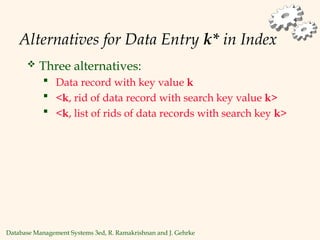
Alternatives for Data Entry k* in Index
 Three alternatives:
 Data record with key value k
 <k, rid of data record with search key value k>
 <k, list of rids of data records with search key k>
Database Management Systems 3ed, R. Ramakrishnan and J. Gehrke
Alternatives for Data Entries (Contd.)
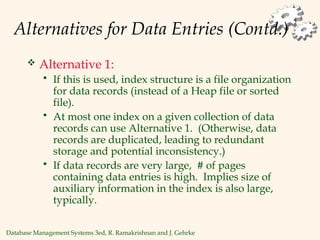
 Alternative 1:
 If this is used, index structure is a file organization
for data records (instead of a Heap file or sorted
file).
 At most one index on a given collection of data
records can use Alternative 1. (Otherwise, data
records are duplicated, leading to redundant
storage and potential inconsistency.)
 If data records are very large, # of pages
containing data entries is high. Implies size of
auxiliary information in the index is also large,
typically.
Database Management Systems 3ed, R. Ramakrishnan and J. Gehrke
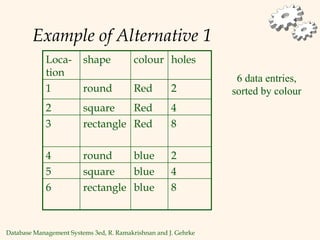
Example of Alternative 1
8
blue
rectangle
6
4
blue
square
5
2
blue
round
4
Red
Red
Red
colour
3
2
1
Loca-
tion
8
rectangle
4
square
2
round
holes
shape
6 data entries,
sorted by colour
Database Management Systems 3ed, R. Ramakrishnan and J. Gehrke 1
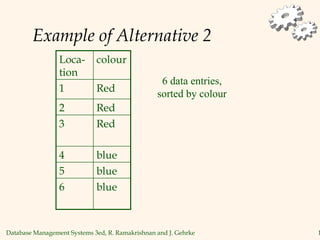
Example of Alternative 2
blue
6
blue
5
blue
4
Red
Red
Red
colour
3
2
1
Loca-
tion
6 data entries,
sorted by colour
Database Management Systems 3ed, R. Ramakrishnan and J. Gehrke 1
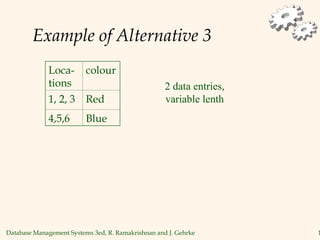
Example of Alternative 3
Loca-
tions
colour
1, 2, 3 Red
4,5,6 Blue
2 data entries,
variable lenth
Database Management Systems 3ed, R. Ramakrishnan and J. Gehrke 1
Alternatives for Data Entries (Contd.)
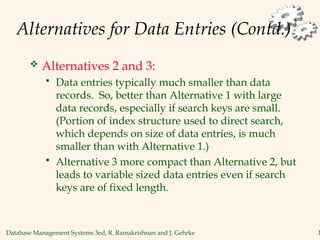
 Alternatives 2 and 3:
 Data entries typically much smaller than data
records. So, better than Alternative 1 with large
data records, especially if search keys are small.
(Portion of index structure used to direct search,
which depends on size of data entries, is much
smaller than with Alternative 1.)
 Alternative 3 more compact than Alternative 2, but
leads to variable sized data entries even if search
keys are of fixed length.
Database Management Systems 3ed, R. Ramakrishnan and J. Gehrke 1
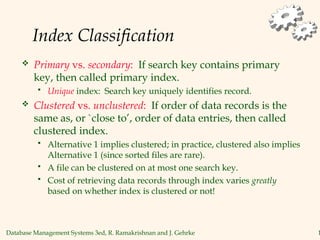
Index Classification
 Primary vs. secondary: If search key contains primary
key, then called primary index.
 Unique index: Search key uniquely identifies record.
 Clustered vs. unclustered: If order of data records is the
same as, or `close to’, order of data entries, then called
clustered index.
 Alternative 1 implies clustered; in practice, clustered also implies
Alternative 1 (since sorted files are rare).
 A file can be clustered on at most one search key.
 Cost of retrieving data records through index varies greatly
based on whether index is clustered or not!
Database Management Systems 3ed, R. Ramakrishnan and J. Gehrke 1
Clustered vs. Unclustered Index
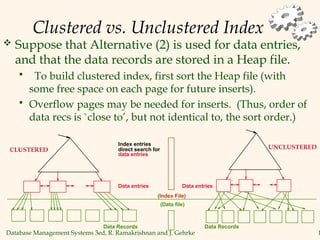
 Suppose that Alternative (2) is used for data entries,
and that the data records are stored in a Heap file.
 To build clustered index, first sort the Heap file (with
some free space on each page for future inserts).
 Overflow pages may be needed for inserts. (Thus, order of
data recs is `close to’, but not identical to, the sort order.)
Index entries
Data entries
direct search for
(Index File)
(Data file)
Data Records
data entries
Data entries
Data Records
CLUSTERED UNCLUSTERED
Database Management Systems 3ed, R. Ramakrishnan and J. Gehrke 1
Hash-Based Indexes
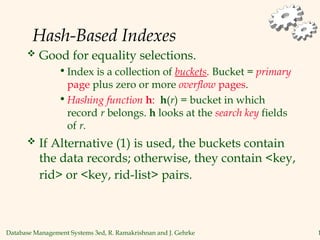
 Good for equality selections.
•Index is a collection of buckets. Bucket = primary
page plus zero or more overflow pages.
•Hashing function h: h(r) = bucket in which
record r belongs. h looks at the search key fields
of r.
 If Alternative (1) is used, the buckets contain
the data records; otherwise, they contain <key,
rid> or <key, rid-list> pairs.
Database Management Systems 3ed, R. Ramakrishnan and J. Gehrke 1
B+ Tree Indexes
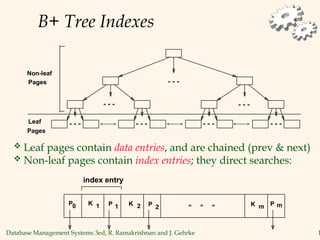
 Leaf pages contain data entries, and are chained (prev & next)
 Non-leaf pages contain index entries; they direct searches:
P0 K 1 P 1 K 2 P 2 K m P m
index entry
Non-leaf
Pages
Pages
Leaf
Database Management Systems 3ed, R. Ramakrishnan and J. Gehrke 1
Example B+ Tree
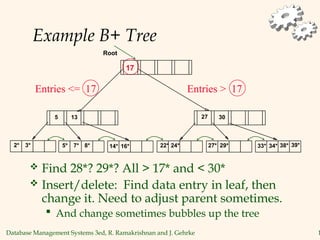
 Find 28*? 29*? All > 17* and < 30*
 Insert/delete: Find data entry in leaf, then
change it. Need to adjust parent sometimes.
 And change sometimes bubbles up the tree
2* 3*
Root
17
30
14* 16* 33* 34* 38* 39*
13
5
7*
5* 8* 22* 24*
27
27* 29*
Entries <= 17 Entries > 17
Database Management Systems 3ed, R. Ramakrishnan and J. Gehrke 1
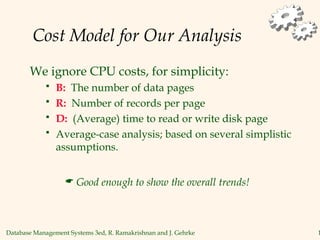
Cost Model for Our Analysis
We ignore CPU costs, for simplicity:
 B: The number of data pages
 R: Number of records per page
 D: (Average) time to read or write disk page
 Average-case analysis; based on several simplistic
assumptions.
 Good enough to show the overall trends!
Database Management Systems 3ed, R. Ramakrishnan and J. Gehrke 1
Comparing File Organizations
 Heap files (random order; insert at eof)
 Sorted files, sorted on <age, sal>
 Clustered B+ tree file, Alternative (1), search
key <age, sal>
 Heap file with unclustered B + tree index on
search key <age, sal>
 Heap file with unclustered hash index on
search key <age, sal>
Database Management Systems 3ed, R. Ramakrishnan and J. Gehrke 2
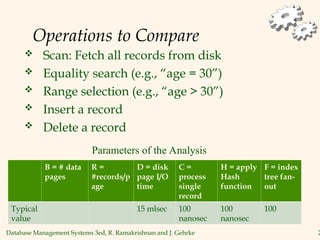
Operations to Compare
 Scan: Fetch all records from disk
 Equality search (e.g., “age = 30”)
 Range selection (e.g., “age > 30”)
 Insert a record
 Delete a record
B = # data
pages
R =
#records/p
age
D = disk
page I/O
time
C =
process
single
record
H = apply
Hash
function
F = index
tree fan-
out
Typical
value
15 mlsec 100
nanosec
100
nanosec
100
Parameters of the Analysis
Database Management Systems 3ed, R. Ramakrishnan and J. Gehrke 2
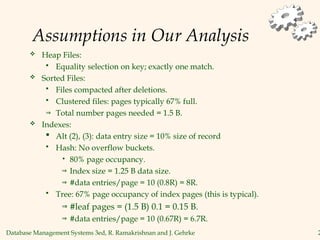
Assumptions in Our Analysis
 Heap Files:
 Equality selection on key; exactly one match.
 Sorted Files:
 Files compacted after deletions.
 Clustered files: pages typically 67% full.
⇒ Total number pages needed = 1.5 B.
 Indexes:
 Alt (2), (3): data entry size = 10% size of record
 Hash: No overflow buckets.
• 80% page occupancy.
⇒ Index size = 1.25 B data size.
⇒ #data entries/page = 10 (0.8R) = 8R.
 Tree: 67% page occupancy of index pages (this is typical).
⇒ #leaf pages = (1.5 B) 0.1 = 0.15 B.
⇒ #data entries/page = 10 (0.67R) = 6.7R.
Database Management Systems 3ed, R. Ramakrishnan and J. Gehrke 2
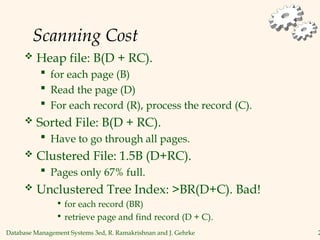
Scanning Cost
 Heap file: B(D + RC).
 for each page (B)
 Read the page (D)
 For each record (R), process the record (C).
 Sorted File: B(D + RC).
 Have to go through all pages.
 Clustered File: 1.5B (D+RC).
 Pages only 67% full.
 Unclustered Tree Index: >BR(D+C). Bad!
• for each record (BR)
• retrieve page and find record (D + C).
Database Management Systems 3ed, R. Ramakrishnan and J. Gehrke 2
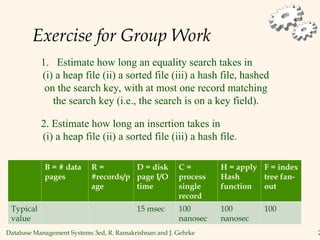
Exercise for Group Work
1. Estimate how long an equality search takes in
(i) a heap file (ii) a sorted file (iii) a hash file, hashed
on the search key, with at most one record matching
the search key (i.e., the search is on a key field).
2. Estimate how long an insertion takes in
(i) a heap file (ii) a sorted file (iii) a hash file.
B = # data
pages
R =
#records/p
age
D = disk
page I/O
time
C =
process
single
record
H = apply
Hash
function
F = index
tree fan-
out
Typical
value
15 msec 100
nanosec
100
nanosec
100
Database Management Systems 3ed, R. Ramakrishnan and J. Gehrke 2
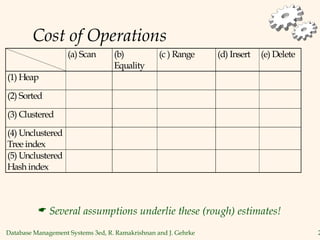
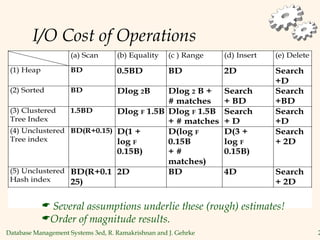
Cost of Operations
(a) Scan (b)
Equality
(c ) Range (d) Insert (e) Delete
(1) Heap
(2) Sorted
(3) Clustered
(4) Unclustered
Tree index
(5) Unclustered
Hash index
 Several assumptions underlie these (rough) estimates!
Database Management Systems 3ed, R. Ramakrishnan and J. Gehrke 2
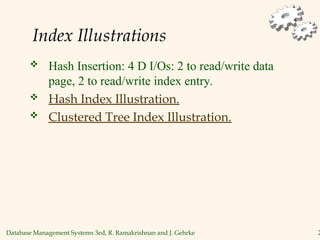
Index Illustrations
 Hash Insertion: 4 D I/Os: 2 to read/write data
page, 2 to read/write index entry.
 Hash Index Illustration.
 Clustered Tree Index Illustration.
Database Management Systems 3ed, R. Ramakrishnan and J. Gehrke 2
I/O Cost of Operations
 Several assumptions underlie these (rough) estimates!
Order of magnitude results.
Database Management Systems 3ed, R. Ramakrishnan and J. Gehrke 2
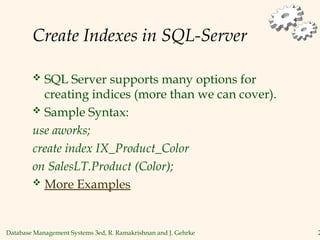
Create Indexes in SQL-Server
 SQL Server supports many options for
creating indices (more than we can cover).
 Sample Syntax:
use aworks;
create index IX_Product_Color
on SalesLT.Product (Color);
 More Examples
Database Management Systems 3ed, R. Ramakrishnan and J. Gehrke 2
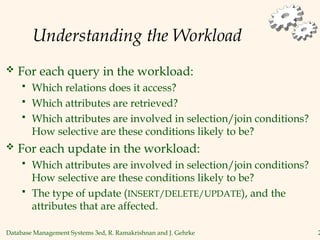
Understanding the Workload
 For each query in the workload:
 Which relations does it access?
 Which attributes are retrieved?
 Which attributes are involved in selection/join conditions?
How selective are these conditions likely to be?
 For each update in the workload:
 Which attributes are involved in selection/join conditions?
How selective are these conditions likely to be?
 The type of update (INSERT/DELETE/UPDATE), and the
attributes that are affected.
Database Management Systems 3ed, R. Ramakrishnan and J. Gehrke 2
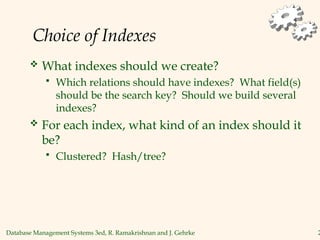
Choice of Indexes
 What indexes should we create?
 Which relations should have indexes? What field(s)
should be the search key? Should we build several
indexes?
 For each index, what kind of an index should it
be?
 Clustered? Hash/tree?
Database Management Systems 3ed, R. Ramakrishnan and J. Gehrke 3
Choice of Indexes (Contd.)
 One approach: Consider the most important queries
in turn. Consider the best plan using the current
indexes, and see if a better plan is possible with an
additional index. If so, create it.
 Obviously, this implies that we must understand how a
DBMS evaluates queries and creates query evaluation plans!
 For now, we discuss simple 1-table queries.
 Before creating an index, must also consider the
impact on updates in the workload!
 Trade-off: Indexes can make queries go faster, updates
slower. Require disk space, too.
Database Management Systems 3ed, R. Ramakrishnan and J. Gehrke 3
Index Selection Guidelines
 Attributes in WHERE clause are candidates for index keys.
 Exact match condition suggests hash index.
 Range query suggests tree index.
• Clustering is especially useful for range queries; can also help on
equality queries if there are many duplicates.
 Multi-attribute search keys should be considered when a
WHERE clause contains several conditions.
 Order of attributes is important for range queries.
 Such indexes can sometimes enable index-only strategies for
important queries.
• For index-only strategies, clustering is not important!
 Try to choose indexes that benefit as many queries as
possible. Since only one index can be clustered per relation,
choose it based on important queries that would benefit the
most from clustering. MS Index Tuning Wizard
Database Management Systems 3ed, R. Ramakrishnan and J. Gehrke 3
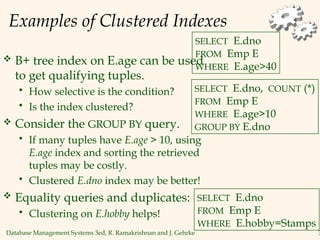
Examples of Clustered Indexes
 B+ tree index on E.age can be used
to get qualifying tuples.
 How selective is the condition?
 Is the index clustered?
 Consider the GROUP BY query.
 If many tuples have E.age > 10, using
E.age index and sorting the retrieved
tuples may be costly.
 Clustered E.dno index may be better!
 Equality queries and duplicates:
 Clustering on E.hobby helps!
SELECT E.dno
FROM Emp E
WHERE E.age>40
SELECT E.dno, COUNT (*)
FROM Emp E
WHERE E.age>10
GROUP BY E.dno
SELECT E.dno
FROM Emp E
WHERE E.hobby=Stamps
Database Management Systems 3ed, R. Ramakrishnan and J. Gehrke 3
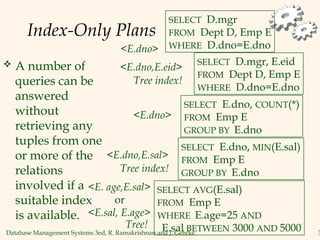
Index-Only Plans
 A number of
queries can be
answered
without
retrieving any
tuples from one
or more of the
relations
involved if a
suitable index
is available.
SELECT D.mgr
FROM Dept D, Emp E
WHERE D.dno=E.dno
SELECT D.mgr, E.eid
FROM Dept D, Emp E
WHERE D.dno=E.dno
SELECT E.dno, COUNT(*)
FROM Emp E
GROUP BY E.dno
SELECT E.dno, MIN(E.sal)
FROM Emp E
GROUP BY E.dno
SELECT AVG(E.sal)
FROM Emp E
WHERE E.age=25 AND
E.sal BETWEEN 3000 AND 5000
<E.dno>
<E.dno,E.eid>
Tree index!
<E.dno>
<E.dno,E.sal>
Tree index!
<E. age,E.sal>
or
<E.sal, E.age>
Tree!
Database Management Systems 3ed, R. Ramakrishnan and J. Gehrke 3
Summary
 Many alternative file organizations exist, each
appropriate in some situation.
 If selection queries are frequent, sorting the
file or building an index is important.
 Hash-based indexes only good for equality search.
 Sorted files and tree-based indexes best for range
search; also good for equality search. (Files rarely
kept sorted in practice; B+ tree index is better.)
 Index is a collection of data entries plus a way
to quickly find entries with given key values.
Database Management Systems 3ed, R. Ramakrishnan and J. Gehrke 3
Summary (Contd.)
 Data entries can be actual data records, <key,
rid> pairs, or <key, rid-list> pairs.
 Choice orthogonal to indexing technique used to
locate data entries with a given key value.
 Can have several indexes on a given file of
data records, each with a different search key.
 Indexes can be classified as clustered vs.
unclustered, and primary vs. secondary.
Differences have important consequences for
utility/performance.
Database Management Systems 3ed, R. Ramakrishnan and J. Gehrke 3
Summary (Contd.)
 Understanding the nature of the workload for the
application, and the performance goals, is essential
to developing a good design.
 What are the important queries and updates? What
attributes/relations are involved?
 Indexes must be chosen to speed up important
queries (and perhaps some updates!).
 Index maintenance overhead on updates to key fields.
 Choose indexes that can help many queries, if possible.
 Build indexes to support index-only strategies.
 Clustering is an important decision, demanding on DBMS
but potentially high payoff.

MYCH8 database management system in .ppt

  • 1.
    Database Management Systems3ed, R. Ramakrishnan and J. Gehrke Overview of Storage and Indexing Chapter 8 “How index-learning turns no student pale Yet holds the eel of science by the tail.” -- Alexander Pope (1688-1744)
  • 2.
    Database Management Systems3ed, R. Ramakrishnan and J. Gehrke System Issues: How to Build a DBMS Query Optimization and Execution Relational Operators Files and Access Methods Buffer Management Disk Space Management DB Discussed so far New topic
  • 3.
    Database Management Systems3ed, R. Ramakrishnan and J. Gehrke Data on External Storage  Disks: Can retrieve random page at fixed cost  But reading several consecutive pages is much cheaper than reading them in random order  Tapes: Can read pages only in sequence  Cheaper than disks; used for archival storage  File organization: Method of arranging a file of records on external storage.  Record id (rid) is sufficient to physically locate record  Indexes are data structures that allow us to find the record ids of records with given values in index search key fields  Architecture: Buffer manager stages pages from external storage to main memory buffer pool. File and index layers make calls to the buffer manager.
  • 4.
    Database Management Systems3ed, R. Ramakrishnan and J. Gehrke Alternative File Organizations Many alternatives exist, each ideal for some situations, and not so good in others:  Heap (random order) files: Suitable when typical access is a file scan retrieving all records.  Sorted Files: Best if records must be retrieved in some order, or only a `range’ of records is needed.  Indexes: Data structures to organize records via trees or hashing. • Like sorted files, they speed up searches for a subset of records, based on values in certain (“search key”) fields • Updates are much faster than in sorted files.
  • 5.
    Database Management Systems3ed, R. Ramakrishnan and J. Gehrke Indexes  An index on a file speeds up selections on the search key fields for the index.  Any subset of the fields of a relation can be the search key for an index on the relation (e.g., age or colour).  Search key is not the same as key (minimal set of fields that uniquely identify a record in a relation).  An index contains a collection of data entries, and supports efficient retrieval of all data entries k* with a given key value k.  Example of Index: Essentials of Game Theory
  • 6.
    Database Management Systems3ed, R. Ramakrishnan and J. Gehrke Alternatives for Data Entry k* in Index  Three alternatives:  Data record with key value k  <k, rid of data record with search key value k>  <k, list of rids of data records with search key k>
  • 7.
    Database Management Systems3ed, R. Ramakrishnan and J. Gehrke Alternatives for Data Entries (Contd.)  Alternative 1:  If this is used, index structure is a file organization for data records (instead of a Heap file or sorted file).  At most one index on a given collection of data records can use Alternative 1. (Otherwise, data records are duplicated, leading to redundant storage and potential inconsistency.)  If data records are very large, # of pages containing data entries is high. Implies size of auxiliary information in the index is also large, typically.
  • 8.
    Database Management Systems3ed, R. Ramakrishnan and J. Gehrke Example of Alternative 1 8 blue rectangle 6 4 blue square 5 2 blue round 4 Red Red Red colour 3 2 1 Loca- tion 8 rectangle 4 square 2 round holes shape 6 data entries, sorted by colour
  • 9.
    Database Management Systems3ed, R. Ramakrishnan and J. Gehrke 1 Example of Alternative 2 blue 6 blue 5 blue 4 Red Red Red colour 3 2 1 Loca- tion 6 data entries, sorted by colour
  • 10.
    Database Management Systems3ed, R. Ramakrishnan and J. Gehrke 1 Example of Alternative 3 Loca- tions colour 1, 2, 3 Red 4,5,6 Blue 2 data entries, variable lenth
  • 11.
    Database Management Systems3ed, R. Ramakrishnan and J. Gehrke 1 Alternatives for Data Entries (Contd.)  Alternatives 2 and 3:  Data entries typically much smaller than data records. So, better than Alternative 1 with large data records, especially if search keys are small. (Portion of index structure used to direct search, which depends on size of data entries, is much smaller than with Alternative 1.)  Alternative 3 more compact than Alternative 2, but leads to variable sized data entries even if search keys are of fixed length.
  • 12.
    Database Management Systems3ed, R. Ramakrishnan and J. Gehrke 1 Index Classification  Primary vs. secondary: If search key contains primary key, then called primary index.  Unique index: Search key uniquely identifies record.  Clustered vs. unclustered: If order of data records is the same as, or `close to’, order of data entries, then called clustered index.  Alternative 1 implies clustered; in practice, clustered also implies Alternative 1 (since sorted files are rare).  A file can be clustered on at most one search key.  Cost of retrieving data records through index varies greatly based on whether index is clustered or not!
  • 13.
    Database Management Systems3ed, R. Ramakrishnan and J. Gehrke 1 Clustered vs. Unclustered Index  Suppose that Alternative (2) is used for data entries, and that the data records are stored in a Heap file.  To build clustered index, first sort the Heap file (with some free space on each page for future inserts).  Overflow pages may be needed for inserts. (Thus, order of data recs is `close to’, but not identical to, the sort order.) Index entries Data entries direct search for (Index File) (Data file) Data Records data entries Data entries Data Records CLUSTERED UNCLUSTERED
  • 14.
    Database Management Systems3ed, R. Ramakrishnan and J. Gehrke 1 Hash-Based Indexes  Good for equality selections. •Index is a collection of buckets. Bucket = primary page plus zero or more overflow pages. •Hashing function h: h(r) = bucket in which record r belongs. h looks at the search key fields of r.  If Alternative (1) is used, the buckets contain the data records; otherwise, they contain <key, rid> or <key, rid-list> pairs.
  • 15.
    Database Management Systems3ed, R. Ramakrishnan and J. Gehrke 1 B+ Tree Indexes  Leaf pages contain data entries, and are chained (prev & next)  Non-leaf pages contain index entries; they direct searches: P0 K 1 P 1 K 2 P 2 K m P m index entry Non-leaf Pages Pages Leaf
  • 16.
    Database Management Systems3ed, R. Ramakrishnan and J. Gehrke 1 Example B+ Tree  Find 28*? 29*? All > 17* and < 30*  Insert/delete: Find data entry in leaf, then change it. Need to adjust parent sometimes.  And change sometimes bubbles up the tree 2* 3* Root 17 30 14* 16* 33* 34* 38* 39* 13 5 7* 5* 8* 22* 24* 27 27* 29* Entries <= 17 Entries > 17
  • 17.
    Database Management Systems3ed, R. Ramakrishnan and J. Gehrke 1 Cost Model for Our Analysis We ignore CPU costs, for simplicity:  B: The number of data pages  R: Number of records per page  D: (Average) time to read or write disk page  Average-case analysis; based on several simplistic assumptions.  Good enough to show the overall trends!
  • 18.
    Database Management Systems3ed, R. Ramakrishnan and J. Gehrke 1 Comparing File Organizations  Heap files (random order; insert at eof)  Sorted files, sorted on <age, sal>  Clustered B+ tree file, Alternative (1), search key <age, sal>  Heap file with unclustered B + tree index on search key <age, sal>  Heap file with unclustered hash index on search key <age, sal>
  • 19.
    Database Management Systems3ed, R. Ramakrishnan and J. Gehrke 2 Operations to Compare  Scan: Fetch all records from disk  Equality search (e.g., “age = 30”)  Range selection (e.g., “age > 30”)  Insert a record  Delete a record B = # data pages R = #records/p age D = disk page I/O time C = process single record H = apply Hash function F = index tree fan- out Typical value 15 mlsec 100 nanosec 100 nanosec 100 Parameters of the Analysis
  • 20.
    Database Management Systems3ed, R. Ramakrishnan and J. Gehrke 2 Assumptions in Our Analysis  Heap Files:  Equality selection on key; exactly one match.  Sorted Files:  Files compacted after deletions.  Clustered files: pages typically 67% full. ⇒ Total number pages needed = 1.5 B.  Indexes:  Alt (2), (3): data entry size = 10% size of record  Hash: No overflow buckets. • 80% page occupancy. ⇒ Index size = 1.25 B data size. ⇒ #data entries/page = 10 (0.8R) = 8R.  Tree: 67% page occupancy of index pages (this is typical). ⇒ #leaf pages = (1.5 B) 0.1 = 0.15 B. ⇒ #data entries/page = 10 (0.67R) = 6.7R.
  • 21.
    Database Management Systems3ed, R. Ramakrishnan and J. Gehrke 2 Scanning Cost  Heap file: B(D + RC).  for each page (B)  Read the page (D)  For each record (R), process the record (C).  Sorted File: B(D + RC).  Have to go through all pages.  Clustered File: 1.5B (D+RC).  Pages only 67% full.  Unclustered Tree Index: >BR(D+C). Bad! • for each record (BR) • retrieve page and find record (D + C).
  • 22.
    Database Management Systems3ed, R. Ramakrishnan and J. Gehrke 2 Exercise for Group Work 1. Estimate how long an equality search takes in (i) a heap file (ii) a sorted file (iii) a hash file, hashed on the search key, with at most one record matching the search key (i.e., the search is on a key field). 2. Estimate how long an insertion takes in (i) a heap file (ii) a sorted file (iii) a hash file. B = # data pages R = #records/p age D = disk page I/O time C = process single record H = apply Hash function F = index tree fan- out Typical value 15 msec 100 nanosec 100 nanosec 100
  • 23.
    Database Management Systems3ed, R. Ramakrishnan and J. Gehrke 2 Cost of Operations (a) Scan (b) Equality (c ) Range (d) Insert (e) Delete (1) Heap (2) Sorted (3) Clustered (4) Unclustered Tree index (5) Unclustered Hash index  Several assumptions underlie these (rough) estimates!
  • 24.
    Database Management Systems3ed, R. Ramakrishnan and J. Gehrke 2 Index Illustrations  Hash Insertion: 4 D I/Os: 2 to read/write data page, 2 to read/write index entry.  Hash Index Illustration.  Clustered Tree Index Illustration.
  • 25.
    Database Management Systems3ed, R. Ramakrishnan and J. Gehrke 2 I/O Cost of Operations  Several assumptions underlie these (rough) estimates! Order of magnitude results.
  • 26.
    Database Management Systems3ed, R. Ramakrishnan and J. Gehrke 2 Create Indexes in SQL-Server  SQL Server supports many options for creating indices (more than we can cover).  Sample Syntax: use aworks; create index IX_Product_Color on SalesLT.Product (Color);  More Examples
  • 27.
    Database Management Systems3ed, R. Ramakrishnan and J. Gehrke 2 Understanding the Workload  For each query in the workload:  Which relations does it access?  Which attributes are retrieved?  Which attributes are involved in selection/join conditions? How selective are these conditions likely to be?  For each update in the workload:  Which attributes are involved in selection/join conditions? How selective are these conditions likely to be?  The type of update (INSERT/DELETE/UPDATE), and the attributes that are affected.
  • 28.
    Database Management Systems3ed, R. Ramakrishnan and J. Gehrke 2 Choice of Indexes  What indexes should we create?  Which relations should have indexes? What field(s) should be the search key? Should we build several indexes?  For each index, what kind of an index should it be?  Clustered? Hash/tree?
  • 29.
    Database Management Systems3ed, R. Ramakrishnan and J. Gehrke 3 Choice of Indexes (Contd.)  One approach: Consider the most important queries in turn. Consider the best plan using the current indexes, and see if a better plan is possible with an additional index. If so, create it.  Obviously, this implies that we must understand how a DBMS evaluates queries and creates query evaluation plans!  For now, we discuss simple 1-table queries.  Before creating an index, must also consider the impact on updates in the workload!  Trade-off: Indexes can make queries go faster, updates slower. Require disk space, too.
  • 30.
    Database Management Systems3ed, R. Ramakrishnan and J. Gehrke 3 Index Selection Guidelines  Attributes in WHERE clause are candidates for index keys.  Exact match condition suggests hash index.  Range query suggests tree index. • Clustering is especially useful for range queries; can also help on equality queries if there are many duplicates.  Multi-attribute search keys should be considered when a WHERE clause contains several conditions.  Order of attributes is important for range queries.  Such indexes can sometimes enable index-only strategies for important queries. • For index-only strategies, clustering is not important!  Try to choose indexes that benefit as many queries as possible. Since only one index can be clustered per relation, choose it based on important queries that would benefit the most from clustering. MS Index Tuning Wizard
  • 31.
    Database Management Systems3ed, R. Ramakrishnan and J. Gehrke 3 Examples of Clustered Indexes  B+ tree index on E.age can be used to get qualifying tuples.  How selective is the condition?  Is the index clustered?  Consider the GROUP BY query.  If many tuples have E.age > 10, using E.age index and sorting the retrieved tuples may be costly.  Clustered E.dno index may be better!  Equality queries and duplicates:  Clustering on E.hobby helps! SELECT E.dno FROM Emp E WHERE E.age>40 SELECT E.dno, COUNT (*) FROM Emp E WHERE E.age>10 GROUP BY E.dno SELECT E.dno FROM Emp E WHERE E.hobby=Stamps
  • 32.
    Database Management Systems3ed, R. Ramakrishnan and J. Gehrke 3 Index-Only Plans  A number of queries can be answered without retrieving any tuples from one or more of the relations involved if a suitable index is available. SELECT D.mgr FROM Dept D, Emp E WHERE D.dno=E.dno SELECT D.mgr, E.eid FROM Dept D, Emp E WHERE D.dno=E.dno SELECT E.dno, COUNT(*) FROM Emp E GROUP BY E.dno SELECT E.dno, MIN(E.sal) FROM Emp E GROUP BY E.dno SELECT AVG(E.sal) FROM Emp E WHERE E.age=25 AND E.sal BETWEEN 3000 AND 5000 <E.dno> <E.dno,E.eid> Tree index! <E.dno> <E.dno,E.sal> Tree index! <E. age,E.sal> or <E.sal, E.age> Tree!
  • 33.
    Database Management Systems3ed, R. Ramakrishnan and J. Gehrke 3 Summary  Many alternative file organizations exist, each appropriate in some situation.  If selection queries are frequent, sorting the file or building an index is important.  Hash-based indexes only good for equality search.  Sorted files and tree-based indexes best for range search; also good for equality search. (Files rarely kept sorted in practice; B+ tree index is better.)  Index is a collection of data entries plus a way to quickly find entries with given key values.
  • 34.
    Database Management Systems3ed, R. Ramakrishnan and J. Gehrke 3 Summary (Contd.)  Data entries can be actual data records, <key, rid> pairs, or <key, rid-list> pairs.  Choice orthogonal to indexing technique used to locate data entries with a given key value.  Can have several indexes on a given file of data records, each with a different search key.  Indexes can be classified as clustered vs. unclustered, and primary vs. secondary. Differences have important consequences for utility/performance.
  • 35.
    Database Management Systems3ed, R. Ramakrishnan and J. Gehrke 3 Summary (Contd.)  Understanding the nature of the workload for the application, and the performance goals, is essential to developing a good design.  What are the important queries and updates? What attributes/relations are involved?  Indexes must be chosen to speed up important queries (and perhaps some updates!).  Index maintenance overhead on updates to key fields.  Choose indexes that can help many queries, if possible.  Build indexes to support index-only strategies.  Clustering is an important decision, demanding on DBMS but potentially high payoff.

Editor's Notes

  • #2 The slides for this text are organized into chapters. This lecture covers Chapter 8. Chapter 1: Introduction to Database Systems Chapter 2: The Entity-Relationship Model Chapter 3: The Relational Model Chapter 4 (Part A): Relational Algebra Chapter 4 (Part B): Relational Calculus Chapter 5: SQL: Queries, Programming, Triggers Chapter 6: Query-by-Example (QBE) Chapter 7: Storing Data: Disks and Files Chapter 8: File Organizations and Indexing Chapter 9: Tree-Structured Indexing Chapter 10: Hash-Based Indexing Chapter 11: External Sorting Chapter 12 (Part A): Evaluation of Relational Operators Chapter 12 (Part B): Evaluation of Relational Operators: Other Techniques Chapter 13: Introduction to Query Optimization Chapter 14: A Typical Relational Optimizer Chapter 15: Schema Refinement and Normal Forms Chapter 16 (Part A): Physical Database Design Chapter 16 (Part B): Database Tuning Chapter 17: Security Chapter 18: Transaction Management Overview Chapter 19: Concurrency Control Chapter 20: Crash Recovery Chapter 21: Parallel and Distributed Databases Chapter 22: Internet Databases Chapter 23: Decision Support Chapter 24: Data Mining Chapter 25: Object-Database Systems Chapter 26: Spatial Data Management Chapter 27: Deductive Databases Chapter 28: Additional Topics
  • #4 Disks read 1 page at a time. We’ll come back to this. Rid is enough to find page containing record.
  • #5 Relation is typically stored as a file of records (= tuples) A file corresponds to several pages Page size is typically 4KB – 8KB. Sorted files: can sort on only one order.
  • #6 Can find record id from data entry. Like index in a book. http://en.wikipedia.org/wiki/Indexing_Society_of_Canada
  • #13 Illustrate with data records being sorted by colour or not. Also show next overhead at the same time. Also illustrate with phone book analogy (Are phone books clustered on name? – answer yes. Are they clustered by phone number? Answer no.
  • #15 Illustrate with blocks. One bucket (page) per colour. Hash function: Red -> 1, Blue -> 2. See figure 8.2 in text.
  • #16 B+ trees “freeze” binary search.
  • #19 Illustrate organizations with blocks as much as possible.
  • #20 Illustrate with Records.
  • #21 Compacted after deletion: move up records to close free space. Necessary because there is no easy way to manage free space. File size is number of pages in file. Nano = 10^-9
  • #24 Show GUI for index in DBMS.
  • #26 Has index insert: need 2D to find and write data page, 2D to find and write index page. Log_F(0.15 B) for finding leaf page in the index.
  • #31 Relate exact match and range query performance back to performance table. Index-only strategy: answer question using data entries only. Often works for aggregation, e.g. count* (see below). Give example of product color from assignment, retrieve all colors.
  • #33 In top query, don’t need to retrieve E tuples. In 2nd query, don’t need to retrieve E tuples either.
  • #35 Original had “dense” vs. “sparse” – perhaps look in Ullman?
  • #36 Work-around for last point, e.g. in SQL server: create views on table, index view. Comments on column storage, key-value.