Copyright © 2016 Ramez Elmasri and Shamkant B. Navathe
CHAPTER 20
Introduction to Transaction
Processing Concepts and Theory
Copyright © 2016 Ramez Elmasri and Shamkant B. Navathe
Introduction
 Transaction
 Describes local unit of database processing
 Transaction processing systems
 Systems with large databases and hundreds of
concurrent users
 Require high availability and fast response time
Slide 20- 3
Copyright © 2016 Ramez Elmasri and Shamkant B. Navathe
20.1 Introduction to Transaction
Processing
 Single-user DBMS
 At most one user at a time can use the system
 Example: home computer
 Multiuser DBMS
 Many users can access the system (database)
concurrently
 Example: airline reservations system
Slide 20- 4
Copyright © 2016 Ramez Elmasri and Shamkant B. Navathe
Introduction to Transaction
Processing (cont’d.)
 Multiprogramming
 Allows operating system to execute multiple
processes concurrently
 Executes commands from one process, then
suspends that process and executes commands
from another process, etc.
Slide 20- 5
Copyright © 2016 Ramez Elmasri and Shamkant B. Navathe
Introduction to Transaction
Processing (cont’d.)
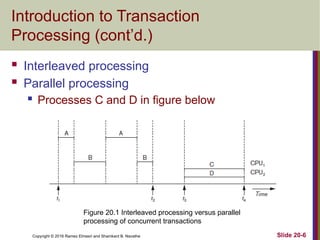
 Interleaved processing
 Parallel processing
 Processes C and D in figure below
Slide 20-6
Figure 20.1 Interleaved processing versus parallel
processing of concurrent transactions
Copyright © 2016 Ramez Elmasri and Shamkant B. Navathe
Transactions
 Transaction: an executing program
 Forms logical unit of database processing
 Begin and end transaction statements
 Specify transaction boundaries
 Read-only transaction
 Read-write transaction
Slide 20- 7
Copyright © 2016 Ramez Elmasri and Shamkant B. Navathe
Database Items
 Database represented as collection of named
data items
 Size of a data item called its granularity
 Data item
 Record
 Disk block
 Attribute value of a record
 Transaction processing concepts independent of
item granularity
Slide 20- 8
Copyright © 2016 Ramez Elmasri and Shamkant B. Navathe
Read and Write Operations
 read_item(X)
 Reads a database item named X into a program
variable named X
 Process includes finding the address of the disk
block, and copying to and from a memory buffer
 write_item(X)
 Writes the value of program variable X into the
database item named X
 Process includes finding the address of the disk
block, copying to and from a memory buffer, and
storing the updated disk block back to disk
Slide 20- 9
Copyright © 2016 Ramez Elmasri and Shamkant B. Navathe
Read and Write Operations (cont’d.)
 Read set of a transaction
 Set of all items read
 Write set of a transaction
 Set of all items written
Slide 20- 10
Figure 20.2 Two sample transactions (a) Transaction T1 (b) Transaction T2
Copyright © 2016 Ramez Elmasri and Shamkant B. Navathe
DBMS Buffers
 DBMS will maintain several main memory data
buffers in the database cache
 When buffers are occupied, a buffer replacement
policy is used to choose which buffer will be
replaced
 Example policy: least recently used
Slide 20- 11
Copyright © 2016 Ramez Elmasri and Shamkant B. Navathe
Concurrency Control
 Transactions submitted by various users may
execute concurrently
 Access and update the same database items
 Some form of concurrency control is needed
 The lost update problem
 Occurs when two transactions that access the
same database items have operations interleaved
 Results in incorrect value of some database items
Slide 20- 12
Copyright © 2016 Ramez Elmasri and Shamkant B. Navathe
The Lost Update Problem
Slide 20-13
Figure 20.3 Some problems that occur when concurrent
execution is uncontrolled (a) The lost update problem
Copyright © 2016 Ramez Elmasri and Shamkant B. Navathe
The Temporary Update Problem
Slide 20-14
Figure 20.3 (cont’d.) Some problems that occur when concurrent execution is
uncontrolled (b) The temporary update problem
Copyright © 2016 Ramez Elmasri and Shamkant B. Navathe
The Incorrect Summary Problem
Slide 20-15
Figure 20.3 (cont’d.) Some problems that occur when concurrent execution is
uncontrolled (c) The incorrect summary problem
Copyright © 2016 Ramez Elmasri and Shamkant B. Navathe
The Unrepeatable Read Problem
 Transaction T reads the same item twice
 Value is changed by another transaction T
between the two reads
 T receives different values for the two reads of
the same item
Slide 20- 16
Copyright © 2016 Ramez Elmasri and Shamkant B. Navathe
Why Recovery is Needed
 Committed transaction
 Effect recorded permanently in the database
 Aborted transaction
 Does not affect the database
 Types of transaction failures
 Computer failure (system crash)
 Transaction or system error
 Local errors or exception conditions detected by
the transaction
Slide 20- 17
Copyright © 2016 Ramez Elmasri and Shamkant B. Navathe
Why Recovery is Needed (cont’d.)
 Types of transaction failures (cont’d.)
 Concurrency control enforcement
 Disk failure
 Physical problems or catastrophes
 System must keep sufficient information to
recover quickly from the failure
 Disk failure or other catastrophes have long
recovery times
Slide 20- 18
Copyright © 2016 Ramez Elmasri and Shamkant B. Navathe
20.2 Transaction and System
Concepts
 System must keep track of when each transaction
starts, terminates, commits, and/or aborts
 BEGIN_TRANSACTION
 READ or WRITE
 END_TRANSACTION
 COMMIT_TRANSACTION
 ROLLBACK (or ABORT)
Slide 20- 19
Copyright © 2016 Ramez Elmasri and Shamkant B. Navathe
Transaction and System Concepts
(cont’d.)
Slide 20-20
Figure 20.4 State transition diagram illustrating
the states for transaction execution
Copyright © 2016 Ramez Elmasri and Shamkant B. Navathe
The System Log
 System log keeps track of transaction operations
 Sequential, append-only file
 Not affected by failure (except disk or
catastrophic failure)
 Log buffer
 Main memory buffer
 When full, appended to end of log file on disk
 Log file is backed up periodically
 Undo and redo operations based on log possible
Slide 20- 21
Copyright © 2016 Ramez Elmasri and Shamkant B. Navathe
Commit Point of a Transaction
 Occurs when all operations that access the
database have completed successfully
 And effect of operations recorded in the log
 Transaction writes a commit record into the log
 If system failure occurs, can search for
transactions with recorded start_transaction but no
commit record
 Force-writing the log buffer to disk
 Writing log buffer to disk before transaction
reaches commit point
Slide 20- 22
Copyright © 2016 Ramez Elmasri and Shamkant B. Navathe
DBMS-Specific Buffer Replacement
Policies
 Page replacement policy
 Selects particular buffers to be replaced when all
are full
 Domain separation (DS) method
 Each domain handles one type of disk pages

Index pages

Data file pages

Log file pages
 Number of available buffers for each domain is
predetermined
Slide 20- 23
Copyright © 2016 Ramez Elmasri and Shamkant B. Navathe
20.3 Desirable Properties of
Transactions
 ACID properties
 Atomicity

Transaction performed in its entirety or not at all
 Consistency preservation

Takes database from one consistent state to
another
 Isolation

Not interfered with by other transactions
 Durability or permanency

Changes must persist in the database
Slide 20- 24
Copyright © 2016 Ramez Elmasri and Shamkant B. Navathe
Desirable Properties of Transactions
(cont’d.)
 Levels of isolation
 Level 0 isolation does not overwrite the dirty reads
of higher-level transactions
 Level 1 isolation has no lost updates
 Level 2 isolation has no lost updates and no dirty
reads
 Level 3 (true) isolation has repeatable reads

In addition to level 2 properties
Slide 20- 25
Copyright © 2016 Ramez Elmasri and Shamkant B. Navathe
20.4 Characterizing Schedules
Based on Recoverability
 Schedule or history
 Order of execution of operations from all
transactions
 Operations from different transactions can be
interleaved in the schedule
 Total ordering of operations in a schedule
 For any two operations in the schedule, one must
occur before the other
Slide 20- 26
Copyright © 2016 Ramez Elmasri and Shamkant B. Navathe
Characterizing Schedules Based on
Recoverability (cont’d.)
 Two conflicting operations in a schedule
 Operations belong to different transactions
 Operations access the same item X
 At least one of the operations is a write_item(X)
 Two operations conflict if changing their order
results in a different outcome
 Read-write conflict
 Write-write conflict
Slide 20- 27
Copyright © 2016 Ramez Elmasri and Shamkant B. Navathe
Characterizing Schedules Based on
Recoverability (cont’d.)
 Recoverable schedules
 Recovery is possible
 Nonrecoverable schedules should not be
permitted by the DBMS
 No committed transaction ever needs to be rolled
back
 Cascading rollback may occur in some
recoverable schedules
 Uncommitted transaction may need to be rolled
back
Slide 20- 28
Copyright © 2016 Ramez Elmasri and Shamkant B. Navathe
Characterizing Schedules Based on
Recoverability (cont’d.)
 Cascadeless schedule
 Avoids cascading rollback
 Strict schedule
 Transactions can neither read nor write an item X
until the last transaction that wrote X has
committed or aborted
 Simpler recovery process

Restore the before image
Slide 20- 29
Copyright © 2016 Ramez Elmasri and Shamkant B. Navathe
20.5 Characterizing Schedules
Based on Serializability
 Serializable schedules
 Always considered to be correct when concurrent
transactions are executing
 Places simultaneous transactions in series
 Transaction T1 before T2, or vice versa
Slide 20- 30
Copyright © 2016 Ramez Elmasri and Shamkant B. Navathe Slide 20-31
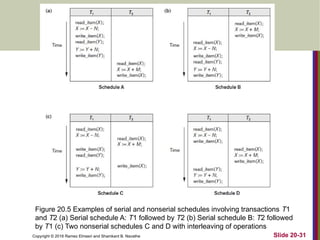
Figure 20.5 Examples of serial and nonserial schedules involving transactions T1
and T2 (a) Serial schedule A: T1 followed by T2 (b) Serial schedule B: T2 followed
by T1 (c) Two nonserial schedules C and D with interleaving of operations
Copyright © 2016 Ramez Elmasri and Shamkant B. Navathe
Characterizing Schedules Based on
Serializability (cont’d.)
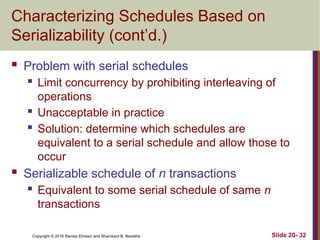
 Problem with serial schedules
 Limit concurrency by prohibiting interleaving of
operations
 Unacceptable in practice
 Solution: determine which schedules are
equivalent to a serial schedule and allow those to
occur
 Serializable schedule of n transactions
 Equivalent to some serial schedule of same n
transactions
Slide 20- 32
Copyright © 2016 Ramez Elmasri and Shamkant B. Navathe
Characterizing Schedules Based on
Serializability (cont’d.)
 Result equivalent schedules
 Produce the same final state of the database

May be accidental
 Cannot be used alone to define equivalence of
schedules
Slide 20- 33
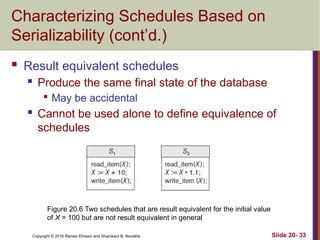
Figure 20.6 Two schedules that are result equivalent for the initial value
of X = 100 but are not result equivalent in general
Copyright © 2016 Ramez Elmasri and Shamkant B. Navathe
Characterizing Schedules Based on
Serializability (cont’d.)
 Conflict equivalence
 Relative order of any two conflicting operations is
the same in both schedules
 Serializable schedules
 Schedule S is serializable if it is conflict equivalent
to some serial schedule S’.
Slide 20- 34
Copyright © 2016 Ramez Elmasri and Shamkant B. Navathe
Characterizing Schedules Based on
Serializability (cont’d.)
 Testing for serializability of a schedule
Slide 20- 35
Algorithm 20.1 Testing conflict serializability of a schedule S
Copyright © 2016 Ramez Elmasri and Shamkant B. Navathe
Characterizing Schedules Based on
Serializability (cont’d.)
Slide 20-36
Figure 20.7 Constructing the precedence graphs for schedules A to D from Figure 20.5 to
test for conflict serializability (a) Precedence graph for serial schedule A (b) Precedence
graph for serial schedule B (c) Precedence graph for schedule C (not serializable) (d)
Precedence graph for schedule D (serializable, equivalent to schedule A)
Copyright © 2016 Ramez Elmasri and Shamkant B. Navathe
How Serializability is Used for
Concurrency Control
 Being serializable is different from being serial
 Serializable schedule gives benefit of concurrent
execution
 Without giving up any correctness
 Difficult to test for serializability in practice
 Factors such as system load, time of transaction
submission, and process priority affect ordering of
operations
 DBMS enforces protocols
 Set of rules to ensure serializability
Slide 20- 37
Copyright © 2016 Ramez Elmasri and Shamkant B. Navathe
View Equivalence and View
Serializability
 View equivalence of two schedules
 As long as each read operation of a transaction
reads the result of the same write operation in both
schedules, the write operations of each transaction
must produce the same results
 Read operations said to see the same view in both
schedules
 View serializable schedule
 View equivalent to a serial schedule
Slide 20- 38
Copyright © 2016 Ramez Elmasri and Shamkant B. Navathe
View Equivalence and View
Serializability (cont’d.)
 Conflict serializability similar to view serializability
if constrained write assumption (no blind writes)
applies
 Unconstrained write assumption
 Value written by an operation can be independent
of its old value
 Debit-credit transactions
 Less-stringent conditions than conflict
serializability or view serializability
Slide 20- 39
Copyright © 2016 Ramez Elmasri and Shamkant B. Navathe
20.6 Transaction Support in SQL
 No explicit Begin_Transaction statement
 Every transaction must have an explicit end
statement
 COMMIT
 ROLLBACK
 Access mode is READ ONLY or READ WRITE
 Diagnostic area size option
 Integer value indicating number of conditions held
simultaneously in the diagnostic area
Slide 20- 40
Copyright © 2016 Ramez Elmasri and Shamkant B. Navathe
Transaction Support in SQL (cont’d.)
 Isolation level option
 Dirty read
 Nonrepeatable read
 Phantoms
Slide 20- 41
Table 20.1 Possible violations based on isolation levels as defined in SQL
Copyright © 2016 Ramez Elmasri and Shamkant B. Navathe
Transaction Support in SQL (cont’d.)
 Snapshot isolation
 Used in some commercial DBMSs
 Transaction sees data items that it reads based on
the committed values of the items in the database
snapshot when transaction starts
 Ensures phantom record problem will not occur
Slide 20- 42
Copyright © 2016 Ramez Elmasri and Shamkant B. Navathe
20.7 Summary
 Single and multiuser database transactions
 Uncontrolled execution of concurrent transactions
 System log
 Failure recovery
 Committed transaction
 Schedule (history) defines execution sequence
 Schedule recoverability
 Schedule equivalence
 Serializability of schedules
Slide 20- 43

transaction processing databse management.pptx

  • 1.
    Copyright © 2016Ramez Elmasri and Shamkant B. Navathe
  • 2.
    Copyright © 2016Ramez Elmasri and Shamkant B. Navathe CHAPTER 20 Introduction to Transaction Processing Concepts and Theory
  • 3.
    Copyright © 2016Ramez Elmasri and Shamkant B. Navathe Introduction  Transaction  Describes local unit of database processing  Transaction processing systems  Systems with large databases and hundreds of concurrent users  Require high availability and fast response time Slide 20- 3
  • 4.
    Copyright © 2016Ramez Elmasri and Shamkant B. Navathe 20.1 Introduction to Transaction Processing  Single-user DBMS  At most one user at a time can use the system  Example: home computer  Multiuser DBMS  Many users can access the system (database) concurrently  Example: airline reservations system Slide 20- 4
  • 5.
    Copyright © 2016Ramez Elmasri and Shamkant B. Navathe Introduction to Transaction Processing (cont’d.)  Multiprogramming  Allows operating system to execute multiple processes concurrently  Executes commands from one process, then suspends that process and executes commands from another process, etc. Slide 20- 5
  • 6.
    Copyright © 2016Ramez Elmasri and Shamkant B. Navathe Introduction to Transaction Processing (cont’d.)  Interleaved processing  Parallel processing  Processes C and D in figure below Slide 20-6 Figure 20.1 Interleaved processing versus parallel processing of concurrent transactions
  • 7.
    Copyright © 2016Ramez Elmasri and Shamkant B. Navathe Transactions  Transaction: an executing program  Forms logical unit of database processing  Begin and end transaction statements  Specify transaction boundaries  Read-only transaction  Read-write transaction Slide 20- 7
  • 8.
    Copyright © 2016Ramez Elmasri and Shamkant B. Navathe Database Items  Database represented as collection of named data items  Size of a data item called its granularity  Data item  Record  Disk block  Attribute value of a record  Transaction processing concepts independent of item granularity Slide 20- 8
  • 9.
    Copyright © 2016Ramez Elmasri and Shamkant B. Navathe Read and Write Operations  read_item(X)  Reads a database item named X into a program variable named X  Process includes finding the address of the disk block, and copying to and from a memory buffer  write_item(X)  Writes the value of program variable X into the database item named X  Process includes finding the address of the disk block, copying to and from a memory buffer, and storing the updated disk block back to disk Slide 20- 9
  • 10.
    Copyright © 2016Ramez Elmasri and Shamkant B. Navathe Read and Write Operations (cont’d.)  Read set of a transaction  Set of all items read  Write set of a transaction  Set of all items written Slide 20- 10 Figure 20.2 Two sample transactions (a) Transaction T1 (b) Transaction T2
  • 11.
    Copyright © 2016Ramez Elmasri and Shamkant B. Navathe DBMS Buffers  DBMS will maintain several main memory data buffers in the database cache  When buffers are occupied, a buffer replacement policy is used to choose which buffer will be replaced  Example policy: least recently used Slide 20- 11
  • 12.
    Copyright © 2016Ramez Elmasri and Shamkant B. Navathe Concurrency Control  Transactions submitted by various users may execute concurrently  Access and update the same database items  Some form of concurrency control is needed  The lost update problem  Occurs when two transactions that access the same database items have operations interleaved  Results in incorrect value of some database items Slide 20- 12
  • 13.
    Copyright © 2016Ramez Elmasri and Shamkant B. Navathe The Lost Update Problem Slide 20-13 Figure 20.3 Some problems that occur when concurrent execution is uncontrolled (a) The lost update problem
  • 14.
    Copyright © 2016Ramez Elmasri and Shamkant B. Navathe The Temporary Update Problem Slide 20-14 Figure 20.3 (cont’d.) Some problems that occur when concurrent execution is uncontrolled (b) The temporary update problem
  • 15.
    Copyright © 2016Ramez Elmasri and Shamkant B. Navathe The Incorrect Summary Problem Slide 20-15 Figure 20.3 (cont’d.) Some problems that occur when concurrent execution is uncontrolled (c) The incorrect summary problem
  • 16.
    Copyright © 2016Ramez Elmasri and Shamkant B. Navathe The Unrepeatable Read Problem  Transaction T reads the same item twice  Value is changed by another transaction T between the two reads  T receives different values for the two reads of the same item Slide 20- 16
  • 17.
    Copyright © 2016Ramez Elmasri and Shamkant B. Navathe Why Recovery is Needed  Committed transaction  Effect recorded permanently in the database  Aborted transaction  Does not affect the database  Types of transaction failures  Computer failure (system crash)  Transaction or system error  Local errors or exception conditions detected by the transaction Slide 20- 17
  • 18.
    Copyright © 2016Ramez Elmasri and Shamkant B. Navathe Why Recovery is Needed (cont’d.)  Types of transaction failures (cont’d.)  Concurrency control enforcement  Disk failure  Physical problems or catastrophes  System must keep sufficient information to recover quickly from the failure  Disk failure or other catastrophes have long recovery times Slide 20- 18
  • 19.
    Copyright © 2016Ramez Elmasri and Shamkant B. Navathe 20.2 Transaction and System Concepts  System must keep track of when each transaction starts, terminates, commits, and/or aborts  BEGIN_TRANSACTION  READ or WRITE  END_TRANSACTION  COMMIT_TRANSACTION  ROLLBACK (or ABORT) Slide 20- 19
  • 20.
    Copyright © 2016Ramez Elmasri and Shamkant B. Navathe Transaction and System Concepts (cont’d.) Slide 20-20 Figure 20.4 State transition diagram illustrating the states for transaction execution
  • 21.
    Copyright © 2016Ramez Elmasri and Shamkant B. Navathe The System Log  System log keeps track of transaction operations  Sequential, append-only file  Not affected by failure (except disk or catastrophic failure)  Log buffer  Main memory buffer  When full, appended to end of log file on disk  Log file is backed up periodically  Undo and redo operations based on log possible Slide 20- 21
  • 22.
    Copyright © 2016Ramez Elmasri and Shamkant B. Navathe Commit Point of a Transaction  Occurs when all operations that access the database have completed successfully  And effect of operations recorded in the log  Transaction writes a commit record into the log  If system failure occurs, can search for transactions with recorded start_transaction but no commit record  Force-writing the log buffer to disk  Writing log buffer to disk before transaction reaches commit point Slide 20- 22
  • 23.
    Copyright © 2016Ramez Elmasri and Shamkant B. Navathe DBMS-Specific Buffer Replacement Policies  Page replacement policy  Selects particular buffers to be replaced when all are full  Domain separation (DS) method  Each domain handles one type of disk pages  Index pages  Data file pages  Log file pages  Number of available buffers for each domain is predetermined Slide 20- 23
  • 24.
    Copyright © 2016Ramez Elmasri and Shamkant B. Navathe 20.3 Desirable Properties of Transactions  ACID properties  Atomicity  Transaction performed in its entirety or not at all  Consistency preservation  Takes database from one consistent state to another  Isolation  Not interfered with by other transactions  Durability or permanency  Changes must persist in the database Slide 20- 24
  • 25.
    Copyright © 2016Ramez Elmasri and Shamkant B. Navathe Desirable Properties of Transactions (cont’d.)  Levels of isolation  Level 0 isolation does not overwrite the dirty reads of higher-level transactions  Level 1 isolation has no lost updates  Level 2 isolation has no lost updates and no dirty reads  Level 3 (true) isolation has repeatable reads  In addition to level 2 properties Slide 20- 25
  • 26.
    Copyright © 2016Ramez Elmasri and Shamkant B. Navathe 20.4 Characterizing Schedules Based on Recoverability  Schedule or history  Order of execution of operations from all transactions  Operations from different transactions can be interleaved in the schedule  Total ordering of operations in a schedule  For any two operations in the schedule, one must occur before the other Slide 20- 26
  • 27.
    Copyright © 2016Ramez Elmasri and Shamkant B. Navathe Characterizing Schedules Based on Recoverability (cont’d.)  Two conflicting operations in a schedule  Operations belong to different transactions  Operations access the same item X  At least one of the operations is a write_item(X)  Two operations conflict if changing their order results in a different outcome  Read-write conflict  Write-write conflict Slide 20- 27
  • 28.
    Copyright © 2016Ramez Elmasri and Shamkant B. Navathe Characterizing Schedules Based on Recoverability (cont’d.)  Recoverable schedules  Recovery is possible  Nonrecoverable schedules should not be permitted by the DBMS  No committed transaction ever needs to be rolled back  Cascading rollback may occur in some recoverable schedules  Uncommitted transaction may need to be rolled back Slide 20- 28
  • 29.
    Copyright © 2016Ramez Elmasri and Shamkant B. Navathe Characterizing Schedules Based on Recoverability (cont’d.)  Cascadeless schedule  Avoids cascading rollback  Strict schedule  Transactions can neither read nor write an item X until the last transaction that wrote X has committed or aborted  Simpler recovery process  Restore the before image Slide 20- 29
  • 30.
    Copyright © 2016Ramez Elmasri and Shamkant B. Navathe 20.5 Characterizing Schedules Based on Serializability  Serializable schedules  Always considered to be correct when concurrent transactions are executing  Places simultaneous transactions in series  Transaction T1 before T2, or vice versa Slide 20- 30
  • 31.
    Copyright © 2016Ramez Elmasri and Shamkant B. Navathe Slide 20-31 Figure 20.5 Examples of serial and nonserial schedules involving transactions T1 and T2 (a) Serial schedule A: T1 followed by T2 (b) Serial schedule B: T2 followed by T1 (c) Two nonserial schedules C and D with interleaving of operations
  • 32.
    Copyright © 2016Ramez Elmasri and Shamkant B. Navathe Characterizing Schedules Based on Serializability (cont’d.)  Problem with serial schedules  Limit concurrency by prohibiting interleaving of operations  Unacceptable in practice  Solution: determine which schedules are equivalent to a serial schedule and allow those to occur  Serializable schedule of n transactions  Equivalent to some serial schedule of same n transactions Slide 20- 32
  • 33.
    Copyright © 2016Ramez Elmasri and Shamkant B. Navathe Characterizing Schedules Based on Serializability (cont’d.)  Result equivalent schedules  Produce the same final state of the database  May be accidental  Cannot be used alone to define equivalence of schedules Slide 20- 33 Figure 20.6 Two schedules that are result equivalent for the initial value of X = 100 but are not result equivalent in general
  • 34.
    Copyright © 2016Ramez Elmasri and Shamkant B. Navathe Characterizing Schedules Based on Serializability (cont’d.)  Conflict equivalence  Relative order of any two conflicting operations is the same in both schedules  Serializable schedules  Schedule S is serializable if it is conflict equivalent to some serial schedule S’. Slide 20- 34
  • 35.
    Copyright © 2016Ramez Elmasri and Shamkant B. Navathe Characterizing Schedules Based on Serializability (cont’d.)  Testing for serializability of a schedule Slide 20- 35 Algorithm 20.1 Testing conflict serializability of a schedule S
  • 36.
    Copyright © 2016Ramez Elmasri and Shamkant B. Navathe Characterizing Schedules Based on Serializability (cont’d.) Slide 20-36 Figure 20.7 Constructing the precedence graphs for schedules A to D from Figure 20.5 to test for conflict serializability (a) Precedence graph for serial schedule A (b) Precedence graph for serial schedule B (c) Precedence graph for schedule C (not serializable) (d) Precedence graph for schedule D (serializable, equivalent to schedule A)
  • 37.
    Copyright © 2016Ramez Elmasri and Shamkant B. Navathe How Serializability is Used for Concurrency Control  Being serializable is different from being serial  Serializable schedule gives benefit of concurrent execution  Without giving up any correctness  Difficult to test for serializability in practice  Factors such as system load, time of transaction submission, and process priority affect ordering of operations  DBMS enforces protocols  Set of rules to ensure serializability Slide 20- 37
  • 38.
    Copyright © 2016Ramez Elmasri and Shamkant B. Navathe View Equivalence and View Serializability  View equivalence of two schedules  As long as each read operation of a transaction reads the result of the same write operation in both schedules, the write operations of each transaction must produce the same results  Read operations said to see the same view in both schedules  View serializable schedule  View equivalent to a serial schedule Slide 20- 38
  • 39.
    Copyright © 2016Ramez Elmasri and Shamkant B. Navathe View Equivalence and View Serializability (cont’d.)  Conflict serializability similar to view serializability if constrained write assumption (no blind writes) applies  Unconstrained write assumption  Value written by an operation can be independent of its old value  Debit-credit transactions  Less-stringent conditions than conflict serializability or view serializability Slide 20- 39
  • 40.
    Copyright © 2016Ramez Elmasri and Shamkant B. Navathe 20.6 Transaction Support in SQL  No explicit Begin_Transaction statement  Every transaction must have an explicit end statement  COMMIT  ROLLBACK  Access mode is READ ONLY or READ WRITE  Diagnostic area size option  Integer value indicating number of conditions held simultaneously in the diagnostic area Slide 20- 40
  • 41.
    Copyright © 2016Ramez Elmasri and Shamkant B. Navathe Transaction Support in SQL (cont’d.)  Isolation level option  Dirty read  Nonrepeatable read  Phantoms Slide 20- 41 Table 20.1 Possible violations based on isolation levels as defined in SQL
  • 42.
    Copyright © 2016Ramez Elmasri and Shamkant B. Navathe Transaction Support in SQL (cont’d.)  Snapshot isolation  Used in some commercial DBMSs  Transaction sees data items that it reads based on the committed values of the items in the database snapshot when transaction starts  Ensures phantom record problem will not occur Slide 20- 42
  • 43.
    Copyright © 2016Ramez Elmasri and Shamkant B. Navathe 20.7 Summary  Single and multiuser database transactions  Uncontrolled execution of concurrent transactions  System log  Failure recovery  Committed transaction  Schedule (history) defines execution sequence  Schedule recoverability  Schedule equivalence  Serializability of schedules Slide 20- 43