Physical Database Design and Database Tuning, R. Ramakrishnan and J. Gehrke, modified by Ch. Eick
Physical Database Design
Part II
Physical Database Design and Database Tuning, R. Ramakrishnan and J. Gehrke, modified by Ch. Eick
Example 1
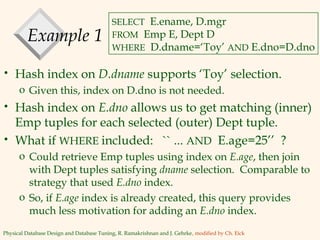
• Hash index on D.dname supports ‘Toy’ selection.
o Given this, index on D.dno is not needed.
• Hash index on E.dno allows us to get matching (inner)
Emp tuples for each selected (outer) Dept tuple.
• What if WHERE included: `` ... AND E.age=25’’ ?
o Could retrieve Emp tuples using index on E.age, then join
with Dept tuples satisfying dname selection. Comparable to
strategy that used E.dno index.
o So, if E.age index is already created, this query provides
much less motivation for adding an E.dno index.
SELECT E.ename, D.mgr
FROM Emp E, Dept D
WHERE D.dname=‘Toy’ AND E.dno=D.dno
Physical Database Design and Database Tuning, R. Ramakrishnan and J. Gehrke, modified by Ch. Eick
Example 2
• Clearly, Emp should be the outer relation.
o Suggests that we build a hash index on D.dno.
• What index should we build on Emp?
o B+ tree on E.sal could be used, OR an index on E.hobby
could be used. Only one of these is needed, and which is
better depends upon the selectivity of the conditions.
o As a rule of thumb, equality selections more selective
than range selections.
• As both examples indicate, our choice of indexes is
guided by the plan(s) that we expect an optimizer to
consider for a query. Have to understand optimizers!
SELECT E.ename, D.mgr
FROM Emp E, Dept D
WHERE E.sal BETWEEN 10000 AND 20000
AND E.hobby=‘Stamps’ AND E.dno=D.dno
Physical Database Design and Database Tuning, R. Ramakrishnan and J. Gehrke, modified by Ch. Eick
Clustering and Joins
• Clustering is especially important when accessing
inner tuples in INL.
o Should make index on E.dno clustered.
• Suppose that the WHERE clause is instead:
WHERE E.hobby=‘Stamps AND E.dno=D.dno
o If many employees collect stamps, Sort-Merge join may be
worth considering. A clustered index on D.dno would help.
• Summary: Clustering is useful whenever many tuples
are to be retrieved.
SELECT E.ename, D.mgr
FROM Emp E, Dept D
WHERE D.dname=‘Toy’ AND E.dno=D.dno
Physical Database Design and Database Tuning, R. Ramakrishnan and J. Gehrke, modified by Ch. Eick
Multi-Attribute Index Keys
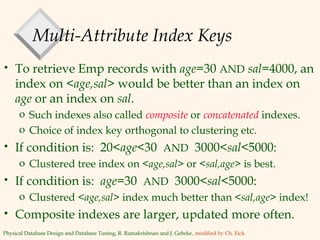
• To retrieve Emp records with age=30 AND sal=4000, an
index on <age,sal> would be better than an index on
age or an index on sal.
o Such indexes also called composite or concatenated indexes.
o Choice of index key orthogonal to clustering etc.
• If condition is: 20<age<30 AND 3000<sal<5000:
o Clustered tree index on <age,sal> or <sal,age> is best.
• If condition is: age=30 AND 3000<sal<5000:
o Clustered <age,sal> index much better than <sal,age> index!
• Composite indexes are larger, updated more often.
Physical Database Design and Database Tuning, R. Ramakrishnan and J. Gehrke, modified by Ch. Eick
Index-Only Plans
• A number of
queries can be
answered
without
retrieving any
tuples from one
or more of the
relations
involved if a
suitable index
is available.
SELECT D.mgr
FROM Dept D, Emp E
WHERE D.dno=E.dno
SELECT D.mgr, E.eid
FROM Dept D, Emp E
WHERE D.dno=E.dno
SELECT E.dno, COUNT(*)
FROM Emp E
GROUP BY E.dno
SELECT E.dno, MIN(E.sal)
FROM Emp E
GROUP BY E.dno
SELECT AVG(E.sal)
FROM Emp E
WHERE E.age=25 AND
E.sal BETWEEN 3000 AND 5000
<E.dno>
<E.dno,E.eid>
Tree index!
<E.dno>
<E.dno,E.sal>
Tree index!
<E. age,E.sal>
or
<E.sal, E.age>
Tree!
Physical Database Design and Database Tuning, R. Ramakrishnan and J. Gehrke, modified by Ch. Eick
Tuning a Relational Schema
• The choice of relational schema should be guided by
the workload, in addition to redundancy issues:
o We may settle for a 3NF schema rather than BCNF.
o Workload may influence the choice we make in
decomposing a relation into 3NF or BCNF.
o We may further decompose a BCNF schema!
o We might denormalize (i.e., undo a decomposition step), or
we might add fields to a relation.
o We might consider horizontal decompositions.
• If such changes are made after a database is in use,
called schema evolution; might want to mask some of
these changes from applications by defining views.
Physical Database Design and Database Tuning, R. Ramakrishnan and J. Gehrke, modified by Ch. Eick
Horizontal Decompositions
• Our definition of decomposition: Relation is replaced
by a collection of relations that are projections. Most
important case.
• Sometimes, might want to replace relation by a
collection of relations that are selections.
o Each new relation has same schema as the original, but a
subset of the rows.
o Collectively, new relations contain all rows of the original.
Typically, the new relations are disjoint.
Physical Database Design and Database Tuning, R. Ramakrishnan and J. Gehrke, modified by Ch. Eick
Horizontal Decompositions (Contd.)
• Suppose that contracts with value > 10000 are subject
to different rules. This means that queries on
Contracts will often contain the condition val>10000.
• One way to deal with this is to build a clustered B+
tree index on the val field of Contracts.
• A second approach is to replace contracts by two new
relations: LargeContracts and SmallContracts, with
the same attributes (CSJDPQV).
o Performs like index on such queries, but no index overhead.
o Can build clustered indexes on other attributes, in addition!
Physical Database Design and Database Tuning, R. Ramakrishnan and J. Gehrke, modified by Ch. Eick 1
Masking Conceptual Schema Changes
• The replacement of Contracts by LargeContracts and
SmallContracts can be masked by the view.
• However, queries with the condition val>10000 must
be asked wrt LargeContracts for efficient execution:
so users concerned with performance have to be
aware of the change.
CREATE VIEW Contracts(cid, sid, jid, did, pid, qty, val)
AS SELECT *
FROM LargeContracts
UNION
SELECT *
FROM SmallContracts
Physical Database Design and Database Tuning, R. Ramakrishnan and J. Gehrke, modified by Ch. Eick 1
Rewriting SQL Queries
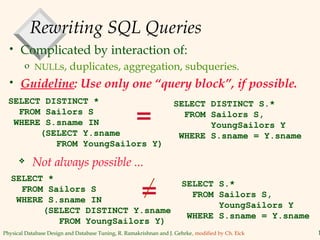
• Complicated by interaction of:
o NULLs, duplicates, aggregation, subqueries.
• Guideline: Use only one “query block”, if possible.
SELECT DISTINCT *
FROM Sailors S
WHERE S.sname IN
(SELECT Y.sname
FROM YoungSailors Y)
SELECT DISTINCT S.*
FROM Sailors S,
YoungSailors Y
WHERE S.sname = Y.sname
SELECT *
FROM Sailors S
WHERE S.sname IN
(SELECT DISTINCT Y.sname
FROM YoungSailors Y)
SELECT S.*
FROM Sailors S,
YoungSailors Y
WHERE S.sname = Y.sname
 Not always possible ...
=
=
Physical Database Design and Database Tuning, R. Ramakrishnan and J. Gehrke, modified by Ch. Eick 1
Summary
• Understanding the nature of the workload for the application,
and the performance goals, is essential to developing a good
design.
o What are the important queries and updates? What attributes/relations
are involved?
• Indexes must be chosen to speed up important queries (and
perhaps some updates!).
o Index maintenance overhead on updates to key fields.
o Choose indexes that can help many queries, if possible.
o Build indexes to support index-only strategies.
o Clustering is an important decision; only one index on a given relation
can be clustered!
• In some other cases it is necessary to rewrite queries and/or or
to change the relational schema to meet runtime requirements.

PDBD- Part2 physical database design.ppt

  • 1.
    Physical Database Designand Database Tuning, R. Ramakrishnan and J. Gehrke, modified by Ch. Eick Physical Database Design Part II
  • 2.
    Physical Database Designand Database Tuning, R. Ramakrishnan and J. Gehrke, modified by Ch. Eick Example 1 • Hash index on D.dname supports ‘Toy’ selection. o Given this, index on D.dno is not needed. • Hash index on E.dno allows us to get matching (inner) Emp tuples for each selected (outer) Dept tuple. • What if WHERE included: `` ... AND E.age=25’’ ? o Could retrieve Emp tuples using index on E.age, then join with Dept tuples satisfying dname selection. Comparable to strategy that used E.dno index. o So, if E.age index is already created, this query provides much less motivation for adding an E.dno index. SELECT E.ename, D.mgr FROM Emp E, Dept D WHERE D.dname=‘Toy’ AND E.dno=D.dno
  • 3.
    Physical Database Designand Database Tuning, R. Ramakrishnan and J. Gehrke, modified by Ch. Eick Example 2 • Clearly, Emp should be the outer relation. o Suggests that we build a hash index on D.dno. • What index should we build on Emp? o B+ tree on E.sal could be used, OR an index on E.hobby could be used. Only one of these is needed, and which is better depends upon the selectivity of the conditions. o As a rule of thumb, equality selections more selective than range selections. • As both examples indicate, our choice of indexes is guided by the plan(s) that we expect an optimizer to consider for a query. Have to understand optimizers! SELECT E.ename, D.mgr FROM Emp E, Dept D WHERE E.sal BETWEEN 10000 AND 20000 AND E.hobby=‘Stamps’ AND E.dno=D.dno
  • 4.
    Physical Database Designand Database Tuning, R. Ramakrishnan and J. Gehrke, modified by Ch. Eick Clustering and Joins • Clustering is especially important when accessing inner tuples in INL. o Should make index on E.dno clustered. • Suppose that the WHERE clause is instead: WHERE E.hobby=‘Stamps AND E.dno=D.dno o If many employees collect stamps, Sort-Merge join may be worth considering. A clustered index on D.dno would help. • Summary: Clustering is useful whenever many tuples are to be retrieved. SELECT E.ename, D.mgr FROM Emp E, Dept D WHERE D.dname=‘Toy’ AND E.dno=D.dno
  • 5.
    Physical Database Designand Database Tuning, R. Ramakrishnan and J. Gehrke, modified by Ch. Eick Multi-Attribute Index Keys • To retrieve Emp records with age=30 AND sal=4000, an index on <age,sal> would be better than an index on age or an index on sal. o Such indexes also called composite or concatenated indexes. o Choice of index key orthogonal to clustering etc. • If condition is: 20<age<30 AND 3000<sal<5000: o Clustered tree index on <age,sal> or <sal,age> is best. • If condition is: age=30 AND 3000<sal<5000: o Clustered <age,sal> index much better than <sal,age> index! • Composite indexes are larger, updated more often.
  • 6.
    Physical Database Designand Database Tuning, R. Ramakrishnan and J. Gehrke, modified by Ch. Eick Index-Only Plans • A number of queries can be answered without retrieving any tuples from one or more of the relations involved if a suitable index is available. SELECT D.mgr FROM Dept D, Emp E WHERE D.dno=E.dno SELECT D.mgr, E.eid FROM Dept D, Emp E WHERE D.dno=E.dno SELECT E.dno, COUNT(*) FROM Emp E GROUP BY E.dno SELECT E.dno, MIN(E.sal) FROM Emp E GROUP BY E.dno SELECT AVG(E.sal) FROM Emp E WHERE E.age=25 AND E.sal BETWEEN 3000 AND 5000 <E.dno> <E.dno,E.eid> Tree index! <E.dno> <E.dno,E.sal> Tree index! <E. age,E.sal> or <E.sal, E.age> Tree!
  • 7.
    Physical Database Designand Database Tuning, R. Ramakrishnan and J. Gehrke, modified by Ch. Eick Tuning a Relational Schema • The choice of relational schema should be guided by the workload, in addition to redundancy issues: o We may settle for a 3NF schema rather than BCNF. o Workload may influence the choice we make in decomposing a relation into 3NF or BCNF. o We may further decompose a BCNF schema! o We might denormalize (i.e., undo a decomposition step), or we might add fields to a relation. o We might consider horizontal decompositions. • If such changes are made after a database is in use, called schema evolution; might want to mask some of these changes from applications by defining views.
  • 8.
    Physical Database Designand Database Tuning, R. Ramakrishnan and J. Gehrke, modified by Ch. Eick Horizontal Decompositions • Our definition of decomposition: Relation is replaced by a collection of relations that are projections. Most important case. • Sometimes, might want to replace relation by a collection of relations that are selections. o Each new relation has same schema as the original, but a subset of the rows. o Collectively, new relations contain all rows of the original. Typically, the new relations are disjoint.
  • 9.
    Physical Database Designand Database Tuning, R. Ramakrishnan and J. Gehrke, modified by Ch. Eick Horizontal Decompositions (Contd.) • Suppose that contracts with value > 10000 are subject to different rules. This means that queries on Contracts will often contain the condition val>10000. • One way to deal with this is to build a clustered B+ tree index on the val field of Contracts. • A second approach is to replace contracts by two new relations: LargeContracts and SmallContracts, with the same attributes (CSJDPQV). o Performs like index on such queries, but no index overhead. o Can build clustered indexes on other attributes, in addition!
  • 10.
    Physical Database Designand Database Tuning, R. Ramakrishnan and J. Gehrke, modified by Ch. Eick 1 Masking Conceptual Schema Changes • The replacement of Contracts by LargeContracts and SmallContracts can be masked by the view. • However, queries with the condition val>10000 must be asked wrt LargeContracts for efficient execution: so users concerned with performance have to be aware of the change. CREATE VIEW Contracts(cid, sid, jid, did, pid, qty, val) AS SELECT * FROM LargeContracts UNION SELECT * FROM SmallContracts
  • 11.
    Physical Database Designand Database Tuning, R. Ramakrishnan and J. Gehrke, modified by Ch. Eick 1 Rewriting SQL Queries • Complicated by interaction of: o NULLs, duplicates, aggregation, subqueries. • Guideline: Use only one “query block”, if possible. SELECT DISTINCT * FROM Sailors S WHERE S.sname IN (SELECT Y.sname FROM YoungSailors Y) SELECT DISTINCT S.* FROM Sailors S, YoungSailors Y WHERE S.sname = Y.sname SELECT * FROM Sailors S WHERE S.sname IN (SELECT DISTINCT Y.sname FROM YoungSailors Y) SELECT S.* FROM Sailors S, YoungSailors Y WHERE S.sname = Y.sname  Not always possible ... = =
  • 12.
    Physical Database Designand Database Tuning, R. Ramakrishnan and J. Gehrke, modified by Ch. Eick 1 Summary • Understanding the nature of the workload for the application, and the performance goals, is essential to developing a good design. o What are the important queries and updates? What attributes/relations are involved? • Indexes must be chosen to speed up important queries (and perhaps some updates!). o Index maintenance overhead on updates to key fields. o Choose indexes that can help many queries, if possible. o Build indexes to support index-only strategies. o Clustering is an important decision; only one index on a given relation can be clustered! • In some other cases it is necessary to rewrite queries and/or or to change the relational schema to meet runtime requirements.

Editor's Notes

  • #1 The slides for this text are organized into chapters. This lecture covers the material on physical database design from Chapter 16. The material on database tuning can be found in Chapter 16, part B. Chapter 1: Introduction to Database Systems Chapter 2: The Entity-Relationship Model Chapter 3: The Relational Model Chapter 4 (Part A): Relational Algebra Chapter 4 (Part B): Relational Calculus Chapter 5: SQL: Queries, Programming, Triggers Chapter 6: Query-by-Example (QBE) Chapter 7: Storing Data: Disks and Files Chapter 8: File Organizations and Indexing Chapter 9: Tree-Structured Indexing Chapter 10: Hash-Based Indexing Chapter 11: External Sorting Chapter 12 (Part A): Evaluation of Relational Operators Chapter 12 (Part B): Evaluation of Relational Operators: Other Techniques Chapter 13: Introduction to Query Optimization Chapter 14: A Typical Relational Optimizer Chapter 15: Schema Refinement and Normal Forms Chapter 16 (Part A): Physical Database Design Chapter 16 (Part B): Database Tuning Chapter 17: Security Chapter 18: Transaction Management Overview Chapter 19: Concurrency Control Chapter 20: Crash Recovery Chapter 21: Parallel and Distributed Databases Chapter 22: Internet Databases Chapter 23: Decision Support Chapter 24: Data Mining Chapter 25: Object-Database Systems Chapter 26: Spatial Data Management Chapter 27: Deductive Databases Chapter 28: Additional Topics