Fundamentals of Database Systems
Seventh Edition
Chapter 20
Introduction to Transaction
Processing Concepts and
Theory
Copyright © 2016, 2011, 2007 Pearson Education, Inc. All Rights Reserved
Introduction
• Transaction
– Describes local unit of database processing
• Transaction processing systems
– Systems with large databases and hundreds of
concurrent users
– Require high availability and fast response time
Copyright © 2016, 2011, 2007 Pearson Education, Inc. All Rights Reserved
20.1 Introduction to Transaction Processing (1 of 3)
• Single-user DBMS
– At most one user at a time can use the system
– Example: home computer
• Multiuser DBMS
– Many users can access the system (database)
concurrently
– Example: airline reservations system
Copyright © 2016, 2011, 2007 Pearson Education, Inc. All Rights Reserved
20.1 Introduction to Transaction Processing (2 of 3)
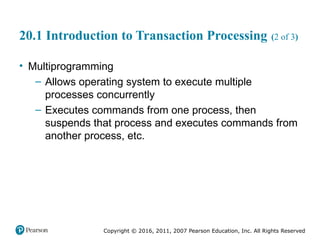
• Multiprogramming
– Allows operating system to execute multiple
processes concurrently
– Executes commands from one process, then
suspends that process and executes commands from
another process, etc.
Copyright © 2016, 2011, 2007 Pearson Education, Inc. All Rights Reserved
20.1 Introduction to Transaction Processing (3 of 3)
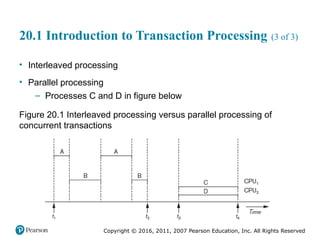
• Interleaved processing
• Parallel processing
– Processes C and D in figure below
Figure 20.1 Interleaved processing versus parallel processing of
concurrent transactions
Copyright © 2016, 2011, 2007 Pearson Education, Inc. All Rights Reserved
Transactions
• Transaction: an executing program
– Forms logical unit of database processing
• Begin and end transaction statements
– Specify transaction boundaries
• Read-only transaction
• Read-write transaction
Copyright © 2016, 2011, 2007 Pearson Education, Inc. All Rights Reserved
Database Items
• Database represented as collection of named data items
• Size of a data item called its granularity
• Data item
– Record
– Disk block
– Attribute value of a record
• Transaction processing concepts independent of item
granularity
Copyright © 2016, 2011, 2007 Pearson Education, Inc. All Rights Reserved
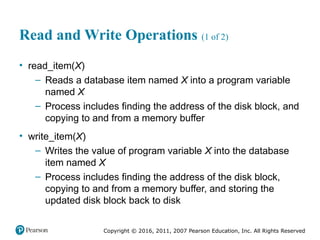
Read and Write Operations (1 of 2)
• read_item(X)
– Reads a database item named X into a program variable
named X
– Process includes finding the address of the disk block, and
copying to and from a memory buffer
• write_item(X)
– Writes the value of program variable X into the database
item named X
– Process includes finding the address of the disk block,
copying to and from a memory buffer, and storing the
updated disk block back to disk
Copyright © 2016, 2011, 2007 Pearson Education, Inc. All Rights Reserved
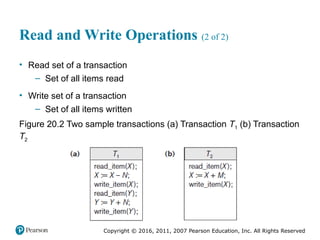
Read and Write Operations (2 of 2)
• Read set of a transaction
– Set of all items read
• Write set of a transaction
– Set of all items written
Figure 20.2 Two sample transactions (a) Transaction T1 (b) Transaction
T2
Copyright © 2016, 2011, 2007 Pearson Education, Inc. All Rights Reserved
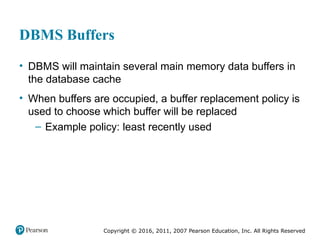
DBMS Buffers
• DBMS will maintain several main memory data buffers in
the database cache
• When buffers are occupied, a buffer replacement policy is
used to choose which buffer will be replaced
– Example policy: least recently used
Copyright © 2016, 2011, 2007 Pearson Education, Inc. All Rights Reserved
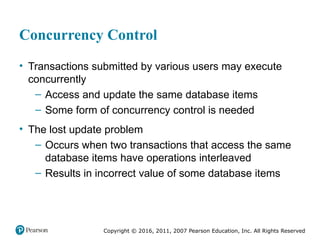
Concurrency Control
• Transactions submitted by various users may execute
concurrently
– Access and update the same database items
– Some form of concurrency control is needed
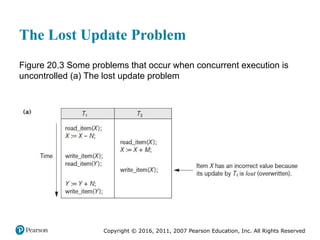
• The lost update problem
– Occurs when two transactions that access the same
database items have operations interleaved
– Results in incorrect value of some database items
Copyright © 2016, 2011, 2007 Pearson Education, Inc. All Rights Reserved
The Lost Update Problem
Figure 20.3 Some problems that occur when concurrent execution is
uncontrolled (a) The lost update problem
Copyright © 2016, 2011, 2007 Pearson Education, Inc. All Rights Reserved
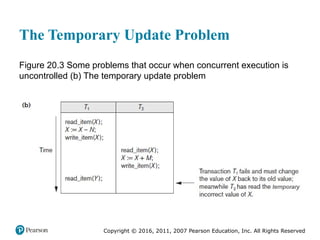
The Temporary Update Problem
Figure 20.3 Some problems that occur when concurrent execution is
uncontrolled (b) The temporary update problem
Copyright © 2016, 2011, 2007 Pearson Education, Inc. All Rights Reserved
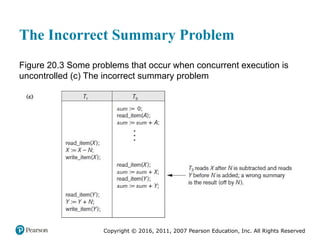
The Incorrect Summary Problem
Figure 20.3 Some problems that occur when concurrent execution is
uncontrolled (c) The incorrect summary problem
Copyright © 2016, 2011, 2007 Pearson Education, Inc. All Rights Reserved
The Unrepeatable Read Problem
• Transaction T reads the same item twice
• Value is changed by another transaction T between the
two reads
• T receives different values for the two reads of the same
item
Copyright © 2016, 2011, 2007 Pearson Education, Inc. All Rights Reserved
Why Recovery is Needed (1 of 2)
• Committed transaction
– Effect recorded permanently in the database
• Aborted transaction
– Does not affect the database
• Types of transaction failures
– Computer failure (system crash)
– Transaction or system error
– Local errors or exception conditions detected by the
transaction
Copyright © 2016, 2011, 2007 Pearson Education, Inc. All Rights Reserved
Why Recovery is Needed (2 of 2)
• Types of transaction failures
– Concurrency control enforcement
– Disk failure
– Physical problems or catastrophes
• System must keep sufficient information to recover
quickly from the failure
– Disk failure or other catastrophes have long recovery
times
Copyright © 2016, 2011, 2007 Pearson Education, Inc. All Rights Reserved
20.2 Transaction and System Concepts (1 of 2)
• System must keep track of when each transaction starts,
terminates, commits, and/or aborts
– BEGIN_TRANSACTION
– READ or WRITE
– END_TRANSACTION
– COMMIT_TRANSACTION
– ROLLBACK (or ABORT)
Copyright © 2016, 2011, 2007 Pearson Education, Inc. All Rights Reserved
20.2 Transaction and System Concepts (2 of 2)
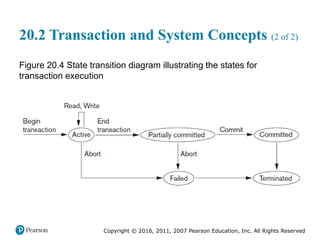
Figure 20.4 State transition diagram illustrating the states for
transaction execution
Copyright © 2016, 2011, 2007 Pearson Education, Inc. All Rights Reserved
The System Log
• System log keeps track of transaction operations
• Sequential, append-only file
• Not affected by failure (except disk or catastrophic failure)
• Log buffer
– Main memory buffer
– When full, appended to end of log file on disk
• Log file is backed up periodically
• Undo and redo operations based on log possible
Copyright © 2016, 2011, 2007 Pearson Education, Inc. All Rights Reserved
Commit Point of a Transaction
• Occurs when all operations that access the database
have completed successfully
– And effect of operations recorded in the log
• Transaction writes a commit record into the log
– If system failure occurs, can search for transactions
with recorded start_transaction but no commit record
• Force-writing the log buffer to disk
– Writing log buffer to disk before transaction reaches
commit point
Copyright © 2016, 2011, 2007 Pearson Education, Inc. All Rights Reserved
DBMS-Specific Buffer Replacement
Policies (1 of 2)
• Page replacement policy
– Selects particular buffers to be replaced when all are full
• Domain separation (DS) method
– Each domain handles one type of disk pages
▪ Index pages
▪ Data file pages
▪ Log file pages
– Number of available buffers for each domain is
predetermined
Copyright © 2016, 2011, 2007 Pearson Education, Inc. All Rights Reserved
DBMS-Specific Buffer Replacement
Policies (2 of 2)
• Hot set method
– Useful in queries that scan a set of pages repeatedly
– Does not replace the set in the buffers until processing is
completed
• The DBMIN method
– Predetermines the pattern of page references for each
algorithm for a particular type of database operation
▪ Calculates locality set using query locality set model
(QLSM)
Copyright © 2016, 2011, 2007 Pearson Education, Inc. All Rights Reserved
20.3 Desirable Properties of Transactions (1 of 2)
• ACID properties
– Atomicity
▪ Transaction performed in its entirety or not at all
• Consistency preservation
– Takes database from one consistent state to another
• Isolation
– Not interfered with by other transactions
• Durability or permanency
– Changes must persist in the database
Copyright © 2016, 2011, 2007 Pearson Education, Inc. All Rights Reserved
20.3 Desirable Properties of Transactions (2 of 2)
• Levels of isolation
– Level 0 isolation does not overwrite the dirty reads of
higher-level transactions
– Level 1 isolation has no lost updates
– Level 2 isolation has no lost updates and no dirty
reads
– Level 3 (true) isolation has repeatable reads
▪ In addition to level 2 properties
– Snapshot isolation
Copyright © 2016, 2011, 2007 Pearson Education, Inc. All Rights Reserved
20.4 Characterizing Schedules Based on
Recoverability (1 of 4)
• Schedule or history
– Order of execution of operations from all transactions
– Operations from different transactions can be
interleaved in the schedule
• Total ordering of operations in a schedule
– For any two operations in the schedule, one must
occur before the other
Copyright © 2016, 2011, 2007 Pearson Education, Inc. All Rights Reserved
20.4 Characterizing Schedules Based on
Recoverability (2 of 4)
• Two conflicting operations in a schedule
– Operations belong to different transactions
– Operations access the same item X
– At least one of the operations is a write_item(X)
• Two operations conflict if changing their order results in a
different outcome
• Read-write conflict
• Write-write conflict
Copyright © 2016, 2011, 2007 Pearson Education, Inc. All Rights Reserved
20.4 Characterizing Schedules Based on
Recoverability (3 of 4)
• Recoverable schedules
– Recovery is possible
• Nonrecoverable schedules should not be permitted by the
DBMS
• No committed transaction ever needs to be rolled back
• Cascading rollback may occur in some recoverable
schedules
– Uncommitted transaction may need to be rolled back
Copyright © 2016, 2011, 2007 Pearson Education, Inc. All Rights Reserved
20.4 Characterizing Schedules Based on
Recoverability (4 of 4)
• Cascadeless schedule
– Avoids cascading rollback
• Strict schedule
– Transactions can neither read nor write an item X until
the last transaction that wrote X has committed or
aborted
– Simpler recovery process
▪ Restore the before image
Copyright © 2016, 2011, 2007 Pearson Education, Inc. All Rights Reserved
20.5 Characterizing Schedules Based on
Serializability (1 of 6)
• Serializable schedules
– Always considered to be correct when concurrent
transactions are executing
– Places simultaneous transactions in series
▪ Transaction T1 before T2, or vice versa
Copyright © 2016, 2011, 2007 Pearson Education, Inc. All Rights Reserved
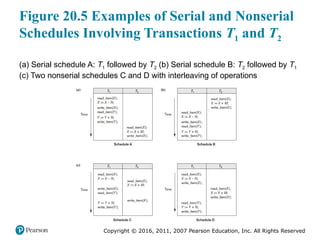
Figure 20.5 Examples of Serial and Nonserial
Schedules Involving Transactions T1 and T2
(a) Serial schedule A: T1 followed by T2 (b) Serial schedule B: T2 followed by T1
(c) Two nonserial schedules C and D with interleaving of operations
Copyright © 2016, 2011, 2007 Pearson Education, Inc. All Rights Reserved
20.5 Characterizing Schedules Based on
Serializability (2 of 6)
• Problem with serial schedules
– Limit concurrency by prohibiting interleaving of
operations
– Unacceptable in practice
– Solution: determine which schedules are equivalent to
a serial schedule and allow those to occur
• Serializable schedule of n transactions
– Equivalent to some serial schedule of same n
transactions
Copyright © 2016, 2011, 2007 Pearson Education, Inc. All Rights Reserved
20.5 Characterizing Schedules Based on
Serializability (3 of 6)
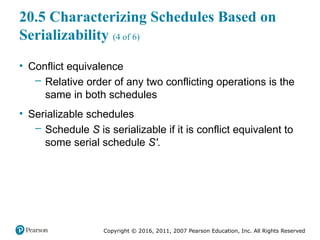
• Result equivalent schedules
– Produce the same final state of the database
▪ May be accidental
– Cannot be used alone to define equivalence of schedules
Figure 20.6 Two schedules that are result equivalent for the initial value of X =
100 but are not result equivalent in general
Copyright © 2016, 2011, 2007 Pearson Education, Inc. All Rights Reserved
20.5 Characterizing Schedules Based on
Serializability (4 of 6)
• Conflict equivalence
– Relative order of any two conflicting operations is the
same in both schedules
• Serializable schedules
– Schedule S is serializable if it is conflict equivalent to
some serial schedule S′.
Copyright © 2016, 2011, 2007 Pearson Education, Inc. All Rights Reserved
20.5 Characterizing Schedules Based on
Serializability (5 of 6)
• Testing for serializability of a schedule
1. For each transaction Ti participating in schedule S, create a node
labeled Ti in the precedence graph.
2. For each case in S where Tj executes a read_item(X) after Ti executes a
write_item(X), create an edge  

i j
T T in the precedence graph.
3. For each case in S where Tj executes a write_item(X) after Ti executes
a read_item(X), create an edge  

i j
T T in the precedence graph.
4. For each case in S where Tj executes a write_item(X) after Ti executes
a write_item(X), create an edge  

i j
T T in the precedence graph.
5. The schedule S is serializable if and only if the precedence graph has
no cycles.
Algorithm 20.1 Testing conflict serializability of a schedule S
Copyright © 2016, 2011, 2007 Pearson Education, Inc. All Rights Reserved
20.5 Characterizing Schedules Based on
Serializability (6 of 6)
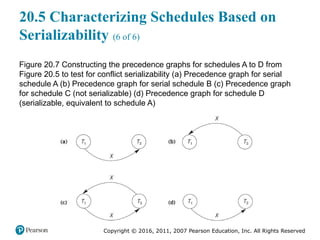
Figure 20.7 Constructing the precedence graphs for schedules A to D from
Figure 20.5 to test for conflict serializability (a) Precedence graph for serial
schedule A (b) Precedence graph for serial schedule B (c) Precedence graph
for schedule C (not serializable) (d) Precedence graph for schedule D
(serializable, equivalent to schedule A)
Copyright © 2016, 2011, 2007 Pearson Education, Inc. All Rights Reserved
How Serializability Is Used for Concurrency
Control
• Being serializable is different from being serial
• Serializable schedule gives benefit of concurrent
execution
– Without giving up any correctness
• Difficult to test for serializability in practice
– Factors such as system load, time of transaction
submission, and process priority affect ordering of
operations
• DBMS enforces protocols
– Set of rules to ensure serializability
Copyright © 2016, 2011, 2007 Pearson Education, Inc. All Rights Reserved
View Equivalence and View Serializability (1 of 2)
• View equivalence of two schedules
– As long as each read operation of a transaction reads
the result of the same write operation in both
schedules, the write operations of each transaction
must produce the same results
– Read operations said to see the same view in both
schedules
• View serializable schedule
– View equivalent to a serial schedule
Copyright © 2016, 2011, 2007 Pearson Education, Inc. All Rights Reserved
View Equivalence and View Serializability (2 of 2)
• Conflict serializability similar to view serializability if
constrained write assumption (no blind writes) applies
• Unconstrained write assumption
– Value written by an operation can be independent of
its old value
• Debit-credit transactions
– Less-stringent conditions than conflict serializability or
view serializability
Copyright © 2016, 2011, 2007 Pearson Education, Inc. All Rights Reserved
20.6 Transaction Support in SQL (1 of 3)
• No explicit Begin_Transaction statement
• Every transaction must have an explicit end statement
– COMMIT
– ROLLBACK
• Access mode is READ ONLY or READ WRITE
• Diagnostic area size option
– Integer value indicating number of conditions held
simultaneously in the diagnostic area
Copyright © 2016, 2011, 2007 Pearson Education, Inc. All Rights Reserved
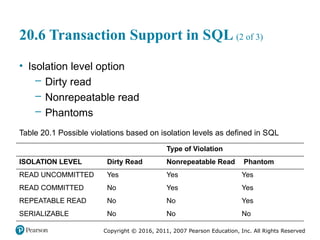
20.6 Transaction Support in SQL (2 of 3)
• Isolation level option
– Dirty read
– Nonrepeatable read
– Phantoms
Table 20.1 Possible violations based on isolation levels as defined in SQL
Blank Type of Violation Type of Violation Type of Violation
ISOLATION LEVEL Dirty Read Nonrepeatable Read Phantom
READ UNCOMMITTED Yes Yes Yes
READ COMMITTED No Yes Yes
REPEATABLE READ No No Yes
SERIALIZABLE No No No
Copyright © 2016, 2011, 2007 Pearson Education, Inc. All Rights Reserved
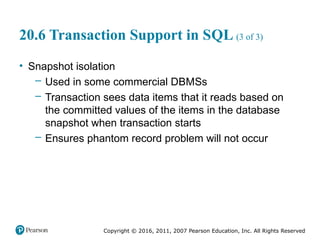
20.6 Transaction Support in SQL (3 of 3)
• Snapshot isolation
– Used in some commercial DBMSs
– Transaction sees data items that it reads based on
the committed values of the items in the database
snapshot when transaction starts
– Ensures phantom record problem will not occur
Copyright © 2016, 2011, 2007 Pearson Education, Inc. All Rights Reserved
20.7 Summary
• Single and multiuser database transactions
• Uncontrolled execution of concurrent transactions
• System log
• Failure recovery
• Committed transaction
• Schedule (history) defines execution sequence
– Schedule recoverability
– Schedule equivalence
• Serializability of schedules
Copyright © 2016, 2011, 2007 Pearson Education, Inc. All Rights Reserved
Copyright

Chapter20 transaction processing system .pptx

  • 1.
    Fundamentals of DatabaseSystems Seventh Edition Chapter 20 Introduction to Transaction Processing Concepts and Theory Copyright © 2016, 2011, 2007 Pearson Education, Inc. All Rights Reserved
  • 2.
    Copyright © 2016,2011, 2007 Pearson Education, Inc. All Rights Reserved Introduction • Transaction – Describes local unit of database processing • Transaction processing systems – Systems with large databases and hundreds of concurrent users – Require high availability and fast response time
  • 3.
    Copyright © 2016,2011, 2007 Pearson Education, Inc. All Rights Reserved 20.1 Introduction to Transaction Processing (1 of 3) • Single-user DBMS – At most one user at a time can use the system – Example: home computer • Multiuser DBMS – Many users can access the system (database) concurrently – Example: airline reservations system
  • 4.
    Copyright © 2016,2011, 2007 Pearson Education, Inc. All Rights Reserved 20.1 Introduction to Transaction Processing (2 of 3) • Multiprogramming – Allows operating system to execute multiple processes concurrently – Executes commands from one process, then suspends that process and executes commands from another process, etc.
  • 5.
    Copyright © 2016,2011, 2007 Pearson Education, Inc. All Rights Reserved 20.1 Introduction to Transaction Processing (3 of 3) • Interleaved processing • Parallel processing – Processes C and D in figure below Figure 20.1 Interleaved processing versus parallel processing of concurrent transactions
  • 6.
    Copyright © 2016,2011, 2007 Pearson Education, Inc. All Rights Reserved Transactions • Transaction: an executing program – Forms logical unit of database processing • Begin and end transaction statements – Specify transaction boundaries • Read-only transaction • Read-write transaction
  • 7.
    Copyright © 2016,2011, 2007 Pearson Education, Inc. All Rights Reserved Database Items • Database represented as collection of named data items • Size of a data item called its granularity • Data item – Record – Disk block – Attribute value of a record • Transaction processing concepts independent of item granularity
  • 8.
    Copyright © 2016,2011, 2007 Pearson Education, Inc. All Rights Reserved Read and Write Operations (1 of 2) • read_item(X) – Reads a database item named X into a program variable named X – Process includes finding the address of the disk block, and copying to and from a memory buffer • write_item(X) – Writes the value of program variable X into the database item named X – Process includes finding the address of the disk block, copying to and from a memory buffer, and storing the updated disk block back to disk
  • 9.
    Copyright © 2016,2011, 2007 Pearson Education, Inc. All Rights Reserved Read and Write Operations (2 of 2) • Read set of a transaction – Set of all items read • Write set of a transaction – Set of all items written Figure 20.2 Two sample transactions (a) Transaction T1 (b) Transaction T2
  • 10.
    Copyright © 2016,2011, 2007 Pearson Education, Inc. All Rights Reserved DBMS Buffers • DBMS will maintain several main memory data buffers in the database cache • When buffers are occupied, a buffer replacement policy is used to choose which buffer will be replaced – Example policy: least recently used
  • 11.
    Copyright © 2016,2011, 2007 Pearson Education, Inc. All Rights Reserved Concurrency Control • Transactions submitted by various users may execute concurrently – Access and update the same database items – Some form of concurrency control is needed • The lost update problem – Occurs when two transactions that access the same database items have operations interleaved – Results in incorrect value of some database items
  • 12.
    Copyright © 2016,2011, 2007 Pearson Education, Inc. All Rights Reserved The Lost Update Problem Figure 20.3 Some problems that occur when concurrent execution is uncontrolled (a) The lost update problem
  • 13.
    Copyright © 2016,2011, 2007 Pearson Education, Inc. All Rights Reserved The Temporary Update Problem Figure 20.3 Some problems that occur when concurrent execution is uncontrolled (b) The temporary update problem
  • 14.
    Copyright © 2016,2011, 2007 Pearson Education, Inc. All Rights Reserved The Incorrect Summary Problem Figure 20.3 Some problems that occur when concurrent execution is uncontrolled (c) The incorrect summary problem
  • 15.
    Copyright © 2016,2011, 2007 Pearson Education, Inc. All Rights Reserved The Unrepeatable Read Problem • Transaction T reads the same item twice • Value is changed by another transaction T between the two reads • T receives different values for the two reads of the same item
  • 16.
    Copyright © 2016,2011, 2007 Pearson Education, Inc. All Rights Reserved Why Recovery is Needed (1 of 2) • Committed transaction – Effect recorded permanently in the database • Aborted transaction – Does not affect the database • Types of transaction failures – Computer failure (system crash) – Transaction or system error – Local errors or exception conditions detected by the transaction
  • 17.
    Copyright © 2016,2011, 2007 Pearson Education, Inc. All Rights Reserved Why Recovery is Needed (2 of 2) • Types of transaction failures – Concurrency control enforcement – Disk failure – Physical problems or catastrophes • System must keep sufficient information to recover quickly from the failure – Disk failure or other catastrophes have long recovery times
  • 18.
    Copyright © 2016,2011, 2007 Pearson Education, Inc. All Rights Reserved 20.2 Transaction and System Concepts (1 of 2) • System must keep track of when each transaction starts, terminates, commits, and/or aborts – BEGIN_TRANSACTION – READ or WRITE – END_TRANSACTION – COMMIT_TRANSACTION – ROLLBACK (or ABORT)
  • 19.
    Copyright © 2016,2011, 2007 Pearson Education, Inc. All Rights Reserved 20.2 Transaction and System Concepts (2 of 2) Figure 20.4 State transition diagram illustrating the states for transaction execution
  • 20.
    Copyright © 2016,2011, 2007 Pearson Education, Inc. All Rights Reserved The System Log • System log keeps track of transaction operations • Sequential, append-only file • Not affected by failure (except disk or catastrophic failure) • Log buffer – Main memory buffer – When full, appended to end of log file on disk • Log file is backed up periodically • Undo and redo operations based on log possible
  • 21.
    Copyright © 2016,2011, 2007 Pearson Education, Inc. All Rights Reserved Commit Point of a Transaction • Occurs when all operations that access the database have completed successfully – And effect of operations recorded in the log • Transaction writes a commit record into the log – If system failure occurs, can search for transactions with recorded start_transaction but no commit record • Force-writing the log buffer to disk – Writing log buffer to disk before transaction reaches commit point
  • 22.
    Copyright © 2016,2011, 2007 Pearson Education, Inc. All Rights Reserved DBMS-Specific Buffer Replacement Policies (1 of 2) • Page replacement policy – Selects particular buffers to be replaced when all are full • Domain separation (DS) method – Each domain handles one type of disk pages ▪ Index pages ▪ Data file pages ▪ Log file pages – Number of available buffers for each domain is predetermined
  • 23.
    Copyright © 2016,2011, 2007 Pearson Education, Inc. All Rights Reserved DBMS-Specific Buffer Replacement Policies (2 of 2) • Hot set method – Useful in queries that scan a set of pages repeatedly – Does not replace the set in the buffers until processing is completed • The DBMIN method – Predetermines the pattern of page references for each algorithm for a particular type of database operation ▪ Calculates locality set using query locality set model (QLSM)
  • 24.
    Copyright © 2016,2011, 2007 Pearson Education, Inc. All Rights Reserved 20.3 Desirable Properties of Transactions (1 of 2) • ACID properties – Atomicity ▪ Transaction performed in its entirety or not at all • Consistency preservation – Takes database from one consistent state to another • Isolation – Not interfered with by other transactions • Durability or permanency – Changes must persist in the database
  • 25.
    Copyright © 2016,2011, 2007 Pearson Education, Inc. All Rights Reserved 20.3 Desirable Properties of Transactions (2 of 2) • Levels of isolation – Level 0 isolation does not overwrite the dirty reads of higher-level transactions – Level 1 isolation has no lost updates – Level 2 isolation has no lost updates and no dirty reads – Level 3 (true) isolation has repeatable reads ▪ In addition to level 2 properties – Snapshot isolation
  • 26.
    Copyright © 2016,2011, 2007 Pearson Education, Inc. All Rights Reserved 20.4 Characterizing Schedules Based on Recoverability (1 of 4) • Schedule or history – Order of execution of operations from all transactions – Operations from different transactions can be interleaved in the schedule • Total ordering of operations in a schedule – For any two operations in the schedule, one must occur before the other
  • 27.
    Copyright © 2016,2011, 2007 Pearson Education, Inc. All Rights Reserved 20.4 Characterizing Schedules Based on Recoverability (2 of 4) • Two conflicting operations in a schedule – Operations belong to different transactions – Operations access the same item X – At least one of the operations is a write_item(X) • Two operations conflict if changing their order results in a different outcome • Read-write conflict • Write-write conflict
  • 28.
    Copyright © 2016,2011, 2007 Pearson Education, Inc. All Rights Reserved 20.4 Characterizing Schedules Based on Recoverability (3 of 4) • Recoverable schedules – Recovery is possible • Nonrecoverable schedules should not be permitted by the DBMS • No committed transaction ever needs to be rolled back • Cascading rollback may occur in some recoverable schedules – Uncommitted transaction may need to be rolled back
  • 29.
    Copyright © 2016,2011, 2007 Pearson Education, Inc. All Rights Reserved 20.4 Characterizing Schedules Based on Recoverability (4 of 4) • Cascadeless schedule – Avoids cascading rollback • Strict schedule – Transactions can neither read nor write an item X until the last transaction that wrote X has committed or aborted – Simpler recovery process ▪ Restore the before image
  • 30.
    Copyright © 2016,2011, 2007 Pearson Education, Inc. All Rights Reserved 20.5 Characterizing Schedules Based on Serializability (1 of 6) • Serializable schedules – Always considered to be correct when concurrent transactions are executing – Places simultaneous transactions in series ▪ Transaction T1 before T2, or vice versa
  • 31.
    Copyright © 2016,2011, 2007 Pearson Education, Inc. All Rights Reserved Figure 20.5 Examples of Serial and Nonserial Schedules Involving Transactions T1 and T2 (a) Serial schedule A: T1 followed by T2 (b) Serial schedule B: T2 followed by T1 (c) Two nonserial schedules C and D with interleaving of operations
  • 32.
    Copyright © 2016,2011, 2007 Pearson Education, Inc. All Rights Reserved 20.5 Characterizing Schedules Based on Serializability (2 of 6) • Problem with serial schedules – Limit concurrency by prohibiting interleaving of operations – Unacceptable in practice – Solution: determine which schedules are equivalent to a serial schedule and allow those to occur • Serializable schedule of n transactions – Equivalent to some serial schedule of same n transactions
  • 33.
    Copyright © 2016,2011, 2007 Pearson Education, Inc. All Rights Reserved 20.5 Characterizing Schedules Based on Serializability (3 of 6) • Result equivalent schedules – Produce the same final state of the database ▪ May be accidental – Cannot be used alone to define equivalence of schedules Figure 20.6 Two schedules that are result equivalent for the initial value of X = 100 but are not result equivalent in general
  • 34.
    Copyright © 2016,2011, 2007 Pearson Education, Inc. All Rights Reserved 20.5 Characterizing Schedules Based on Serializability (4 of 6) • Conflict equivalence – Relative order of any two conflicting operations is the same in both schedules • Serializable schedules – Schedule S is serializable if it is conflict equivalent to some serial schedule S′.
  • 35.
    Copyright © 2016,2011, 2007 Pearson Education, Inc. All Rights Reserved 20.5 Characterizing Schedules Based on Serializability (5 of 6) • Testing for serializability of a schedule 1. For each transaction Ti participating in schedule S, create a node labeled Ti in the precedence graph. 2. For each case in S where Tj executes a read_item(X) after Ti executes a write_item(X), create an edge    i j T T in the precedence graph. 3. For each case in S where Tj executes a write_item(X) after Ti executes a read_item(X), create an edge    i j T T in the precedence graph. 4. For each case in S where Tj executes a write_item(X) after Ti executes a write_item(X), create an edge    i j T T in the precedence graph. 5. The schedule S is serializable if and only if the precedence graph has no cycles. Algorithm 20.1 Testing conflict serializability of a schedule S
  • 36.
    Copyright © 2016,2011, 2007 Pearson Education, Inc. All Rights Reserved 20.5 Characterizing Schedules Based on Serializability (6 of 6) Figure 20.7 Constructing the precedence graphs for schedules A to D from Figure 20.5 to test for conflict serializability (a) Precedence graph for serial schedule A (b) Precedence graph for serial schedule B (c) Precedence graph for schedule C (not serializable) (d) Precedence graph for schedule D (serializable, equivalent to schedule A)
  • 37.
    Copyright © 2016,2011, 2007 Pearson Education, Inc. All Rights Reserved How Serializability Is Used for Concurrency Control • Being serializable is different from being serial • Serializable schedule gives benefit of concurrent execution – Without giving up any correctness • Difficult to test for serializability in practice – Factors such as system load, time of transaction submission, and process priority affect ordering of operations • DBMS enforces protocols – Set of rules to ensure serializability
  • 38.
    Copyright © 2016,2011, 2007 Pearson Education, Inc. All Rights Reserved View Equivalence and View Serializability (1 of 2) • View equivalence of two schedules – As long as each read operation of a transaction reads the result of the same write operation in both schedules, the write operations of each transaction must produce the same results – Read operations said to see the same view in both schedules • View serializable schedule – View equivalent to a serial schedule
  • 39.
    Copyright © 2016,2011, 2007 Pearson Education, Inc. All Rights Reserved View Equivalence and View Serializability (2 of 2) • Conflict serializability similar to view serializability if constrained write assumption (no blind writes) applies • Unconstrained write assumption – Value written by an operation can be independent of its old value • Debit-credit transactions – Less-stringent conditions than conflict serializability or view serializability
  • 40.
    Copyright © 2016,2011, 2007 Pearson Education, Inc. All Rights Reserved 20.6 Transaction Support in SQL (1 of 3) • No explicit Begin_Transaction statement • Every transaction must have an explicit end statement – COMMIT – ROLLBACK • Access mode is READ ONLY or READ WRITE • Diagnostic area size option – Integer value indicating number of conditions held simultaneously in the diagnostic area
  • 41.
    Copyright © 2016,2011, 2007 Pearson Education, Inc. All Rights Reserved 20.6 Transaction Support in SQL (2 of 3) • Isolation level option – Dirty read – Nonrepeatable read – Phantoms Table 20.1 Possible violations based on isolation levels as defined in SQL Blank Type of Violation Type of Violation Type of Violation ISOLATION LEVEL Dirty Read Nonrepeatable Read Phantom READ UNCOMMITTED Yes Yes Yes READ COMMITTED No Yes Yes REPEATABLE READ No No Yes SERIALIZABLE No No No
  • 42.
    Copyright © 2016,2011, 2007 Pearson Education, Inc. All Rights Reserved 20.6 Transaction Support in SQL (3 of 3) • Snapshot isolation – Used in some commercial DBMSs – Transaction sees data items that it reads based on the committed values of the items in the database snapshot when transaction starts – Ensures phantom record problem will not occur
  • 43.
    Copyright © 2016,2011, 2007 Pearson Education, Inc. All Rights Reserved 20.7 Summary • Single and multiuser database transactions • Uncontrolled execution of concurrent transactions • System log • Failure recovery • Committed transaction • Schedule (history) defines execution sequence – Schedule recoverability – Schedule equivalence • Serializability of schedules
  • 44.
    Copyright © 2016,2011, 2007 Pearson Education, Inc. All Rights Reserved Copyright

Editor's Notes

  • #1 If this PowerPoint presentation contains mathematical equations, you may need to check that your computer has the following installed: 1) MathType Plugin 2) Math Player (free versions available) 3) NVDA Reader (free versions available)