My Work

                By: Jay Ryan R. Santos

Disclaimer: All Media presented on this presentation are
not owned by the user but serve as for “For Reference
                         Only”
My Work
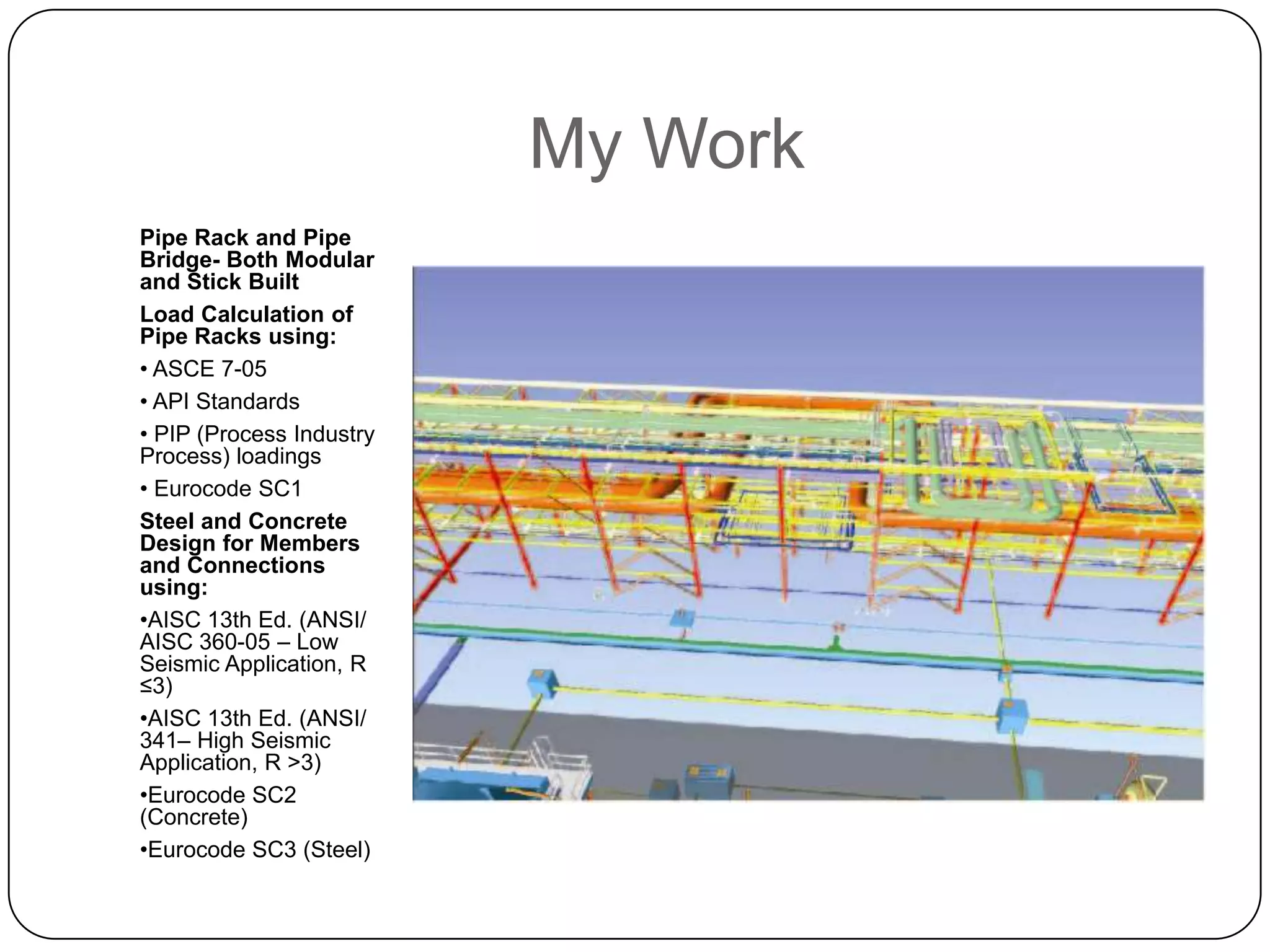
Pipe Rack and Pipe
Bridge- Both Modular
and Stick Built
Load Calculation of
Pipe Racks using:
• ASCE 7-05
• API Standards
• PIP (Process Industry
Process) loadings
• Eurocode SC1
Steel and Concrete
Design for Members
and Connections
using:
•AISC 13th Ed. (ANSI/
AISC 360-05 – Low
Seismic Application, R
≤3)
•AISC 13th Ed. (ANSI/
341– High Seismic
Application, R >3)
•Eurocode SC2
(Concrete)
•Eurocode SC3 (Steel)
My EPC Work
Equipment Structures -
Both Modular and Stick
Built
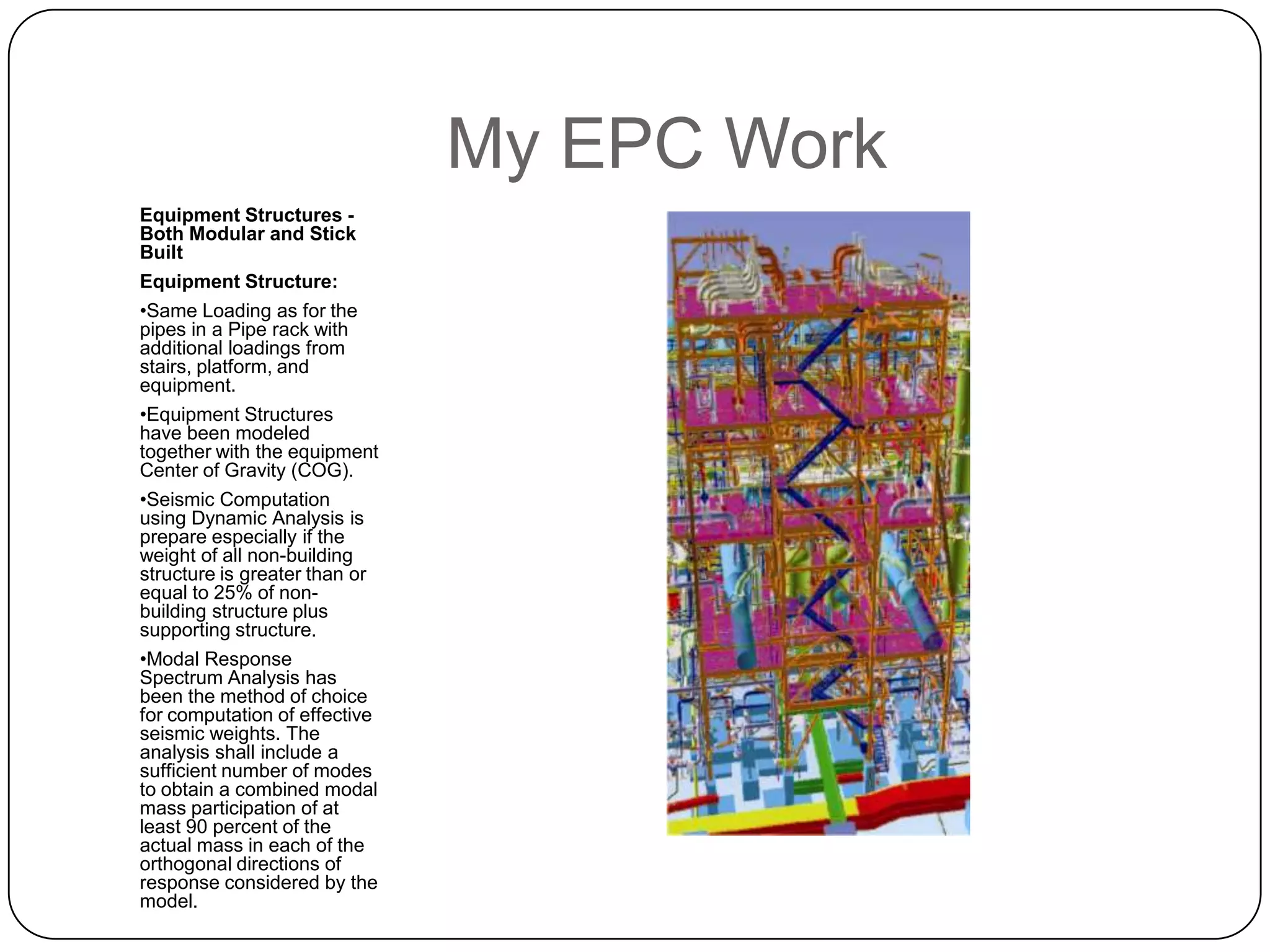
Equipment Structure:
•Same Loading as for the
pipes in a Pipe rack with
additional loadings from
stairs, platform, and
equipment.
•Equipment Structures
have been modeled
together with the equipment
Center of Gravity (COG).
•Seismic Computation
using Dynamic Analysis is
prepare especially if the
weight of all non-building
structure is greater than or
equal to 25% of non-
building structure plus
supporting structure.
•Modal Response
Spectrum Analysis has
been the method of choice
for computation of effective
seismic weights. The
analysis shall include a
sufficient number of modes
to obtain a combined modal
mass participation of at
least 90 percent of the
actual mass in each of the
orthogonal directions of
response considered by the
model.
My EPC Work
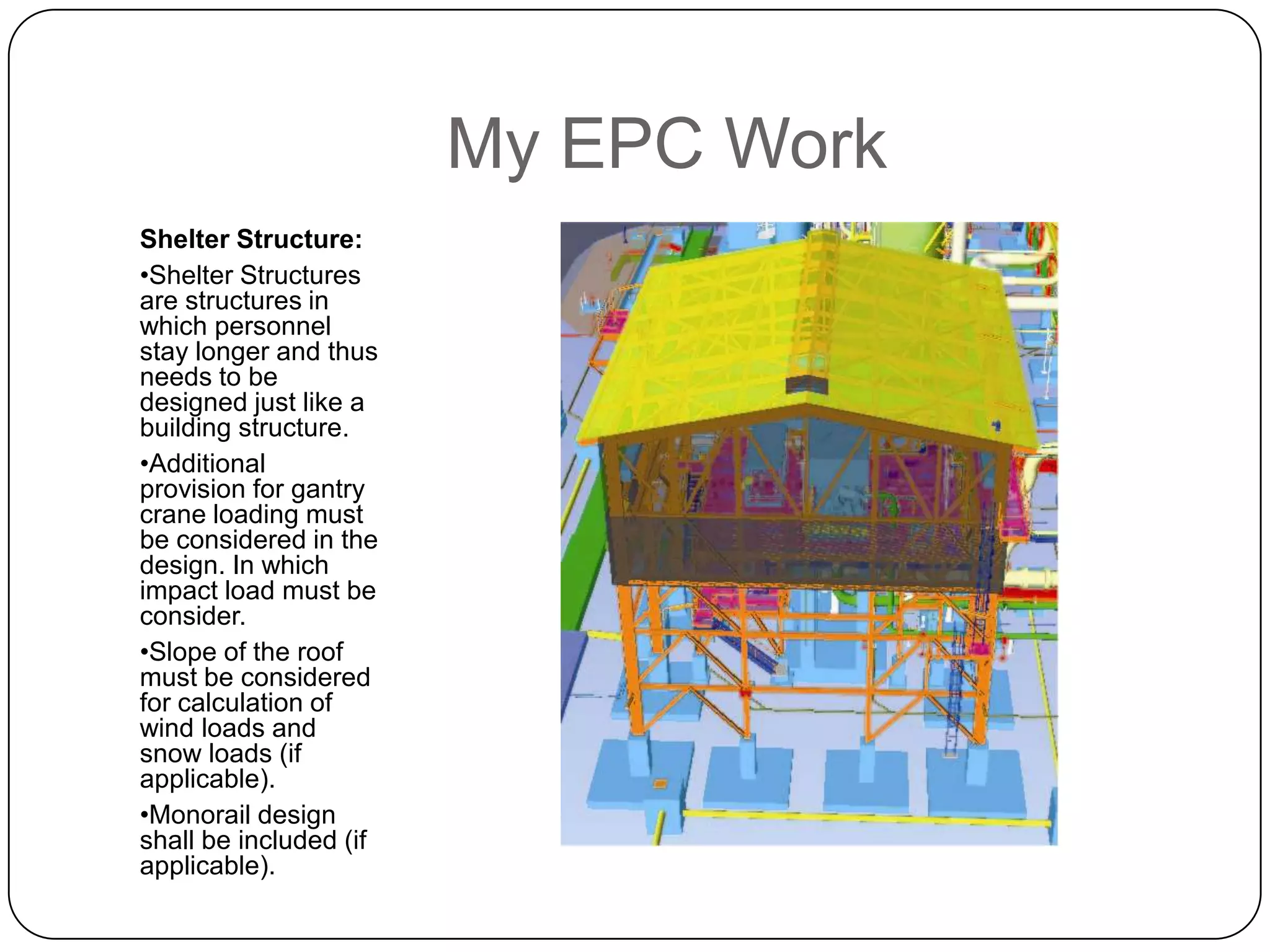
Shelter Structure:
•Shelter Structures
are structures in
which personnel
stay longer and thus
needs to be
designed just like a
building structure.
•Additional
provision for gantry
crane loading must
be considered in the
design. In which
impact load must be
consider.
•Slope of the roof
must be considered
for calculation of
wind loads and
snow loads (if
applicable).
•Monorail design
shall be included (if
applicable).
My EPC Work
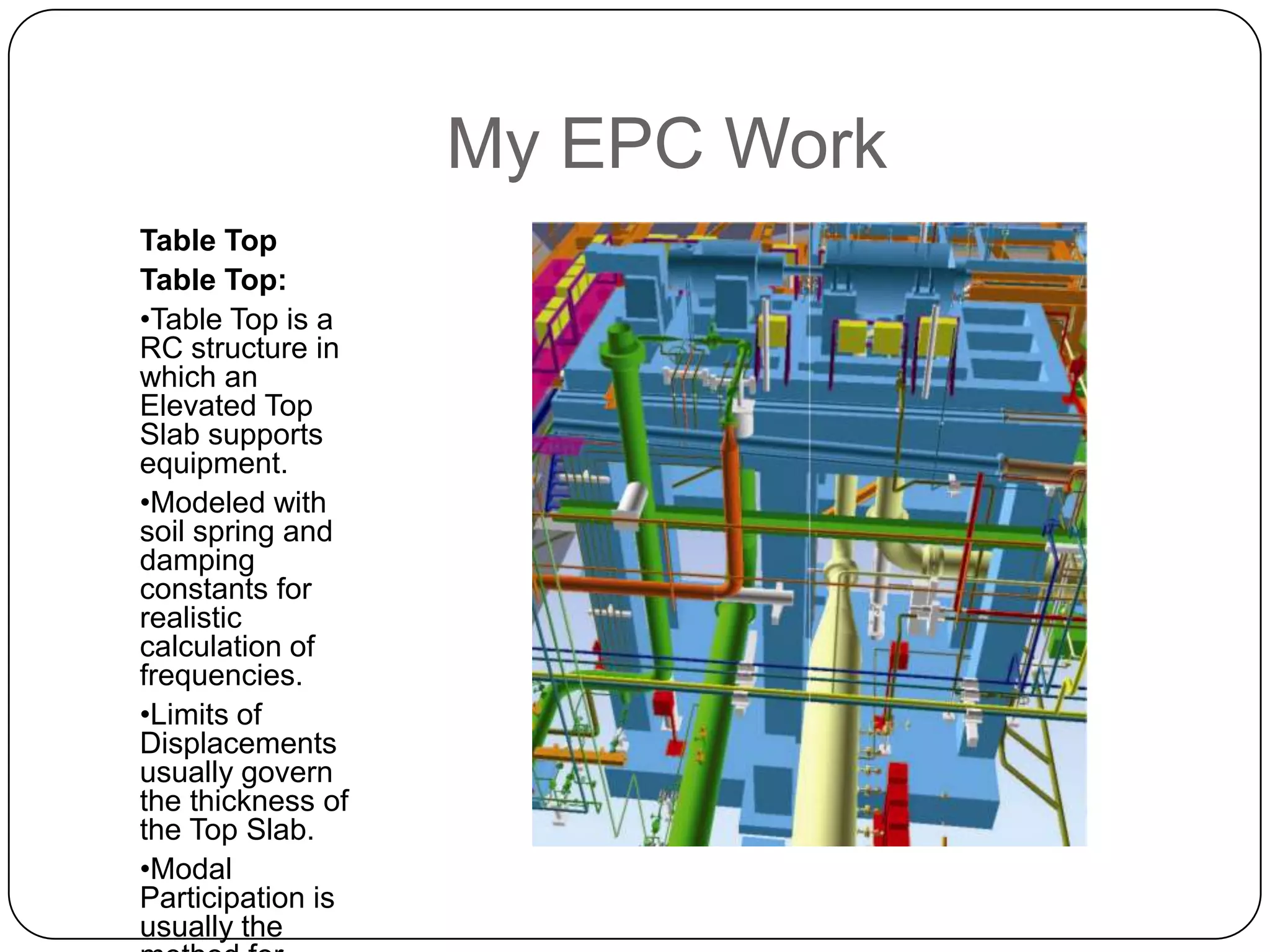
Table Top
Table Top:
•Table Top is a
RC structure in
which an
Elevated Top
Slab supports
equipment.
•Modeled with
soil spring and
damping
constants for
realistic
calculation of
frequencies.
•Limits of
Displacements
usually govern
the thickness of
the Top Slab.
•Modal
Participation is
usually the
My EPC Work
Modular
Structures
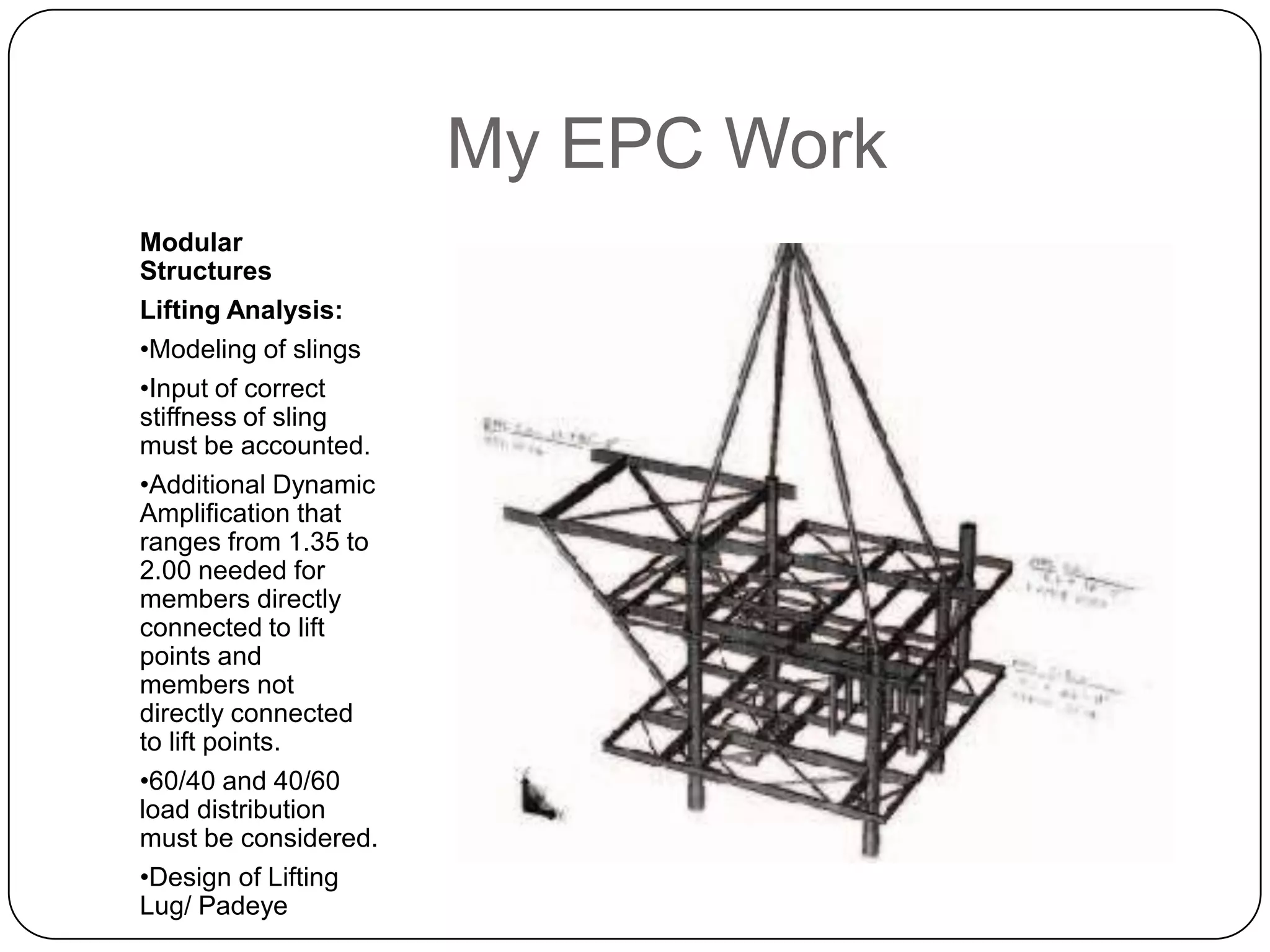
Lifting Analysis:
•Modeling of slings
•Input of correct
stiffness of sling
must be accounted.
•Additional Dynamic
Amplification that
ranges from 1.35 to
2.00 needed for
members directly
connected to lift
points and
members not
directly connected
to lift points.
•60/40 and 40/60
load distribution
must be considered.
•Design of Lifting
Lug/ Padeye
My EPC Work
Land
Transportation
Analysis:
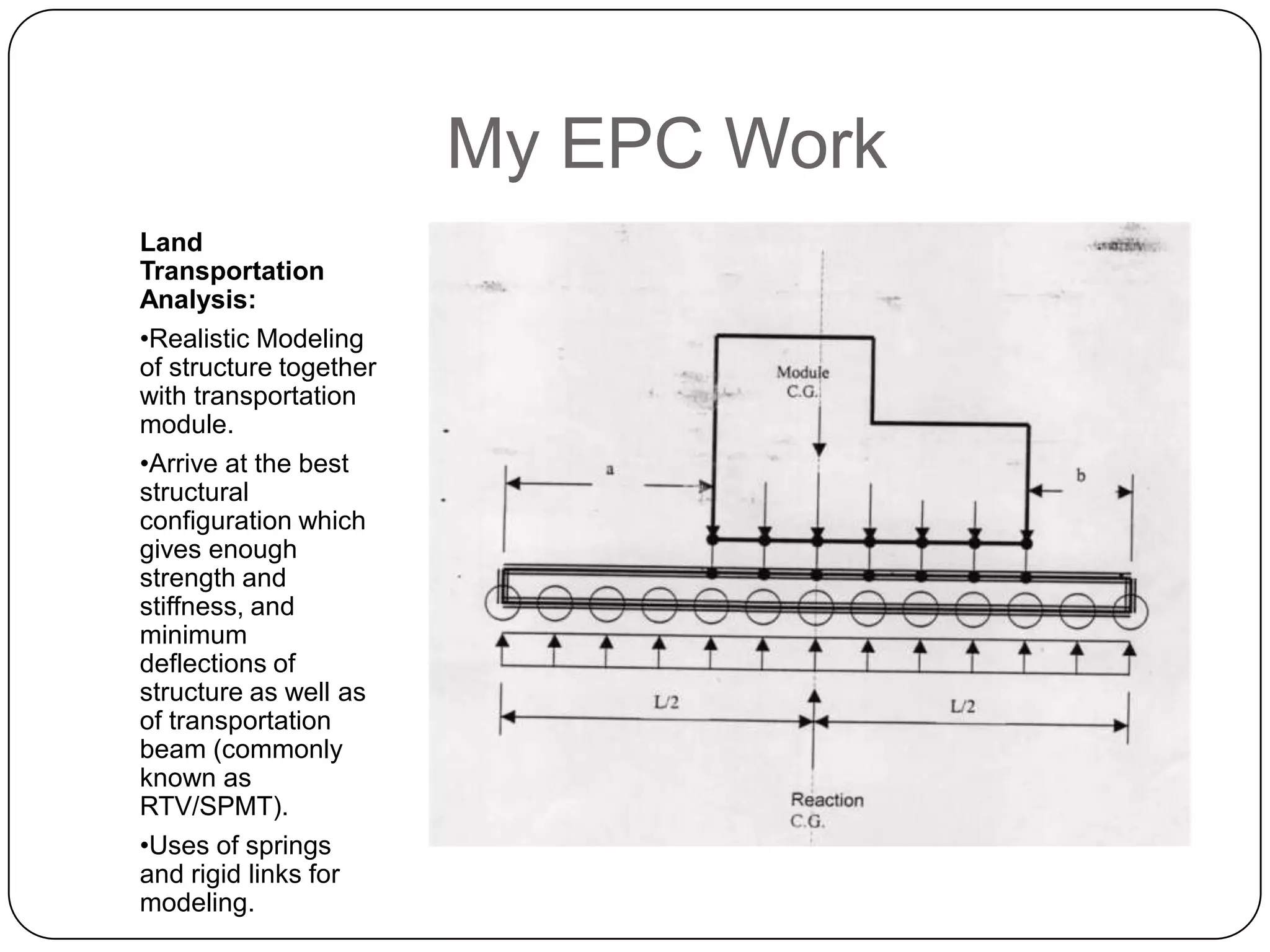
•Realistic Modeling
of structure together
with transportation
module.
•Arrive at the best
structural
configuration which
gives enough
strength and
stiffness, and
minimum
deflections of
structure as well as
of transportation
beam (commonly
known as
RTV/SPMT).
•Uses of springs
and rigid links for
modeling.
My EPC Work Experiences
Water
Transportation
Analysis:
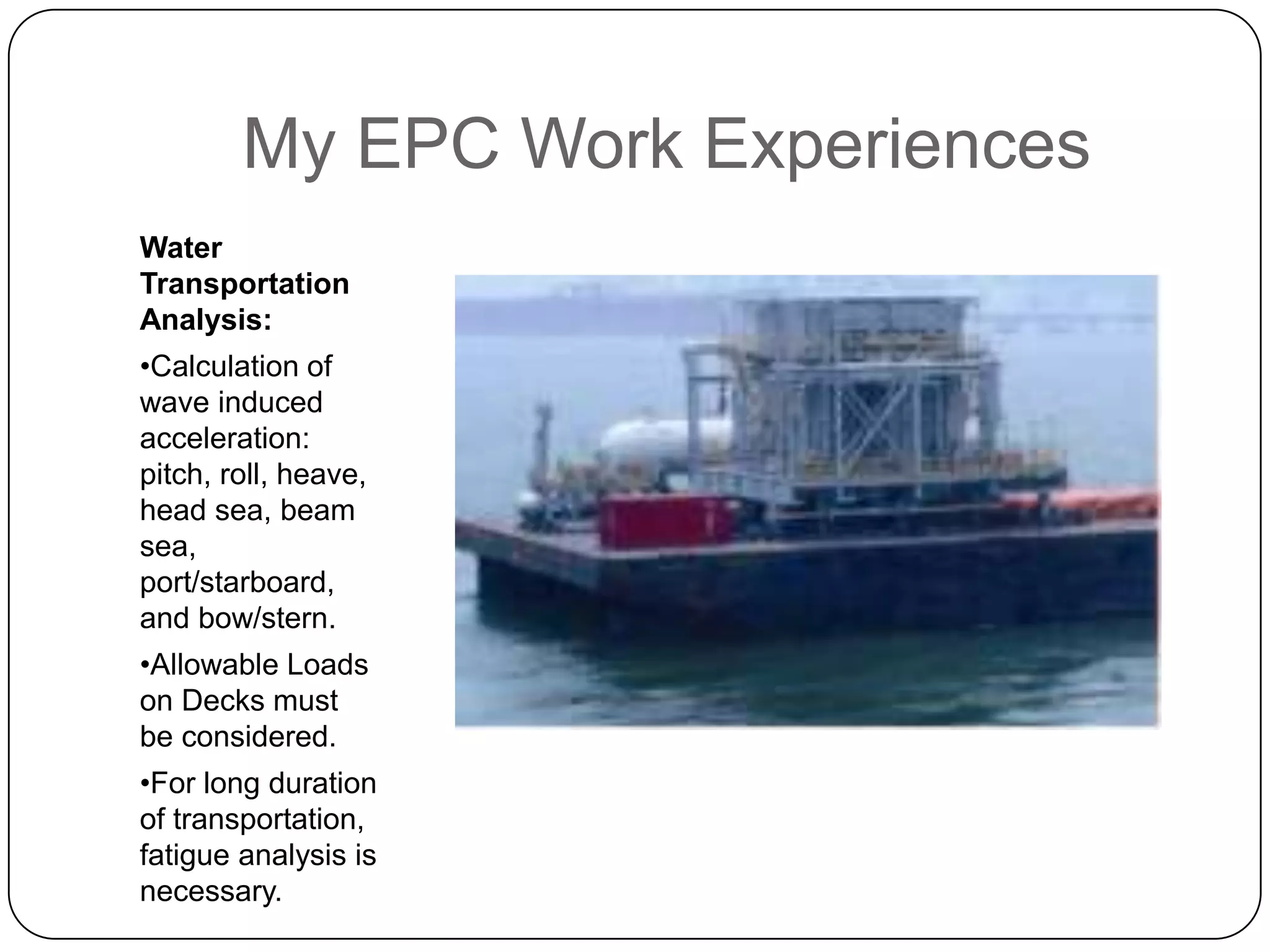
•Calculation of
wave induced
acceleration:
pitch, roll, heave,
head sea, beam
sea,
port/starboard,
and bow/stern.
•Allowable Loads
on Decks must
be considered.
•For long duration
of transportation,
fatigue analysis is
necessary.
My EPC Work Experiences
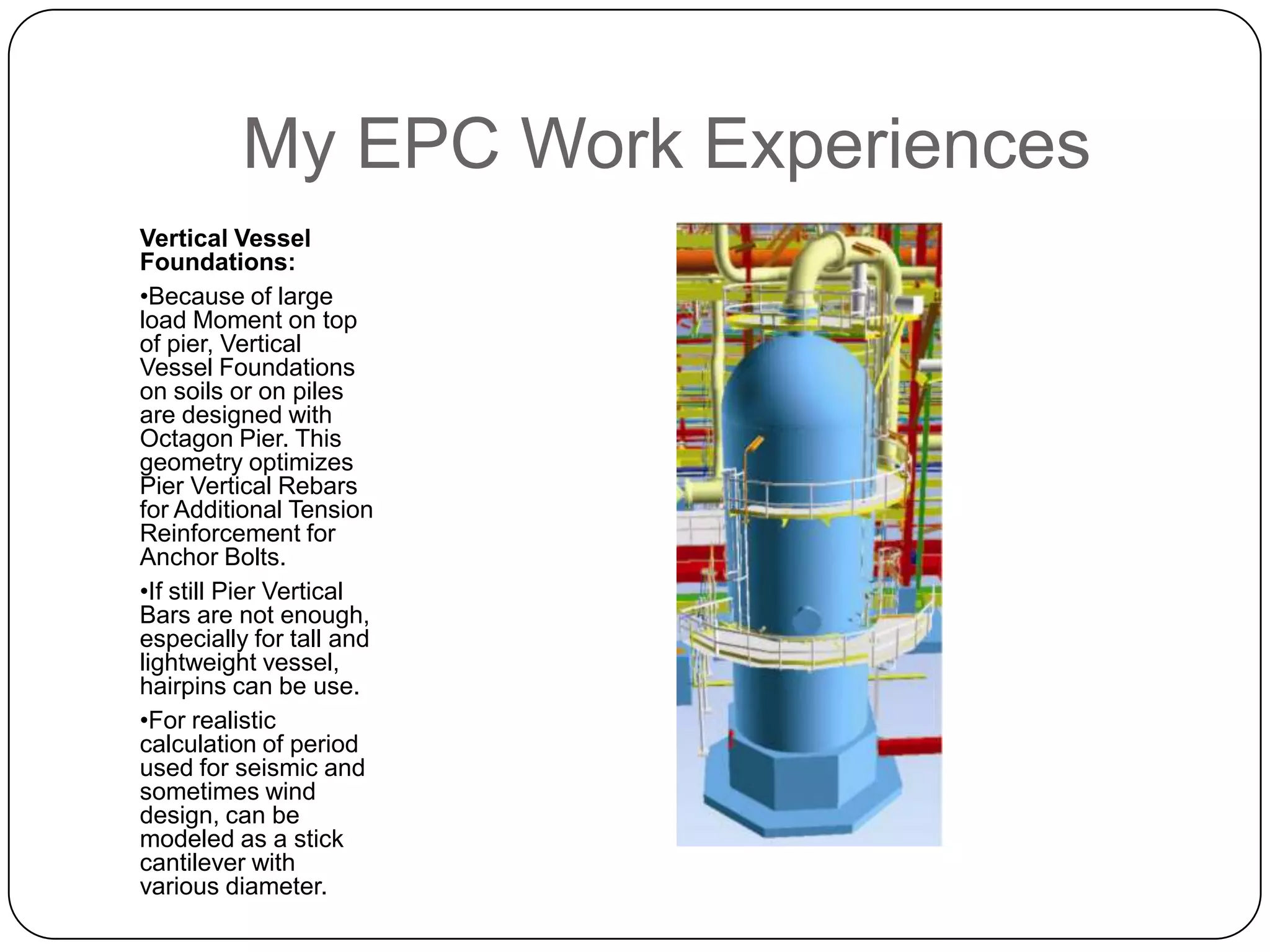
Vertical Vessel
Foundations:
•Because of large
load Moment on top
of pier, Vertical
Vessel Foundations
on soils or on piles
are designed with
Octagon Pier. This
geometry optimizes
Pier Vertical Rebars
for Additional Tension
Reinforcement for
Anchor Bolts.
•If still Pier Vertical
Bars are not enough,
especially for tall and
lightweight vessel,
hairpins can be use.
•For realistic
calculation of period
used for seismic and
sometimes wind
design, can be
modeled as a stick
cantilever with
various diameter.
My EPC Work
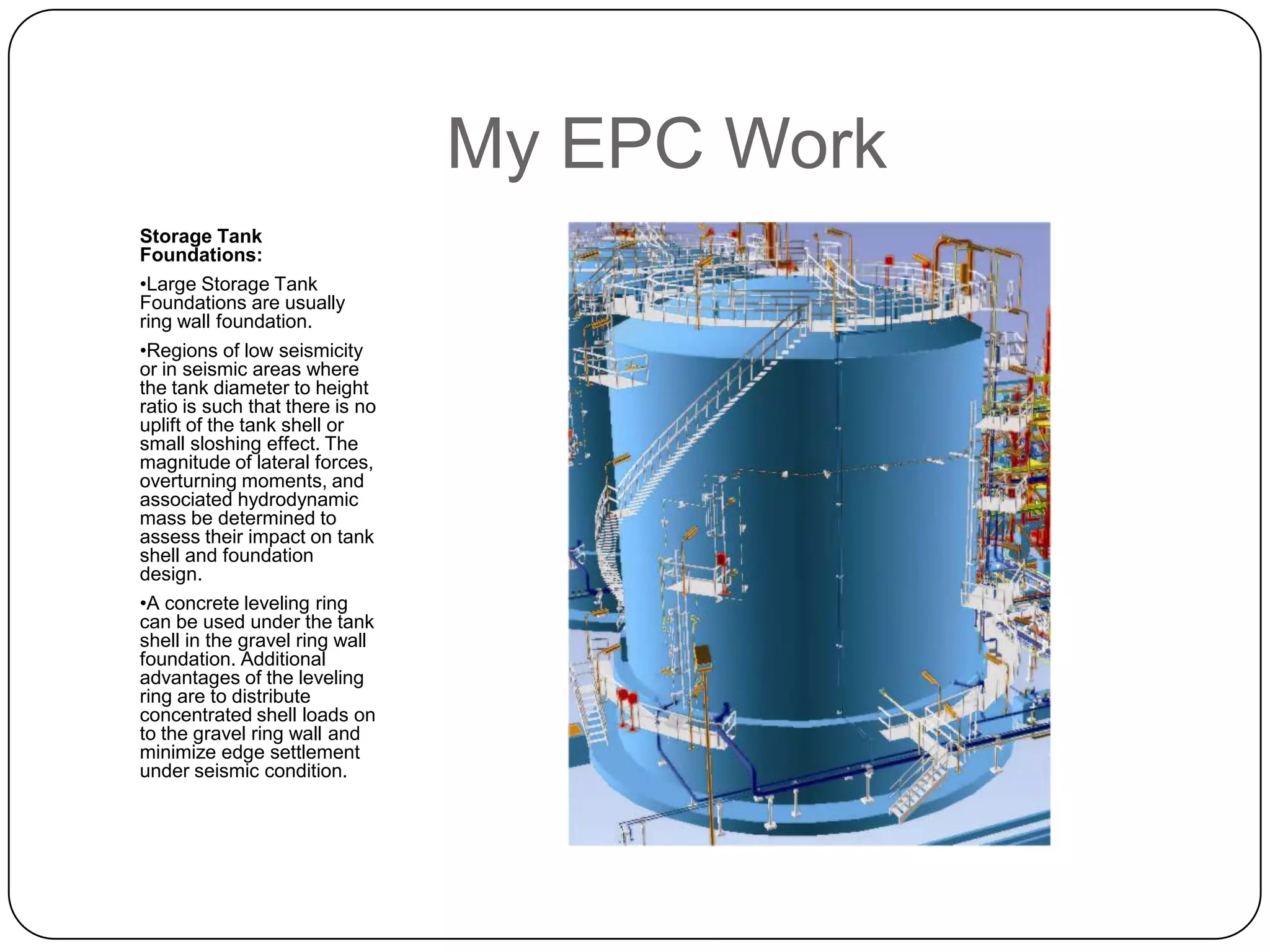
Storage Tank
Foundations:
•Large Storage Tank
Foundations are usually
ring wall foundation.
•Regions of low seismicity
or in seismic areas where
the tank diameter to height
ratio is such that there is no
uplift of the tank shell or
small sloshing effect. The
magnitude of lateral forces,
overturning moments, and
associated hydrodynamic
mass be determined to
assess their impact on tank
shell and foundation
design.
•A concrete leveling ring
can be used under the tank
shell in the gravel ring wall
foundation. Additional
advantages of the leveling
ring are to distribute
concentrated shell loads on
to the gravel ring wall and
minimize edge settlement
under seismic condition.
My EPC Work
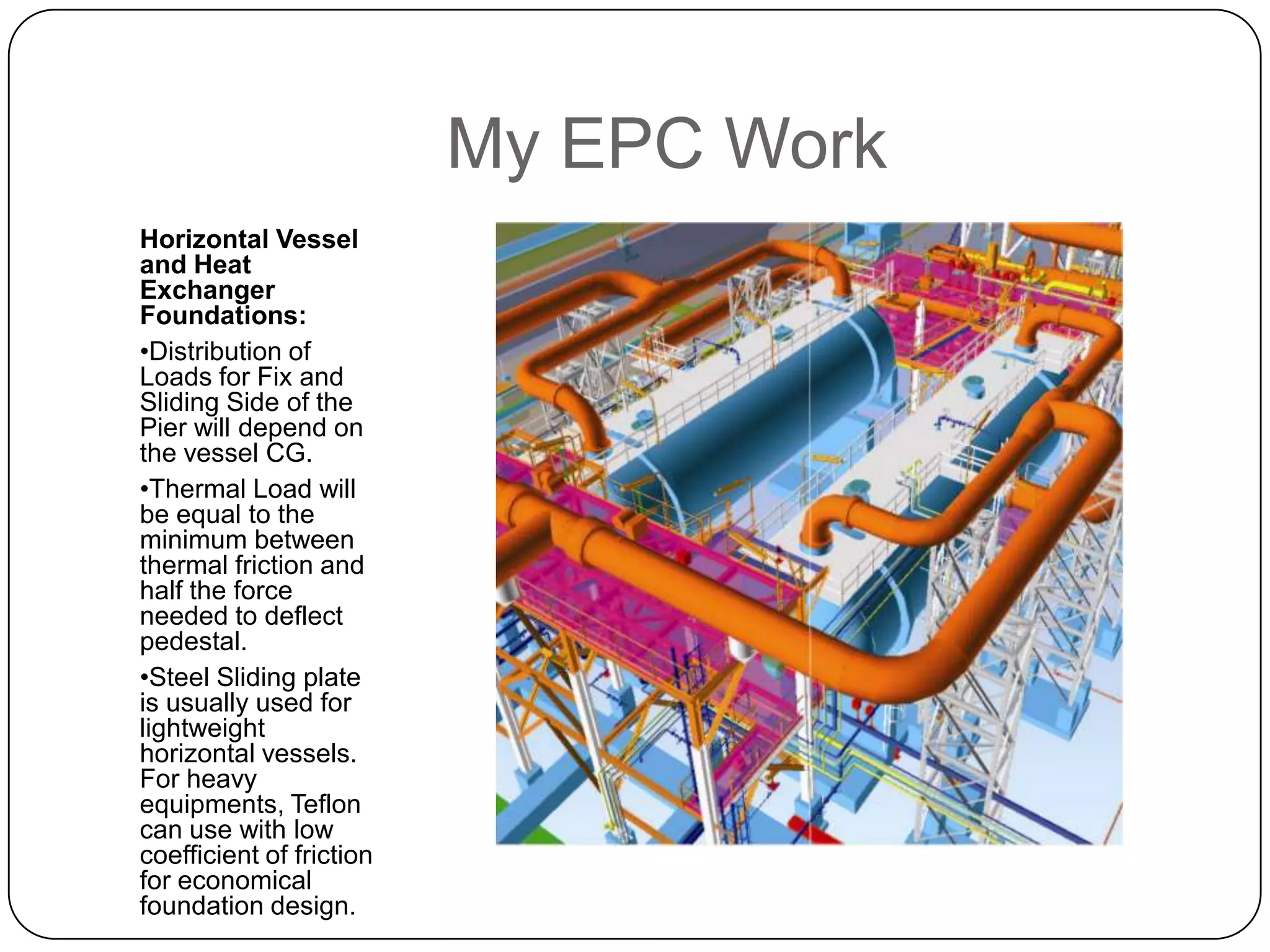
Horizontal Vessel
and Heat
Exchanger
Foundations:
•Distribution of
Loads for Fix and
Sliding Side of the
Pier will depend on
the vessel CG.
•Thermal Load will
be equal to the
minimum between
thermal friction and
half the force
needed to deflect
pedestal.
•Steel Sliding plate
is usually used for
lightweight
horizontal vessels.
For heavy
equipments, Teflon
can use with low
coefficient of friction
for economical
foundation design.
My EPC Work
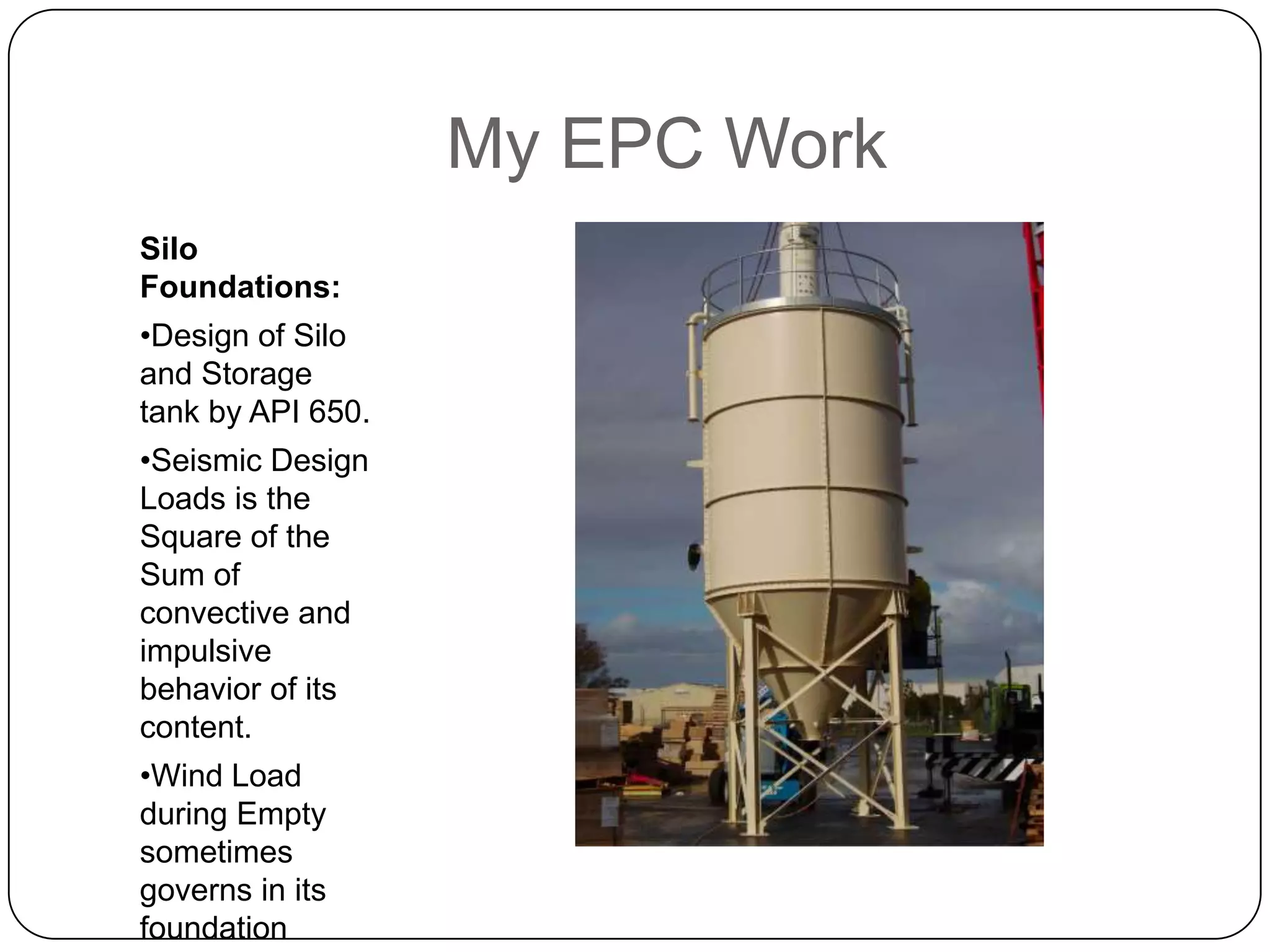
Silo
Foundations:
•Design of Silo
and Storage
tank by API 650.
•Seismic Design
Loads is the
Square of the
Sum of
convective and
impulsive
behavior of its
content.
•Wind Load
during Empty
sometimes
governs in its
foundation
My EPC Work
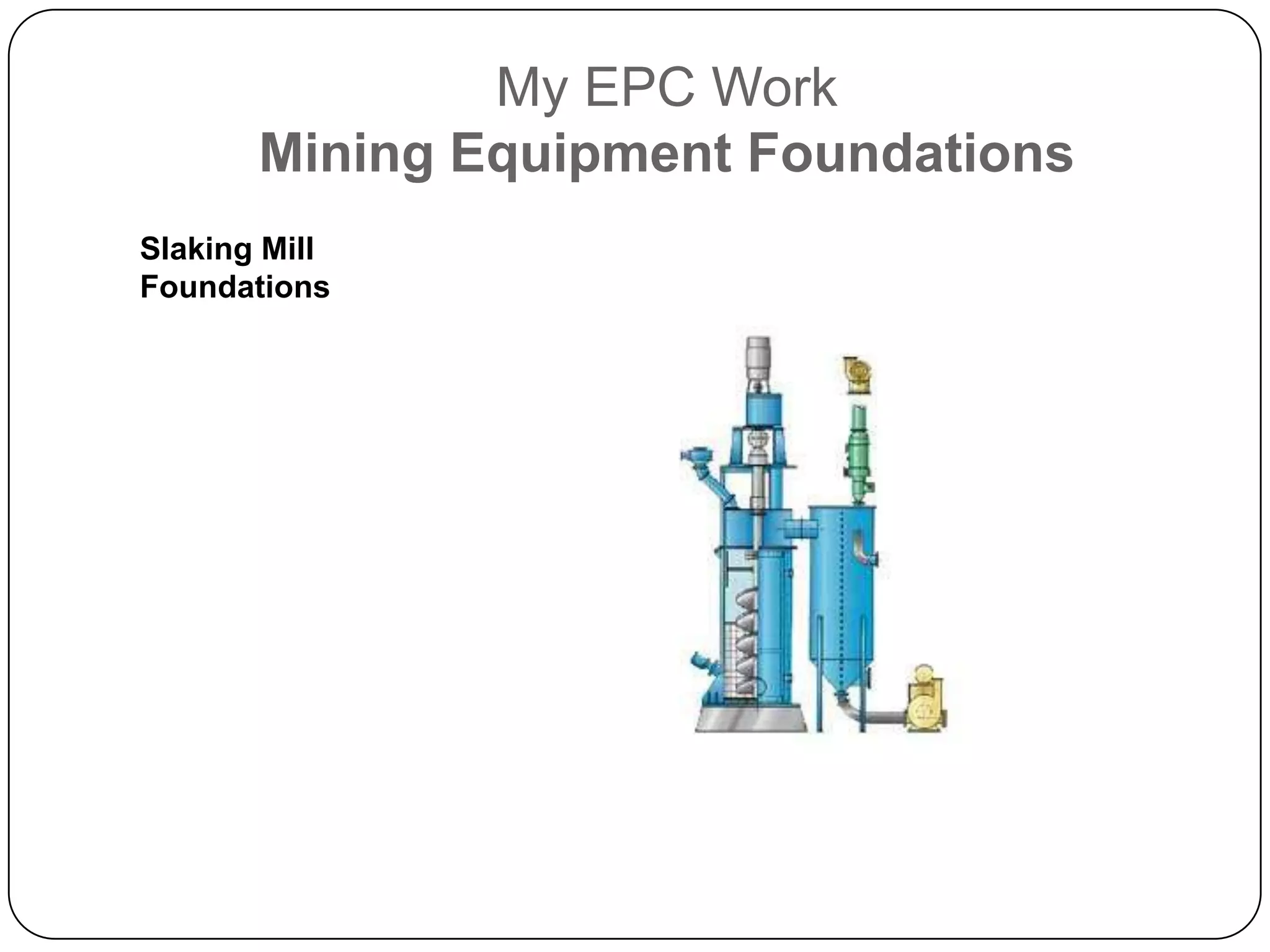
       Mining Equipment Foundations
Slaking Mill
Foundations
My EPC Work
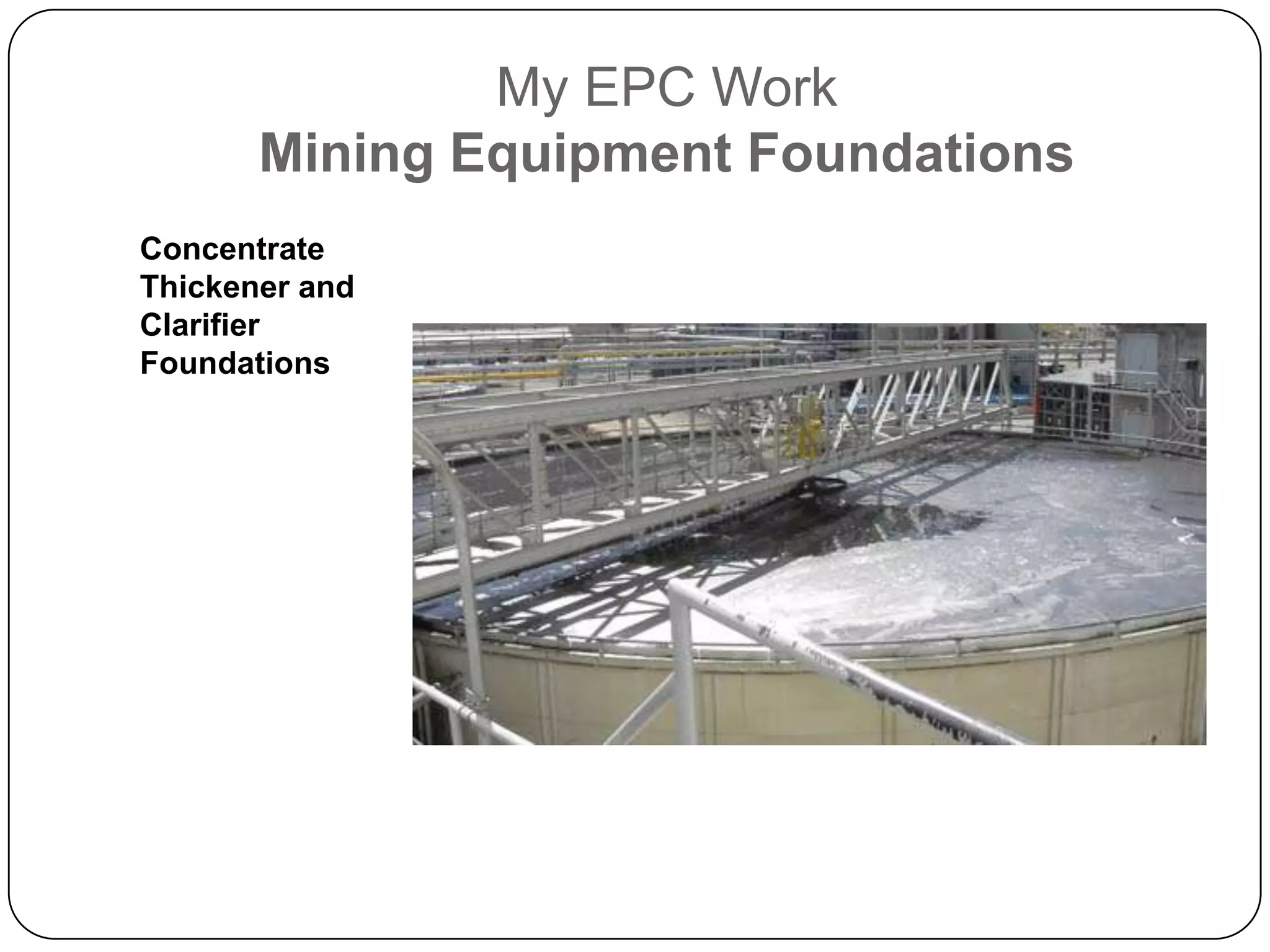
       Mining Equipment Foundations
Concentrate
Thickener and
Clarifier
Foundations
My EPC Work Experiences-
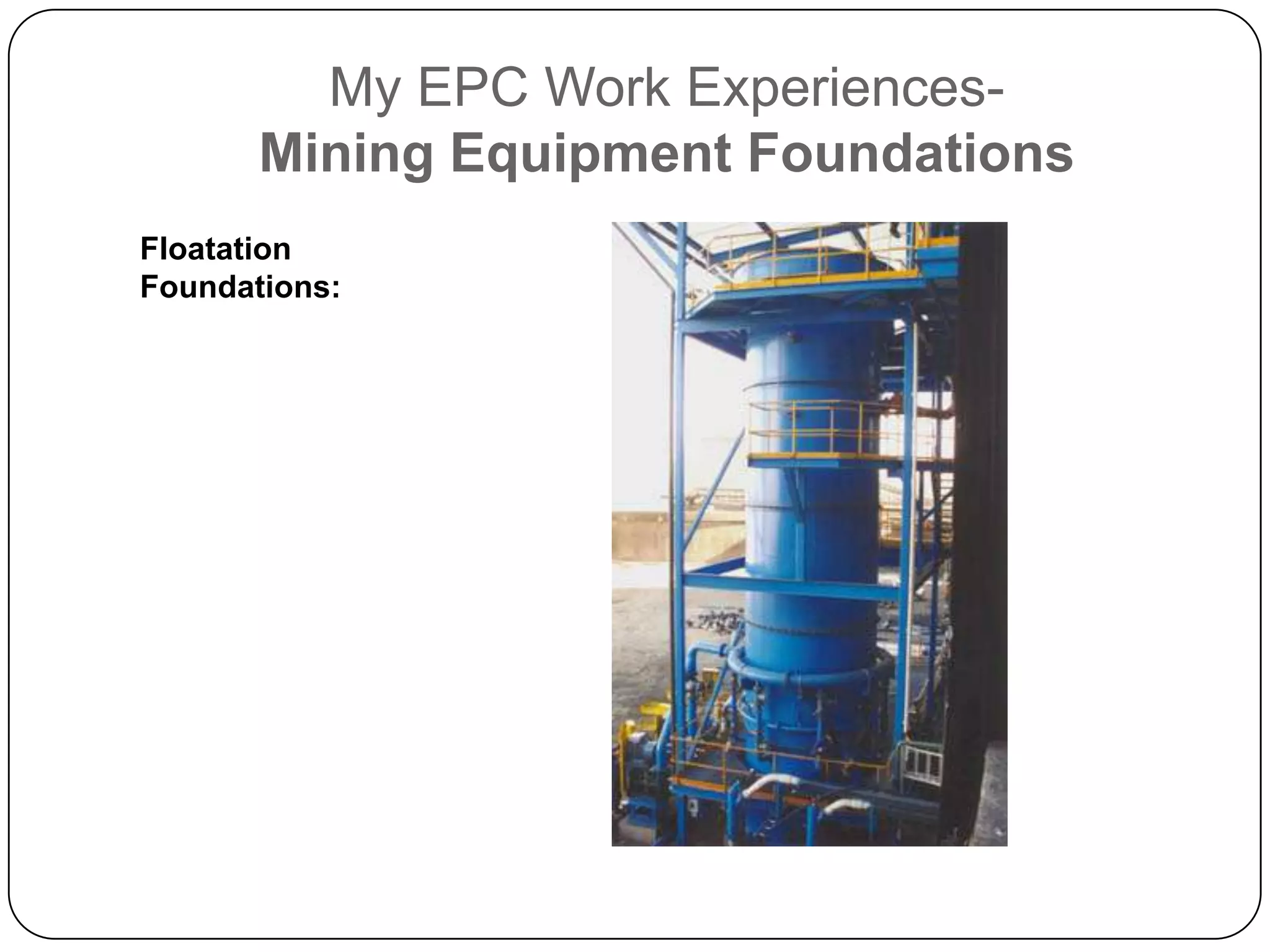
       Mining Equipment Foundations
Floatation
Foundations:
My EPC Work
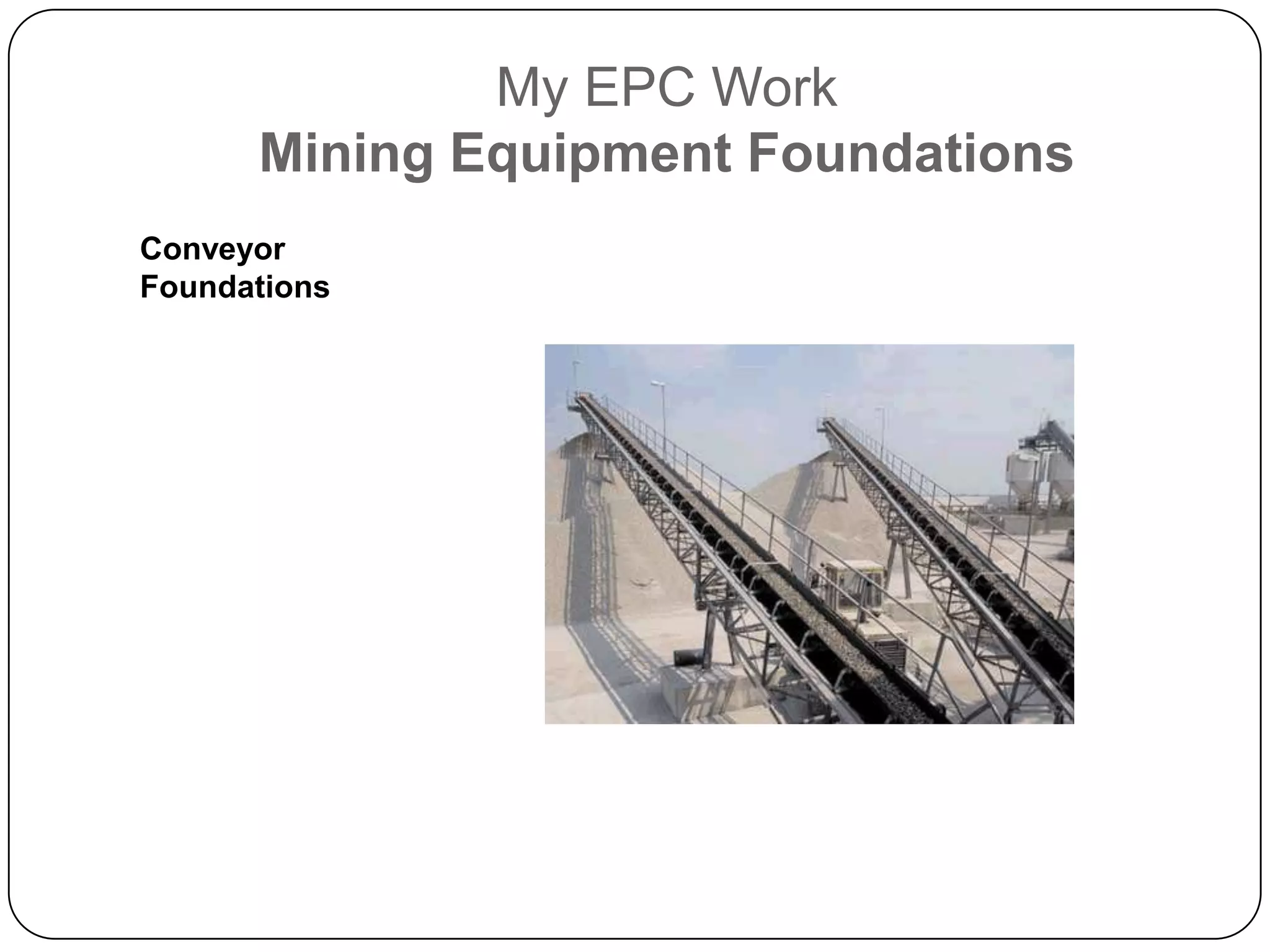
      Mining Equipment Foundations
Conveyor
Foundations
My EPC Work Experiences-
      Mining Equipment Foundations
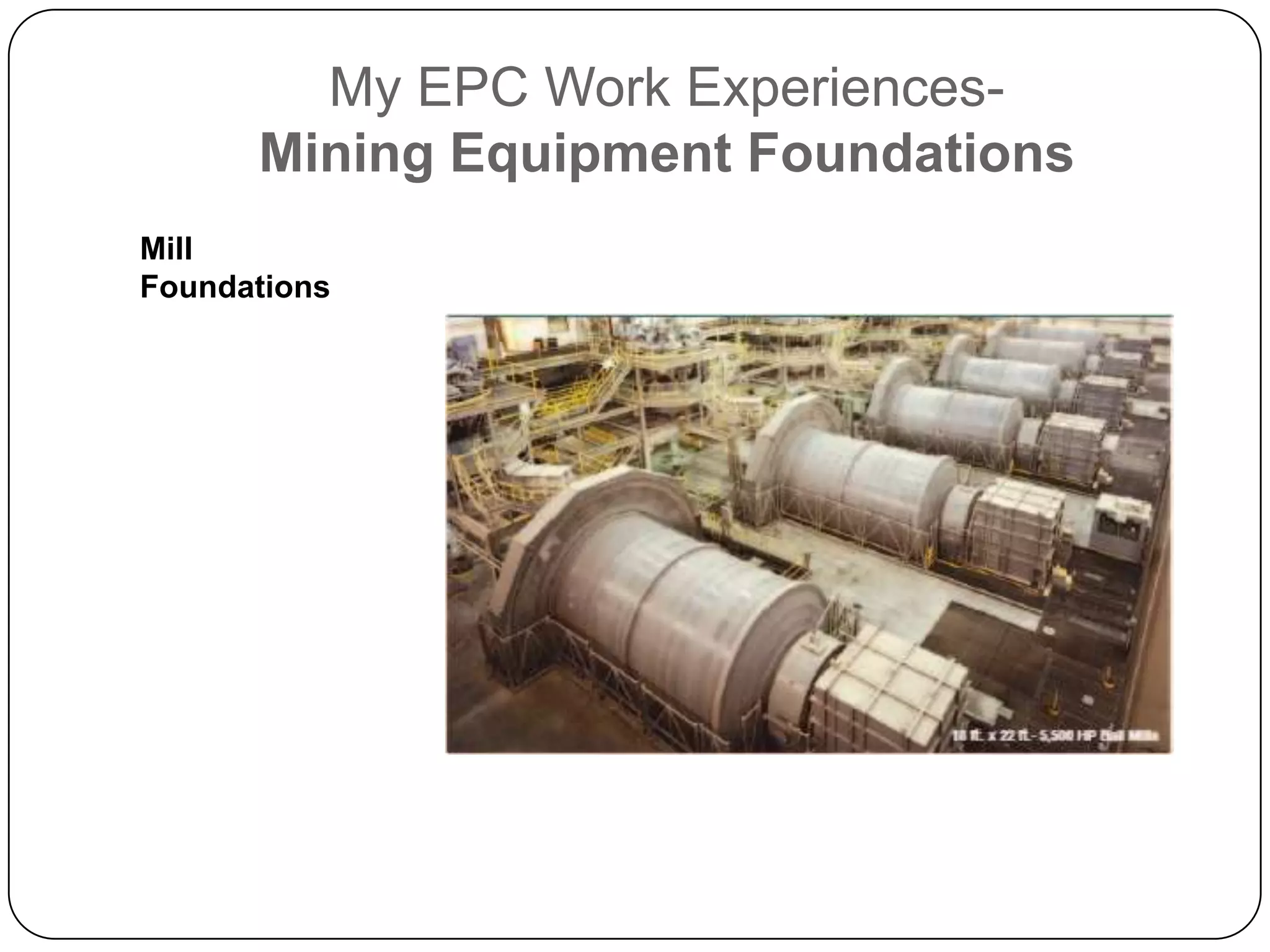
Mill
Foundations
My EPC Work Experiences
Contact me at:

Email:
jayryansantos@gmail.com

My Work

  • 1.
    My Work By: Jay Ryan R. Santos Disclaimer: All Media presented on this presentation are not owned by the user but serve as for “For Reference Only”
  • 2.
    My Work Pipe Rackand Pipe Bridge- Both Modular and Stick Built Load Calculation of Pipe Racks using: • ASCE 7-05 • API Standards • PIP (Process Industry Process) loadings • Eurocode SC1 Steel and Concrete Design for Members and Connections using: •AISC 13th Ed. (ANSI/ AISC 360-05 – Low Seismic Application, R ≤3) •AISC 13th Ed. (ANSI/ 341– High Seismic Application, R >3) •Eurocode SC2 (Concrete) •Eurocode SC3 (Steel)
  • 3.
    My EPC Work EquipmentStructures - Both Modular and Stick Built Equipment Structure: •Same Loading as for the pipes in a Pipe rack with additional loadings from stairs, platform, and equipment. •Equipment Structures have been modeled together with the equipment Center of Gravity (COG). •Seismic Computation using Dynamic Analysis is prepare especially if the weight of all non-building structure is greater than or equal to 25% of non- building structure plus supporting structure. •Modal Response Spectrum Analysis has been the method of choice for computation of effective seismic weights. The analysis shall include a sufficient number of modes to obtain a combined modal mass participation of at least 90 percent of the actual mass in each of the orthogonal directions of response considered by the model.
  • 4.
    My EPC Work ShelterStructure: •Shelter Structures are structures in which personnel stay longer and thus needs to be designed just like a building structure. •Additional provision for gantry crane loading must be considered in the design. In which impact load must be consider. •Slope of the roof must be considered for calculation of wind loads and snow loads (if applicable). •Monorail design shall be included (if applicable).
  • 5.
    My EPC Work TableTop Table Top: •Table Top is a RC structure in which an Elevated Top Slab supports equipment. •Modeled with soil spring and damping constants for realistic calculation of frequencies. •Limits of Displacements usually govern the thickness of the Top Slab. •Modal Participation is usually the
  • 6.
    My EPC Work Modular Structures LiftingAnalysis: •Modeling of slings •Input of correct stiffness of sling must be accounted. •Additional Dynamic Amplification that ranges from 1.35 to 2.00 needed for members directly connected to lift points and members not directly connected to lift points. •60/40 and 40/60 load distribution must be considered. •Design of Lifting Lug/ Padeye
  • 7.
    My EPC Work Land Transportation Analysis: •RealisticModeling of structure together with transportation module. •Arrive at the best structural configuration which gives enough strength and stiffness, and minimum deflections of structure as well as of transportation beam (commonly known as RTV/SPMT). •Uses of springs and rigid links for modeling.
  • 8.
    My EPC WorkExperiences Water Transportation Analysis: •Calculation of wave induced acceleration: pitch, roll, heave, head sea, beam sea, port/starboard, and bow/stern. •Allowable Loads on Decks must be considered. •For long duration of transportation, fatigue analysis is necessary.
  • 9.
    My EPC WorkExperiences Vertical Vessel Foundations: •Because of large load Moment on top of pier, Vertical Vessel Foundations on soils or on piles are designed with Octagon Pier. This geometry optimizes Pier Vertical Rebars for Additional Tension Reinforcement for Anchor Bolts. •If still Pier Vertical Bars are not enough, especially for tall and lightweight vessel, hairpins can be use. •For realistic calculation of period used for seismic and sometimes wind design, can be modeled as a stick cantilever with various diameter.
  • 10.
    My EPC Work StorageTank Foundations: •Large Storage Tank Foundations are usually ring wall foundation. •Regions of low seismicity or in seismic areas where the tank diameter to height ratio is such that there is no uplift of the tank shell or small sloshing effect. The magnitude of lateral forces, overturning moments, and associated hydrodynamic mass be determined to assess their impact on tank shell and foundation design. •A concrete leveling ring can be used under the tank shell in the gravel ring wall foundation. Additional advantages of the leveling ring are to distribute concentrated shell loads on to the gravel ring wall and minimize edge settlement under seismic condition.
  • 11.
    My EPC Work HorizontalVessel and Heat Exchanger Foundations: •Distribution of Loads for Fix and Sliding Side of the Pier will depend on the vessel CG. •Thermal Load will be equal to the minimum between thermal friction and half the force needed to deflect pedestal. •Steel Sliding plate is usually used for lightweight horizontal vessels. For heavy equipments, Teflon can use with low coefficient of friction for economical foundation design.
  • 12.
    My EPC Work Silo Foundations: •Designof Silo and Storage tank by API 650. •Seismic Design Loads is the Square of the Sum of convective and impulsive behavior of its content. •Wind Load during Empty sometimes governs in its foundation
  • 13.
    My EPC Work Mining Equipment Foundations Slaking Mill Foundations
  • 14.
    My EPC Work Mining Equipment Foundations Concentrate Thickener and Clarifier Foundations
  • 15.
    My EPC WorkExperiences- Mining Equipment Foundations Floatation Foundations:
  • 16.
    My EPC Work Mining Equipment Foundations Conveyor Foundations
  • 17.
    My EPC WorkExperiences- Mining Equipment Foundations Mill Foundations
  • 18.
    My EPC WorkExperiences Contact me at: Email: jayryansantos@gmail.com