My Teacher,  the Computer Screen The Use of computers and software in education
Mathematics Technology’s Edge: The Educational Benefits of Computer-Aided Instruction  Lisa Barrow, Lisa Markman and Cecelia Elena Rouse. (2008) Princeton University. Geography Project GeoSim: A GIS-based Simulation Laboratory for Introductory Geography Clifford A Shaffer (1995) Virginia Polytechnic Institute. Language Arts/English E-Comp: A Few Words About Teaching Writing With Computers (1997) THE Journal.
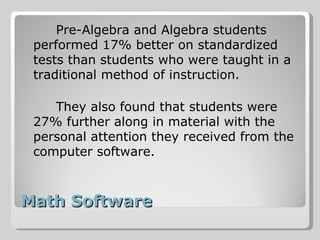
Math Software Pre-Algebra and Algebra students performed 17% better on standardized tests than students who were taught in a traditional method of instruction. They also found that students were 27% further along in material with the personal attention they received from the computer software.
Students using computer aided instruction (CAI) in larger classes did better than CAI being used in smaller classes because in the larger classes they were not held back by the lecture time available. Smaller classes that used traditional instruction still did very well because of the personal attention that the teacher could give out to each struggling student.
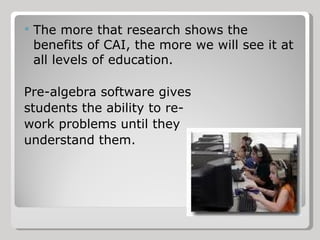
The more that research shows the benefits of CAI, the more we will see it at all levels of education. Pre-algebra software gives students the ability to re- work problems until they understand them.
Geography Software Allowing students to see computer models of geographic sequences can help them better understand the laws that govern our universe. Virginia Polytechnic Institute researchers would like to see Geographical Information Systems being used to develop interactive software that would guide students through natural processes.
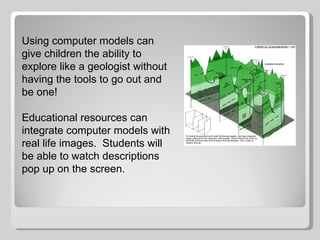
Using computer models can give children the ability to explore like a geologist without having the tools to go out and be one! Educational resources can integrate computer models with real life images.  Students will be able to watch descriptions pop up on the screen.
Software Models can help bring harmony between the lecture and the actual. Teachers can start by looking at: http://geosim.cs.vt.edu/ This website offers links to different geography simulation programs.
Language Arts/English When a student is writing or practicing writing, it is far less intimidating to ask questions when they don’t have to raise their hand.
Further on in secondary education, the software will be used to encourage peer review and audience analysis to help students develop influence and argument. Students often feel that the question they have is dumb, so they could actually type a question in and the teacher can read the answer aloud, or come and help.  This can help boost a student’s confidence to ask questions in the future.
Conclusions Elementary schools have been using computers for years.  Both geographical studies and pre-algebra studies seek for better qualified instructors, but admit that it is hard to get because of the competition for higher paying jobs in non-education markets. For English teachers, it is good to note that amount of reading peaks at fourth grade and then declines even through High School.
I started typing when I was in third grade, and by the time I was in keyboarding class in elementary school I was way ahead of the other students. Being taught by interactive programs has large advantages but should be balanced with well trained teachers who truly care about the well being of their students.

My Teacher, The Computer Screen

  • 1.
    My Teacher, the Computer Screen The Use of computers and software in education
  • 2.
    Mathematics Technology’s Edge:The Educational Benefits of Computer-Aided Instruction Lisa Barrow, Lisa Markman and Cecelia Elena Rouse. (2008) Princeton University. Geography Project GeoSim: A GIS-based Simulation Laboratory for Introductory Geography Clifford A Shaffer (1995) Virginia Polytechnic Institute. Language Arts/English E-Comp: A Few Words About Teaching Writing With Computers (1997) THE Journal.
  • 3.
    Math Software Pre-Algebraand Algebra students performed 17% better on standardized tests than students who were taught in a traditional method of instruction. They also found that students were 27% further along in material with the personal attention they received from the computer software.
  • 4.
    Students using computeraided instruction (CAI) in larger classes did better than CAI being used in smaller classes because in the larger classes they were not held back by the lecture time available. Smaller classes that used traditional instruction still did very well because of the personal attention that the teacher could give out to each struggling student.
  • 5.
    The more thatresearch shows the benefits of CAI, the more we will see it at all levels of education. Pre-algebra software gives students the ability to re- work problems until they understand them.
  • 6.
    Geography Software Allowingstudents to see computer models of geographic sequences can help them better understand the laws that govern our universe. Virginia Polytechnic Institute researchers would like to see Geographical Information Systems being used to develop interactive software that would guide students through natural processes.
  • 7.
    Using computer modelscan give children the ability to explore like a geologist without having the tools to go out and be one! Educational resources can integrate computer models with real life images. Students will be able to watch descriptions pop up on the screen.
  • 8.
    Software Models canhelp bring harmony between the lecture and the actual. Teachers can start by looking at: http://geosim.cs.vt.edu/ This website offers links to different geography simulation programs.
  • 9.
    Language Arts/English Whena student is writing or practicing writing, it is far less intimidating to ask questions when they don’t have to raise their hand.
  • 10.
    Further on insecondary education, the software will be used to encourage peer review and audience analysis to help students develop influence and argument. Students often feel that the question they have is dumb, so they could actually type a question in and the teacher can read the answer aloud, or come and help. This can help boost a student’s confidence to ask questions in the future.
  • 11.
    Conclusions Elementary schoolshave been using computers for years. Both geographical studies and pre-algebra studies seek for better qualified instructors, but admit that it is hard to get because of the competition for higher paying jobs in non-education markets. For English teachers, it is good to note that amount of reading peaks at fourth grade and then declines even through High School.
  • 12.
    I started typingwhen I was in third grade, and by the time I was in keyboarding class in elementary school I was way ahead of the other students. Being taught by interactive programs has large advantages but should be balanced with well trained teachers who truly care about the well being of their students.

Editor's Notes

  • #2 10-12 slides (1 title slide, 1 menu slide, 2-3 slides per article, 1 conclusion slide) (12 pts.) Per article: 1-2 summary slides, 1 personal reflection slide (4 pts.) Graphics, charts, or other visual aids (5 pts.) Appropriate font, font size, and font color (4 pts.) Navigation links/buttons (action buttons and/or hyperlinks) (4 pts.)  Citations in APA for each article (4 pts.) Custom animations and animation schemes, where appropriate (4 pts.)  Creative and original design with visual appeal and balance  (4 pts.) User-friendly and organized, professional-looking formatting and alignment (4 pts.)  Slide transitions between all slides (5 pts.)