






February 9, 2017
Aliza Carpio, Jessica Cho, Laura Nunnery,
Madelaine Daianu
Prototyping
with mystartupXX
Intuit Confidential and Proprietary 2
What and why of prototyping
Who are you solving for? Primary and Secondary
Which type (various types) do you use (and examples)?
• Software, Data and Hardware
(20 min) Let's work in small teams
Developing a learning plan to get customer feedback
Wrap up (Review)
The Plan
Prototype
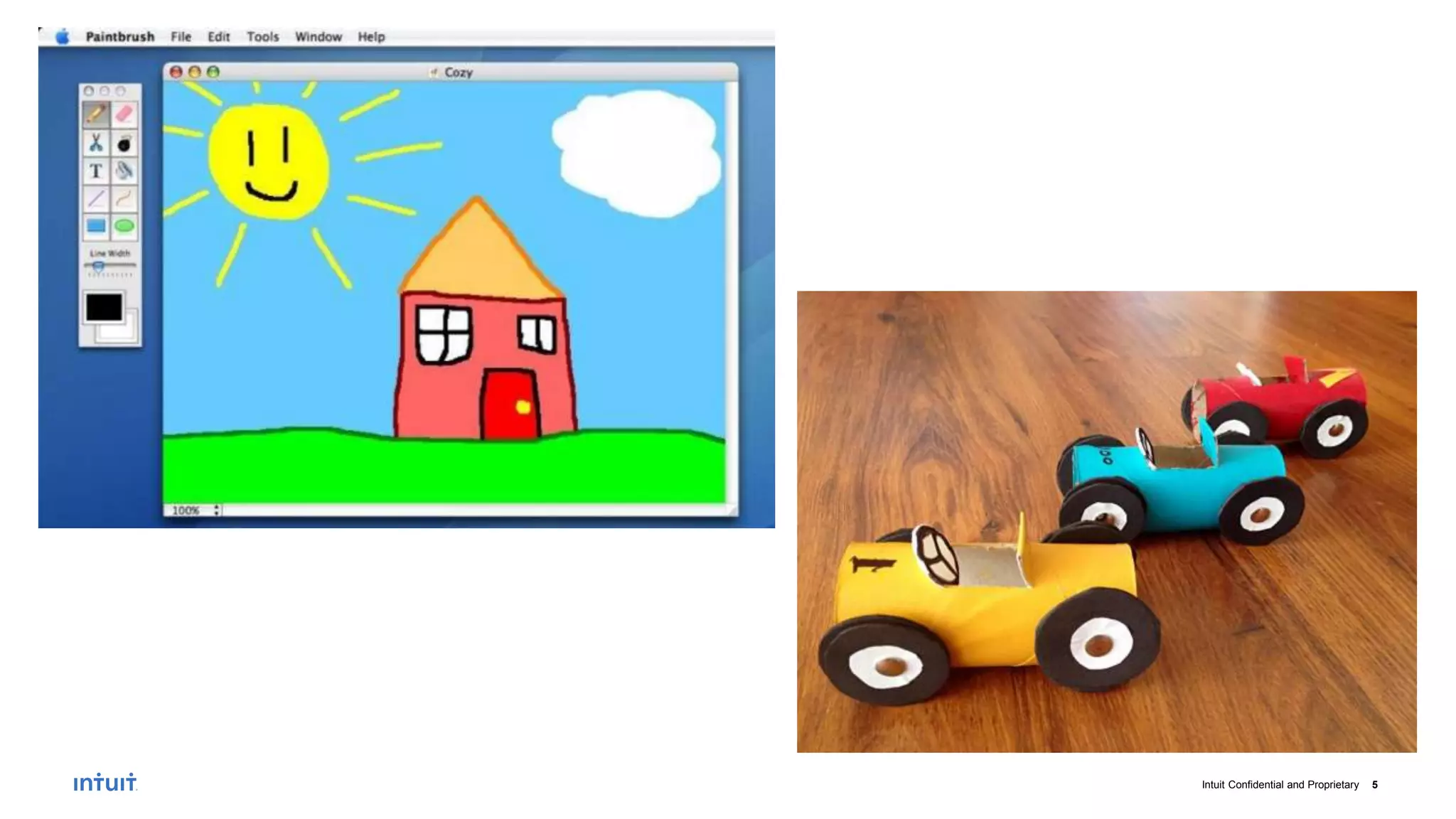
A prototype is a way to
visually express, test, and
iterate on your idea
Intuit Confidential and Proprietary 5
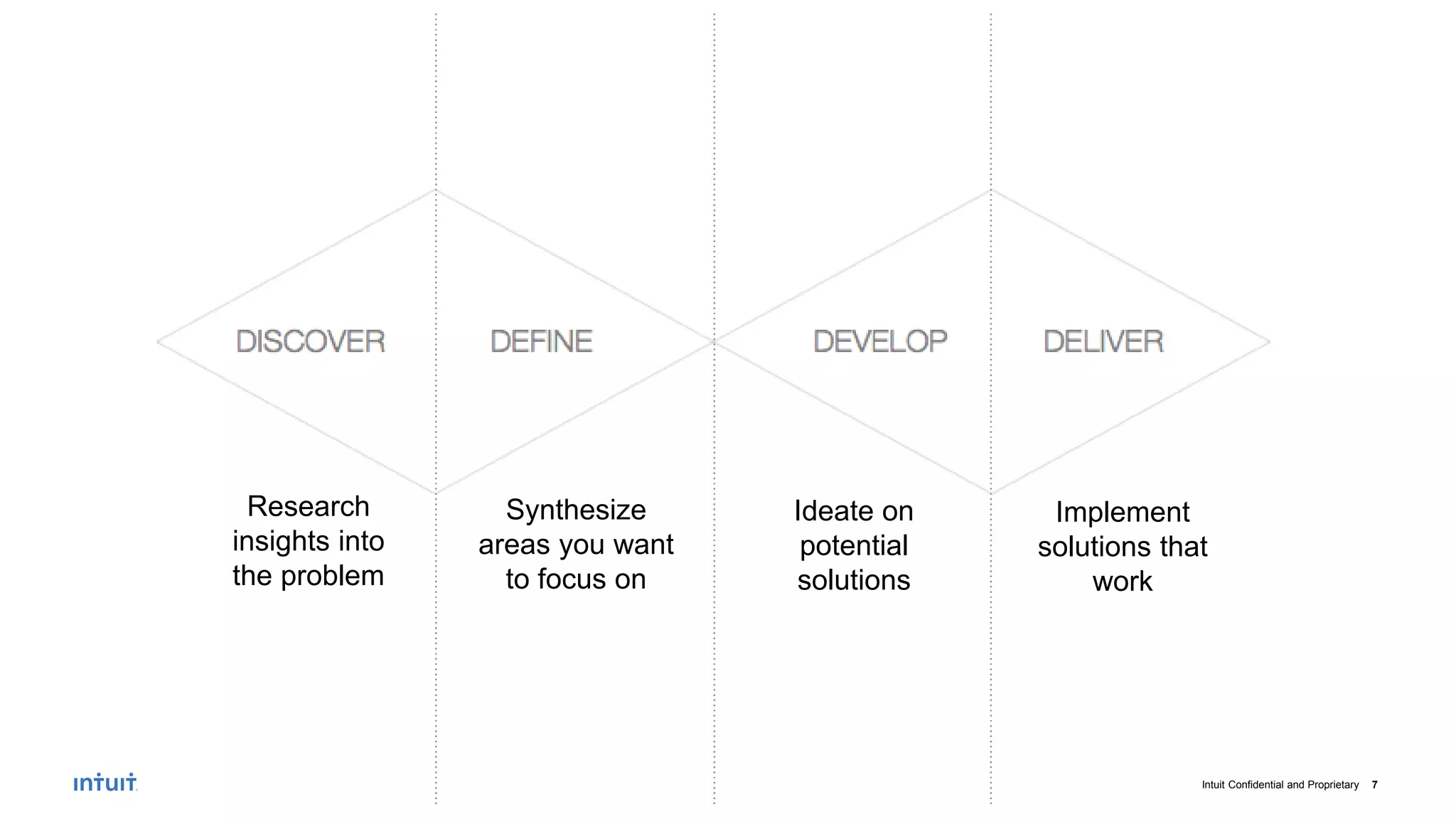
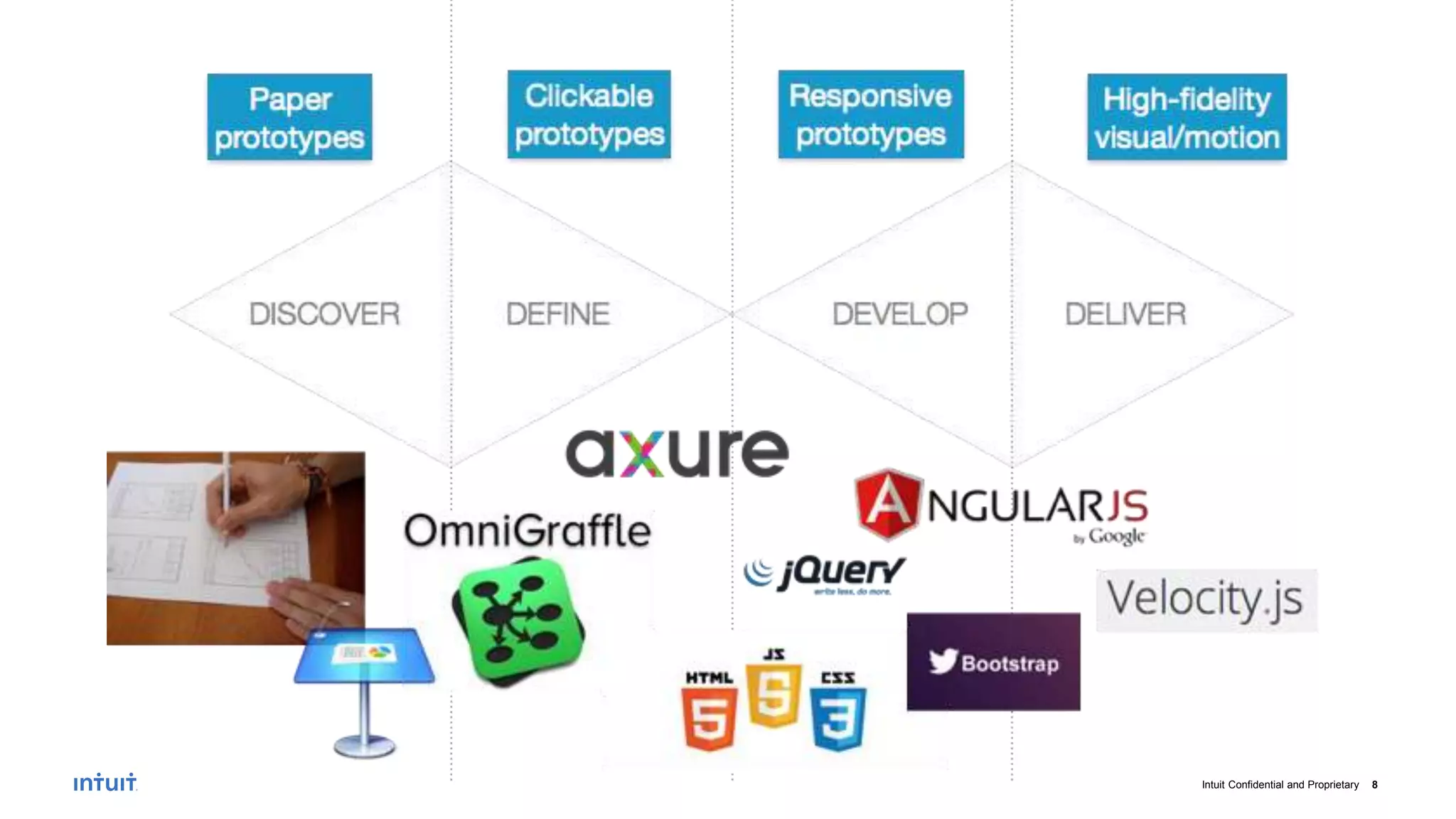
Double Diamond
Intuit Confidential and Proprietary 7
Research
insights into
the problem
Synthesize
areas you want
to focus on
Ideate on
potential
solutions
Implement
solutions that
work
Intuit Confidential and Proprietary 8
Intuit Confidential and Proprietary 9
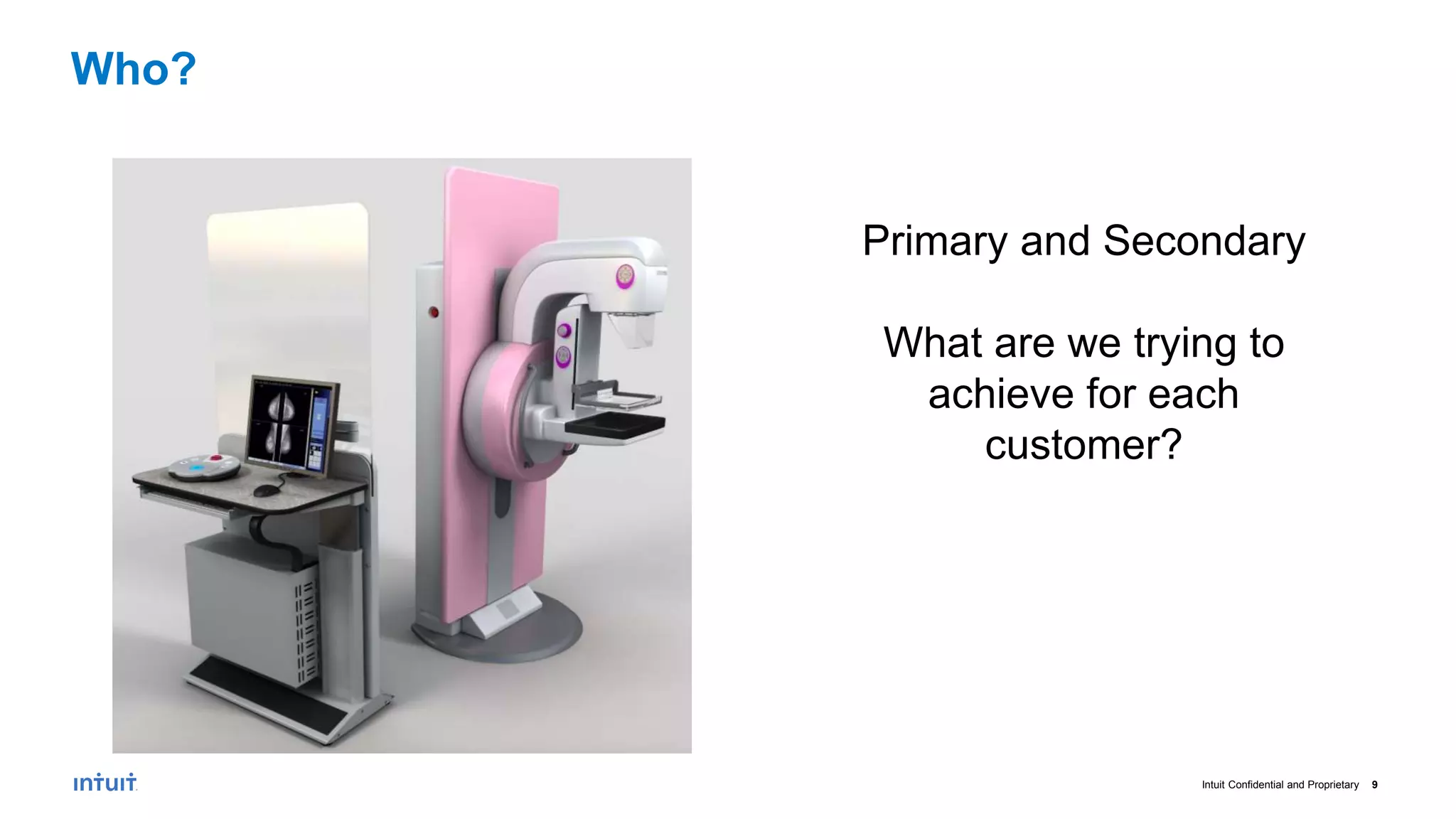
Who?
Primary and Secondary
What are we trying to
achieve for each
customer?
Software
Intuit Confidential and Proprietary 11
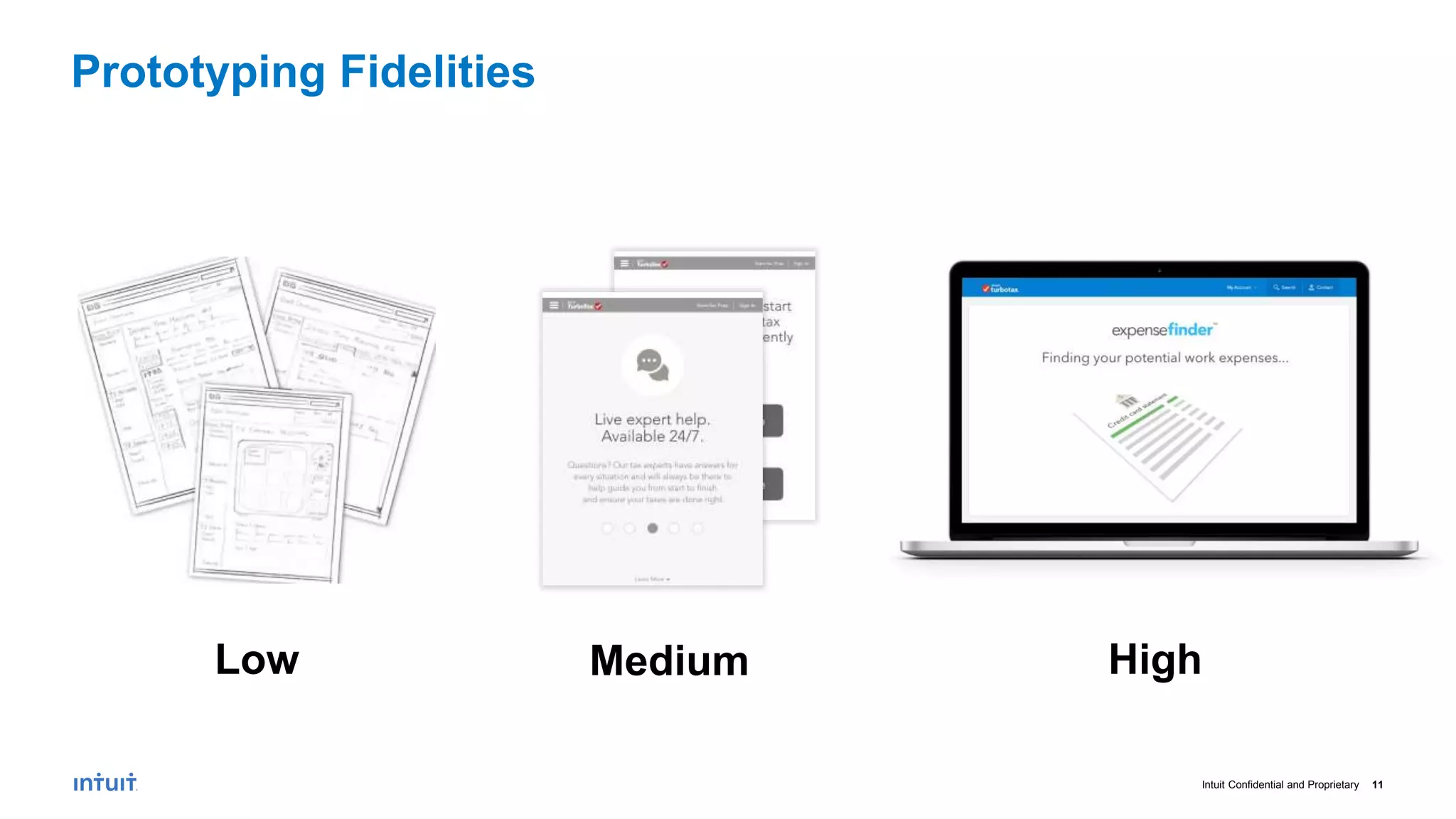
Prototyping Fidelities
Low Medium High
Intuit Confidential and Proprietary 12
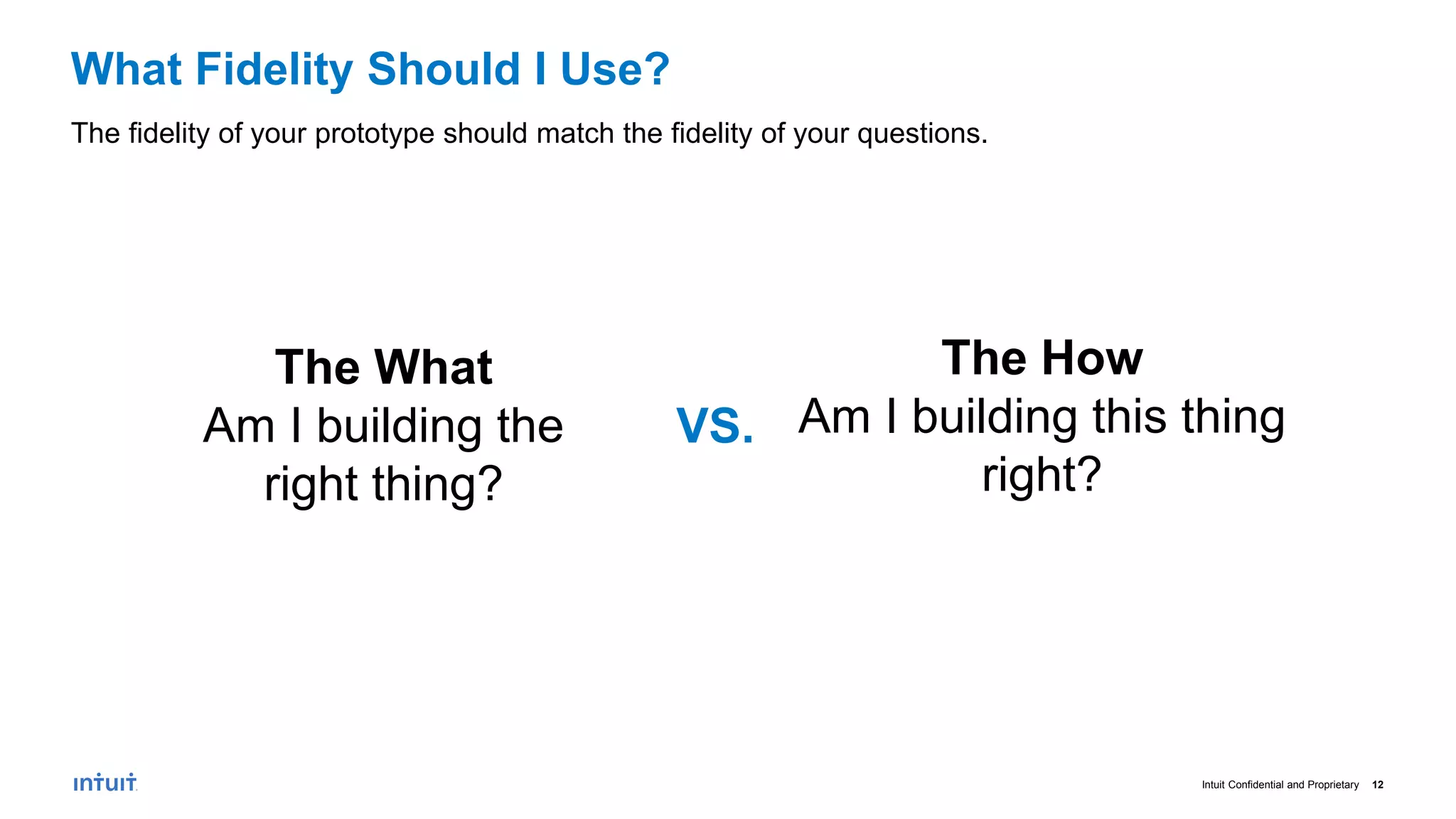
What Fidelity Should I Use?
The fidelity of your prototype should match the fidelity of your questions.
The What
Am I building the
right thing?
The How
Am I building this thing
right?
VS.
Intuit Confidential and Proprietary 13
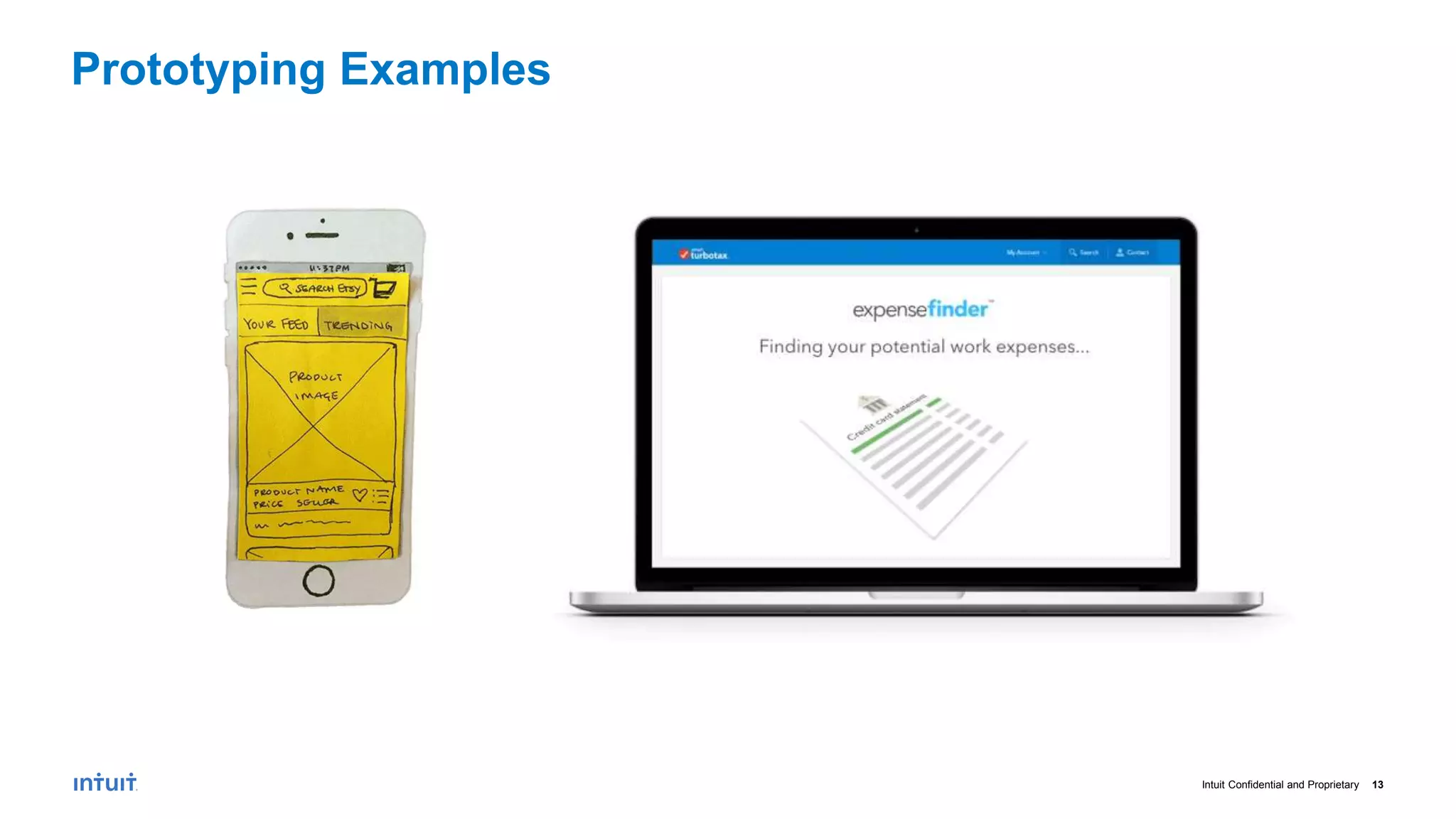
Prototyping Examples
Hardware
Intuit Confidential and Proprietary 15
Tom Chi: Google
Glass
Intuit Confidential and Proprietary 16
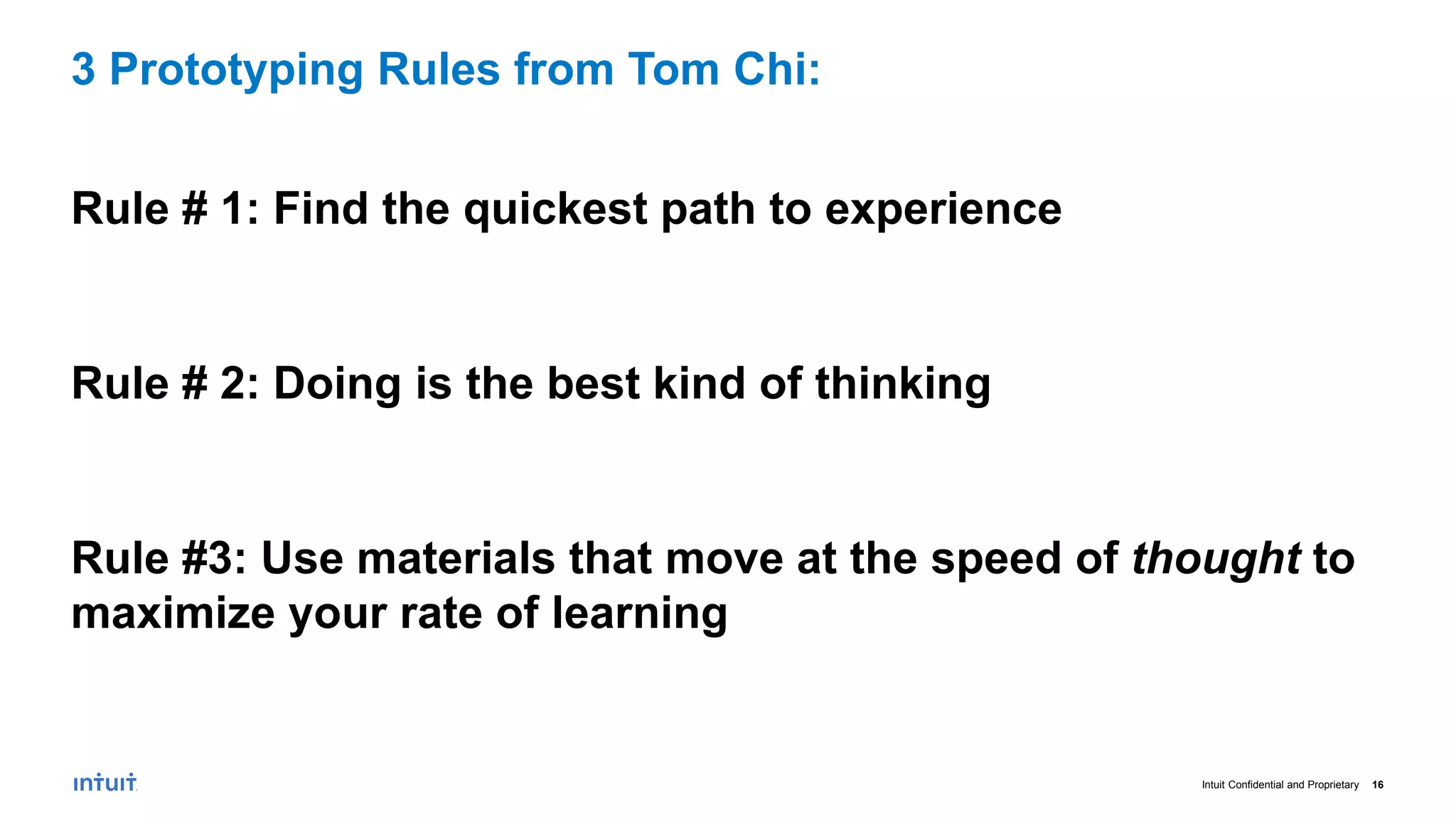
Rule # 1: Find the quickest path to experience
Rule # 2: Doing is the best kind of thinking
Rule #3: Use materials that move at the speed of thought to
maximize your rate of learning
3 Prototyping Rules from Tom Chi:
How does software and
hardware complement
each other?
Data
Intuit Confidential and Proprietary 19
A data prototype is a functional prototype that
has the objective to clean the data, create rules
to transform the data for certain purposes and
creates a dataset as a result of those rules
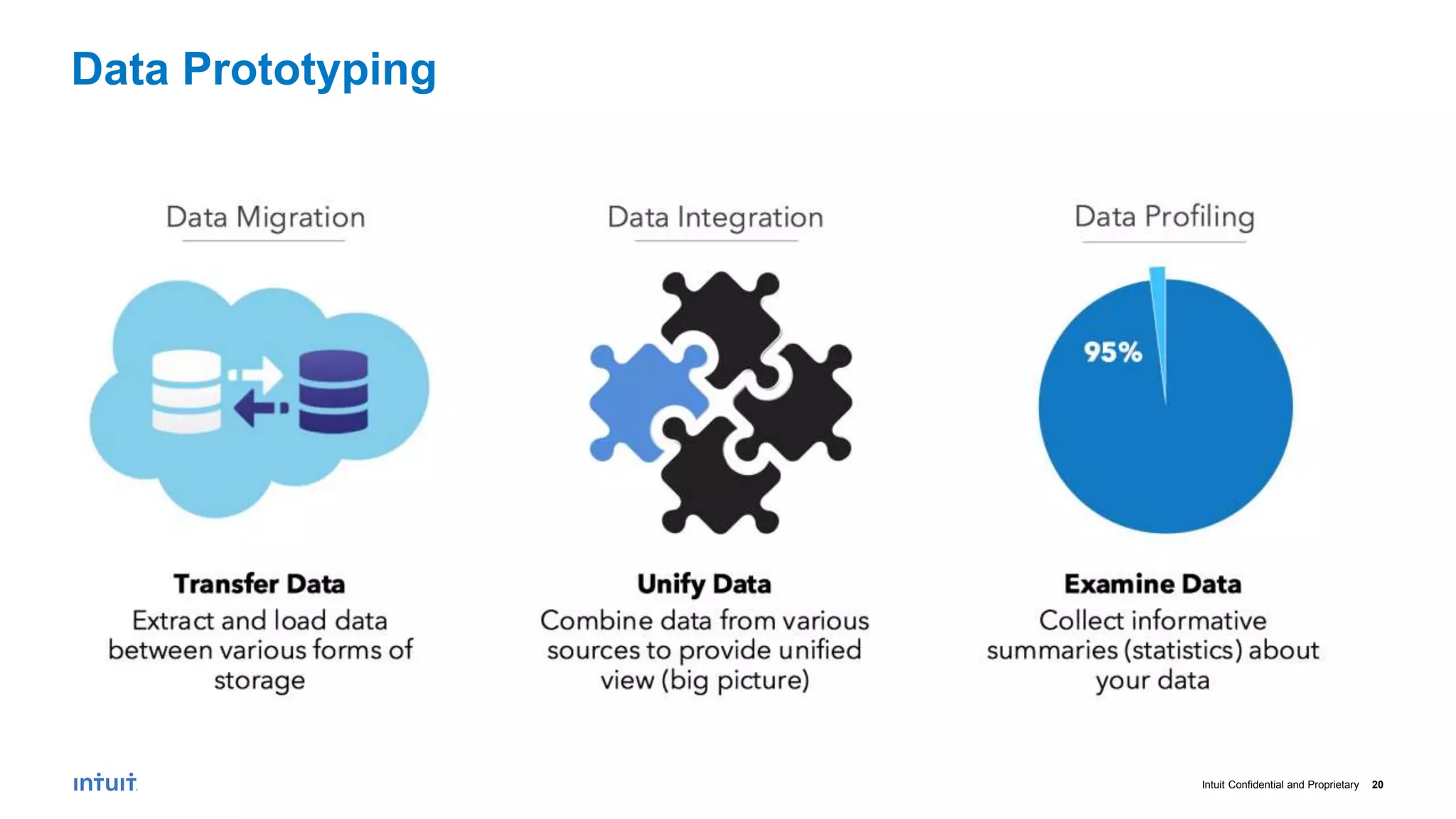
Data Prototyping
Intuit Confidential and Proprietary 20
Data Prototyping
Intuit Confidential and Proprietary 24
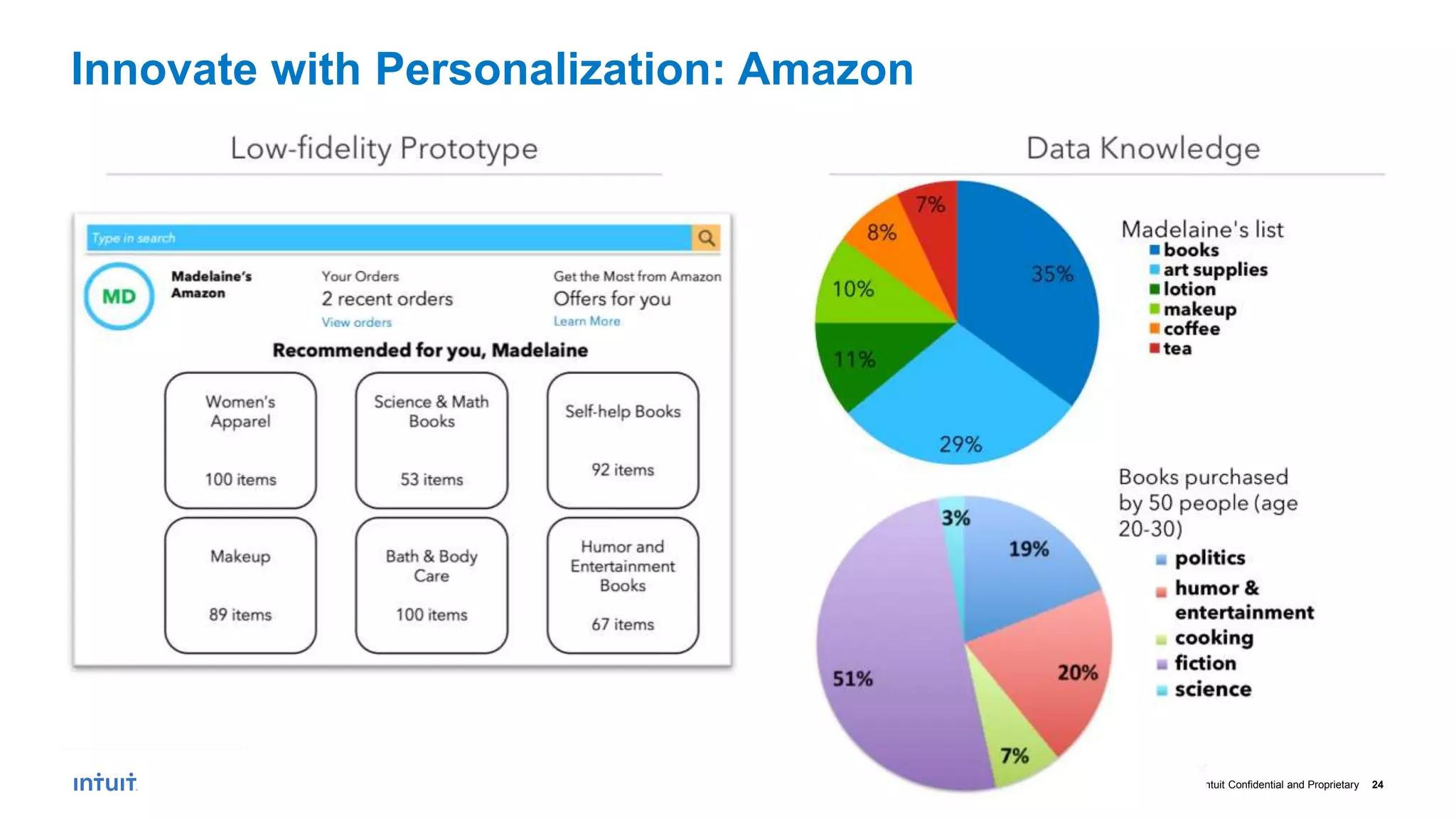
Innovate with Personalization: Amazon
Intuit Confidential and Proprietary 25
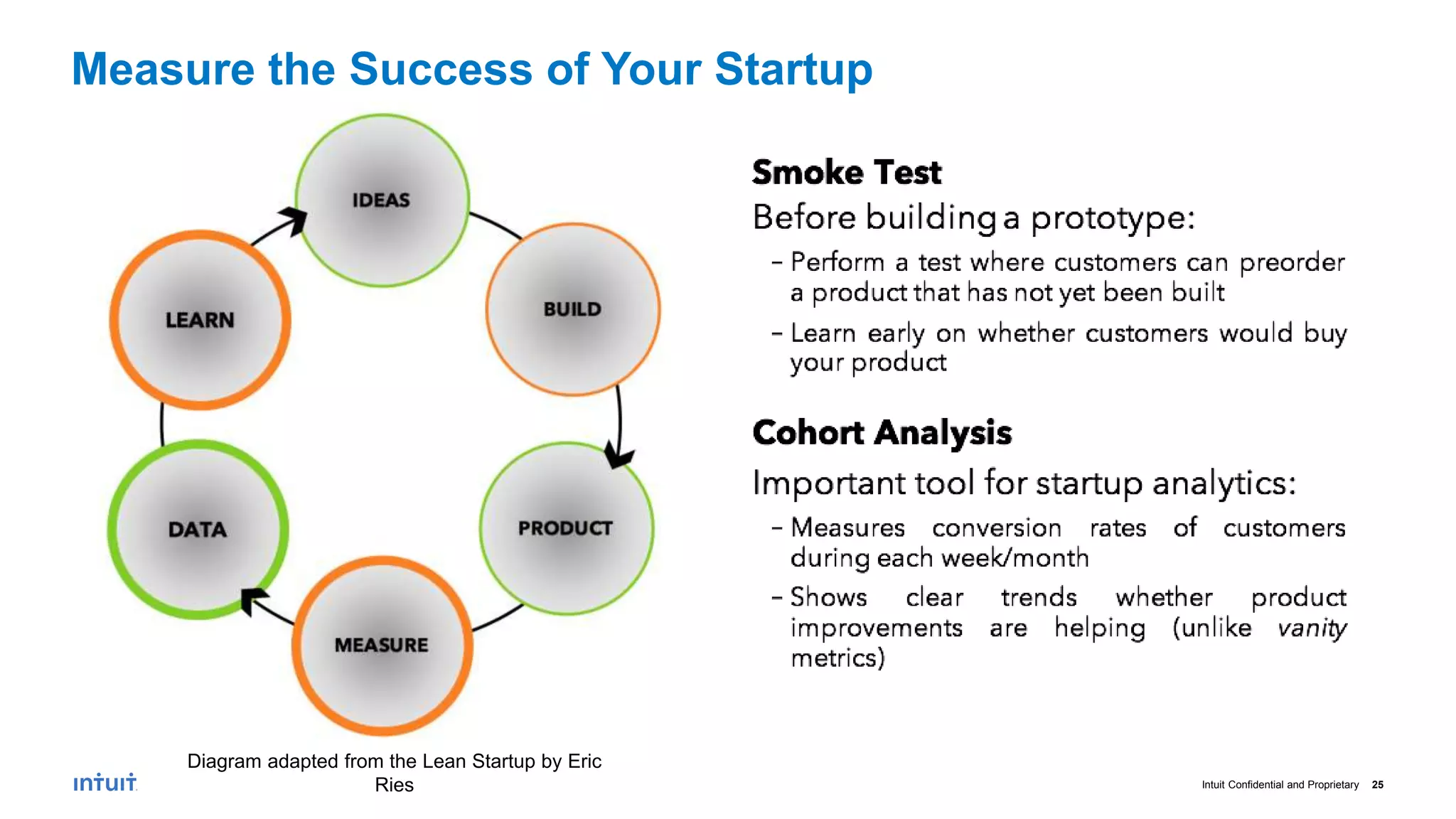
Measure the Success of Your Startup
Diagram adapted from the Lean Startup by Eric
Ries
Intuit Confidential and Proprietary 26
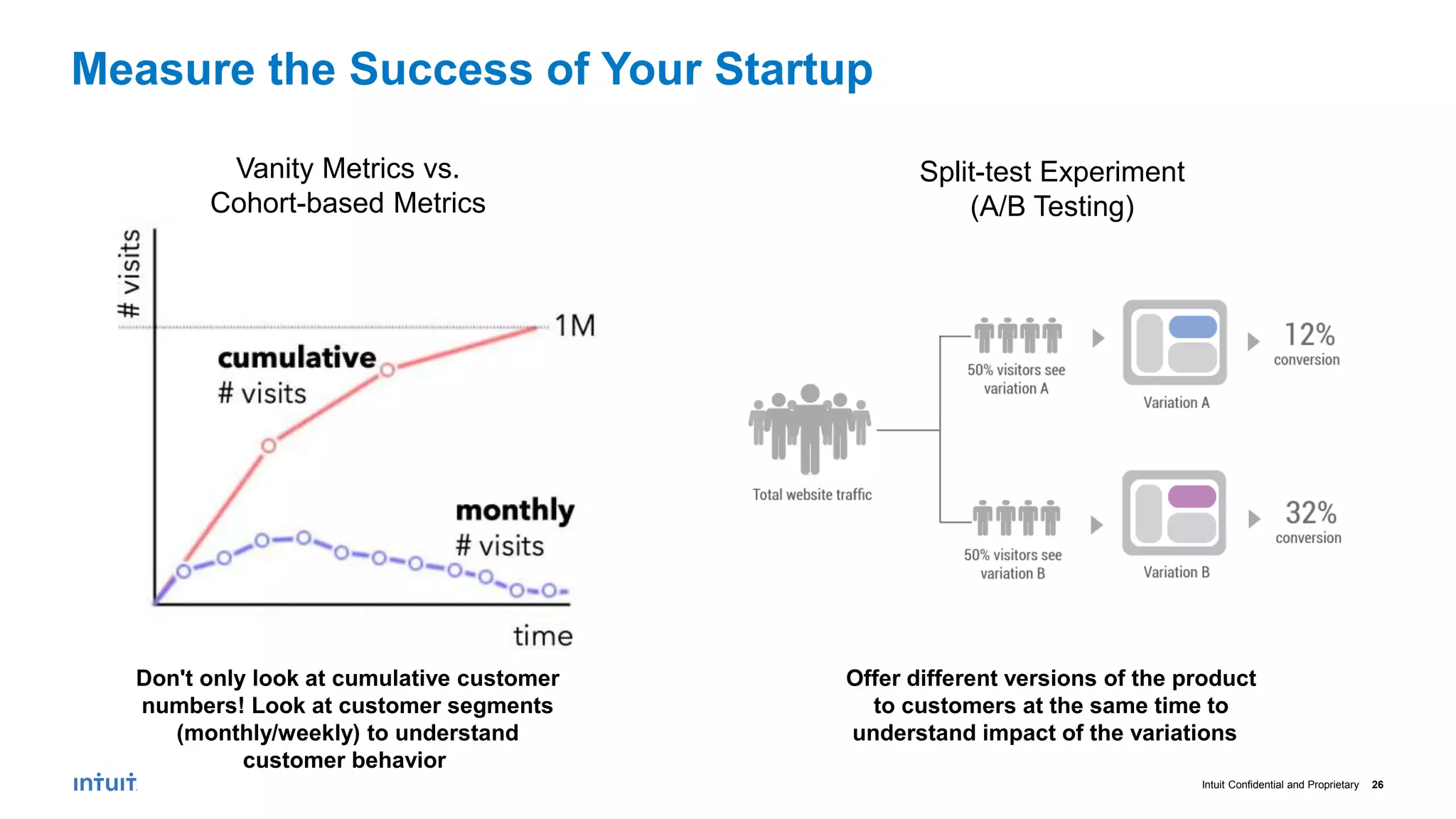
Measure the Success of Your Startup
Split-test Experiment
(A/B Testing)
Vanity Metrics vs.
Cohort-based Metrics
Offer different versions of the product
to customers at the same time to
understand impact of the variations
Don't only look at cumulative customer
numbers! Look at customer segments
(monthly/weekly) to understand
customer behavior
Lab
Rapid Prototyping
Rapid Prototyping
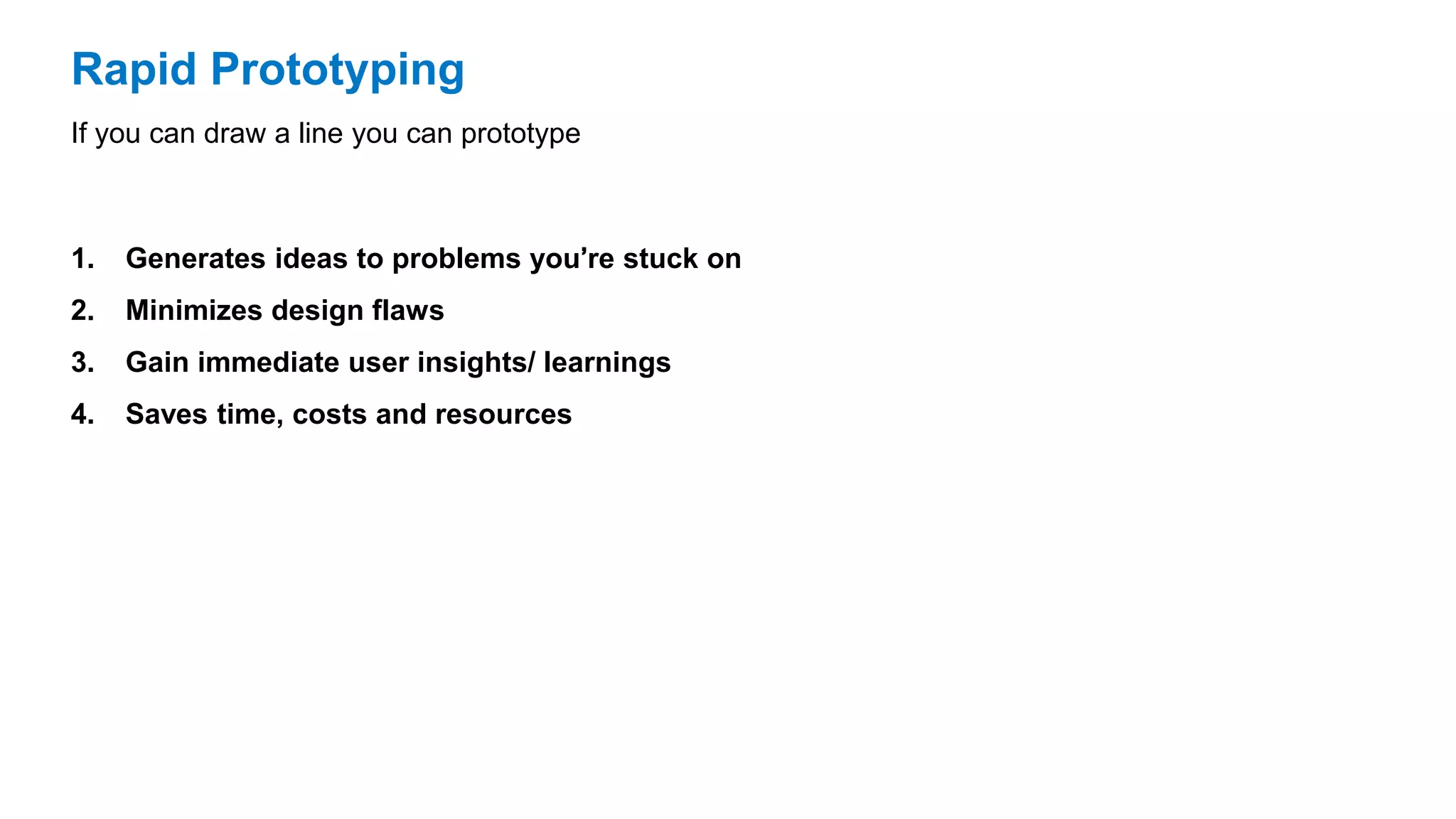
1. Generates ideas to problems you’re stuck on
2. Minimizes design flaws
3. Gain immediate user insights/ learnings
4. Saves time, costs and resources
If you can draw a line you can prototype
Rapid Prototyping
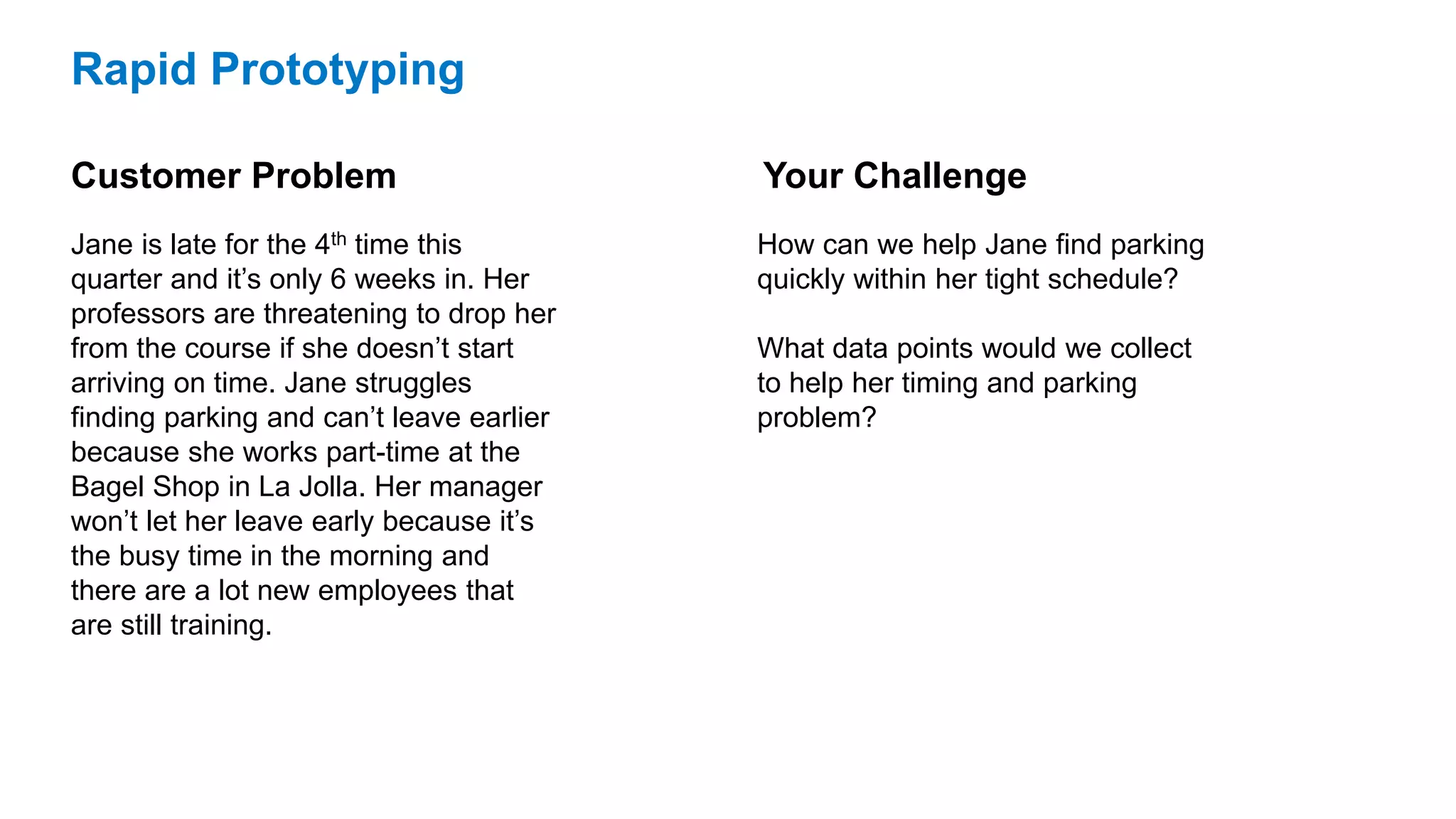
Customer Problem
Jane is late for the 4th time this
quarter and it’s only 6 weeks in. Her
professors are threatening to drop her
from the course if she doesn’t start
arriving on time. Jane struggles
finding parking and can’t leave earlier
because she works part-time at the
Bagel Shop in La Jolla. Her manager
won’t let her leave early because it’s
the busy time in the morning and
there are a lot new employees that
are still training.
How can we help Jane find parking
quickly within her tight schedule?
What data points would we collect
to help her timing and parking
problem?
Your Challenge
Rapid Prototyping
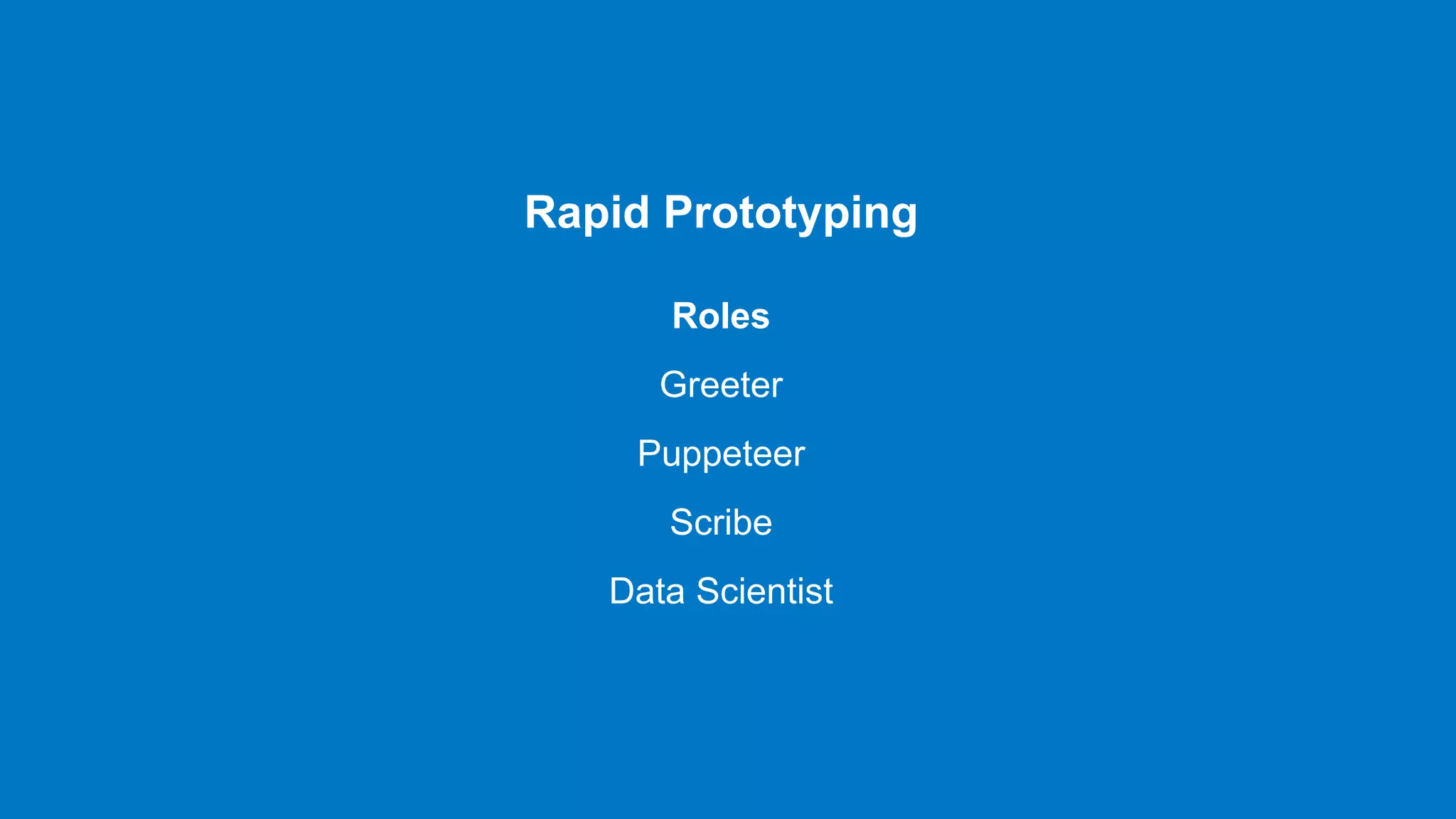
Roles
Greeter
Puppeteer
Scribe
Data Scientist
Intuit Confidential and Proprietary 31
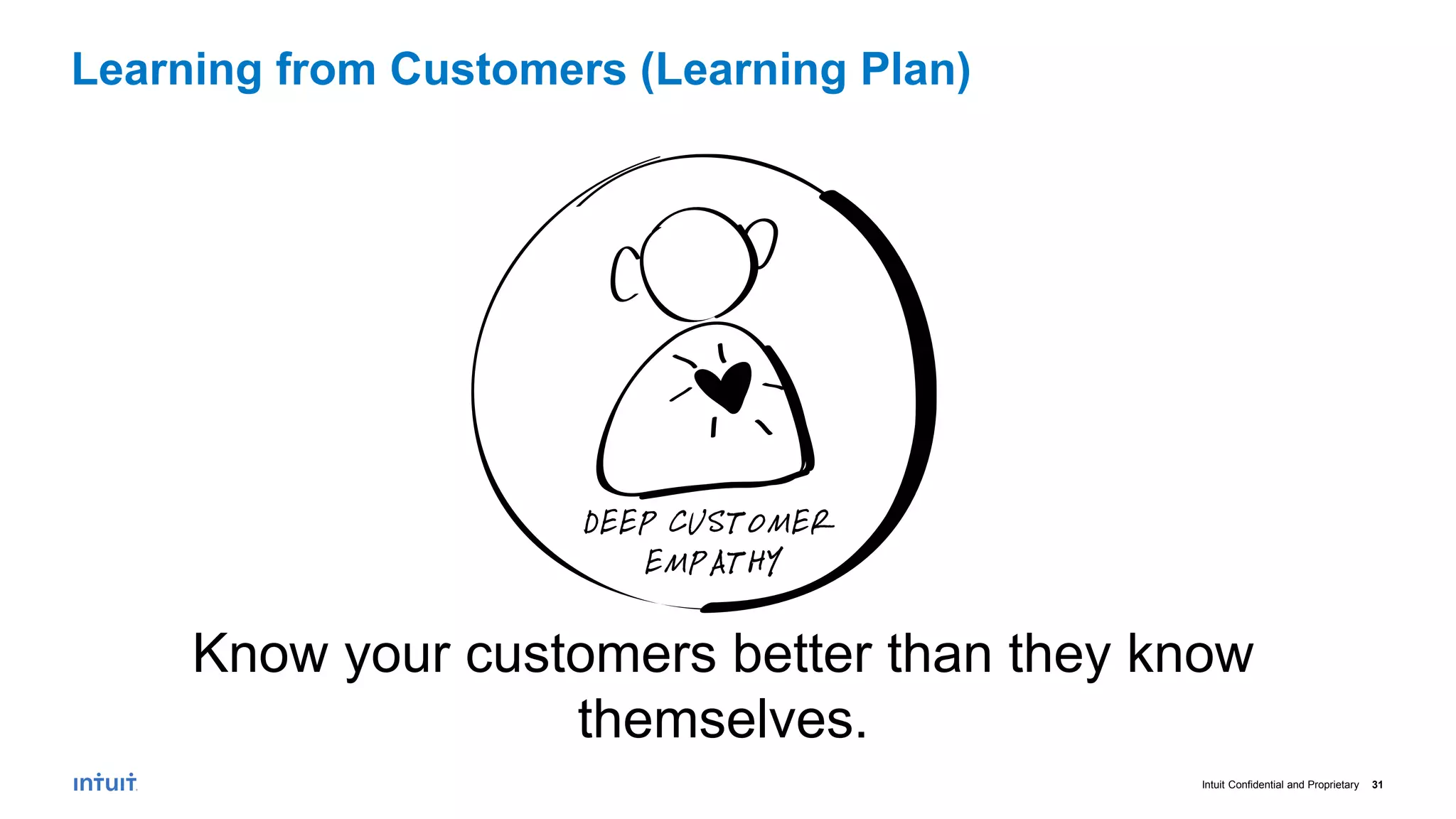
Know your customers better than they know
themselves.
Learning from Customers (Learning Plan)
Intuit Confidential and Proprietary 32
Intuit Confidential and Proprietary
INTERVIEWING BEST PRACTICES
Intuit Confidential and Proprietary 33
Intuit Confidential and Proprietary33
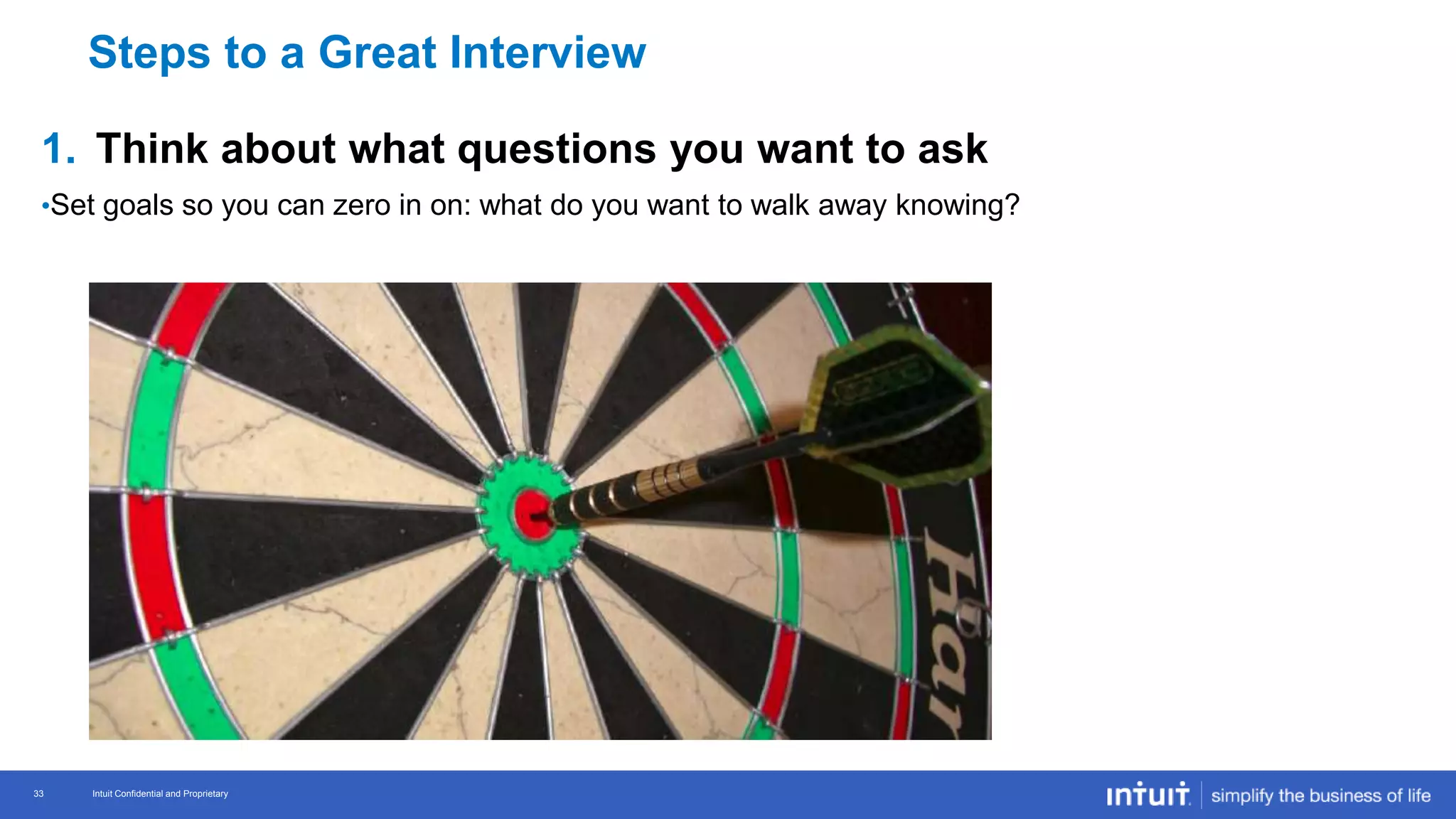
1. Think about what questions you want to ask
•Set goals so you can zero in on: what do you want to walk away knowing?
Steps to a Great Interview
Intuit Confidential and Proprietary 34
Intuit Confidential and Proprietary34
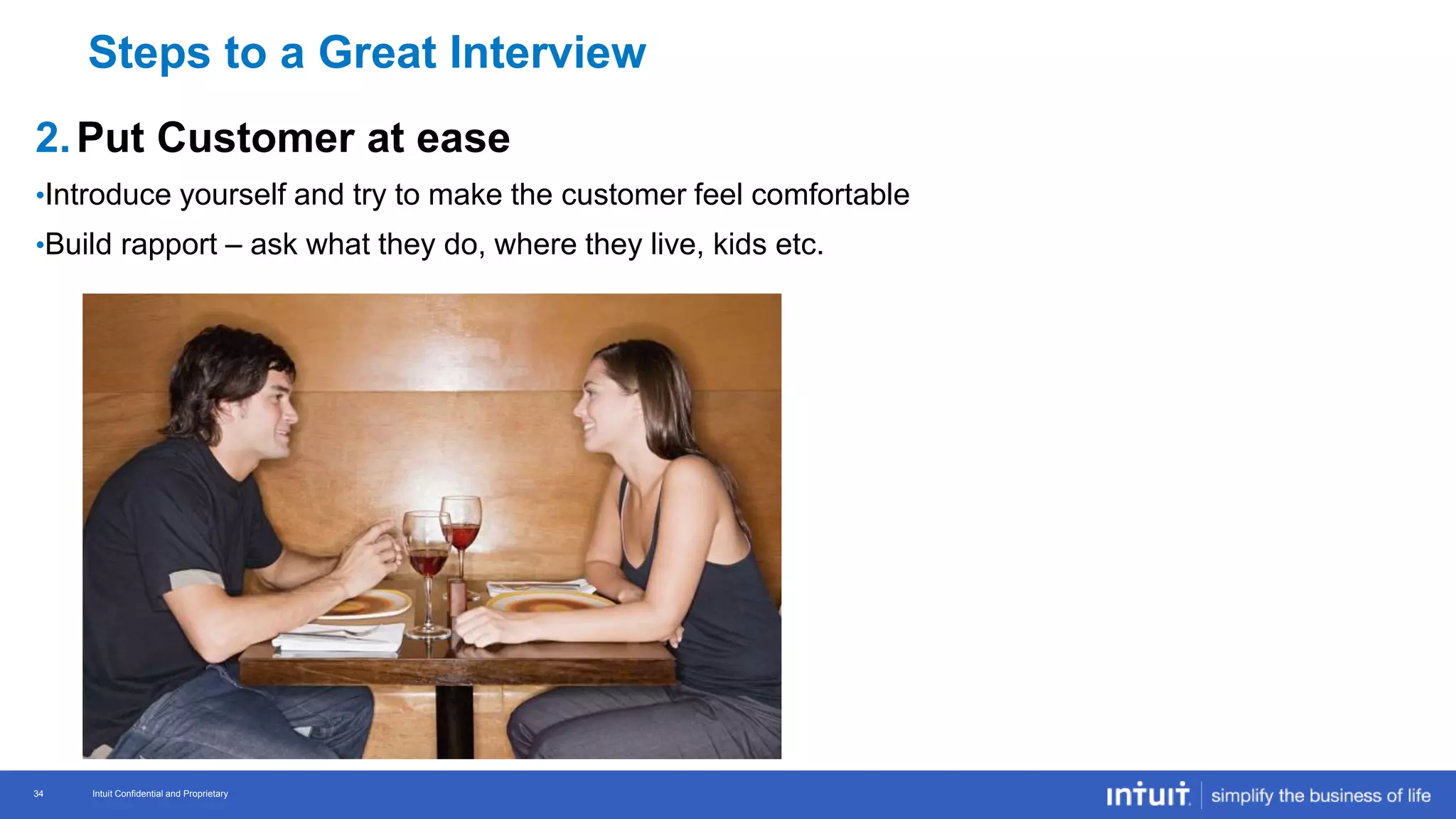
2.Put Customer at ease
•Introduce yourself and try to make the customer feel comfortable
•Build rapport – ask what they do, where they live, kids etc.
Steps to a Great Interview
Intuit Confidential and Proprietary 35
Intuit Confidential and Proprietary35
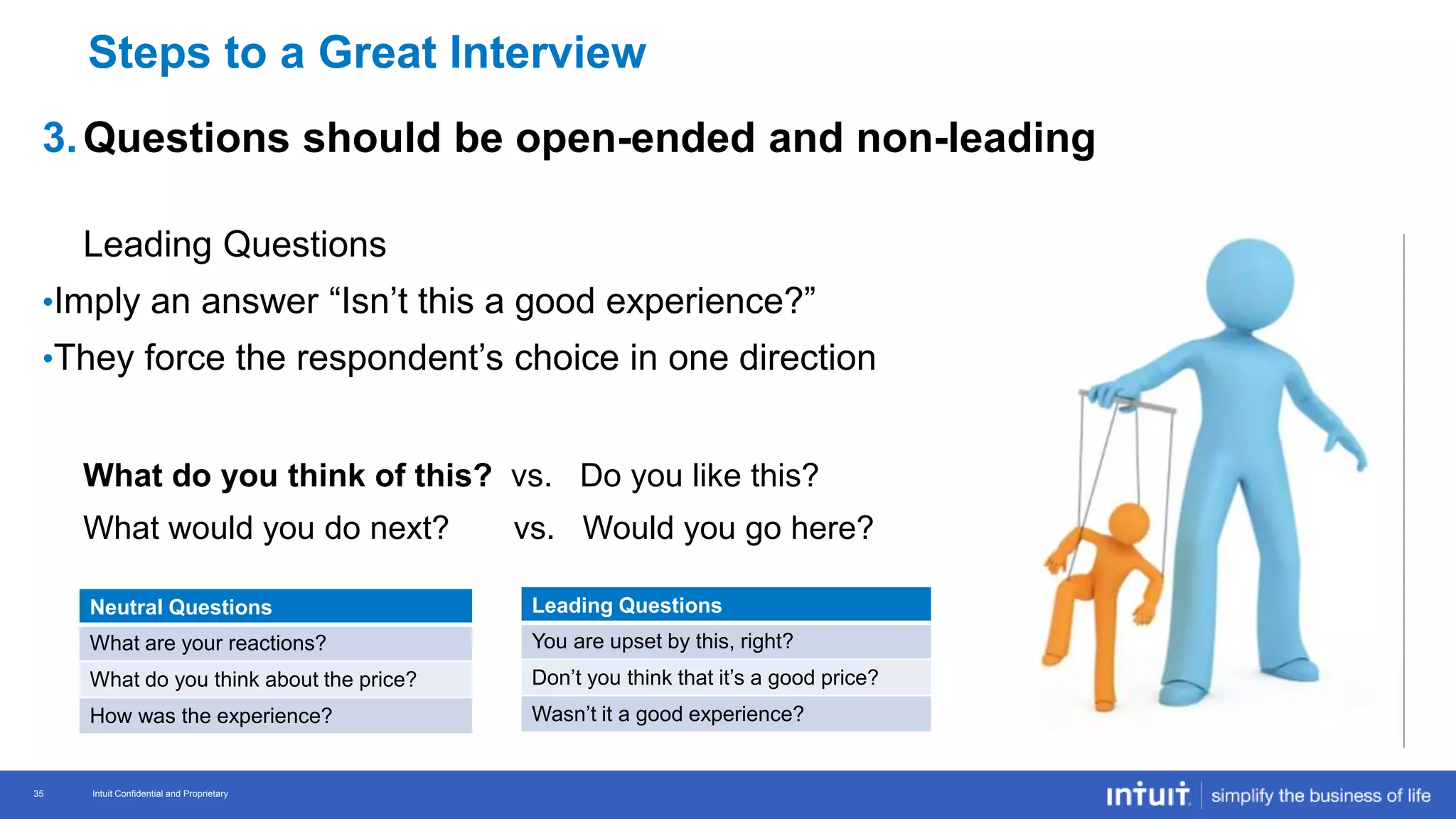
3.Questions should be open-ended and non-leading
Leading Questions
•Imply an answer “Isn’t this a good experience?”
•They force the respondent’s choice in one direction
What do you think of this? vs. Do you like this?
What would you do next? vs. Would you go here?
Neutral Questions
What are your reactions?
What do you think about the price?
How was the experience?
Leading Questions
You are upset by this, right?
Don’t you think that it’s a good price?
Wasn’t it a good experience?
Steps to a Great Interview
Intuit Confidential and Proprietary 36
Intuit Confidential and Proprietary36
“What is working today?”
“What is not working today?”
“What are your wish-fors?”
“What do you think about this idea?”
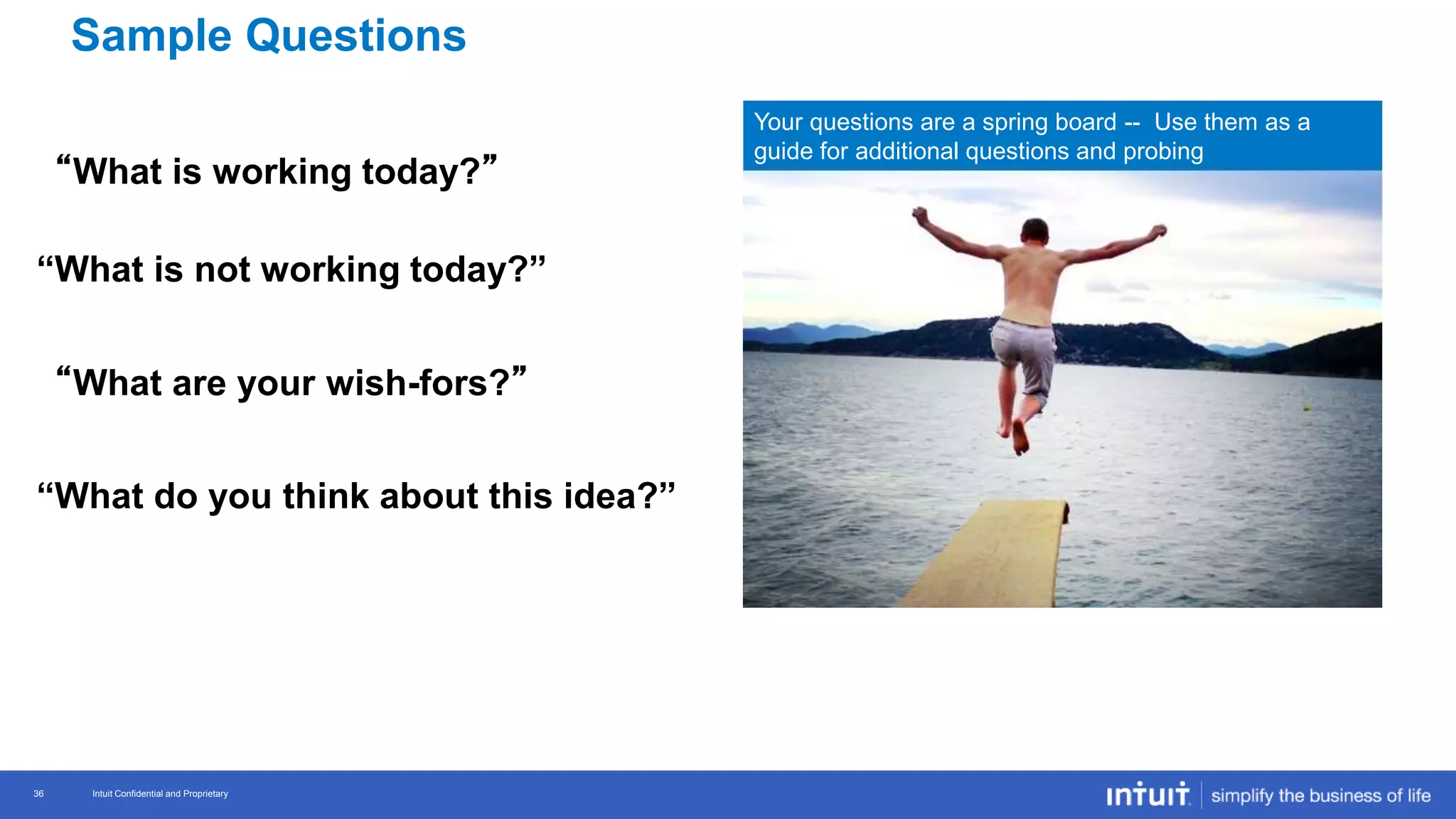
Your questions are a spring board -- Use them as a
guide for additional questions and probing
Sample Questions
Intuit Confidential and Proprietary 37
Intuit Confidential and Proprietary37
4. Ask your questions and listen actively
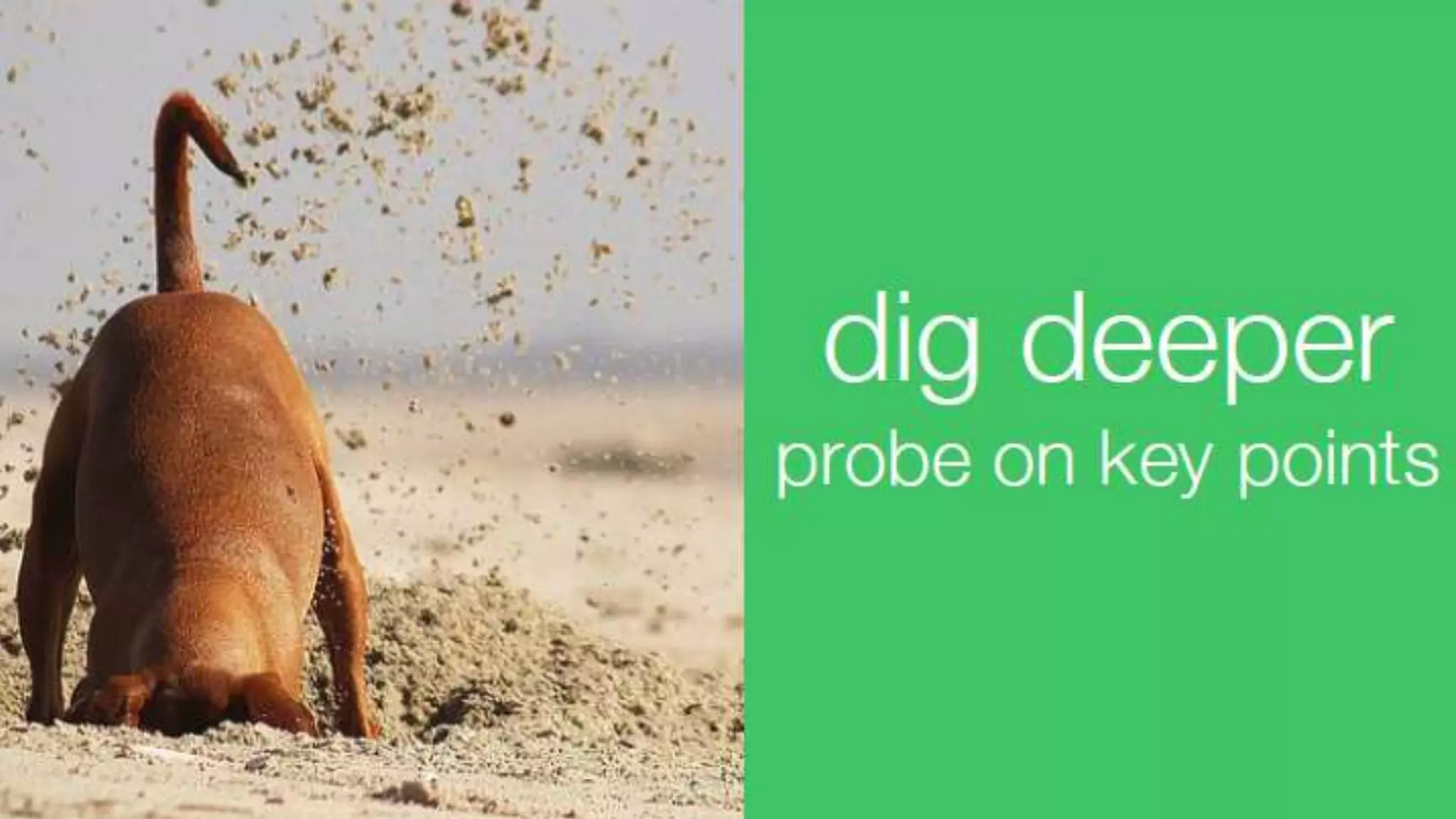
•Remember to focus on the details and probe for more
info
•Minimize how much you are talking – if you are talking,
you are not learning
•Don't assume you know the answer -- Test your
discoveries, “let me make sure I understand…”
Steps to a Great Interview
Intuit Confidential and Proprietary 38
Intuit Confidential and Proprietary38
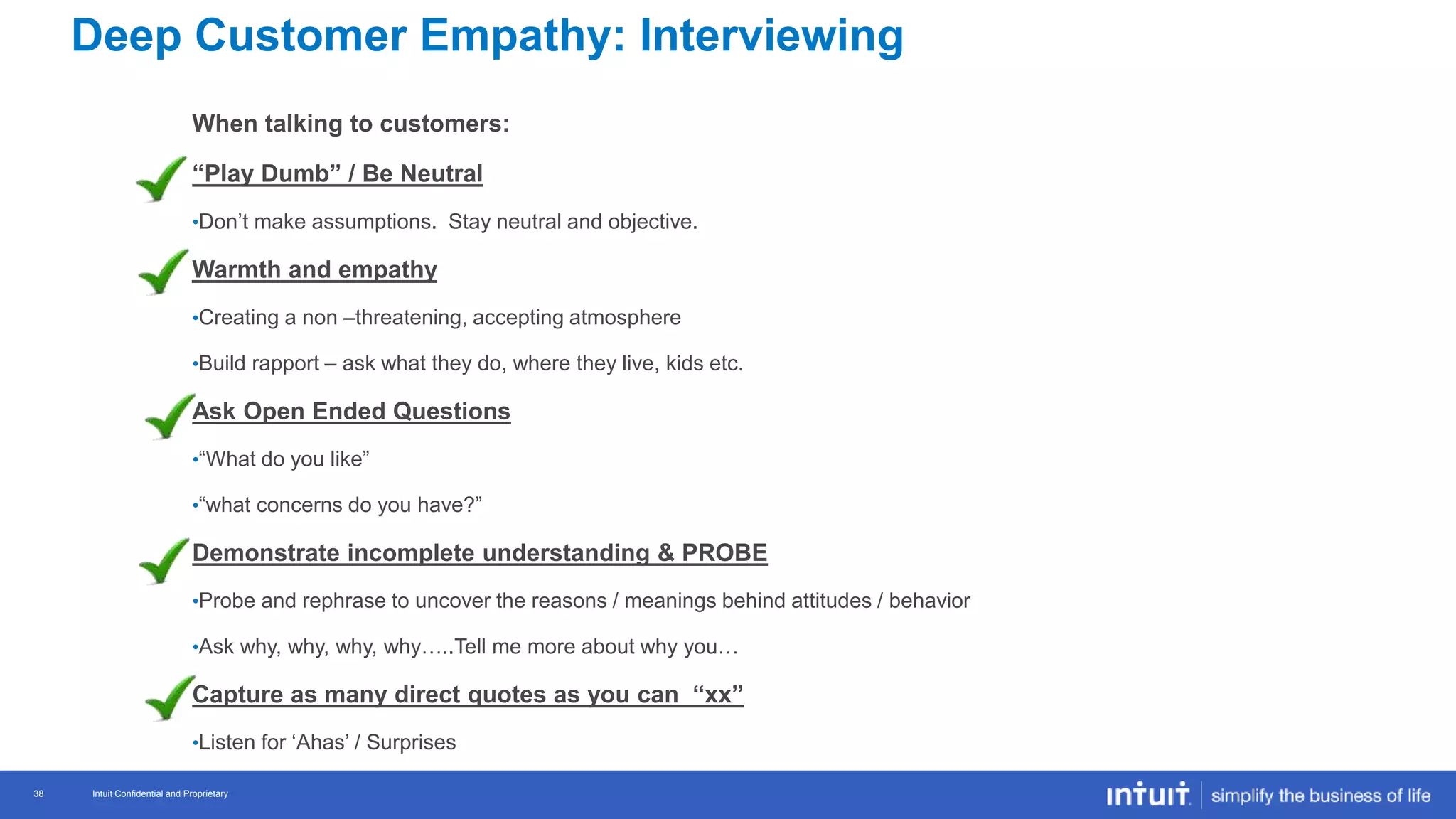
When talking to customers:
“Play Dumb” / Be Neutral
•Don’t make assumptions. Stay neutral and objective.
Warmth and empathy
•Creating a non –threatening, accepting atmosphere
•Build rapport – ask what they do, where they live, kids etc.
Ask Open Ended Questions
•“What do you like”
•“what concerns do you have?”
Demonstrate incomplete understanding & PROBE
•Probe and rephrase to uncover the reasons / meanings behind attitudes / behavior
•Ask why, why, why, why…..Tell me more about why you…
Capture as many direct quotes as you can “xx”
•Listen for ‘Ahas’ / Surprises
Deep Customer Empathy: Interviewing
Intuit Confidential and Proprietary 39
Intuit Confidential and Proprietary39
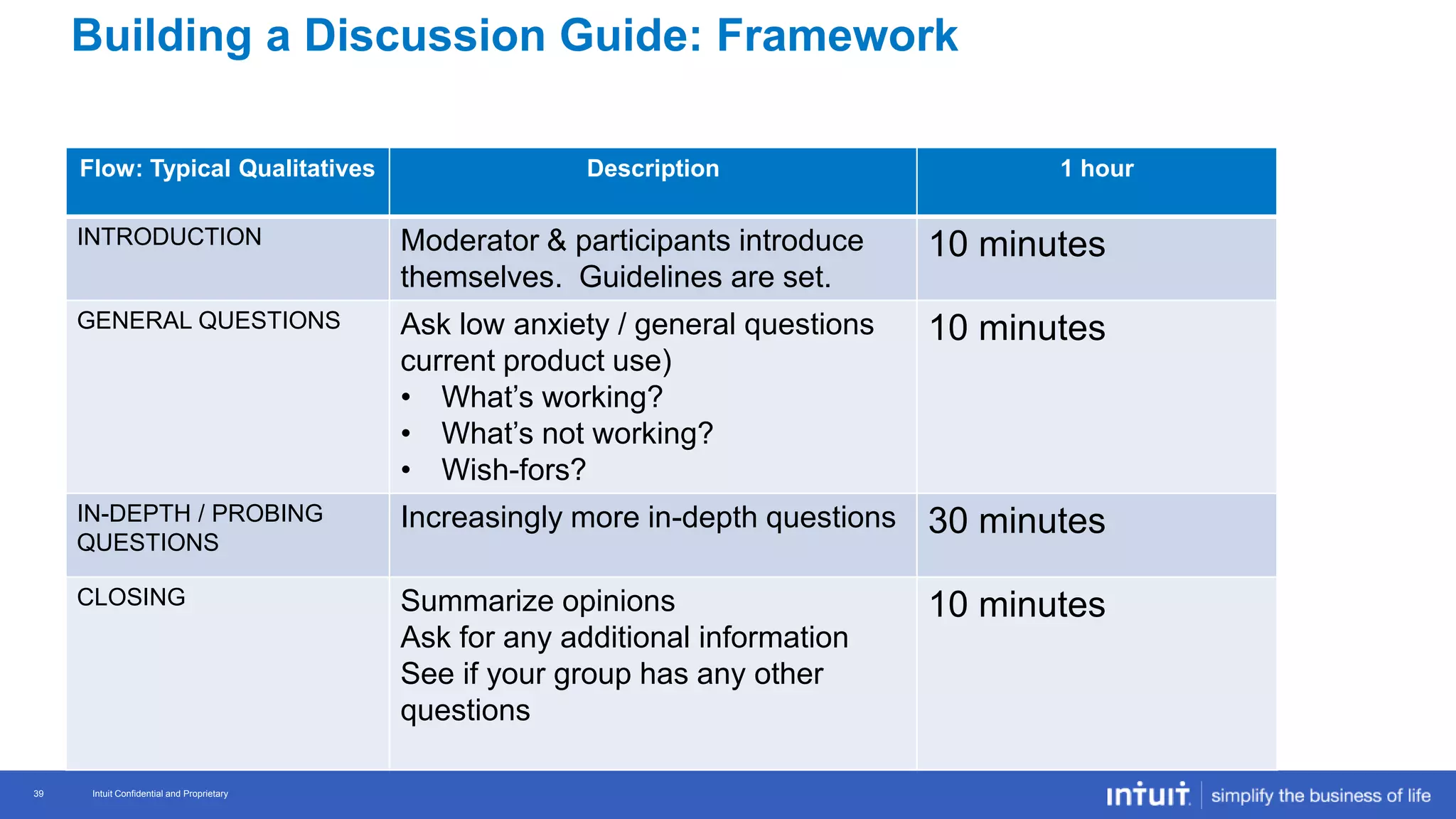
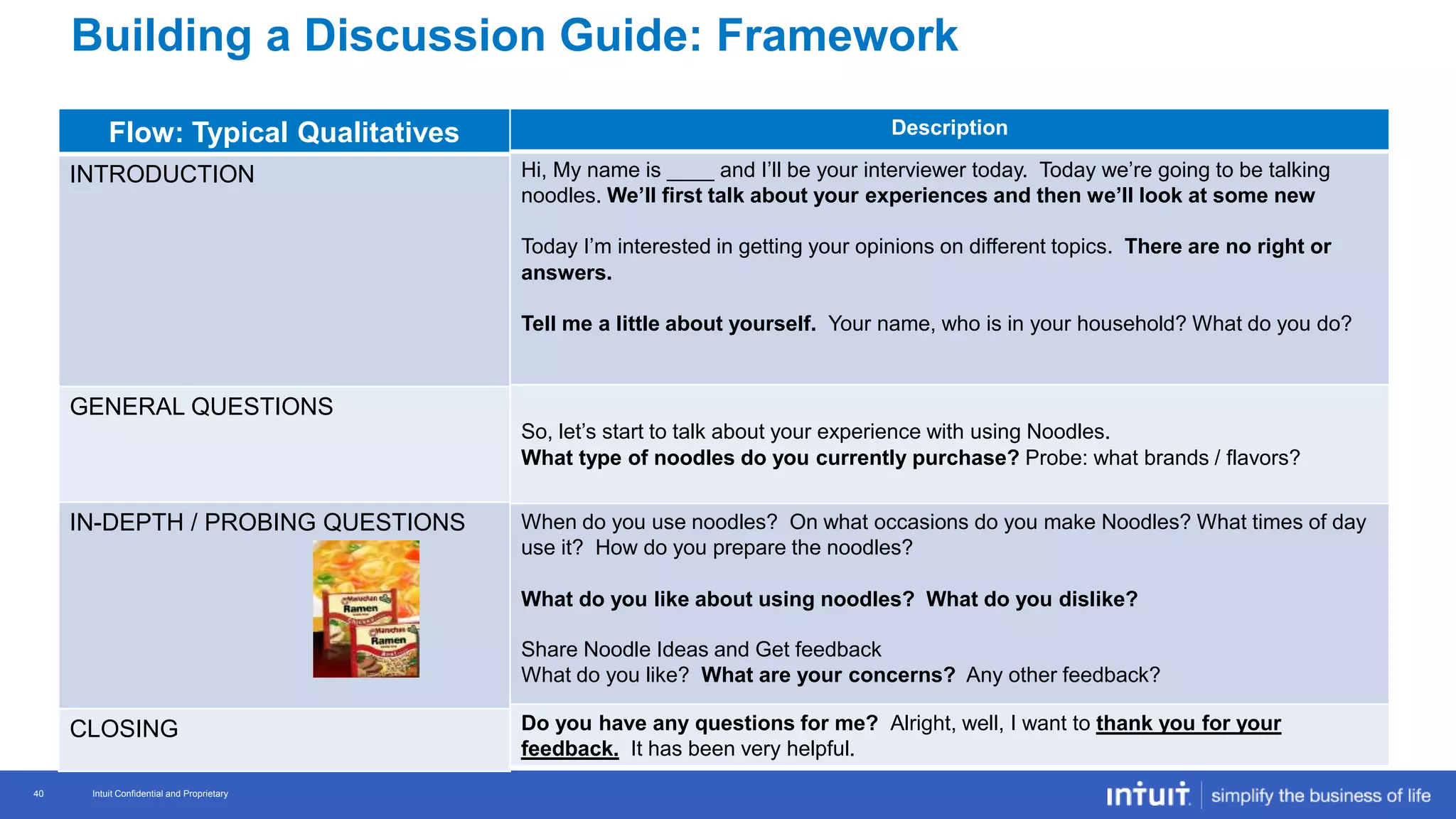
Flow: Typical Qualitatives Description 1 hour
INTRODUCTION Moderator & participants introduce
themselves. Guidelines are set.
10 minutes
GENERAL QUESTIONS Ask low anxiety / general questions
current product use)
• What’s working?
• What’s not working?
• Wish-fors?
10 minutes
IN-DEPTH / PROBING
QUESTIONS
Increasingly more in-depth questions 30 minutes
CLOSING Summarize opinions
Ask for any additional information
See if your group has any other
questions
10 minutes
Building a Discussion Guide: Framework
Intuit Confidential and Proprietary 40
Intuit Confidential and Proprietary40
Flow: Typical Qualitatives
INTRODUCTION
GENERAL QUESTIONS
IN-DEPTH / PROBING QUESTIONS
CLOSING
Description
Hi, My name is ____ and I’ll be your interviewer today. Today we’re going to be talking
noodles. We’ll first talk about your experiences and then we’ll look at some new
Today I’m interested in getting your opinions on different topics. There are no right or
answers.
Tell me a little about yourself. Your name, who is in your household? What do you do?
So, let’s start to talk about your experience with using Noodles.
What type of noodles do you currently purchase? Probe: what brands / flavors?
When do you use noodles? On what occasions do you make Noodles? What times of day
use it? How do you prepare the noodles?
What do you like about using noodles? What do you dislike?
Share Noodle Ideas and Get feedback
What do you like? What are your concerns? Any other feedback?
Do you have any questions for me? Alright, well, I want to thank you for your
feedback. It has been very helpful.
Building a Discussion Guide: Framework
Intuit Confidential and Proprietary 41
Intuit Confidential and Proprietary41
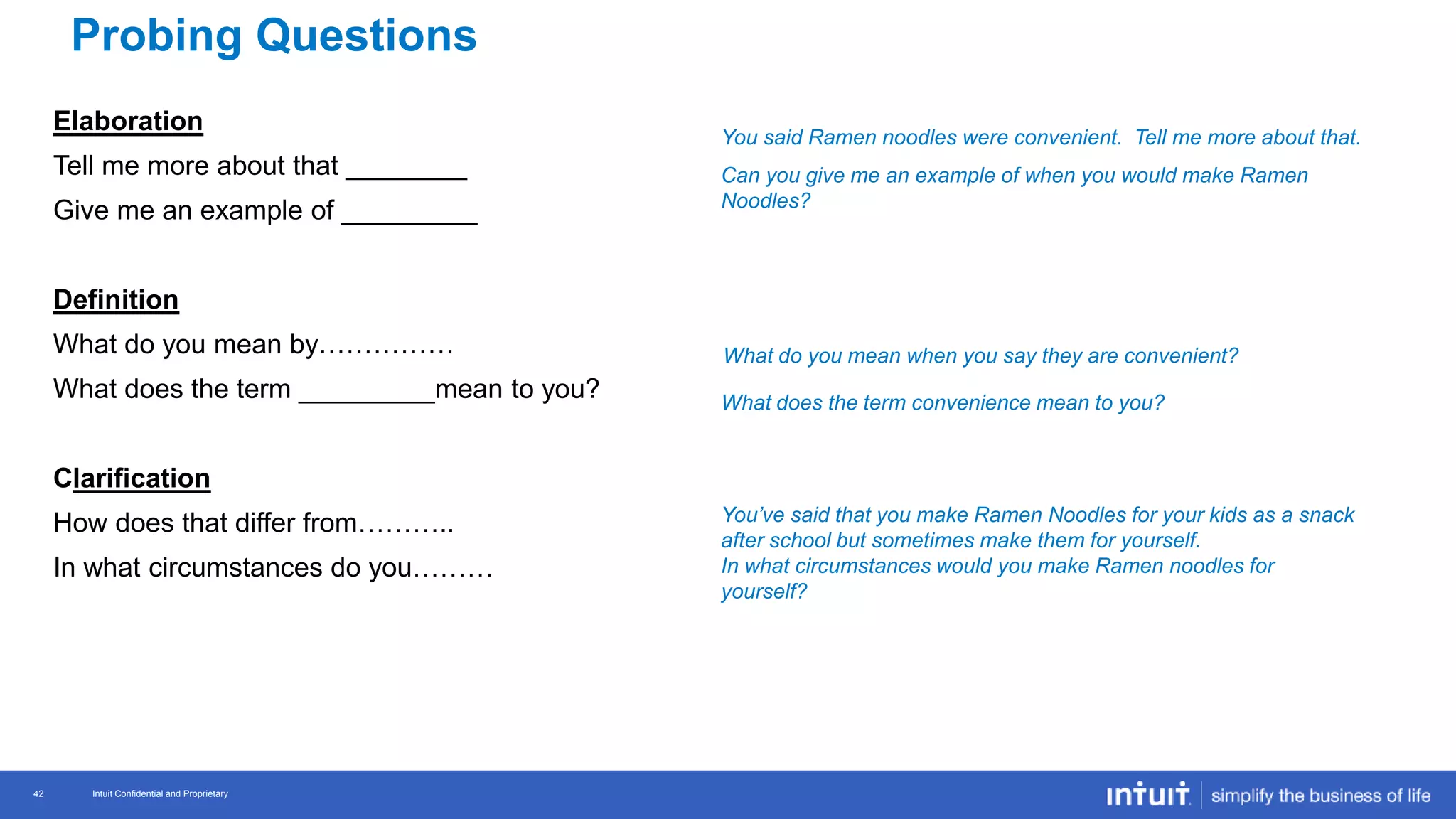
Why Probing Questions
“I like Ramen Noodles. It’s convenient”
What does CONVENIENT mean?
Intuit Confidential and Proprietary 42
Intuit Confidential and Proprietary42
Elaboration
Tell me more about that ________
Give me an example of _________
Definition
What do you mean by……………
What does the term _________mean to you?
Clarification
How does that differ from………..
In what circumstances do you………
You said Ramen noodles were convenient. Tell me more about that.
Can you give me an example of when you would make Ramen
Noodles?
What do you mean when you say they are convenient?
What does the term convenience mean to you?
You’ve said that you make Ramen Noodles for your kids as a snack
after school but sometimes make them for yourself.
In what circumstances would you make Ramen noodles for
yourself?
Probing Questions
Intuit Confidential and Proprietary 43
Intuit Confidential and Proprietary43
5. Thank the customer!
•They are taking time out of their day to provide feedback.
•Tell them that you learned a lot from them (even if you didn’t!)
Steps to a Great Interview
Intuit Confidential and Proprietary 44
Intuit Confidential and Proprietary44
6. Debrief
•It’s important to debrief as a team
•What did you learn? What were surprises?
Steps to a Great Interview
Intuit Confidential and Proprietary 45
Thank You!
Any Questions?

My startupxx prototyping v2

  • 1.
    February 9, 2017 AlizaCarpio, Jessica Cho, Laura Nunnery, Madelaine Daianu Prototyping with mystartupXX
  • 2.
    Intuit Confidential andProprietary 2 What and why of prototyping Who are you solving for? Primary and Secondary Which type (various types) do you use (and examples)? • Software, Data and Hardware (20 min) Let's work in small teams Developing a learning plan to get customer feedback Wrap up (Review) The Plan
  • 3.
  • 4.
    A prototype isa way to visually express, test, and iterate on your idea
  • 5.
  • 6.
  • 7.
    Intuit Confidential andProprietary 7 Research insights into the problem Synthesize areas you want to focus on Ideate on potential solutions Implement solutions that work
  • 8.
  • 9.
    Intuit Confidential andProprietary 9 Who? Primary and Secondary What are we trying to achieve for each customer?
  • 10.
  • 11.
    Intuit Confidential andProprietary 11 Prototyping Fidelities Low Medium High
  • 12.
    Intuit Confidential andProprietary 12 What Fidelity Should I Use? The fidelity of your prototype should match the fidelity of your questions. The What Am I building the right thing? The How Am I building this thing right? VS.
  • 13.
    Intuit Confidential andProprietary 13 Prototyping Examples
  • 14.
  • 15.
    Intuit Confidential andProprietary 15 Tom Chi: Google Glass
  • 16.
    Intuit Confidential andProprietary 16 Rule # 1: Find the quickest path to experience Rule # 2: Doing is the best kind of thinking Rule #3: Use materials that move at the speed of thought to maximize your rate of learning 3 Prototyping Rules from Tom Chi:
  • 17.
    How does softwareand hardware complement each other?
  • 18.
  • 19.
    Intuit Confidential andProprietary 19 A data prototype is a functional prototype that has the objective to clean the data, create rules to transform the data for certain purposes and creates a dataset as a result of those rules Data Prototyping
  • 20.
    Intuit Confidential andProprietary 20 Data Prototyping
  • 24.
    Intuit Confidential andProprietary 24 Innovate with Personalization: Amazon
  • 25.
    Intuit Confidential andProprietary 25 Measure the Success of Your Startup Diagram adapted from the Lean Startup by Eric Ries
  • 26.
    Intuit Confidential andProprietary 26 Measure the Success of Your Startup Split-test Experiment (A/B Testing) Vanity Metrics vs. Cohort-based Metrics Offer different versions of the product to customers at the same time to understand impact of the variations Don't only look at cumulative customer numbers! Look at customer segments (monthly/weekly) to understand customer behavior
  • 27.
  • 28.
    Rapid Prototyping 1. Generatesideas to problems you’re stuck on 2. Minimizes design flaws 3. Gain immediate user insights/ learnings 4. Saves time, costs and resources If you can draw a line you can prototype
  • 29.
    Rapid Prototyping Customer Problem Janeis late for the 4th time this quarter and it’s only 6 weeks in. Her professors are threatening to drop her from the course if she doesn’t start arriving on time. Jane struggles finding parking and can’t leave earlier because she works part-time at the Bagel Shop in La Jolla. Her manager won’t let her leave early because it’s the busy time in the morning and there are a lot new employees that are still training. How can we help Jane find parking quickly within her tight schedule? What data points would we collect to help her timing and parking problem? Your Challenge
  • 30.
  • 31.
    Intuit Confidential andProprietary 31 Know your customers better than they know themselves. Learning from Customers (Learning Plan)
  • 32.
    Intuit Confidential andProprietary 32 Intuit Confidential and Proprietary INTERVIEWING BEST PRACTICES
  • 33.
    Intuit Confidential andProprietary 33 Intuit Confidential and Proprietary33 1. Think about what questions you want to ask •Set goals so you can zero in on: what do you want to walk away knowing? Steps to a Great Interview
  • 34.
    Intuit Confidential andProprietary 34 Intuit Confidential and Proprietary34 2.Put Customer at ease •Introduce yourself and try to make the customer feel comfortable •Build rapport – ask what they do, where they live, kids etc. Steps to a Great Interview
  • 35.
    Intuit Confidential andProprietary 35 Intuit Confidential and Proprietary35 3.Questions should be open-ended and non-leading Leading Questions •Imply an answer “Isn’t this a good experience?” •They force the respondent’s choice in one direction What do you think of this? vs. Do you like this? What would you do next? vs. Would you go here? Neutral Questions What are your reactions? What do you think about the price? How was the experience? Leading Questions You are upset by this, right? Don’t you think that it’s a good price? Wasn’t it a good experience? Steps to a Great Interview
  • 36.
    Intuit Confidential andProprietary 36 Intuit Confidential and Proprietary36 “What is working today?” “What is not working today?” “What are your wish-fors?” “What do you think about this idea?” Your questions are a spring board -- Use them as a guide for additional questions and probing Sample Questions
  • 37.
    Intuit Confidential andProprietary 37 Intuit Confidential and Proprietary37 4. Ask your questions and listen actively •Remember to focus on the details and probe for more info •Minimize how much you are talking – if you are talking, you are not learning •Don't assume you know the answer -- Test your discoveries, “let me make sure I understand…” Steps to a Great Interview
  • 38.
    Intuit Confidential andProprietary 38 Intuit Confidential and Proprietary38 When talking to customers: “Play Dumb” / Be Neutral •Don’t make assumptions. Stay neutral and objective. Warmth and empathy •Creating a non –threatening, accepting atmosphere •Build rapport – ask what they do, where they live, kids etc. Ask Open Ended Questions •“What do you like” •“what concerns do you have?” Demonstrate incomplete understanding & PROBE •Probe and rephrase to uncover the reasons / meanings behind attitudes / behavior •Ask why, why, why, why…..Tell me more about why you… Capture as many direct quotes as you can “xx” •Listen for ‘Ahas’ / Surprises Deep Customer Empathy: Interviewing
  • 39.
    Intuit Confidential andProprietary 39 Intuit Confidential and Proprietary39 Flow: Typical Qualitatives Description 1 hour INTRODUCTION Moderator & participants introduce themselves. Guidelines are set. 10 minutes GENERAL QUESTIONS Ask low anxiety / general questions current product use) • What’s working? • What’s not working? • Wish-fors? 10 minutes IN-DEPTH / PROBING QUESTIONS Increasingly more in-depth questions 30 minutes CLOSING Summarize opinions Ask for any additional information See if your group has any other questions 10 minutes Building a Discussion Guide: Framework
  • 40.
    Intuit Confidential andProprietary 40 Intuit Confidential and Proprietary40 Flow: Typical Qualitatives INTRODUCTION GENERAL QUESTIONS IN-DEPTH / PROBING QUESTIONS CLOSING Description Hi, My name is ____ and I’ll be your interviewer today. Today we’re going to be talking noodles. We’ll first talk about your experiences and then we’ll look at some new Today I’m interested in getting your opinions on different topics. There are no right or answers. Tell me a little about yourself. Your name, who is in your household? What do you do? So, let’s start to talk about your experience with using Noodles. What type of noodles do you currently purchase? Probe: what brands / flavors? When do you use noodles? On what occasions do you make Noodles? What times of day use it? How do you prepare the noodles? What do you like about using noodles? What do you dislike? Share Noodle Ideas and Get feedback What do you like? What are your concerns? Any other feedback? Do you have any questions for me? Alright, well, I want to thank you for your feedback. It has been very helpful. Building a Discussion Guide: Framework
  • 41.
    Intuit Confidential andProprietary 41 Intuit Confidential and Proprietary41 Why Probing Questions “I like Ramen Noodles. It’s convenient” What does CONVENIENT mean?
  • 42.
    Intuit Confidential andProprietary 42 Intuit Confidential and Proprietary42 Elaboration Tell me more about that ________ Give me an example of _________ Definition What do you mean by…………… What does the term _________mean to you? Clarification How does that differ from……….. In what circumstances do you……… You said Ramen noodles were convenient. Tell me more about that. Can you give me an example of when you would make Ramen Noodles? What do you mean when you say they are convenient? What does the term convenience mean to you? You’ve said that you make Ramen Noodles for your kids as a snack after school but sometimes make them for yourself. In what circumstances would you make Ramen noodles for yourself? Probing Questions
  • 43.
    Intuit Confidential andProprietary 43 Intuit Confidential and Proprietary43 5. Thank the customer! •They are taking time out of their day to provide feedback. •Tell them that you learned a lot from them (even if you didn’t!) Steps to a Great Interview
  • 44.
    Intuit Confidential andProprietary 44 Intuit Confidential and Proprietary44 6. Debrief •It’s important to debrief as a team •What did you learn? What were surprises? Steps to a Great Interview
  • 45.
  • 46.

Editor's Notes

  • #5 https://uxmag.com/articles/what-a-prototype-is-and-is-not Do you know what a prototpye is? Can you help me define it in your own words? 
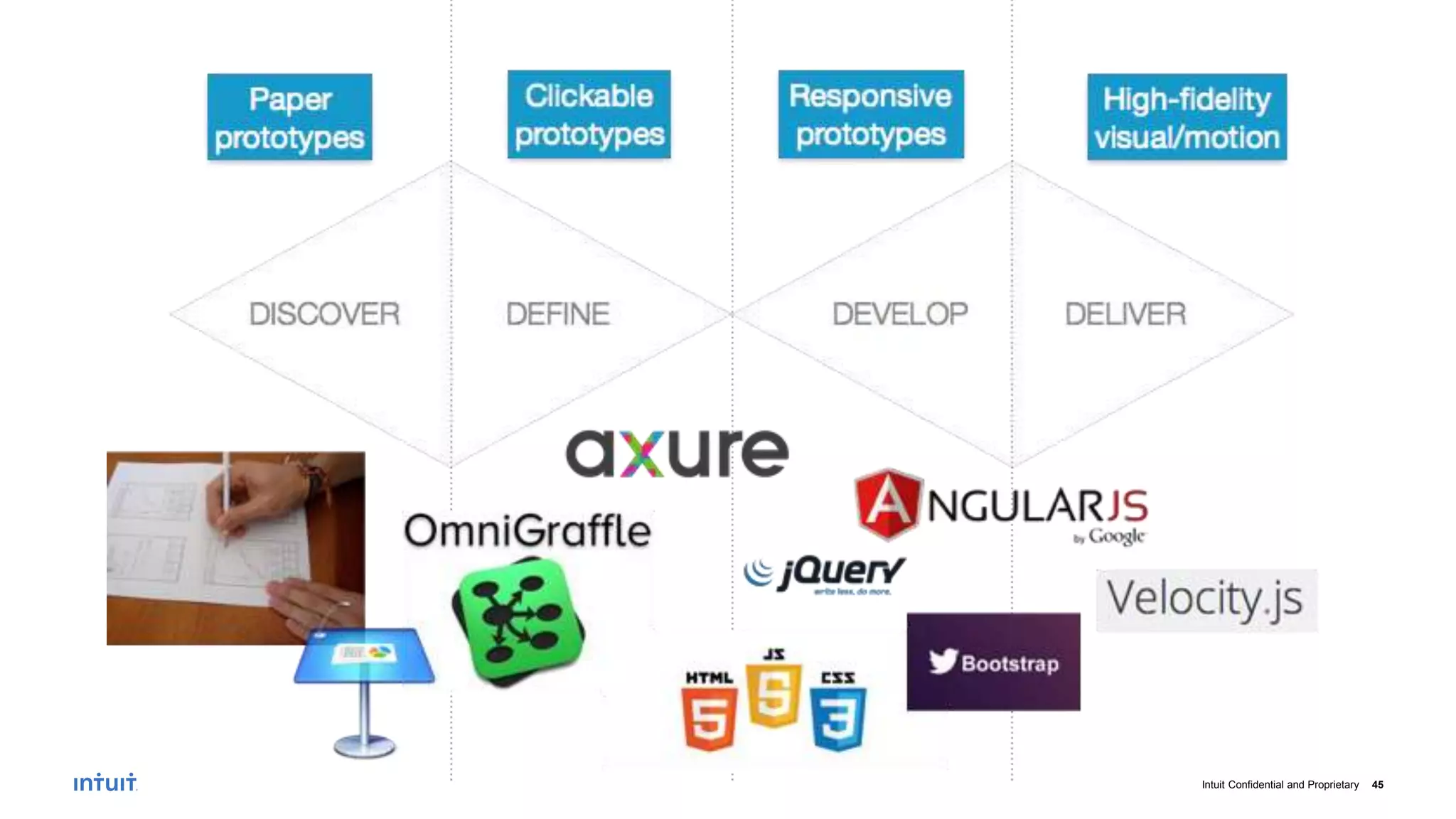
  • #8 Discover insights into the problem, Define the area you want to focus on, Develop potential solutions, Deliver solutions that work   Research, Synthesis, Ideation, Implementation  
  • #9 You don't necessarily have to go in this order It doesn't matter what stage you're in, find the right fidelity that works for your project 
  • #15 https://www.youtube.com/watch?v=d5_h1VuwD6g
  • #16 https://www.youtube.com/watch?v=d5_h1VuwD6g&t=95s Until 2:06
  • #17 http://blog.fictiv.com/posts/4-fundamental-objectives-of-prototyping-hardware Data prototpying— assess how customers respond to your startup 
  • #25 Learn about your customer segments using data – from the data, you can identify that people between 20-30 prefer using Amazon to buy books of various kinds(hypothetical)  Personalize your product based on a quantified breakdown of customer purchases – recommend relevant books to customers
  • #35 When you meet someone for the first time– how much money do you make?
  • #36 I spent 3 days on this. I hope you really like it!
  • #40 Start general and add more specific / in depth questions later
  • #41 Probe: Are respondents preparing noodles for themselves or someone else (ie kids). Are they used as a snack or a meal? Do respondents add ingredients outside of the packet?
  • #45 Helps you to get alignment across the team /
  • #46 You don't necessarily have to go in this order It doesn't matter what stage you're in, find the right fidelity that works for your project