An Engineer’s Essential
Tool is Design Thinking
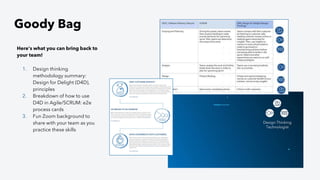
Goody Bag
Here’s what you can bring back to
your team!
1. Design thinking
methodology summary:
Design for Delight (D4D),
principles
2. Breakdown of how to use
D4D in Agile/SCRUM: e2e
process cards
3. Fun Zoom background to
share with your team as you
practice these skills
Understanding your customers’
needs or pain will help you
narrow to the problem you are
trying to solve.
Ask “What is the customer
problem?”
Consider as many ideas and
potential solutions before you
narrow to the one.
Ask “How might we solve this?”
Establish an “experimentation
mindset,” which means you are
testing and measuring at all times.
Ask “How might we test our
hypothesis or solution before we
code it?”
Software Delivery Lifecycle (SDLC) SCRUM
Design for Delight
(Design Thinking)
Scoping and Planning - Review product backlog to make
priority decisions for upcoming
sprint.
- Determine scope of work.
- Connect with customers; listen to
calls, read online reviews or agent
transcripts for insights.
- Use insights to narrow on most
critical one(s). Go broad by
brainstorming solutions before
narrowing to sprint scope.
- Determine what experiments to run
with “cheap” prototypes.
Analysis Analyze the work and further break
down story to plan for upcoming
sprint.
Use a narrowing method, 2x2, to
prioritize.
Design Product Backlog - “Cheap” and rapid prototyping
- Narrow on customer benefit of your
solution
- Narrow to key insights
Implementation Sprint work, completing stories Check in with customers
SDLC, Software Delivery Lifecycle SCRUM
Design for Delight
(Design Thinking)
Testing and Integration Testing and code coverage as part of
sprint work
- During code review process, the
reviewer may create a
comprehensive list of issues to fix.
- Best practice is to narrow to set of
most critical fixes
Deployment and Maintenance Deploy to production and provide
monitoring and support
- Once solution is deployed in
production, teams listen to and
interact with customers to see how
their solution fixed a problem or how
a new feature is received.
- As you learn, determine if there are
other problems you and your team
still need to solve for future sprints.
Download the Zoom background!

Goody bag ghc design thinking tools

  • 1.
  • 2.
    Goody Bag Here’s whatyou can bring back to your team! 1. Design thinking methodology summary: Design for Delight (D4D), principles 2. Breakdown of how to use D4D in Agile/SCRUM: e2e process cards 3. Fun Zoom background to share with your team as you practice these skills
  • 3.
    Understanding your customers’ needsor pain will help you narrow to the problem you are trying to solve. Ask “What is the customer problem?” Consider as many ideas and potential solutions before you narrow to the one. Ask “How might we solve this?” Establish an “experimentation mindset,” which means you are testing and measuring at all times. Ask “How might we test our hypothesis or solution before we code it?”
  • 4.
    Software Delivery Lifecycle(SDLC) SCRUM Design for Delight (Design Thinking) Scoping and Planning - Review product backlog to make priority decisions for upcoming sprint. - Determine scope of work. - Connect with customers; listen to calls, read online reviews or agent transcripts for insights. - Use insights to narrow on most critical one(s). Go broad by brainstorming solutions before narrowing to sprint scope. - Determine what experiments to run with “cheap” prototypes. Analysis Analyze the work and further break down story to plan for upcoming sprint. Use a narrowing method, 2x2, to prioritize. Design Product Backlog - “Cheap” and rapid prototyping - Narrow on customer benefit of your solution - Narrow to key insights Implementation Sprint work, completing stories Check in with customers
  • 5.
    SDLC, Software DeliveryLifecycle SCRUM Design for Delight (Design Thinking) Testing and Integration Testing and code coverage as part of sprint work - During code review process, the reviewer may create a comprehensive list of issues to fix. - Best practice is to narrow to set of most critical fixes Deployment and Maintenance Deploy to production and provide monitoring and support - Once solution is deployed in production, teams listen to and interact with customers to see how their solution fixed a problem or how a new feature is received. - As you learn, determine if there are other problems you and your team still need to solve for future sprints.
  • 6.
    Download the Zoombackground!