An Engineer’s Essential Tool in Agile:
Design Thinking
Aliza Carpio
Principal Tech Evangelist,
Innovation Catalyst
San Diego, USA
https://www.linkedin.com/in/alizacarpio/
Sonia May-Patlán
Software Engineer,
Innovation Catalyst
Edmonton, CA
https://www.linkedin.com/in/sonia-may-patlan/
What we’ll cover
The Case for Change
Design Thinking Overview
Deep Dive on Design for Delight (D4D): Design Thinking Methodology
Connecting Agile Framework & D4D: Applying in our Day-to-Day
Walk Through a Sample Use Case (End to End)
Your Goody Bag: Key Takeaways
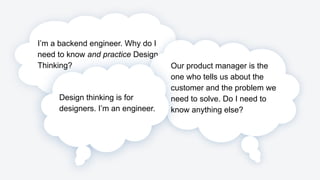
I’m a backend engineer. Why do I
need to know and practice Design
Thinking? Our product manager is the
one who tells us about the
customer and the problem we
need to solve. Do I need to
know anything else?
Design thinking is for
designers. I’m an engineer.
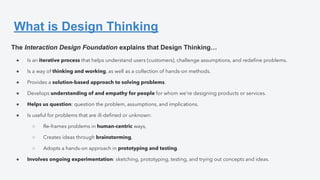
What is Design Thinking
The Interaction Design Foundation explains that Design Thinking…
● Is an iterative process that helps understand users (customers), challenge assumptions, and redefine problems.
● Is a way of thinking and working, as well as a collection of hands-on methods.
● Provides a solution-based approach to solving problems.
● Develops understanding of and empathy for people for whom we’re designing products or services.
● Helps us question: question the problem, assumptions, and implications.
● Is useful for problems that are ill-defined or unknown:
○ Re-frames problems in human-centric ways,
○ Creates ideas through brainstorming,
○ Adopts a hands-on approach in prototyping and testing.
● Involves ongoing experimentation: sketching, prototyping, testing, and trying out concepts and ideas.
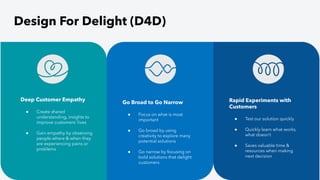
Design For Delight (D4D)
Deep Customer Empathy
● Create shared
understanding, insights to
improve customers’ lives
● Gain empathy by observing
people where & when they
are experiencing pains or
problems
Rapid Experiments with
Customers
● Test our solution quickly
● Quickly learn what works,
what doesn’t
● Saves valuable time &
resources when making
next decision
Go Broad to Go Narrow
● Focus on what is most
important
● Go broad by using
creativity to explore many
potential solutions
● Go narrow by focusing on
bold solutions that delight
customers
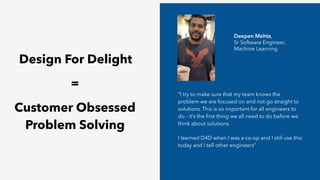
Design For Delight
=
Customer Obsessed
Problem Solving
“I try to make sure that my team knows the
problem we are focused on and not go straight to
solutions. This is so important for all engineers to
do - it’s the first thing we all need to do before we
think about solutions.
I learned D4D when I was a co-op and I still use this
today and I tell other engineers”
Deepen Mehta,
Sr Software Engineer,
Machine Learning
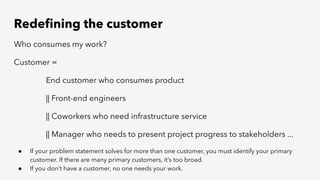
Redefining the customer
Who consumes my work?
Customer =
End customer who consumes product
|| Front-end engineers
|| Coworkers who need infrastructure service
|| Manager who needs to present project progress to stakeholders ...
● If your problem statement solves for more than one customer, you must identify your primary
customer. If there are many primary customers, it’s too broad.
● If you don’t have a customer, no one needs your work.
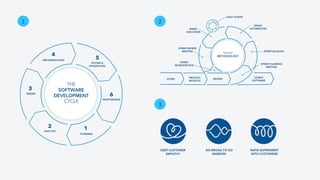
How does Design Thinking (D4D)
connect to SDLC and Agile?
1 2
3
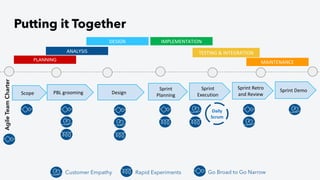
Using D4D principles across each
phase of the SCRUM process
AgileTeamCharter
PLANNING
ANALYSIS
DESIGN IMPLEMENTATION
TESTING & INTEGRATION
MAINTENANCE
Scope PBL grooming Design
Sprint
Planning
Sprint
Execution
Sprint Retro
and Review
Sprint Demo
Daily
Scrum
Customer Empathy Rapid Experiments Go Broad to Go Narrow
Putting it Together
Let’s put this into practice
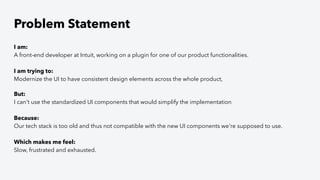
Problem Statement
I am:
A front-end developer at Intuit, working on a plugin for one of our product functionalities.
I am trying to:
Modernize the UI to have consistent design elements across the whole product,
But:
I can't use the standardized UI components that would simplify the implementation
Because:
Our tech stack is too old and thus not compatible with the new UI components we're supposed to use.
Which makes me feel:
Slow, frustrated and exhausted.
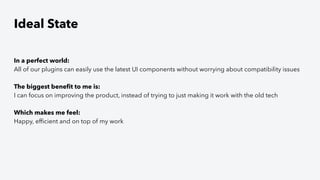
Ideal State
In a perfect world:
All of our plugins can easily use the latest UI components without worrying about compatibility issues
The biggest benefit to me is:
I can focus on improving the product, instead of trying to just making it work with the old tech
Which makes me feel:
Happy, efficient and on top of my work
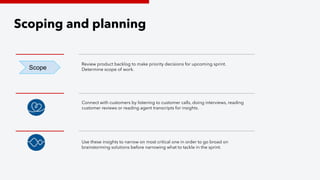
Use these insights to narrow on most critical one in order to go broad on
brainstorming solutions before narrowing what to tackle in the sprint.
Scope
Scoping and planning
Review product backlog to make priority decisions for upcoming sprint.
Determine scope of work.
Connect with customers by listening to customer calls, doing interviews, reading
customer reviews or reading agent transcripts for insights.
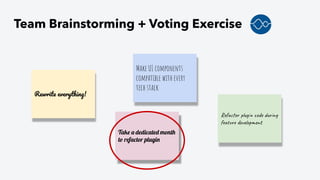
Rewrit everythin !
Make UI components
compatible with every
tech stack
Ref r ug de n
fe e d op t
Tak dedicate mont
t refactor plugi
Team Brainstorming + Voting Exercise
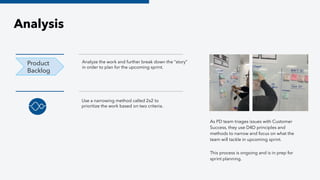
Analysis
Analyze the work and further break down the “story”
in order to plan for the upcoming sprint.
Product
Backlog
As PD team triages issues with Customer
Success, they use D4D principles and
methods to narrow and focus on what the
team will tackle in upcoming sprint.
This process is ongoing and is in prep for
sprint planning.
Use a narrowing method called 2x2 to
prioritize the work based on two criteria.
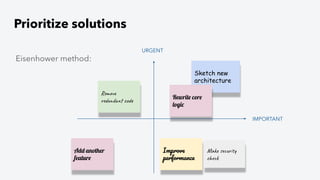
Prioritize solutions
Eisenhower method:
URGENT
IMPORTANT
Improv
performanc
Sketch new
architecture
Rem
re d co
Rewrit cor
logi
Ad another
featur
Mak ur
c e k
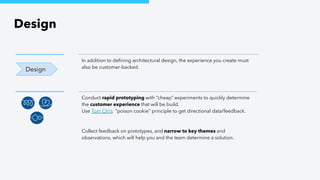
Design
Design
In addition to defining architectural design, the experience you create must
also be customer-backed.
Conduct rapid prototyping with “cheap” experiments to quickly determine
the customer experience that will be build.
Use Tom Chi’s “poison cookie” principle to get directional data/feedback.
Collect feedback on prototypes, and narrow to key themes and
observations, which will help you and the team determine a solution.
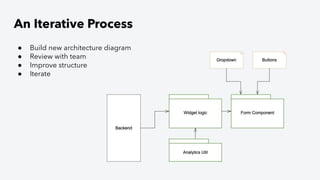
● Build new architecture diagram
● Review with team
● Improve structure
● Iterate
An Iterative Process
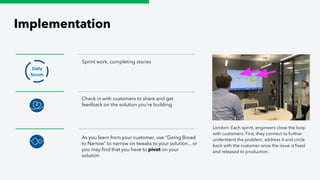
Implementation
Sprint work, completing stories
Daily
Scrum
Check in with customers to share and get
feedback on the solution you’re building.
As you learn from your customer, use “Going Broad
to Narrow” to narrow on tweaks to your solution... or
you may find that you have to pivot on your
solution
London: Each sprint, engineers close the loop
with customers. First, they connect to further
understand the problem, address it and circle
back with the customer once the issue is fixed
and released to production.
Testing and Integration
How would you also ensure that the solution/fix meets the customer
benefit you declared?
Testing and code coverage is part of sprint work
During code review process, the code reviewer may create a
comprehensive list of issues to fix. However, it is best practice if the code
reviewer narrows to the set of most critical fixes
Daily
Scrum
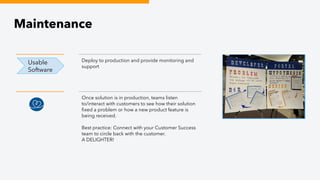
Maintenance
Deploy to production and provide monitoring and
support
Once solution is in production, teams listen
to/interact with customers to see how their solution
fixed a problem or how a new product feature is
being received.
Best practice: Connect with your Customer Success
team to circle back with the customer.
A DELIGHTER!
Usable
Software
Project Retrospective
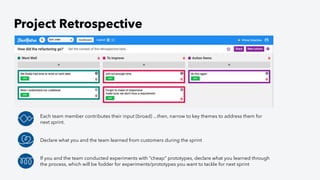
Each team member contributes their input (broad) ...then, narrow to key themes to address them for
next sprint.
Declare what you and the team learned from customers during the sprint
If you and the team conducted experiments with “cheap” prototypes, declare what you learned through
the process, which will be fodder for experiments/prototypes you want to tackle for next sprint
Key Takeaways
Goody Bag
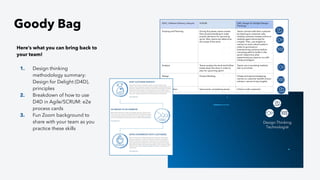
Here’s what you can bring back to
your team!
1. Design thinking
methodology summary:
Design for Delight (D4D),
principles
2. Breakdown of how to use
D4D in Agile/SCRUM: e2e
process cards
3. Fun Zoom background to
share with your team as you
practice these skills
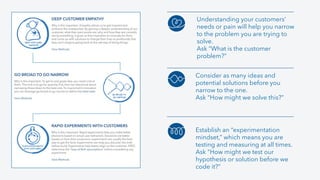
Understanding your customers’
needs or pain will help you narrow
to the problem you are trying to
solve.
Ask “What is the customer
problem?”
Consider as many ideas and
potential solutions before you
narrow to the one.
Ask “How might we solve this?”
Establish an “experimentation
mindset,” which means you are
testing and measuring at all times.
Ask “How might we test our
hypothesis or solution before we
code it?”
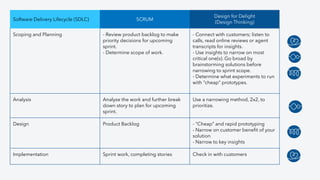
Software Delivery Lifecycle (SDLC) SCRUM
Design for Delight
(Design Thinking)
Scoping and Planning - Review product backlog to make
priority decisions for upcoming
sprint.
- Determine scope of work.
- Connect with customers; listen to
calls, read online reviews or agent
transcripts for insights.
- Use insights to narrow on most
critical one(s). Go broad by
brainstorming solutions before
narrowing to sprint scope.
- Determine what experiments to run
with “cheap” prototypes.
Analysis Analyze the work and further break
down story to plan for upcoming
sprint.
Use a narrowing method, 2x2, to
prioritize.
Design Product Backlog - “Cheap” and rapid prototyping
- Narrow on customer benefit of your
solution
- Narrow to key insights
Implementation Sprint work, completing stories Check in with customers
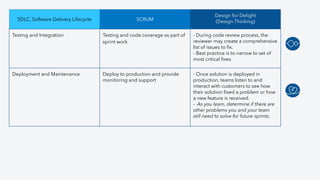
SDLC, Software Delivery Lifecycle SCRUM
Design for Delight
(Design Thinking)
Testing and Integration Testing and code coverage as part of
sprint work
- During code review process, the
reviewer may create a comprehensive
list of issues to fix.
- Best practice is to narrow to set of
most critical fixes
Deployment and Maintenance Deploy to production and provide
monitoring and support
- Once solution is deployed in
production, teams listen to and
interact with customers to see how
their solution fixed a problem or how
a new feature is received.
- As you learn, determine if there are
other problems you and your team
still need to solve for future sprints.
Download the Zoom background!
Aliza Carpio
Principal Tech Evangelist,
Innovation Catalyst
San Diego, USA
https://www.linkedin.com/in/alizacarpio/
Sonia May-Patlán
Software Engineer,
Innovation Catalyst
Edmonton, CA
https://www.linkedin.com/in/sonia-may-patlan/
Thanks for
Joining Us!
Questions?
Download our slides here:
bit.ly/Devweekdesignthink

An Engineer’s Essential Tool in Agile: Design Thinking

  • 1.
    An Engineer’s EssentialTool in Agile: Design Thinking
  • 2.
    Aliza Carpio Principal TechEvangelist, Innovation Catalyst San Diego, USA https://www.linkedin.com/in/alizacarpio/ Sonia May-Patlán Software Engineer, Innovation Catalyst Edmonton, CA https://www.linkedin.com/in/sonia-may-patlan/
  • 3.
    What we’ll cover TheCase for Change Design Thinking Overview Deep Dive on Design for Delight (D4D): Design Thinking Methodology Connecting Agile Framework & D4D: Applying in our Day-to-Day Walk Through a Sample Use Case (End to End) Your Goody Bag: Key Takeaways
  • 4.
    I’m a backendengineer. Why do I need to know and practice Design Thinking? Our product manager is the one who tells us about the customer and the problem we need to solve. Do I need to know anything else? Design thinking is for designers. I’m an engineer.
  • 5.
    What is DesignThinking The Interaction Design Foundation explains that Design Thinking… ● Is an iterative process that helps understand users (customers), challenge assumptions, and redefine problems. ● Is a way of thinking and working, as well as a collection of hands-on methods. ● Provides a solution-based approach to solving problems. ● Develops understanding of and empathy for people for whom we’re designing products or services. ● Helps us question: question the problem, assumptions, and implications. ● Is useful for problems that are ill-defined or unknown: ○ Re-frames problems in human-centric ways, ○ Creates ideas through brainstorming, ○ Adopts a hands-on approach in prototyping and testing. ● Involves ongoing experimentation: sketching, prototyping, testing, and trying out concepts and ideas.
  • 6.
    Design For Delight(D4D) Deep Customer Empathy ● Create shared understanding, insights to improve customers’ lives ● Gain empathy by observing people where & when they are experiencing pains or problems Rapid Experiments with Customers ● Test our solution quickly ● Quickly learn what works, what doesn’t ● Saves valuable time & resources when making next decision Go Broad to Go Narrow ● Focus on what is most important ● Go broad by using creativity to explore many potential solutions ● Go narrow by focusing on bold solutions that delight customers
  • 7.
    Design For Delight = CustomerObsessed Problem Solving “I try to make sure that my team knows the problem we are focused on and not go straight to solutions. This is so important for all engineers to do - it’s the first thing we all need to do before we think about solutions. I learned D4D when I was a co-op and I still use this today and I tell other engineers” Deepen Mehta, Sr Software Engineer, Machine Learning
  • 8.
    Redefining the customer Whoconsumes my work? Customer = End customer who consumes product || Front-end engineers || Coworkers who need infrastructure service || Manager who needs to present project progress to stakeholders ... ● If your problem statement solves for more than one customer, you must identify your primary customer. If there are many primary customers, it’s too broad. ● If you don’t have a customer, no one needs your work.
  • 9.
    How does DesignThinking (D4D) connect to SDLC and Agile?
  • 10.
  • 11.
    Using D4D principlesacross each phase of the SCRUM process
  • 12.
    AgileTeamCharter PLANNING ANALYSIS DESIGN IMPLEMENTATION TESTING &INTEGRATION MAINTENANCE Scope PBL grooming Design Sprint Planning Sprint Execution Sprint Retro and Review Sprint Demo Daily Scrum Customer Empathy Rapid Experiments Go Broad to Go Narrow Putting it Together
  • 13.
    Let’s put thisinto practice
  • 14.
    Problem Statement I am: Afront-end developer at Intuit, working on a plugin for one of our product functionalities. I am trying to: Modernize the UI to have consistent design elements across the whole product, But: I can't use the standardized UI components that would simplify the implementation Because: Our tech stack is too old and thus not compatible with the new UI components we're supposed to use. Which makes me feel: Slow, frustrated and exhausted.
  • 15.
    Ideal State In aperfect world: All of our plugins can easily use the latest UI components without worrying about compatibility issues The biggest benefit to me is: I can focus on improving the product, instead of trying to just making it work with the old tech Which makes me feel: Happy, efficient and on top of my work
  • 16.
    Use these insightsto narrow on most critical one in order to go broad on brainstorming solutions before narrowing what to tackle in the sprint. Scope Scoping and planning Review product backlog to make priority decisions for upcoming sprint. Determine scope of work. Connect with customers by listening to customer calls, doing interviews, reading customer reviews or reading agent transcripts for insights.
  • 17.
    Rewrit everythin ! MakeUI components compatible with every tech stack Ref r ug de n fe e d op t Tak dedicate mont t refactor plugi Team Brainstorming + Voting Exercise
  • 18.
    Analysis Analyze the workand further break down the “story” in order to plan for the upcoming sprint. Product Backlog As PD team triages issues with Customer Success, they use D4D principles and methods to narrow and focus on what the team will tackle in upcoming sprint. This process is ongoing and is in prep for sprint planning. Use a narrowing method called 2x2 to prioritize the work based on two criteria.
  • 19.
    Prioritize solutions Eisenhower method: URGENT IMPORTANT Improv performanc Sketchnew architecture Rem re d co Rewrit cor logi Ad another featur Mak ur c e k
  • 20.
    Design Design In addition todefining architectural design, the experience you create must also be customer-backed. Conduct rapid prototyping with “cheap” experiments to quickly determine the customer experience that will be build. Use Tom Chi’s “poison cookie” principle to get directional data/feedback. Collect feedback on prototypes, and narrow to key themes and observations, which will help you and the team determine a solution.
  • 21.
    ● Build newarchitecture diagram ● Review with team ● Improve structure ● Iterate An Iterative Process
  • 22.
    Implementation Sprint work, completingstories Daily Scrum Check in with customers to share and get feedback on the solution you’re building. As you learn from your customer, use “Going Broad to Narrow” to narrow on tweaks to your solution... or you may find that you have to pivot on your solution London: Each sprint, engineers close the loop with customers. First, they connect to further understand the problem, address it and circle back with the customer once the issue is fixed and released to production.
  • 23.
    Testing and Integration Howwould you also ensure that the solution/fix meets the customer benefit you declared? Testing and code coverage is part of sprint work During code review process, the code reviewer may create a comprehensive list of issues to fix. However, it is best practice if the code reviewer narrows to the set of most critical fixes Daily Scrum
  • 24.
    Maintenance Deploy to productionand provide monitoring and support Once solution is in production, teams listen to/interact with customers to see how their solution fixed a problem or how a new product feature is being received. Best practice: Connect with your Customer Success team to circle back with the customer. A DELIGHTER! Usable Software
  • 25.
    Project Retrospective Each teammember contributes their input (broad) ...then, narrow to key themes to address them for next sprint. Declare what you and the team learned from customers during the sprint If you and the team conducted experiments with “cheap” prototypes, declare what you learned through the process, which will be fodder for experiments/prototypes you want to tackle for next sprint
  • 26.
  • 27.
    Goody Bag Here’s whatyou can bring back to your team! 1. Design thinking methodology summary: Design for Delight (D4D), principles 2. Breakdown of how to use D4D in Agile/SCRUM: e2e process cards 3. Fun Zoom background to share with your team as you practice these skills
  • 28.
    Understanding your customers’ needsor pain will help you narrow to the problem you are trying to solve. Ask “What is the customer problem?” Consider as many ideas and potential solutions before you narrow to the one. Ask “How might we solve this?” Establish an “experimentation mindset,” which means you are testing and measuring at all times. Ask “How might we test our hypothesis or solution before we code it?”
  • 29.
    Software Delivery Lifecycle(SDLC) SCRUM Design for Delight (Design Thinking) Scoping and Planning - Review product backlog to make priority decisions for upcoming sprint. - Determine scope of work. - Connect with customers; listen to calls, read online reviews or agent transcripts for insights. - Use insights to narrow on most critical one(s). Go broad by brainstorming solutions before narrowing to sprint scope. - Determine what experiments to run with “cheap” prototypes. Analysis Analyze the work and further break down story to plan for upcoming sprint. Use a narrowing method, 2x2, to prioritize. Design Product Backlog - “Cheap” and rapid prototyping - Narrow on customer benefit of your solution - Narrow to key insights Implementation Sprint work, completing stories Check in with customers
  • 30.
    SDLC, Software DeliveryLifecycle SCRUM Design for Delight (Design Thinking) Testing and Integration Testing and code coverage as part of sprint work - During code review process, the reviewer may create a comprehensive list of issues to fix. - Best practice is to narrow to set of most critical fixes Deployment and Maintenance Deploy to production and provide monitoring and support - Once solution is deployed in production, teams listen to and interact with customers to see how their solution fixed a problem or how a new feature is received. - As you learn, determine if there are other problems you and your team still need to solve for future sprints.
  • 31.
    Download the Zoombackground!
  • 32.
    Aliza Carpio Principal TechEvangelist, Innovation Catalyst San Diego, USA https://www.linkedin.com/in/alizacarpio/ Sonia May-Patlán Software Engineer, Innovation Catalyst Edmonton, CA https://www.linkedin.com/in/sonia-may-patlan/ Thanks for Joining Us! Questions? Download our slides here: bit.ly/Devweekdesignthink