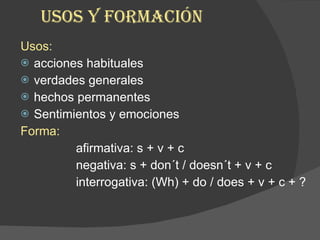
USOS Y FORMACIÓN Usos:  acciones habituales  verdades generales  hechos permanentes Sentimientos y emociones Forma:  afirmativa: s + v + c negativa: s + don´t / doesn´t + v + c interrogativa: (Wh) + do / does + v + c + ?
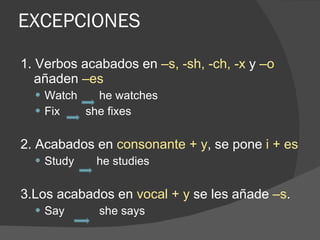
EXCEPCIONES 1. Verbos acabados en  –s, -sh, -ch, -x  y  –o  añaden  –es Watch    he watches Fix  she fixes 2. Acabados en  consonante + y , se pone  i + es Study  he studies 3.Los acabados en  vocal + y  se les añade  –s . Say    she says
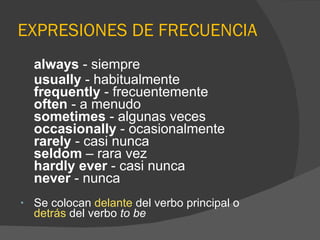
EXPRESIONES DE FRECUENCIA always  - siempre usually  - habitualmente frequently  - frecuentemente often  - a menudo sometimes  - algunas veces occasionally  - ocasionalmente rarely  - casi nunca seldom  – rara vez hardly ever  - casi nunca never  - nunca Se colocan  delante  del verbo principal o  detrás  del verbo  to be
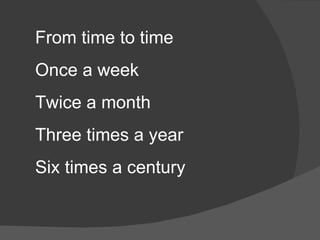
From time to time Once a week Twice a month Three times a year Six times a century
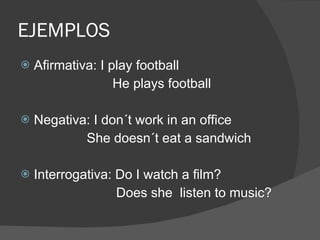
EJEMPLOS Afirmativa: I play football He plays football Negativa: I don´t work in an office She doesn´t eat a sandwich Interrogativa: Do I watch a film?  Does she  listen to music?
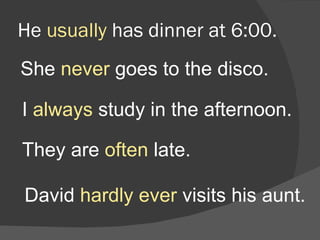
He  usually  has dinner at 6:00. She  never  goes to the disco. I  always  study in the afternoon. They are  often  late. David  hardly ever  visits his aunt.
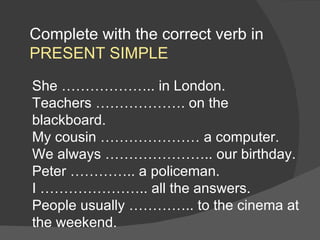
Complete with the correct verb in  PRESENT SIMPLE She ……………….. in London. Teachers ………………. on the blackboard. My cousin ………………… a computer. We always ………………….. our birthday. Peter ………….. a policeman. I ………………….. all the answers. People usually ………….. to the cinema at the weekend.
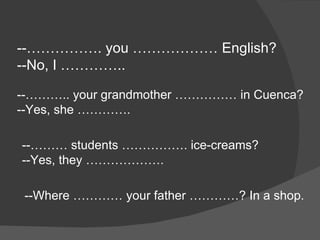
--……………. you ……………… English? --No, I ………….. --……….. your grandmother …………… in Cuenca? --Yes, she …………. --……… students ……………. ice-creams? --Yes, they ……………….  --Where ………… your father …………? In a shop.
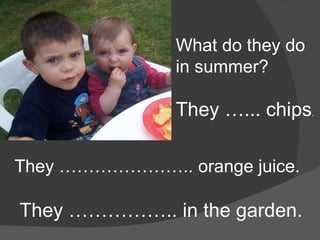
What do they do in summer? They …... chips . They ………………….. orange juice. They …………….. in the garden.
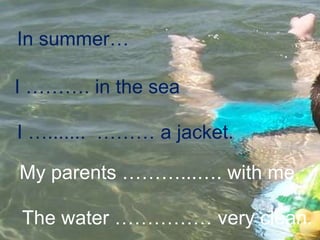
In summer… I ………. in the sea I ….......  ……… a jacket. My parents ………...…. with me. The water …………… very clean.

My present simple

  • 1.
  • 2.
    USOS Y FORMACIÓNUsos: acciones habituales verdades generales hechos permanentes Sentimientos y emociones Forma: afirmativa: s + v + c negativa: s + don´t / doesn´t + v + c interrogativa: (Wh) + do / does + v + c + ?
  • 3.
    EXCEPCIONES 1. Verbosacabados en –s, -sh, -ch, -x y –o añaden –es Watch he watches Fix she fixes 2. Acabados en consonante + y , se pone i + es Study he studies 3.Los acabados en vocal + y se les añade –s . Say she says
  • 4.
    EXPRESIONES DE FRECUENCIAalways - siempre usually - habitualmente frequently - frecuentemente often - a menudo sometimes - algunas veces occasionally - ocasionalmente rarely - casi nunca seldom – rara vez hardly ever - casi nunca never - nunca Se colocan delante del verbo principal o detrás del verbo to be
  • 5.
    From time totime Once a week Twice a month Three times a year Six times a century
  • 6.
    EJEMPLOS Afirmativa: Iplay football He plays football Negativa: I don´t work in an office She doesn´t eat a sandwich Interrogativa: Do I watch a film? Does she listen to music?
  • 7.
    He usually has dinner at 6:00. She never goes to the disco. I always study in the afternoon. They are often late. David hardly ever visits his aunt.
  • 8.
    Complete with thecorrect verb in PRESENT SIMPLE She ……………….. in London. Teachers ………………. on the blackboard. My cousin ………………… a computer. We always ………………….. our birthday. Peter ………….. a policeman. I ………………….. all the answers. People usually ………….. to the cinema at the weekend.
  • 9.
    --……………. you ………………English? --No, I ………….. --……….. your grandmother …………… in Cuenca? --Yes, she …………. --……… students ……………. ice-creams? --Yes, they ………………. --Where ………… your father …………? In a shop.
  • 10.
    What do theydo in summer? They …... chips . They ………………….. orange juice. They …………….. in the garden.
  • 11.
    In summer… I………. in the sea I …....... ……… a jacket. My parents ………...…. with me. The water …………… very clean.